Mastectomy in Hyderabad — answered honestly, planned gently
Facing breast-removal surgery is frightening — but you have more options, and more support, than the word suggests. CION's surgical oncologists remove the breast only when it is the safest choice, plan reconstruction from the start, and guide you through cost and Aarogyasri.
Conservation-first — the breast is removed only when it's safest
Reconstruction planned early · Telugu-speaking teams
Clear indicative costs & Aarogyasri / insurance help
Written by Dr. Srinivasulu Mukta, Surgical Oncologist (MBBS, MCh, 35+ years). · Medically reviewed by Dr. Rajendar Byshetty, MCh (AIIMS), Surgical Oncology. · Reviewed 10 July 2026
Understanding the surgery
What is a mastectomy — and is it always necessary?
A mastectomy is surgery to remove all of the breast tissue to treat or prevent breast cancer. It is not automatically the only option: for many early cancers the breast can be conserved (a lumpectomy plus radiation). At CION, a mastectomy is recommended only when it is the safest way to clear the cancer — a decision made by a multidisciplinary tumour board, not a single surgeon.
Your team may advise a mastectomy when the tumour is large relative to the breast, when there is cancer in more than one area, when earlier breast-conserving surgery has not cleared it, when radiation is not advisable, or when a strong inherited risk makes removal the safer long-term choice. Whatever the reason, the goal is the same: treat the cancer thoroughly while protecting as much of your appearance, comfort and function as safely possible.
A calm, unhurried consultation — surgery options explained before any decision.
When a mastectomy may be recommended
Large or multiple tumours
A tumour that is large for the breast size, or cancer in more than one part of the breast.
Conservation not suitable
When breast-conserving surgery has not cleared the margins, or radiation isn't advisable.
Inherited high risk
A strong family history or a known genetic change may make removal the safer long-term choice.
Your options
Will you lose the whole breast? Conservation vs mastectomy
Not every breast cancer needs a mastectomy. Breast-conserving surgery (a lumpectomy that removes the tumour and a margin of healthy tissue, usually followed by radiation) can be as effective as mastectomy for many early cancers. A mastectomy becomes the safer choice when the cancer is larger, in several areas, or harder to clear. The right answer is decided for your specific case — never assumed.
Breast conservation (lumpectomy)
Mastectomy
What is removed
The tumour plus a rim of healthy tissue — most of the breast stays.
All of the breast tissue (skin and nipple may be preserved in some types).
Often suits
Smaller, single-area cancers where clear margins are achievable.
Larger or multi-area cancers, unclear margins, or when radiation isn't advisable.
Radiation after
Usually recommended.
Sometimes needed, depending on the findings.
Reconstruction
Not usually required.
Immediate or delayed reconstruction is often possible.
The trade-off
Keeps the breast; adds a course of radiation.
Removes the breast; may avoid radiation and eases the worry of recurrence in that breast.
Your breast-surgery options explainer
Answer three quick questions to see what a typical pathway might involve — then talk it through with an oncologist. This is educational, not a diagnosis.
Has your surgeon suggested breast conservation might be possible?
Are you interested in breast reconstruction?
Is there a strong family history of breast or ovarian cancer?
What a typical pathway might involve
Whether the breast can be conserved or needs to be removed depends on the tumour's size and spread — a tumour board reviews this together, so it's reasonable to ask directly whether conservation is an option for you. Reconstruction can also be done later, so you don't have to decide now. If you're unsure about family risk, a short genetic-counselling conversation can tell you whether testing is worthwhile.
If you'd like to understand where you sit, our breast cancer team in Hyderabad can review your reports and give a clear, honest recommendation — including a second opinion if you already have a plan elsewhere.
Types of surgery
Types of mastectomy
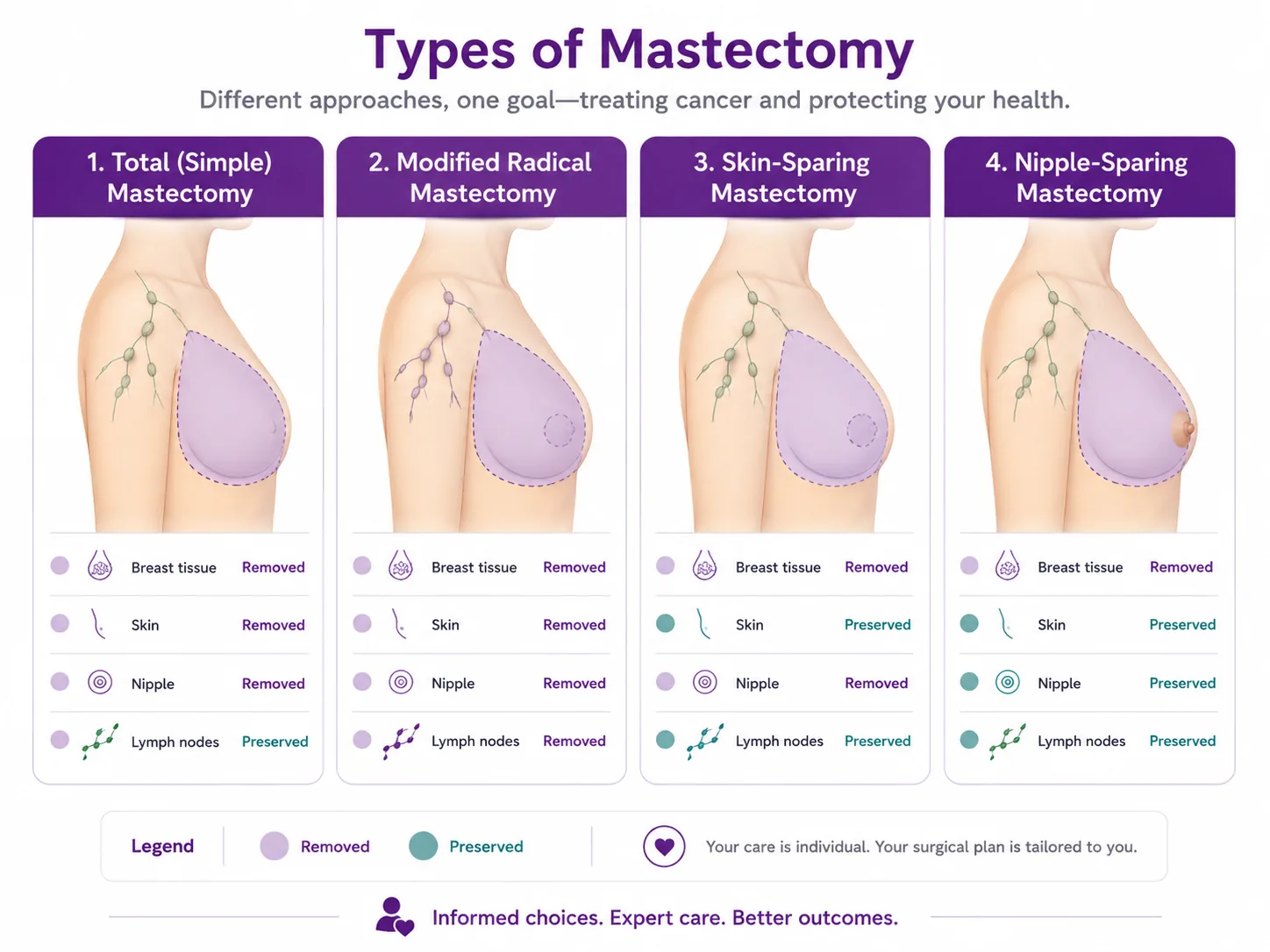
There is no single "mastectomy". The main types differ by how much skin and which structures are removed or preserved — a simple (total) removes the whole breast; a modified radical also removes underarm lymph nodes and is the most common type in India; skin-sparing and nipple-sparing keep the skin envelope (and sometimes the nipple) for a more natural reconstruction. Your surgeon recommends the least extensive option that safely clears the cancer.
Total, modified radical, skin-sparing and nipple-sparing mastectomy — what is removed and what is preserved in each.
Simple (total) mastectomy
Removes all of the breast tissue, skin and nipple, without taking the underarm lymph nodes. Often used for preventive surgery or when nodes are not involved.
Modified radical mastectomy (MRM)
Removes the whole breast and the underarm (axillary) lymph nodes. The most common mastectomy in India, used when the cancer has, or may have, reached the nodes.
Skin-sparing mastectomy
Removes the breast tissue and nipple but keeps most of the breast skin, giving a better foundation for immediate reconstruction.
Nipple-sparing mastectomy
Keeps the breast skin and the nipple, where the cancer's position makes it safe — the most natural-looking option when suitable.
Radical mastectomy
An older, extensive operation that also removes the chest-wall muscles. Rarely needed today and used only when the cancer involves the muscle.
Double (bilateral) & preventive
Removal of both breasts — sometimes chosen for cancer in both breasts, or preventively for people at very high inherited risk after genetic counselling.
Before surgery
Diagnosis & the tests before a mastectomy
Before any surgery, your team confirms the diagnosis with a biopsy and checks the extent with imaging — so the operation is planned around your exact cancer. A biopsy is safe and does not spread cancer. These are the tests that decide which mastectomy, if any, is right for you.
Diagnostic services we offer — book any of these directly:
Breast biopsy (core needle)
A small tissue sample to confirm the diagnosis and receptor status — the only way to be certain.
Your mastectomy is one part of a complete plan. Reconstruction, lymph-node surgery, and — when your pathology indicates — radiation, chemotherapy or other treatment are decided together by the tumour board. Below are the surgeries and treatments you can book a consult for directly.
Surgeries & treatments — book a consult for any of these:
Mastectomy (breast removal)
Simple, modified radical, skin-sparing or nipple-sparing — the least extensive option that safely clears the cancer.
In Hyderabad, a mastectomy is typically an indicative ₹85,000 – ₹2,40,000, depending on the type of surgery, whether reconstruction is done, room category and length of stay. Under Aarogyasri / PMJAY, eligible breast-cancer surgery at empanelled centres may be largely covered — and private insurance is accepted cashless. These are estimates, not a quotation.
Cost is the single biggest worry for most families, so it helps to see roughly what drives it. Use the estimator to get an indicative range for your situation, then request an exact estimate for your case.
Indicative cost estimator
Indicative range
₹85,000 – ₹1,40,000
for a simple mastectomy, general room, self-pay
Figures are indicative only and not a quotation. Aarogyasri / PMJAY may cover eligible breast-cancer surgery at empanelled centres, subject to eligibility. Your actual cost depends on your diagnosis and plan.
A worry about a breast lump, a biopsy report, or a mastectomy decision shouldn't wait. Book a free consultation and, if you already have a biopsy, a free written second opinion.
Your reports re-read by a senior surgical oncologist
Reviewed by a multidisciplinary tumour board
Aarogyasri / PMJAY & insurance guidance, in Telugu
Support
Financial support & Aarogyasri
Cost should not delay treatment. Under Aarogyasri and PMJAY, eligible breast-cancer surgery — including mastectomy — may be largely covered at empanelled centres, and private insurance is accepted cashless. Our counsellors help check eligibility, arrange approvals and map out what you will actually pay — often far less than families fear.
A mastectomy usually takes two to three hours under general anaesthesia, with a hospital stay of about one to three days. Most women go home with one or two small drains to remove fluid, which come out within one to two weeks. Everyday activities return over a few weeks, with gentle shoulder and arm exercises to protect movement and lower the risk of lymphoedema. Pain is usually well controlled, and the care team guides every step.
1
Surgery day
2–3 hours under general anaesthesia; you wake in recovery with dressings and drains.
2
Hospital stay
About 1–3 days; the team manages pain and shows you simple drain care.
3
Drain care (1–2 wks)
Drains stay a short while at home and are removed at a quick follow-up visit.
4
Arm & shoulder rehab
Gentle guided exercises restore movement and lower lymphoedema risk.
5
Follow-up & next steps
Wound review, pathology discussion, and any further treatment planned together.
Protecting your arm and shoulder
Because underarm lymph nodes are sometimes removed, the arm on the operated side needs care to keep it moving well and to reduce the chance of swelling (lymphoedema). Our physiotherapists start you on gentle, staged exercises, and our rehabilitation team stays with you through recovery.
Getting back to your life
Most women return to normal daily life, work and family within a few weeks, building up as strength returns. Removing the breast does not remove all future risk, so ongoing follow-up matters — but for very many women, a mastectomy is a decisive step toward putting the cancer behind them.
Reconstruction
Reconstruction & feeling like yourself again
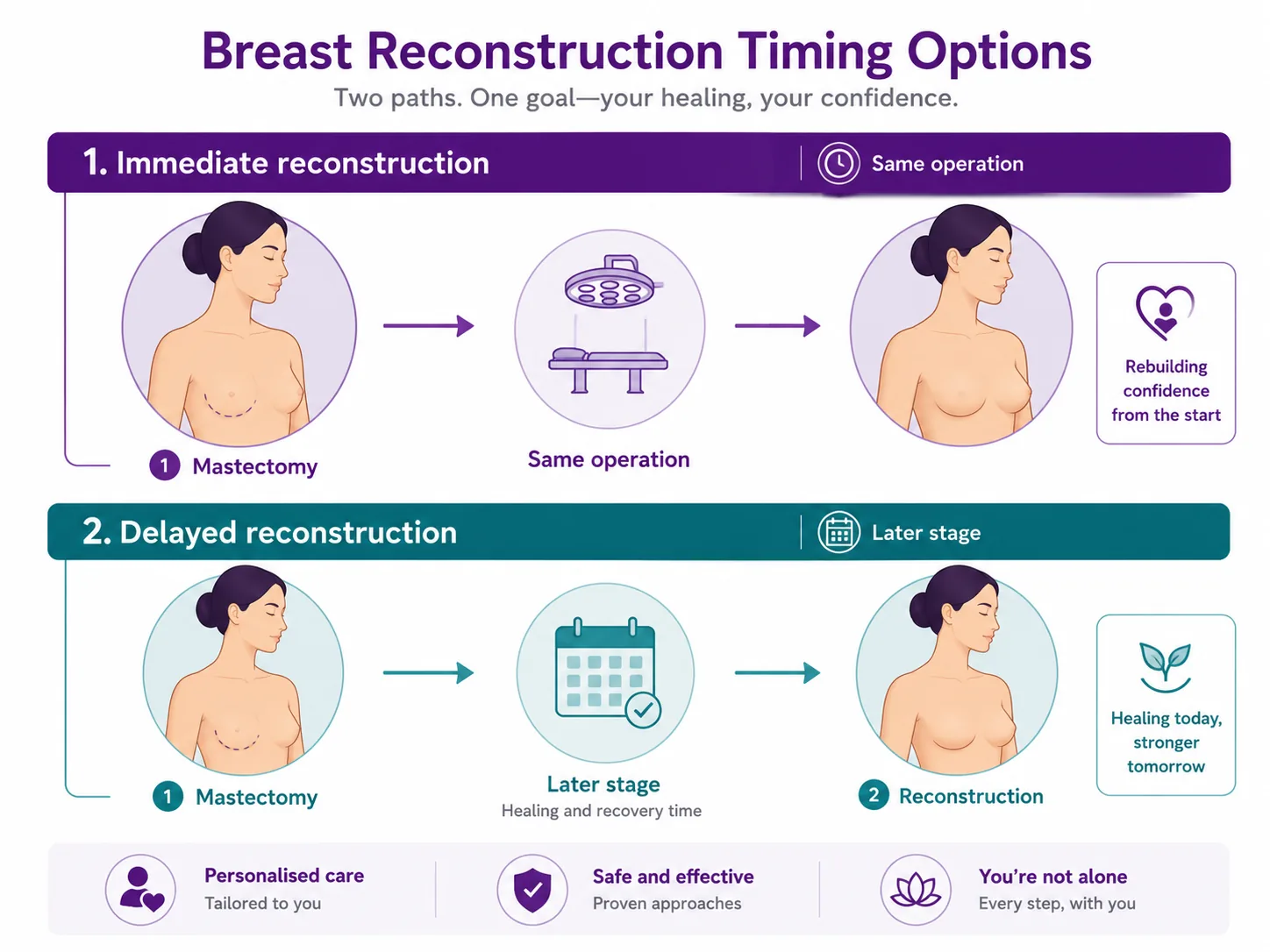
For many women the hardest part of a mastectomy is the fear of how they will look and feel afterwards.Breast reconstruction can rebuild the breast shape, either during the same operation (immediate) or at a later stage (delayed), using an implant or your own tissue. You do not have to decide everything at once — the option stays open.
Immediate reconstruction happens in the same operation; delayed reconstruction is done at a later stage — both remain options for most patients.
Immediate reconstruction
The breast is rebuilt in the same operation as the mastectomy, so you wake with a breast shape already restored. Often possible with skin- or nipple-sparing surgery.
Delayed reconstruction
Reconstruction is done weeks, months or even years later — useful if you need other treatment first, or simply want time to decide.
Whichever path fits, the emotional side matters as much as the physical. CION's counsellors support you and your family through body-image, relationship and confidence concerns — because feeling like yourself again is part of the treatment, not an afterthought.
9 clinics in Hyderabad · 35+ across Telangana & AP
CION cancer care is closer than you think.
We're never more than 30 minutes away. Same panel of specialists at every centre. Same tumour board reviews. Same NCCN protocols. Pick the closest one and call directly — or let us pick for you.
Share your name and number — we'll call you back within 30 minutes to schedule your consultation.
A mastectomy is a big decision — you don't have to make it alone.
Before you decide anything, let a surgical oncologist review your reports and tell you honestly whether the breast can be conserved. Free consultation and free written second opinion.
The worries families carry are real, and some are made heavier by things people say. Here are honest, gentle answers to the fears we hear most in Telangana.
"Losing a breast means losing my identity — will my husband and family still accept me?"
Fact: A mastectomy does not change who you are. Skin- and nipple-sparing techniques and reconstruction can restore the breast shape, and counselling supports you and your partner. Countless women in Telangana go on to full married, family and social lives after a mastectomy.
"Will the surgery or biopsy make the cancer spread?"
Fact: This is a widespread, harmful myth. A biopsy and surgery are safe, standard steps done under controlled conditions — they do not spread cancer. What actually causes harm is delay. Removing the tumour is one of the most effective ways to stop cancer, not start it.
"Can a middle-class family really afford cancer surgery?"
Fact: Cost should not be the reason care is delayed. Aarogyasri and PMJAY cover eligible breast-cancer surgery at empanelled centres, and insurance is accepted cashless. Our counsellors help you check eligibility and arrange approvals — often the out-of-pocket cost is far less than families fear.
"Can the cancer come back after the breast is removed?"
Fact: Removing the breast greatly reduces the chance of cancer returning in that area, but no surgery can promise zero risk. Your team may recommend added treatment based on the pathology, and regular follow-up catches anything early. A mastectomy is a powerful step in a strong plan.
"Is cancer contagious or a punishment — should we keep the diagnosis secret?"
Fact: Cancer is not contagious — you cannot catch it by touching, sharing food or caring for someone. It is not a punishment or a curse. Hiding a diagnosis only isolates the patient and delays care. Speaking openly lets your family rally around you.
"Can Ayurveda or home remedies cure it, so we can avoid surgery?"
Fact: Relying on unproven remedies instead of evidence-based treatment is one of the most dangerous choices — it uses up the window when breast cancer is most treatable. If you want something complementary for comfort, discuss it with your oncology team so it fits safely alongside treatment.
"I will never look normal again — I'll be disfigured for life."
Fact: Modern surgery protects appearance wherever it safely can. Skin- and nipple-sparing techniques, and immediate or delayed reconstruction, rebuild the breast shape far more than people expect — and a well-fitted external prosthesis is another simple, dignified option.
"I'll lose the use of my arm and never lift anything again."
Fact: Most women regain full arm and shoulder movement with guided physiotherapy. When underarm nodes are removed there is a small risk of swelling (lymphoedema), which staged exercises and early care keep low. Your rehab team supports you the whole way.
"Reconstruction is just vanity — it's not for women like me."
Fact: Reconstruction is a recognised, medical part of breast cancer care, not vanity. It helps many women feel whole again and is available under schemes and insurance in eligible cases. It is entirely your choice — and the option stays open even years later.
"A mastectomy always means chemotherapy and losing all my hair."
Fact: Not always. Whether you need chemotherapy depends on your tumour type and stage, not on having a mastectomy. Many women need no chemotherapy at all. Where it is advised, side effects are actively managed today, and your team supports you through it.
"Only older women get breast cancer, so this can't be serious for me."
Fact: Breast cancer affects women across a wide age range, including younger women in Telangana. Age does not make it less treatable — acting early does. Whatever your age, a suspicious lump or a biopsy report deserves a specialist review.
"Surgery is too risky at my age, or with my diabetes / blood pressure."
Fact: Age and controlled conditions like diabetes rarely rule out surgery. A pre-operative assessment optimises your health first, and anaesthesia is given by specialists. For most patients the risk of leaving the cancer untreated is far greater than the risk of the operation.
"If I remove one breast, I'll be told to remove both."
Fact: A double mastectomy is only considered for cancer in both breasts, or for very high inherited risk after genetic counselling — never automatically. For most women, only the affected breast is treated. The plan is always specific to you.
"Getting a second opinion will offend my doctor and waste time."
Fact: A second opinion is normal and welcomed in cancer care — it confirms the plan and gives you confidence before major surgery. At CION it is free when you have a biopsy report, and it does not delay urgent treatment.
"It's better to wait and watch than rush into an operation."
Fact: Watchful waiting is not safe for a diagnosed breast cancer — delay lets a treatable cancer grow and spread. Taking time to understand your options is wise; postponing treatment out of fear is not. Your team helps you decide at the right pace, safely.
"Anaesthesia is dangerous — I might not wake up."
Fact: Modern general anaesthesia for planned surgery is very safe and given by trained anaesthetists who monitor you throughout. Serious problems are rare. Your fitness is checked beforehand and any concerns, like sugar or heart issues, are managed before the operation.
"Once the breast is gone, my future — marriage, children — is over."
Fact: A mastectomy does not end your future. Women marry, have relationships and raise families after breast surgery. If fertility or breastfeeding matters to you, tell your team early — these concerns can be part of your plan from the start.
"Telling my family will only worry them — better to hide it."
Fact: Support improves outcomes. Families who know can help you attend appointments, eat well and stay on treatment. Hiding it usually delays care and leaves you carrying the fear alone. There is real strength in facing it together.
Why CION
Why choose CION for your mastectomy in Hyderabad
Conservation first
We remove the breast only when it's the safest option — and always tell you honestly whether it can be conserved.
Reconstruction planned early
Skin- and nipple-sparing techniques and immediate reconstruction are discussed from the start, not as an afterthought.
One team, one decision
A multidisciplinary tumour board — surgical, medical and radiation oncologists together — plans your care.
Care closer to home
35+ centres across Telangana & Andhra Pradesh mean follow-up and support near where you live.
Aarogyasri & insurance help
Financial counsellors handle scheme eligibility, approvals and cashless insurance so cost never blocks care.
Support all the way through
Genetic counselling, nutrition, psycho-oncology and rehabilitation — integrated, not outsourced.
Real stories · real courage
15,000+ patients chose CION. Hear from them directly.
These aren't paid endorsements or written reviews. These are video testimonials from real patients and families — recorded on their own phones, in their own words. Pick any one. Watch it. Then decide.
4.8★800+ Google reviews
50+video testimonials
15,000+patients treated
Successful Chemotherapy & Radiation Done by Dr. Owais Mohammed & Dr. Kirti Ranjan
Watch video →
Successful Chemotherapy Done by Dr. C Raghavendra Reddy
Watch video →
Surgery, Chemo & Radiation Done by Dr. Imaduddin, Dr. Vinay, Dr. Owais, Dr. Kirti
Watch video →
Successful Radical Thymectomy Done by Dr. Mohammed Imaduddin & Dr. Vinay Mamidala
Watch video →
Successful Surgery Done by Dr. Rajender Byshetty
Watch video →
Successful Chemo & Surgery Done by Dr. Imad, Dr. Vinay, Dr. Owais & Dr. Raghavendra
Watch video →
Successful Chemo & Surgery Done by Dr. Imad, Dr. Vinay, Dr. Owais & Dr. Raghavendra
Watch video →
Successful Chemo & Radiation Done by Dr. Owais Mohammed & Dr. Kirti Ranjan Mohanty
Watch video →
Successful Breast Cancer Surgery Done by Dr. Imaduddin Mohammed & Dr. Vinay Mamidala
Watch video →
Successful Chemotherapy Done by Dr. Bharati Devi Gorantla
Watch video →
Successful Chemo & Surgery Done by Dr. Owais Mohammed & Dr. Imaduddin Mohammed
Watch video →
Successful Chemotherapy Done by Dr. Gundu Naresh
Watch video →
Successful Bone Marrow Transplantation - Neuroblastoma
Watch video →
Successful Surgery & Chemo - Carcinoma of Caecum
Watch video →
Successful Oral chemotherapy & mastectomy surgery
Watch video →
Successful Oral chemotherapy & mastectomy surgery
Watch video →
Successful Chemotherapy
Watch video →
Successful Surgery by Dr. Mohammed Imaduddin
Watch video →
Successful Bone Marrow Transplantation
Watch video →
Successful Oral chemotherapy & mastectomy surgery
Watch video →
Successful Oral chemotherapy & mastectomy surgery
Watch video →
Successful Chemotherapy
Watch video →
Successful Buccal Mucosa Surgery
Watch video →
Successful Complex Surgery Mandibulectomy Reconstruction
Mastectomy in Hyderabad — frequently asked questions
How much does a mastectomy cost in Hyderabad?
In Hyderabad, a mastectomy is typically an indicative ₹85,000 to ₹2,40,000, depending on the type of surgery, whether reconstruction is done, room category and length of stay. Under Aarogyasri / PMJAY, eligible surgery at empanelled centres may be largely covered, and insurance is accepted cashless. These are indicative figures — CION gives an accurate estimate after assessment.
Is a mastectomy covered under Aarogyasri?
Eligible breast-cancer surgery, including mastectomy, may be covered under Aarogyasri and PMJAY at empanelled centres, subject to eligibility. CION's counsellors help you check whether you qualify, arrange the approvals and handle the paperwork, so cost is far less of a barrier than most families expect.
Is a mastectomy a major surgery, and how long is recovery?
Yes, it is a major operation, usually taking two to three hours with a hospital stay of about one to three days. Most women return to everyday activities within a few weeks, guided by gentle shoulder and arm exercises. Drains are removed within one to two weeks, and the care team supports each step.
Is a mastectomy painful?
Some discomfort is normal after surgery, but pain is usually well controlled with medication and eases over the following days and weeks. Many women describe tightness or numbness across the chest and underarm rather than severe pain. Your team adjusts pain relief to keep you comfortable.
What are the types of mastectomy?
The main types are simple (total) mastectomy, which removes the whole breast; modified radical mastectomy, which also removes the underarm lymph nodes and is the most common type in India; and skin-sparing and nipple-sparing mastectomies, which keep the skin envelope, and sometimes the nipple, for a more natural reconstruction. A double (bilateral) or preventive mastectomy removes both breasts in selected cases. Your surgeon recommends the least extensive option that safely clears the cancer.
Will I lose the whole breast, or can it be conserved?
Not every breast cancer needs a mastectomy. Breast-conserving surgery (a lumpectomy plus radiation) can be as effective as mastectomy for many early cancers. A mastectomy becomes the safer choice when the cancer is larger, in several areas, or harder to clear. The decision is made for your specific case by a tumour board — never assumed — and a second opinion is welcome.
What is a modified radical mastectomy?
A modified radical mastectomy (MRM) removes the whole breast together with the underarm (axillary) lymph nodes, while preserving the chest-wall muscles. It is the most common mastectomy performed in India and is used when the cancer has reached, or may have reached, the lymph nodes.
Can the nipple and skin be saved (nipple-sparing or skin-sparing surgery)?
Often, yes, when the cancer's position makes it safe. Skin-sparing mastectomy keeps most of the breast skin, and nipple-sparing mastectomy keeps the skin and the nipple, giving the most natural-looking result and a better foundation for immediate reconstruction. Your surgeon confirms whether it is safe in your case.
Can I have breast reconstruction after a mastectomy?
Often, yes. Reconstruction can be done in the same operation (immediate) or later (delayed), using an implant or your own tissue. Skin-sparing and nipple-sparing techniques help the result look natural. Raising it early lets your surgeon plan the mastectomy with reconstruction in mind, though the option stays open even years later.
Do I need chemotherapy or radiation after a mastectomy?
It depends on your tumour type, size and whether lymph nodes are involved — not simply on having a mastectomy. Some women need no further treatment; others benefit from radiation, chemotherapy or medical therapy based on the pathology. A multidisciplinary tumour board decides what, if anything, is needed to lower the risk of recurrence.
Can breast cancer come back after a mastectomy?
A mastectomy greatly lowers the chance of the cancer returning in that area, though no surgery removes all risk. Additional treatment may be advised based on your pathology, and regular follow-up is there to catch anything early. For most women it is a decisive step in their treatment.
Will a mastectomy affect my arm (lymphoedema)?
When underarm lymph nodes are removed, there is a small chance of swelling in the arm on that side, called lymphoedema. Gentle, staged shoulder and arm exercises with a physiotherapist keep the arm moving and lower this risk, and early care manages it well if it occurs. A sentinel lymph node biopsy, which removes fewer nodes, reduces the risk further where suitable.
How long does the operation take and how many days in hospital?
A mastectomy usually takes about two to three hours under general anaesthesia, and the hospital stay is generally one to three days. If immediate reconstruction is done in the same operation, the surgery and stay can be a little longer. Your surgeon gives you an exact plan for your case.
Is a double (bilateral) or preventive mastectomy ever needed?
Sometimes. A double mastectomy may be advised when there is cancer in both breasts, or chosen preventively by people at very high inherited risk after genetic counselling. It is never automatic — for most women only the affected breast is treated, and the decision is always individual.
How soon can I return to work and normal life after a mastectomy?
Most women return to normal daily life, work and family within a few weeks, building up as strength returns and guided by their care team. Desk-based work is usually possible sooner than physically demanding work. Follow-up visits check healing and plan any further treatment your pathology indicates.
Which is the best hospital for a mastectomy in Hyderabad?
Look for a centre with fellowship-trained surgical oncologists, multidisciplinary tumour-board planning, reconstruction options and strong support services. CION Cancer Clinics offers all of these across 35+ centres in Telangana and Andhra Pradesh, with financial counselling for Aarogyasri and insurance.
Can I choose a female breast surgeon at CION?
Many patients prefer a female surgeon or a female member of the care team, and we do our best to accommodate this. Please mention your preference when you book, and our coordinators will arrange your consultation accordingly wherever possible.
What is the difference between a lumpectomy and a mastectomy?
A lumpectomy (breast-conserving surgery) removes only the tumour plus a rim of healthy tissue, keeping most of the breast, and is usually followed by radiation. A mastectomy removes all of the breast tissue. For many early cancers the two give comparable survival, so the right choice depends on the size, location and extent of your cancer.
What should I eat, and how do I care for my arm, after surgery?
Eat a balanced, protein-rich diet to support healing, guided by our nutrition team. Protect the arm on the operated side with gentle, staged exercises to keep it moving and reduce swelling (lymphoedema), and follow your physiotherapist's advice on lifting and activity as you recover.
Does a biopsy or surgery make breast cancer spread?
No. A biopsy and surgery are safe, standard steps done under carefully controlled conditions and do not spread cancer. This is a common but harmful myth. The real danger is delay — postponing a biopsy or surgery gives a treatable cancer time to grow. Removing the tumour is one of the most effective ways to stop cancer.
Explore
Explore breast cancer care at CION
Everything around a mastectomy — the other breast surgeries, tests, treatments, hospitals and support. Tap any topic to read more.
Early, honest answers change how a mastectomy feels — and sometimes whether you need one at all. Book a free consultation or second opinion at any of our 9 Hyderabad clinics — part of 35+ centres across Telangana & Andhra Pradesh.
Medical disclaimer: This page is for general information about mastectomy and does not replace professional medical advice, diagnosis or treatment. Always consult a qualified oncologist about your individual care. Costs shown are indicative only and not a quotation. Content is periodically reviewed by CION's medical team.

 CION Ameerpet