Oral Cancer: Signs, Causes, Stages & Treatment in Hyderabad
Mouth cancer is highly treatable when caught early — yet in Telangana it's too often found late. Learn the early signs, the gutka and tobacco link, how it's diagnosed and treated, and what it may cost — with the right team beside you.
Written & medically reviewed by Dr. Vajja Sandeep Kumar, Surgical Oncologist (MBBS, MS & DrNB, Surgical Oncology), CION Cancer Clinics. · Reviewed 6 July 2026
Overview
What is oral cancer?
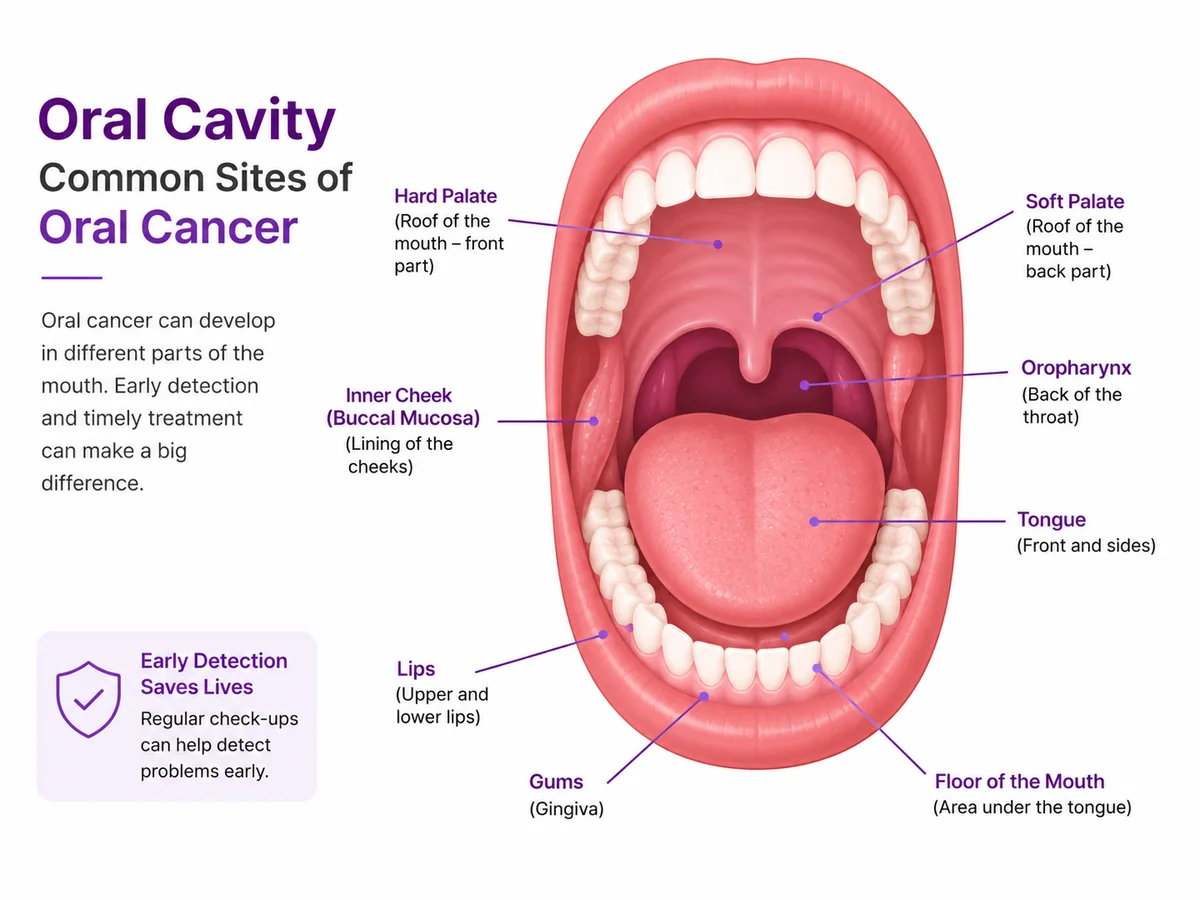
Oral cancer begins in the lining of the mouth — most often the tongue, inner cheeks (buccal mucosa), gums, floor of the mouth, lips or palate. About 9 in 10 cases are squamous cell carcinomas, usually starting as a patch or a sore that doesn't heal. Found early, it's very treatable.
Because the mouth is easy to see and feel, oral cancer is one of the few cancers you can help catch yourself — long before it becomes serious. India accounts for nearly one in three oral cancers worldwide, and the burden is especially heavy in Telangana and Andhra Pradesh.
The sites where oral cancer can develop.
Early detection
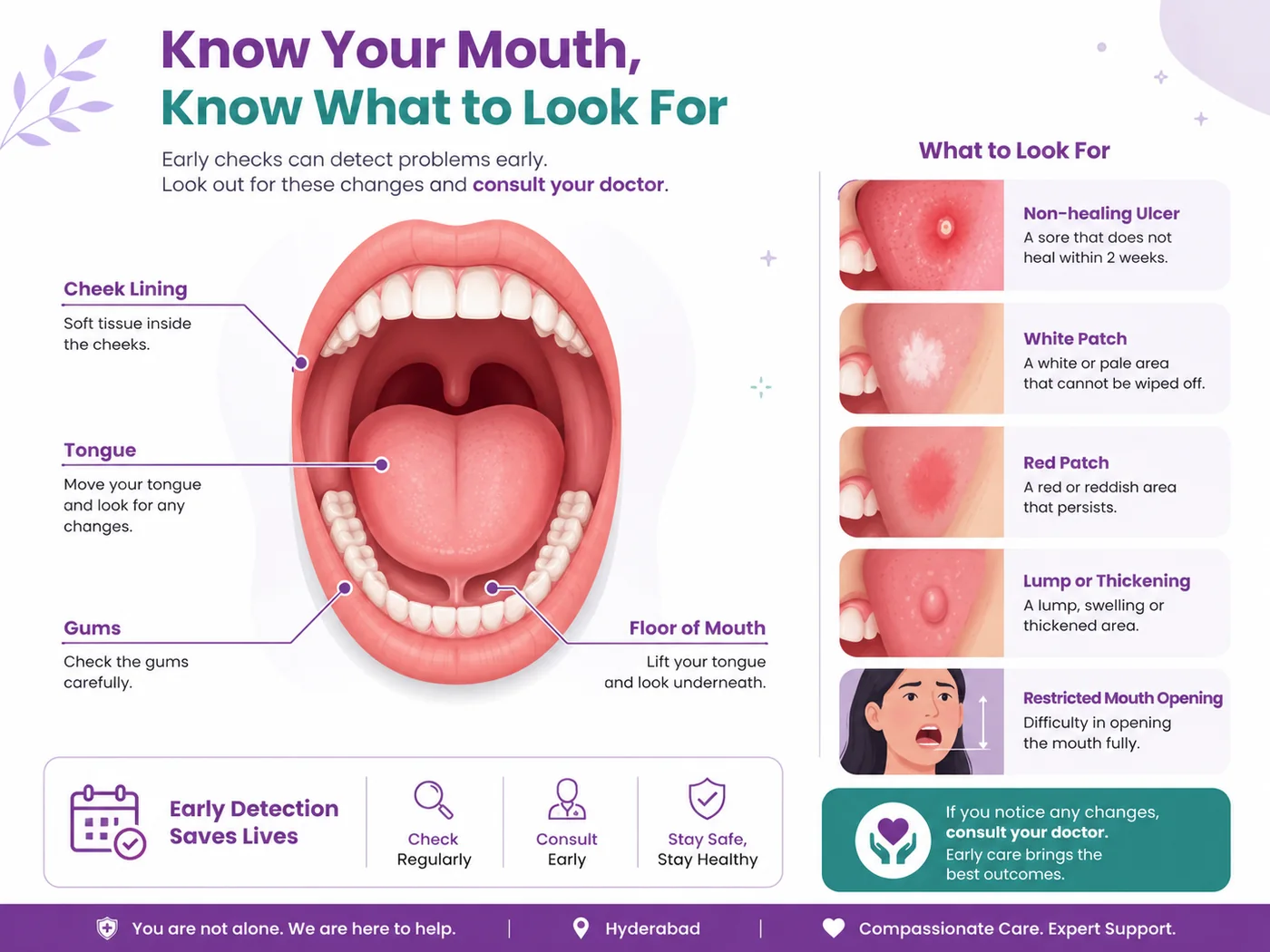
Early warning signs — and when to see a doctor
See a doctor if a mouth ulcer, white or red patch, lump, or difficulty opening your mouth lasts more than two to three weeks. Early oral cancer is often painless, so waiting for pain is the most common — and most costly — mistake.
This tool doesn't diagnose oral cancer or replace a medical opinion. Many signs have harmless causes — but anything lasting beyond two weeks should be checked.
Causes
What causes oral cancer?
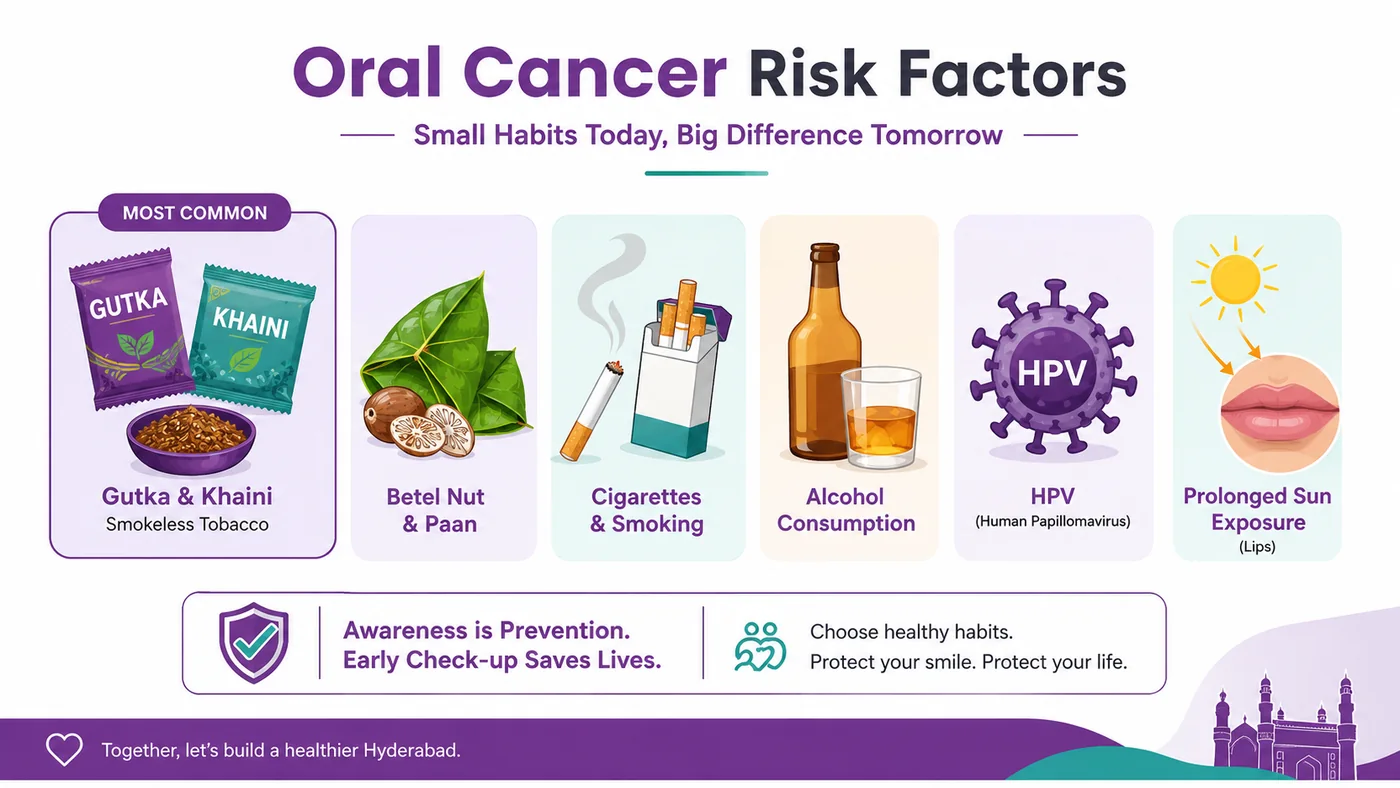
In Telangana and Andhra Pradesh, oral cancer is driven above all by gutka, khaini and betel/areca nut, along with smoking, alcohol and, for some cancers at the back of the mouth, HPV. Most of these risks are avoidable — and stopping them lowers your risk at any age.
This isn't about blame. Tobacco and areca nut are made to be habit-forming, and quitting is hard. What matters is knowing the link, getting any suspicious change checked, and getting support to stop. See the full list of oral cancer risk factors.
Don't ignore this
Oral submucous fibrosis & precancerous conditions
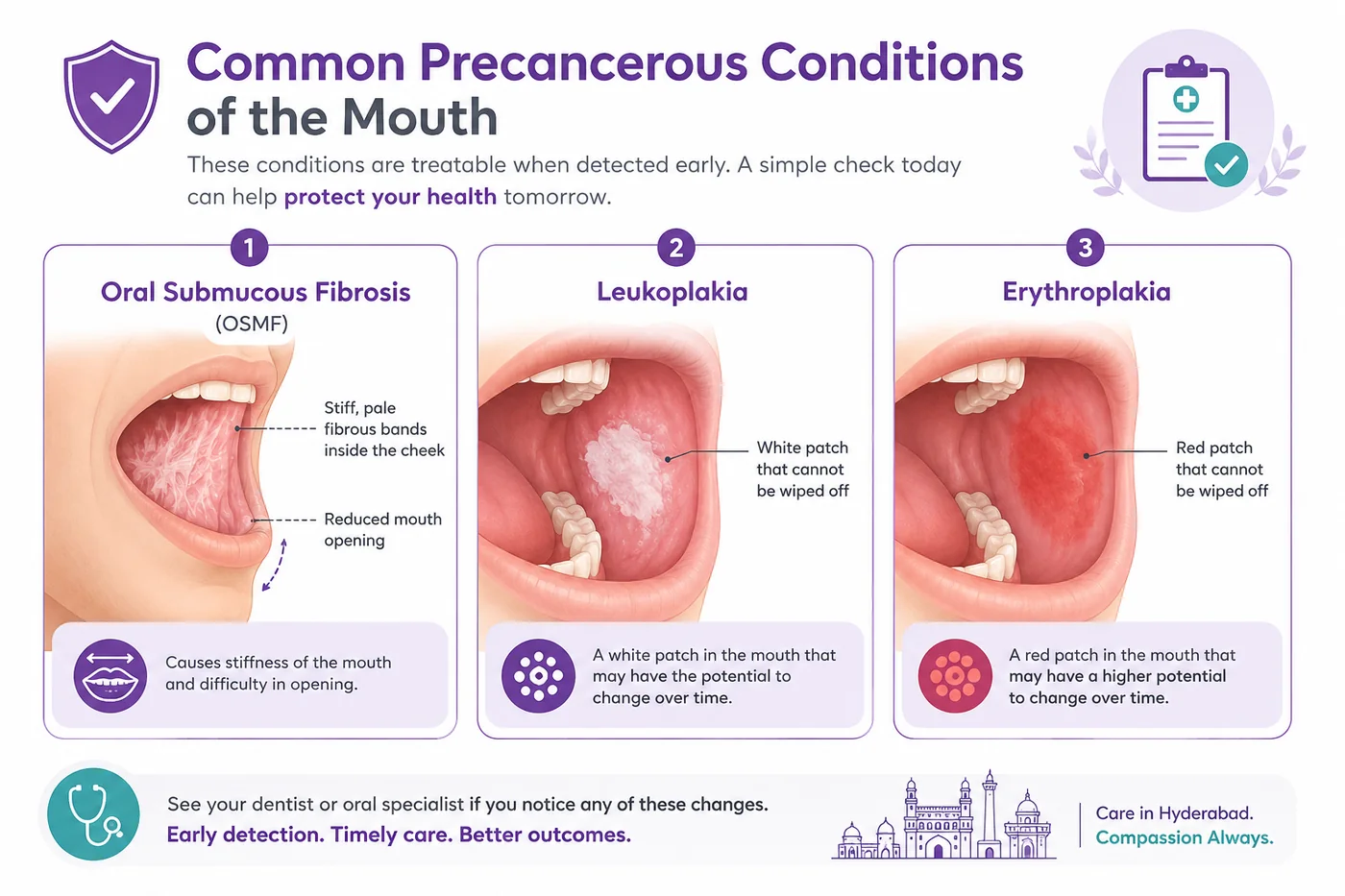
Some mouth conditions are not cancer yet, but can turn into it — and they need checking. Oral submucous fibrosis (OSMF), a stiffening of the mouth common in areca-nut and gutka users, is especially important because it often goes unrecognised — and is now seen even in teenagers in this region.
Oral submucous fibrosis
Progressive stiffening of the mouth lining — harder mouth opening, burning with spicy food. Strongly linked to areca nut and gutka.
Leukoplakia
A white patch that can't be wiped away. Most are harmless, but some carry early cell changes and must be assessed.
Erythroplakia
A red velvety patch — less common but more likely to show serious cell changes, so it always needs review.
Staging
The stages of oral cancer
Oral cancer is grouped into four stages by how large the tumour is and how far it has spread. Earlier stages usually need less treatment and have better outcomes — the strongest reason to act on early signs. Read more on oral cancer staging and TNM staging.
Understand each stage
Simplified for understanding. Your exact stage and plan are decided by your oncology team after examination and scans.
Stage I & II — early
A small tumour that hasn't spread to lymph nodes. Often a single approach — surgery or radiation — with good outcomes and quicker recovery. See stage 1 & 2 treatment.
Stage III & IV — advanced
A larger tumour, or spread to lymph nodes or nearby structures. Usually a combination of surgery, radiation and sometimes chemotherapy. See stage 3 & 4 treatment and can stage 4 be cured?
Diagnosis & tests
How oral cancer is diagnosed
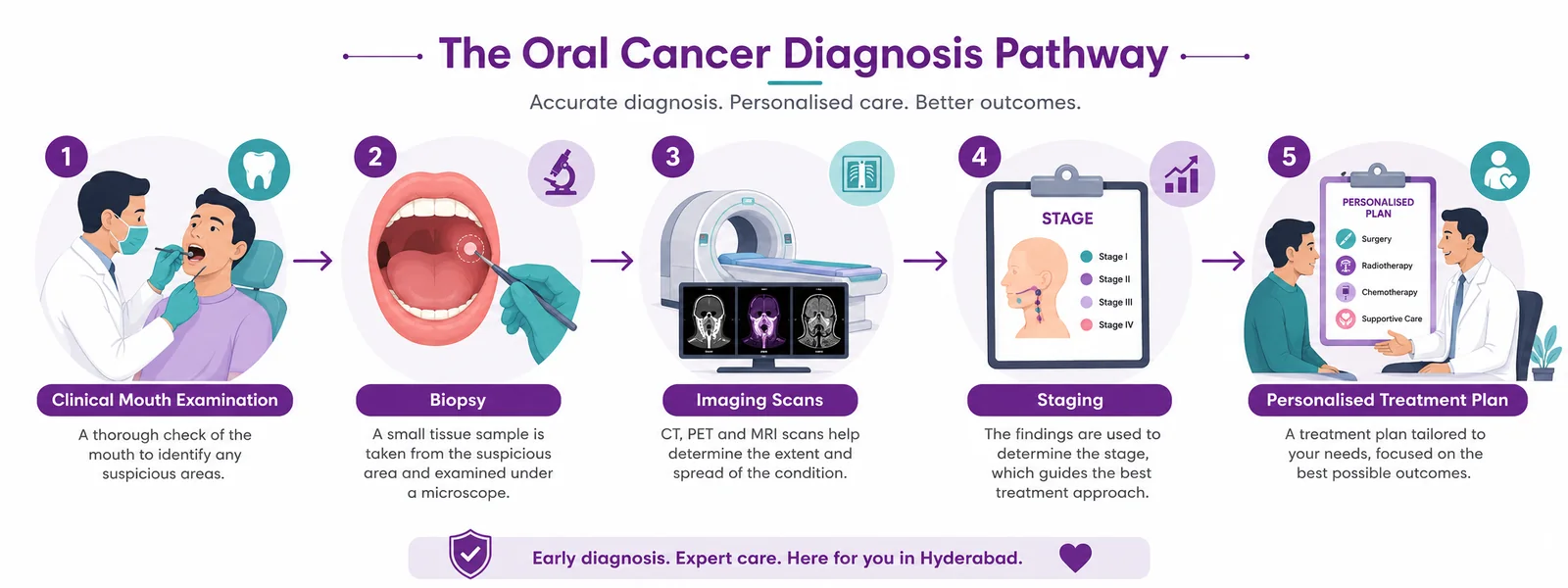
Diagnosis starts with a mouth examination and a biopsy — a small tissue sample — followed by scans to check the extent. A biopsy is safe and does not spread cancer; it is the only way to be sure. Learn how oral cancer is diagnosed.
Diagnostic services we offer — book any of these directly:
Oral cancer biopsy
A small tissue sample to confirm diagnosis — the only way to be certain.
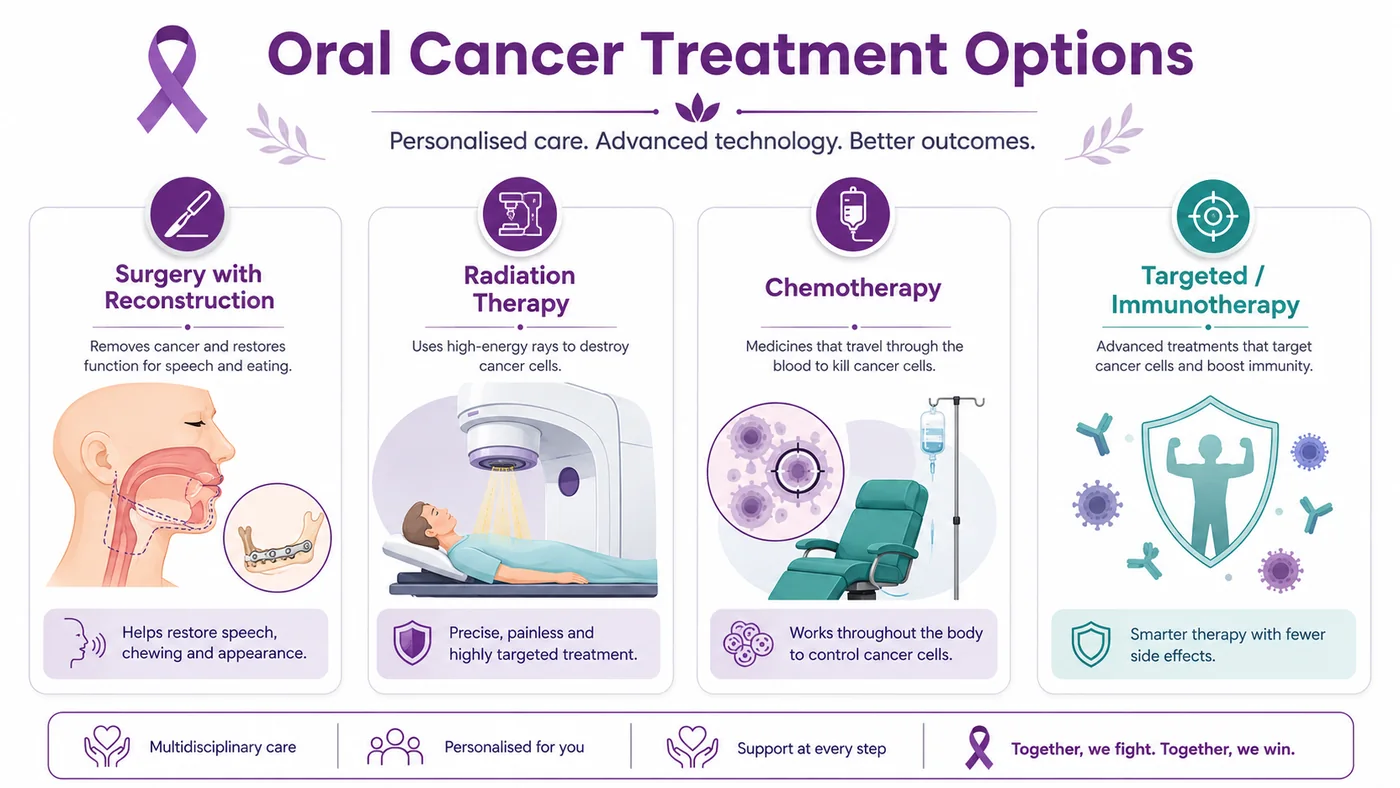
Treatment usually combines surgery, radiation therapy and, when needed, chemotherapy or targeted therapy, chosen by a multidisciplinary team for your stage. Where the tongue, cheek or jaw is affected, reconstruction helps restore speech, eating and appearance. See our full guide to oral cancer treatment in Hyderabad.
Treatments we deliver — book a consult for any of these:
Surgery & reconstruction
Removing the tumour and rebuilding the area to protect speech, swallowing and appearance.
Indicative cost of oral cancer treatment in Hyderabad
The cost depends on the stage, treatment plan and room category — best given as an indicative range after assessment. Eligible treatment, including radiation, may be covered under Aarogyasri / PMJAY at empanelled centres. See detailed treatment cost, surgery cost and radiation cost.
Estimate an indicative range
Indicative range
—
Figures are indicative only and not a quotation. For an accurate estimate, request a callback.
A worry about a mouth ulcer or a biopsy report shouldn't wait. Book a free consultation and, if you already have a biopsy, a free written second opinion.
Your slides re-read by a senior pathologist
Reviewed by a multidisciplinary tumour board
Aarogyasri / PMJAY & insurance guidance
Support
Financial support & Aarogyasri
Cost should not delay treatment. Under Aarogyasri and PMJAY, eligible oral cancer treatment — including radiation therapy — may be largely covered at empanelled centres. Our team helps check eligibility and guides you on insurance and EMI. See affordable oral cancer treatment.
9 clinics in Hyderabad · 35+ across Telangana & AP
CION cancer care is closer than you think.
We're never more than 30 minutes away. Same panel of specialists at every centre. Same tumour board reviews. Same NCCN protocols. Pick the closest one and call directly — or let us pick for you.
Fear and stigma keep people away from care. Here are the beliefs we hear most in Telangana, and the facts.
“A biopsy or surgery will spread the cancer.”
Fact: Biopsy and surgery are safe, standard steps done under controlled conditions — they don't spread cancer. The real risk is delay, which lets a treatable cancer grow.
“Cancer is contagious — I can catch it.”
Fact: Oral cancer is not infectious. You can't catch it by sharing food, kissing, or caring for someone. This myth isolates patients when they most need family.
“If there's no pain, it can't be cancer.”
Fact: Early oral cancer is usually painless. Waiting for pain is the commonest reason people are diagnosed late. Act on a patch or ulcer, not on pain.
“Radiation will make me radioactive.”
Fact: Standard external radiotherapy does not make you radioactive; you can be around family and children safely. Your team explains any exception clearly.
“Surgery will leave me unable to speak or eat.”
Fact: Modern surgery is paired with reconstruction and speech-and-swallowing rehab to restore function and appearance wherever possible.
“Home remedies alone can cure it.”
Fact: Relying on unproven remedies wastes the window when oral cancer is most treatable. Discuss anything complementary with your oncology team, not as a replacement.
“It's a punishment; talking about it makes it worse.”
Fact: Cancer is a disease with biological causes — not a judgement. Speaking openly lets family support you and helps you get treated sooner.
“Once you have cancer, there's no point treating it.”
Fact: Oral cancer is one of the more treatable cancers, especially when found early — and even advanced disease can often be controlled. Treatment changes outcomes.
“Treatment is unaffordable — we can't manage it.”
Fact: Under Aarogyasri and PMJAY, eligible treatment (including radiation) may be largely covered at empanelled centres. We help check eligibility, insurance and EMI.
“Quitting gutka now won't make any difference.”
Fact: Stopping tobacco and areca nut lowers your risk at any age — and after treatment it strongly reduces the chance of a second cancer. It is never too late.
“Oral cancer only happens to old men.”
Fact: In Telangana it affects women who chew tobacco too, and OSMF is now seen even in teenagers. Anyone with a chewing habit or a non-healing patch is at risk.
“Chemotherapy always means being bedridden and losing all your hair.”
Fact: Side effects vary by drug and are actively managed today. Many people continue daily life through treatment; your team supports you at every step.
“A second opinion will offend my doctor or waste time.”
Fact: A second opinion is normal and welcomed in cancer care — it confirms the plan and gives you confidence. At CION it's free when you have a biopsy report.
“Ayurvedic or herbal treatment is safer than surgery.”
Fact: No herbal remedy is proven to cure oral cancer, and relying on one delays effective care. Tell your oncologist about anything you take so it's used safely alongside treatment.
“If I ignore the ulcer, it might just go away.”
Fact: A harmless ulcer heals within two weeks. One that persists beyond that needs checking — early oral cancer looks minor but grows steadily.
“Surgery will leave me disfigured for life.”
Fact: Reconstruction with flap surgery rebuilds form and function, and rehabilitation restores speech, chewing and appearance far more than people expect.
“Only smokers get oral cancer, not tobacco chewers.”
Fact: Chewed tobacco — gutka, khaini, zarda — and areca nut are the leading causes of oral cancer in this region, often more than smoking.
“Telling my family will only worry them — better to hide it.”
Fact: Support improves outcomes. Families who know can help you attend appointments, eat well and stay on treatment. Hiding it usually delays care.
Why CION
Why choose CION for oral cancer care
A dedicated cancer network
CION treats cancer and only cancer — focused, patient-specific care, not a general hospital's approach.
Close to home
9 clinics across Hyderabad and 35+ centres across Telangana & AP, so care and follow-up don't mean long journeys.
The full team, together
Surgical, medical and radiation oncologists plan every case in a multidisciplinary tumour board.
Affordable & transparent
Indicative costs up front, Aarogyasri and PMJAY support including radiation, help with insurance and EMI.
NABH-accredited centres
Treatment is delivered within NABH-accredited facilities and their safety and quality standards.
Support beyond treatment
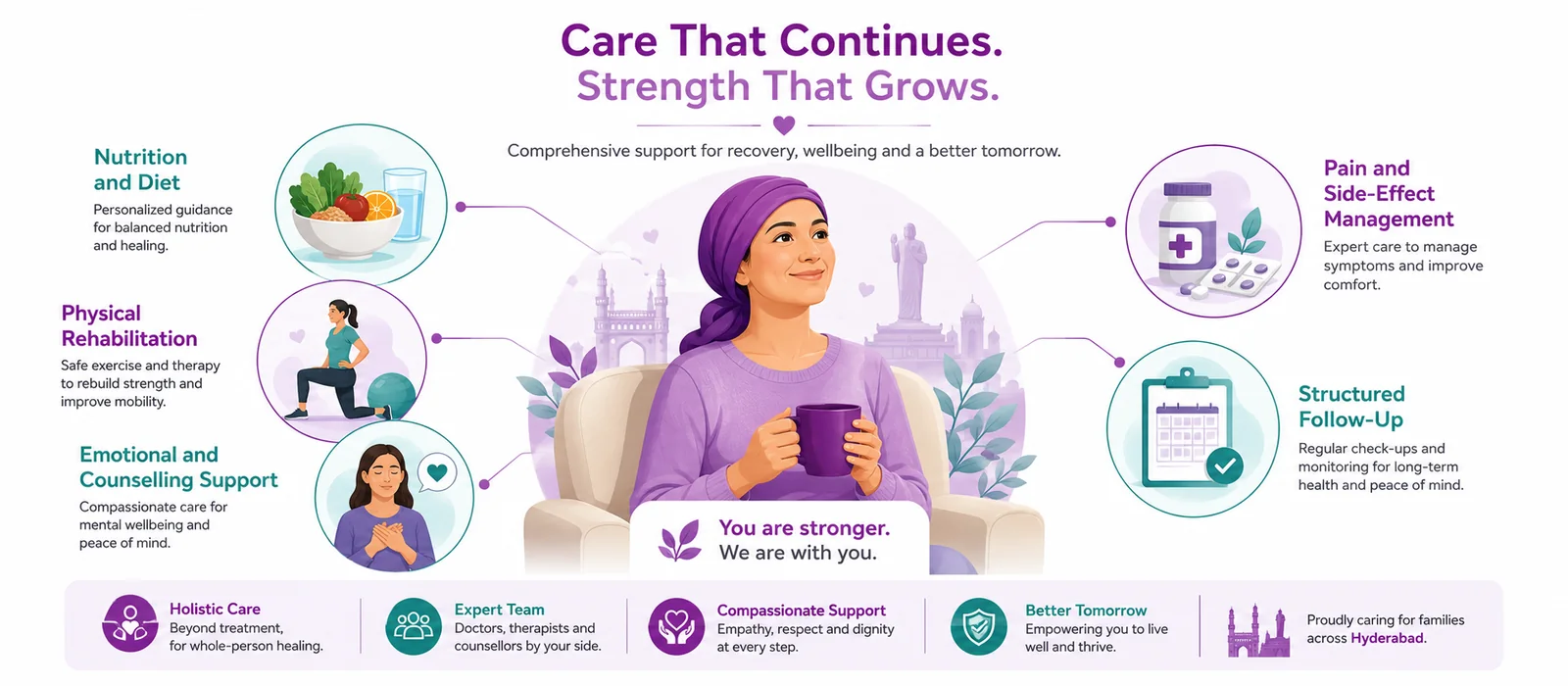
Nutrition, counselling, speech-and-swallowing rehab and pain care are part of the plan.
Real stories · real courage
15,000+ patients chose CION. Hear from them directly.
These aren't paid endorsements or written reviews. These are video testimonials from real patients and families — recorded on their own phones, in their own words. Pick any one. Watch it. Then decide.
4.8★800+ Google reviews
50+video testimonials
15,000+patients treated
Successful Chemotherapy & Radiation Done by Dr. Owais Mohammed & Dr. Kirti Ranjan
Watch video →
Successful Chemotherapy Done by Dr. C Raghavendra Reddy
Watch video →
Surgery, Chemo & Radiation Done by Dr. Imaduddin, Dr. Vinay, Dr. Owais, Dr. Kirti
Watch video →
Successful Radical Thymectomy Done by Dr. Mohammed Imaduddin & Dr. Vinay Mamidala
Watch video →
Successful Surgery Done by Dr. Rajender Byshetty
Watch video →
Successful Chemo & Surgery Done by Dr. Imad, Dr. Vinay, Dr. Owais & Dr. Raghavendra
Watch video →
Successful Chemo & Surgery Done by Dr. Imad, Dr. Vinay, Dr. Owais & Dr. Raghavendra
Watch video →
Successful Chemo & Radiation Done by Dr. Owais Mohammed & Dr. Kirti Ranjan Mohanty
Watch video →
Successful Breast Cancer Surgery Done by Dr. Imaduddin Mohammed & Dr. Vinay Mamidala
Watch video →
Successful Chemotherapy Done by Dr. Bharati Devi Gorantla
Watch video →
Successful Chemo & Surgery Done by Dr. Owais Mohammed & Dr. Imaduddin Mohammed
Watch video →
Successful Chemotherapy Done by Dr. Gundu Naresh
Watch video →
Successful Bone Marrow Transplantation - Neuroblastoma
Watch video →
Successful Surgery & Chemo - Carcinoma of Caecum
Watch video →
Successful Oral chemotherapy & mastectomy surgery
Watch video →
Successful Oral chemotherapy & mastectomy surgery
Watch video →
Successful Chemotherapy
Watch video →
Successful Surgery by Dr. Mohammed Imaduddin
Watch video →
Successful Bone Marrow Transplantation
Watch video →
Successful Oral chemotherapy & mastectomy surgery
Watch video →
Successful Oral chemotherapy & mastectomy surgery
Watch video →
Successful Chemotherapy
Watch video →
Successful Buccal Mucosa Surgery
Watch video →
Successful Complex Surgery Mandibulectomy Reconstruction
Oral cancer affects eating, speech and confidence. Support around treatment is built into your care.
Nutrition counselling
Keeping strength and weight when eating and swallowing are affected. Diet during treatment
Mental-health support
Emotional support for appearance, speech and confidence. Learn more
Speech & swallowing rehab
Therapy to rebuild speech and safe swallowing after treatment. Learn more
Caregiver guide
Practical help for families supporting a loved one. Learn more
Pain management
Comfort and symptom control at any stage. Learn more
Follow-up & survivorship
Structured review to watch for recurrence and support recovery. Follow-up schedule
FAQ
Frequently asked questions about oral cancer
What is the first sign of oral cancer?
The most common first sign is a mouth ulcer, sore or patch that does not heal within 2 weeks. Other early clues include a white or red patch inside the mouth, a lump or thickening felt inside the cheek or under the tongue, restricted mouth opening, or unexplained loose teeth. Persistent one-sided ear pain without any ear infection is another important warning sign. Early oral cancer is usually painless, so do not wait for pain.
Is oral cancer curable?
Yes — oral cancer is highly curable when caught early. At an early, localised stage outcomes are generally good and many people return to a full life. Even advanced oral cancers can often be cured or controlled with a combination of surgery, radiation, chemotherapy and immunotherapy. The single biggest factor in outcome is how early it is diagnosed, which is why acting on early signs matters most.
Is oral cancer contagious?
No. Oral cancer is not infectious. You cannot catch it by sharing food or utensils, kissing, or caring for someone who has it. This common myth wrongly isolates patients at the very time they most need family support.
Does a biopsy spread oral cancer?
No. A biopsy is a safe, standard step done under controlled conditions and does not spread cancer. It is the only way to be sure whether a patch or ulcer is cancer. The real danger is delay, not the biopsy.
Does gutka, khaini or paan cause oral cancer?
Yes. Smokeless tobacco such as gutka, khaini and zarda, along with betel/areca nut (supari) and paan, is the leading cause of oral cancer in Telangana and Andhra Pradesh. Chewing tobacco harms the mouth lining through prolonged direct contact, and areca nut on its own can cause oral submucous fibrosis, a precancerous condition. Stopping these habits — even after years — greatly lowers the risk.
What is oral submucous fibrosis (OSMF)?
Oral submucous fibrosis is a precancerous condition almost entirely caused by chronic areca-nut and gutka use. It progressively stiffens the lining of the cheeks, making it harder to open the mouth wide, and is often accompanied by a burning sensation with spicy food. Without intervention, OSMF can progress to oral cancer. Anyone with restricted mouth opening or a daily chewing habit should be assessed by an oncologist.
How much does oral cancer treatment cost in Hyderabad?
Cost depends on the stage, treatment plan, the modalities used and room category, so it is best given as an indicative range after assessment. Eligible treatment, including radiation therapy, may be covered under Aarogyasri or PMJAY at empanelled centres, and we help with insurance and EMI. Use the cost estimator on this page for an indicative figure, then request a callback for an accurate estimate.
Is oral cancer treatment covered by Aarogyasri or PMJAY?
Yes, for eligible patients. Under Aarogyasri and PMJAY, eligible oral cancer treatment — including radiation therapy — may be largely covered at empanelled centres. Our team helps you check eligibility and complete the paperwork, and guides you on private insurance and EMI options if a scheme does not apply.
Can oral cancer be prevented?
Largely, yes. The great majority of oral cancers in India are preventable. Stopping all forms of tobacco and areca nut, limiting alcohol, treating chronic sharp tooth edges or ill-fitting dentures, maintaining good oral hygiene, and doing a 2-minute monthly self-examination of the mouth in front of a mirror are the most effective preventive measures.
How is oral cancer diagnosed?
Diagnosis starts with an examination of the mouth and neck, followed by a biopsy — a small tissue sample — which confirms whether it is cancer. Imaging such as CT, MRI and PET-CT is then used to check how far it has spread and to decide the stage. A biopsy is safe and does not spread cancer; it is the only way to be certain.
What are the stages of oral cancer?
Oral cancer is grouped into four stages by how large the tumour is and how far it has spread. Stage I and II are early, with a small tumour and no lymph-node spread, usually needing a single treatment. Stage III and IV are advanced, with a larger tumour or spread to lymph nodes or nearby structures, usually needing a combination of surgery, radiation and sometimes chemotherapy. Your exact stage is decided after examination and scans.
Can stage 4 oral cancer be cured?
Stage 4 oral cancer is more difficult to treat, but it can still often be cured or controlled with the right combination of surgery, radiation, chemotherapy, targeted therapy or immunotherapy, planned by a multidisciplinary tumour board. Outcomes depend on the exact extent of spread and overall health, so a specialist assessment is essential rather than assuming the worst.
Will I be able to speak and eat after oral cancer surgery?
In most cases, yes. Modern oral cancer surgery is paired with reconstruction (including flap surgery) and speech-and-swallowing rehabilitation to restore function and appearance wherever possible. Many people return to speaking, eating and normal life, especially when the cancer is treated early and rehabilitation begins promptly.
Does radiation therapy make me radioactive?
No. Standard external-beam radiotherapy does not make you radioactive, and you can safely be around family, including children. Your radiation oncologist will clearly explain any exception (such as certain specialised treatments) before it begins.
How long does oral cancer treatment take?
It varies by stage and plan. Early-stage disease treated with a single surgery may involve a hospital stay of a few days plus recovery, while radiation courses often run over several weeks and combined treatment can take a few months in total. Your team gives you a personalised timeline once the stage and plan are confirmed.
What is the survival rate for oral cancer?
Survival depends heavily on stage at diagnosis. Early-stage oral cancers have much better outcomes than advanced ones, which is why early detection is so important. Rather than rely on a single national figure, ask your oncologist for outcomes relevant to your specific stage and treatment plan.
Can oral cancer come back after treatment?
It can, which is why structured follow-up matters. Regular reviews after treatment watch for any recurrence or a new (second) cancer so it can be caught and treated early. Stopping tobacco and areca nut after treatment strongly reduces the chance of the cancer returning or a second cancer developing.
Which specialist should I see for oral cancer or a mouth ulcer that won't heal?
For a mouth ulcer, patch or lump that has not healed in two weeks, see a surgical oncologist or head-and-neck oncologist. At CION, your case is reviewed by a team — surgical, medical and radiation oncologists together — so you get a coordinated plan rather than a single-doctor decision.
Can women get oral cancer without smoking?
Yes. In Telangana and Andhra Pradesh many women who have never smoked use chewing tobacco or areca nut daily, and they account for a significant share of oral cancers — often presenting at an advanced stage. Any woman with a chewing habit or a non-healing mouth change should be checked.
Is a mouth ulcer always cancer?
No — most mouth ulcers are harmless and heal within two weeks. The concern is an ulcer that does not heal in that time, or one with a white or red patch, a lump, or numbness, especially in someone who uses tobacco or areca nut. When in doubt, it is quick and safe to have it checked.
Explore
Explore oral cancer care
Our complete guide to oral cancer — treatment, symptoms, causes, tests, surgery, cost and recovery. Tap any topic to read more.
Worried about a symptom? Talk to a CION oncologist.
Early answers change outcomes. Book a free consultation or second opinion at any of our 9 Hyderabad clinics — part of 35+ centres across Telangana & Andhra Pradesh.
Medical disclaimer: This page is for general information and awareness and does not replace professional medical advice, diagnosis or treatment. Always consult a qualified oncologist. Costs shown are indicative only and not a quotation. Content is periodically reviewed by CION's medical team.

 CION Ameerpet