Skin Cancer: Easy to See, Easy to Treat — When Caught Early
A changing mole, or a sore that won’t heal, deserves a check — but most skin spots are completely harmless. Skin cancer is one of the most preventable cancers, and because it’s usually on the surface where you can see it, it’s often caught early and highly curable. And no — it’s a myth that Indians don’t get skin cancer.
Free consultation with an oncologist · free written second opinion
Fully multidisciplinary — surgery, radiation & immunotherapy under one roof
9 clinics in Hyderabad · 35+ across Telangana & AP
Written & medically reviewed by Dr. Sridhar Kamani, Surgical Oncologist (MBBS, MS & DrNB, Surgical Oncology), CION Cancer Clinics — with our medical & radiation oncology team. · Reviewed 9 July 2026
Overview
What is skin cancer?
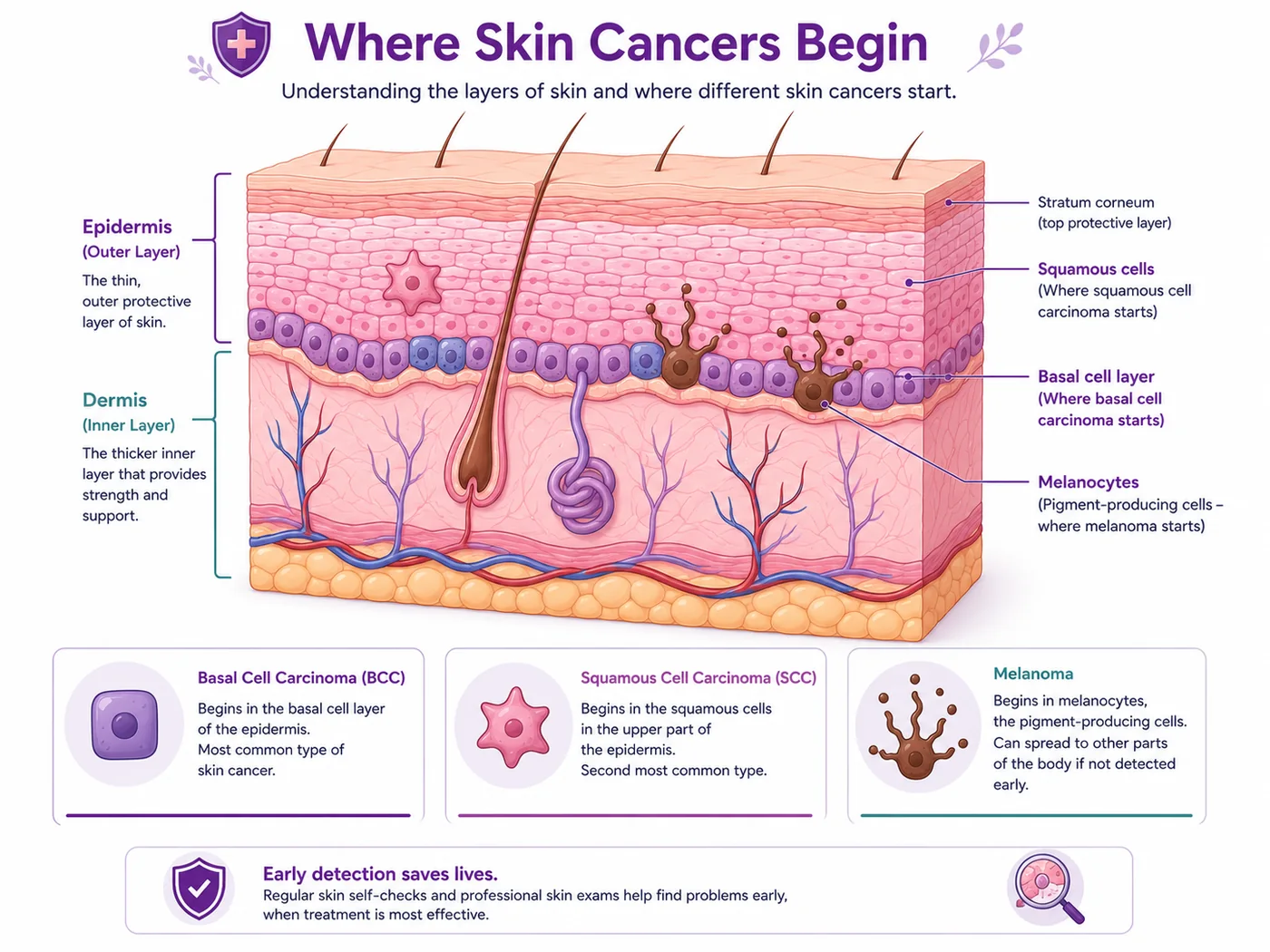
Skin cancer happens when skin cells grow out of control. There are three main types — basal cell (the commonest), squamous cell, and melanoma (less common but the most serious) — and because it’s usually on the skin where you can see it, it’s often caught early and highly curable.
Each type starts from a different cell in the skin — which is why they look and behave differently, and why knowing the signs is so useful.
The three main skin cancers begin from three different skin cells.
Check a mole
A changing mole, or a sore that won’t heal? Check it
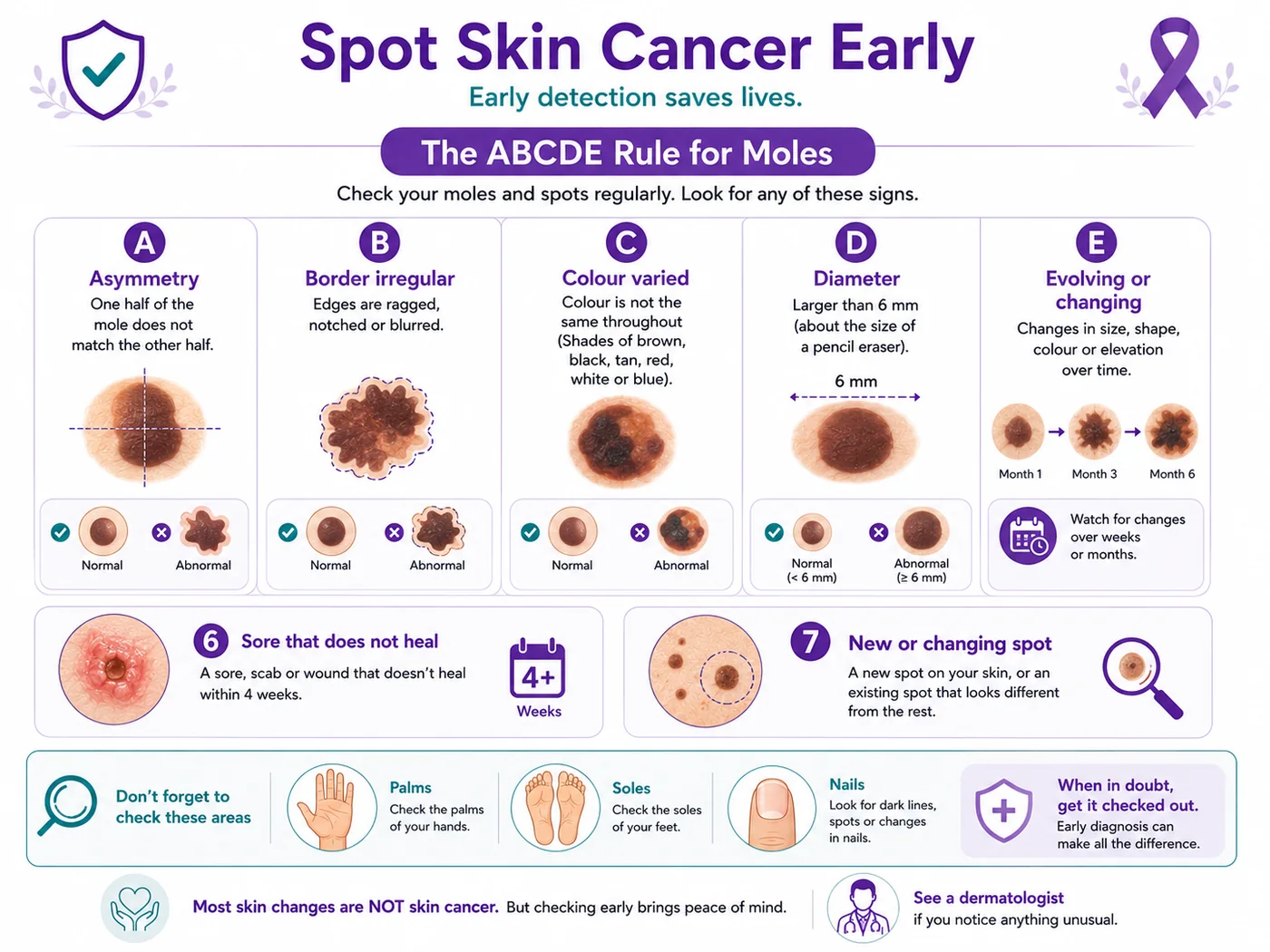
Most moles and skin spots are completely harmless — what matters is change. A mole that’s growing or changing (the ABCDE signs below), a sore that hasn’t healed in weeks, or a new dark streak under a nail deserves a check. Checking early makes skin cancer — especially melanoma — far easier to cure.
The ABCDE mole check
Tick anything you notice. This is an awareness guide, not a diagnosis — most moles are harmless.
Your result
Tick what applies
Most moles and skin spots are harmless. Your guidance appears here — and remember to check your palms, soles and nails too.
This tool doesn’t diagnose anything or replace medical advice. A changing mole, a non-healing sore, or a new dark streak under a nail should be checked by a doctor — most turn out to be harmless, and early ones are very treatable.
Symptoms
Signs & symptoms
The warning signs are a mole that’s changing (use the ABCDE rule), a sore or spot that won’t heal, and any new growth that looks different from the rest — the “ugly duckling”. In darker skin especially, also check the palms, soles and under the nails.
A mole that’s changing (ABCDE)
A sore or spot that won’t heal
A new growth unlike the others
A spot that itches, crusts or bleeds
A dark streak under a nail
A changing spot on a sole or palm
It’s change — not pain — that matters most. If something on your skin is new, changing or won’t heal, book a consultation.
Skin cancer & Indian skin
“Indians don’t get skin cancer” — the myth, and what to watch
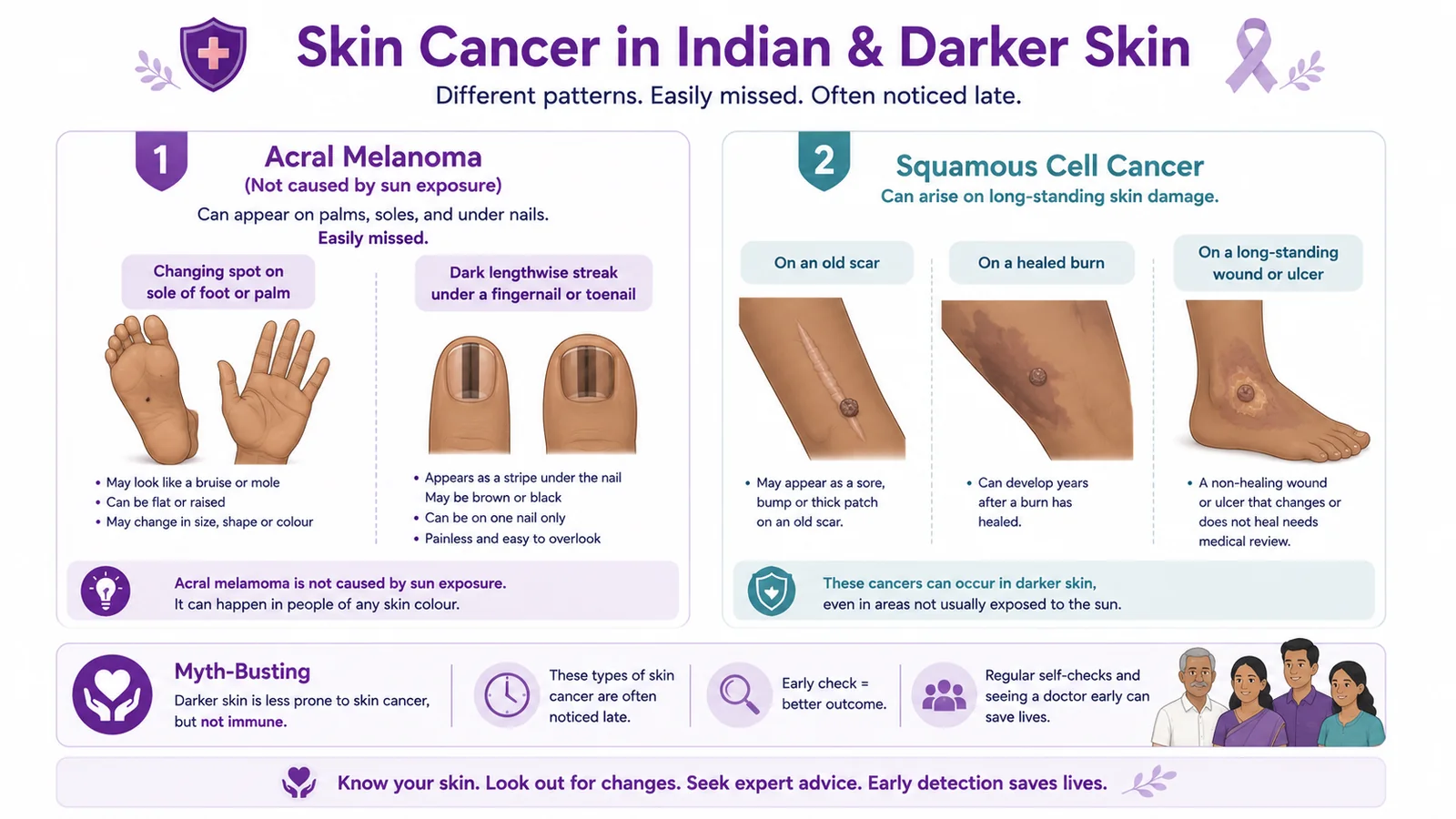
It’s a myth that Indians or people with dark skin don’t get skin cancer. It’s less common in darker skin — but it does happen, and it’s often diagnosed late, precisely because no one expects it. Two patterns matter most here: melanoma on the soles, palms or under a nail (acral — not caused by sun, and easily mistaken for a mole, bruise or fungal nail), and squamous cell cancer on an old scar, burn or long-standing wound.
Myth: “People with dark skin don’t need to worry about skin cancer.”
Fact: It’s less common in darker skin, but it does occur — and is often found late because it’s unexpected. Watch the soles, palms and nails, and any old scar or wound, and get changes checked.
Prevention
Prevention & self-checks
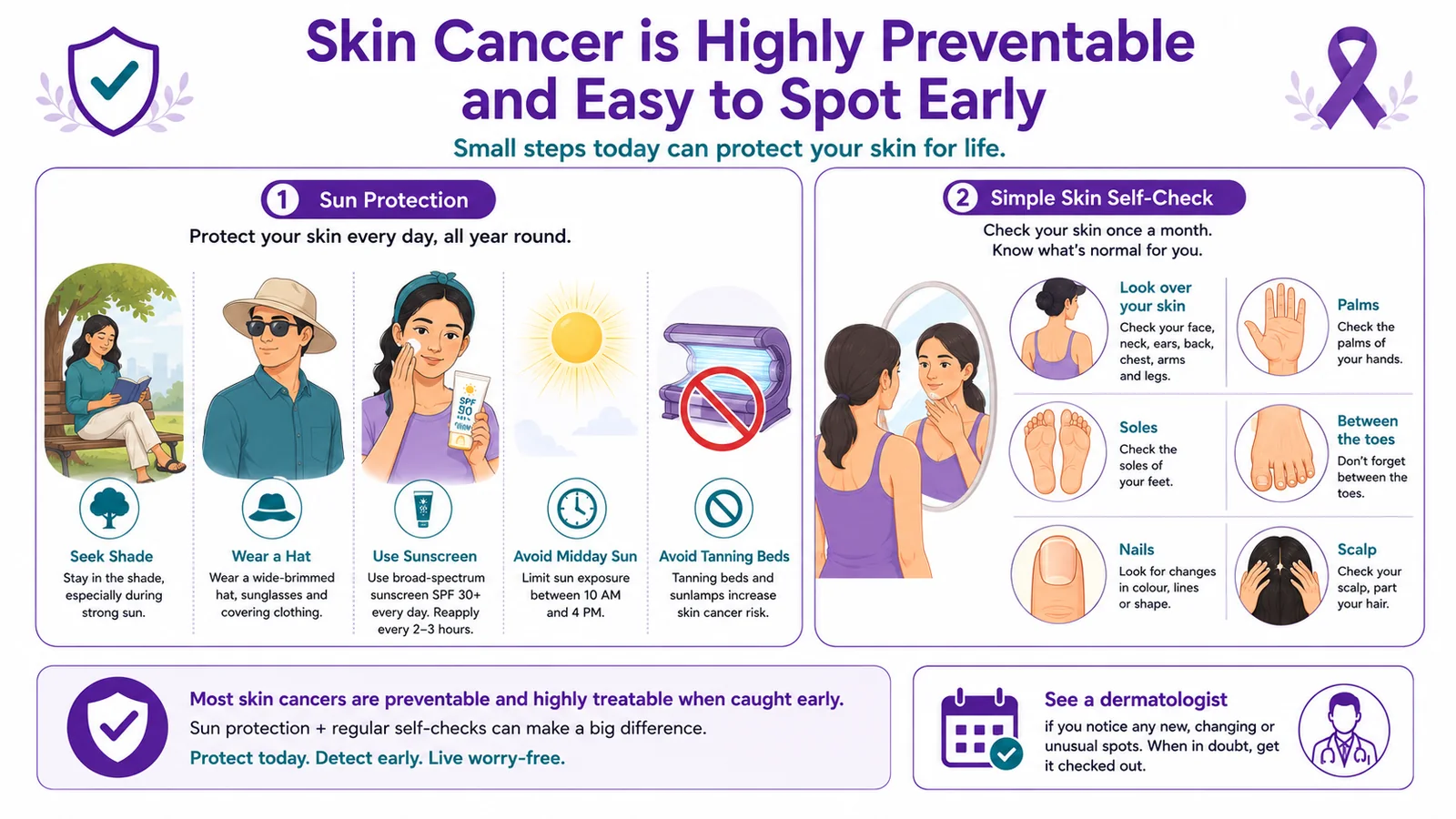
Skin cancer is one of the most preventable cancers. Sun protection — shade, covering clothing, a hat, sunscreen, avoiding midday sun and tanning beds — prevents most of it. And because it’s usually visible, a simple monthly self-check (including the palms, soles, between the toes, nails and scalp) helps catch it early.
The biggest cause of basal cell, squamous cell and most melanomas is UV — sun and tanning beds. But other things raise risk too — and, importantly, acral melanoma on the soles, palms and nails isn’t caused by sun at all.
UV — sun & tanning beds (the main cause)
Fair skin & a history of sunburn
Many or unusual moles
A weakened immune system (incl. transplant)
Old scars, burns & long-standing wounds
Older age & family history
Having a risk factor doesn’t mean you’ll get skin cancer — and sun protection lowers the risk for everyone. If skin cancer runs in your family, genetic counselling can help.
Types
The three types (plus one to know)
There are three main types — plus one especially important in darker skin. Basal cell (commonest, rarely spreads, very curable), squamous cell (can spread if neglected, curable early), melanoma (less common but the most serious), and acral melanoma (on soles/palms/nails — the type most often seen in darker skin).
Understand the types
Simplified for understanding. Your exact type is confirmed by examining and testing the spot, and guides your personalised plan.
Staging
The stages of melanoma
Basal and squamous cell cancers are usually caught while still local and treated simply. Melanoma is staged 0 to IV — from a melanoma confined to the top layer of skin, through thicker tumours and lymph-node involvement, to spread to distant organs. Early (thin) melanoma is highly curable.
Understand the stages (melanoma)
Simplified for understanding. Your exact stage and plan are confirmed by your team after tests.
Diagnosis
How skin cancer is diagnosed
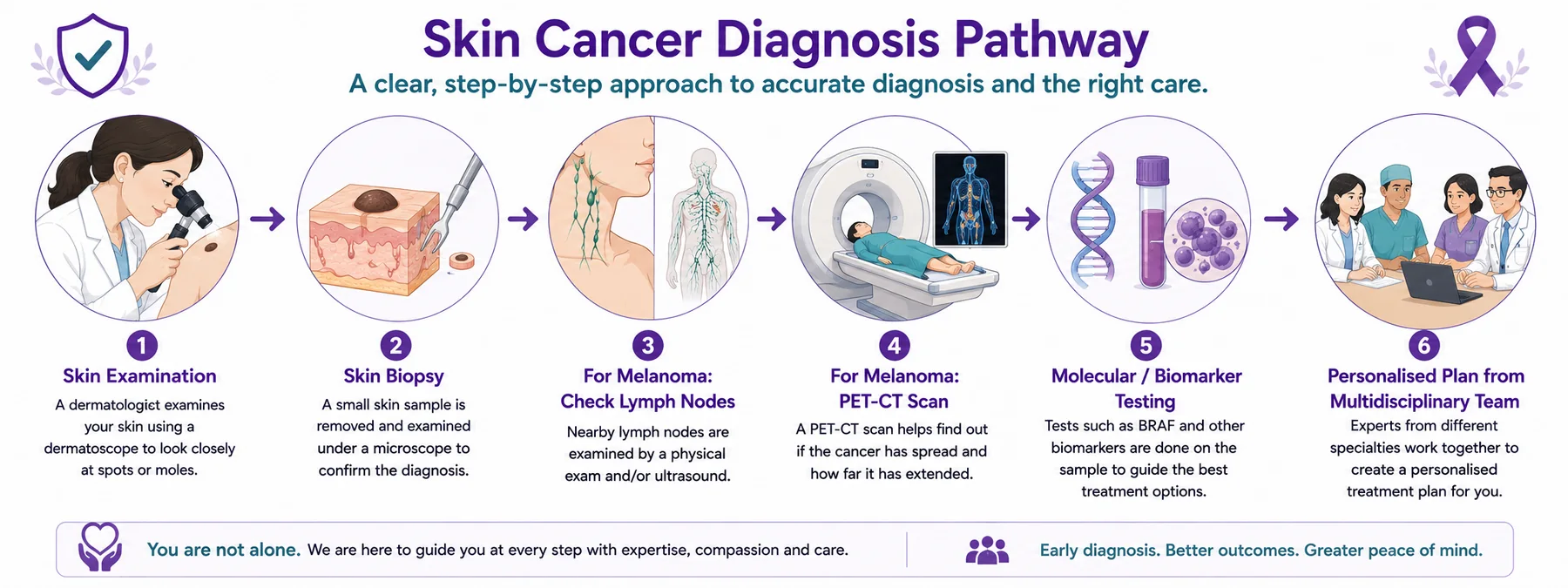
Diagnosis starts with a skin examination — often with a dermatoscope, a special magnifier — and a biopsy (taking a small sample of the spot) confirms it. For melanoma, the nearby lymph nodes may be checked and a PET-CT used to see the extent, and molecular testing (such as BRAF) guides treatment for advanced disease.
From a skin check to a precise, personalised plan.
Diagnostic services we offer — book any of these directly:
Skin examination & dermoscopy
A close look at the spot with a dermatoscope (a special magnifier) — carried out with our dermatology colleagues to decide what needs a biopsy.
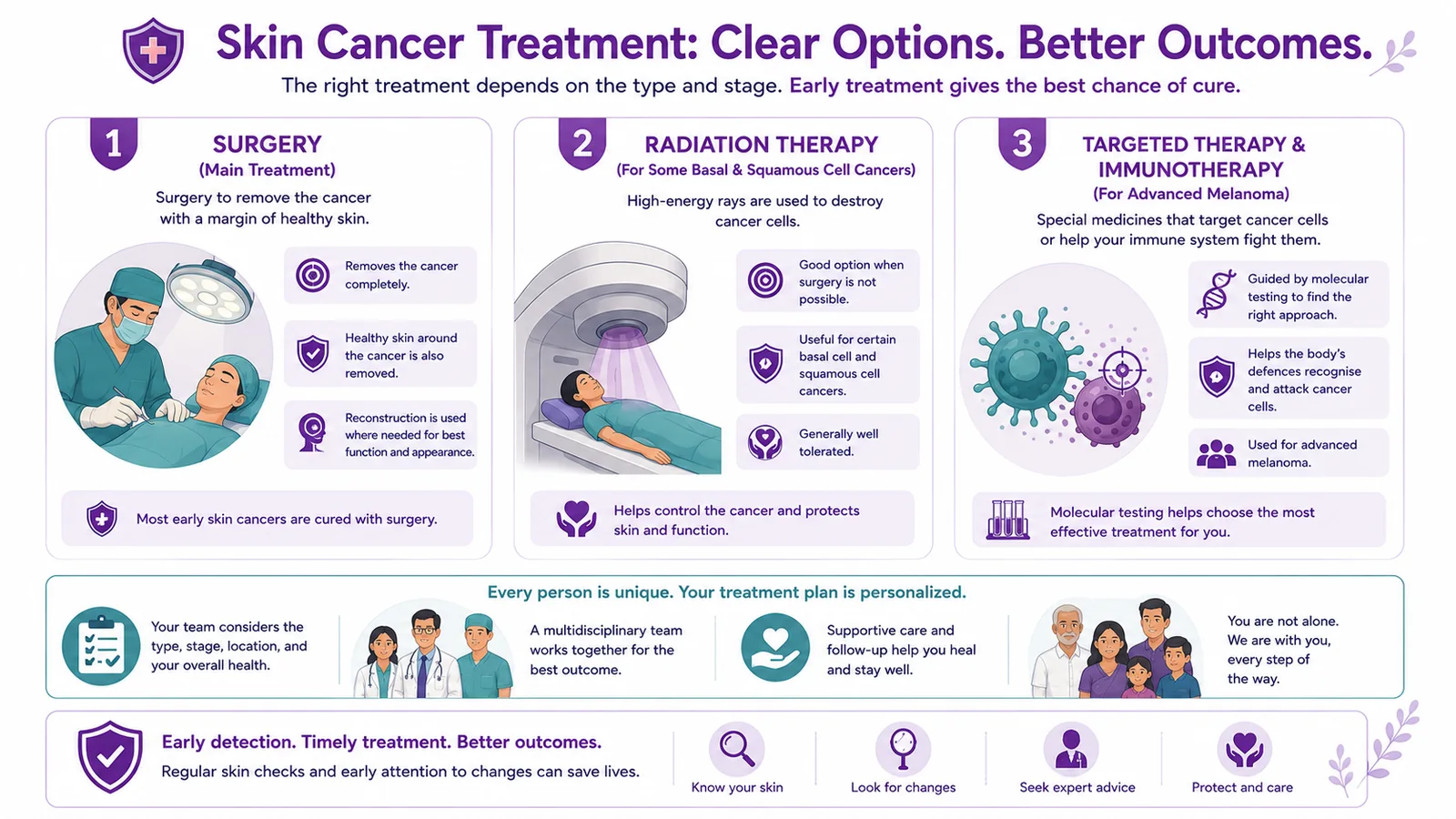
For most skin cancers, surgery to remove the cancer — with a margin of healthy skin — is the main and often the only treatment needed. Radiation is an option for some basal and squamous cell cancers, and for advanced melanoma, immunotherapy and targeted therapy (guided by molecular testing) have transformed outcomes. Reconstruction is used where needed. See our full guide to skin cancer treatment in Hyderabad.
Advanced melanoma has changed. Treatments that harness the immune system (immunotherapy) and target specific molecular changes (guided by BRAF testing) now control many advanced melanomas — sometimes for years — where once there were few options. CION provides surgery, radiation and medical oncology in-house, and coordinates dermoscopy and Mohs surgery with our dermatology / dermatologic-surgery colleagues.
Treatments & care we offer — book a consult for any of these:
Surgery — excision (the mainstay)
Removing the cancer with a margin of healthy skin — wide local excision for larger or melanoma cancers. The main, and often only, treatment needed.
Indicative cost of skin cancer treatment in Hyderabad
Cost varies widely — an early skin cancer is often removed as a minor day procedure at modest cost, while advanced melanoma needing immunotherapy costs more. It’s best given as an indicative range after assessment. Eligible treatment may be covered under Aarogyasri / PMJAY at empanelled centres.
Estimate an indicative range
Indicative range
—
Figures are indicative only and not a quotation. For an accurate estimate, request a callback.
A changing mole, a sore that won’t heal, a dark streak under a nail, or a diagnosis you want a second view on shouldn’t wait. Book a free consultation and, if you already have a report, a free written second opinion.
Reviewed by a surgical, medical & radiation oncology team
Dermoscopy and biopsy to give you a clear answer — most spots are harmless
Aarogyasri / PMJAY & insurance guidance
Support
Financial support & Aarogyasri
Cost should not delay care. Under Aarogyasri and PMJAY, eligible skin cancer treatment may be largely covered at empanelled centres. Our team helps check eligibility and guides you on insurance and EMI.
9 clinics in Hyderabad · 35+ across Telangana & AP
CION cancer care is closer than you think.
We're never more than 30 minutes away. Same panel of specialists at every centre. Same tumour board reviews. Same NCCN protocols. Pick the closest one and call directly — or let us pick for you.
Don't see your city? Call
18002028726
— we'll find your nearest CION partner centre.
Meet the oncologists
Skin cancer is treated by a team, not one doctor.
Skin cancer care at CION brings together surgical, medical and radiation oncology — with dermatology / dermatologic-surgery colleagues for dermoscopy and Mohs surgery — part of 17 senior specialists across CION.
Share your name and number — we'll call you back within 30 minutes to schedule your consultation.
A mole that’s changed, or a sore that won’t heal? Get it checked.
Most skin spots are harmless — and skin cancer, caught early, is one of the most curable cancers. Whatever your skin tone, don’t wait: check your palms, soles and nails too. Our oncologists see and treat this every day.
The worries and myths we hear most about skin cancer, and the facts.
“Indians / dark-skinned people don’t get skin cancer.”
Fact: Less common, but it occurs — and is often found late because it’s unexpected. Watch the soles, palms, nails and old scars, and get changes checked.
“It’s just a mole / a spot / a fungal nail.”
Fact: Most are harmless — but a changing mole, a non-healing sore, or a new dark streak under a nail should be checked. Acral melanoma is often mistaken for a wart or fungal nail.
“Melanoma is a death sentence.”
Fact: Caught early it’s highly curable, and even advanced melanoma is now often controlled for years with immunotherapy and targeted therapy.
“I don’t burn, so I’m safe.”
Fact: Sun protection still matters — and acral melanoma isn’t caused by sun at all, so sun isn’t the whole story.
“Removing skin cancer will disfigure me.”
Fact: Most are removed with minor surgery; tissue-sparing techniques (including Mohs surgery for some facial cancers) give good results, and reconstruction is available where needed.
“If it doesn’t hurt, it’s not serious.”
Fact: Many skin cancers are painless — it’s change, not pain, that signals a problem.
“Sunscreen isn’t needed for brown or black skin.”
Fact: Darker skin has more natural protection, but not complete protection. Sun safety still helps — and it’s good for your skin in other ways too.
“A biopsy will make the cancer spread.”
Fact: A biopsy is a safe, standard step that gives you a clear answer. The real risk is delay, which lets a treatable cancer grow.
“Skin cancer is contagious.”
Fact: Skin cancer is not infectious. You can’t catch it from — or pass it to — anyone by touch or by being close to them.
“Only very old people get skin cancer.”
Fact: Risk rises with age, but melanoma and acral melanoma can occur in younger adults too — which is why any changing spot is worth checking at any age.
“A mole I’ve had for years can’t be dangerous.”
Fact: A long-standing mole that starts to change — in size, shape, colour or feel — is exactly the kind that should be checked. It’s change that matters.
“It’s only on my skin, so it can’t be serious.”
Fact: Most skin cancers stay local and are very curable — but melanoma and neglected squamous cancers can spread, which is why early checking is worth it.
“Home remedies or creams can cure it.”
Fact: Relying on unproven remedies wastes the window when skin cancer is most treatable. Discuss anything complementary with your team, not as a replacement.
“Treatment is unaffordable — we can’t manage it.”
Fact: Under Aarogyasri and PMJAY, eligible treatment may be largely covered at empanelled centres. We help check eligibility, insurance and EMI.
“A dark line under my nail is just from an injury.”
Fact: Often it is — but a new dark streak under a nail, especially one that widens or won’t grow out, should be checked, as it can be acral melanoma.
“Once skin cancer is removed, I never need checking again.”
Fact: People who’ve had one skin cancer are more likely to get another, so regular skin checks afterwards genuinely matter.
“If it comes back, nothing more can be done.”
Fact: Skin cancer that returns can often be treated again with surgery, radiation or modern drug therapy — decisions are made with you.
“There’s no point getting a second opinion.”
Fact: A clear second opinion at a centre that treats skin cancer can confirm the diagnosis and plan — and give you real peace of mind.
Why CION
Why choose CION for skin cancer care
Fully multidisciplinary, in-house
Surgery, radiation and medical oncology under one roof — the whole of skin cancer care in one place.
Surgical excision
Removal with a margin, wide local excision, and sentinel lymph node biopsy for melanoma — with reconstruction where needed.
Modern melanoma therapy
Immunotherapy and molecular-guided targeted therapy (BRAF testing) for advanced melanoma.
India-aware & myth-busting
Attention to acral melanoma (soles/palms/nails) and cancers on scars and burns — patterns often missed in darker skin.
Prevention & surveillance
Sun-protection and self-check education, and ongoing skin checks after treatment.
Close, NABH-accredited care
9 clinics across Hyderabad and 35+ across Telangana, within NABH-accredited facilities.
Real stories · real courage
15,000+ patients chose CION. Hear from them directly.
These aren't paid endorsements or written reviews. These are video testimonials from real patients and families — recorded on their own phones, in their own words. Pick any one. Watch it. Then decide.
4.8★800+ Google reviews
50+video testimonials
15,000+patients treated
Successful Chemotherapy & Radiation Done by Dr. Owais Mohammed & Dr. Kirti Ranjan
Watch video →
Successful Chemotherapy Done by Dr. C Raghavendra Reddy
Watch video →
Surgery, Chemo & Radiation Done by Dr. Imaduddin, Dr. Vinay, Dr. Owais, Dr. Kirti
Watch video →
Successful Radical Thymectomy Done by Dr. Mohammed Imaduddin & Dr. Vinay Mamidala
Watch video →
Successful Surgery Done by Dr. Rajender Byshetty
Watch video →
Successful Chemo & Surgery Done by Dr. Imad, Dr. Vinay, Dr. Owais & Dr. Raghavendra
Watch video →
Successful Chemo & Surgery Done by Dr. Imad, Dr. Vinay, Dr. Owais & Dr. Raghavendra
Watch video →
Successful Chemo & Radiation Done by Dr. Owais Mohammed & Dr. Kirti Ranjan Mohanty
Watch video →
Successful Breast Cancer Surgery Done by Dr. Imaduddin Mohammed & Dr. Vinay Mamidala
Watch video →
Successful Chemotherapy Done by Dr. Bharati Devi Gorantla
Watch video →
Successful Chemo & Surgery Done by Dr. Owais Mohammed & Dr. Imaduddin Mohammed
Watch video →
Successful Chemotherapy Done by Dr. Gundu Naresh
Watch video →
Successful Bone Marrow Transplantation - Neuroblastoma
Watch video →
Successful Surgery & Chemo - Carcinoma of Caecum
Watch video →
Successful Oral chemotherapy & mastectomy surgery
Watch video →
Successful Oral chemotherapy & mastectomy surgery
Watch video →
Successful Chemotherapy
Watch video →
Successful Surgery by Dr. Mohammed Imaduddin
Watch video →
Successful Bone Marrow Transplantation
Watch video →
Successful Oral chemotherapy & mastectomy surgery
Watch video →
Successful Oral chemotherapy & mastectomy surgery
Watch video →
Successful Chemotherapy
Watch video →
Successful Buccal Mucosa Surgery
Watch video →
Successful Complex Surgery Mandibulectomy Reconstruction
Can Indians or people with dark skin get skin cancer?
Yes. It is less common in darker skin, because melanin offers some protection — but it does occur, and is often diagnosed late precisely because it is unexpected. In darker skin it tends to appear in less sun-exposed places — the soles, palms, under the nails, or on old scars and wounds — so it is worth checking these areas. This under-recognised pattern is exactly why early awareness matters so much in India.
How do I know if a mole is skin cancer?
Most moles are harmless. Use the ABCDE rule — Asymmetry, an irregular Border, more than one Colour, a Diameter over about 6 mm, and Evolving (changing) — and see a doctor about any mole that is changing, a sore that will not heal, or a new dark streak under a nail. A quick check, and if needed a small biopsy, gives a clear answer.
Is melanoma always fatal?
No. Caught early — while it is thin and has not spread — melanoma is highly curable with surgery. And advanced melanoma, once very hard to treat, is now often controlled for years with immunotherapy and targeted therapy. The earlier it is found, the better the outlook, which is why checking changes early matters so much.
Does skin cancer hurt?
Often not — many skin cancers are painless, which is why they are easy to ignore. A basal cell cancer may just be a spot or sore that will not heal; a melanoma may simply be a changing mole. Do not wait for pain — it is change, not pain, that matters.
Is skin cancer treatment disfiguring?
Usually not. Most skin cancers are removed with minor surgery, and techniques that spare healthy tissue — including Mohs surgery for some facial cancers — give good cosmetic results. Where a larger area is removed, reconstruction restores appearance. Your team plans treatment with both cure and appearance in mind.
What are the three main types of skin cancer?
There are three main types. Basal cell carcinoma is the commonest, grows slowly, rarely spreads and is almost always curable. Squamous cell carcinoma is the second commonest, can spread if neglected but is highly curable when caught early, and in India can arise on old scars, burns or long-standing wounds. Melanoma is less common but the most serious, because it is more likely to spread — so early detection matters most here.
What is acral melanoma?
Acral melanoma is a type of melanoma that appears on the soles, palms or under a nail. It is not caused by sun exposure, and it is the type most often seen in people with darker skin. Because it can look like a mole, a bruise or a fungal nail, it is easily missed and often found late — so any new or changing dark spot or streak on the feet, hands or nails is worth having checked.
Can a scar, burn or old wound turn into skin cancer?
It can, though it is uncommon. Squamous cell cancer can sometimes develop on an old scar, a healed burn, or a wound or ulcer that has not healed for a long time. If a long-standing scar or wound starts to change — growing, developing a lump, bleeding or not healing — it should be examined by a doctor.
What causes skin cancer, and who is at higher risk?
The biggest cause of basal cell, squamous cell and most melanomas is ultraviolet (UV) radiation from the sun and tanning beds. Other things raise risk too: fair skin and a history of sunburn, many or unusual moles, a weakened immune system (including after an organ transplant), old scars or burns, older age, and a family history of skin cancer. Importantly, acral melanoma on the soles, palms and nails is not caused by sun at all.
How can I prevent skin cancer?
Skin cancer is one of the most preventable cancers. Sun protection prevents most of it — seek shade, wear covering clothing and a hat, use sunscreen, avoid the midday sun, and never use tanning beds. Because skin cancer is usually visible, a simple monthly self-check — including the palms, soles, between the toes, nails and scalp — helps catch it early. Regular checks matter most if you have had skin cancer before or have a weakened immune system.
What is the ABCDE rule?
The ABCDE rule is a simple way to check a mole for warning signs of melanoma. A is for Asymmetry (one half unlike the other); B is for an irregular Border; C is for Colour (more than one colour, or uneven); D is for Diameter (bigger than about 6 mm, or growing); and E is for Evolving (any change over time — in size, shape, colour, or new itching or bleeding). Any of these is a reason to have the mole looked at — most turn out to be harmless.
How is skin cancer diagnosed?
Diagnosis starts with a skin examination, often using a dermatoscope (a special magnifier), and a biopsy — taking a small sample of the spot to examine under the microscope — confirms whether it is skin cancer and which type. For melanoma, the nearby lymph nodes may be checked (sometimes with a sentinel lymph node biopsy), a PET-CT may be used to see the extent, and molecular testing (such as BRAF) guides treatment for advanced disease.
How is skin cancer treated?
For most skin cancers, surgery to remove the cancer with a margin of healthy skin is the main and often the only treatment needed. Radiation therapy is an option for some basal and squamous cell cancers, or when surgery is not ideal. For advanced melanoma, immunotherapy and targeted therapy (guided by molecular testing such as BRAF) have transformed outcomes. Reconstruction is used where a larger area is removed, and your plan is personalised to your type, stage and situation.
What is Mohs surgery?
Mohs surgery is a specialised, tissue-sparing technique used for some skin cancers — particularly on the face and other cosmetically sensitive areas. The cancer is removed in thin layers, each checked under the microscope, so that as little healthy tissue as possible is taken while removing all of the cancer. At CION it is carried out in coordination with our dermatology / dermatologic-surgery colleagues.
Has treatment for advanced melanoma really improved?
Yes — this is one of the most hopeful stories in cancer care. Advanced melanoma was once very hard to treat, but immunotherapy (which harnesses your own immune system) and targeted therapy (which acts on specific molecular changes, guided by BRAF testing) now control many advanced melanomas, sometimes for years. This is why molecular testing and a specialist team assessment are so valuable.
Will I need chemotherapy for skin cancer?
Most skin cancers do not need chemotherapy — they are treated with surgery, and sometimes radiation. For advanced melanoma, modern drug treatment is usually immunotherapy or targeted therapy rather than traditional chemotherapy, because these work better for melanoma. Your medical oncologist will explain exactly what, if anything, is recommended for your situation.
How much does skin cancer treatment cost in Hyderabad?
It varies widely — an early skin cancer is often removed as a minor day procedure at modest cost, while advanced melanoma needing immunotherapy costs more. It is best given as an indicative range after assessment. Eligible treatment may be covered under Aarogyasri or PMJAY at empanelled centres. Use the cost estimator on this page for an indicative figure, then request a callback for an accurate estimate.
Does skin cancer treatment qualify for Aarogyasri or PMJAY?
Eligible skin cancer treatment may be covered under Aarogyasri and PMJAY at empanelled centres, and cost should not delay care. Our team helps check your eligibility and guides you on private insurance and EMI options, so there are no surprises.
Is skin cancer hereditary?
Most skin cancer is not inherited, but a family history of melanoma, having many or unusual moles, and certain rare inherited conditions can raise the risk. If skin cancer — especially melanoma — runs in your family, it is worth mentioning to your doctor and being extra careful with sun protection and regular skin checks; genetic counselling can help where relevant.
How often should I check my own skin?
A simple self-check about once a month is a good habit — get to know what is normal for you, so you notice change. Look over your whole body, including the areas that are easy to forget: the palms, soles, between the toes, under the nails and the scalp. See a doctor about anything new, changing or not healing. If you have had skin cancer before or have a weakened immune system, more regular professional skin checks are advisable.
Explore
Explore skin cancer care
Our guide to skin cancer — treatment, doctors, prevention, tests and support — plus the wider CION cluster. Tap any topic to read more.
A mole that’s changed, or a sore that won’t heal? Early skin cancer is very treatable.
Most skin spots are harmless — and skin cancer, caught early, is one of the most curable cancers. Whatever your skin tone, don’t wait: check your palms, soles and nails too. Book a consultation, skin check or second opinion at any of our 9 Hyderabad clinics, part of 35+ centres across Telangana & Andhra Pradesh.
Medical disclaimer: This page is for general information and awareness and does not replace professional medical advice, diagnosis or treatment. A changing mole, a sore that won’t heal, or a new dark streak under a nail should be assessed by a doctor. Always consult a qualified oncologist or dermatologist. Costs shown are indicative only and not a quotation. Content is periodically reviewed by CION’s medical team.

 CION Ameerpet