Blood Cancer: Leukaemia, Lymphoma & Myeloma — Care in Hyderabad
“Blood cancer” isn’t one disease — it covers three: leukaemia, lymphoma and myeloma. It’s systemic, so it’s treated with medicines (and sometimes a transplant), not surgery — and many blood cancers are among the most treatable, and most curable, cancers. A clear, hopeful guide to the symptoms, types and treatment.
Free consultation with a medical oncologist
Precise molecular subtyping — the right treatment for your type
9 clinics in Hyderabad · 35+ across Telangana & AP
Written & medically reviewed by Dr. C. Raghavendra Reddy, Medical Oncologist (DM Medical Oncology, DNB), CION Cancer Clinics — systemic therapy is the heart of blood-cancer care, with our radiation oncology team. · Reviewed 9 July 2026
Overview
What is blood cancer?
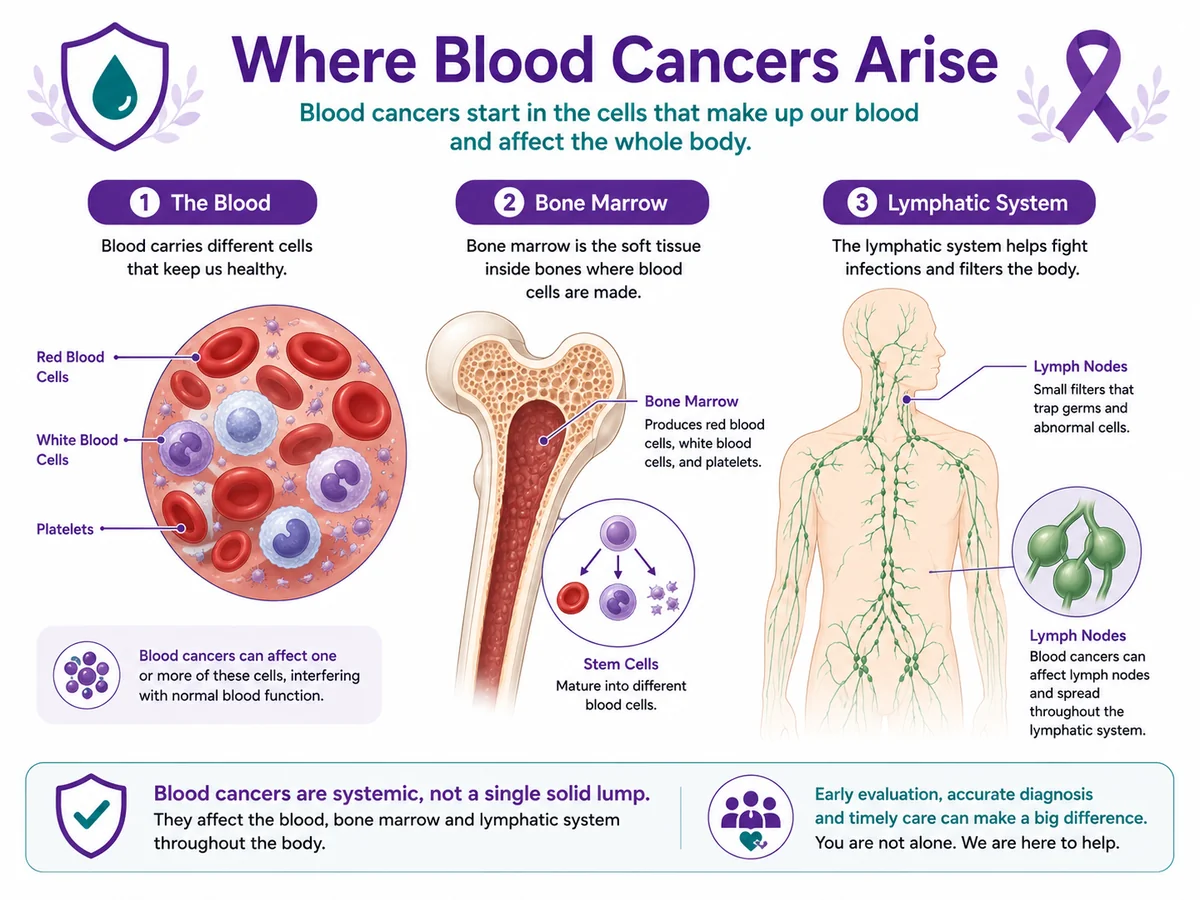
Blood cancer is an umbrella term for cancers that affect the blood, bone marrow and lymphatic system. Unlike solid tumours, there’s usually no single lump — the cancer is systemic, so it’s treated with medicines (and sometimes a transplant), not surgery. The three main types are leukaemia, lymphoma and myeloma.
It can affect any age, including children. And there’s real reason for hope: many blood cancers are among the most treatable — and some of the most curable — cancers.
Blood cancer affects the blood, bone marrow and lymphatic system.
The common worry
Vague symptoms that won’t go away? Get them checked
Blood cancer symptoms are often vague and easily mistaken for everyday illness — tiredness, frequent infections, bruising, swollen glands. Most of the time these have ordinary causes, like a viral illness or low iron. But symptoms that are persistent or unexplained — especially if a blood test is abnormal — deserve a check.
Should I get this checked?
Tick anything that’s persistent or unexplained. This is an awareness guide, not a diagnosis — most of these symptoms have ordinary causes.
Your result
Tick what applies
Most of these symptoms have ordinary causes. Your guidance appears here.
This tool doesn’t diagnose anything or replace medical advice. Persistent or unexplained symptoms should be checked by a doctor — often starting with a simple blood test.
Symptoms
Signs & symptoms
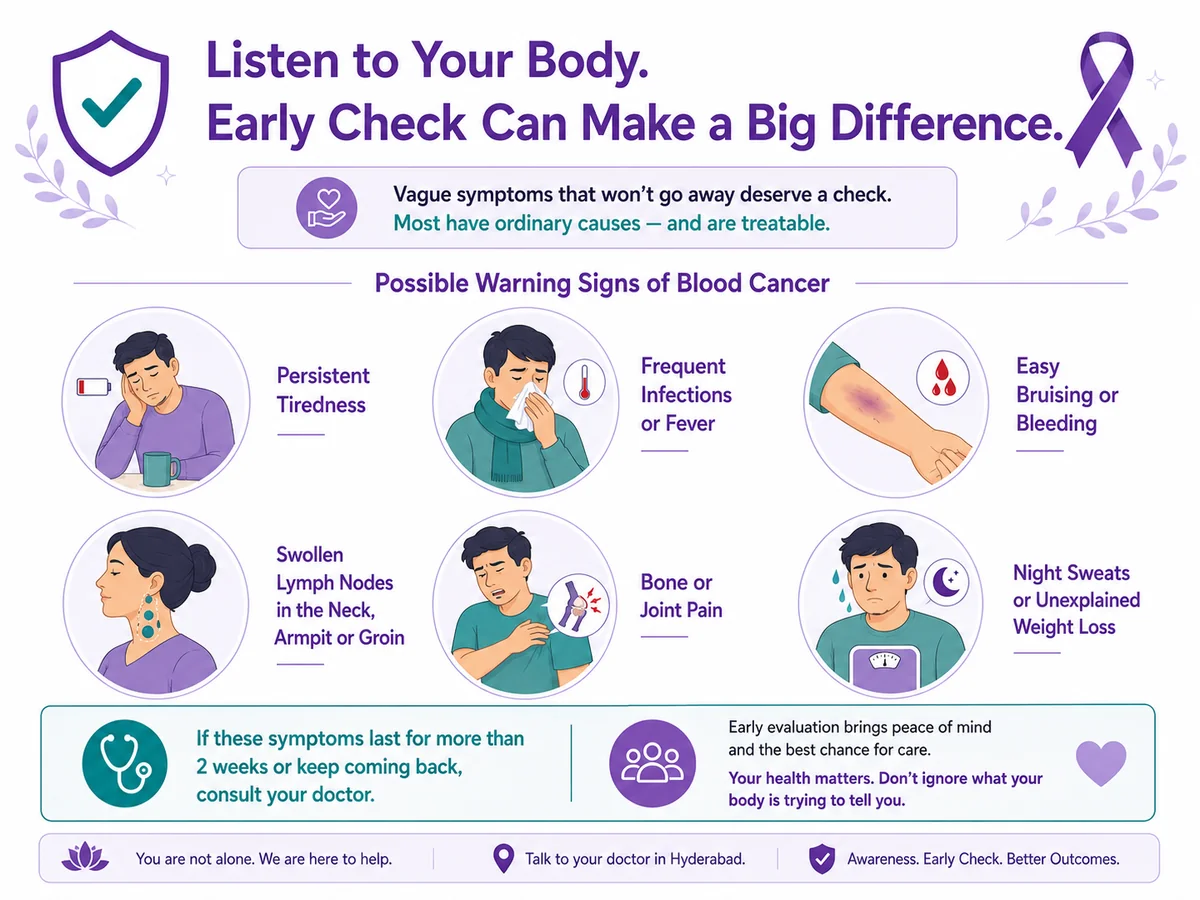
Because blood cancers affect blood cells, symptoms often reflect a shortage of healthy cells: tiredness (low red cells), infections (low or abnormal white cells), and bruising or bleeding (low platelets) — plus swollen lymph nodes, bone pain, fever, night sweats and weight loss. Symptoms vary by type, and many overlap with common conditions — so persistent ones deserve a check.
Persistent tiredness or weakness
Frequent infections or fever
Easy bruising or bleeding
Swollen lymph nodes (painless)
Bone or joint pain
Night sweats or weight loss
Symptoms that persist beyond a couple of weeks, or an abnormal blood test, are the pattern that matters. If that’s you, book a consultation.
The three main types
The three main types of blood cancer
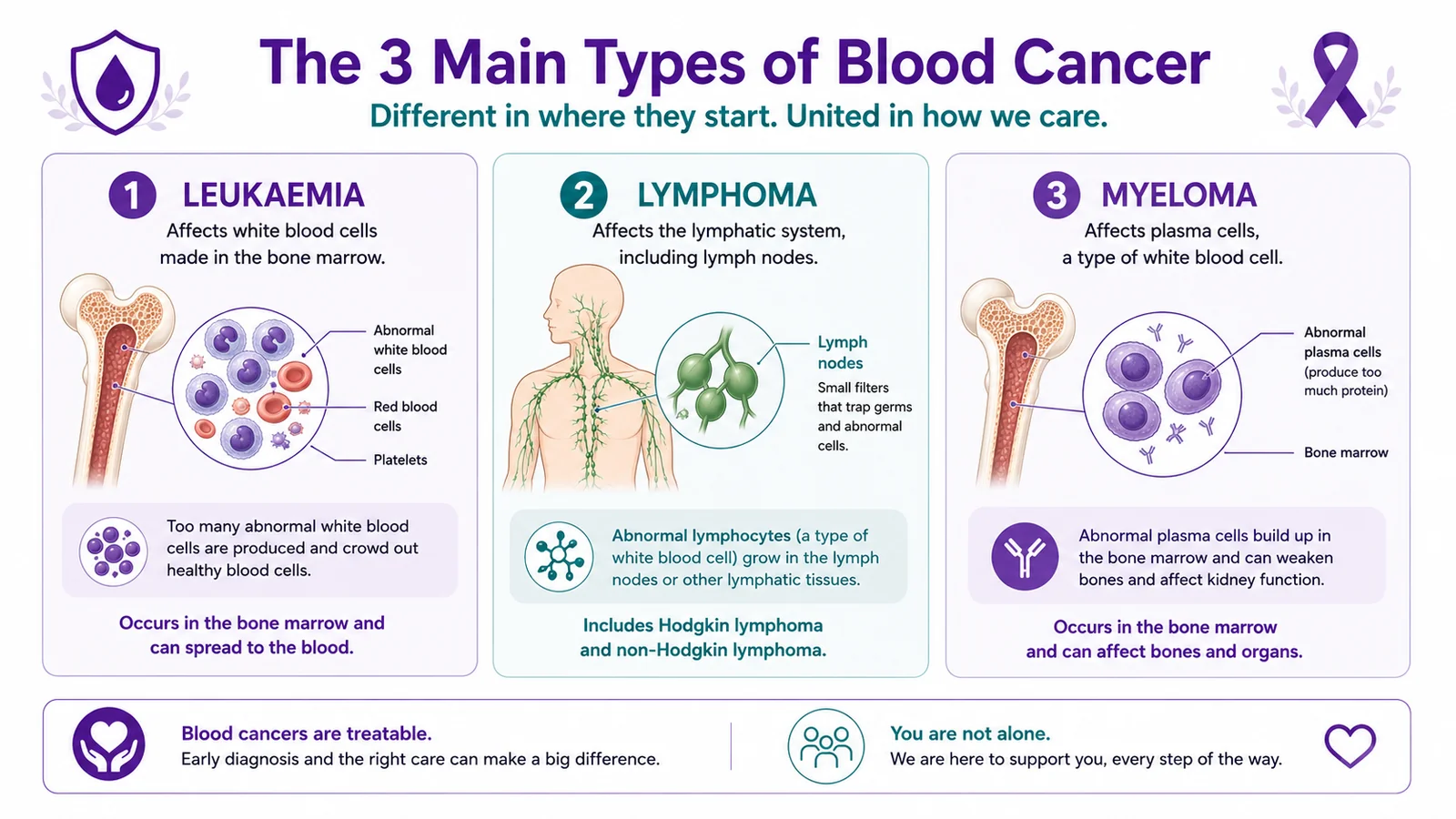
“Blood cancer” covers three main diseases: leukaemia (white blood cells, from the bone marrow), lymphoma (the lymphatic system and lymph nodes), and myeloma (plasma cells in the bone marrow). Knowing exactly which one — and its subtype — is what decides treatment.
Understand the types
Simplified for understanding. Your exact type and subtype are confirmed by testing your blood and a biopsy, and guide your personalised plan.
Causes & risk
Causes, risk & who it affects
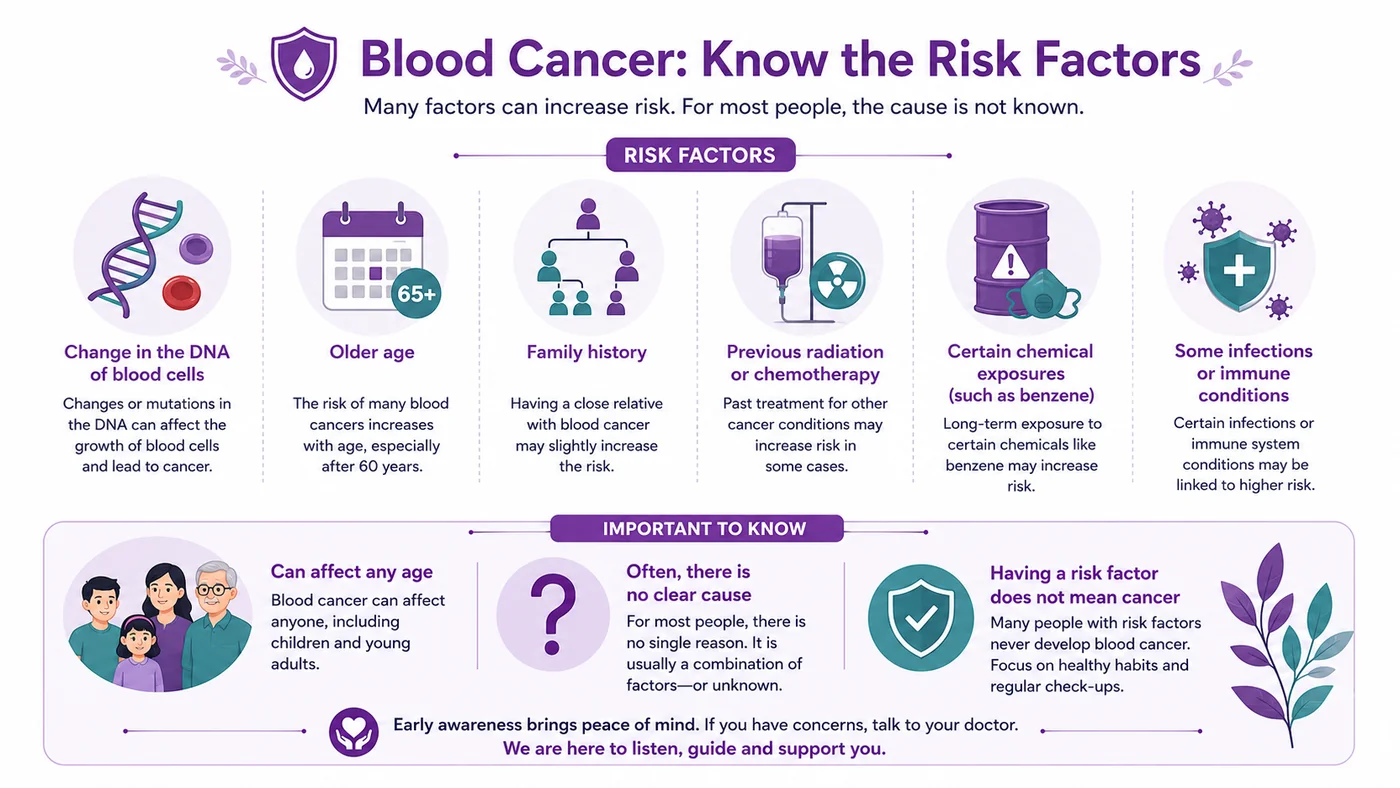
Blood cancers begin when a blood cell’s DNA changes — and for most people there’s no clear cause. Some things raise risk: older age, a family history, previous radiation or chemotherapy, certain chemical exposures (like benzene), and some infections or immune conditions. But blood cancer can affect any age — including children — and having a risk factor doesn’t mean you’ll get cancer.
Leukaemia is the commonest cancer in children — and childhood leukaemia has one of the highest cure rates of any cancer. See paediatric cancer care.
Diagnosis
How blood cancer is diagnosed
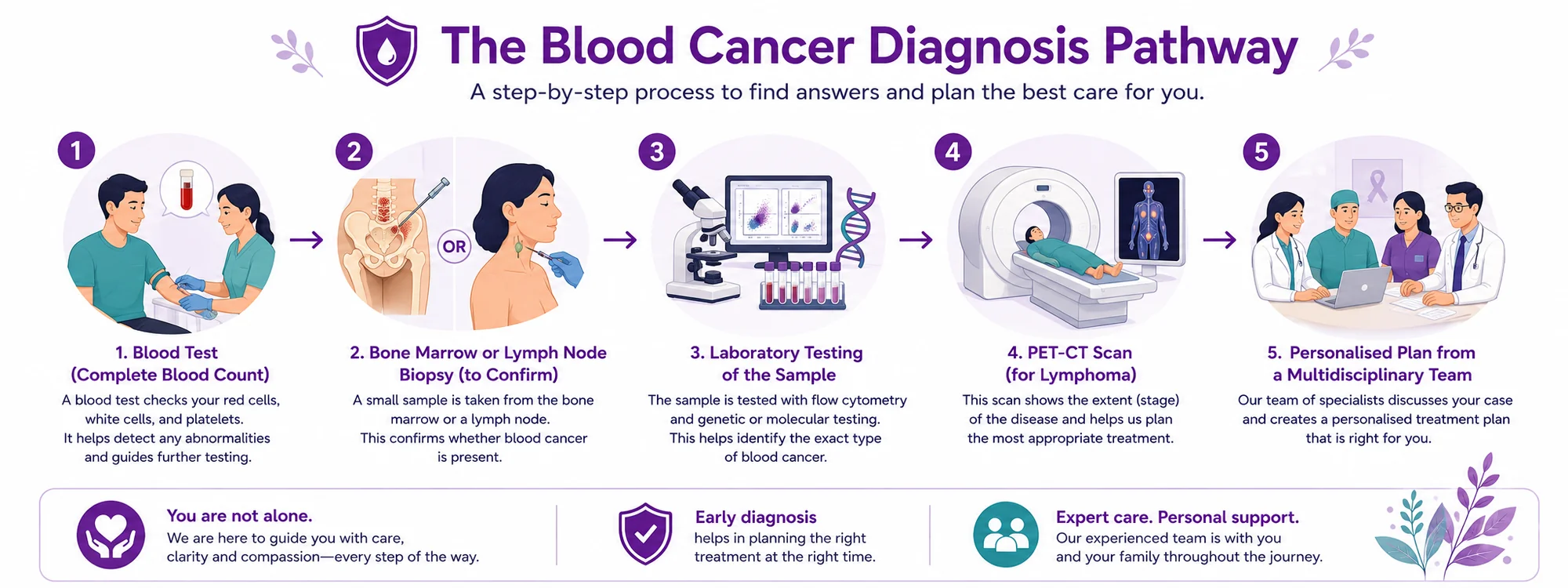
Diagnosis usually starts with a blood test (a complete blood count) that flags an abnormality, followed by a bone marrow or lymph node biopsy to confirm, and specialised lab tests — flow cytometry and genetic/molecular testing — that identify the exact type and subtype. For lymphoma, a PET-CT checks how widespread it is. This precise subtyping is what makes modern, personalised treatment possible.
From a simple blood test to a precise, personalised diagnosis.
Diagnostic tests we offer — book any of these directly:
Complete blood count (CBC)
A simple blood test that’s usually the first step — it flags anaemia, abnormal white cells or low platelets that prompt further checks.
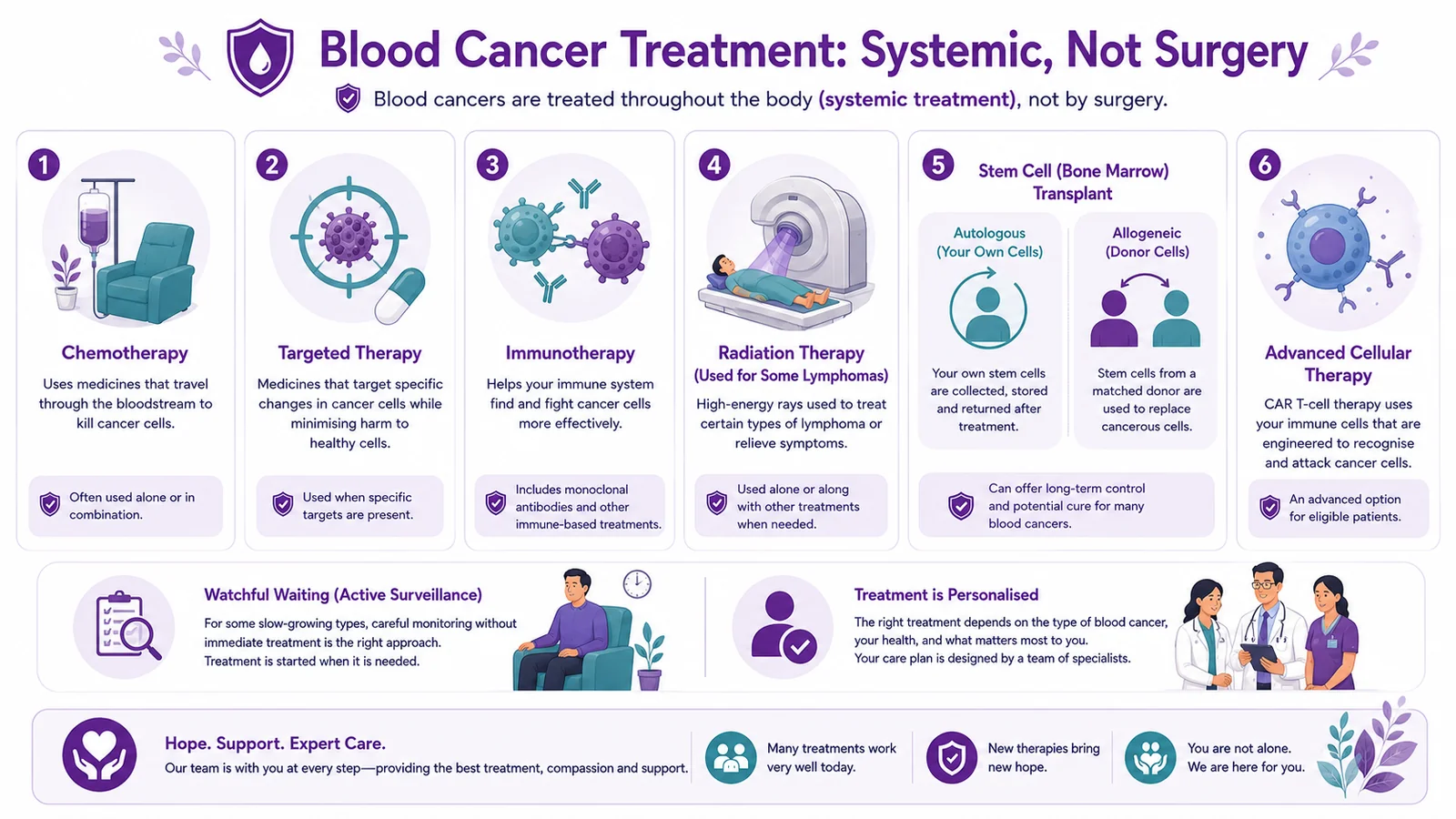
Blood cancer is treated systemically — with medicines that reach cancer cells throughout the body — not with surgery. Options include chemotherapy, targeted therapy (aimed at the cancer’s specific genetic change), immunotherapy, and radiation (for some lymphomas). For many blood cancers, a stem cell (bone marrow) transplant can be curative, and CAR T-cell therapy is an option for some. Some slow-growing types are carefully monitored rather than treated straight away. See our full guide to blood cancer treatment in Hyderabad.
How CION fits in: our medical and radiation oncologists provide the chemotherapy, targeted therapy, immunotherapy and radiation that treat most blood cancers, and coordinate stem cell (bone marrow) transplant and CAR T-cell therapy with specialist transplant centres — so your care is joined up across the team. For slow-growing types, careful monitoring (“watchful waiting”) is sometimes the wisest first step.
Treatments & care we offer — book a consult for any of these:
Chemotherapy
The backbone for many blood cancers — medicines that reach cancer cells throughout the body.
Indicative cost of blood cancer treatment in Hyderabad
Cost depends on the type, subtype and treatment — chemotherapy, targeted therapy, immunotherapy, radiation, or a stem cell transplant — so it’s best given as an indicative range after assessment. Eligible treatment may be covered under Aarogyasri / PMJAY at empanelled centres.
Estimate an indicative range
Indicative range
—
Figures are indicative only and not a quotation — a stem cell transplant is delivered via a specialist partner centre, so its cost may sit outside CION’s own billing. For an accurate estimate, request a callback.
Vague symptoms that won’t settle, a swollen gland, an abnormal blood test, or a diagnosis you want a second view on shouldn’t wait. Book a free consultation and, if you already have reports, a free written second opinion — including the exact subtype and the right treatment for it.
Reviewed by a medical oncologist, with our haemato-oncology board
Cost should not delay care. Under Aarogyasri and PMJAY, eligible blood cancer treatment may be largely covered at empanelled centres. Our team helps check eligibility and guides you on insurance and EMI.
9 clinics in Hyderabad · 35+ across Telangana & AP
CION cancer care is closer than you think.
We're never more than 30 minutes away. Same panel of specialists at every centre. Same tumour board reviews. Same NCCN protocols. Pick the closest one and call directly — or let us pick for you.
Don't see your city? Call
18002028726
— we'll find your nearest CION partner centre.
Meet the oncologists
Blood cancer is treated by a team, not one doctor.
Care is led by medical oncology (chemotherapy, targeted therapy and immunotherapy are central here), with radiation oncology in-house and stem cell transplant / CAR-T coordinated with specialist transplant centres — part of 17 senior specialists across CION.
Share your name and number — we'll call you back within 30 minutes to schedule your consultation.
Tired, bruising easily, or a gland that won’t go down? Get it checked.
Most vague symptoms turn out to have ordinary causes — and when blood cancer is found, modern treatment offers real hope, with many types highly curable. A simple blood count is often the first, most reassuring step.
The worries and myths we hear most about blood cancer, and the facts — shared with honesty and care.
“My tiredness must mean blood cancer.”
Fact: Tiredness, infections and bruising far more often come from ordinary causes — but persistent or unexplained symptoms, especially with an abnormal blood test, are worth checking.
“Blood cancer is untreatable — a death sentence.”
Fact: Many blood cancers are among the most curable cancers — and even those that aren’t can often be controlled for years with modern treatment.
“A swollen gland means cancer.”
Fact: Most swollen glands are infections. One that’s painless, persists, or keeps growing should be checked — but it’s usually not cancer.
“Any blood cancer needs a bone marrow transplant.”
Fact: Many are treated with medicines alone. A transplant is used only for certain types, and isn’t needed for everyone.
“There’s no surgery, so nothing can be done.”
Fact: Blood cancers are treated with powerful systemic medicines that reach the whole body — surgery simply isn’t the right tool for them.
“Children can’t get blood cancer.”
Fact: Leukaemia is actually the commonest cancer in children — and childhood leukaemia has one of the highest cure rates of any cancer.
“Blood cancer is contagious — I could catch it.”
Fact: Blood cancer is not infectious. You can’t catch it from, or pass it to, anyone by living with, caring for or being close to them.
“A biopsy will make the cancer spread.”
Fact: A bone marrow or lymph node biopsy is a safe, standard test done under controlled conditions. The real risk is delay, which lets a treatable cancer grow.
“A high white cell count always means leukaemia.”
Fact: A raised white count is far more often due to infection or inflammation. What matters is the pattern and the type of cells — which a specialist reads on the blood film and confirms with further tests.
“Chemotherapy is worse than the disease.”
Fact: Modern chemotherapy is far better tolerated than it once was, with strong supportive care to manage side effects — and for many blood cancers it is what makes cure possible.
“Myeloma can’t be treated because it isn’t curable.”
Fact: Myeloma is very treatable — modern therapy, often with a stem cell transplant, controls it for years and protects quality of life, even though it isn’t usually cured.
“A stem cell transplant is too risky to consider.”
Fact: A transplant is a well-established, potentially curative treatment for certain blood cancers, done at specialist centres with careful support. Whether it’s right for you is a decision made together.
“Blood cancer always comes back.”
Fact: Many people are cured and never relapse — especially with Hodgkin lymphoma and childhood leukaemia. If it does return, further treatment, including newer therapies, can still help.
“There’s no point getting a second opinion.”
Fact: The exact subtype changes the treatment completely — a specialist review at a centre that treats blood cancer can confirm the diagnosis and open up the right options.
“Blood cancer treatment is unaffordable.”
Fact: Under Aarogyasri and PMJAY, eligible treatment may be largely covered at empanelled centres. We help check eligibility, insurance and EMI so cost doesn’t delay care.
“If it runs in my family, I’ll definitely get it.”
Fact: Most blood cancer isn’t inherited, and a family history only slightly raises risk for a few types. Having a relative with blood cancer doesn’t mean you’ll get it.
“Herbal or home remedies can cure blood cancer.”
Fact: Relying on unproven remedies wastes the window when blood cancer is most treatable. Discuss anything complementary with your oncology team, alongside proven treatment — not instead of it.
“Treatment means months admitted in hospital.”
Fact: Much blood cancer treatment is given as day-care or short stays. Some slow-growing types are simply monitored (“watchful waiting”) with no immediate treatment at all.
Why CION
Why choose CION for blood cancer care
Medical oncology at the core
Chemotherapy, targeted therapy and immunotherapy — the heart of modern blood-cancer treatment.
Precise molecular subtyping
Flow cytometry and genetic testing pinpoint the exact type — so treatment is personalised.
Transplant & CAR-T, coordinated
Stem cell transplant and CAR T-cell therapy delivered with specialist transplant centres.
Haemato-oncology board
Multidisciplinary planning with PET-CT, for leukaemia, lymphoma and myeloma alike.
Hopeful, honest care
Clear answers, watchful waiting where wise, and strong support through treatment.
Close, NABH-accredited care
9 clinics across Hyderabad and 35+ across Telangana, within NABH-accredited facilities.
Real stories · real courage
15,000+ patients chose CION. Hear from them directly.
These aren't paid endorsements or written reviews. These are video testimonials from real patients and families — recorded on their own phones, in their own words. Pick any one. Watch it. Then decide.
4.8★800+ Google reviews
50+video testimonials
15,000+patients treated
Successful Chemotherapy & Radiation Done by Dr. Owais Mohammed & Dr. Kirti Ranjan
Watch video →
Successful Chemotherapy Done by Dr. C Raghavendra Reddy
Watch video →
Surgery, Chemo & Radiation Done by Dr. Imaduddin, Dr. Vinay, Dr. Owais, Dr. Kirti
Watch video →
Successful Radical Thymectomy Done by Dr. Mohammed Imaduddin & Dr. Vinay Mamidala
Watch video →
Successful Surgery Done by Dr. Rajender Byshetty
Watch video →
Successful Chemo & Surgery Done by Dr. Imad, Dr. Vinay, Dr. Owais & Dr. Raghavendra
Watch video →
Successful Chemo & Surgery Done by Dr. Imad, Dr. Vinay, Dr. Owais & Dr. Raghavendra
Watch video →
Successful Chemo & Radiation Done by Dr. Owais Mohammed & Dr. Kirti Ranjan Mohanty
Watch video →
Successful Breast Cancer Surgery Done by Dr. Imaduddin Mohammed & Dr. Vinay Mamidala
Watch video →
Successful Chemotherapy Done by Dr. Bharati Devi Gorantla
Watch video →
Successful Chemo & Surgery Done by Dr. Owais Mohammed & Dr. Imaduddin Mohammed
Watch video →
Successful Chemotherapy Done by Dr. Gundu Naresh
Watch video →
Successful Bone Marrow Transplantation - Neuroblastoma
Watch video →
Successful Surgery & Chemo - Carcinoma of Caecum
Watch video →
Successful Oral chemotherapy & mastectomy surgery
Watch video →
Successful Oral chemotherapy & mastectomy surgery
Watch video →
Successful Chemotherapy
Watch video →
Successful Surgery by Dr. Mohammed Imaduddin
Watch video →
Successful Bone Marrow Transplantation
Watch video →
Successful Oral chemotherapy & mastectomy surgery
Watch video →
Successful Oral chemotherapy & mastectomy surgery
Watch video →
Successful Chemotherapy
Watch video →
Successful Buccal Mucosa Surgery
Watch video →
Successful Complex Surgery Mandibulectomy Reconstruction
Care goes beyond treatment — protecting you through it, and supporting wellbeing and recovery.
Infection & blood-count support
Careful monitoring and support to manage low blood counts and infection risk during treatment. Learn more
Psycho-oncology
Emotional support for you and your family through diagnosis and treatment. Learn more
Nutrition support
Diet support to keep strength up through treatment and recovery. Learn more
Fertility preservation
For younger patients, we discuss fertility-preserving options before treatment starts. Talk to us
Pain & palliative care
Comfort and symptom control at any stage, alongside active treatment. Learn more
Second opinion & follow-up
A clear, unhurried review of your diagnosis and options, and structured follow-up. Get a second opinion
FAQ
Frequently asked questions about blood cancer
What is blood cancer?
Blood cancer is an umbrella term for cancers that affect the blood, bone marrow and lymphatic system. The three main types are leukaemia (white blood cells), lymphoma (the lymphatic system) and myeloma (plasma cells). Unlike solid tumours, there is usually no lump to remove — blood cancer is treated with medicines, and sometimes a transplant, rather than surgery.
What are the three main types of blood cancer?
The three main types are leukaemia, lymphoma and myeloma. Leukaemia starts in the blood-forming cells of the bone marrow. Lymphoma starts in the lymphocytes of the lymph nodes and lymphatic system, and is divided into Hodgkin and non-Hodgkin lymphoma. Myeloma starts in plasma cells in the bone marrow. There is also a smaller group of related bone-marrow disorders (such as myelodysplastic syndromes and myeloproliferative neoplasms). Each main type has several subtypes that behave and are treated differently.
What is the difference between leukaemia, lymphoma and myeloma?
All three are cancers of white blood cells, but they begin in different places. Leukaemia starts in the bone marrow and spills cancerous cells into the bloodstream, so symptoms are mostly blood-related (tiredness, infections, bruising). Lymphoma starts in lymphocytes within the lymph nodes and lymphatic tissue, and usually shows up as a swollen lymph node. Myeloma starts in plasma cells in the bone marrow and often causes bone pain, fractures, kidney problems and low blood counts. Despite the differences, all three are diagnosed with blood tests, bone marrow or lymph node examination and imaging, and many of the same haemato-oncology specialists treat all three.
What are the first signs and symptoms of blood cancer?
The most common early signs are persistent tiredness or weakness (from anaemia), frequent or hard-to-shake infections and unexplained fever (from abnormal white cells), and easy bruising or bleeding (from low platelets). Others include a painless swollen lymph node, bone or joint pain, drenching night sweats, and unexplained weight loss. The unifying theme is that symptoms persist or worsen over weeks rather than settling on their own — and many overlap with everyday illness, so persistent or unexplained ones deserve a check, often starting with a simple blood test.
Are my symptoms blood cancer?
Probably not — the common symptoms of blood cancer (tiredness, infections, bruising, swollen glands) far more often come from ordinary causes like a viral illness or low iron. But symptoms that are persistent or unexplained, especially with an abnormal blood test, should be checked. A simple blood count is often the first step and can reassure you or point to what is going on.
Is a swollen lymph node a sign of blood cancer?
Usually not — most swollen lymph nodes are caused by infections and settle within a few weeks. A node is more worth checking if it is painless, firm, keeps growing, lasts more than a few weeks, or comes with night sweats, fever or weight loss. If in doubt, get it looked at — a persistent node can be assessed with a simple examination and, if needed, a biopsy.
Is blood cancer curable?
Often, yes — many blood cancers are among the most treatable and curable cancers. Hodgkin lymphoma and childhood leukaemia have very high cure rates, and targeted therapy has transformed some others, such as chronic myeloid leukaemia (now controlled with a daily tablet). Even blood cancers that are not usually considered curable, like myeloma or chronic leukaemias, can often be controlled for many years. Your outlook depends on the exact type and subtype.
What is the difference between acute and chronic blood cancer?
Acute blood cancers grow quickly and need prompt treatment; chronic ones grow slowly and may be carefully monitored (“watchful waiting”) before any treatment is needed. Which one you have shapes how urgently, and how, it is treated — but both are managed by a specialist team, and slow-growing types can often be controlled for many years.
How is blood cancer diagnosed?
Diagnosis usually starts with a complete blood count that flags an abnormality, followed by a bone marrow or lymph node biopsy to confirm, and specialised lab tests — flow cytometry and genetic or molecular testing — that identify the exact type and subtype. For lymphoma, a PET-CT scan checks how widespread it is. This precise subtyping is what makes modern, personalised treatment possible.
Can a blood test detect blood cancer?
A simple complete blood count often gives the first clue — it can show anaemia, abnormal or very high or low white cells, or low platelets. But a blood count alone cannot confirm the diagnosis or the exact type. A specialist confirms it with a blood film, a bone marrow or lymph node biopsy, and flow cytometry and genetic testing. So a blood test is a very useful starting point, not the final answer.
Does blood cancer treatment always mean a bone marrow transplant?
No. Many blood cancers are treated with medicines alone — chemotherapy, targeted therapy or immunotherapy. A stem cell (bone marrow) transplant, using your own cells or a donor’s, is used for certain blood cancers and can be curative, but it is not needed for everyone. At CION, we provide the medicine-based treatment and coordinate transplant with specialist transplant centres when it is the right option.
How is blood cancer treated?
Blood cancer is treated systemically — with medicines that reach cancer cells throughout the body — not with surgery. Treatment can include chemotherapy, targeted therapy aimed at the cancer’s specific genetic change, immunotherapy, and radiation for some lymphomas. For many blood cancers a stem cell transplant can be curative, and CAR T-cell therapy is an option for some — both coordinated with specialist centres. Some slow-growing types are carefully monitored rather than treated straight away.
What is CAR T-cell therapy?
CAR T-cell therapy is a modern form of cellular immunotherapy in which some of your own immune (T) cells are collected, re-engineered in a lab to recognise and attack the cancer, and returned to you. It has produced remarkable results in certain lymphomas and leukaemias, particularly when other treatments have not worked. It is delivered at specialist centres; CION coordinates access to CAR-T with those partner centres as part of your overall care.
Can children get blood cancer?
Yes — leukaemia is in fact the commonest cancer in children. The good news is that childhood leukaemia, particularly acute lymphoblastic leukaemia (ALL), has one of the highest cure rates of any cancer, with most children cured. Children’s blood cancers are treated by paediatric and haemato-oncology teams; see our page on paediatric cancer care for more.
What causes blood cancer, and who is at higher risk?
Blood cancers begin when a blood cell’s DNA changes, and for most people there is no clear cause. Some things raise the risk: older age, a family history, previous radiation or chemotherapy for another cancer, certain chemical exposures such as benzene, and some infections or a weakened immune system. But blood cancer can affect any age, including children, and having a risk factor does not mean you will get cancer.
Is blood cancer hereditary?
Most blood cancer is not inherited. A family history slightly raises the risk for a few types, and some rare inherited syndromes increase risk, but the great majority of blood cancers happen in people with no family history at all. Having a relative with a blood cancer does not mean you will develop one — if you are concerned, a specialist can advise whether any assessment is worthwhile.
What is watch and wait (watchful waiting)?
For some slow-growing blood cancers — such as certain chronic leukaemias and low-grade lymphomas — the wisest first step can be careful monitoring rather than immediate treatment. This is called watch and wait, or watchful waiting. You are reviewed regularly, and treatment begins only if and when it is needed. It is a recognised, evidence-based approach that avoids unnecessary treatment while keeping you closely observed.
How much does blood cancer treatment cost in Hyderabad?
Cost depends on the type, subtype and treatment — chemotherapy, targeted therapy, immunotherapy, radiation, or a stem cell transplant — so it is best given as an indicative range after assessment. A stem cell transplant is delivered via a specialist partner centre and may be billed there. Eligible treatment may be covered under Aarogyasri or PMJAY at empanelled centres. Use the cost estimator on this page for an indicative figure, then request a callback for an accurate estimate.
Does Aarogyasri or PMJAY cover blood cancer treatment?
Eligible blood cancer treatment may be largely covered under Aarogyasri and PMJAY at empanelled centres, including many diagnostic tests, chemotherapy and supportive care. Because blood cancer treatment is often long, sustained financial support matters — our team helps check your eligibility and guides you on private insurance and EMI so cost does not delay care. Where a treatment such as a transplant is delivered at a partner centre, we explain clearly what is covered and where.
Explore
Explore blood cancer care
Our complete guide to blood cancer — the three types, symptoms, diagnosis, treatment, costs and living with it — plus the leukaemia and lymphoma sub-hubs. Tap any topic to read more.
Worried about blood cancer? Let’s get you clear, hopeful answers.
Most vague symptoms turn out to have ordinary causes — and when blood cancer is found, modern treatment offers real hope, with many types highly curable. Book a consultation or second opinion at any of our 9 Hyderabad clinics, part of 35+ centres across Telangana & Andhra Pradesh.
Medical disclaimer: This page is for general information and awareness and does not replace professional medical advice, diagnosis or treatment. Heavy or unexplained bleeding, or a high fever with a known low white-cell count, needs urgent medical attention. Always consult a qualified oncologist. Costs shown are indicative only and not a quotation. Content is periodically reviewed by CION’s medical team.

 CION Ameerpet