Nasal Cancer: Signs, Types, Causes & Treatment in Hyderabad
Nasal (nasal cavity & paranasal sinus) cancer is rare — and its early signs are easily mistaken for sinusitis. The clue is symptoms that are persistent and one-sided: a blocked nostril, repeated nosebleeds or facial changes that don't clear. Learn the signs, the occupational risks, how it's diagnosed and treated, and what it may cost.
Written & medically reviewed by Dr. Vajja Sandeep Kumar, Surgical Oncologist — Head & Neck (MBBS, MS & DrNB, Surgical Oncology), CION Cancer Clinics. · Reviewed 6 July 2026
Overview
What is nasal cancer?
Nasal cancer begins in the lining of the nasal cavity or the paranasal sinuses — the air spaces in the bones around the nose. It's uncommon, and because these spaces sit close to the eyes and the base of the skull, symptoms and treatment can involve the face and eyes.
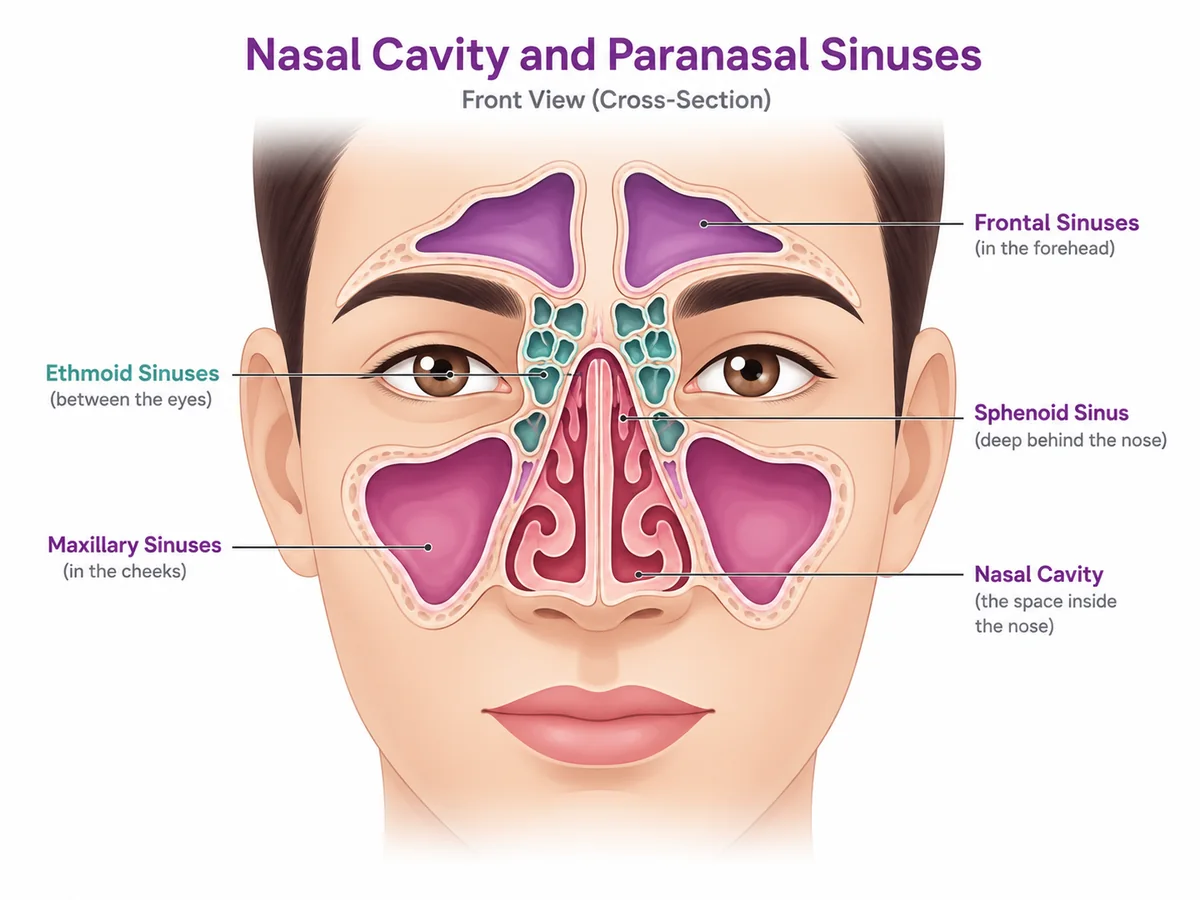
The sinuses are hollow spaces in the cheeks (maxillary), between the eyes (ethmoid), in the forehead (frontal) and deep behind the nose (sphenoid). Cancer here is often found late because early signs feel like an ordinary sinus problem — which is exactly why acting on persistent one-sided symptoms matters.
The nasal cavity and the four paranasal sinuses.
The key question
Nasal cancer, or just sinusitis?
Most nose and sinus symptoms are ordinary sinusitis — but persistent, one-sided symptoms that don't clear are the pattern to check. Ordinary sinusitis usually affects both sides and settles; a blocked nostril, nosebleeds or facial changes on one side that linger deserve a specialist look.
Sinusitis or something more? A quick check
Tick anything that applies. This is an awareness guide, not a diagnosis — most symptoms turn out to be ordinary sinusitis.
Your result
Tick what applies
Most nose and sinus symptoms are ordinary sinusitis. Your result appears here.
This tool doesn't diagnose nasal cancer or replace a medical opinion. Persistent, one-sided nasal symptoms should be checked — a nasal endoscopy gives clarity. Please consult a CION specialist.
Early detection
Signs & symptoms — and when to see a doctor
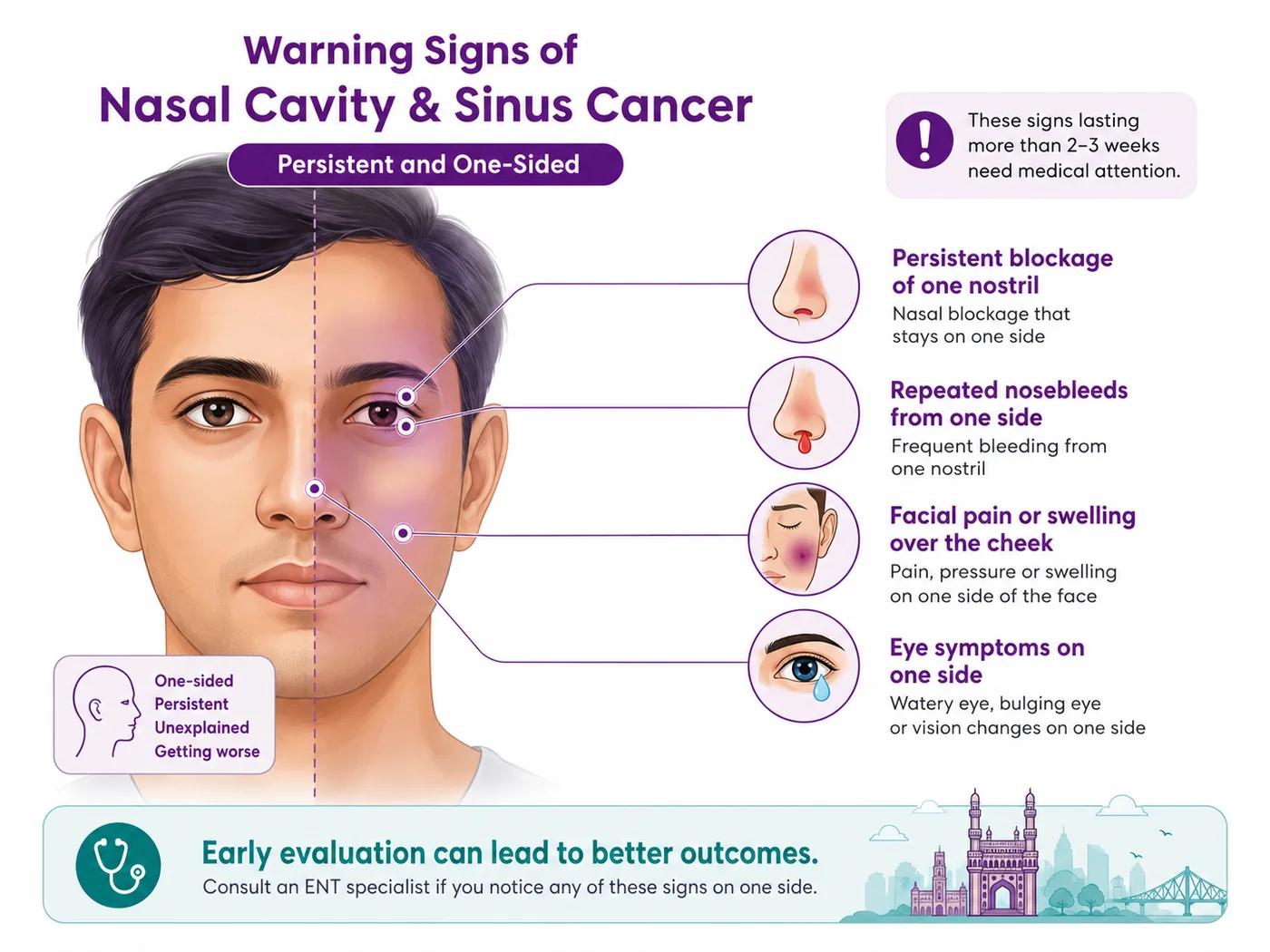
The warning pattern is persistent, one-sided nasal symptoms. A blockage of one nostril, repeated nosebleeds from one side, facial pain or swelling, reduced smell, or eye changes lasting beyond 2–3 weeks should be checked — early evaluation improves outcomes.
Persistent blockage of one nostril
Repeated nosebleeds from one side
Facial pain, pressure or swelling on one side
A reduced or lost sense of smell
Eye symptoms — watering, bulging or double vision
A lump on the face or in the neck, or loose upper teeth
Not every symptom means cancer — but a one-sided pattern that lasts is worth a specialist check. If in doubt, our team can review your symptoms and arrange a nasal endoscopy or scan.
Types & outlook
The types of nasal cancer
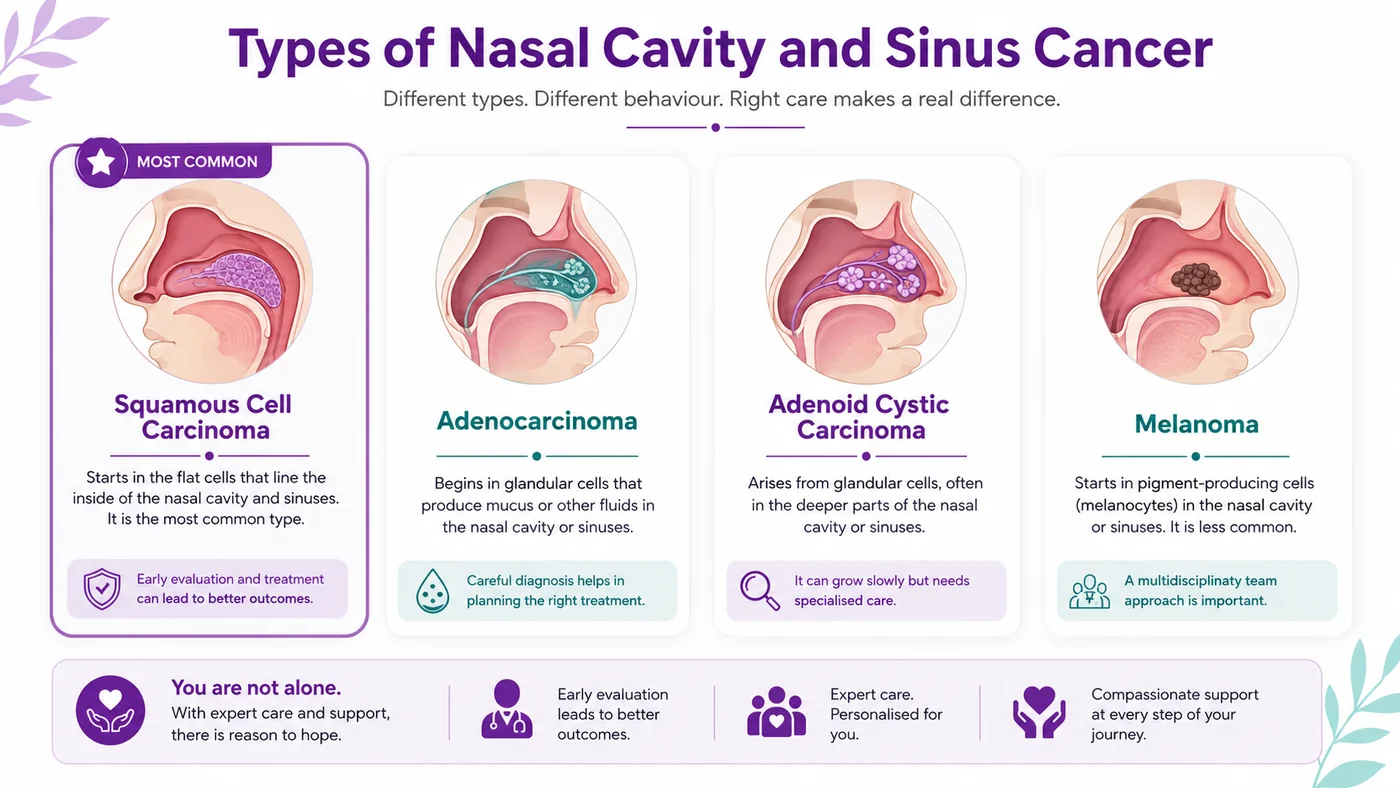
Nasal and sinus cancers come in several types, and the type shapes treatment. Squamous cell carcinoma is the most common; others include adenocarcinoma, adenoid cystic carcinoma and mucosal melanoma. Some grow slowly, some need urgent specialised care — your type guides the plan.
Understand each type
Simplified for understanding. Your exact type, stage and plan are confirmed by your oncology team after tests.
Causes
What causes nasal cancer?
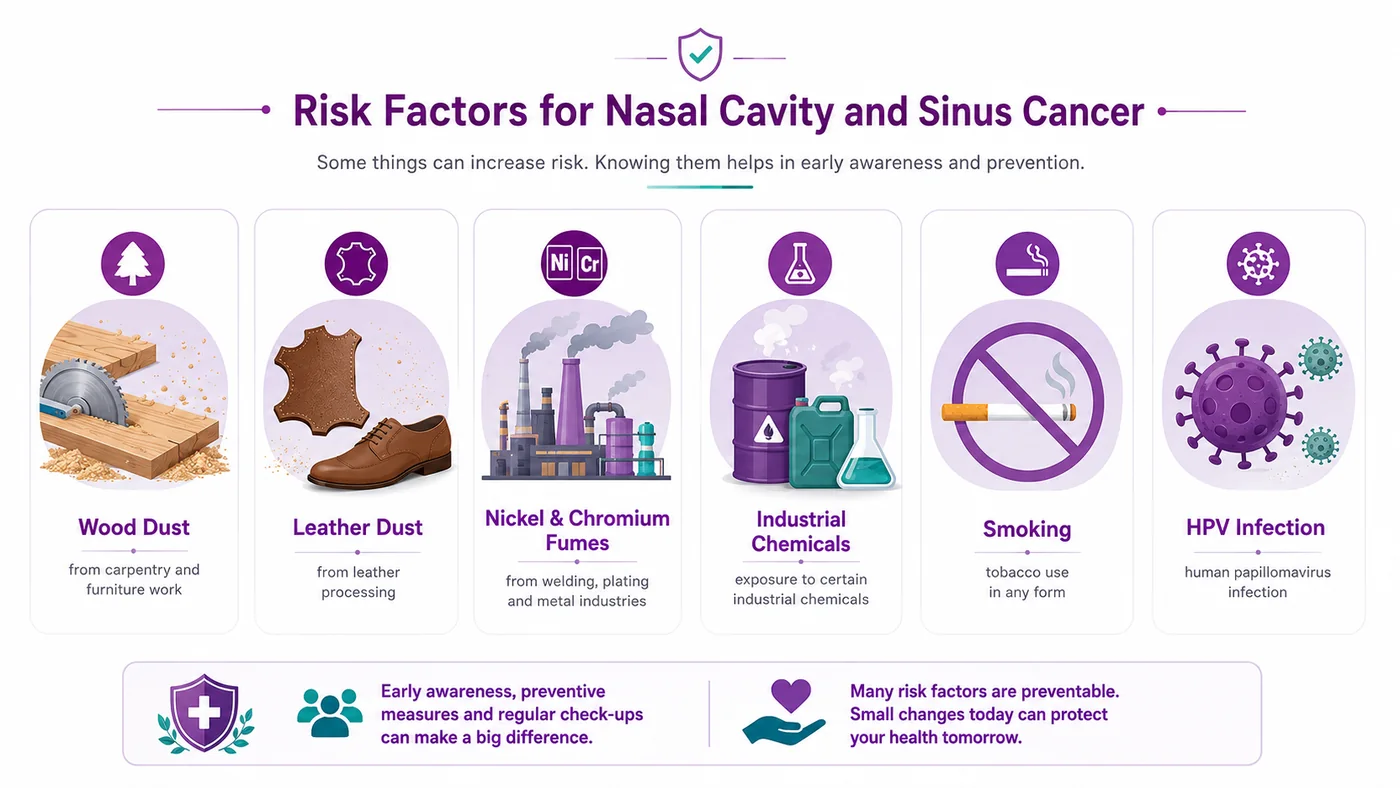
Nasal cancer is strongly linked to long-term workplace dust and fumes. The main risks are wood dust (carpentry, furniture), leather dust, nickel/chromium and certain industrial chemicals, plus smoking and HPV. If you've worked with these and have persistent one-sided nasal symptoms, get checked.
This isn't about blame — many exposures were part of a job done for years. Awareness matters most: workers in wood, furniture, leather and metal trades benefit from acting early on one-sided nasal symptoms rather than waiting.
Staging
The stages of nasal cancer
Staging describes how far the cancer has spread — from confined to the nasal cavity or one sinus, out to nearby bone, the eye socket or skull base, the lymph nodes, and finally distant organs. Because the area is anatomically complex, staging guides whether surgery, radiation or a combination fits best.
Early / confined
Limited to the nasal cavity or a single sinus, without spread. Often treated with surgery — increasingly minimally invasive — sometimes followed by radiation, with better outcomes.
Locally advanced / spread
Involving nearby bone, the eye socket or skull base, lymph nodes, or distant organs. Managed by the full team with a combination of surgery, radiation and chemotherapy or targeted therapy.
Diagnosis & tests
How nasal cancer is diagnosed
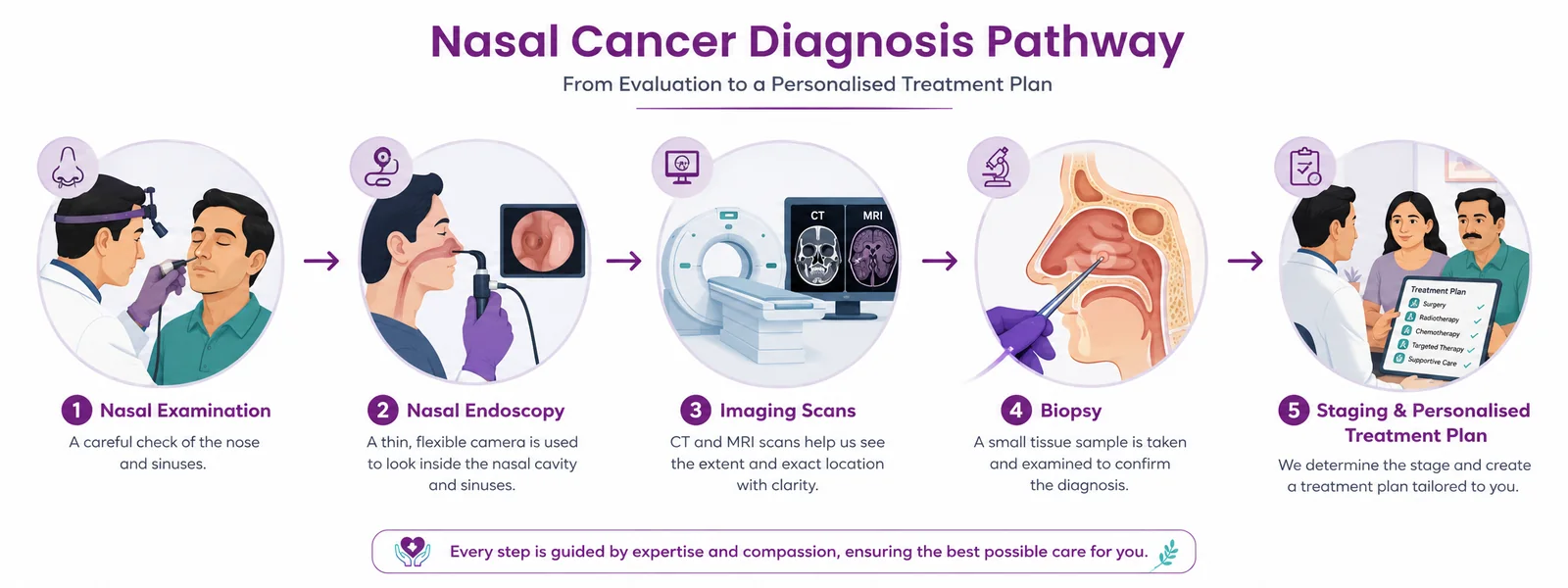
Diagnosis centres on a nasal endoscopy — a thin camera passed into the nose — with imaging (CT and MRI) and a biopsy. The endoscopy lets the specialist see inside the nasal cavity and sinuses directly; the biopsy confirms the diagnosis and type. A biopsy is safe and does not spread cancer.
From nasal endoscopy to a personalised plan.
Diagnostic services we offer — book any of these directly:
Nasal endoscopy
A thin camera passed gently into the nose to see the nasal cavity and sinuses directly.
After examination and endoscopy, CT/MRI and a biopsy confirm the diagnosis; a PET-CT may be used for staging. More on how cancer is diagnosed.
Treatment
Nasal cancer treatment options
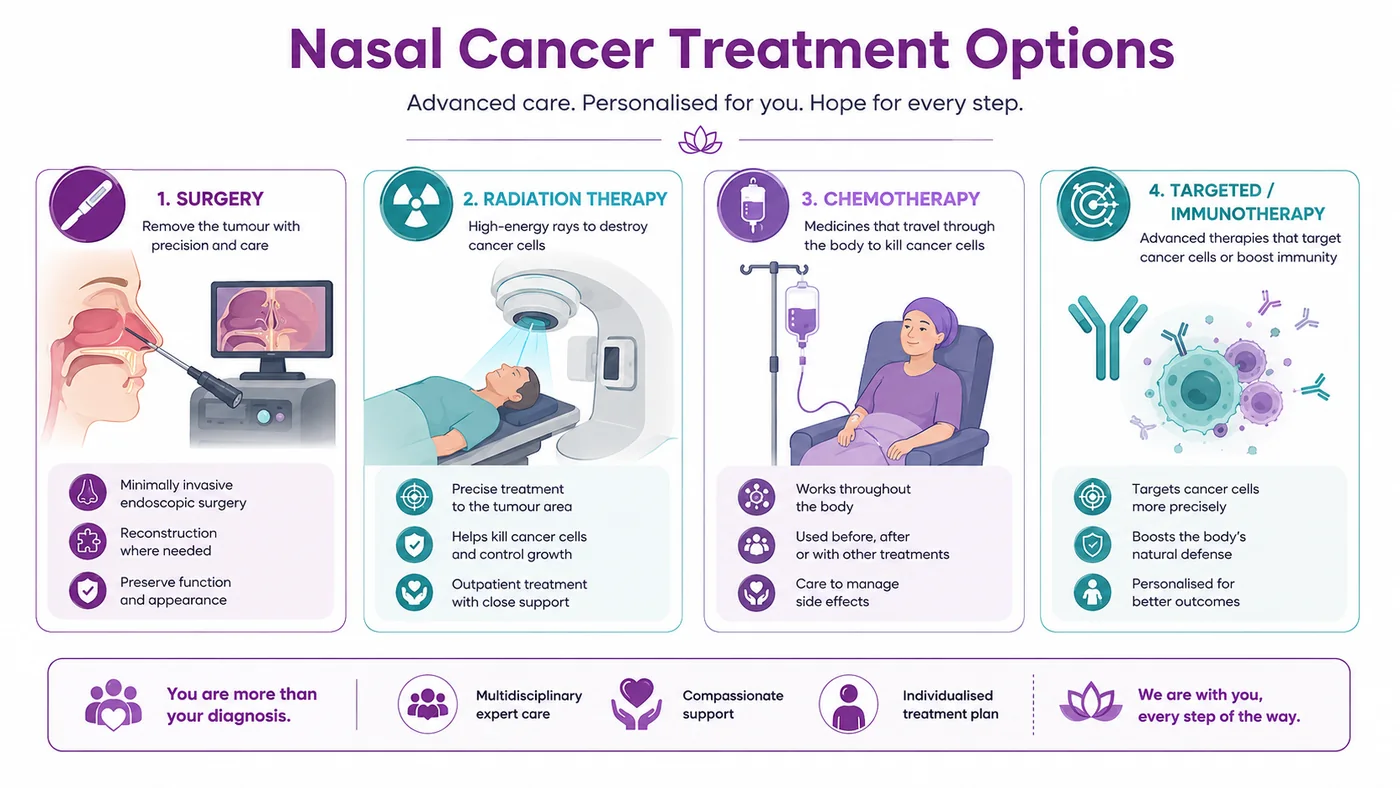
Surgery is usually the main treatment — increasingly done endoscopically through the nostril — often with radiation afterwards. Chemotherapy or targeted therapy is added for advanced cases. The plan is set by a multidisciplinary head & neck team for your type and stage. See our full guide to nasal cancer treatment in Hyderabad.
Treatments we deliver — book a consult for any of these:
Endoscopic surgery & reconstruction
Removing the tumour — often endoscopically through the nostril — with reconstruction where needed to protect appearance and function.
Indicative cost of nasal cancer treatment in Hyderabad
Cost depends on the type, the surgery, and whether radiation is needed — best given as an indicative range after assessment. Eligible treatment, including radiation, may be covered under Aarogyasri / PMJAY at empanelled centres. See indicative radiation cost details.
Estimate an indicative range
Indicative range
—
Figures are indicative only and not a quotation. For an accurate estimate, request a callback.
A one-sided blocked nose, a repeated nosebleed or a CT/biopsy report shouldn't wait. Book a free consultation and, if you already have a biopsy, a free written second opinion.
Reviewed by a head & neck oncology team
Endoscopy, imaging & biopsy arranged in one place
Aarogyasri / PMJAY & insurance guidance
Support
Financial support & Aarogyasri
Cost should not delay treatment. Under Aarogyasri and PMJAY, eligible nasal cancer treatment — including radiation therapy — may be largely covered at empanelled centres. Our team helps check eligibility and guides you on insurance and EMI.
9 clinics in Hyderabad · 35+ across Telangana & AP
CION cancer care is closer than you think.
We're never more than 30 minutes away. Same panel of specialists at every centre. Same tumour board reviews. Same NCCN protocols. Pick the closest one and call directly — or let us pick for you.
Don't see your city? Call
18002028726
— we'll find your nearest CION partner centre.
Meet the oncologists
Nasal cancer is treated by a team, not one doctor.
Surgical, medical and radiation oncologists — with ENT / skull-base collaboration — plan every case together in a multidisciplinary tumour board, part of 17 senior specialists across CION.
Share your name and number — we'll call you back within 30 minutes to schedule your consultation.
One-sided nasal symptoms that haven't cleared in 3 weeks?
Most turn out to be ordinary sinusitis — and if it's more, finding it early changes everything. Our head & neck oncologists can review your symptoms and arrange the right test.
The worries we hear most about nasal cancer, and the facts.
“It’s just sinusitis, it’ll pass.”
Fact: Ordinary sinusitis is usually both-sided and settles. Persistent, one-sided symptoms that don’t clear are the commonest reason nasal cancer is found late — get that pattern checked.
“Surgery will disfigure my face.”
Fact: Much nasal cancer surgery is now endoscopic — through the nostril, with no facial incision — and reconstruction protects appearance and function where open surgery is needed.
“I’ll lose my sense of smell and won’t breathe properly.”
Fact: Many people keep smell and normal breathing; the team plans to preserve function wherever possible, and rehabilitation helps recovery.
“Nosebleeds are never serious.”
Fact: Occasional nosebleeds are common and harmless — but repeated bleeding from the same nostril, especially with blockage, should be checked.
“My job couldn’t have caused this.”
Fact: Long-term wood/leather dust and some industrial chemicals are established risks. It isn’t your fault — awareness simply means checking one-sided symptoms sooner.
“Ayurveda or home remedies can cure it.”
Fact: There’s no evidence any remedy alone cures nasal cancer, and delaying proven treatment is risky. Discuss anything complementary with your oncology team, not as a replacement.
“A biopsy will make the cancer spread.”
Fact: A biopsy is a safe, standard step done under controlled conditions and does not spread cancer. It’s the only way to confirm the diagnosis and type. The real risk is delay.
“If there’s no pain, it can’t be cancer.”
Fact: Early nasal cancer is often painless and feels like a blocked nose. Waiting for pain is a common reason it’s found late — act on a one-sided pattern, not on pain.
“Radiation will make me radioactive and harm my family.”
Fact: Standard external-beam radiotherapy does not make you radioactive; you can safely be around family and children. Your radiation oncologist explains any exception clearly.
“Nasal cancer is always fatal — there’s no point treating it.”
Fact: Found early and confined, nasal and sinus cancers are often treatable, usually with surgery and radiation. Even advanced disease can frequently be controlled — treatment changes outcomes.
“Treatment is unaffordable — we can’t manage it.”
Fact: Under Aarogyasri and PMJAY, eligible treatment (including radiation) may be largely covered at empanelled centres. We help check eligibility, insurance and EMI.
“Only smokers get nasal cancer.”
Fact: Smoking is one risk, but occupational wood and leather dust, nickel/chromium and industrial chemicals are major causes — many patients have never smoked.
“A blocked nose for months is just normal for me.”
Fact: A blockage that stays on one side and doesn’t clear with usual treatment isn’t something to accept — a quick nasal endoscopy can tell you what’s going on.
“Endoscopic surgery through the nose can’t remove a real tumour.”
Fact: Endoscopic skull-base and sinonasal surgery is an established, specialised technique that can fully remove many nasal and sinus tumours, with less disruption than open surgery.
“A second opinion will offend my doctor or waste time.”
Fact: A second opinion is normal and welcomed in cancer care — it confirms the type and plan and gives you confidence. At CION it’s free when you have a biopsy report.
“Chemotherapy always means being bedridden and losing all my hair.”
Fact: Not every nasal cancer needs chemotherapy, and when it’s used, side effects vary by drug and are actively managed. Many people continue daily life through treatment.
“It’s so rare that doctors won’t know how to treat it.”
Fact: Nasal cancer is uncommon, which is exactly why it belongs with a dedicated head & neck oncology team that plans these cases together in a tumour board.
“If I ignore it, it might just go away.”
Fact: A harmless nasal problem settles within a couple of weeks. One-sided symptoms that persist beyond that grow steadily if it’s cancer — checking early keeps treatment simpler.
Why CION
Why choose CION for nasal cancer care
A dedicated cancer network
CION treats cancer and only cancer — focused, patient-specific care, not a general hospital's approach.
Multidisciplinary head & neck team
Surgical, radiation and medical oncologists — with ENT / skull-base collaboration — plan every case in a tumour board.
Early-detection focus
We take persistent one-sided nasal symptoms seriously rather than dismissing them as sinusitis.
Affordable & transparent
Indicative costs up front, Aarogyasri and PMJAY support including radiation, help with insurance and EMI.
NABH-accredited centres
Treatment is delivered within NABH-accredited facilities and their safety and quality standards.
Close for follow-up
9 clinics across Hyderabad and 35+ centres across Telangana & AP, so care and follow-up stay convenient.
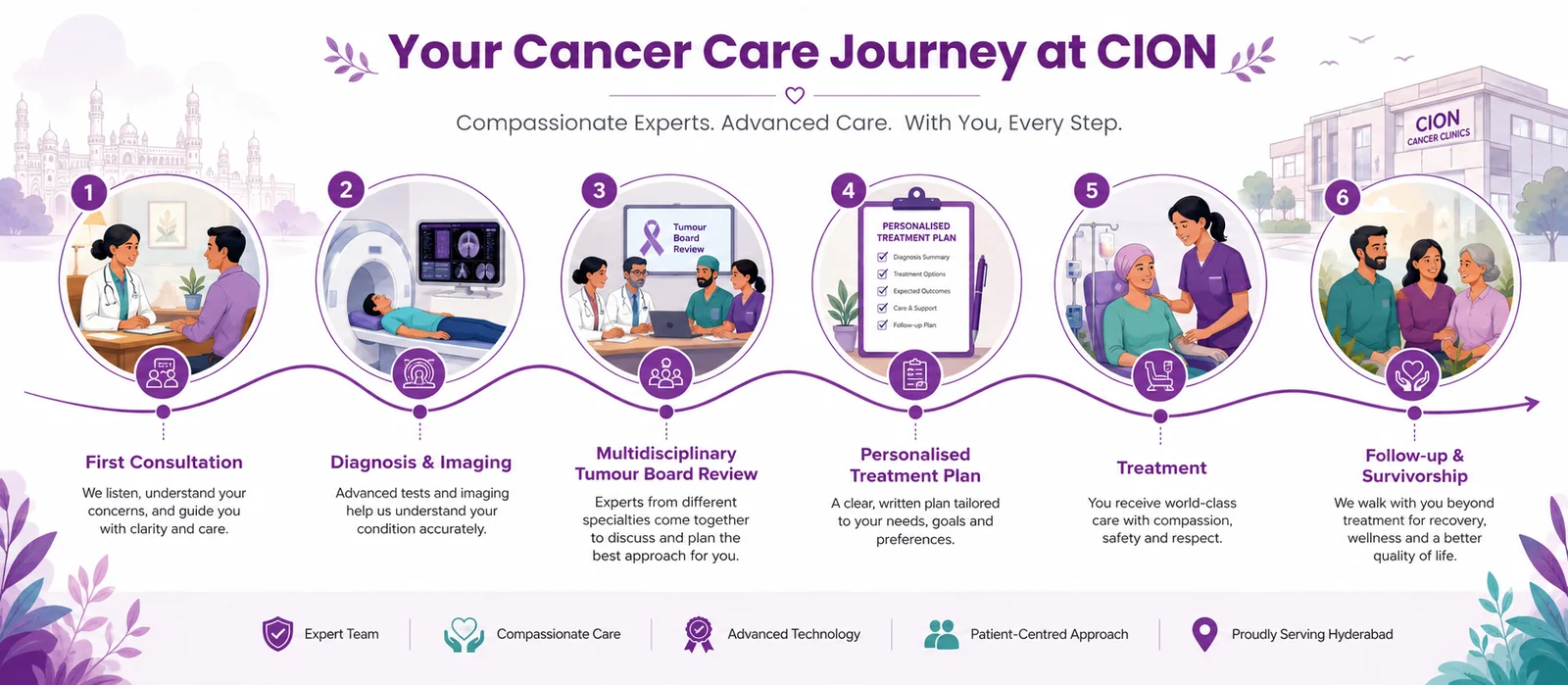
Your care journey at CION — from first consultation to survivorship.
Real stories · real courage
15,000+ patients chose CION. Hear from them directly.
These aren't paid endorsements or written reviews. These are video testimonials from real patients and families — recorded on their own phones, in their own words. Pick any one. Watch it. Then decide.
4.8★800+ Google reviews
50+video testimonials
15,000+patients treated
Successful Chemotherapy & Radiation Done by Dr. Owais Mohammed & Dr. Kirti Ranjan
Watch video →
Successful Chemotherapy Done by Dr. C Raghavendra Reddy
Watch video →
Surgery, Chemo & Radiation Done by Dr. Imaduddin, Dr. Vinay, Dr. Owais, Dr. Kirti
Watch video →
Successful Radical Thymectomy Done by Dr. Mohammed Imaduddin & Dr. Vinay Mamidala
Watch video →
Successful Surgery Done by Dr. Rajender Byshetty
Watch video →
Successful Chemo & Surgery Done by Dr. Imad, Dr. Vinay, Dr. Owais & Dr. Raghavendra
Watch video →
Successful Chemo & Surgery Done by Dr. Imad, Dr. Vinay, Dr. Owais & Dr. Raghavendra
Watch video →
Successful Chemo & Radiation Done by Dr. Owais Mohammed & Dr. Kirti Ranjan Mohanty
Watch video →
Successful Breast Cancer Surgery Done by Dr. Imaduddin Mohammed & Dr. Vinay Mamidala
Watch video →
Successful Chemotherapy Done by Dr. Bharati Devi Gorantla
Watch video →
Successful Chemo & Surgery Done by Dr. Owais Mohammed & Dr. Imaduddin Mohammed
Watch video →
Successful Chemotherapy Done by Dr. Gundu Naresh
Watch video →
Successful Bone Marrow Transplantation - Neuroblastoma
Watch video →
Successful Surgery & Chemo - Carcinoma of Caecum
Watch video →
Successful Oral chemotherapy & mastectomy surgery
Watch video →
Successful Oral chemotherapy & mastectomy surgery
Watch video →
Successful Chemotherapy
Watch video →
Successful Surgery by Dr. Mohammed Imaduddin
Watch video →
Successful Bone Marrow Transplantation
Watch video →
Successful Oral chemotherapy & mastectomy surgery
Watch video →
Successful Oral chemotherapy & mastectomy surgery
Watch video →
Successful Chemotherapy
Watch video →
Successful Buccal Mucosa Surgery
Watch video →
Successful Complex Surgery Mandibulectomy Reconstruction
Nasal (nasal cavity and paranasal sinus) cancer is uncommon and varies by type and stage. Found early and confined to the nasal cavity or a single sinus, it is often treatable, usually with surgery and radiation. Because early symptoms mimic sinusitis it is often found late, so acting on persistent one-sided symptoms matters most. Your outlook depends on the exact type and stage, which your oncology team explains after tests.
Is a one-sided blocked nose a sign of cancer?
Usually not — most nasal blockage is caused by sinusitis, allergy or a deviated septum. But a blockage or bleeding that is persistent, one-sided and not improving deserves a specialist check, because that one-sided pattern is what raises concern. A quick nasal endoscopy can tell you what is going on.
How is nasal cancer different from sinusitis?
Ordinary sinusitis usually affects both sides of the nose and settles with treatment. Nasal cancer more often causes persistent, one-sided symptoms — a blocked nostril, repeated nosebleeds, facial swelling or eye changes — that do not clear. When in doubt, a nasal endoscopy and, if needed, a scan give the answer.
What are the early signs of nasal (sinonasal) cancer?
The warning pattern is persistent and one-sided: a blocked nostril that will not clear, repeated nosebleeds from the same side, facial pain, pressure or swelling, a reduced or lost sense of smell, eye symptoms such as watering, bulging or double vision, or a lump on the face or neck and loose upper teeth. Any of these lasting beyond two to three weeks should be checked.
Can wood dust or leather dust cause nasal cancer?
Yes. Long-term exposure to wood dust (carpentry and furniture work), leather dust, nickel and chromium and certain industrial chemicals is an established risk for nasal and sinus cancer. If you have worked with these materials and have persistent one-sided nasal symptoms, it is worth getting them checked — this is why awareness matters most for wood, furniture, leather and metal trades.
What causes nasal cancer besides occupational dust?
Alongside occupational wood and leather dust, nickel, chromium and industrial chemicals, other risk factors include smoking and infection with human papillomavirus (HPV). Many of these risks are avoidable, and having a risk factor does not mean you will get nasal cancer — but it is a reason to act promptly on persistent one-sided symptoms.
What are the types of nasal and sinus cancer?
Several types exist, and the type shapes treatment. Squamous cell carcinoma is the most common, arising in the flat cells lining the nasal cavity and sinuses. Others include adenocarcinoma (from mucus-producing glandular cells), adenoid cystic carcinoma (which tends to grow slowly but needs long-term specialised care) and mucosal melanoma (from pigment-producing cells). Your exact type is confirmed by biopsy.
How is nasal cancer diagnosed?
Diagnosis centres on a nasal endoscopy — a thin camera passed gently into the nose so the specialist can see the nasal cavity and sinuses directly. Imaging with CT and MRI shows how far it extends and how close it is to the eye socket and skull base, and a biopsy (a small tissue sample) confirms the diagnosis and type. A PET-CT may be used to check for spread and to stage the cancer.
Does a biopsy spread nasal cancer?
No. A biopsy is a safe, standard step performed under controlled conditions and does not spread cancer. It is the only way to be sure whether an abnormal area is cancer and, if so, which type — which is essential for planning the right treatment. The real danger is delay, not the biopsy.
What is a nasal endoscopy and does it hurt?
A nasal endoscopy is an outpatient test in which a thin, flexible camera is passed into the nostril to look directly inside the nasal cavity and sinuses. It is usually done after a numbing spray and is generally quick and well tolerated, with only mild discomfort. It gives the specialist a clear view that examination alone cannot.
How is nasal cancer treated?
Surgery is usually the main treatment and is increasingly done endoscopically through the nostril, often followed by radiation therapy. For deep tumours where surgery is difficult, radiation may be the main option, and chemotherapy or targeted therapy is added for advanced disease. The plan is decided by a multidisciplinary head and neck team based on your type and stage.
What is endoscopic (minimally invasive) nasal cancer surgery?
Endoscopic sinonasal surgery removes the tumour through the nostril using a camera and fine instruments, with no external facial incision in many cases. It is an established, specialised technique that can fully remove many nasal and sinus tumours with less disruption than open surgery, and reconstruction is used where needed to protect appearance and function.
Will nasal cancer surgery affect my face, eyes or sense of smell?
Modern nasal cancer surgery is often minimally invasive and is planned to preserve appearance and function wherever possible. Many people keep normal breathing and their sense of smell. Where more extensive surgery is needed near the eye or skull base, reconstruction and rehabilitation help protect and restore function, and your surgeon explains exactly what to expect for your case.
How much does nasal cancer treatment cost in Hyderabad?
Cost depends on the type, stage, the surgery and whether radiation or chemotherapy is needed, so it is best given as an indicative range after assessment. Eligible treatment, including radiation therapy, may be covered under Aarogyasri or PMJAY at empanelled centres, and we help with insurance and EMI. Use the estimator on this page for an indicative figure, then request a callback for an accurate estimate.
Is nasal cancer treatment covered by Aarogyasri or PMJAY?
Yes, for eligible patients. Under Aarogyasri and PMJAY, eligible nasal cancer treatment — including radiation therapy — may be largely covered at empanelled centres. Our team helps you check eligibility and complete the paperwork, and guides you on private insurance and EMI options if a scheme does not apply.
Does radiation therapy for nasal cancer make me radioactive?
No. Standard external-beam radiotherapy does not make you radioactive, and you can safely be around family, including children. Your radiation oncologist will clearly explain any exception before treatment begins. Radiation for nasal cancer is precisely targeted to protect nearby structures such as the eyes.
Can nasal cancer spread to the eyes or brain?
Because the nasal cavity and sinuses sit close to the eye sockets and the base of the skull, advanced nasal cancer can extend towards these structures — which is why accurate imaging and staging matter. Treatment planned by a head and neck team aims to control the cancer while protecting the eyes and surrounding structures as much as possible.
How long does nasal cancer treatment take?
It varies by type, stage and plan. Surgery may involve a short hospital stay plus recovery, while a course of radiation typically runs over several weeks, and combined treatment can take a few months in total. Your team gives you a personalised timeline once the type, stage and plan are confirmed.
Can nasal cancer come back after treatment?
It can, which is why structured follow-up matters. Regular reviews after treatment watch for any recurrence so it can be caught and treated early. Attending your follow-up appointments and reporting any new or returning one-sided nasal symptoms promptly gives the best chance of catching a recurrence early.
Which specialist should I see for persistent one-sided nasal symptoms?
For a blocked nostril, repeated one-sided nosebleeds or facial changes that have not cleared in two to three weeks, see a head and neck cancer specialist (surgical oncologist), often working with an ENT specialist for the endoscopy. At CION your case is reviewed by a team — surgical, medical and radiation oncologists together — so you get a coordinated plan rather than a single-doctor decision.
Explore
Explore nasal cancer care
Our guide to nasal & sinus cancer — treatment, doctors, diagnosis, cost and support. Tap any topic to read more.
Nasal Cancer — Treatment & Specialist Care (Hyderabad)
One-sided nasal symptoms that won't clear? Get them checked.
Most turn out to be ordinary sinusitis — and if it's more, finding it early changes everything. Book a free consultation or second opinion at any of our 9 Hyderabad clinics, part of 35+ centres across Telangana & Andhra Pradesh.
Medical disclaimer: This page is for general information and awareness and does not replace professional medical advice, diagnosis or treatment. Always consult a qualified oncologist. Costs shown are indicative only and not a quotation. Content is periodically reviewed by CION's medical team.

 CION Ameerpet