Blood in the stool or a change in bowel habit is worrying — but most such symptoms aren’t cancer, so don’t just assume the worst (or that it’s “only piles”). And here’s the hopeful part: because colon cancer grows slowly from polyps, screening can find and remove them before cancer ever develops — and caught early, colon cancer is highly curable.
Free consultation with a surgical or medical oncologist
Screening & colonoscopy that removes polyps before they become cancer
9 clinics in Hyderabad · 35+ across Telangana & AP
Written & medically reviewed by Dr. Sridhar Kamani, Surgical Oncologist (MBBS, MS & DrNB, Surgical Oncology), CION Cancer Clinics — with our medical oncology team. · Reviewed 9 July 2026
Overview
What is colon cancer?
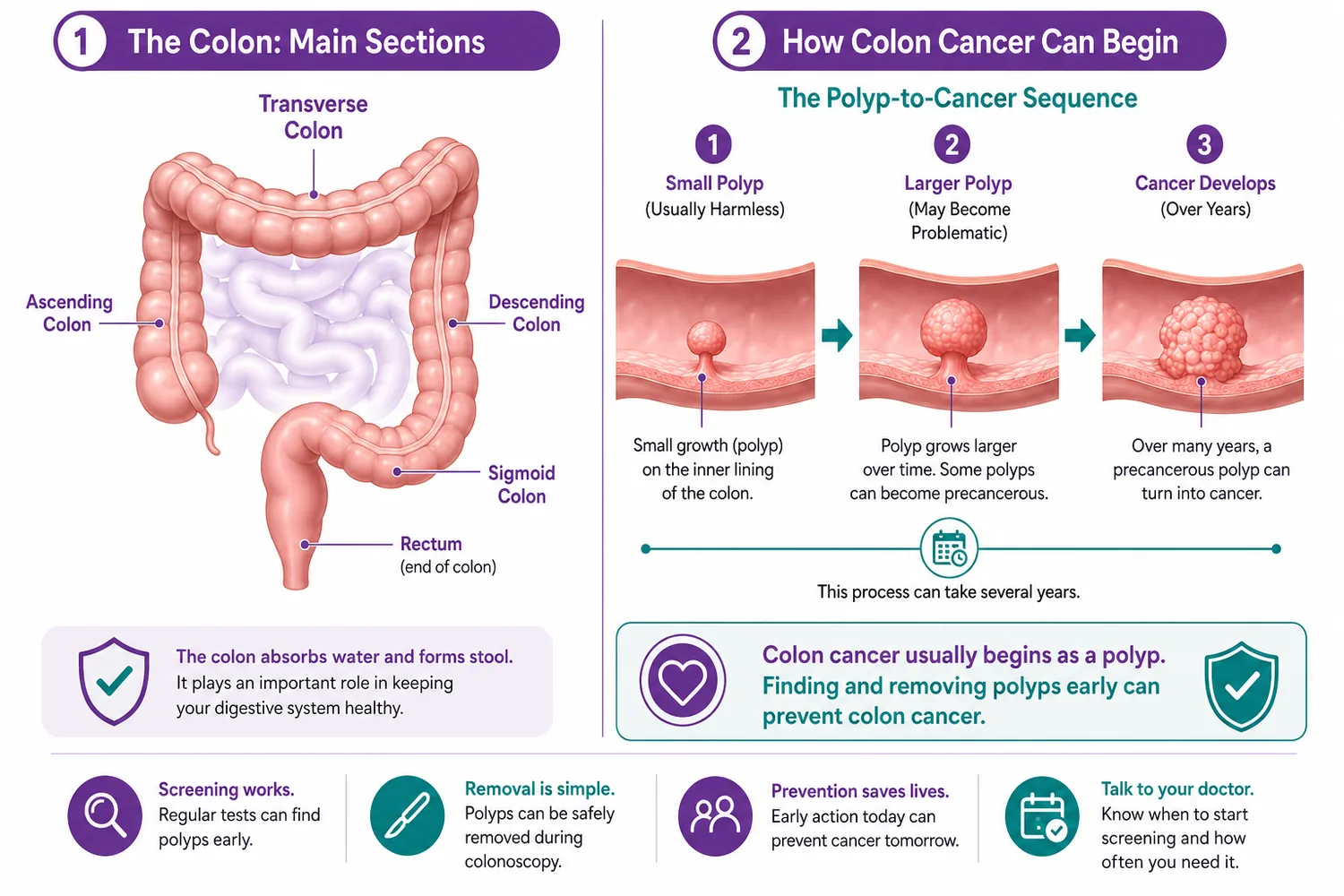
Colon cancer — part of “colorectal cancer” — begins when cells in the colon (the large bowel) grow out of control. It usually develops slowly from a small growth called a polyp, over several years — which is exactly why it’s one of the most preventable cancers, and, caught early, one of the most curable.
“Colorectal cancer” covers the colon and the rectum; this page focuses on the colon. Both are treated a little differently — an important point we come back to under treatment.
Colon cancer usually begins as a polyp — and removing polyps early can prevent it.
The common worry
Blood in the stool or a change in bowel habit? Don’t just assume it’s piles
Blood in the stool, or a change in bowel habit that lasts, is frightening — but most such symptoms are not cancer. Piles (haemorrhoids), minor infections and IBS are far more common. Still, don’t just assume it’s piles: persistent bleeding or a change in bowel habit deserves a check — and don’t assume you’re “too young.” Checking early changes outcomes.
Should I get this checked?
Tick anything that’s persistent. This is an awareness guide, not a diagnosis — most of these symptoms have benign causes.
Your result
Tick what applies
Most bowel symptoms are not cancer. Your guidance appears here.
This tool doesn’t diagnose anything or replace medical advice. Blood in the stool, or a change in bowel habit that persists, should be checked by a doctor — most causes are benign and treatable.
Symptoms
Signs & symptoms
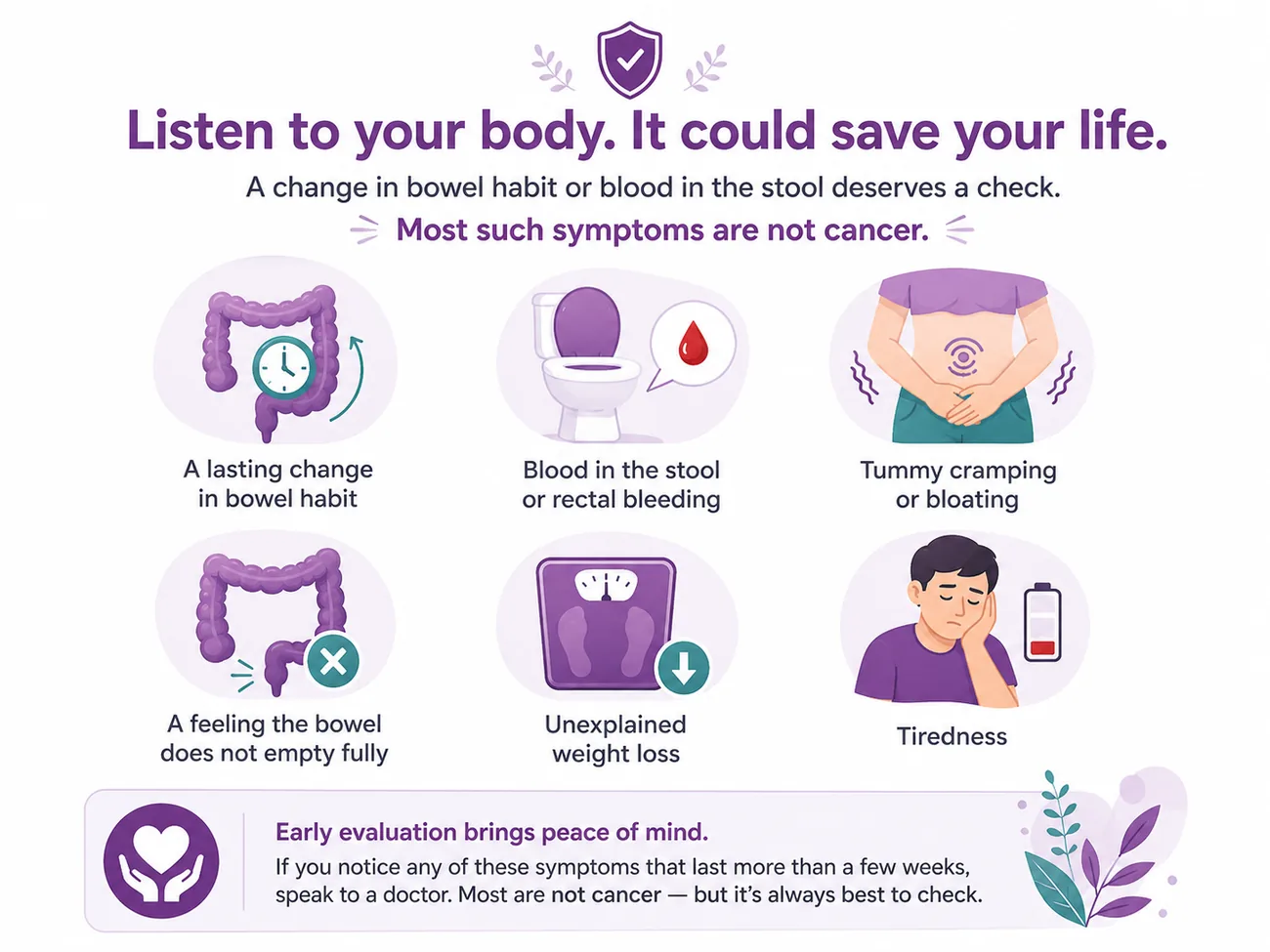
The commonest signs are a lasting change in bowel habit, blood in the stool or rectal bleeding, and tummy pain or bloating. Later, there may be a feeling the bowel doesn’t empty fully, unexplained weight loss, and tiredness from low iron. Many overlap with piles or IBS — so a change that persists deserves a check.
A lasting change in bowel habit
Blood in the stool or rectal bleeding
Tummy pain, cramping or bloating
Feeling the bowel doesn’t empty fully
Unexplained weight loss
Tiredness from low iron
A change that lasts more than a couple of weeks — especially bleeding — is the pattern that matters. If that’s you, book a consultation.
Screening & prevention
Screening can prevent colon cancer — not just find it early
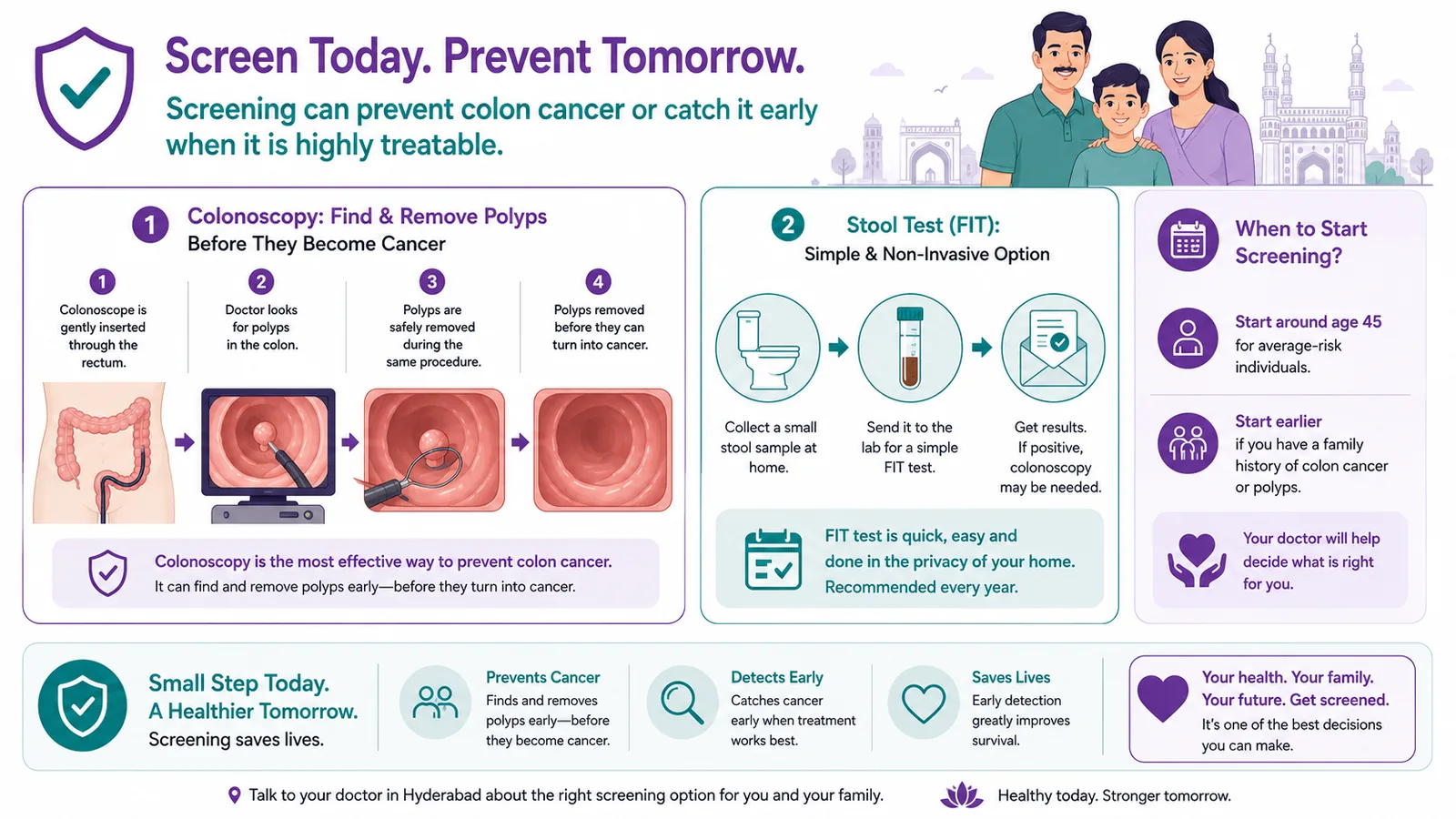
Colon cancer is one of the few cancers that screening can actually prevent. Because it grows slowly from polyps, a colonoscopy can find and remove polyps before they ever become cancer — or catch cancer early, when it’s highly curable. Screening is usually advised from around age 45 (earlier with a family history), and a simple stool test (FIT) is a non-invasive option.
Screening removes polyps and prevents most colorectal cancers — yet uptake in India is low. Learn more about cancer screening, and if bowel cancer runs in your family, ask about genetic counselling.
Colon cancer is no longer just an older person’s disease — it’s rising in adults under 50. Because younger people aren’t routinely screened, and their symptoms are often mistaken for piles or an upset stomach, they’re frequently diagnosed late. If you’re young with persistent symptoms, don’t let anyone dismiss them. The reassuring part: younger patients often do as well as — or better than — older patients when found at the same stage.
Myth: “I’m too young for colon cancer.”
Fact: Colon cancer is rising in under-50s — and young people are often diagnosed late because their symptoms get dismissed. Persistent bowel symptoms deserve a check at any age, and being young is not a reason to wait.
Causes & risk
Causes, risk & reducing risk
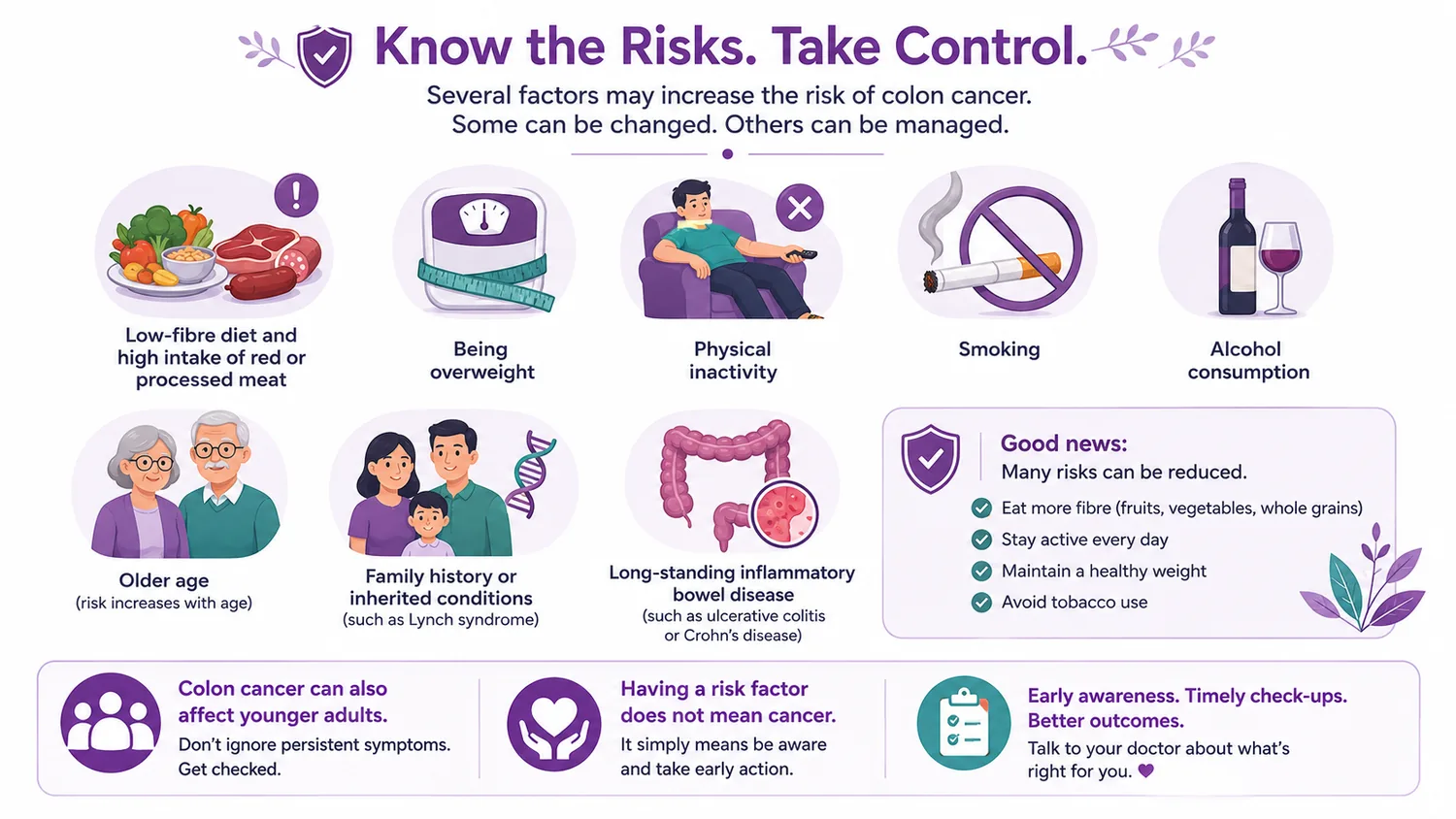
Risk rises with age and family history, and with inherited conditions like Lynch syndrome or FAP and long-standing inflammatory bowel disease — but many risks are within your control. A low-fibre diet, lots of red and processed meat, excess weight, inactivity, smoking and alcohol all raise risk, while fibre, activity and a healthy weight lower it.
Most colon cancers are adenocarcinomas, which begin in the gland cells of the bowel lining — usually from a polyp. For advanced disease, the tumour is tested for molecular features — such as MSI/MMR status and KRAS or BRAF changes — which decide whether targeted therapy or immunotherapy will help.
Understand the types & testing
Simplified for understanding. Your exact type and molecular results are confirmed by testing your biopsy, and guide your personalised plan.
Staging
The stages of colon cancer
Colon cancer is staged 0 to IV — from a cancer contained in a polyp, through growth into the bowel wall and nearby lymph nodes, to spread to distant organs like the liver. Early stages are highly curable — most stage I–II colon cancers are cured by surgery.
Understand the stages
Simplified for understanding. Your exact stage and plan are confirmed by your team after tests.
Diagnosis
How colon cancer is diagnosed
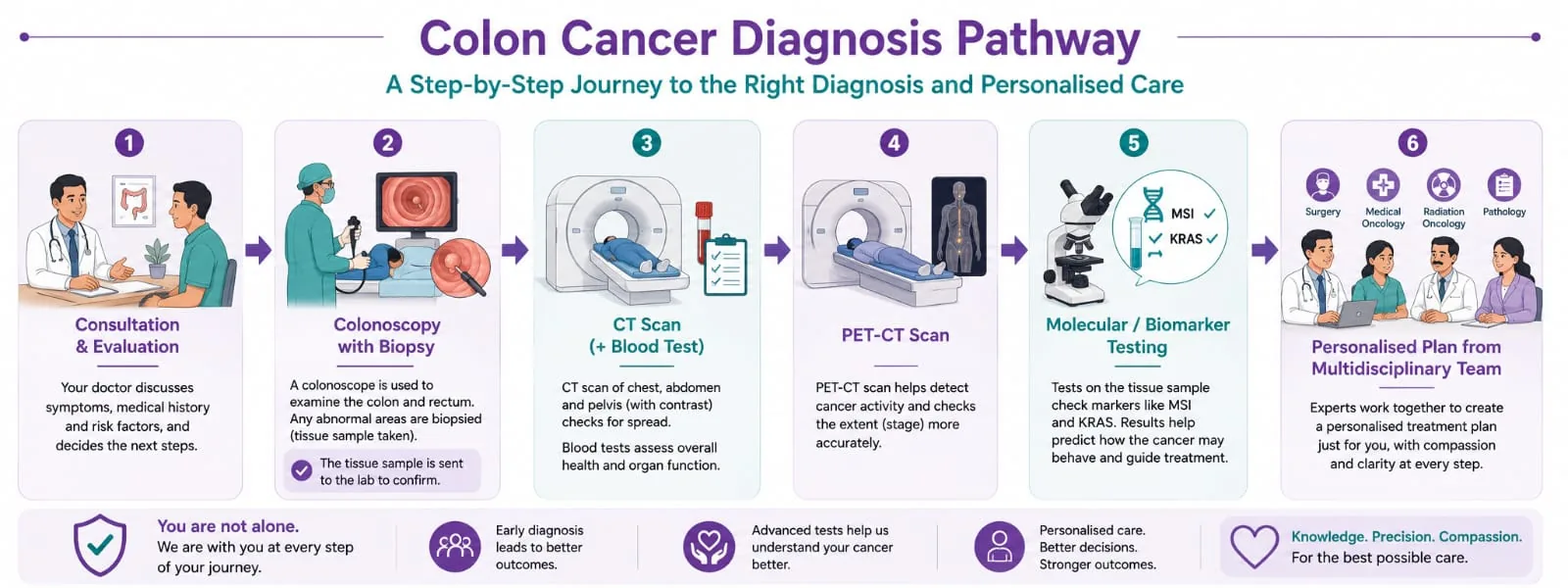
The key test is a colonoscopy, which lets the doctor see the whole colon and take a biopsy to confirm the diagnosis (and remove polyps). A CT scan and a blood marker (CEA) help assess it, a PET-CT checks the extent, and molecular testing guides treatment for advanced disease.
From colonoscopy to a precise, personalised plan.
Diagnostic services we offer — book any of these directly:
Colonoscopy + biopsy
The key test — it sees the whole colon, takes a biopsy to confirm the diagnosis, and can remove polyps in the same sitting.
For most colon cancers, surgery is the main, curative treatment — removing the affected part of the colon and nearby lymph nodes, often by keyhole (minimally invasive) surgery. Chemotherapy may follow to lower the chance of return, and for advanced disease, targeted therapy and immunotherapy (guided by molecular testing) are used. See our full guide to colon cancer treatment in Hyderabad.
Colon vs rectal: radiation therapy is a key treatment for rectal cancer, but is not usually part of colon cancer treatment — colon cancer is treated mainly with surgery and, when needed, chemotherapy and molecular-guided therapies. If your cancer is in the rectum, see our rectal cancer page.
Treatments & care we offer — book a consult for any of these:
Colon surgery (colectomy)
The curative backbone — removing the affected part of the colon and nearby lymph nodes, often by keyhole (minimally invasive) surgery, with the bowel rejoined.
Indicative cost of colon cancer treatment in Hyderabad
Cost depends on the stage and treatment — surgery, chemotherapy, and targeted therapy or immunotherapy for advanced disease — so it’s best given as an indicative range after assessment. Eligible treatment may be covered under Aarogyasri / PMJAY at empanelled centres.
Estimate an indicative range
Indicative range
—
Figures are indicative only and not a quotation. For an accurate estimate, request a callback.
Blood in the stool, a change in bowel habit, a colonoscopy or scan finding, or a diagnosis you want a second view on shouldn’t wait. Book a free consultation and, if you already have a report, a free written second opinion.
Reviewed by a surgical and medical oncologist
Screening, colonoscopy & polyp removal — prevention, not just detection
Aarogyasri / PMJAY & insurance guidance
Support
Financial support & Aarogyasri
Cost should not delay care. Under Aarogyasri and PMJAY, eligible colon cancer treatment may be largely covered at empanelled centres. Our team helps check eligibility and guides you on insurance and EMI.
9 clinics in Hyderabad · 35+ across Telangana & AP
CION cancer care is closer than you think.
We're never more than 30 minutes away. Same panel of specialists at every centre. Same tumour board reviews. Same NCCN protocols. Pick the closest one and call directly — or let us pick for you.
Don't see your city? Call
18002028726
— we'll find your nearest CION partner centre.
Meet the oncologists
Colon cancer is treated by a team, not one doctor.
Care is led by surgical oncology (surgery is the curative backbone in colon cancer) with medical oncology for chemotherapy and molecular-guided therapy — part of 17 senior specialists across CION. Radiation is used mainly for rectal cancer, not colon.
Share your name and number — we'll call you back within 30 minutes to schedule your consultation.
Bowel symptoms, or due a screening? Take the next step — it could prevent cancer.
Most bowel symptoms turn out to be harmless — and screening can stop colon cancer before it starts by removing polyps. Whatever your age, don’t just assume it’s piles. Our oncologists help with this every day.
The worries and myths we hear most about colon cancer, answered plainly and without embarrassment.
“Blood in the stool is just piles.”
Fact: Most bleeding is piles — but never simply assume it. New or persistent bleeding, especially with a change in bowel habit or weight loss, should be checked.
“I’m too young for colon cancer.”
Fact: It’s rising in under-50s, who are often diagnosed late because symptoms get dismissed. Persistent bowel symptoms deserve a check at any age.
“A colonoscopy is dangerous and awful.”
Fact: Colonoscopy is a quick, safe, sedated test that can prevent cancer by removing polyps — and it’s the best way to catch colon cancer early.
“Colon cancer means a permanent colostomy bag.”
Fact: A permanent stoma is mainly a low-rectal-cancer concern; most colon operations rejoin the bowel, and a stoma, when needed, is often temporary.
“There’s nothing you can do to prevent it.”
Fact: Colon cancer is one of the most preventable cancers — screening removes polyps, and diet, weight and activity all lower risk.
“Colon cancer is a death sentence.”
Fact: Found early, it’s highly curable — and even advanced colon cancer is very treatable today, with some still cured.
“If I feel fine, I can’t have colon cancer.”
Fact: Early colon cancer often causes no symptoms at all — which is exactly why screening from around age 45 (earlier with a family history) matters.
“The bowel prep for a colonoscopy is unbearable.”
Fact: The prep is the least pleasant part, but it’s just one evening, modern preps are easier, and the test itself is done under sedation. It’s a small price for peace of mind.
“A biopsy or surgery makes the cancer spread.”
Fact: Biopsy and surgery are safe, standard steps done under controlled conditions. The real risk is delay, which lets a treatable cancer grow.
“Cancer is contagious — I could catch it.”
Fact: Colon cancer is not infectious. You can’t catch it from, or pass it to, anyone by living with or caring for them.
“Only older men get colon cancer.”
Fact: Colon cancer affects women and men, and is rising in younger adults. Anyone with persistent bowel symptoms should be checked, regardless of age or sex.
“Surgery means I’ll never eat normally again.”
Fact: Most people return to a normal diet after recovering from colon surgery. Our nutrition team supports you through recovery and beyond.
“Chemotherapy is worse than the disease.”
Fact: Modern chemotherapy is far better tolerated than it once was, with strong supportive care for side effects — and, after surgery, it can meaningfully lower the chance of the cancer returning.
“Treatment is unaffordable — we can’t manage it.”
Fact: Under Aarogyasri and PMJAY, eligible treatment may be largely covered at empanelled centres. We help check eligibility, insurance and EMI.
“If it runs in my family, I’ll definitely get it.”
Fact: A family history raises risk but doesn’t make cancer certain. Genetic counselling (for Lynch syndrome or FAP) and earlier screening can find and remove polyps before cancer develops.
“Once colon cancer spreads, nothing can be done.”
Fact: Even stage IV colon cancer is very treatable — with chemotherapy, targeted therapy and immunotherapy, and sometimes surgery to remove limited spread — and some people are still cured.
“Only red meat causes it, so if I avoid it I’m safe.”
Fact: Diet is one factor among many — age, family history, IBD, weight, inactivity, smoking and alcohol all matter. Screening is what actually prevents most colon cancers.
“Home remedies or a special diet alone can cure it.”
Fact: Relying on unproven remedies wastes the window when colon cancer is most curable. Discuss anything complementary with your oncology team, not as a replacement for treatment.
Why CION
Why choose CION for colon cancer care
Surgery-led, curative care
Colon resection, often keyhole (minimally invasive), by a surgical oncology team — the curative backbone of colon cancer.
Medical oncology
Chemotherapy and molecular-guided targeted therapy and immunotherapy for advanced disease.
Screening & polyp removal
Colonoscopy that prevents cancer by removing polyps — prevention, not just detection.
Molecular subtyping
MSI/MMR and KRAS/BRAF testing to personalise treatment for advanced colon cancer.
GI tumour board & genetics
Multidisciplinary planning with PET-CT, plus Lynch/FAP genetic counselling for families.
Close, NABH-accredited care
9 clinics across Hyderabad and 35+ across Telangana, within NABH-accredited facilities.
Real stories · real courage
15,000+ patients chose CION. Hear from them directly.
These aren't paid endorsements or written reviews. These are video testimonials from real patients and families — recorded on their own phones, in their own words. Pick any one. Watch it. Then decide.
4.8★800+ Google reviews
50+video testimonials
15,000+patients treated
Successful Chemotherapy & Radiation Done by Dr. Owais Mohammed & Dr. Kirti Ranjan
Watch video →
Successful Chemotherapy Done by Dr. C Raghavendra Reddy
Watch video →
Surgery, Chemo & Radiation Done by Dr. Imaduddin, Dr. Vinay, Dr. Owais, Dr. Kirti
Watch video →
Successful Radical Thymectomy Done by Dr. Mohammed Imaduddin & Dr. Vinay Mamidala
Watch video →
Successful Surgery Done by Dr. Rajender Byshetty
Watch video →
Successful Chemo & Surgery Done by Dr. Imad, Dr. Vinay, Dr. Owais & Dr. Raghavendra
Watch video →
Successful Chemo & Surgery Done by Dr. Imad, Dr. Vinay, Dr. Owais & Dr. Raghavendra
Watch video →
Successful Chemo & Radiation Done by Dr. Owais Mohammed & Dr. Kirti Ranjan Mohanty
Watch video →
Successful Breast Cancer Surgery Done by Dr. Imaduddin Mohammed & Dr. Vinay Mamidala
Watch video →
Successful Chemotherapy Done by Dr. Bharati Devi Gorantla
Watch video →
Successful Chemo & Surgery Done by Dr. Owais Mohammed & Dr. Imaduddin Mohammed
Watch video →
Successful Chemotherapy Done by Dr. Gundu Naresh
Watch video →
Successful Bone Marrow Transplantation - Neuroblastoma
Watch video →
Successful Surgery & Chemo - Carcinoma of Caecum
Watch video →
Successful Oral chemotherapy & mastectomy surgery
Watch video →
Successful Oral chemotherapy & mastectomy surgery
Watch video →
Successful Chemotherapy
Watch video →
Successful Surgery by Dr. Mohammed Imaduddin
Watch video →
Successful Bone Marrow Transplantation
Watch video →
Successful Oral chemotherapy & mastectomy surgery
Watch video →
Successful Oral chemotherapy & mastectomy surgery
Watch video →
Successful Chemotherapy
Watch video →
Successful Buccal Mucosa Surgery
Watch video →
Successful Complex Surgery Mandibulectomy Reconstruction
Care goes beyond surgery — recovery, nutrition, wellbeing, family risk and follow-up.
Stoma care & rehabilitation
Support and advice if a stoma is needed — most are temporary — and recovery after bowel surgery. Learn more
Nutrition support
Diet and fibre guidance through treatment and recovery, and for long-term bowel health. Learn more
Psycho-oncology
Emotional support for you and your family through diagnosis and treatment. Learn more
Genetic counselling (Lynch/FAP)
For families with a strong history of bowel cancer — assessing risk and planning earlier screening. Learn more
Pain & palliative care
Comfort and symptom control at any stage, alongside active treatment. Learn more
Second opinion & follow-up
A clear, unhurried review of your diagnosis and options, and structured follow-up. Get a second opinion
FAQ
Frequently asked questions about colon cancer
Is blood in the stool always cancer?
No — most rectal bleeding is caused by piles (haemorrhoids) or an anal fissure, not cancer. But blood in the stool should never simply be assumed to be piles, especially if it is new, persistent, or comes with a change in bowel habit or weight loss. A quick check can reassure you or catch something early.
What are the early symptoms of colon cancer?
The commonest signs are a lasting change in bowel habit (looser, more frequent, or constipation), blood in the stool or rectal bleeding, and tummy pain, cramping or bloating. Later there may be a feeling that the bowel does not empty fully, unexplained weight loss, and tiredness from low iron. Many of these overlap with piles or IBS, so a change that persists for more than a couple of weeks deserves a check. Early colon cancer can also cause no symptoms at all, which is why screening matters.
Can colon cancer be prevented?
To a large extent, yes — more than most cancers. Because colon cancer usually grows slowly from polyps, a colonoscopy can find and remove polyps before they ever become cancer, preventing the disease. A healthy weight, more fibre, less red and processed meat, staying active, and not smoking also lower the risk.
Am I too young for colon cancer?
Not necessarily — colon cancer is rising in adults under 50. Because younger people are not routinely screened and their symptoms are often mistaken for piles or an upset stomach, they are frequently diagnosed late. If you are young with persistent bowel symptoms, insist on getting them checked — being young is not a reason to wait.
At what age should I start colon cancer screening?
For people at average risk, screening is usually advised from around age 45. You should start earlier — and be screened more often — if you have a family history of colon cancer or polyps, an inherited condition such as Lynch syndrome or FAP, or long-standing inflammatory bowel disease. Your doctor will help decide what is right for you, and a simple stool test (FIT) is a non-invasive first option.
What is a colonoscopy, and does it hurt?
A colonoscopy is a test in which a thin, flexible camera is passed gently through the back passage to look at the whole lining of the colon. It is usually done under sedation, so most people feel little or nothing and do not remember much of it. It is the most effective way to prevent colon cancer, because any polyps found can be removed during the same procedure — before they can ever become cancer. The bowel-cleansing prep the evening before is the least pleasant part, but it is short-lived.
What is a polyp, and does having polyps mean I have cancer?
A polyp is a small growth on the inner lining of the colon. Most polyps are harmless and are not cancer, but some types can slowly turn into cancer over several years if left. That is exactly why screening works so well: removing polyps during a colonoscopy stops them ever becoming cancer. Having a polyp removed usually means you will be advised when to have your next colonoscopy.
Is colon cancer curable?
Often, yes — especially when found early. Colon cancer confined to the bowel is highly curable with surgery, and even cancers that have spread to lymph nodes are frequently cured with surgery and chemotherapy. Even stage IV colon cancer is very treatable, and some are still cured. Your outlook depends on the stage, which is why checking symptoms early and screening matter so much.
What are the stages of colon cancer?
Colon cancer is staged from 0 to IV. Stage 0 is very early, contained in a polyp or the inner lining. Stages I–II have grown into the bowel wall but not the lymph nodes, and are usually treated with surgery. Stage III has spread to nearby lymph nodes and is treated with surgery followed by chemotherapy. Stage IV has spread to distant organs such as the liver or lungs and is treated with chemotherapy, targeted therapy or immunotherapy, and sometimes surgery. Early stages are highly curable.
How is colon cancer diagnosed?
The key test is a colonoscopy, which lets the doctor see the whole colon and take a biopsy to confirm the diagnosis (and remove polyps). A CT scan of the chest, abdomen and pelvis checks the extent, a blood marker called CEA helps with assessment and follow-up, and a PET-CT is used in selected cases. For advanced disease, the tumour is also tested for molecular features that guide treatment.
What is the difference between colon cancer and rectal cancer?
Both are “colorectal cancer,” but they start in different parts of the large bowel — the colon (the long part) versus the rectum (the last few inches). They are treated a little differently: radiation therapy is a key treatment for rectal cancer but is not usually part of colon cancer treatment, and a permanent stoma is much more a concern with low rectal cancer than with colon cancer. If your cancer is in the rectum, see our rectal cancer page.
How is colon cancer treated?
For most colon cancers, surgery is the main, curative treatment — removing the affected part of the colon and nearby lymph nodes, often by keyhole (minimally invasive) surgery, with the bowel rejoined. Chemotherapy may follow to lower the chance of the cancer returning, particularly for stage III (and some stage II) disease. For advanced or stage IV disease, targeted therapy and immunotherapy — guided by molecular testing — are used, sometimes alongside surgery for limited spread.
Will I need a colostomy bag?
Usually not for colon cancer — a permanent stoma is much more a concern with low rectal cancer. Most colon operations rejoin the bowel so it works normally, and when a stoma is needed it is often temporary. Your surgeon will explain exactly what to expect, and our stoma-care and rehabilitation team supports you if one is needed.
Is radiation used to treat colon cancer?
Not usually. Radiation therapy is a key treatment for rectal cancer, but colon cancer is treated mainly with surgery and, when needed, chemotherapy and molecular-guided targeted therapy or immunotherapy. This is one of the important differences between colon and rectal cancer. Our radiation oncologists lead treatment for rectal cancer and other sites.
What is molecular testing (MSI, KRAS, BRAF) and why does it matter?
For advanced colon cancer, the tumour is tested for molecular features. MSI/MMR status shows whether a cancer is likely to respond especially well to immunotherapy. KRAS and BRAF are genetic changes that guide which targeted therapies will or will not work. Testing for these helps personalise treatment to your specific cancer. For early colon cancer, surgery is usually curative and this testing is less central.
Is colon cancer hereditary?
Most colon cancer is not inherited, but a minority is linked to a family history or an inherited condition such as Lynch syndrome or familial adenomatous polyposis (FAP). If colon or other bowel cancer runs in your family, genetic counselling can clarify your risk and, where relevant, guide earlier and more frequent screening for you and close relatives — which can find and remove polyps before cancer ever develops.
How much does colon cancer treatment cost in Hyderabad?
Cost depends on the stage and treatment — surgery, chemotherapy, and targeted therapy or immunotherapy for advanced disease — so it is best given as an indicative range after assessment. Eligible treatment may be covered under Aarogyasri or PMJAY at empanelled centres. Use the cost estimator on this page for an indicative figure, then request a callback for an accurate estimate.
Does colon cancer treatment qualify for Aarogyasri or PMJAY?
Eligible colon cancer treatment may be largely covered under Aarogyasri and PMJAY at empanelled centres, and cost should not delay care. Our team helps check your eligibility and guides you on private insurance and EMI options, and will explain clearly what is covered so there are no surprises.
Can colon cancer come back after treatment?
It can, which is why structured follow-up is an important part of care after treatment — usually with regular check-ups, CEA blood tests, scans and colonoscopies for a few years. Follow-up is designed to pick up any return early, when it is most treatable, and to check for new polyps. Chemotherapy after surgery, when advised, also lowers the chance of the cancer returning.
Explore
Explore colon & colorectal cancer care
Our guide to colon cancer — treatment, doctors, screening, tests and support — plus the wider colorectal cluster. Tap any topic to read more.
Bowel symptoms, a diagnosis, or due a screening? Talk to a specialist.
Most bowel symptoms turn out to be harmless — and screening can stop colon cancer before it starts by removing polyps. Whatever your age, don’t just assume it’s piles. Book a consultation, screening or second opinion at any of our 9 Hyderabad clinics, part of 35+ centres across Telangana & Andhra Pradesh.
Medical disclaimer: This page is for general information and awareness and does not replace professional medical advice, diagnosis or treatment. Heavy rectal bleeding, severe abdominal pain, or an inability to pass stool or wind needs urgent medical attention. Always consult a qualified oncologist. Costs shown are indicative only and not a quotation. Content is periodically reviewed by CION’s medical team.

 CION Ameerpet