Rectal Cancer: Signs, Screening, Causes & Treatment in Hyderabad
Rectal bleeding is usually just piles — but bleeding that's persistent, or comes with a change in bowel habits or weight loss, deserves a check. Screening can prevent rectal cancer, and modern treatment focuses on preserving the sphincter — so a permanent colostomy bag is often avoidable.
Written & medically reviewed by Dr. Sridhar Kamani, Surgical Oncologist (MBBS, MS & DrNB, Surgical Oncology), CION Cancer Clinics. · Reviewed 6 July 2026
Overview
What is rectal cancer?
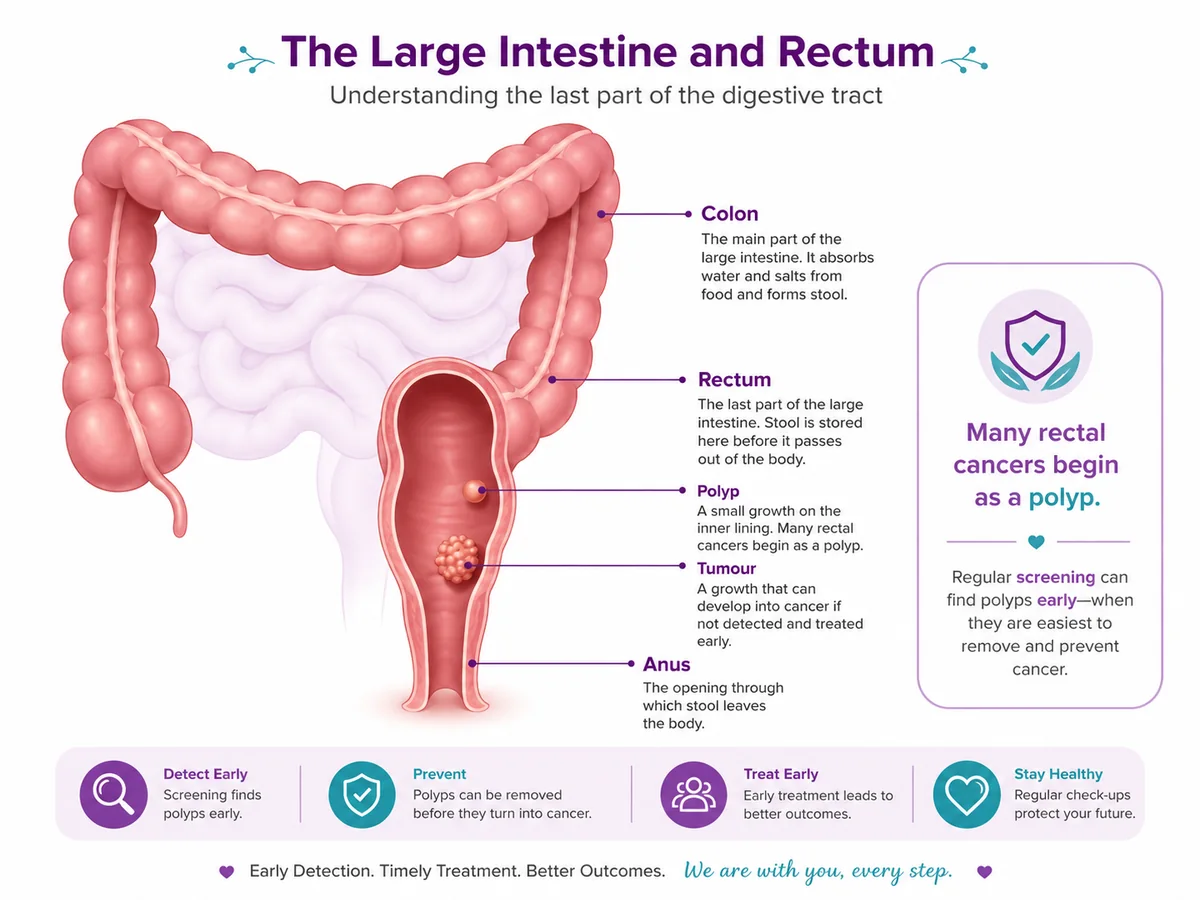
Rectal cancer begins in the rectum — the last part of the large bowel, just before the anus. Almost all rectal cancers are a type called adenocarcinoma, and most begin as a small growth called a polyp. Together with colon cancer it's known as colorectal or bowel cancer.
Because most rectal cancers start as a polyp that grows slowly, they can often be caught — or even prevented — through screening. Rectal cancer is closely related to colon cancer but is treated a little differently, because the rectum sits low in the pelvis close to the sphincter.
The large intestine and rectum — where rectal cancer begins.
The key question
Rectal bleeding: cancer, or just piles?
Most rectal bleeding is from piles (haemorrhoids) or a fissure — not cancer. But bleeding that is persistent, mixed in with the stool, or comes with a change in bowel habits, weight loss, or is after age 45, should be checked. A colonoscopy reliably tells the difference — the danger is simply assuming it's piles.
Piles, or worth a check? A quick guide
Tick anything that applies. This is an awareness guide, not a diagnosis — most rectal bleeding turns out to be piles.
Your result
Tick what applies
Most rectal bleeding is from piles. Your result appears here.
This tool doesn't diagnose cancer or replace a medical opinion. Persistent rectal bleeding or a change in bowel habits should be checked — a colonoscopy gives certainty. Please consult a CION specialist.
Early detection
Signs & symptoms
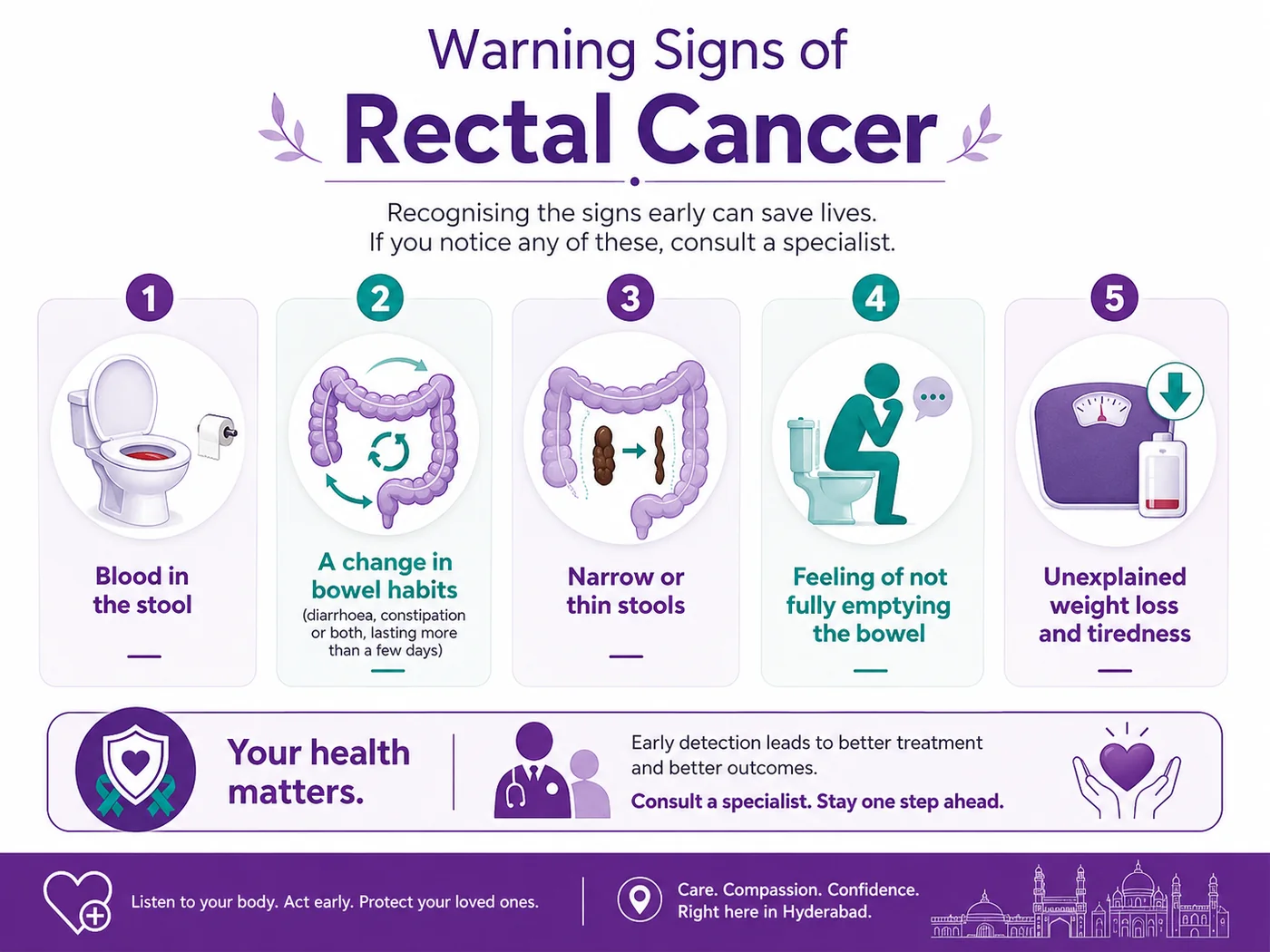
The commonest signs are rectal bleeding and a lasting change in bowel habits. Blood in the stool, narrower stools, a feeling of not fully emptying, ongoing abdominal discomfort, or unexplained weight loss and tiredness — especially together or lasting more than a few weeks — should be checked.
Blood in the stool or rectal bleeding
A change in bowel habits (looser, harder, or both)
Narrow or thin stools
A feeling of not fully emptying the bowel
Ongoing abdominal discomfort, cramps or bloating
Unexplained weight loss, tiredness or low blood count
Not sure whether your symptom needs a check? Rectal cancer often shares early signs with piles and fissures — a short colorectal screening or consultation settles it. If a close relative has had bowel cancer, mention it.
Causes & risk
What causes rectal cancer?
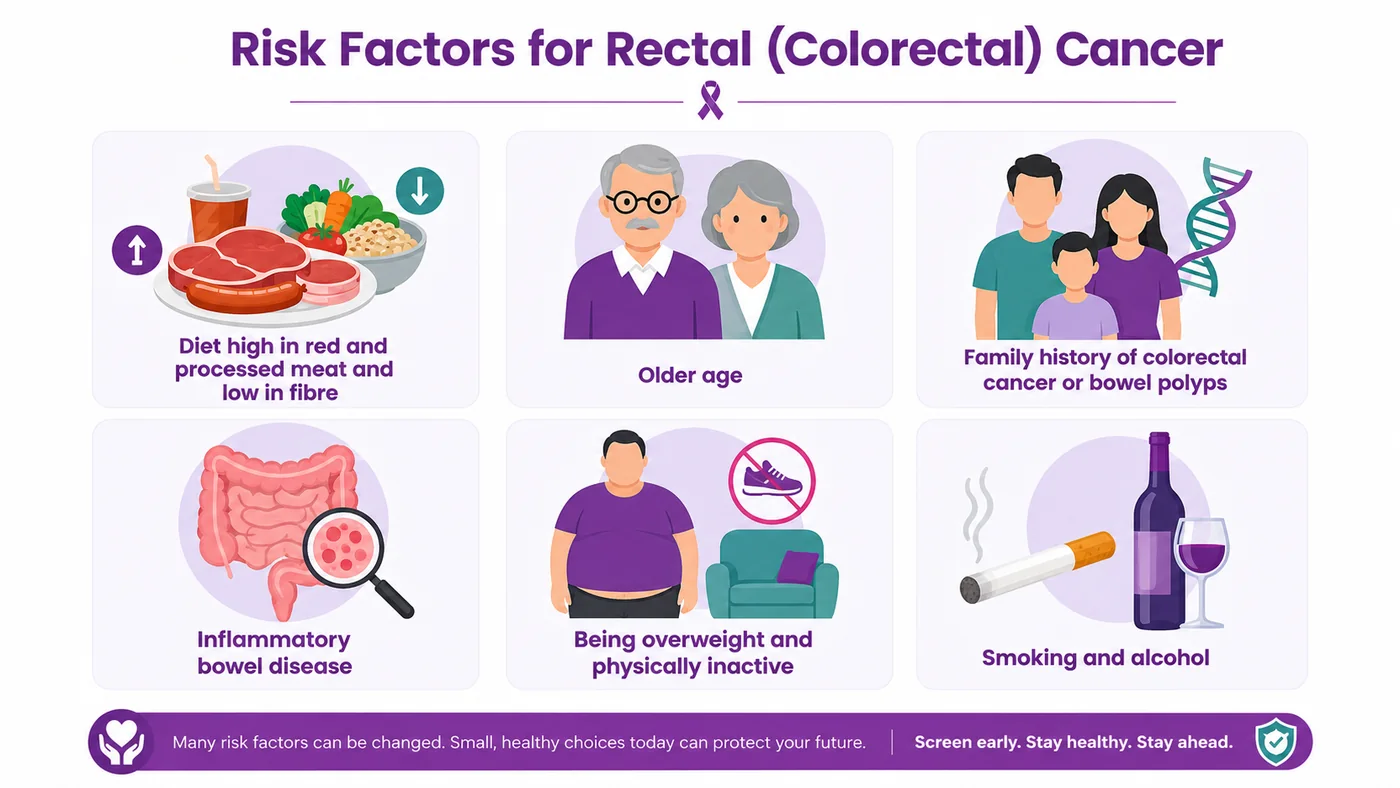
Rectal cancer risk is strongly linked to diet, lifestyle, age and family history. The main factors are a diet high in red and processed meat and low in fibre, older age, a family history of bowel cancer or polyps, inflammatory bowel disease, being overweight and inactive, and smoking and alcohol. Many are modifiable.
Cases are also rising in younger adults, so age alone shouldn't be reassuring — persistent symptoms deserve a check even under 45. A high-fibre diet, regular activity, and not smoking all lower your risk.
Screening & prevention
Screening can prevent rectal cancer
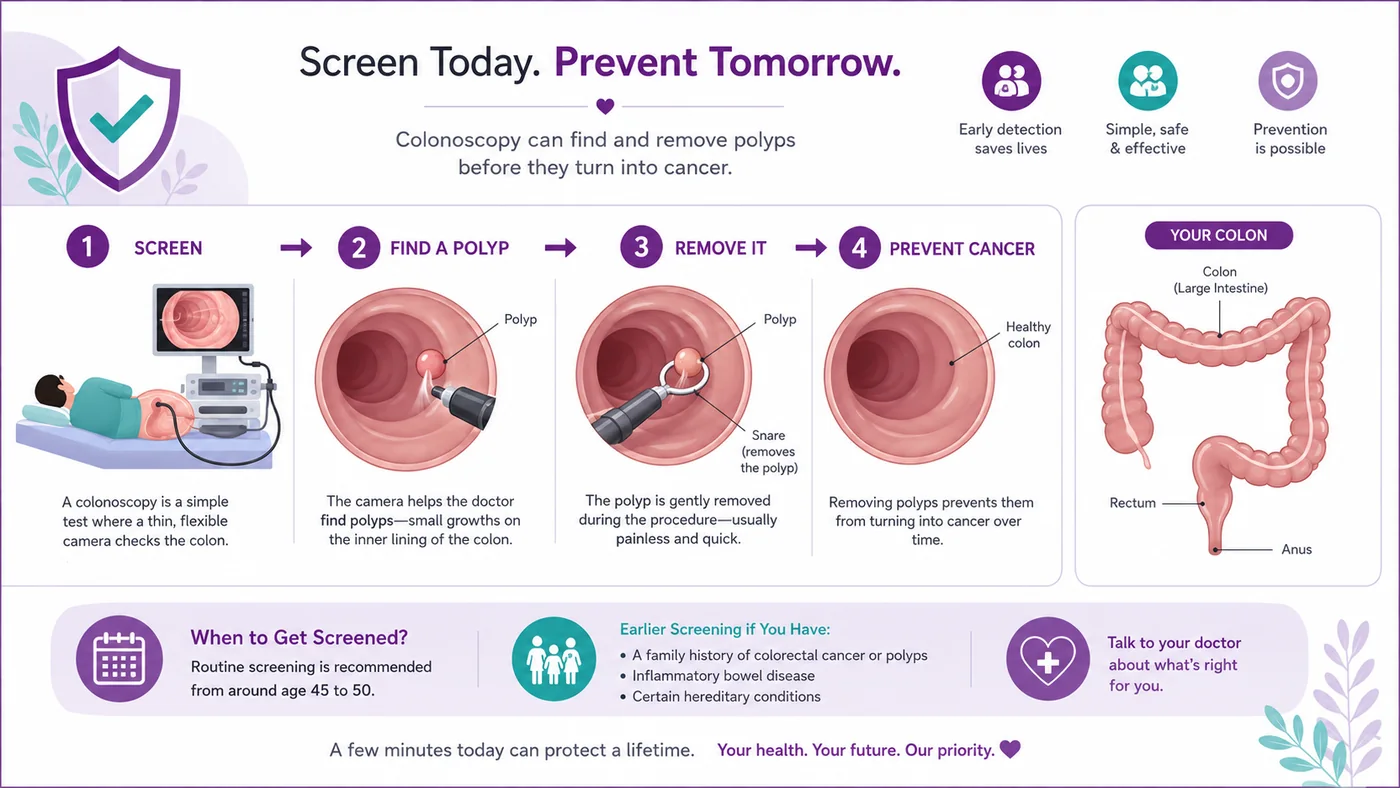
Rectal cancer is one of the few cancers that can often be prevented. A colonoscopy can find and remove polyps before they turn cancerous. Screening is generally recommended from around age 45–50 — or earlier with a family history of bowel cancer or polyps, or inflammatory bowel disease.
Screening finds and removes polyps before they become cancer.
Rectal cancer is grouped into stages 0 to IV, and the stage guides treatment more than almost anything else. It reflects how deep the tumour has grown, whether it has reached lymph nodes, and whether it has spread further. Early stages are often highly curable.
Understand the stages
Simplified for understanding. Your exact stage and plan are confirmed by your oncology team after scans and tests.
Diagnosis & tests
How rectal cancer is diagnosed
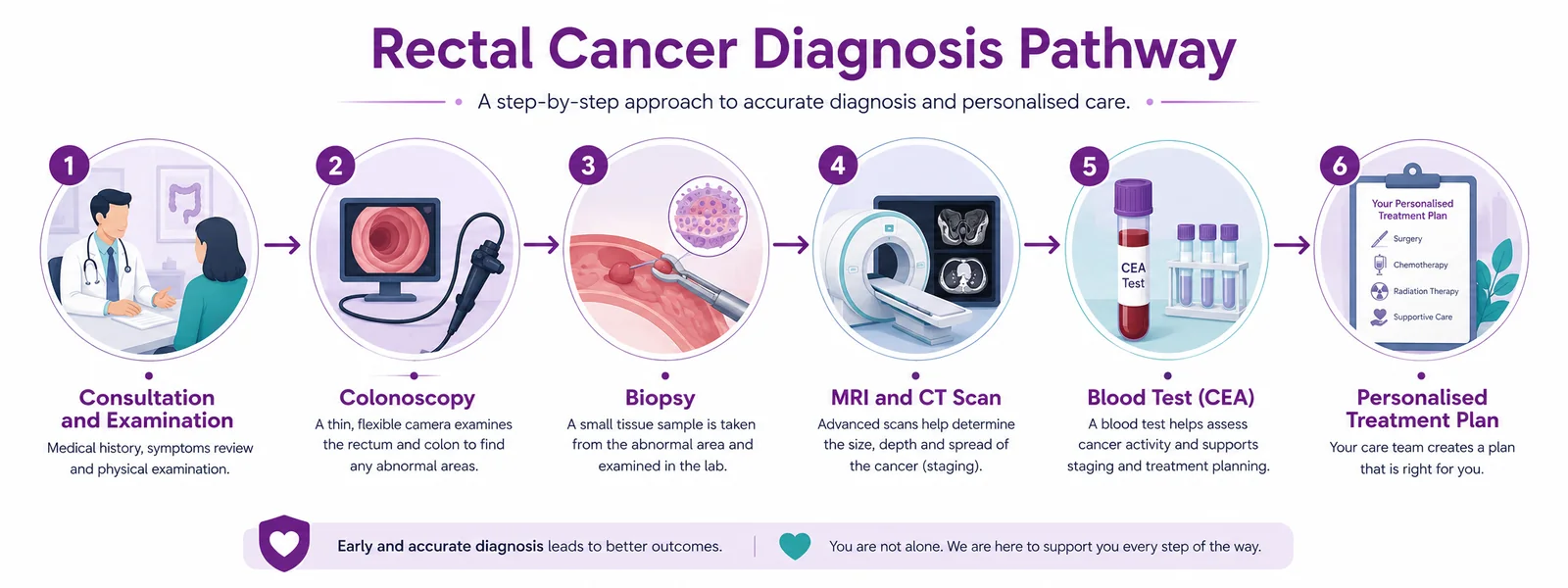
Diagnosis centres on a colonoscopy with a biopsy, plus an MRI and CT to stage the cancer. The colonoscopy lets the specialist see the rectum directly and take a tissue sample; a pelvic MRI shows how deep the tumour is, and a CEA blood test helps planning and follow-up.
From colonoscopy to a personalised plan.
Diagnostic services we offer — book any of these directly:
Colonoscopy
A direct look inside the rectum and colon that can both find and remove polyps — the key test to tell piles from cancer.
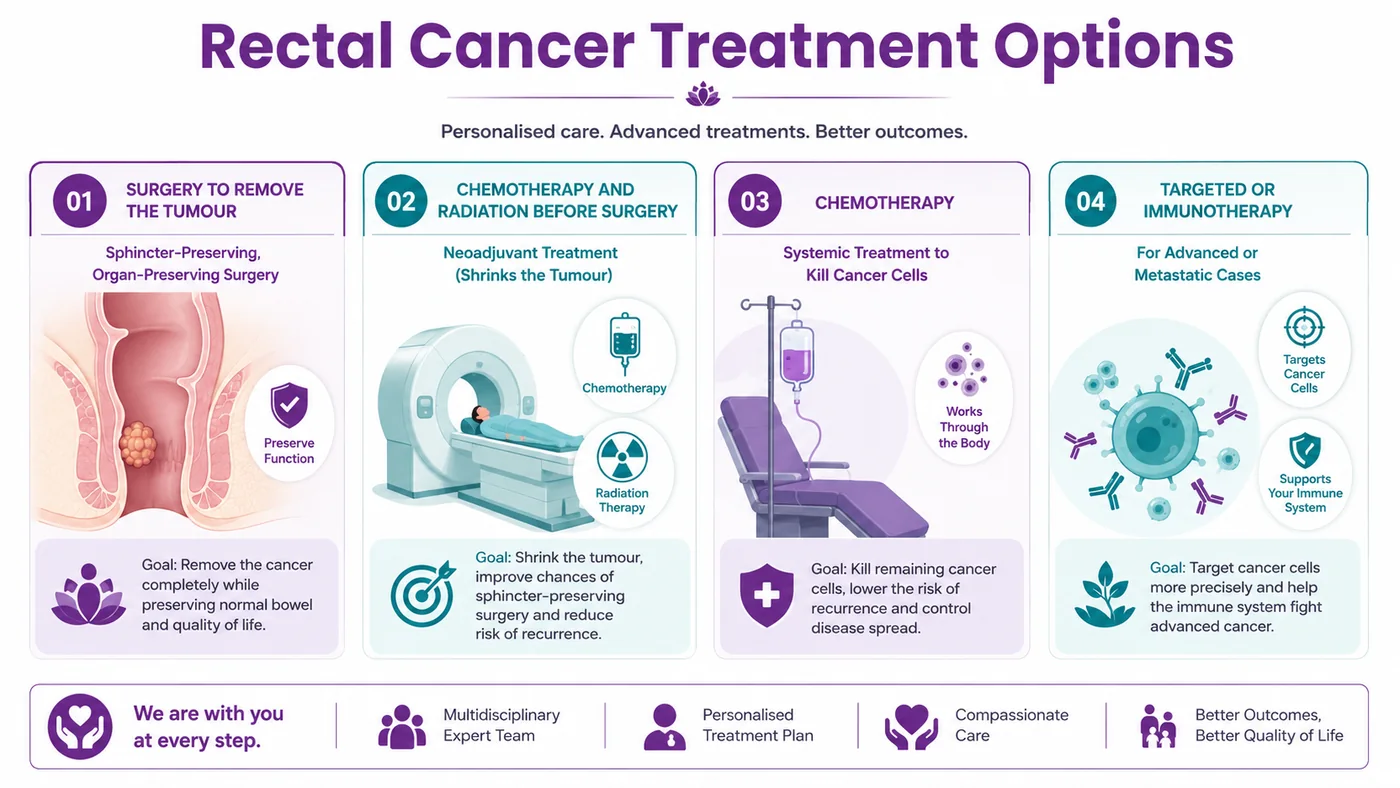
Treatment is planned by a team and often combines surgery with chemotherapy and radiation given before surgery. Giving treatment first can shrink the tumour, improve the chance of sphincter-preserving surgery, and reduce the need for a permanent colostomy.
Treatments we deliver — book a consult for any of these:
Sphincter-preserving surgery
Removing the tumour while preserving normal bowel function wherever possible — often minimally invasive and organ-preserving (including TME).
About the colostomy bag: many people fear a permanent bag — but with sphincter-preserving surgery and treatment given before surgery, it's often avoidable, and where a stoma is needed it is frequently temporary. Your surgeon explains what's realistic for you.
Indicative cost of rectal cancer treatment in Hyderabad
Cost depends on the stage, the surgery, and whether chemotherapy and radiation are needed — best given as an indicative range after assessment. Eligible treatment, including radiation, may be covered under Aarogyasri / PMJAY at empanelled centres.
Estimate an indicative range
Indicative range
—
Figures are indicative only and not a quotation. For an accurate estimate, request a callback.
A worry about rectal bleeding or a colonoscopy report shouldn't wait. Book a free consultation and, if you already have a biopsy, a free written second opinion.
Your colonoscopy & biopsy re-read by a specialist
Reviewed by a multidisciplinary tumour board
Aarogyasri / PMJAY & insurance guidance
Support
Financial support & Aarogyasri
Cost should not delay treatment. Under Aarogyasri and PMJAY, eligible rectal cancer treatment — including radiation — may be largely covered at empanelled centres. Our team helps check eligibility and guides you on insurance and EMI.
9 clinics in Hyderabad · 35+ across Telangana & AP
CION cancer care is closer than you think.
We're never more than 30 minutes away. Same panel of specialists at every centre. Same tumour board reviews. Same NCCN protocols. Pick the closest one and call directly — or let us pick for you.
Share your name and number — we'll call you back within 30 minutes to schedule your consultation.
Bleeding or a change in bowel habits that won't settle? Get it checked.
Most rectal bleeding is just piles — but a colonoscopy is the only way to be sure, and finding anything early changes everything. Our oncologists see colorectal cases every day.
Fear and embarrassment keep people away from care. Here are the worries we hear most about rectal cancer, and the facts.
“Blood when I go to the toilet is just piles.”
Fact: Often it is — but persistent bleeding, a change in bowel habits, or bleeding after 45 should be checked. A colonoscopy is the only reliable way to be sure, so don't simply assume.
“Rectal cancer means a permanent colostomy bag.”
Fact: Often avoidable — sphincter-preserving surgery and treatment given before surgery reduce the need for a permanent stoma, and where one is needed it's frequently temporary.
“I'll lose control of my bowels.”
Fact: Modern surgery aims to preserve the sphincter and nerves; many people regain good control, and rehabilitation supports recovery.
“A colonoscopy is unbearable and embarrassing.”
Fact: It's done with sedation, takes only a little time, and can prevent cancer by removing polyps — a few minutes for real peace of mind.
“I'm too young for bowel cancer.”
Fact: Rates are rising in younger adults. Persistent symptoms deserve a check at any age — don't let age delay you.
“Home remedies can treat the bleeding.”
Fact: Remedies may mask bleeding and delay diagnosis. Get persistent symptoms checked, and discuss anything complementary with your oncology team rather than relying on it.
“A biopsy or surgery will spread the cancer.”
Fact: Biopsy and surgery are safe, standard steps done under controlled conditions — they don't spread cancer. The real risk is delay, which lets a treatable cancer grow.
“Cancer is contagious — I can catch it.”
Fact: Rectal cancer is not infectious. You can't catch it from someone, share it through food, or pass it on by caring for a patient.
“If there's no pain, it can't be serious.”
Fact: Early rectal cancer is often painless, and the first sign may simply be bleeding or a change in bowel habits. Waiting for pain is what makes people present late.
“Radiation will make me radioactive.”
Fact: Standard external radiotherapy does not make you radioactive; you can be around family and children safely. Your team explains any exception clearly.
“Treatment is unaffordable — we can't manage it.”
Fact: Under Aarogyasri and PMJAY, eligible treatment (including radiation) may be largely covered at empanelled centres. We help check eligibility, insurance and EMI.
“Chemotherapy always means being bedridden and losing all my hair.”
Fact: Side effects vary by drug and are actively managed today. Many people continue daily life through treatment; your team supports you at every step.
“A second opinion will offend my doctor or waste time.”
Fact: A second opinion is normal and welcomed in cancer care — it confirms the plan and gives you confidence. At CION it's free when you have a biopsy report.
“Surgery will end my sex life or fertility.”
Fact: Modern rectal surgery aims to preserve the nerves that control these functions, and your team discusses fertility and function openly before treatment, with support available.
“Once it's cancer, there's no point treating it.”
Fact: Rectal cancer is very treatable, especially early — and even advanced disease can often be controlled with a combined approach. Treatment changes outcomes.
“Screening is only for people who already have symptoms.”
Fact: The opposite — screening is for people without symptoms. A colonoscopy can remove polyps before they ever become cancer, which is why it's advised from around 45.
“Telling my family will only worry them — better to hide it.”
Fact: Support improves outcomes. Families who know can help you attend appointments, eat well and stay on treatment. Hiding it usually delays care.
“Ayurvedic or herbal treatment is safer than surgery.”
Fact: No herbal remedy is proven to cure rectal cancer, and relying on one delays effective care. Tell your oncologist about anything you take so it's used safely alongside treatment.
Why CION
Why choose CION for rectal cancer care
A dedicated cancer network
CION treats cancer and only cancer — focused, patient-specific care, not a general hospital or a single-surgeon setup.
Multidisciplinary tumour board
Surgical, medical and radiation oncologists sequence surgery, chemotherapy and radiation together — critical for getting rectal cancer treatment in the right order.
Sphincter-preservation focus
We prioritise organ- and sphincter-preserving treatment to avoid a permanent colostomy wherever it's safe to do so.
Screening & early detection
We take rectal bleeding seriously rather than dismissing it as piles, and offer screening that can prevent cancer.
Affordable & transparent
Indicative costs up front, Aarogyasri/PMJAY support including radiation, and help with insurance and EMI.
Close, NABH-accredited care
9 clinics across Hyderabad and 35+ across Telangana & AP, within NABH-accredited facilities.
Real stories · real courage
15,000+ patients chose CION. Hear from them directly.
These aren't paid endorsements or written reviews. These are video testimonials from real patients and families — recorded on their own phones, in their own words. Pick any one. Watch it. Then decide.
4.8★800+ Google reviews
50+video testimonials
15,000+patients treated
Successful Chemotherapy & Radiation Done by Dr. Owais Mohammed & Dr. Kirti Ranjan
Watch video →
Successful Chemotherapy Done by Dr. C Raghavendra Reddy
Watch video →
Surgery, Chemo & Radiation Done by Dr. Imaduddin, Dr. Vinay, Dr. Owais, Dr. Kirti
Watch video →
Successful Radical Thymectomy Done by Dr. Mohammed Imaduddin & Dr. Vinay Mamidala
Watch video →
Successful Surgery Done by Dr. Rajender Byshetty
Watch video →
Successful Chemo & Surgery Done by Dr. Imad, Dr. Vinay, Dr. Owais & Dr. Raghavendra
Watch video →
Successful Chemo & Surgery Done by Dr. Imad, Dr. Vinay, Dr. Owais & Dr. Raghavendra
Watch video →
Successful Chemo & Radiation Done by Dr. Owais Mohammed & Dr. Kirti Ranjan Mohanty
Watch video →
Successful Breast Cancer Surgery Done by Dr. Imaduddin Mohammed & Dr. Vinay Mamidala
Watch video →
Successful Chemotherapy Done by Dr. Bharati Devi Gorantla
Watch video →
Successful Chemo & Surgery Done by Dr. Owais Mohammed & Dr. Imaduddin Mohammed
Watch video →
Successful Chemotherapy Done by Dr. Gundu Naresh
Watch video →
Successful Bone Marrow Transplantation - Neuroblastoma
Watch video →
Successful Surgery & Chemo - Carcinoma of Caecum
Watch video →
Successful Oral chemotherapy & mastectomy surgery
Watch video →
Successful Oral chemotherapy & mastectomy surgery
Watch video →
Successful Chemotherapy
Watch video →
Successful Surgery by Dr. Mohammed Imaduddin
Watch video →
Successful Bone Marrow Transplantation
Watch video →
Successful Oral chemotherapy & mastectomy surgery
Watch video →
Successful Oral chemotherapy & mastectomy surgery
Watch video →
Successful Chemotherapy
Watch video →
Successful Buccal Mucosa Surgery
Watch video →
Successful Complex Surgery Mandibulectomy Reconstruction
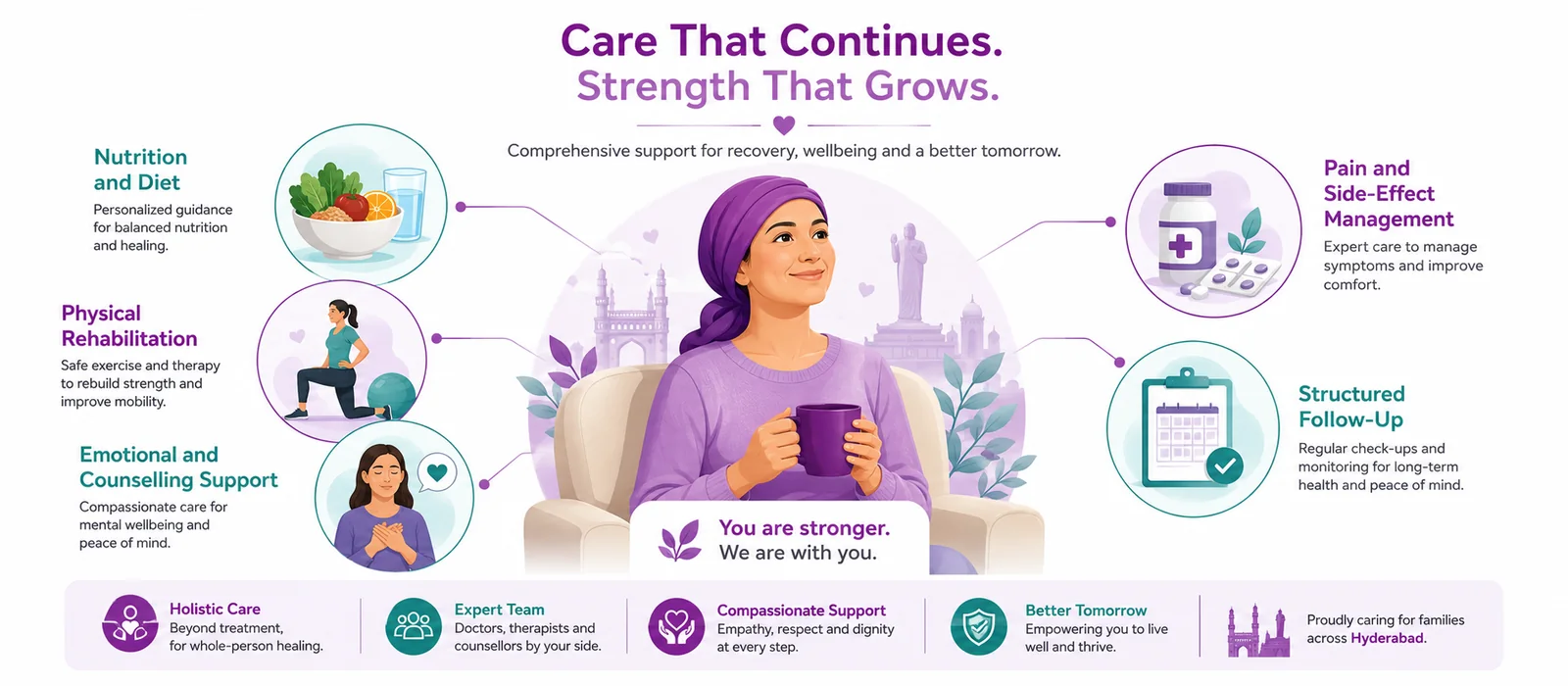
Rectal cancer care goes beyond treatment — stoma support, nutrition, wellbeing and follow-up are built in.
Stoma care & support
Practical guidance and support if a temporary or permanent stoma is part of your care. Learn more
Nutrition counselling
Diet support before and after treatment to keep strength and manage bowel changes. Learn more
Psycho-oncology
Emotional support for you and your family through diagnosis and recovery. Learn more
Pain & palliative care
Comfort and symptom control at any stage, alongside active treatment. Learn more
Survivorship & follow-up
Structured review after treatment to watch for recurrence and support recovery. Talk to us
Second opinion
A clear, unhurried review of your diagnosis and options — including whether a stoma can be avoided. Get a second opinion
FAQ
Frequently asked questions about rectal cancer
Is rectal cancer curable?
Rectal cancer is very treatable, especially when found early — early-stage disease is often cured, usually with surgery, and outcomes are good. More advanced disease is treated with a combination of chemotherapy, radiation and surgery. Your outlook depends mainly on the stage, which your team explains clearly after scans and tests.
Is rectal bleeding always cancer, or could it just be piles?
Usually it is piles (haemorrhoids), a fissure or another benign cause — not cancer. But bleeding that is persistent, comes with a change in bowel habits or weight loss, or occurs after 45, should be checked. A colonoscopy reliably tells the difference — do not just assume it is piles.
What are the early warning signs of rectal cancer?
The most common signs are blood in the stool or rectal bleeding and a lasting change in bowel habits. Others include narrow or thin stools, a feeling of not fully emptying the bowel, ongoing abdominal discomfort or cramps, and unexplained weight loss, tiredness or a low blood count. Any of these lasting more than a few weeks — especially together — should be checked.
Will I need a permanent colostomy bag?
Often not. Modern rectal cancer treatment focuses on sphincter-preserving surgery, and giving chemotherapy and radiation before surgery can shrink the tumour and reduce the need for a permanent stoma. Where a stoma is needed it is sometimes temporary and can later be reversed. Your surgeon explains what is realistic for your case.
When should I get a colonoscopy or colorectal cancer screening?
Screening looks for cancer or polyps before symptoms appear — a colonoscopy can find and remove polyps before they become cancer. Screening is generally recommended from around age 45 to 50, or earlier if you have a family history of bowel cancer or polyps, or inflammatory bowel disease. If you already have symptoms, you should be assessed regardless of age.
How is rectal cancer diagnosed?
Diagnosis centres on a colonoscopy, which lets the specialist see the rectum directly and take a biopsy (a small tissue sample) to confirm cancer. A pelvic MRI shows how deep the tumour is, a CT scan checks for spread, and a CEA blood test helps planning and follow-up. A biopsy is safe and does not spread cancer; it is the only way to be certain.
What are the stages of rectal cancer?
Rectal cancer is grouped into stages 0 to IV. Stage 0–I is very early and limited to the inner lining or wall of the rectum, often treated with surgery alone. Stage II has grown deeper into or through the rectal wall but not reached lymph nodes. Stage III has spread to nearby lymph nodes. Stage IV has spread to distant organs such as the liver or lungs. The stage guides treatment more than almost anything else.
What causes rectal cancer and what are the risk factors?
Rectal cancer risk is strongly linked to diet and lifestyle, age and family history. The main factors are a diet high in red and processed meat and low in fibre, older age, a family history of bowel cancer or polyps, inflammatory bowel disease, being overweight and physically inactive, and smoking and alcohol. Many of these are modifiable, so a high-fibre diet, activity and not smoking all lower risk.
Can rectal cancer be prevented?
To a large extent, yes — it is one of the few cancers that screening can prevent. A colonoscopy can find and remove polyps before they turn cancerous, and a high-fibre diet, regular exercise, a healthy weight, and avoiding tobacco and excess alcohol all reduce risk. Screening from around age 45 (earlier with a family history) is the single most effective step.
How much does rectal cancer treatment cost in Hyderabad?
Cost depends on the stage, the surgery, and whether chemotherapy and radiation are needed, so it is best given as an indicative range after assessment. Eligible treatment, including radiation, may be covered under Aarogyasri or PMJAY at empanelled centres. Use the cost estimator on this page for an indicative figure, then request a callback for an accurate estimate.
Is rectal cancer treatment covered by Aarogyasri or PMJAY?
Yes, for eligible patients. Under Aarogyasri and PMJAY, eligible rectal cancer treatment — including radiation therapy — may be largely covered at empanelled centres. Our team helps you check eligibility and complete the paperwork, and guides you on private insurance and EMI options if a scheme does not apply.
What is the difference between colon cancer and rectal cancer?
Both are colorectal (bowel) cancers and share many risk factors, but they differ by location: colon cancer starts higher in the large bowel, while rectal cancer starts in the rectum, the last few centimetres before the anus. Because the rectum sits low in the pelvis close to the sphincter, rectal cancer is often treated with radiation and chemotherapy before surgery to preserve function — an approach used less often for colon cancer.
What is neoadjuvant treatment (treatment before surgery)?
Neoadjuvant treatment means chemotherapy and/or radiation given before surgery. In rectal cancer it can shrink the tumour, improve the chance of sphincter-preserving surgery, lower the risk of the cancer coming back locally, and in some cases reduce the need for a permanent stoma. Your tumour board decides whether it is right for your stage.
Will treatment affect bowel control or sexual function?
It can, especially with surgery low in the rectum, but techniques today aim to preserve the nerves and the sphincter, and support and rehabilitation help recovery. Many people regain good bowel control over time. Your team discusses bowel, bladder and sexual function — and fertility where relevant — openly with you before treatment.
Can young adults get rectal cancer?
Yes. Rectal and colorectal cancer rates are rising in adults under 50 worldwide. Being young does not rule it out, so persistent rectal bleeding, a change in bowel habits, or unexplained weight loss should be checked at any age rather than assumed to be piles.
Does a biopsy or colonoscopy spread cancer?
No. A colonoscopy and biopsy are safe, standard procedures done under controlled conditions and do not spread cancer. A colonoscopy can actually prevent cancer by removing polyps, and a biopsy is the only reliable way to confirm a diagnosis. The real danger is delay, not the test.
What is the survival rate for rectal cancer?
Survival depends heavily on the stage at diagnosis — early-stage rectal cancer has much better outcomes than advanced disease, which is why acting on symptoms and screening matters so much. Rather than rely on a single figure, ask your oncologist for outcomes relevant to your specific stage and treatment plan.
Can rectal cancer come back after treatment?
It can, which is why structured follow-up matters. Regular reviews, scans and CEA blood tests after treatment watch for any recurrence so it can be caught and treated early. A healthy diet, activity and not smoking, along with keeping to your follow-up schedule, all support long-term recovery.
Which specialist should I see for rectal bleeding or suspected rectal cancer?
For persistent rectal bleeding or a change in bowel habits, see a surgical or gastrointestinal oncologist, who can arrange a colonoscopy. At CION, your case is reviewed by a team — surgical, medical and radiation oncologists together — so you get a coordinated plan rather than a single-doctor decision.
Explore
Explore rectal cancer care
Our complete guide to rectal cancer — treatment, doctors, screening, cost and the wider GI cluster. Tap any topic to read more.
Worried about a symptom? Talk to a CION oncologist.
Early answers change outcomes. Book a free consultation or second opinion at any of our 9 Hyderabad clinics — part of 35+ centres across Telangana & Andhra Pradesh.
Medical disclaimer: This page is for general information and awareness and does not replace professional medical advice, diagnosis or treatment. Always consult a qualified oncologist. Costs shown are indicative only and not a quotation. Content is periodically reviewed by CION's medical team.

 CION Ameerpet