An orchidectomy removes a testicle to treat testicular cancer — and for most men it is far less life-changing than it sounds. It usually means removing just one testicle, so testosterone, fertility and your sex life are typically unaffected; a natural-looking implant and sperm banking are available; and testicular cancer is one of the most treatable of all cancers. CION's surgical-oncology team guides you through every step.
One testicle usually preserves testosterone & fertility
Prosthesis & sperm-banking options
Among the most treatable cancers · Aarogyasri help
★★★★★Rated 4.8/5 · 800+ Google reviews
35+ centres, close to home
17 oncologists, one team
Among the most treatable cancers
Aarogyasri & insurance help
PR
Written by Dr. Purushotham Reddy K, Surgical Oncologist (MCh, Surgical Oncology). Medically reviewed by Dr. Srinivasulu Mukta, MCh (Surgical Oncology), 35+ years. · Reviewed 10 July 2026
Understanding the surgery
What is an orchidectomy — and why is it done?
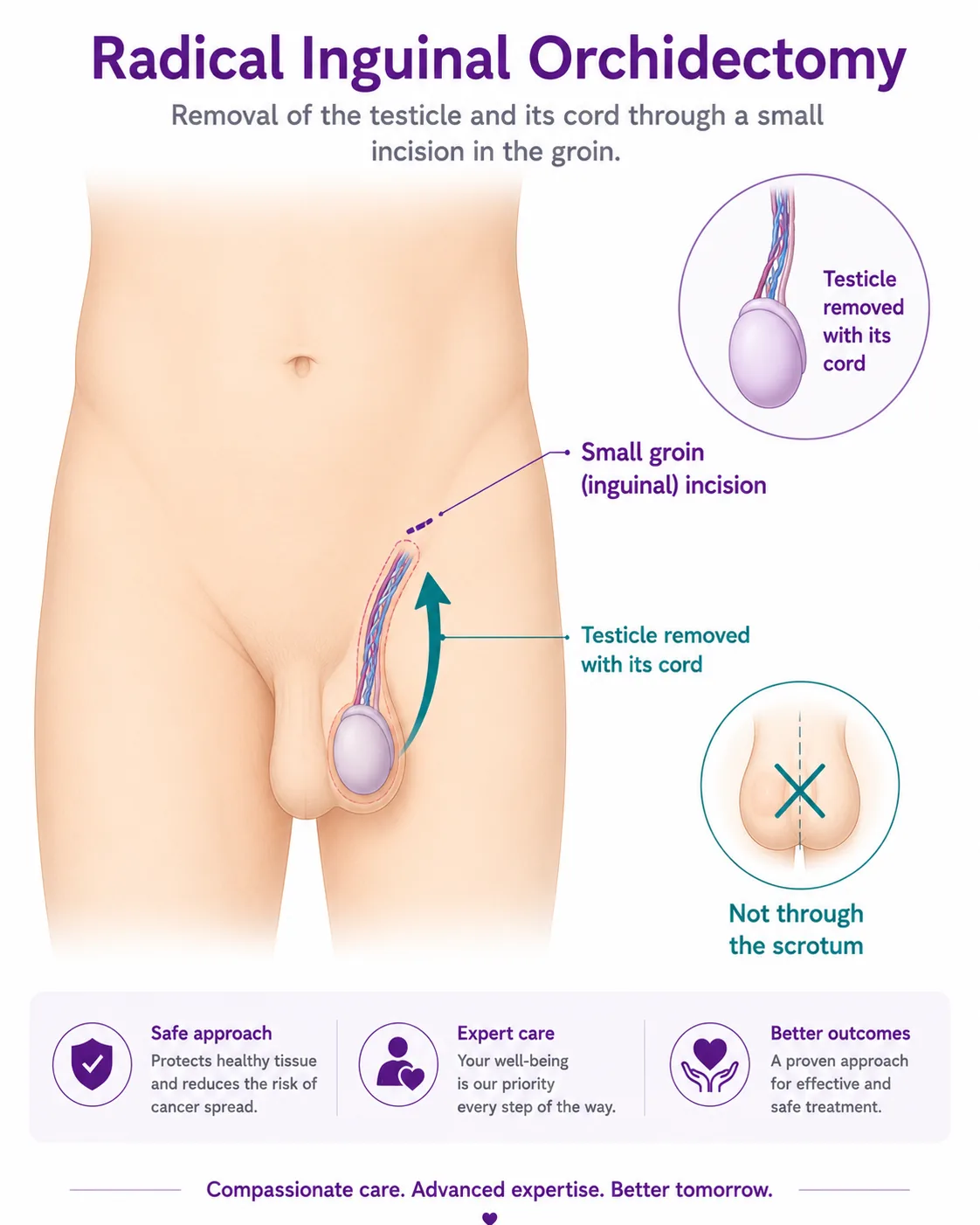
An orchidectomy (also spelled orchiectomy) is surgery to remove a testicle. For testicular cancer, it is a radical inguinal orchidectomy — the testicle is removed through a small cut in the groin, not through the scrotum, which is the safest way to treat the cancer. It is usually both the way the diagnosis is confirmed and the main treatment, and in most cases only the affected testicle is removed. A second, less common reason is to lower testosterone in advanced prostate cancer.
This page covers orchidectomy for cancer. Because only one testicle is usually removed, most men keep normal testosterone, fertility and sexual function — and where appearance or fertility are a concern, a natural-looking implant and sperm banking are available. At CION, the surgery is done by an experienced surgical-oncology team, with support for the emotional side that young men understandably feel.
Two reasons for an orchidectomy
Testicular cancer (main)
Radical inguinal orchidectomy to remove the affected testicle — usually just one — as the primary treatment for testicular cancer, and the way the diagnosis is confirmed.
Advanced prostate cancer
Bilateral orchidectomy to lower testosterone — a quick, one-time alternative to ongoing hormone injections. More below.
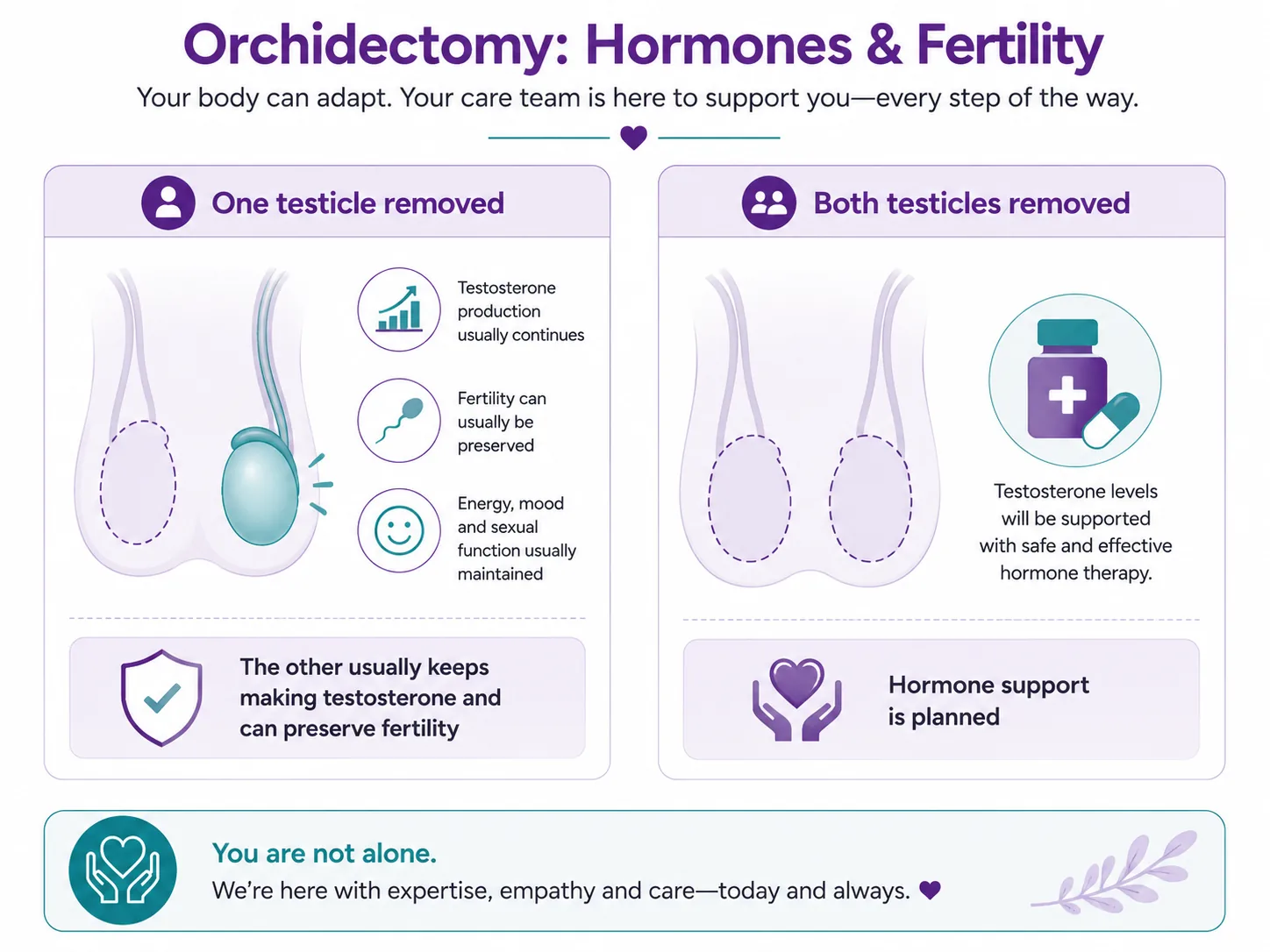
This is the worry almost every man carries, so here is the honest, reassuring answer: when only one testicle is removed — which is usual — the remaining testicle keeps making testosterone and sperm, so your masculinity, sex life and, in most cases, your fertility are unaffected. You do not become “less of a man.” Because treatment that may follow can affect fertility, sperm banking before any further treatment is a simple, important safeguard. And if both testicles ever need to be removed, hormone support keeps you well.
Testosterone & sex life
One remaining testicle usually keeps testosterone at normal levels, so energy, mood, erections and sex life are typically unchanged.
Fertility
Most men remain fertile with one testicle. As later treatment can affect fertility, sperm banking beforehand keeps your options open — ask about it early.
Appearance
A natural-looking silicone implant (prosthesis) can restore the look and feel, placed during the surgery or later — entirely your choice.
If both are removed
In the rare case both testicles are removed, safe and effective hormone (testosterone) support keeps your wellbeing, libido and function.
These are common, valid questions, and our team discusses them openly and without embarrassment. Psycho-oncology counsellors support you and, if you wish, your partner.
With one testicle removed, the other usually keeps testosterone and fertility; if both are removed, hormone support is planned.
Diagnosis & staging
Tests that confirm testicular cancer and guide surgery
A painless lump or swelling in a testicle is the most common sign — and it should be checked without delay. A scrotal ultrasound and blood tumour-marker tests point to the diagnosis; the orchidectomy itself confirms it, and scans then check whether it has spread. Your team uses these to decide, with you, exactly what comes next.
Diagnostic services we offer — book any of these:
Scrotal ultrasound
A quick, painless scan of the testicle — usually the first test when a lump or swelling is found.
A radical inguinal orchidectomy is a short, well-established operation, usually under an hour. The testicle is removed together with its cord through a small incision in the groin — not through the scrotum — because this is the safe way to remove a cancer without disturbing it. It is often a day-care procedure or a single overnight stay. If you would like, a natural-looking silicone implant (prosthesis) can be placed to restore the appearance, during the same operation or later.
Why through the groin?
Removing the testicle and its cord through the groin avoids disturbing the cancer and reduces the risk of spread — the recognised standard for testicular cancer.
The prosthesis (implant)
A soft silicone implant looks and feels natural in the scrotum. Many men choose it for confidence; many are comfortable without it. There is no right answer — only your preference.
The testicle is removed through a small groin (inguinal) incision, not the scrotum — the safest approach for cancer.
Treatment
Testicular cancer treatments we deliver
The orchidectomy is usually the main step — but it is rarely the whole story. After surgery, many men need only careful monitoring (surveillance); some are advised a course of chemotherapy or radiation based on the type and stage. Fertility preservation and a prosthesis are offered alongside. CION delivers the full pathway and helps you choose.
Services we deliver — book a consult for any of these:
Radical inguinal orchidectomy
Removal of the affected testicle through the groin — the primary treatment for testicular cancer, usually just one side.
Recovery from the operation is usually quick: mild soreness for a few days, back to light activity within a week or two, and to full activity and sport over a few weeks. Afterwards, blood tumour-marker tests and scans confirm the exact type and stage, which guides what — if anything — comes next: for many men, careful monitoring is enough; for some, a course of chemotherapy or radiation is advised. Testicular cancer responds very well to treatment, even when it has spread, and follow-up keeps you on track.
1
Surgery day
A short operation, often under an hour; day-care or one overnight stay.
2
Home recovery (1–2 wks)
Mild soreness; back to light activity soon, avoiding heavy lifting and sport at first.
3
Markers & staging
Blood tumour markers and scans confirm the type and stage to guide next steps.
4
Further treatment (if needed)
Often just monitoring; sometimes chemotherapy or radiation, depending on type and stage.
5
Follow-up
Regular checks and marker tests — testicular cancer has an excellent long-term outlook.
Most men return to work, sport and normal life within a few weeks. With one testicle, life continues as before — including relationships and, for most, fatherhood. The emotional side is real too, especially for younger men, and support is part of your care from the start.
Cost & coverage
Orchidectomy cost in Hyderabad Indicative
In Hyderabad, an orchidectomy is typically an indicative ₹60,000 – ₹1,50,000 — a relatively short operation, often day-care or a one-night stay. Adding a testicular implant increases it. Under Aarogyasri / PMJAY, eligible cancer surgery at empanelled centres may be largely covered, and insurance is accepted cashless. These are estimates, not a quotation; any further treatment such as chemotherapy is costed separately.
Indicative cost estimator
Pick your situation for an indicative range, then request an exact estimate for your case.
Indicative range
₹60,000 – ₹1,30,000
for a radical inguinal orchidectomy, no prosthesis, general room, self-pay
Figures are indicative only and not a quotation. Aarogyasri / PMJAY may cover eligible cancer surgery at empanelled centres, subject to eligibility. Any further treatment is costed separately.
A lump you noticed, or a diagnosis you've just had, shouldn't wait — and there is nothing embarrassing about getting it checked. Book a free, confidential consultation and, if you already have reports, a free second opinion.
Your reports reviewed by a senior surgical oncologist
Honest answers on fertility, testosterone and the prosthesis
Aarogyasri / PMJAY & insurance guidance
The prostate-cancer context
Bilateral orchidectomy for advanced prostate cancer
Advanced prostate cancer is driven by testosterone, so lowering it slows the cancer. This can be done with regular hormone injections, or with a small, one-time operation to remove both testicles (a bilateral orchidectomy) — which lowers testosterone permanently without ongoing injections or their cost. It is a quick, usually day-care procedure, and for some men it is the simpler, more affordable choice. Your oncologist explains both options honestly so you can decide.
How it helps
Removing both testicles lowers the testosterone that fuels prostate cancer — an effective, permanent form of hormone therapy, without repeat injections.
What to expect
Like other hormone therapy, it can bring hot flushes, reduced libido and other effects, which are managed and supported. See also our prostatectomy in Hyderabad page.
Support
Financial support & Aarogyasri
Cost should never be the reason to delay getting checked or treated. An orchidectomy is a relatively modest, often day-care operation — among the more affordable cancer surgeries — and under Aarogyasri and PMJAY, eligible cancer surgery may be largely covered at empanelled centres, with private insurance accepted cashless. Our counsellors check eligibility, arrange approvals and map out what you will actually pay, including any further treatment.
9 clinics in Hyderabad · 35+ across Telangana & AP
CION cancer care is closer than you think.
We're never more than 30 minutes away. Same panel of specialists at every centre. Same tumour board reviews. Same NCCN protocols. Pick the closest one and call directly — or let us pick for you.
Don't see your city? Call
18002028726
— we'll find your nearest CION partner centre.
Meet the surgical oncology team
Your orchidectomy is performed by a team, not one doctor.
Fellowship-trained surgical oncologists who treat cancer day in, day out — part of 17 senior specialists across CION, with medical and radiation oncology in the same tumour board.
Share your name and number — we'll call you back within 30 minutes to schedule your consultation.
Found a lump? Don't wait — and don't be embarrassed.
A painless testicular lump is the most common sign of a highly treatable cancer. Getting checked is quick, private and the strong, sensible thing to do. Let CION's team review it honestly.
These are the worries young men rarely say out loud. Here are honest, respectful answers to the ones we hear most in Telangana.
“Will I still be a man — and will people be able to tell?”
Fact: Yes, you very much remain a man. With one testicle removed — the usual case — the other keeps making testosterone, so your strength, voice, mood and sex life stay the same. Nothing changes visibly to others, and a natural-looking silicone implant can restore the appearance completely if the space bothers you. Either choice is normal.
“Will I be able to have children?”
Fact: Most men remain fertile with one testicle, so fatherhood is very much still possible. The important safeguard is that treatments which may follow can affect fertility — so sperm banking before any further treatment protects your options. It is a simple, private step our team raises early.
“Will my sex life change?”
Fact: For most men, no. With one testicle producing normal testosterone, erections, desire and sexual function usually continue exactly as before. The operation is on the testicle, not on the nerves involved in erections. If both are ever removed, testosterone support keeps libido and function well.
“I'm too embarrassed to get a lump checked — can I wait and see?”
Fact: Please don't wait. A painless lump is the most common sign of testicular cancer, and embarrassment is the main reason young men delay — losing the time that makes treatment easiest. Examinations are quick and private, most lumps turn out harmless, and if it is cancer, it is one of the most treatable of all.
“Can a middle-class family afford it?”
Fact: An orchidectomy is a relatively modest, often day-care operation — among the more affordable cancer surgeries. Aarogyasri and PMJAY cover eligible cancer surgery at empanelled centres, insurance is accepted cashless, and our counsellors help check eligibility and map costs. Cost should never delay getting checked.
“Will the surgery spread the cancer?”
Fact: No — the operation is specially designed to prevent that. The testicle is removed through the groin, with its cord, precisely so the cancer is not disturbed or given a route to spread. This is why a needle biopsy through the scrotum is avoided. Delay is the real risk, not the surgery.
“Losing a testicle will ruin my marriage prospects.”
Fact: It need not, and this is a treatable, manageable, private matter — not a barrier to a full family life. With one testicle, testosterone, sex life and, for most, fertility continue. Many men marry and become fathers after an orchidectomy. A prosthesis and, if you wish, counselling are there to support your confidence.
“Will I need a lifelong hormone injection or medicine?”
Fact: Not when only one testicle is removed — the remaining one makes all the testosterone your body needs, so no hormone medicine is required. Hormone support is only planned in the rare case both testicles are removed, and it keeps you well.
“A painless lump is probably harmless, so I can ignore it.”
Fact: Most testicular lumps are painless, and that is exactly why they get ignored — the absence of pain is not reassurance. Any new lump, swelling or change in a testicle should be checked promptly with a quick, private examination and scan. Catching it early keeps treatment simplest.
“Everyone at work and home will know what surgery I had.”
Fact: No one needs to know anything you don't choose to share. Your care is confidential, the incision is small and in the groin, and there is no visible change to others — especially if you choose an implant. Many men return to work within a week or two with no questions asked.
“The operation will be very painful with a long hospital stay.”
Fact: A radical inguinal orchidectomy is a short operation, usually under an hour, and often a day-care procedure or a single overnight stay. Pain is generally mild and well controlled, and most men are back to light activity within a week or two.
“If I need chemotherapy after, it must be very serious.”
Fact: Needing chemotherapy does not mean a poor outcome — testicular cancer responds very well to treatment, even when it has spread. For many men, surgery plus monitoring is enough; for others, a course of chemotherapy or radiation is a planned, effective next step, not a bad sign.
“Herbal or home remedies can shrink the lump instead.”
Fact: No home or herbal remedy is proven to treat testicular cancer, and relying on one wastes the window when it is most treatable. Please get any lump checked and tell your oncologist about anything you take, so it can be used safely alongside proper treatment.
“A testicular implant will be obvious or uncomfortable.”
Fact: A modern silicone prosthesis is soft and designed to look and feel natural in the scrotum. Many men are comfortable with one and forget it is there; many others are happy without one. It can be placed during the surgery or later — there is no pressure either way.
“I'm too young for this to be cancer.”
Fact: Testicular cancer is actually most common in younger men, often in their teens, twenties and thirties — so being young is a reason to check a lump, not to dismiss it. It is also among the most treatable cancers, and early care makes treatment simpler.
“With one testicle, my body is incomplete now.”
Fact: One healthy testicle does the full job — making testosterone and sperm — so your body continues to function normally. Removing a cancerous testicle is a decisive step toward health, not a loss of wholeness, and a prosthesis can restore the appearance if you wish.
“Getting a second opinion will offend my doctor or waste time.”
Fact: A second opinion is normal and welcomed in cancer care — it confirms the plan and gives you confidence. At CION it can be arranged quickly, reviewing your ultrasound, markers and reports together, so you decide with clarity rather than fear.
“It's safer to have a biopsy through the scrotum first.”
Fact: For a suspected testicular cancer, a needle biopsy through the scrotum is deliberately avoided, because it can disturb the cancer. The safe, standard approach is a radical inguinal orchidectomy — removing the testicle through the groin — which both confirms the diagnosis and treats it.
Why CION
Why choose CION for your orchidectomy in Hyderabad
Experienced surgical-oncology team
Radical inguinal orchidectomy done the recognised, standard way, by surgical oncologists who treat cancer every day.
Fertility protected early
Sperm banking is raised and arranged before any further treatment — so your future family options stay open.
Prosthesis available
A natural-looking implant can be placed during surgery or later — your choice, no pressure.
Reassurance, not alarm
We explain honestly that one testicle usually preserves testosterone, fertility and sex life — and that this is a highly treatable cancer.
Emotional support for young men
Confidential psycho-oncology support for body image, relationships and anxiety — for you and, if you wish, your partner.
Care closer to home + Aarogyasri
35+ centres across Telangana & AP, Telugu-speaking teams, and full Aarogyasri / insurance counselling.
Real stories · real courage
15,000+ patients chose CION. Hear from them directly.
These aren't paid endorsements or written reviews. These are video testimonials from real patients and families — recorded on their own phones, in their own words. Pick any one. Watch it. Then decide.
4.8★800+ Google reviews
50+video testimonials
15,000+patients treated
Successful Chemotherapy & Radiation Done by Dr. Owais Mohammed & Dr. Kirti Ranjan
Watch video →
Successful Chemotherapy Done by Dr. C Raghavendra Reddy
Watch video →
Surgery, Chemo & Radiation Done by Dr. Imaduddin, Dr. Vinay, Dr. Owais, Dr. Kirti
Watch video →
Successful Radical Thymectomy Done by Dr. Mohammed Imaduddin & Dr. Vinay Mamidala
Watch video →
Successful Surgery Done by Dr. Rajender Byshetty
Watch video →
Successful Chemo & Surgery Done by Dr. Imad, Dr. Vinay, Dr. Owais & Dr. Raghavendra
Watch video →
Successful Chemo & Surgery Done by Dr. Imad, Dr. Vinay, Dr. Owais & Dr. Raghavendra
Watch video →
Successful Chemo & Radiation Done by Dr. Owais Mohammed & Dr. Kirti Ranjan Mohanty
Watch video →
Successful Breast Cancer Surgery Done by Dr. Imaduddin Mohammed & Dr. Vinay Mamidala
Watch video →
Successful Chemotherapy Done by Dr. Bharati Devi Gorantla
Watch video →
Successful Chemo & Surgery Done by Dr. Owais Mohammed & Dr. Imaduddin Mohammed
Watch video →
Successful Chemotherapy Done by Dr. Gundu Naresh
Watch video →
Successful Bone Marrow Transplantation - Neuroblastoma
Watch video →
Successful Surgery & Chemo - Carcinoma of Caecum
Watch video →
Successful Oral chemotherapy & mastectomy surgery
Watch video →
Successful Oral chemotherapy & mastectomy surgery
Watch video →
Successful Chemotherapy
Watch video →
Successful Surgery by Dr. Mohammed Imaduddin
Watch video →
Successful Bone Marrow Transplantation
Watch video →
Successful Oral chemotherapy & mastectomy surgery
Watch video →
Successful Oral chemotherapy & mastectomy surgery
Watch video →
Successful Chemotherapy
Watch video →
Successful Buccal Mucosa Surgery
Watch video →
Successful Complex Surgery Mandibulectomy Reconstruction
An orchidectomy is more than an operation — especially for a young man. At CION, emotional support, fertility, nutrition, comfort and rehabilitation are one coordinated plan.
Psychology counselling
Body-image, confidence and relationship support for you and your partner. Learn more
Nutrition counselling
Strength and general health through treatment and recovery. Learn more
Genetic counselling
Hereditary-risk guidance where a family pattern is suspected. Learn more
Rehabilitation
Physiotherapy and recovery support to get you back to sport and life. Learn more
Palliative & comfort care
Comfort and symptom support at any stage, alongside treatment. Learn more
Financial counselling
Aarogyasri, PMJAY and cashless insurance guidance so cost never blocks care. Learn more
FAQ
Orchidectomy in Hyderabad — frequently asked questions
How much does an orchidectomy cost in Hyderabad?
In Hyderabad, an orchidectomy is typically an indicative ₹60,000 to ₹1,50,000 — a relatively short operation, often day-care or a one-night stay. Adding a testicular implant increases it. Under Aarogyasri / PMJAY, eligible cancer surgery at empanelled centres may be largely covered, and insurance is accepted cashless. Any further treatment such as chemotherapy is costed separately, and CION gives an accurate estimate after assessment.
Is an orchidectomy covered under Aarogyasri?
Eligible testicular-cancer surgery, including a radical inguinal orchidectomy, may be covered under Aarogyasri and PMJAY at empanelled centres, subject to eligibility. CION's counsellors help you check whether you qualify, arrange approvals and handle the paperwork, so cost is far less of a barrier than most families expect.
What is a radical inguinal orchidectomy?
It is surgery to remove the affected testicle together with its cord through a small incision in the groin (the inguinal region) — not through the scrotum. Removing it through the groin is the safe standard for testicular cancer, because it avoids disturbing the cancer. The operation both confirms the diagnosis and treats it, and usually only one testicle is removed.
Will I still be able to have children after an orchidectomy?
Most men remain fertile after removal of one testicle, as the other continues to produce sperm. Because later treatments such as chemotherapy or radiation can affect fertility, sperm banking before any further treatment is recommended to protect your options. Raise it early with your team — it is a simple, private step.
Will removing a testicle affect my testosterone and sex life?
Usually not. One remaining testicle typically keeps testosterone at normal levels, so energy, mood, erections and sex life continue as before. The surgery does not affect the nerves involved in erections. If both testicles are removed, testosterone support maintains wellbeing and function.
Can I have a testicular implant (prosthesis)?
Yes. A soft silicone implant that looks and feels natural can be placed in the scrotum, either during the orchidectomy or at a later date. Many men choose it for confidence; many are comfortable without one. It is entirely your choice, with no pressure either way.
How long is recovery after an orchidectomy?
Recovery is usually quick — mild soreness for a few days, back to light activity within a week or two, and to full activity and sport over a few weeks. It is often a day-care procedure or a single overnight stay. Your team guides your return to work and exercise.
Is an orchidectomy the only treatment I'll need?
Often, the surgery plus monitoring (surveillance) is enough. For some men, a course of chemotherapy or radiation is advised based on the type and stage, confirmed by tumour-marker blood tests and scans after surgery. Testicular cancer responds very well to treatment, even when it has spread.
What is sperm banking, and when should I do it?
Sperm banking is storing a sample of sperm before treatment so you can have children later if treatment affects fertility. Because chemotherapy or radiation that may follow surgery can reduce fertility, it is best done before any further treatment. It is a simple, private process our team raises early so nothing is left to chance.
Why is the testicle removed through the groin and not the scrotum?
Removing the testicle and its cord through a small groin (inguinal) incision avoids disturbing the cancer and reduces the risk of spread — it is the recognised standard for testicular cancer. For the same reason, a needle biopsy through the scrotum is avoided when cancer is suspected.
Which is the best hospital for an orchidectomy in Hyderabad?
Look for a cancer centre with experienced surgical (uro-)oncology surgeons, fertility (sperm-banking) support, a prosthesis option, and psycho-oncology support for younger men. CION Cancer Clinics offers these across 35+ centres in Telangana and Andhra Pradesh, with Aarogyasri and insurance counselling.
How treatable is testicular cancer?
Testicular cancer is one of the most treatable of all cancers, and it responds very well to treatment even when it has spread. Getting a lump checked early keeps treatment simplest, but even later-stage disease is treated with a high degree of success. Removing the testicle promptly is a decisive, effective step.
Will the surgery spread the cancer?
No — the operation is designed to prevent that. The testicle is removed through the groin, with its cord, precisely so the cancer is not disturbed or given a route to spread. This is why a scrotal needle biopsy is avoided. Removing the testicle promptly is one of the safest and most effective steps against testicular cancer; delay is the real risk.
I found a painless lump — should I still get it checked?
Yes, promptly. A painless lump or swelling in a testicle is the most common sign of testicular cancer, and the absence of pain is not reassurance. The examination is quick and private, most lumps turn out to be harmless, and if it is cancer, early care keeps treatment simplest. There is nothing to be embarrassed about.
Why is an orchidectomy used for prostate cancer too?
Advanced prostate cancer is driven by testosterone. Removing both testicles (a bilateral orchidectomy) lowers testosterone permanently — a quick, one-time alternative to ongoing hormone injections. It has similar effects to hormone-lowering medicines, and your oncologist helps you choose between them.
Will an orchidectomy make me less masculine or weaker?
No. With one testicle removed, the other keeps testosterone at normal levels, so strength, energy, voice and sex life are typically unchanged — you do not become "less of a man." Removing a testicle to treat cancer is a sign of strength, not a loss of manhood, and a prosthesis can restore the appearance if you wish.
What tests will I need before and after the surgery?
Before surgery you will usually have a scrotal ultrasound and blood tumour-marker tests (AFP, β-hCG, LDH). The removed testicle is examined under a microscope (histopathology) to confirm the exact type, and staging scans such as a CT check whether the cancer has spread. These results guide whether monitoring or further treatment is advised.
Can I go back to work and sport after an orchidectomy?
Yes. Most men return to work within a week or two and to full activity and sport over a few weeks, building up gradually and avoiding heavy lifting at first. With one testicle, day-to-day life — including relationships and, for most, fatherhood — continues as before.
Explore
Explore testicular cancer care at CION
Treatment, surgery, tests and support around testicular cancer. Tap any topic to read more.
Early answers change outcomes. Book a free consultation or second opinion at any of our 9 Hyderabad clinics — part of 35+ centres across Telangana & Andhra Pradesh.
Medical disclaimer: This page provides general information about orchidectomy for testicular and prostate cancer and is not a substitute for professional medical advice, diagnosis or treatment. Costs shown are indicative only and not a quotation. Testicular cancer is highly treatable, but no outcome can be guaranteed. Always consult a qualified oncologist about your individual care. Content is periodically reviewed by CION's medical team.

 CION Ameerpet