
Lymphoma diagnosis & tests · Hyderabad
The Deauville score is the 1-to-5 scale your team uses to read a PET scan in lymphoma.
On this page
The Deauville 5-point scale reads your PET uptake against two internal references: the mediastinal blood pool and the liver. A lower number generally means less active disease.
The Deauville score on your report
Tap the number on your report to see what it usually means.
Complete metabolic response
A Deauville 1 means no uptake above background. On an interim PET, a fall to 1-3 is reassuring and suggests the lymphoma is responding well. On an end-of-treatment PET, 1-3 is usually called a complete metabolic response.
Complete metabolic response
A Deauville 2 means uptake at or below the blood pool in the middle of your chest. On an interim PET, a fall to 1-3 is reassuring and suggests the lymphoma is responding well. On an end-of-treatment PET, 1-3 is usually called a complete metabolic response.
Usually a good response, read in context
A Deauville 3 means uptake above the blood pool in your chest but at or below your liver. On an interim PET, some teams treat a 3 differently from a 1-2, so ask how your team reads it. On an end-of-treatment PET, 1-3 is usually called a complete metabolic response.
Residual active disease possible
A Deauville 4 means uptake moderately higher than the liver. On an interim PET, a persistent 4-5 may prompt a closer look or a change of approach, decided after tumour-board review. On an end-of-treatment PET, a 4-5 suggests residual active disease and may lead to further tests, a repeat scan or a repeat biopsy before any next step.
Active disease, needs close review
A Deauville 5 means uptake markedly higher than the liver, or a new site of disease. On an interim PET, a persistent 4-5 may prompt a closer look or a change of approach, decided after tumour-board review. On an end-of-treatment PET, a 4-5 suggests residual active disease and may lead to further tests, a repeat scan or a repeat biopsy before any next step.
Reported separately
A Deauville X marks new uptake that is unlikely to be related to lymphoma. It is reported separately for clarity, so ask your team what they think it shows.
No clear score to check
Can't find a Deauville number on your report, or not sure which one is yours? A specialist can find it and go through it with you.
Want a specialist to go through your report with you? The consultation is free.
Book free consultation| Score | What the PET shows | Usual meaning |
|---|---|---|
| 1 | No uptake above background | Complete metabolic response |
| 2 | Uptake at or below the mediastinal blood pool | Complete metabolic response |
| 3 | Uptake above the mediastinum but at or below the liver | Usually a good response — interpreted in context |
| 4 | Uptake moderately higher than the liver | Residual metabolically active disease possible |
| 5 | Uptake markedly higher than the liver, or any new site of disease | Active disease — needs close review |
| X | New uptake unlikely to be related to lymphoma | Reported separately for clarity |
The mediastinal blood pool is the blood in the middle of your chest. Uptake is how brightly an area takes up the tracer and glows on the scan.
Scores 1-3 are generally read as a favourable response and 4-5 as possible residual disease — but the exact cut-off depends on whether it is an interim or end-of-treatment scan, and on your lymphoma type. Scoring follows the Lugano classification and NCCN/ESMO guidance. Outcomes vary by individual.
The score is given by the nuclear medicine doctor or radiologist who reads your scan. Many reports also use one of four response terms from the Lugano criteria:
Complete metabolic response (CMR): no meaningful lymphoma activity is left on the scan. It usually goes with a Deauville 1, 2 or 3.
Partial metabolic response (PMR): a Deauville 4 or 5 where uptake has fallen since the scan before treatment.
No metabolic response (NMR): a Deauville 4 or 5 where uptake has barely changed since the scan before treatment.
Progressive metabolic disease (PMD): areas of disease are more active than before, or new ones have appeared.
Free consultation
The Deauville score is a simple, internationally agreed way of reading a PET-CT scan in lymphoma. Instead of asking "how big is the lump?", it asks "how metabolically active is it?" — how brightly the lymphoma tissue takes up the radioactive glucose tracer (FDG) used in a PET scan. Active lymphoma is hungry for glucose and lights up; tissue that has responded to treatment fades.
The clever part is that the score does not rely on an absolute number. It compares the uptake in your lymphoma against two reference points inside your own body — the blood pool in the middle of your chest (the mediastinum) and your liver. That makes the reading reproducible from scan to scan and from centre to centre, which is why the PET scan lymphoma score has become a standard tool under the Lugano response criteria endorsed by NCCN and ESMO.
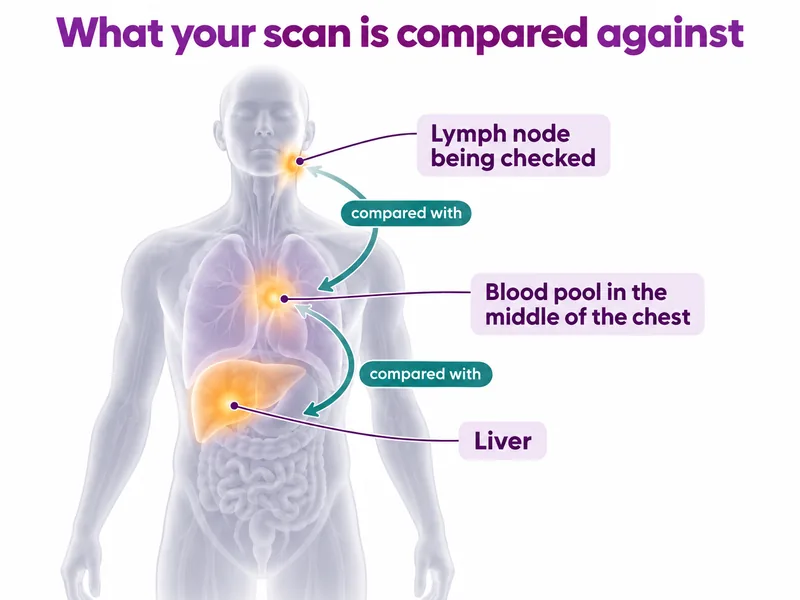
Did you know?
The Deauville 5-point scale was agreed at an international workshop in Deauville, France, in 2009, and was later built into the Lugano classification (2014) as the standard way to report PET response in lymphomas that show up clearly on PET. Because it scores tumour uptake against your own mediastinal blood pool and liver rather than an absolute value, the same score means the same thing across different scanners and hospitals. (Source: The Lugano Classification, Cheson et al., J Clin Oncol 2014; referenced in NCCN and ESMO lymphoma guidelines.)
For the wider picture, see our Lymphoma hub and our Lymphoma Treatment in Hyderabad page — and remember the score is always read alongside the rest of your pathology and clinical picture.
The same Deauville number is interpreted differently depending on when the scan is done. This is one of the most common sources of anxiety, so it is worth understanding clearly.
Often done after the first couple of cycles, the interim scan is an early progress check. A rapid fall to a Deauville 1-3 is reassuring and suggests the lymphoma is responding well. A persistent 4-5 may prompt a closer look or a change of approach — a "PET-adapted" strategy used especially in Hodgkin lymphoma within NCCN and ESMO frameworks. Any change is decided by your treating team after tumour-board review.
Done after treatment finishes, this scan confirms the overall response. A Deauville 1-3 here is usually called a complete metabolic response — a strong, encouraging result. A 4-5 suggests residual active disease and may lead to further tests, a repeat scan, or a repeat lymph node biopsy to confirm before any next step is planned.
The key message: a single high number is not a diagnosis of failure. It is a prompt to look more carefully, in context.
Did you know?
On an end-of-treatment PET in aggressive lymphomas such as diffuse large B-cell lymphoma, a low Deauville score (a complete metabolic response) is strongly associated with better long-term outcomes in published series, while a positive scan warrants confirmation before acting. Outcomes vary from person to person. (Source: NCCN and ESMO lymphoma guidelines; Lugano response criteria.)
A PET scan measures glucose uptake — and lymphoma is not the only thing that consumes glucose. Several harmless processes can raise the uptake and push a score up, which is exactly why the number is never read on its own:
Because of this, a Deauville 4 or 5 is correlated with your symptoms, blood results (including LDH and other blood tests) and the pattern on the scan. Where doubt remains, a short-interval repeat scan or a fresh biopsy settles it. This measured, coordinated reading is central to how CION interprets response.
Free written second opinion
Get a free written second opinion from CION's lymphoma tumour board — especially valuable if you have an interim PET with a Deauville 4 or 5 and are unsure of the next step.
PET response scoring is one link in a longer chain of tests. Understanding where it fits helps the whole report make sense:
PET can suggest active disease, but it cannot name the lymphoma subtype. That comes from a lymph node biopsy — ideally an excisional biopsy of the whole node where possible, or a core needle biopsy — studied with flow cytometry and immunohistochemistry. Sometimes a bone marrow biopsy is added.
A baseline PET-CT maps where the lymphoma is before treatment and provides the starting point every later scan is compared against. Whether your subtype reliably shows up on PET is confirmed on your subtype identification and pathology work-up.
Interim and end-of-treatment PET scans are then read on the Deauville scale to track how the disease is responding. Related findings — such as bulky disease at diagnosis or an enlarged node picked up on a scan — all feed into how your team interprets each score.
A Deauville number on its own is not a verdict. It is one piece of information that a lymphoma team weaves into a coordinated plan.
Because the score is standardised, your radiologist, haematologist and radiation oncologist all read it the same way. That matters most on an interim scan, where a fast drop to a low score is an early sign the treatment is working.
At CION, interim and end-of-treatment PET results are discussed at a multidisciplinary tumour board. A score of 4 or 5 is correlated with your symptoms, blood tests and scan pattern before any decision — never acted on as a number in isolation.
Chemotherapy, antibody (immunotherapy) treatment, IMRT radiation and monitoring are delivered directly by CION. Where a response calls for intensified therapy such as a stem-cell transplant, that is coordinated through accredited partner facilities.
You deserve to understand your own report. Our team walks you through your PET scan lymphoma score, what it does and does not mean for you, and what the next step is — with transparent costs up front. Request your free second opinion.
A PET-CT report carries a lot of weight, and a second opinion is especially worthwhile in a few situations:
CION offers a dedicated, free written second-opinion service. You deserve a plan built around healing, not billing — with transparent costs explained up front. You can also see our lymphoma doctors and lymphoma hospital pages. Request your free second opinion or call 1800 202 8726.
In most situations a lower number is better. A Deauville score of 1, 2 or 3 is usually considered a complete metabolic response — the lymphoma is no longer lighting up more than your liver, which is a reassuring sign. A score of 4 or 5 suggests there is still metabolically active disease and may prompt a change of plan or a closer look. It is important to know that the "good" cut-off can shift with the situation: on an interim scan, some teams treat a 3 differently from a 1-2. There is no single universally "safe" number in every case, so the score should always be explained to you in the context of your lymphoma type, stage and stage of treatment.
Your haemato-oncologist (a blood cancer specialist) usually reviews the result within a few days of the scan. A raised score is first checked against your symptoms, blood tests and the pattern on the scan, and is sometimes confirmed with a repeat scan or a biopsy. A change, such as adding to, intensifying or switching treatment, is usually considered only after that. Changing course on an interim scan is best established in Hodgkin lymphoma.
SUVmax (maximum standardised uptake value) is the single highest reading inside one spot. It can shift with the scanner, blood sugar and timing, even when the disease has not changed. For lymphoma response, the Lugano criteria rely mainly on the 5-point Deauville scale. SUVmax is usually more useful as a trend between scans done the same way. CION's page on comparing SUV between two scans lists what must match.
Scanning too soon can mislead, because treatment-related inflammation can look like lymphoma. After the last chemotherapy cycle, international consensus advises waiting at least 3 weeks, preferably 6 to 8. After radiotherapy, the usual wait is about 3 months (12 weeks). An interim (mid-treatment) scan is usually done at least 10 days after the last chemotherapy dose. CION's guide to PET timing after radiotherapy explains when teams may scan sooner.
Bring the full scan images on CD or USB in DICOM format (the standard medical image file), not prints or screenshots. Add the original written report and your earlier PET scans and reports, especially the one before treatment. A short note from your oncologist on your lymphoma type, stage and the exact question usually helps. CION's guide to getting your PET-CT images re-read lists each item.
The Deauville 5-point scale is used most extensively in Hodgkin lymphoma and in the common non-Hodgkin lymphomas that show up clearly on PET such as diffuse large B-cell lymphoma, where PET-CT is a standard response tool under the Lugano response criteria. Some lymphomas take up the PET tracer only weakly or unpredictably, so PET and the Deauville score are less useful for them and other measures are used instead. Whether the score applies to your case depends on your exact subtype — something confirmed on your pathology report. Your CION haematologist will tell you whether PET response scoring is part of your monitoring plan.
No single scan or score decides that. A low end-of-treatment Deauville score (1-3, often called a complete metabolic response) is a strong, encouraging sign and is linked in published series to better outcomes — but it is one part of a bigger picture that includes your lymphoma type, stage, blood markers such as LDH, and how you are followed up afterwards. Outcomes vary from person to person. Your team will explain what your own score means for your follow-up and monitoring.
The Deauville score is a simple 1-to-5 scale used to read a PET-CT scan in lymphoma. Rather than measuring the size of a lump, it compares how brightly the lymphoma tissue takes up the radioactive glucose tracer against two reference points in your own body — the blood pool in the middle of the chest (mediastinum) and the liver. A score of 1 means no uptake above background; a score of 5 means uptake much higher than the liver, or new sites of disease. It gives your lymphoma team a shared, reproducible way to describe how active the disease looks, especially part-way through treatment.
The Deauville 5-point scale reads a PET scan against two internal references. Score 1 — no uptake above background. Score 2 — uptake at or below the mediastinal blood pool. Score 3 — uptake above the mediastinum but at or below the liver. Score 4 — uptake moderately higher than the liver. Score 5 — uptake markedly higher than the liver, or any new disease site. Scores 1-3 are generally read as a good response (often "PET-negative"), while 4-5 suggest residual active disease. The exact cut-off used depends on whether it is an interim or end-of-treatment scan, which is why the number is always interpreted by your specialist team, not read in isolation.
An interim PET scan is done part-way through treatment — often after the first two cycles — to see how the lymphoma is responding early. The Deauville score on this scan is a powerful early signal: a fast fall to a low score (1-3) suggests the disease is responding well, while a persistently high score (4-5) can indicate a less complete response. In Hodgkin lymphoma especially, this "PET-adapted" approach is used within NCCN and ESMO frameworks to consider whether treatment intensity might be adjusted. Any change to your plan is a specialist decision made by the treating team after tumour-board review — never on the number alone.
Yes. PET measures glucose uptake, and several harmless things can raise it — inflammation, a recent infection, healing tissue after biopsy or radiation, and normal activity in the thymus, bowel or brown fat. A high Deauville score on an interim scan does not automatically mean the treatment has failed. This is exactly why a raised score is not acted on in isolation: it is correlated with your symptoms, blood tests and the pattern on the scan, and it may be confirmed with a repeat scan after an interval or, if needed, a repeat lymph node biopsy. Reading the score in this wider clinical picture is central to how CION coordinates lymphoma care.
Free written second opinion
Just received a PET-CT with a Deauville score, unsure whether it is good news, or need a second opinion before the next cycle? CION's lymphoma team is here.
New answers on this page also draw on CION's own published pages on interim PET in lymphoma, comparing SUV between scans, PET timing after radiotherapy, getting PET-CT images re-read and the Deauville scale's report terms.
Medical disclaimer: General information about reading a PET scan, not a diagnosis or a treatment plan. Only a specialist who has seen your full scans and history can say what your score means for you, so contact your team about anything that worries you.