Cytoreductive surgery & HIPEC · Hyderabad & Telangana
Debulking (cytoreductive) surgery in Hyderabad
For advanced ovarian and other cancers that have spread inside the abdomen, debulking surgery removes as much of the visible cancer as possible — so the chemotherapy that follows can work as well as it can. It is major surgery for a serious situation, and a real, active step, planned by an experienced surgical-oncology team who will be honest with you at every stage.
Cytoreductive surgery & HIPEC for peritoneal disease
Advanced & recurrent cancer, planned by a tumour board
An honest outlook — hopeful, never over-promised
★★★★★Rated 4.8/5 · 800+ Google reviews
Cytoreductive surgery & HIPEC
17 oncologists, one tumour board
35+ centres, close to home
Aarogyasri & insurance help
SM
Written by Dr. Srinivasulu Mukta, Surgical Oncologist (MCh, Surgical Oncology · 35+ years). Medically reviewed by Dr. Muralidhar Muddusetty, MRCS (Edinburgh), Surgical Oncology. · Reviewed 10 July 2026
Understanding the surgery
What is debulking (cytoreductive) surgery?
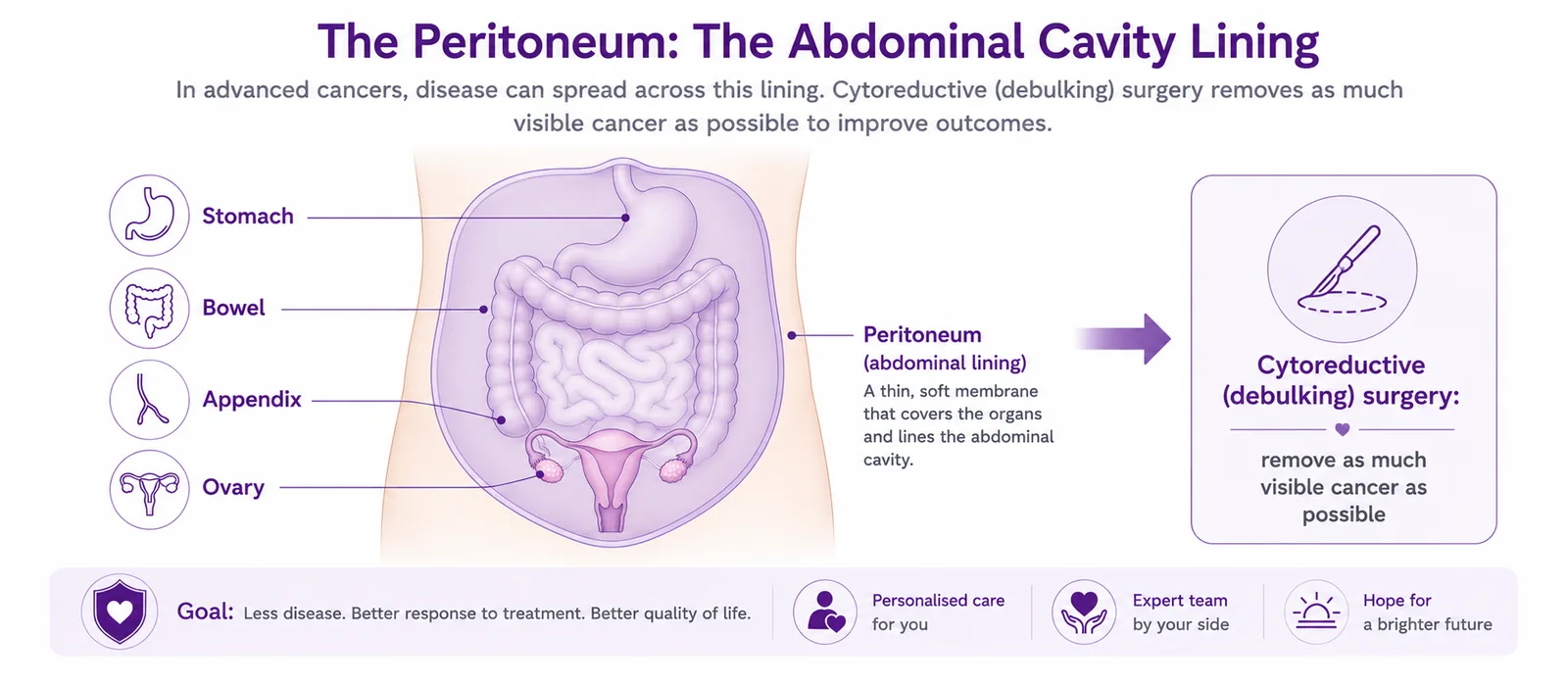
Debulking surgery — also called cytoreductive surgery — is an operation to remove as much of the visible cancer as possible from within the abdomen, ideally leaving nothing behind, or only very small deposits. It is used most often for advanced ovarian cancer and for cancers that have spread across the lining of the abdomen. Why surgeons aim to remove "as much as possible" matters: the less cancer that is left, the better the chemotherapy that follows tends to work, and the better the outlook can be.
It is a bigger operation than surgery for early cancer, because the cancer may involve more than one area, and the surgeon may need to remove or repair several structures in one operation. That sounds daunting — but it is done by an experienced surgical-oncology team, planned carefully in advance, and always discussed honestly with you and your family first, so you know what to expect and why. At CION the decision — surgery, and how much surgery — is made by a multidisciplinary tumour board, not on the day.
Remove the visible cancer
The goal — "optimal cytoreduction" — is to remove all the cancer that can be seen, or as much as can be safely removed.
Help chemotherapy work
The less cancer left behind, the more effective the chemotherapy that follows tends to be.
Planned by a team
Decided by a multidisciplinary tumour board and carried out by an experienced surgical-oncology team.
Advanced & peritoneal disease
Which cancers debulking surgery treats
Debulking surgery is used most often for advanced ovarian cancer, and also for other cancers that have spread to the peritoneum — the lining of the abdomen. This includes cancers of the bowel (colorectal), the appendix, and the stomach when they spread across the abdominal cavity. Whether debulking is right depends on how far the cancer has spread and whether the surgeon judges that most or all of it can be safely removed — a decision made by the tumour board.
Debulking surgery treats advanced ovarian cancer and peritoneal spread from bowel, appendix and stomach cancers — the tumour board decides suitability.
Advanced ovarian cancer
The most common reason for debulking — removing cancer that has spread within the abdomen, with chemotherapy before or after. Ovarian cancer
Bowel (colorectal) cancer with peritoneal spread
Selected patients whose colorectal cancer has spread to the abdominal lining may be suitable for cytoreductive surgery & HIPEC. Colon cancer
Appendix cancer & pseudomyxoma peritonei
A classic reason for cytoreductive surgery with HIPEC, where mucus-producing tumour spreads across the abdomen. Cancer surgery
Stomach cancer with peritoneal spread
Considered for carefully selected patients as part of a wider treatment plan decided by the tumour board. Stomach cancer
Diagnosis & staging
Tests that confirm the diagnosis and plan the surgery
Before any operation, the cancer is confirmed and its spread mapped. A biopsy establishes the diagnosis, scans show how far the cancer has reached across the abdomen, and the surgeon assesses whether most or all of it can be safely removed. Your surgical-oncology team then decides — with you — the right operation, its timing, and whether HIPEC applies.
Diagnostic services we offer — book any of these:
Biopsy & histopathology
A tissue sample that confirms whether it is cancer, the exact type, and how it is likely to behave — the foundation of the plan.
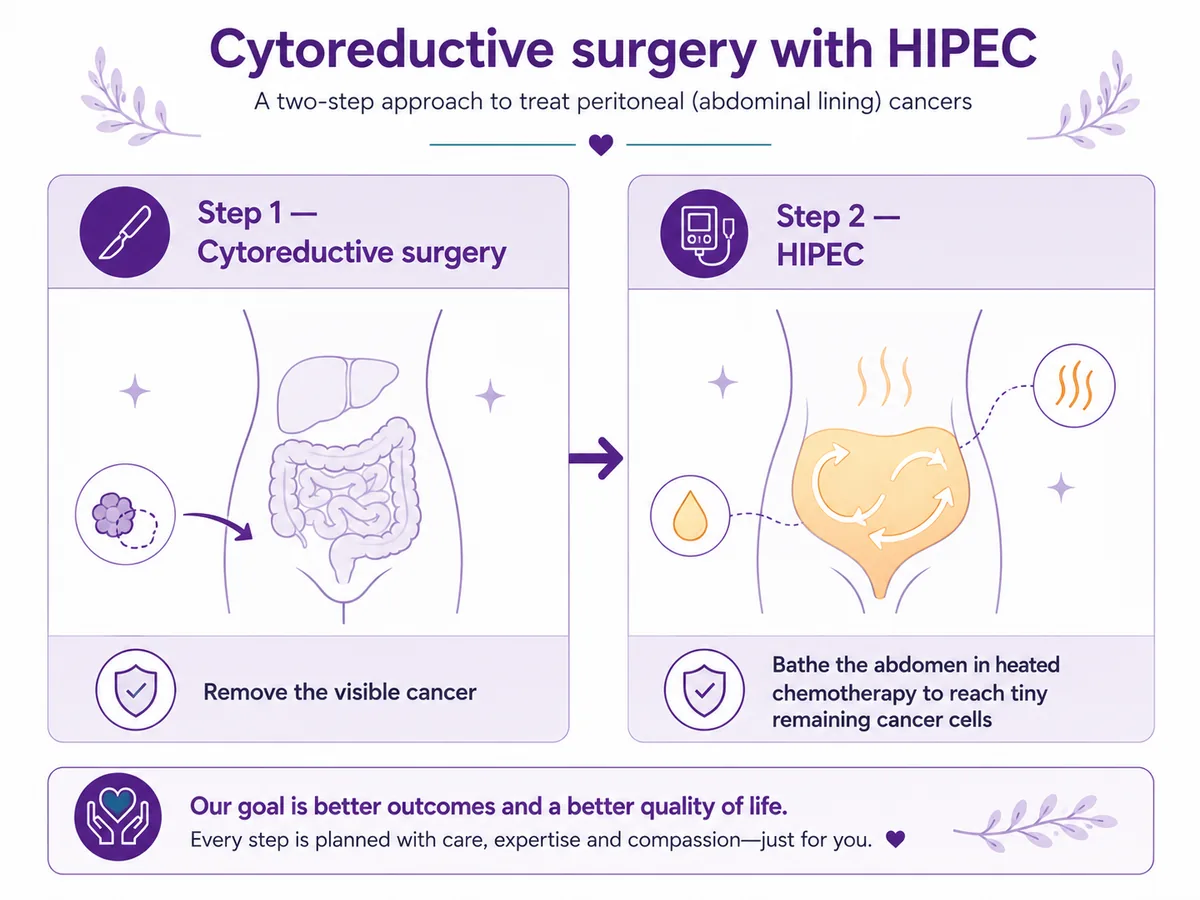
HIPEC stands for heated intraperitoneal chemotherapy. In a combined operation known as CRS + HIPEC, the surgeon first removes the visible cancer (cytoreductive surgery), and then, during the same operation, the abdomen is bathed in a warmed chemotherapy solution for a period of time before it is drained. The idea is that heated chemotherapy, delivered directly into the abdomen, can reach tiny cancer cells left behind that the eye cannot see. It is a specialised procedure for carefully selected patients — CION offers it as part of comprehensive care for peritoneal disease.
CRS + HIPEC in two steps: remove the visible cancer, then bathe the abdomen in heated chemotherapy to reach tiny remaining cells.
Who it may suit
Selected patients whose cancer is confined to the abdomen — for example appendix, some colorectal, and some ovarian cancers — where the surgeon believes all or nearly all visible cancer can be removed. Suitability is assessed carefully by the team.
What it is not
HIPEC is not a routine add-on for everyone, and it is not offered where it would not help or would not be safe. We will always be honest about whether it is likely to benefit you — and about the extra recovery a combined operation involves.
Because it is a longer, more complex operation, CRS + HIPEC needs an experienced team and careful preparation. You can read an independent overview of HIPEC from Cancer Research UK.
Treatment
Advanced-cancer treatments we deliver
Surgery is one part of care — CION delivers the full range and helps you choose. For advanced ovarian and peritoneal cancers that means cytoreductive surgery, cytoreductive surgery with HIPEC where it is likely to help, and chemotherapy and maintenance therapy planned around your surgery. Every plan is set by a tumour board for your cancer and your situation.
Treatments we deliver — book a consult for any of these:
Debulking (cytoreductive) surgery
Removing as much visible cancer as possible from the abdomen — the core operation for advanced ovarian and peritoneal disease.
Debulking surgery can happen at different points. In primary debulking, surgery comes first and chemotherapy follows. In interval debulking, chemotherapy is given first to shrink the cancer, and surgery follows — often chosen when removing everything upfront would be too difficult. Secondary debulking is surgery for a cancer that has come back, in selected patients. Which sequence is right is decided by the tumour board, based on how much can be safely removed and your overall health.
Approach
What it means
Often chosen when
Primary debulking
Surgery first, then chemotherapy.
The surgeon judges that most or all of the visible cancer can be removed upfront.
Interval debulking
Chemotherapy first to shrink the cancer, then surgery.
Upfront removal would be too extensive; HIPEC is sometimes added at this stage.
Secondary debulking
Surgery for cancer that has returned.
The recurrence is limited and can be removed in a suitable patient.
There is no single "right" order for everyone — the safest, most complete removal of the cancer comes first, and the sequence is chosen to make that possible. Your team explains clearly why they recommend one path, and a second opinion is always welcome.
An honest answer
Does surgery help if the cancer is advanced?
This is the question that matters most, and the honest answer is that for many people, yes — it can help meaningfully. For advanced ovarian and peritoneal cancers, removing as much of the visible cancer as possible, together with chemotherapy, can improve how well treatment works and how long the cancer is kept under control. It is not a guarantee, and every situation is different — but debulking is one of the most active and worthwhile steps available for advanced disease, which is why it is offered so widely.
Why removing more helps
The amount of cancer left after surgery is one of the strongest influences on how well treatment goes. Removing all or nearly all of the visible cancer gives the chemotherapy the best chance to work.
Honest, not falsely hopeful
We will never over-promise. Your team will tell you clearly what surgery can and cannot do in your situation, so you can make the decision that is right for you and your family.
Facing advanced cancer is frightening, and wanting a clear, truthful picture is completely natural. A good team gives you exactly that — honest information, realistic hope where it exists, and full support whatever you decide.
What to expect
The operation & recovery
Debulking is major surgery, and recovery is more involved than for a smaller operation — but it follows a clear path, with the team supporting you at every step. Expect a longer operation, a hospital stay that often includes time in intensive care for close monitoring, and a recovery measured in weeks. A combined CRS + HIPEC operation is longer still and needs more recovery. Knowing this in advance helps you and your family prepare, practically and emotionally.
1
Before surgery
Scans and tests plan the operation and check you are ready for it.
2
The operation
A longer operation to remove the visible cancer, sometimes with HIPEC.
3
In hospital & ICU
Close monitoring in intensive care, then a ward, with pain and nutrition managed.
4
Recovery (weeks)
Strength returns over several weeks; any chemotherapy is planned around it.
5
Ongoing support
Physical, nutritional and emotional support continues throughout.
The care does not stop when the operation is over. Any chemotherapy is timed around your recovery, and nutrition, physiotherapy and emotional support continue through the whole journey.
Cost & coverage
Debulking surgery cost in Hyderabad Indicative
The cost depends on the extent of the surgery and whether HIPEC is included — a combined CRS + HIPEC operation costs more than debulking alone, because it is longer and more complex. Indicatively, debulking sits around ₹2,00,000 – ₹5,00,000 and CRS + HIPEC higher. The reassuring part: this is treatment for advanced cancer, so it is generally covered under Aarogyasri / PMJAY at empanelled centres, and by most health-insurance policies. Cover for HIPEC specifically can vary — our team checks your policy and scheme eligibility and gives a clear, written estimate before anything is planned. These are estimates, not a quotation.
Indicative cost estimator
Pick your situation for an indicative range, then request an exact estimate for your case.
Indicative range
₹2,00,000 – ₹5,00,000
for debulking (cytoreductive) surgery, general room, self-pay
Figures are indicative only and not a quotation. Surgery for advanced cancer is generally covered under Aarogyasri / PMJAY at empanelled centres and by most insurance; HIPEC cover can vary. Your actual cost depends on the extent of surgery, ICU and hospital stay, and any cancer treatment around it.
An advanced-cancer diagnosis shouldn't wait. Book a free consultation and, if you already have a biopsy or scan report, a free written second opinion on whether debulking or HIPEC is right for you.
Your reports reviewed by a senior surgical oncologist
An honest answer on debulking, HIPEC and timing
Aarogyasri / PMJAY & insurance guidance
Support
Financial support & Aarogyasri
Cost should not delay treatment for advanced cancer. Under Aarogyasri and PMJAY, eligible advanced-cancer surgery may be largely covered at empanelled centres, and private insurance is accepted cashless. Cover for HIPEC specifically can vary, so we confirm it separately. Our counsellors help check eligibility, arrange approvals and map out what you will actually pay — often far less than families fear.
9 clinics in Hyderabad · 35+ across Telangana & AP
CION cancer care is closer than you think.
We're never more than 30 minutes away. Same panel of specialists at every centre. Same tumour board reviews. Same NCCN protocols. Pick the closest one and call directly — or let us pick for you.
Don't see your city? Call
18002028726
— we'll find your nearest CION partner centre.
Meet the surgical oncology team
Your debulking surgery is planned by a team, not one doctor.
Surgical, medical and radiation oncologists plan every advanced-cancer case together in a multidisciplinary tumour board — part of 17 senior specialists across CION.
Share your name and number — we'll call you back within 30 minutes to schedule your consultation.
Facing advanced cancer? Don't decide alone.
Whether debulking or CRS + HIPEC is right — and the safest timing — depends on your cancer and how far it has spread. Let CION's tumour board review your reports and give you an honest, cancer-first recommendation.
These worries are real, and some are made heavier by what people say. Here are honest, gentle answers to the fears we hear most from families in Telangana.
“If the cancer has already spread, isn’t surgery pointless?”
Fact: Not at all. Debulking surgery is designed precisely for cancer that has spread within the abdomen. Removing as much of the visible cancer as possible, together with chemotherapy, is one of the most active steps available for advanced disease — it can improve how well treatment works and how long the cancer is controlled. It is not a guarantee, but for many people it helps meaningfully.
“Will the operation spread the cancer around my body?”
Fact: This is a common, harmful myth. Removing cancer under controlled surgical conditions does not spread it through the body. What actually causes harm is delay, which lets a treatable cancer grow. Cytoreductive surgery is one of the most effective ways to remove cancer that has spread across the abdomen.
“Debulking is such a big operation — I won’t survive it.”
Fact: It is major surgery, and honesty matters — but it is done every day by experienced surgical-oncology teams, planned carefully, with close monitoring in intensive care afterwards. Your fitness for surgery is assessed thoroughly beforehand, and the team only recommends the operation when the benefit is judged to outweigh the risk for you.
“HIPEC sounds extreme — is heated chemotherapy dangerous?”
Fact: HIPEC is heated chemotherapy placed directly in the abdomen during surgery, for carefully selected patients, by an experienced team. Like any major surgery it has risks, which your team explains fully. It is only offered where it is likely to help and be safe — it is not a routine add-on, and it is never done just for the sake of it.
“Should I have chemotherapy first, or surgery first — and does it matter?”
Fact: Both are valid, and the order is chosen for a reason. Primary debulking is surgery first, then chemotherapy; interval debulking gives chemotherapy first to shrink the cancer, then surgery — often chosen when upfront removal would be too extensive. The tumour board decides based on how much can be safely removed and your overall health.
“Can a middle-class family afford surgery for advanced cancer?”
Fact: Cost should not be the reason care is delayed. This is treatment for advanced cancer, so Aarogyasri and PMJAY generally cover eligible surgery at empanelled centres, and private insurance is accepted cashless. Cover for HIPEC specifically can vary — we check it separately. Our counsellors help map out what you will actually pay, often far less than families fear.
“If the cancer comes back, the surgery will have been for nothing.”
Fact: Even when cancer returns, debulking often buys valuable time and better control, and for a returning cancer that is limited, secondary debulking may be possible. Surgery is one part of a longer plan, not a single all-or-nothing event — and every step that keeps the cancer in check has real value.
“Home or herbal remedies can treat advanced cancer instead of surgery.”
Fact: No home or herbal remedy is proven to cure advanced cancer, and relying on one wastes the window when treatment can help most. Tell your oncologist about anything you take so it can be used safely alongside proper treatment — but do not let it replace treatment.
“I’m too old for such a major operation.”
Fact: Age alone does not decide it — your fitness, the cancer type and its spread do. Older patients are assessed individually, with other health conditions taken into account, and the team recommends the option most likely to help you rather than going by a number. Sometimes that is full debulking; sometimes a different plan is safer.
“Recovery will take months in bed and I’ll be a burden.”
Fact: Debulking is major surgery, so recovery is measured in weeks, not days — but it follows a clear path with the team supporting you. Strength returns gradually, pain is managed, and nutrition and physiotherapy help you rebuild. Most families find the reality more manageable, and more supported, than they feared.
“A tumour board is just extra delay — I should decide quickly.”
Fact: A tumour board is not a delay — it is several specialists deciding your plan together, which leads to safer, better decisions than one doctor alone. It is arranged quickly and gives you a coordinated, honest recommendation on whether and when to operate.
“Asking for a second opinion will offend my doctor.”
Fact: A second opinion is normal and welcomed in cancer care — it confirms the plan and gives you confidence, especially for a big decision like debulking or HIPEC. At CION it is free when you have a biopsy or scan report, and it can be arranged quickly, without offending anyone.
“They’ll give me false hope just to operate.”
Fact: An honest team does the opposite. You will be told clearly what surgery can and cannot do in your situation, with realistic hope where it exists and never over-promising. Debulking is recommended when the benefit is genuine — and if it is not likely to help, we say so.
“Once the visible cancer is removed, I’m completely cured.”
Fact: Surgery is a decisive step, but advanced cancer is treated with surgery and chemotherapy together, and follow-up matters. No treatment promises zero risk, which is why the plan continues after the operation — to keep the cancer under control and catch any change early. Follow-up is a safety net, not a sign of doubt.
“HIPEC is available everywhere, so any hospital will do.”
Fact: CRS + HIPEC is a specialised, complex operation that needs an experienced surgical-oncology team and careful selection — it is not offered well everywhere. What matters most is the surgeon, the team and honest selection of who truly benefits, not a machine or a label.
“The surgery will leave me in severe, lasting pain.”
Fact: Pain after major abdominal surgery is expected in the early days, and it is actively managed with medication and close monitoring in hospital. Discomfort settles over the recovery weeks, and the team helps you manage it throughout. Lasting severe pain is not the normal outcome.
“Advanced cancer means the worst — there’s no point in treatment.”
Fact: An advanced diagnosis is frightening, but for many people active treatment — debulking, HIPEC where suitable, and chemotherapy — meaningfully controls the cancer and improves quality of life. A tumour board gives you an honest picture of what treatment can achieve for your situation, and the team walks with you through every step.
“I have to travel far from home for this kind of surgery.”
Fact: CION provides advanced-cancer surgery and care across 35+ centres in Telangana and Andhra Pradesh, with Telugu-speaking teams and Aarogyasri support — so specialist care is closer to home than most families expect. Your consultation, planning and follow-up can be coordinated near you.
Why CION
Why choose CION for debulking surgery in Hyderabad
Cytoreductive surgery & HIPEC
An experienced team offering debulking and, where it is likely to help, cytoreductive surgery with HIPEC for peritoneal disease.
A tumour-board plan
Every case is planned by a multidisciplinary tumour board, so the timing and extent of surgery are decided by specialists together.
Advanced & recurrent disease
Experience with advanced ovarian and peritoneal cancers, and with selected surgery for cancer that has come back.
Honest guidance
Clear, truthful conversations about what surgery can and cannot do — with realistic hope, never over-promising.
Aarogyasri & insurance help
Advanced-cancer surgery is generally covered under Aarogyasri at empanelled centres; our team helps with paperwork and estimates.
Care closer to home
35+ centres across Telangana & AP, Telugu-speaking teams, and supportive care through the whole journey.
Real stories · real courage
15,000+ patients chose CION. Hear from them directly.
These aren't paid endorsements or written reviews. These are video testimonials from real patients and families — recorded on their own phones, in their own words. Pick any one. Watch it. Then decide.
4.8★800+ Google reviews
50+video testimonials
15,000+patients treated
Successful Chemotherapy & Radiation Done by Dr. Owais Mohammed & Dr. Kirti Ranjan
Watch video →
Successful Chemotherapy Done by Dr. C Raghavendra Reddy
Watch video →
Surgery, Chemo & Radiation Done by Dr. Imaduddin, Dr. Vinay, Dr. Owais, Dr. Kirti
Watch video →
Successful Radical Thymectomy Done by Dr. Mohammed Imaduddin & Dr. Vinay Mamidala
Watch video →
Successful Surgery Done by Dr. Rajender Byshetty
Watch video →
Successful Chemo & Surgery Done by Dr. Imad, Dr. Vinay, Dr. Owais & Dr. Raghavendra
Watch video →
Successful Chemo & Surgery Done by Dr. Imad, Dr. Vinay, Dr. Owais & Dr. Raghavendra
Watch video →
Successful Chemo & Radiation Done by Dr. Owais Mohammed & Dr. Kirti Ranjan Mohanty
Watch video →
Successful Breast Cancer Surgery Done by Dr. Imaduddin Mohammed & Dr. Vinay Mamidala
Watch video →
Successful Chemotherapy Done by Dr. Bharati Devi Gorantla
Watch video →
Successful Chemo & Surgery Done by Dr. Owais Mohammed & Dr. Imaduddin Mohammed
Watch video →
Successful Chemotherapy Done by Dr. Gundu Naresh
Watch video →
Successful Bone Marrow Transplantation - Neuroblastoma
Watch video →
Successful Surgery & Chemo - Carcinoma of Caecum
Watch video →
Successful Oral chemotherapy & mastectomy surgery
Watch video →
Successful Oral chemotherapy & mastectomy surgery
Watch video →
Successful Chemotherapy
Watch video →
Successful Surgery by Dr. Mohammed Imaduddin
Watch video →
Successful Bone Marrow Transplantation
Watch video →
Successful Oral chemotherapy & mastectomy surgery
Watch video →
Successful Oral chemotherapy & mastectomy surgery
Watch video →
Successful Chemotherapy
Watch video →
Successful Buccal Mucosa Surgery
Watch video →
Successful Complex Surgery Mandibulectomy Reconstruction
Advanced-cancer treatment is a journey for the whole family. At CION, surgery, chemotherapy support, nutrition, comfort and emotional care are one coordinated plan — so you are supported medically, emotionally and physically from diagnosis through recovery.
Ovarian cancer care
Full diagnosis and treatment for ovarian cancer, of which debulking is often part. Learn more
Nutrition counselling
Nutrition to build strength before surgery and support recovery after. Learn more
Psychology counselling
Emotional support for you and your family through a hard diagnosis. Learn more
Rehabilitation
Physiotherapy and recovery support to rebuild strength after major surgery. Learn more
Palliative & comfort care
Comfort and symptom support at any stage, alongside active treatment. Learn more
Financial counselling
Aarogyasri, PMJAY and cashless insurance guidance so cost never blocks care. Learn more
FAQ
Debulking surgery in Hyderabad — frequently asked questions
What is debulking (cytoreductive) surgery?
It is an operation to remove as much of the visible cancer as possible from within the abdomen, ideally leaving none behind or only very small amounts. It is used most often for advanced ovarian cancer and for cancers that have spread to the lining of the abdomen (the peritoneum). Removing more cancer helps the chemotherapy that follows work better.
What are the goals of debulking surgery?
The main goal is optimal cytoreduction — removing all the visible cancer, or as much as can be safely removed. The amount of cancer left after surgery is one of the strongest influences on how well treatment goes, so surgeons aim to leave as little as possible, giving chemotherapy the best chance to work.
Which cancers typically need debulking surgery?
Most often advanced ovarian cancer, and cancers that have spread to the peritoneum (the abdominal lining) — including some bowel (colorectal), appendix and stomach cancers. Whether it is suitable depends on how far the cancer has spread and whether most of it can be safely removed, which the tumour board assesses.
What is HIPEC, and is it safe?
HIPEC is heated chemotherapy delivered directly into the abdomen during surgery, after the visible cancer has been removed, to reach tiny cells left behind. It is a specialised procedure for carefully selected patients, done by an experienced team. Like any major surgery it has risks, which your team explains fully; it is only offered where it is likely to help and be safe.
What is CRS + HIPEC?
CRS + HIPEC is a combined operation: cytoreductive surgery (CRS) to remove the visible cancer, followed in the same operation by HIPEC — heated chemotherapy circulated through the abdomen to reach microscopic disease. It is used for selected peritoneal cancers, such as appendix, some colorectal and some ovarian cancers, where the surgeon believes all or nearly all visible cancer can be removed.
Should I have surgery first, or chemotherapy first?
Both are valid. In primary debulking, surgery comes first, then chemotherapy. In interval debulking, chemotherapy is given first to shrink the cancer, then surgery follows — often chosen when upfront removal would be too extensive. The tumour board decides based on how much can be safely removed and your overall health.
Does debulking surgery help if the cancer is advanced?
For many people, yes — it can help meaningfully. Removing as much visible cancer as possible, together with chemotherapy, can improve how well treatment works and how long the cancer is controlled. It is not a guarantee and every situation differs, but debulking is one of the most active steps available for advanced disease.
How long is recovery after debulking surgery?
Debulking is major surgery, so recovery is measured in weeks and the hospital stay often includes time in intensive care for close monitoring. A combined CRS + HIPEC operation is longer and needs more recovery. Your team supports you throughout, and any chemotherapy is planned around your recovery.
What is secondary debulking surgery?
Secondary debulking is surgery for a cancer that has come back, in selected patients whose recurrence is limited and can be removed. Whether it is suitable is assessed carefully by the tumour board, weighing how much can be safely removed against your overall health.
How much does debulking surgery cost in Hyderabad?
Indicatively, debulking (cytoreductive) surgery is around Rs. 2,00,000 to Rs. 5,00,000, and a combined CRS + HIPEC operation costs more because it is longer and more complex. The actual cost depends on the extent of surgery, ICU and hospital stay, and any cancer treatment around it. As it is treatment for advanced cancer, it is generally covered under Aarogyasri / PMJAY at empanelled centres, and CION gives an accurate written estimate after assessment. Figures are indicative only, not a quotation.
Is debulking surgery covered by Aarogyasri or insurance?
It is treatment for advanced cancer, so it is generally covered under Aarogyasri and PMJAY at empanelled centres and by most health-insurance policies. Cover for HIPEC specifically can vary. CION's counsellors check your policy and scheme eligibility, arrange approvals, and provide a written estimate before anything is planned.
Will the surgery spread the cancer?
No. Removing the cancer under controlled surgical conditions does not spread it through the body — this is a common myth. What causes real harm is delay, which lets a treatable cancer grow. Cytoreductive surgery is one of the most effective ways to remove cancer that has spread across the abdomen.
Who is suitable for CRS + HIPEC?
Selected patients whose cancer is confined to the abdomen — for example appendix, some colorectal, and some ovarian cancers — where the surgeon believes all or nearly all visible cancer can be removed. HIPEC is not a routine add-on for everyone; suitability is assessed carefully by the team, and it is only offered where it is likely to help and be safe.
Can debulking surgery be done for a cancer that has come back?
In selected patients, yes — this is called secondary debulking. When a returning cancer is limited and can be safely removed, surgery may again be worthwhile. The tumour board assesses each recurrence individually, considering the pattern of disease and your overall health.
What happens before debulking surgery?
Scans (usually CT, sometimes MRI or PET-CT) and blood tests map where the cancer has spread and check your fitness for surgery. The tumour board reviews everything and, with you, decides the right operation, its timing, and whether HIPEC applies. You will hear clearly what is planned and why, and have time to ask questions.
Will I need chemotherapy as well as surgery?
Usually, yes. For advanced ovarian and peritoneal cancers, chemotherapy is given before or after surgery — and sometimes maintenance therapy afterwards — as part of the plan, not a sign the surgery failed. The tumour board decides the combination and timing that treats your cancer most thoroughly.
Which is the best hospital for debulking or HIPEC surgery in Hyderabad?
Look for a cancer centre with an experienced surgical-oncology team, multidisciplinary tumour-board planning, the ability to offer cytoreductive surgery with HIPEC where appropriate, and honest guidance on what surgery can achieve. CION Cancer Clinics offers cytoreductive surgery and HIPEC across 35+ centres in Telangana and Andhra Pradesh, with Telugu-speaking teams and Aarogyasri counselling.
Should I get a second opinion before debulking surgery?
A second opinion is normal and welcomed in cancer care, especially before a major decision like debulking or HIPEC — it confirms the plan and gives you confidence. At CION it is free when you have a biopsy or scan report, and it can be arranged quickly. It confirms whether surgery is right for you and the safest timing.
Explore
Explore advanced-cancer care at CION
Treatment, surgery, tests and support around the cancers debulking treats — ovarian, bowel, appendix and stomach. Tap any topic to read more.
Speak to a surgical oncologist about debulking or HIPEC
Early answers change outcomes. Book a free consultation or second opinion at any of our 9 Hyderabad clinics — part of 35+ centres across Telangana & Andhra Pradesh.
Medical disclaimer: This page provides general information about debulking (cytoreductive) surgery and HIPEC for advanced cancer and is not a substitute for professional medical advice, diagnosis or treatment. The outlook is hopeful but never guaranteed, and HIPEC is not a routine add-on for everyone — it is offered only where it is likely to help and be safe. Costs shown are indicative only and not a quotation. Always consult a qualified surgical oncologist about your individual care. Content is periodically reviewed by CION's medical team.

 CION Ameerpet