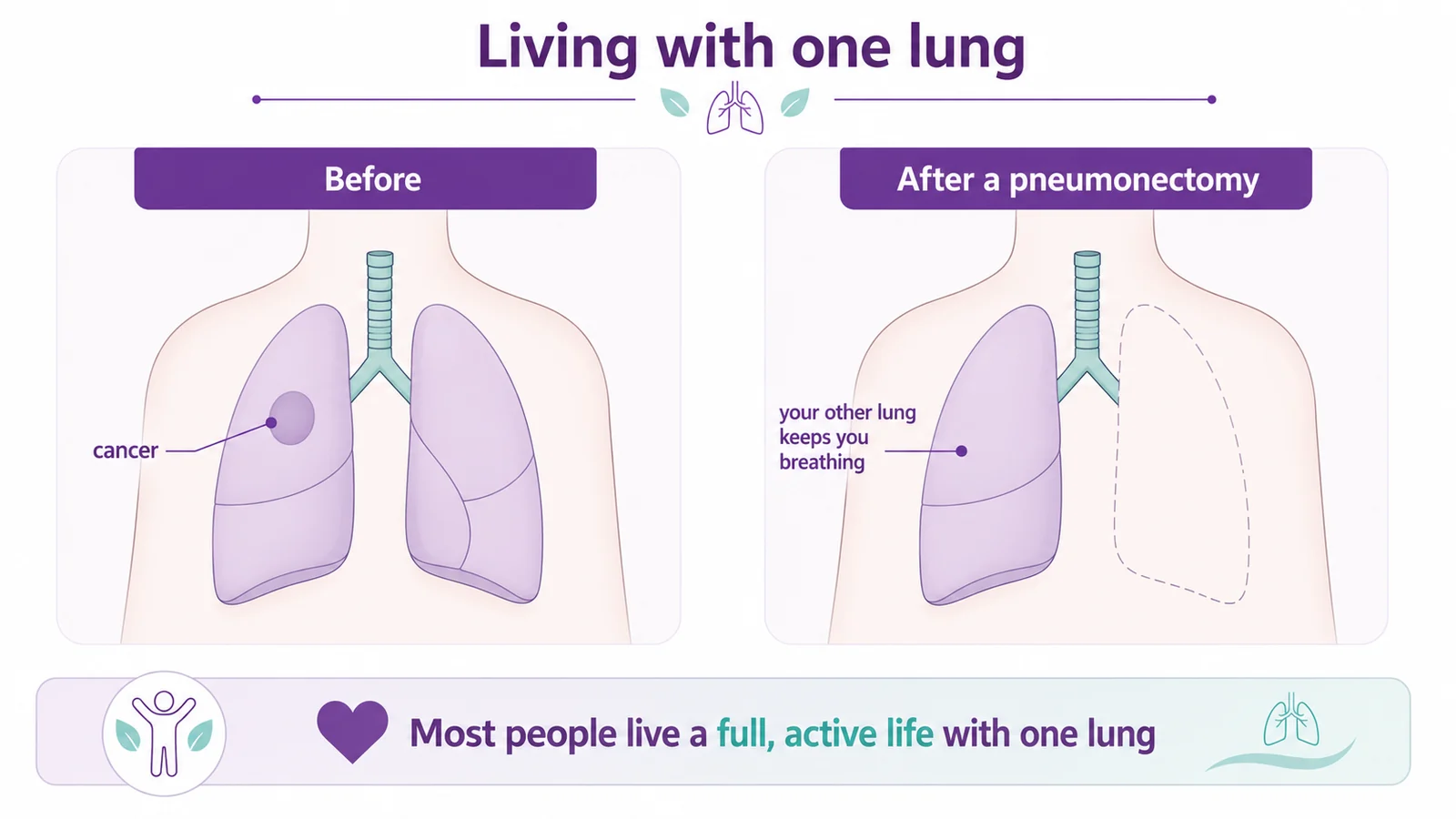
A pneumonectomy removes a whole lung on one side, to treat a lung cancer that is too central or extensive to be removed by taking just a lobe. The question this raises is frightening — and the answer is reassuring: yes, you can live and breathe with one lung. The remaining lung takes over, and most people return to a full, active life. Where it is possible, our surgeons first consider a lung-sparing sleeve operation to avoid removing the whole lung.
Most people live a full, active life with one lung
A lung-sparing sleeve operation is considered first
Lung-function tests confirm your other lung can cope
Clear indicative costs & Aarogyasri help
★★★★★Rated 4.8/5 · 800+ Google reviews
A full life with one lung
Sleeve-sparing considered first
Lung-function assessment
35+ centres · Aarogyasri help
MM
Written by Dr. Muralidhar Muddusetty, Surgical Oncologist (MBBS & MS Surgery, AIIMS · DNB · MRCS Edinburgh), with CION’s lung (thoracic) surgical oncology team. Medically reviewed by Dr. Srinivasulu Mukta, MCh (Surgical Oncology), 35+ years. · Reviewed 16 July 2026
Understanding the surgery
What is a pneumonectomy — and why is it done?
A pneumonectomy is an operation that removes an entire lung — the whole lung on one side of the chest. It is the most extensive lung-cancer operation, used when the cancer is too central or extensive to be cleared by removing just a lobe (a lobectomy) — for example when it involves the main airway or the central blood vessels, or crosses between lobes. Because it removes a whole lung, it is only advised when it is needed to remove the cancer completely, and only after careful lung-function tests confirm your other lung can cope.
The most important thing to understand is this: you can live and breathe with one lung. The remaining lung takes over, and most people return to normal daily life — with somewhat less spare capacity for very hard exertion. Wherever possible, the surgeon first considers whether a lung-sparing “sleeve” operation could clear the cancer instead, avoiding a pneumonectomy altogether. Where a pneumonectomy is the right choice, it gives the best chance of removing the cancer completely.
The principle in three ideas
The whole lung on one side
Removed only when a central or extensive cancer cannot be cleared by taking a single lobe — never as a shortcut.
You can live with one lung
The remaining lung takes over the work; most people return to a full, active life, with less reserve only for very hard exertion.
Checked carefully first
Lung-function tests confirm your other lung can cope, and a lung-sparing sleeve option is considered before anything is planned.
The fear that stops many people in their tracks is: “how will I breathe with a whole lung gone?” The reassuring, honest answer is that most people live a full, active life with one lung. The remaining lung takes over the work, and after recovery people walk, travel, work and enjoy daily life. You will have less spare capacity for very hard exertion — running a marathon, for instance — but ordinary activities are usually well within reach. This is exactly why lung-function tests are done beforehand: to confirm your remaining lung has enough reserve, so surgery is only advised when you can manage well with one lung.
After a pneumonectomy, the remaining lung takes over — most people live a full, active life with one lung.
Ordinary life, back within reach
Walking, working, travelling, stairs, temple visits, time with family — after recovery, everyday activity is usually well within reach.
The honest counterweight
You will have less reserve for very hard exertion — strenuous sport, or climbing many flights quickly. We would rather tell you plainly than over-promise.
Why we can say this safely
Because your reserve is measured first. A pneumonectomy is advised only when the tests show your remaining lung can carry you.
Why it’s needed — and how it’s sometimes avoided
Why a whole lung? And the sleeve-resection alternative
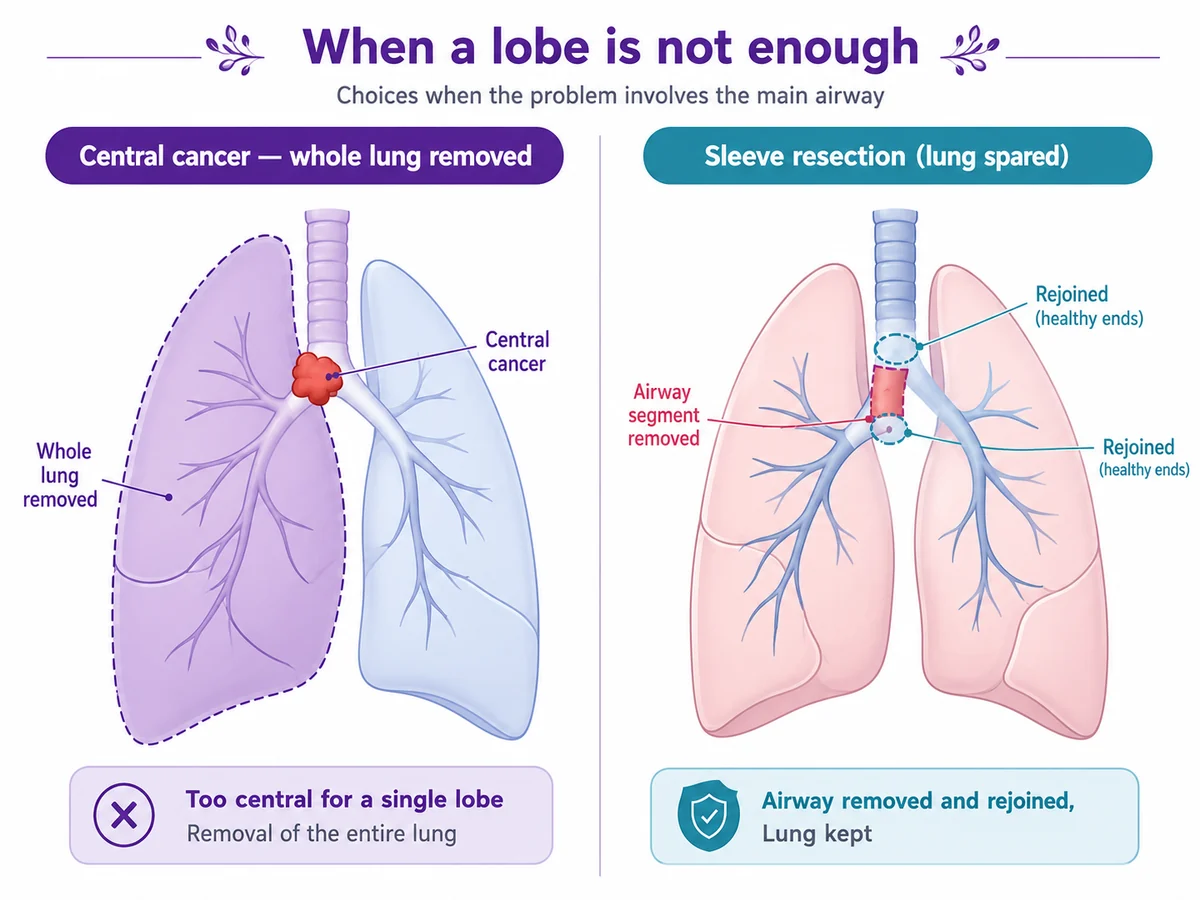
Surgeons always prefer to remove as little lung as possible. A pneumonectomy is used only when the cancer is too central — sitting where the main airway and blood vessels enter the lung, or crossing between lobes — so that taking a single lobe would leave cancer behind. But there is often a lung-sparing alternative worth knowing about: a “sleeve resection”. In a sleeve operation, the surgeon removes the affected part of the airway (sometimes with a lobe) and then rejoins the healthy ends — clearing the central cancer while keeping the rest of the lung.
A sleeve operation is not suitable for every tumour — it depends on exactly where the cancer sits and how far it extends. But it is always worth asking about, and at CION your surgeon considers whether a sleeve operation is possible before a pneumonectomy is proposed.
A central cancer may need the whole lung; a lung-sparing sleeve resection removes and rejoins the airway to clear it while keeping the lung.
Pneumonectomy
Sleeve resection (lung-sparing)
Removes
The whole lung on one side.
The affected airway (with or without a lobe); the healthy ends are rejoined.
Used when
The cancer is too central or extensive to be cleared any other way.
A central cancer can be cleared while sparing the rest of the lung.
Lung kept
One lung remains — the other side.
Most of the lung on that side is kept.
Considered
When a sleeve or lobectomy cannot clear the cancer completely.
First, wherever it is oncologically safe to do so.
Lung surgery is a spectrum by how much is removed: a segmentectomy or wedge resection (less than a lobe), a lobectomy (a whole lobe — the standard for many lung cancers), and a pneumonectomy (the whole lung). Where a cancer is smaller or nearer the outer lung, a more limited operation may be all that is needed. The right operation is matched to your cancer, not chosen in advance. Read more about lung cancer surgery →
Diagnosis & staging
Tests that confirm the diagnosis and decide the operation
Before any pneumonectomy, two questions must be answered. First: can the cancer be cleared any other way — by a sleeve operation or a lobectomy? Scans and airway tests show exactly how central the tumour is. Second: can your remaining lung cope? Lung-function (breathing) tests, and sometimes an exercise test, measure your reserve. Only when both answers are clear does your team recommend an operation, and explain why.
Diagnostic services we offer — book any of these:
CT chest scan
Detailed imaging of the lungs to locate the tumour and show how central it is — the first step in deciding how much lung must come out.
A pneumonectomy is one part of treating lung cancer — CION coordinates the whole plan. Surgery removes the cancer; depending on the type and stage, treatment before or after may add radiotherapy, or medicines that treat cancer throughout the body. Every plan is set by a lung tumour board for your situation, so nothing is over- or under-treated — and so the extent of surgery is right for your cancer, not chosen in advance.
Services we deliver — book a consult for any of these:
Pneumonectomy
Removing the whole lung on one side when a central or extensive cancer cannot be cleared otherwise — with intensive monitoring in the early days and breathing rehabilitation after.
Removing the affected airway and rejoining the healthy ends — clearing a central cancer while keeping the rest of the lung. Considered before a pneumonectomy wherever possible.
Precisely targeted radiotherapy, used before or after surgery where the plan calls for it, or instead of surgery in selected cases. Aarogyasri-covered at empanelled centres.
Whether a pneumonectomy is right for you depends on two things: whether the cancer can be cleared any other way — a sleeve operation or a lobectomy — and whether your remaining lung can cope without the one being removed. Before surgery you have lung-function (breathing) tests, and sometimes tests of how well you exercise, to measure your reserve. If the tests show your other lung is strong enough, a pneumonectomy can go ahead; if not, the team looks at lung-sparing surgery, or at treatments that do not involve an operation. This careful check is exactly why most people who have a pneumonectomy manage well with one lung.
Question 1 — can it be cleared another way?
Scans and a bronchoscopy show how central the cancer is and whether it involves the main airway or central vessels. If a sleeve resection or a lobectomy could remove it completely, that is what is offered. A pneumonectomy is not the starting point.
Question 2 — can your other lung cope?
Breathing tests, and sometimes an exercise test, measure your reserve. Surgery is advised only when the results show you can manage well with one lung — which is why life afterwards is usually far better than people fear.
Right or left matters
The right lung is a little larger than the left, so a right pneumonectomy removes slightly more and carries a somewhat higher risk than a left. We tell you honestly what this means for your side, and plan for it.
The decision is made with you
Every case goes to a lung tumour board — surgical, radiation and medical oncologists together. You will understand what is proposed and why before anything is planned, and a second opinion is always welcome.
This page is general information, not a diagnosis or a personal recommendation. Only a thoracic surgical oncologist who knows your scans, your lung-function tests and your health can advise what is right for you.
A pneumonectomy is major surgery, and it is honest to say the recovery is longer than for a smaller lung operation. Expect a hospital stay of about a week, often with a day or two of close monitoring at first, and fuller recovery over one to three months as your remaining lung settles into taking over. Breathing physiotherapy starts early and matters a great deal. Most people adjust well, rebuild their activity gradually, and return to a good quality of life; any further treatment is planned around surgery by the tumour board.
1
Before surgery
Scans, lung-function and sometimes exercise tests confirm the operation is needed and that your other lung can cope. A lung-sparing sleeve option is considered first, and you are prepared honestly for what to expect.
2
The operation
The whole lung on one side is removed by an experienced lung surgical team, with the airway and vessels sealed securely. Right and left are planned differently.
3
In hospital
About a week, often with close monitoring at first. Breathing physiotherapy starts early, and you are helped to move and to breathe deeply.
4
Recovery & ongoing care
Fuller recovery over one to three months as the remaining lung takes over; a gradual return to activity with rehabilitation; and any further treatment planned by the tumour board, with follow-up.
Recovery is supported at every step — breathing physiotherapy, nutrition to keep your strength up, and emotional support for you and your family — so you build back steadily, not alone. More on recovery after lung surgery →
Cost & coverage
What does a pneumonectomy cost in Hyderabad? Indicative
A pneumonectomy is a major operation with intensive monitoring, so it costs more than a smaller lung resection — and one that also needs chest-wall or blood-vessel reconstruction costs more again, while a lung-sparing sleeve resection sits in a different, often somewhat lower range. The reassuring part: this is cancer surgery, so it is generally covered under Aarogyasri / PMJAY at empanelled centres and by most health-insurance policies, usually alongside any treatment around it. These are estimates, not a quotation.
Indicative cost estimator
Pick your situation for an indicative range, then request an exact estimate for your case.
Indicative range
₹3,00,000 – ₹6,00,000
for a pneumonectomy, general room, self-pay
Figures are indicative only and not a quotation. Aarogyasri / PMJAY may cover eligible cancer surgery at empanelled centres, subject to eligibility. Your actual cost depends on the operation, any reconstruction, intensive monitoring, the hospital stay and any treatment around it.
Before you accept that the whole lung must go, let a senior lung surgical oncologist look at your scans. Book a free consultation and, if you already have a biopsy or scan report, a free written second opinion.
Your scans & reports reviewed by a senior surgical oncologist
An honest answer on whether a lung-sparing sleeve operation is possible
Aarogyasri / PMJAY & insurance guidance
Support
Financial support & Aarogyasri
Cost should not delay treatment, and it should never be the reason a family hesitates over an operation this important. Under Aarogyasri and PMJAY, eligible cancer surgery may be largely covered at empanelled centres, and private insurance is accepted cashless. Our counsellors help check eligibility, arrange approvals and map out what you will actually pay — often far less than families fear.
9 clinics in Hyderabad · 35+ across Telangana & AP
CION cancer care is closer than you think.
We're never more than 30 minutes away. Same panel of specialists at every centre. Same tumour board reviews. Same NCCN protocols. Pick the closest one and call directly — or let us pick for you.
Don't see your city? Call
18002028726
— we'll find your nearest CION partner centre.
Meet the surgical oncology team
Your lung surgery is planned by a team, not one doctor.
Surgical, radiation and medical oncologists plan every case together in a multidisciplinary lung tumour board — part of 17 senior specialists across CION.
Share your name and number — we'll call you back within 30 minutes to schedule your consultation.
Told a whole lung must come out? Don’t decide alone.
Sometimes it truly is needed — and sometimes a lung-sparing sleeve operation can clear the cancer instead. Let CION’s lung tumour board review your scans and give you an honest answer either way.
These are the worries people rarely say out loud. Here are honest, respectful answers to the ones we hear most in Telangana.
“Losing a whole lung means I’ll never breathe properly again.”
Fact: Most people live a full, active life with one lung. The remaining lung takes over the work, and after recovery people walk, travel, work and enjoy daily life. You will have less spare capacity for very hard exertion, but ordinary activity is usually well within reach — and this is checked with breathing tests before surgery is ever advised.
“I’ll be on oxygen for the rest of my life.”
Fact: For the great majority, this does not happen. Your lung reserve is measured beforehand precisely so that the remaining lung can support you normally. Long-term oxygen is not the usual outcome of a planned pneumonectomy — if the tests suggested you could not manage, the operation would not be recommended.
“They’re taking the whole lung because it’s easier for the surgeon.”
Fact: The opposite is true. Surgeons always prefer to remove as little lung as possible, and a pneumonectomy is a bigger operation with a longer recovery. It is used only when the cancer is too central or extensive to be cleared by taking a lobe — and your surgeon checks whether a lung-sparing sleeve operation could avoid it first.
“Half my breathing is gone, so I’ll only be half alive.”
Fact: Lung capacity is not a simple half-and-half sum. The remaining lung adapts and takes over much of the work, which is why everyday life — walking, stairs, work, family — is usually well within reach afterwards. What you notice is less reserve at the very top end of exertion, not the loss of ordinary living.
“It’s too late — if they need the whole lung, the cancer must be hopeless.”
Fact: Needing a pneumonectomy is about where the cancer sits — centrally, near the main airway or vessels — not about it being hopeless. A pneumonectomy is offered precisely because it gives the best chance of removing the cancer completely. It is a treatment decision about position, not a verdict.
“I smoked for years, so this is my fault and I don’t deserve treatment.”
Fact: Where the tobacco came from does not change your right to good care, and no one at CION will judge you for it. Lung cancer also occurs in people who never smoked. We focus on treating you well now — and if you would like help to stop smoking, we support that too, without lectures.
“A middle-class family can’t afford an operation this big.”
Fact: Aarogyasri and PMJAY cover eligible cancer surgery at empanelled centres, and private insurance is accepted cashless. Our counsellors help you check eligibility, arrange approvals and map out what you will actually pay — often far less than families fear. Cost should not decide this.
“The empty space where my lung was will collapse my chest or crush my heart.”
Fact: This is a very common fear and it does not happen. The space left behind gradually fills with fluid and the body settles around it over the weeks after surgery — this is expected and your team monitors it. Your heart and remaining lung continue to work.
“Cutting into the cancer during surgery will make it spread.”
Fact: This is a common, harmful myth. Removing the lung under controlled surgical conditions does not spread cancer through the body. What actually causes harm is delay, which lets a treatable cancer grow — and can turn an operation that would have spared lung into one that cannot.
“I’m too old for an operation this major.”
Fact: Age alone does not decide it — fitness and lung reserve do. Your team assesses you individually with breathing tests and, where useful, an exercise test. For some people a pneumonectomy is well tolerated at an older age; for others a different treatment fits better. It is judged case by case, honestly.
“Right or left makes no difference — they’re not telling me everything.”
Fact: It does make a difference, and we say so plainly. The right lung is a little larger than the left, so a right pneumonectomy removes slightly more and carries a somewhat higher risk; a left is generally better tolerated. Either way, your lung-function tests confirm you can cope, and the team plans for your side.
“If they offer a sleeve operation, they’re cutting corners on my cancer.”
Fact: A sleeve resection is not a lesser operation — it removes the affected airway and rejoins the healthy ends, clearing the central cancer while keeping your lung. It is offered only when it can clear the cancer as completely. Where it cannot, you will be told, and a pneumonectomy recommended instead.
“I’ll never climb stairs or walk to the temple again.”
Fact: Most people do exactly these things again. After recovery and breathing rehabilitation, ordinary activity — stairs, walking, outings, work — is usually well within reach. You may pause a little more on a long climb than before. That is a real change, and a very different thing from losing your life back.
“I’ll be in unbearable pain after chest surgery.”
Fact: Chest surgery is uncomfortable, and we will not pretend otherwise — but pain is actively managed with medication and reviewed daily. Good pain relief is not a luxury here: it helps you breathe deeply and move early, which is exactly what helps the remaining lung take over. You will not be left to endure it.
“The cancer will just come back anyway, so why go through this.”
Fact: Removing the cancer completely gives you the best chance of it staying controlled — that is the whole point of the operation. Follow-up scans catch any change early, when further treatment works best. Going through a pneumonectomy is a strong step, not a wasted one.
“A second opinion will offend my doctor or waste time.”
Fact: A second opinion is normal and welcomed in cancer care, and for a decision this big it is genuinely worth having. It either confirms the plan and gives you confidence, or it finds an option worth discussing. At CION it can be arranged quickly, and it is free when you have a scan or biopsy report to review.
“If I need chemo or radiation afterwards, the surgery failed.”
Fact: Not at all. For many lung cancers, treatment before or after surgery is a planned part of getting the best result — decided by the type and stage from the start, not by anything going wrong. Your tumour board maps out the whole plan before the operation, and explains it to you.
“Herbal or home remedies could shrink it and save my lung.”
Fact: No home or herbal remedy is proven to clear a lung cancer, and relying on one wastes the window when surgery — sometimes lung-sparing surgery — is still possible. That delay is what turns a sleeve operation into a pneumonectomy. Tell your oncologist about anything you take, so it can be used safely alongside proper treatment.
“I’ll never be able to travel or fly again.”
Fact: Most people travel again, including by air, once they have recovered and their team confirms they are ready. Your doctor advises on timing based on your recovery and your lung-function results. This is a question to ask at follow-up — not a door that closes.
“My family will have to look after me forever — I’ll be a burden.”
Fact: The early weeks do need help, and that is normal after major surgery. But recovery moves steadily: most people become independent in daily life again over one to three months, and return to work and routine. Breathing physiotherapy and rehabilitation are there to get you back to yourself, not to manage a permanent decline.
Why CION
Why choose CION for a pneumonectomy in Hyderabad
Lung-sparing considered first
A sleeve or smaller operation is considered before a pneumonectomy — keeping lung wherever it is oncologically safe to do so.
Careful lung-function workup
Breathing and, where useful, exercise tests confirm your remaining lung can cope — so surgery is advised only when you can manage well.
Experienced lung surgical team
A major operation performed by an experienced lung (thoracic) surgical oncology team, with intensive monitoring in the early days.
Breathing rehabilitation
Physiotherapy and a structured return to activity help you rebuild your fitness and confidence with one lung.
A tumour-board approach
Every case reviewed by a lung multidisciplinary tumour board, so the extent of surgery and any other treatment fit together.
Aarogyasri & care close to home
Cancer surgery is covered under Aarogyasri at empanelled centres; 35+ centres across Telangana & AP, with Telugu-speaking teams.
Real stories · real courage
15,000+ patients chose CION. Hear from them directly.
These aren't paid endorsements or written reviews. These are video testimonials from real patients and families — recorded on their own phones, in their own words. Pick any one. Watch it. Then decide.
4.8★800+ Google reviews
50+video testimonials
15,000+patients treated
Successful Chemotherapy & Radiation Done by Dr. Owais Mohammed & Dr. Kirti Ranjan
Watch video →
Successful Chemotherapy Done by Dr. C Raghavendra Reddy
Watch video →
Surgery, Chemo & Radiation Done by Dr. Imaduddin, Dr. Vinay, Dr. Owais, Dr. Kirti
Watch video →
Successful Radical Thymectomy Done by Dr. Mohammed Imaduddin & Dr. Vinay Mamidala
Watch video →
Successful Surgery Done by Dr. Rajender Byshetty
Watch video →
Successful Chemo & Surgery Done by Dr. Imad, Dr. Vinay, Dr. Owais & Dr. Raghavendra
Watch video →
Successful Chemo & Surgery Done by Dr. Imad, Dr. Vinay, Dr. Owais & Dr. Raghavendra
Watch video →
Successful Chemo & Radiation Done by Dr. Owais Mohammed & Dr. Kirti Ranjan Mohanty
Watch video →
Successful Breast Cancer Surgery Done by Dr. Imaduddin Mohammed & Dr. Vinay Mamidala
Watch video →
Successful Chemotherapy Done by Dr. Bharati Devi Gorantla
Watch video →
Successful Chemo & Surgery Done by Dr. Owais Mohammed & Dr. Imaduddin Mohammed
Watch video →
Successful Chemotherapy Done by Dr. Gundu Naresh
Watch video →
Successful Bone Marrow Transplantation - Neuroblastoma
Watch video →
Successful Surgery & Chemo - Carcinoma of Caecum
Watch video →
Successful Oral chemotherapy & mastectomy surgery
Watch video →
Successful Oral chemotherapy & mastectomy surgery
Watch video →
Successful Chemotherapy
Watch video →
Successful Surgery by Dr. Mohammed Imaduddin
Watch video →
Successful Bone Marrow Transplantation
Watch video →
Successful Oral chemotherapy & mastectomy surgery
Watch video →
Successful Oral chemotherapy & mastectomy surgery
Watch video →
Successful Chemotherapy
Watch video →
Successful Buccal Mucosa Surgery
Watch video →
Successful Complex Surgery Mandibulectomy Reconstruction
A pneumonectomy is one part of lung cancer care. At CION, surgery, radiotherapy, any other treatment, and breathing and emotional support are one coordinated plan — from diagnosis through to recovery and follow-up.
Breathing & rehabilitation
Physiotherapy to help the remaining lung take over and to rebuild your strength after surgery. Learn more
Nutrition counselling
Dietitian support to keep your strength up before major lung surgery and through recovery. Learn more
Psychology counselling
Emotional support for you and your family through diagnosis, surgery and life with one lung. Learn more
Help to stop smoking
Practical, non-judgemental support to stop — which helps recovery and your remaining lung. Learn more
Palliative & comfort care
Comfort and symptom support at any stage, alongside treatment — including help with breathlessness. Learn more
Financial counselling
Aarogyasri, PMJAY and cashless insurance guidance so cost never blocks care. Learn more
FAQ
Pneumonectomy in Hyderabad — frequently asked questions
What is a pneumonectomy?
A pneumonectomy is an operation that removes an entire lung — the whole lung on one side of the chest. It is the most extensive lung-cancer operation, used when the cancer is too central or extensive to be cleared by removing just a lobe — for example when it involves the main airway or central blood vessels, or crosses between lobes. It is only advised when it is needed to remove the cancer completely, and after tests confirm your other lung can cope.
Can I live and breathe with only one lung?
Yes. Most people live a full, active life with one lung — the remaining lung takes over the work, and after recovery people walk, travel, work and enjoy daily life. You will have less spare capacity for very hard exertion, but ordinary activities are usually well within reach. Lung-function tests are done before surgery to confirm your remaining lung has enough reserve, so a pneumonectomy is only advised when you can manage well with one lung.
Why do I need the whole lung removed, not just a lobe?
A lobectomy — removing one lobe — is always preferred when it can clear the cancer. A pneumonectomy is needed when the cancer is too central, sitting where the main airway and blood vessels enter the lung, or crossing between lobes, so that taking a single lobe would leave cancer behind. Removing the whole lung then gives the best chance of removing the cancer completely. Your surgeon first checks whether a lung-sparing sleeve operation could avoid it.
Can a smaller operation — a sleeve resection — avoid a pneumonectomy?
Sometimes, yes. In a sleeve resection, the surgeon removes the affected part of the airway (sometimes with a lobe) and rejoins the healthy ends — clearing a central cancer while keeping the rest of the lung, and avoiding a pneumonectomy. It is not suitable for every tumour, but at CION your surgeon considers whether a sleeve operation is possible first, because keeping lung is always preferred when it is oncologically safe.
Is a right pneumonectomy riskier than a left?
The right lung is a little larger than the left, so a right pneumonectomy removes slightly more lung and carries a somewhat higher risk; a left pneumonectomy is generally better tolerated. Either way, lung-function tests beforehand confirm your remaining lung can cope, and the team plans the operation and recovery accordingly. Your surgeon explains what this means for your side.
What is life like after a pneumonectomy — activity and breathing?
After recovery, most people return to a good quality of life — walking, working, travelling and enjoying daily activities. Your remaining lung takes over, so you may notice you get more breathless with very hard exertion, such as climbing many flights quickly or strenuous sport, but ordinary activity is usually well within reach. Breathing physiotherapy and a gradual return to activity help you rebuild your fitness.
How long is recovery after a pneumonectomy?
A pneumonectomy is major surgery with a longer recovery than a smaller lung operation — a hospital stay of about a week, often with close monitoring at first, and fuller recovery over one to three months as your remaining lung settles into taking over. Breathing physiotherapy starts early and is important. Most people adjust well and rebuild their activity gradually; any further treatment is planned around surgery.
How much does a pneumonectomy cost in Hyderabad?
A pneumonectomy is a major operation with intensive monitoring, so an indicative range is around ₹3,00,000 to ₹6,00,000, and more if chest-wall or blood-vessel reconstruction is needed. A lung-sparing sleeve resection sits in a different, often somewhat lower range. Under Aarogyasri / PMJAY, eligible cancer surgery at empanelled centres may be largely covered, and insurance is accepted cashless. CION gives an accurate written estimate after assessment; figures on this page are indicative only and not a quotation.
Is a pneumonectomy covered by Aarogyasri or insurance?
It is cancer surgery, so it is generally covered under Aarogyasri and PMJAY at empanelled centres, subject to eligibility, and by most health-insurance policies cashless — usually alongside any treatment around it. CION is Aarogyasri empanelled; our counsellors check your policy and scheme eligibility, arrange approvals and provide a written estimate before anything is planned.
What tests decide whether I can have a pneumonectomy?
Two things are assessed. First, whether the cancer can be cleared any other way: a CT scan and a bronchoscopy show how central it is and whether a sleeve resection or a lobectomy could remove it. Second, whether your remaining lung can cope: lung-function (breathing) tests, and sometimes an exercise test, measure your reserve. Surgery is advised only when both answers support it, and every case is reviewed by a lung tumour board.
What happens to the space left behind after the lung is removed?
This worries many people, and the answer is reassuring: the space gradually fills with fluid and the body settles around it over the weeks after surgery. This is expected and normal, and your team monitors it as part of your follow-up. Your heart and your remaining lung continue to do their work.
Will I need oxygen after a pneumonectomy?
For the great majority of people, no. Oxygen may be used for a short time in hospital immediately after surgery, but long-term oxygen at home is not the usual outcome of a planned pneumonectomy. Your lung reserve is measured beforehand precisely so that your remaining lung can support you normally — if the tests suggested otherwise, the operation would not be recommended.
Can a pneumonectomy be done by keyhole (VATS) surgery?
Most pneumonectomies are done as open surgery, because the cancers that need a whole lung removed are central and involve the main airway and blood vessels, where direct access matters for safety and for removing the cancer completely. Keyhole (VATS) surgery is more commonly used for smaller lung operations such as a lobectomy. Your surgeon explains which approach is right for your cancer and why.
Will I need chemotherapy, radiotherapy or other treatment as well?
Often, yes — and that is planned, not a sign anything went wrong. Depending on the type and stage of your lung cancer, treatment before or after surgery may include radiotherapy, or medicines that treat cancer throughout the body such as chemotherapy, immunotherapy or targeted therapy. Your lung tumour board decides the whole plan from the start and explains it to you.
How long will I stay in hospital after a pneumonectomy?
Expect about a week, often with a day or two of close monitoring at first because this is major surgery. Breathing physiotherapy starts early, and you are helped to move and to breathe deeply. Your team guides you through pain relief and activity, and you go home when it is safe — with clear advice on recovery over the following one to three months.
Can I fly or travel after a pneumonectomy?
Most people travel again, including by air, once they have recovered and their team confirms they are ready. The timing depends on your recovery and your lung-function results, so it is a question to raise at follow-up rather than something to assume either way. Your doctor will give you advice specific to your situation.
Can I exercise or play sport after losing a lung?
Ordinary exercise — walking, everyday activity, gentle fitness — is usually well within reach after recovery, and breathing rehabilitation is designed to help you rebuild. Where you will notice the difference is at the top end of exertion: strenuous sport or very hard efforts demand reserve you no longer have. Many people set new, realistic goals with their physiotherapist and do well.
Am I too old for a pneumonectomy?
Age alone does not decide suitability — fitness and lung reserve matter more. Breathing tests, and sometimes an exercise test, measure whether you can manage with one lung. Your team assesses you individually and recommends the option most likely to help you, which may be a pneumonectomy, a lung-sparing operation, or a treatment that does not involve surgery.
Does surgery spread the cancer?
No. Removing the lung under controlled surgical conditions does not spread cancer through the body — this is a common and harmful myth. What causes real harm is delay, which lets a treatable cancer grow, and can turn an operation that would have spared lung into one that cannot. Surgery remains one of the most effective ways to remove a lung cancer completely.
Which is the best hospital for a pneumonectomy in Hyderabad?
Look for a cancer centre with fellowship-trained surgical oncologists experienced in lung surgery, multidisciplinary tumour-board planning, a careful lung-function workup before any decision, a willingness to consider lung-sparing sleeve resection first, and coordinated support such as breathing rehabilitation afterwards. CION Cancer Clinics offers these across 35+ centres in Telangana and Andhra Pradesh, with Aarogyasri and insurance counselling. You can request a specific surgeon when booking.
Explore
Explore lung cancer care around a pneumonectomy
Treatment, surgery, tests, recovery and cost around lung cancer. Tap any topic to read more.
Speak to a surgical oncologist about a pneumonectomy
Early answers change outcomes — and sometimes they save lung. Book a free consultation or second opinion at any of our 9 Hyderabad clinics, part of 35+ centres across Telangana & Andhra Pradesh.
Medical disclaimer: This page provides general information about pneumonectomy (surgery to remove a whole lung) for lung cancer and is not a substitute for professional medical advice, diagnosis or treatment. It is not a diagnosis or a personal recommendation: only a thoracic surgical oncologist who knows your scans, your lung-function tests and your health can advise what is right for you. Costs shown are indicative only and not a quotation. Lung surgery at CION is performed by our surgical oncology team, with every case planned by a multidisciplinary lung tumour board. Always consult a qualified oncologist about your individual care. Content is periodically reviewed by CION’s medical team.

 CION Ameerpet