A radical hysterectomy is the main operation for early cervical cancer. It removes more than a simple hysterectomy — the uterus, cervix, the tissue beside the cervix and the upper vagina, with the pelvic lymph nodes — to clear the cancer with a safe margin. The tender questions are understandable: can I still have children? will I go into menopause? The hopeful answers: for very early cancers a fertility-sparing operation may be possible, and the ovaries can often be kept, so your natural hormones continue.
Fertility-sparing trachelectomy where it is safe
Ovaries & hormones preserved where possible
Nerve-sparing for the bladder · gynae-oncology tumour board
★★★★★Rated 4.8/5 · 800+ Google reviews
35+ centres, close to home
17 oncologists, one team
Fertility & nerve-sparing where safe
Aarogyasri & insurance help
MM
Written by Dr. Muralidhar Muddusetty, MRCS (Edinburgh), AIIMS-trained Surgical Oncologist. Medically reviewed by Dr. Paila Gowri Naidu, MCh (Surgical Oncology), FMAS. · Reviewed 14 July 2026
Understanding the surgery
What is a radical hysterectomy?
A radical hysterectomy removes the uterus and cervix together with the tissue beside the cervix (the parametrium) and the upper part of the vagina, and removes and checks the pelvic lymph nodes. It is the main operation for early cervical cancer. Removing this extra surrounding tissue is what makes it “radical” — it gives a clear margin around the cancer, which a simple hysterectomy (uterus and cervix only) does not. In many women, especially younger ones, the ovaries can be kept, so natural hormones continue.
Not every cervical cancer needs, or is treated by, a radical hysterectomy. Very early cancers may be treated with a smaller operation — a cone biopsy or a fertility-sparing trachelectomy — while locally advanced cervical cancer is usually treated with chemoradiation and brachytherapy rather than surgery. Your team recommends the right treatment for the stage of your cancer and your wishes, planned together by a gynae-oncology tumour board.
What a radical hysterectomy does
Clears the cancer with a margin
The uterus, cervix, upper vagina and the tissue beside the cervix are removed together, for a clear margin around the cancer.
Checks the pelvic nodes
The pelvic lymph nodes are removed and examined — both to treat the cancer and to stage it accurately.
Keeps what it can
The ovaries are often preserved for hormones, and for very early cancers fertility can sometimes be kept.
Diagnosis & staging
Tests that confirm cervical cancer and guide surgery
Before any surgery, the cancer is confirmed and staged. A biopsy establishes the diagnosis, and scans show how far the cancer reaches and whether the nodes are involved. Your gynae-oncology team then decides — with you — the right operation and whether a fertility-sparing option applies.
Diagnostic services we offer — book any of these:
Pap smear & HPV test
Simple tests that detect cervical cell changes and the HPV virus early — the first step for cervical cancer.
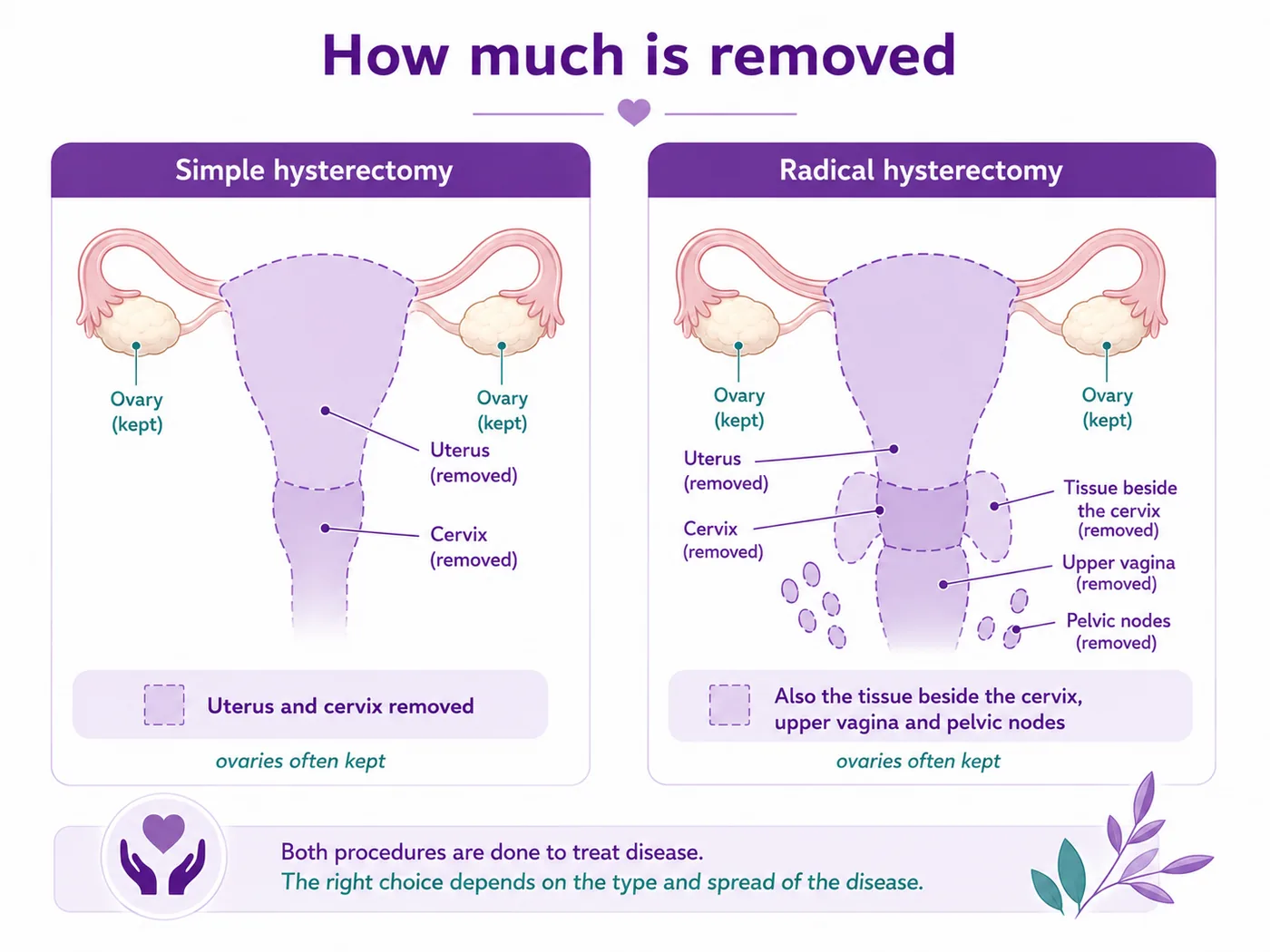
The difference is how much is removed around the cervix. A simple hysterectomy removes only the uterus and cervix — used for non-cancer conditions and some very early, pre-invasive changes. A radical hysterectomy removes the uterus and cervix plus the tissue beside the cervix (the parametrium), the upper vagina and the pelvic lymph nodes — the extra tissue that gives a safe margin around a cervical cancer. In both, the ovaries can often be kept. The right operation depends on the stage of the cancer.
A simple hysterectomy removes the uterus and cervix; a radical hysterectomy also removes the tissue beside the cervix, the upper vagina and the pelvic nodes — with the ovaries often kept.
Simple hysterectomy
Radical hysterectomy
What is removed
The uterus and cervix.
The uterus, cervix, tissue beside the cervix, upper vagina and pelvic lymph nodes.
Used for
Non-cancer conditions and some very early, pre-invasive changes.
Early cervical cancer.
The ovaries
Often kept.
Often kept, especially in younger women, so hormones continue.
Fertility
Ends the ability to carry a pregnancy.
Ends the ability to carry a pregnancy — unless a fertility-sparing trachelectomy is suitable.
For cervical cancer — also removes the tissue beside the cervix, the upper vagina and the pelvic nodes.
Fertility-sparing option
For a very early cancer, a trachelectomy removes the cervix but keeps the uterus — so pregnancy can still be possible.
How it's done
The approach, the nodes & sparing the bladder
For a radical hysterectomy for cervical cancer, open (abdominal) surgery is the established standard — large studies have shown it gives the best outcomes, so it is preferred over keyhole surgery for this operation, with a minimally invasive approach considered only in carefully selected situations. The pelvic lymph nodes are removed and examined at the same time. Because the surgery works close to the nerves that serve the bladder, the surgeon uses nerve-sparing techniques where possible to protect bladder function. Every case is planned by a gynae-oncology tumour board.
Open (abdominal) — the standard
For cervical cancer, open radical hysterectomy is the evidence-based standard and the approach CION follows for the best outcomes.
Pelvic node dissection
The pelvic lymph nodes are removed and examined during the operation, to treat and to stage the cancer accurately.
Nerve-sparing for the bladder
Careful, nerve-sparing technique protects the nerves near the cervix, helping bladder function recover.
What about keyhole or robotic surgery? For a radical hysterectomy for cervical cancer, the best evidence favours open surgery, so CION does not present keyhole or robotic as superior for this operation. A minimally invasive approach may be considered only in carefully selected situations — the surgeon recommends the safest approach for your cancer, not the newest machine.
Treatment
Cervical-cancer treatments we deliver
Surgery is one part of care — CION delivers the full range and helps you choose. For cervical cancer that means the radical operation and, where a cancer is very early, fertility-sparing surgery — alongside radiation with chemotherapy and brachytherapy when the stage calls for them. Every plan is set by a gynae-oncology tumour board.
Treatments we deliver — book a consult for any of these:
Radical hysterectomy
The main operation for early cervical cancer — the uterus, cervix, surrounding tissue, upper vagina and pelvic nodes removed with a clear margin.
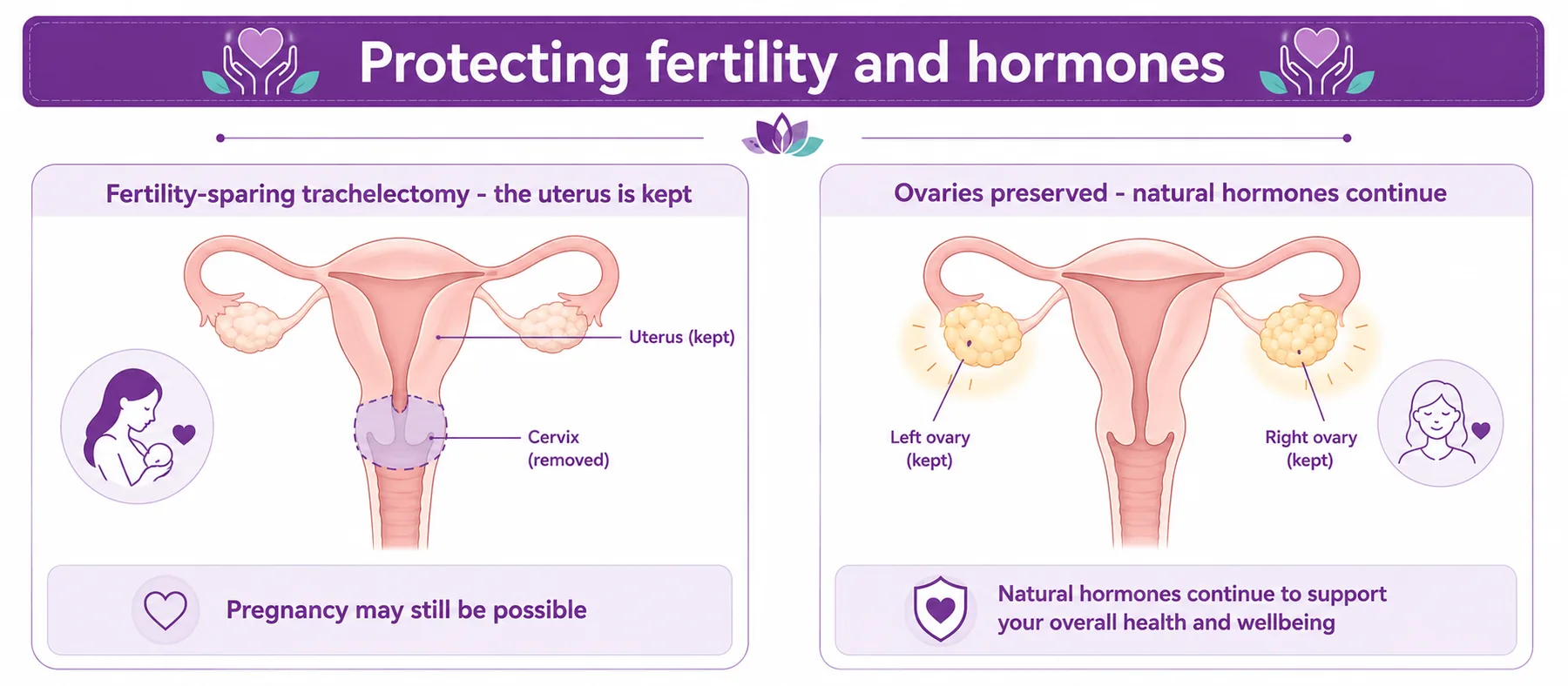
These are the questions that weigh most, and there is real, honest hope here. A radical hysterectomy removes the uterus, so pregnancy is not possible afterwards — but for a very early cervical cancer, a fertility-sparing radical trachelectomy may be an option: it removes the cervix and the tissue beside it and checks the pelvic nodes, but keeps the uterus, so pregnancy can still be possible. Separately, the ovaries are not the same as the uterus — in younger women they can usually be kept (or moved out of the way of any later radiation), so natural hormones continue and surgery alone does not bring on menopause.
Two ways function is protected: a fertility-sparing trachelectomy keeps the uterus for a very early cancer, and the ovaries can be preserved so hormones continue.
Fertility-sparing trachelectomy
For a very early cancer, removing the cervix and the tissue beside it while keeping the uterus can preserve the chance of pregnancy. Whether it is suitable depends on the size and type of the cancer, assessed carefully beforehand — so raise fertility early.
Keeping the ovaries
In younger women the ovaries can often be kept, or moved out of the way of any later radiation, so natural hormones continue and surgery alone does not trigger menopause. Your team discusses whether this is right for you.
Intimacy & sexual health
Because the upper vagina is removed it is a little shorter afterwards, but it usually stretches and adjusts, and most women return to a satisfying sex life. Keeping the ovaries helps comfort and lubrication; your team discusses this openly.
Identity & emotional support
Feelings of loss are normal and valid. CION's psycho-oncology counsellors support you and your family through the emotional side — because feeling like yourself again is part of the treatment.
What to expect & recovery
Surgery, recovery and life after
A radical hysterectomy is major pelvic surgery, but it follows a clear, well-supported path. It is done under general anaesthetic and needs a hospital stay of a few days. A urinary catheter is used for a short while, because the bladder can be slow to wake up after surgery near its nerves; this usually settles. Because the pelvic nodes are removed, there is a small chance of leg swelling (lymphoedema) later, which is watched for and managed early. Most women are back to gentle activities within weeks, with fuller recovery over one to two months, and the node results guide whether any further treatment helps.
1
Before surgery
Scans and tests confirm the stage; your surgeon explains the operation, fertility and ovary options.
2
The operation
Open (abdominal) surgery removes the cancer with a clear margin; nodes cleared, ovaries kept where possible.
3
In hospital
A stay of a few days, a catheter for a short while, and good pain control while the bladder recovers.
4
Early recovery
Gentle activity over weeks, an eye on the bladder and any leg swelling, building up gradually.
5
Follow-up
The node results guide any further treatment, with ongoing follow-up and support.
Most women return to normal daily life, work and family over one to two months, building up as strength returns. Follow-up focuses on your recovery and on watching for any change, with support for the hormonal and emotional side throughout — the care does not stop when the operation is over.
Cost & coverage
Radical hysterectomy cost in Hyderabad Indicative
The cost depends on the operation — a fertility-sparing trachelectomy, a standard radical hysterectomy, or a more extended node dissection — with room category and length of stay. In Hyderabad this is typically an indicative ₹1,60,000 – ₹3,40,000. The reassuring part: this is cancer surgery, so it is generally covered under Aarogyasri / PMJAY at empanelled centres, and by most health-insurance policies cashless. These are estimates, not a quotation.
Indicative cost estimator
Pick your situation for an indicative range, then request an exact estimate for your case.
Indicative range
₹1,60,000 – ₹3,40,000
for a radical hysterectomy, general room, self-pay
Figures are indicative only and not a quotation. Cervical cancer surgery is generally covered under Aarogyasri / PMJAY at empanelled centres, subject to eligibility. Your actual cost depends on your diagnosis and plan.
An early cervical cancer diagnosis shouldn't wait. Book a free consultation and, if you already have a biopsy report, a free written second opinion.
Your reports reviewed by a senior gynae-oncology surgeon
An honest answer on surgery — and whether fertility can be preserved
Aarogyasri / PMJAY & insurance guidance
Support
Financial support & Aarogyasri
Cost should not delay treatment. Under Aarogyasri and PMJAY, eligible cervical-cancer surgery may be largely covered at empanelled centres, and private insurance is accepted cashless. Our counsellors help check eligibility, arrange approvals and map out what you will actually pay — often far less than families fear.
9 clinics in Hyderabad · 35+ across Telangana & AP
CION cancer care is closer than you think.
We're never more than 30 minutes away. Same panel of specialists at every centre. Same tumour board reviews. Same NCCN protocols. Pick the closest one and call directly — or let us pick for you.
Don't see your city? Call
18002028726
— we'll find your nearest CION partner centre.
Meet the surgical oncology team
Your radical hysterectomy is planned by a team, not one doctor.
Surgical, radiation and medical oncologists plan every cervical-cancer case together in a multidisciplinary tumour board — part of 17 senior specialists across CION.
Share your name and number — we'll call you back within 30 minutes to schedule your consultation.
An early cervical cancer diagnosis? Don't decide alone.
The right operation — and whether fertility can be preserved — depends on your cancer and its stage. Let CION's tumour board review your reports and give you an honest, cancer-first recommendation.
Common fears about a radical hysterectomy — answered
These worries are real, and some are made heavier by what people say. Here are honest, gentle answers to the fears we hear most in Telangana.
“If my womb is removed, can I never have children — what will my family say?”
Fact: A radical hysterectomy removes the uterus, so it does end the ability to carry a pregnancy — but for a very early cervical cancer a fertility-sparing trachelectomy may keep the uterus, so it is vital to ask before surgery is fixed. Where fertility cannot be preserved, your team talks through the options and supports you and your family. A woman's worth is not measured by her womb, and cancer treatment is a medical necessity, not a failing.
“Will I suddenly go into menopause — and is that dangerous?”
Fact: Not from the surgery alone, if the ovaries are kept. The ovaries — which make your hormones — are separate from the uterus, and in younger women they can often be preserved, or moved out of the way of any later radiation, so natural hormones continue. Menopause follows only if the ovaries are removed or affected by radiation. Ask your surgeon exactly what is planned for your ovaries.
“Will a radical hysterectomy leave me unable to control my bladder?”
Fact: It can affect the bladder temporarily. Because the surgery works near the nerves that serve the bladder, it can be slow to wake up, so a catheter is used for a short while. Nerve-sparing techniques help protect these nerves, and bladder function usually settles with support. Your team guides you through this part of recovery.
“Cervical cancer comes from an infection — is it my fault, and should I hide it?”
Fact: Cervical cancer is linked to a very common virus (HPV) that most people encounter at some point — it is not a mark of character, and it is nobody's fault. Shame or hiding the diagnosis only delays care and isolates you when support matters most. There is no blame in a cancer diagnosis, and a good team treats you with respect and confidentiality.
“Will the surgery spread the cancer?”
Fact: This is a common, harmful myth. Removing the cancer under controlled surgical conditions does not spread it through the body. What actually causes harm is delay, which lets a treatable cancer grow. A radical hysterectomy removes the cancer with a clear margin, and the pelvic nodes are checked during the operation to understand and control any spread.
“Will removing my womb make me less of a woman — will my husband still accept me?”
Fact: A radical hysterectomy does not change who you are. Your identity, relationships and role in your family remain. The uterus is an organ, not the seat of womanhood, and removing it to treat cancer is an act of care. Many women lead full personal, married and social lives afterwards, and counselling supports you and your partner through the change.
“Will a radical hysterectomy end my intimate life for good?”
Fact: Because the upper part of the vagina is removed, it is a little shorter afterwards, though it usually stretches and adjusts over time, and most women return to a satisfying sex life. Keeping the ovaries helps natural lubrication and comfort. Your team is used to discussing this openly and can offer support and simple measures that help.
“Can a middle-class family afford cancer surgery?”
Fact: Cost should not be the reason care is delayed. Aarogyasri and PMJAY cover eligible cervical-cancer surgery at empanelled centres, and private insurance is accepted cashless. Our counsellors help you check eligibility and map out what you will actually pay — often far less than families fear.
“Keyhole or robotic surgery is the only good option, and CION doesn't push it.”
Fact: For a radical hysterectomy for cervical cancer, large studies have shown that open (abdominal) surgery gives the best outcomes — so it is the established standard, and it would be wrong to present keyhole or robotic as superior for this operation. A minimally invasive approach is considered only in carefully selected cases. What matters most is the surgeon and the cancer plan, not the machine.
“If I need chemoradiation after surgery, it means the surgery failed.”
Fact: Not at all. For some cervical cancers a planned course of radiation with chemotherapy is given after surgery to give the best control — it is part of the plan, not a failure. And for locally advanced cancer, chemoradiation with brachytherapy is the right treatment from the start, rather than surgery. Your tumour board chooses what treats your cancer most thoroughly.
“Home or herbal remedies can treat the cancer instead of surgery.”
Fact: No home or herbal remedy is proven to cure cervical cancer, and relying on one wastes the window when it is most treatable. Tell your oncologist about anything you take so it can be used safely alongside proper treatment — but do not let it replace treatment.
“A big scar and months in bed are unavoidable.”
Fact: A radical hysterectomy for cervical cancer is usually an open operation, so there is an abdominal incision — but pain is well controlled, most women are up and moving within a day or two, and the hospital stay is a few days. Recovery to normal activity is typically one to two months, building up gradually — not months in bed.
“I'm too old — or too young — for this surgery.”
Fact: Age alone does not decide it — your fitness, the cancer type and its stage do. For younger women, fertility and the ovaries are weighed carefully; for older women, other health conditions are considered. Your team assesses you individually and recommends the option most likely to help you, rather than going by a number.
“Talking about gynae problems is shameful — better to stay quiet.”
Fact: These are normal, important medical questions, not a source of shame. Raising them with your surgeon before surgery leads to better decisions and better support — especially about fertility, the ovaries and the bladder. Silence only delays care and deepens worry; a respectful team makes these conversations easy.
“Once the uterus is removed, the cancer is definitely gone forever.”
Fact: A radical hysterectomy treats early cervical cancer very effectively, and for most women it is a decisive step. But no treatment promises zero risk, which is why follow-up matters — it watches for any change and catches it early, when further treatment works best. Follow-up is a safety net, not a sign of doubt.
“I must decide on surgery immediately, without a second opinion.”
Fact: A second opinion is normal and welcomed in cancer care — it confirms the plan and gives you confidence, especially about fertility and the extent of surgery. At CION it is free when you have a biopsy report, and it can be arranged quickly, without offending anyone.
“The leg swelling after node removal will cripple me.”
Fact: Because the pelvic nodes are removed, there is a small chance of leg swelling (lymphoedema) later — but it is watched for and managed early, and simple measures and physiotherapy help keep it in check. It is a manageable risk, not an inevitable one, and your team supports you if it appears.
“A cancer diagnosis means the worst — there is no point in surgery.”
Fact: Early cervical cancer is very treatable, and for many women a radical hysterectomy is a decisive step toward putting it behind them. Even for advanced disease, chemoradiation with brachytherapy offers real, effective treatment. A tumour board gives you an honest picture of what treatment can achieve for your situation — and the care team walks with you through every step.
Why CION
Why choose CION for a radical hysterectomy in Hyderabad
Fertility-sparing options
Where a cancer is very early, fertility-sparing surgery that keeps the uterus — discussed sensitively and early.
Ovary & hormone preservation
Keeping the ovaries where possible, or moving them out of a radiation field, so natural hormones continue.
Nerve-sparing for the bladder
Careful, nerve-sparing technique to protect bladder function during this pelvic surgery.
Evidence-based approach
Open surgery as the established standard for cervical cancer — the approach the best evidence supports.
A tumour-board approach
Every case planned by a gynae-oncology multidisciplinary tumour board, so surgery and any further treatment fit together.
Care closer to home + Aarogyasri
35+ centres across Telangana & AP, Telugu-speaking teams, and full Aarogyasri / insurance counselling.
Real stories · real courage
15,000+ patients chose CION. Hear from them directly.
These aren't paid endorsements or written reviews. These are video testimonials from real patients and families — recorded on their own phones, in their own words. Pick any one. Watch it. Then decide.
4.8★800+ Google reviews
50+video testimonials
15,000+patients treated
Successful Chemotherapy & Radiation Done by Dr. Owais Mohammed & Dr. Kirti Ranjan
Watch video →
Successful Chemotherapy Done by Dr. C Raghavendra Reddy
Watch video →
Surgery, Chemo & Radiation Done by Dr. Imaduddin, Dr. Vinay, Dr. Owais, Dr. Kirti
Watch video →
Successful Radical Thymectomy Done by Dr. Mohammed Imaduddin & Dr. Vinay Mamidala
Watch video →
Successful Surgery Done by Dr. Rajender Byshetty
Watch video →
Successful Chemo & Surgery Done by Dr. Imad, Dr. Vinay, Dr. Owais & Dr. Raghavendra
Watch video →
Successful Chemo & Surgery Done by Dr. Imad, Dr. Vinay, Dr. Owais & Dr. Raghavendra
Watch video →
Successful Chemo & Radiation Done by Dr. Owais Mohammed & Dr. Kirti Ranjan Mohanty
Watch video →
Successful Breast Cancer Surgery Done by Dr. Imaduddin Mohammed & Dr. Vinay Mamidala
Watch video →
Successful Chemotherapy Done by Dr. Bharati Devi Gorantla
Watch video →
Successful Chemo & Surgery Done by Dr. Owais Mohammed & Dr. Imaduddin Mohammed
Watch video →
Successful Chemotherapy Done by Dr. Gundu Naresh
Watch video →
Successful Bone Marrow Transplantation - Neuroblastoma
Watch video →
Successful Surgery & Chemo - Carcinoma of Caecum
Watch video →
Successful Oral chemotherapy & mastectomy surgery
Watch video →
Successful Oral chemotherapy & mastectomy surgery
Watch video →
Successful Chemotherapy
Watch video →
Successful Surgery by Dr. Mohammed Imaduddin
Watch video →
Successful Bone Marrow Transplantation
Watch video →
Successful Oral chemotherapy & mastectomy surgery
Watch video →
Successful Oral chemotherapy & mastectomy surgery
Watch video →
Successful Chemotherapy
Watch video →
Successful Buccal Mucosa Surgery
Watch video →
Successful Complex Surgery Mandibulectomy Reconstruction
A radical hysterectomy is more than an operation. At CION, nutrition, emotional and sexual-health support, genetic risk, comfort and rehabilitation are one coordinated plan — so you are supported medically, emotionally and physically from diagnosis through survivorship.
Nutrition counselling
Strength and general health through treatment and recovery. Learn more
Psychology counselling
Identity, intimacy and family support for you and your partner. Learn more
Genetic counselling
Hereditary-risk guidance for you and your relatives where it applies. Learn more
Rehabilitation
Physiotherapy and recovery support to rebuild strength after surgery. Learn more
Palliative & comfort care
Comfort and symptom support at any stage, alongside treatment. Learn more
Financial counselling
Aarogyasri, PMJAY and cashless insurance guidance so cost never blocks care. Learn more
FAQ
Radical hysterectomy in Hyderabad — frequently asked questions
What is a radical hysterectomy?
A radical hysterectomy is surgery for early cervical cancer that removes the uterus, cervix, the tissue beside the cervix (the parametrium) and the upper part of the vagina, and removes and checks the pelvic lymph nodes. Removing this extra surrounding tissue gives a clear margin around the cancer. In many women the ovaries can be kept, so natural hormones continue.
What is the difference between a radical and a simple hysterectomy?
A simple hysterectomy removes only the uterus and cervix, and is used for non-cancer conditions and some very early, pre-invasive changes. A radical hysterectomy removes the uterus and cervix plus the tissue beside the cervix, the upper vagina and the pelvic lymph nodes — the extra tissue that gives a safe margin around a cervical cancer. Your surgeon recommends the right one for the stage of your cancer.
Will I be able to have children after a radical hysterectomy?
A radical hysterectomy removes the uterus, so pregnancy is not possible afterwards. However, for a very early cervical cancer, a fertility-sparing radical trachelectomy may be an option — it removes the cervix and the tissue beside it but keeps the uterus, so pregnancy can still be possible. If having children matters to you, raise it early, as it shapes the choice of operation.
Will I go into menopause after a radical hysterectomy?
Not from the surgery alone, if the ovaries are kept. The ovaries, which make your hormones, are separate from the uterus, and in younger women they can often be preserved, or moved out of the way of any later radiation, so natural hormones continue. Menopause can follow only if the ovaries are removed or affected by radiation. Your team discusses whether your ovaries can be kept.
Will a radical hysterectomy affect my bladder?
It can, temporarily. Because the surgery removes tissue beside the cervix near the nerves that serve the bladder, the bladder can be slow to wake up afterwards, so a catheter is used for a short while. Nerve-sparing techniques help protect these nerves, and bladder function usually settles with support. Your team guides you through this part of recovery.
Will it affect sex, and is the vagina shortened?
Because the upper part of the vagina is removed, it is a little shorter afterwards, though it usually stretches and adjusts over time, and most women return to a satisfying sex life. Keeping the ovaries helps maintain natural lubrication and comfort. Your team is used to discussing this openly and can offer support and simple measures that help.
Is open or keyhole surgery better for cervical cancer?
For a radical hysterectomy for cervical cancer, large studies have shown that open (abdominal) surgery gives the best outcomes, so it is the established standard and is preferred over keyhole surgery for this particular operation. A minimally invasive approach may be considered only in carefully selected situations. Your surgeon recommends the safest approach for your cancer.
Is a radical hysterectomy covered by Aarogyasri or insurance?
It is cancer surgery, so it is generally covered under Aarogyasri and PMJAY at empanelled centres and by most health-insurance policies cashless. CION's team checks your policy and scheme eligibility and provides a written estimate before anything is planned.
How much does a radical hysterectomy cost in Hyderabad?
In Hyderabad, a radical hysterectomy is typically an indicative ₹1,60,000 to ₹3,40,000, depending on whether it is a standard radical hysterectomy, a fertility-sparing trachelectomy or a more extended node dissection, along with room category and length of stay. Under Aarogyasri / PMJAY, eligible cervical-cancer surgery at empanelled centres may be largely covered, and insurance is accepted cashless. CION gives an accurate estimate after assessment.
How long is recovery after a radical hysterectomy?
A radical hysterectomy usually needs a hospital stay of a few days, with a urinary catheter for a short while as the bladder recovers. Most women are back to gentle activities within weeks, with fuller recovery over one to two months, avoiding heavy lifting at first. The node results are reviewed to guide any further treatment, and your team follows up.
Is a fertility-sparing operation possible for me?
For a very early cervical cancer, a fertility-sparing radical trachelectomy that keeps the uterus may be an option. Whether it is safe depends on the size, type and stage of the cancer, so raise it early, before surgery is planned. A tumour board and, if you wish, a second opinion will tell you whether it applies to you.
Will the surgery spread the cancer?
No. Removing the cancer under controlled surgical conditions does not spread it through the body — this is a common myth. What causes real harm is delay, which lets a treatable cancer grow. A radical hysterectomy removes the cancer with a clear margin, and the pelvic nodes are checked during the operation to understand any spread.
Do my ovaries have to be removed as well?
Not always — it depends on the cancer type, its stage and your age. For early cervical cancer in younger women the ovaries can often be preserved, or moved out of the way of any later radiation, so natural hormones continue. Removing the ovaries before natural menopause can cause surgical menopause, so ask your surgeon exactly what is planned and why.
Why are the pelvic lymph nodes removed?
The pelvic lymph nodes are removed and examined during a radical hysterectomy both to treat the cancer and to stage it accurately. Checking the nodes tells your team whether the cancer has begun to spread, which guides whether any further treatment, such as radiation with chemotherapy, would help. It is a routine, important part of the operation.
Will I need chemotherapy or radiation after surgery?
Sometimes. For some cervical cancers a planned course of radiation with chemotherapy is given after surgery to give the best control — this is part of the treatment plan, not a sign the surgery failed. For locally advanced cervical cancer, chemoradiation with brachytherapy is the right treatment from the start rather than surgery. Your tumour board decides based on the pathology results.
Can cervical cancer come back after a radical hysterectomy?
A radical hysterectomy treats early cervical cancer very effectively, and for most women it is a decisive step. No treatment promises zero risk, which is why follow-up matters — it watches for any change and catches it early, when further treatment works best. Regular follow-up is a safety net that gives you and your team confidence.
Which is the best hospital for a radical hysterectomy in Hyderabad?
Look for a cancer centre with fellowship-trained gynae-oncology surgeons, multidisciplinary tumour-board planning, fertility-sparing and nerve-sparing technique, and open surgery as the standard for cervical cancer. CION Cancer Clinics offers these across 35+ centres in Telangana and Andhra Pradesh, with Aarogyasri and insurance counselling.
Which doctor should I see for cervical cancer surgery in Hyderabad?
For cervical cancer surgery, see a surgical oncologist with gynae-oncology experience. At CION your case is reviewed by a team — surgical, radiation and medical oncologists together — so you get a coordinated, cancer-first plan rather than a single-doctor decision. You can request a specific surgeon when booking.
Explore
Explore cervical & gynae-cancer care at CION
Treatment, surgery, tests and support around cervical, uterine and ovarian cancer. Tap any topic to read more.
Speak to a gynae-oncology surgeon about your options
Early answers change outcomes. Book a free consultation or second opinion at any of our 9 Hyderabad clinics — part of 35+ centres across Telangana & Andhra Pradesh.
Medical disclaimer: This page provides general information about radical hysterectomy (cervical cancer surgery) and is not a substitute for professional medical advice, diagnosis or treatment. Costs shown are indicative only and not a quotation. Open (abdominal) surgery is the established standard for cervical cancer; locally advanced disease is treated with chemoradiation and brachytherapy rather than surgery; a radical hysterectomy removes the uterus (ending pregnancy) unless a fertility-sparing trachelectomy is suitable, and the ovaries can often be kept. Always consult a qualified gynae-oncology surgeon about your individual care. Content is periodically reviewed by CION's medical team.

 CION Ameerpet