Surgery for low rectal & anal cancer · Hyderabad & Telangana
Abdominoperineal resection (APR) in Hyderabad
An APR is surgery for a cancer very low in the rectum, or at the anus, that sits too close to the sphincter to save it. Because the anus is removed, it means a permanent colostomy — and that fear is completely understandable. The honest reason is where the cancer sits, not a lack of trying: wherever a cancer is higher up, we save the sphincter instead. An APR removes the cancer completely, and life with a colostomy is manageable and fully supported.
Sphincter-preserving surgery whenever it is safe · TME standard
Specialist stoma-care nurse & support · keyhole where suitable
Aarogyasri for cancer · clear indicative costs
★★★★★Rated 4.8/5 · 800+ Google reviews
Sphincter-preserving first
TME — the surgical standard
Stoma care & support
35+ centres · Aarogyasri help
MM
Written by Dr. Muralidhar Muddusetty, MRCS (Edinburgh), AIIMS-trained, Colorectal & GI surgical oncology lead, with CION's colorectal surgical oncology team. Medically reviewed by Dr. Vajja Sandeep Kumar, DrNB (Surgical Oncology), FALS Oncology. · Reviewed 14 July 2026
Understanding the surgery
What is an abdominoperineal resection?
An abdominoperineal resection (APR) removes the anus, the rectum and part of the lower bowel together with the surrounding tissue and lymph nodes, taken out through two approaches — through the tummy (abdominal) and around the back passage (perineal). Because the anus is removed, the bowel cannot be rejoined, so the upper end is brought out to a small opening on the tummy — a permanent colostomy — where bowel motions collect in a discreet pouch. It is used for a cancer very low in the rectum, or an anal cancer, that involves or sits too close to the sphincter muscle to preserve it.
An APR is only done when the sphincter genuinely cannot be saved. For cancers higher up, a sphincter-preserving operation (a low anterior resection) rejoins the bowel and avoids a permanent colostomy — and this is always done when it is safe. Rectal cancer surgery follows the TME standard (removing the rectum within its surrounding envelope for a clean margin), and most low rectal cancers are treated with chemoradiation before surgery to give the best result.
Removes the cancer completely
The anus, rectum and surrounding tissue are removed together with a clear margin, to the TME standard.
A permanent colostomy
Because the anus is removed, a small permanent stoma on the tummy collects bowel motions in a discreet pouch.
Only when the sphincter can't be saved
For cancers higher up, sphincter-preserving surgery avoids a permanent colostomy — done whenever it is safe.
Why a permanent colostomy
APR vs sphincter-preserving surgery (LAR)
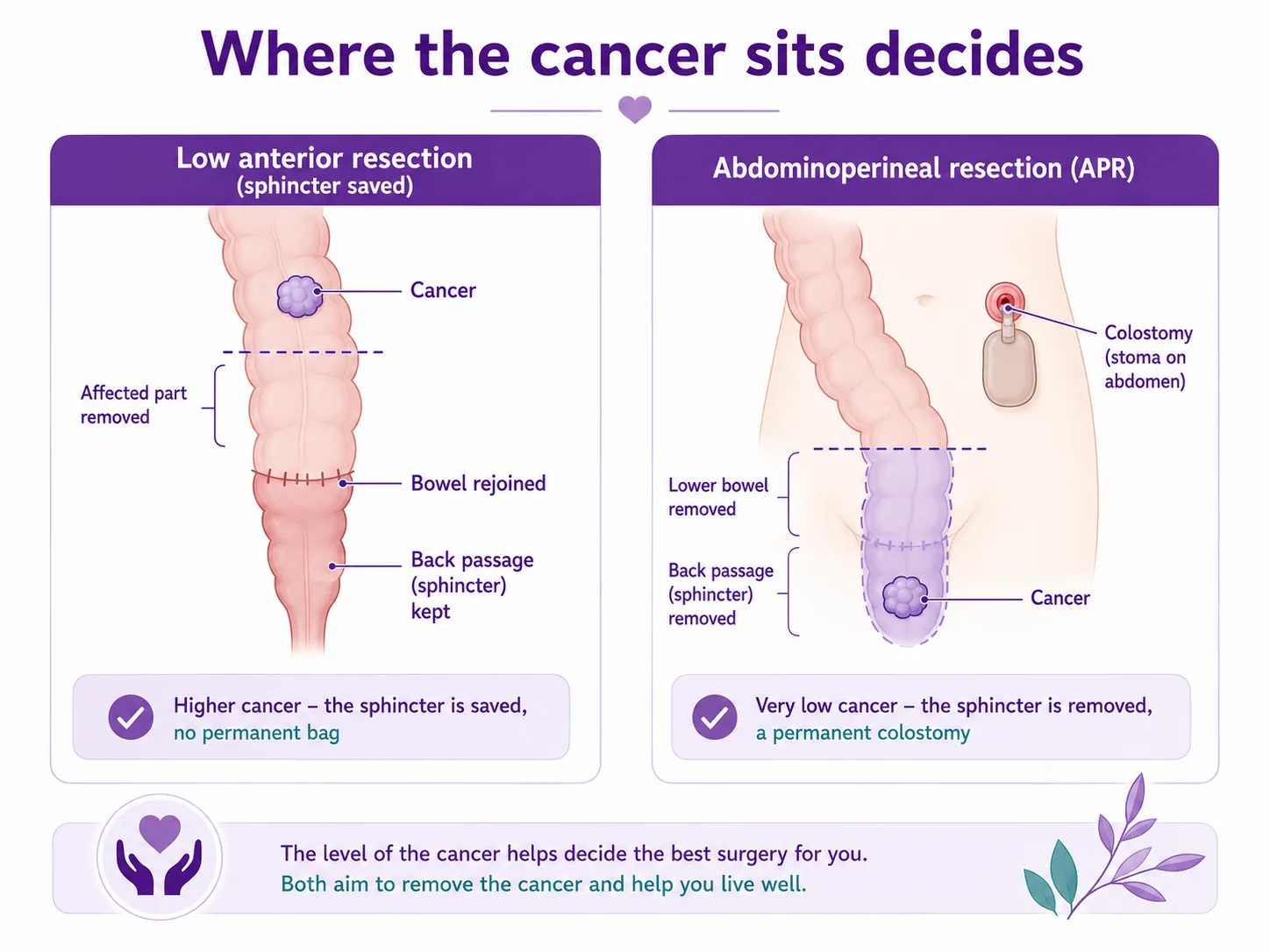
The single thing that decides whether you can keep the sphincter is how low the cancer sits. When a rectal cancer is higher up, a low anterior resection (LAR) removes the affected part and rejoins the bowel, keeping the back passage — often with a temporary stoma that is reversed after a few weeks, so there is no permanent colostomy. When a cancer is very low, at or into the sphincter, there is no way to remove it fully and safely while keeping the anus — so an APR is needed, with a permanent colostomy. In other words, the permanent colostomy is dictated by the cancer's position, not a lack of effort — and the whole team's aim is always to save the sphincter whenever it is oncologically safe.
Where the cancer sits decides: a higher cancer allows a sphincter-saving rejoin (no permanent bag); a very low cancer at the sphincter needs an APR with a permanent colostomy.
Low anterior resection (LAR)
Abdominoperineal resection (APR)
For
Upper & mid rectal cancers (higher up).
Very low rectal or anal cancers involving the sphincter.
The sphincter
Saved — the bowel is rejoined.
Removed — it cannot be safely kept.
Stoma
Often a temporary stoma, reversed after a few weeks.
A permanent colostomy.
What decides it
How low the cancer sits — the team always saves the sphincter whenever it is oncologically safe.
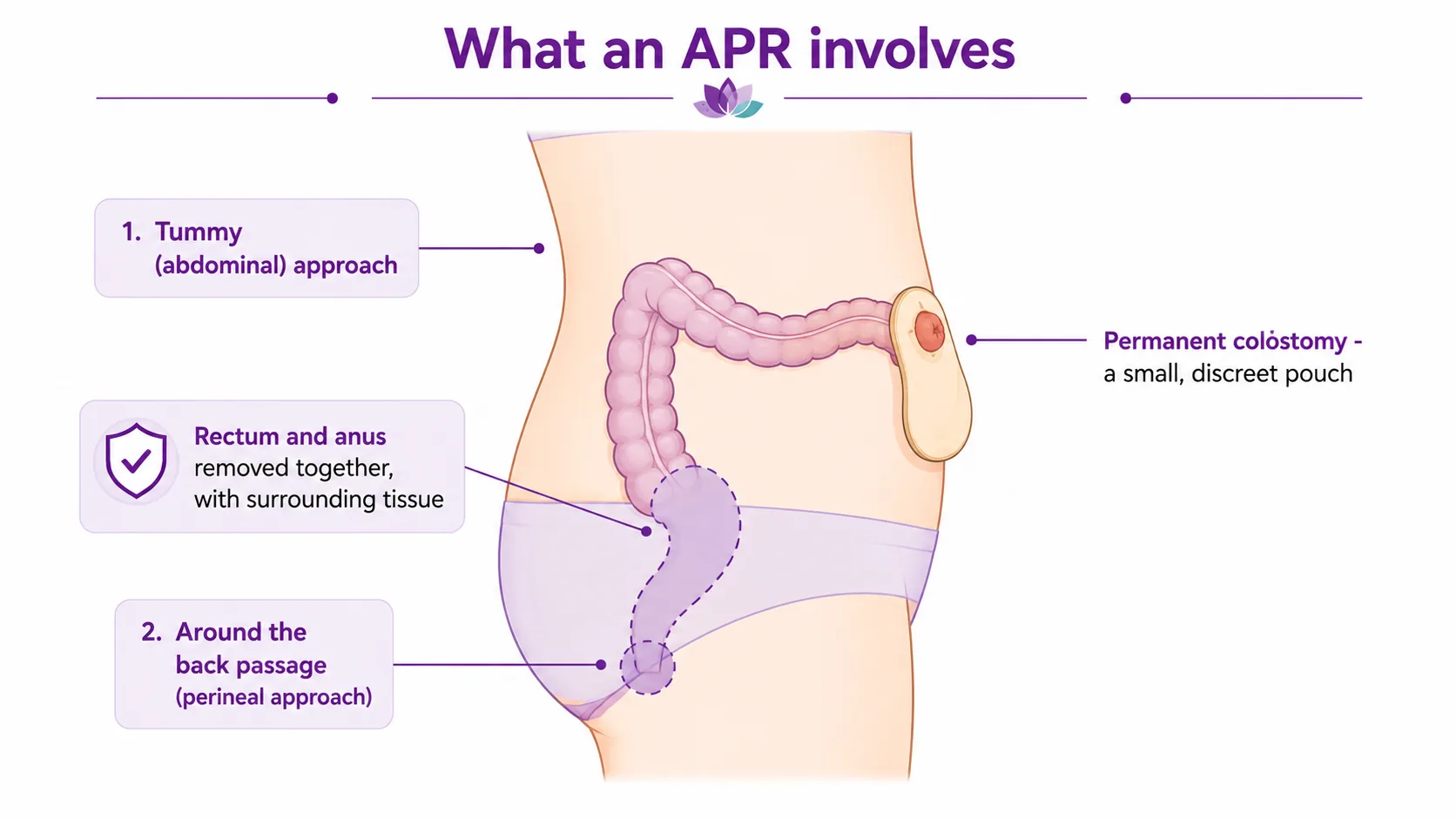
An APR is done through two approaches in one operation. Through the tummy, the surgeon frees the lower bowel within its surrounding envelope (the TME technique, for a clean margin) and brings the cut upper end out to form the colostomy. Through a smaller cut around the back passage, the anus and the very lowest bowel are removed together with the surrounding tissue. Wherever possible it is done by keyhole (laparoscopic) surgery for a smaller wound and faster recovery, with robotic surgery available through a partner pathway; the surgeon also protects the nearby nerves to the bladder and sexual function.
Abdominal approach
Through the tummy, the lower bowel is freed to the TME standard and the colostomy is formed on the abdomen.
Perineal approach
Through a cut around the back passage, the anus and lowest bowel are removed with the surrounding tissue.
An APR uses a tummy approach (forming the colostomy) and a back-passage approach (removing the anus and lowest bowel).
Keyhole where suitable
Laparoscopic (keyhole) surgery for smaller wounds and quicker recovery, with robotic available through a partner pathway.
Nerve-sparing technique
The nerves to the bladder and sexual function run close to the rectum and are protected wherever possible.
Tumour-board planned
Every case is planned by a colorectal multidisciplinary tumour board so surgery, chemoradiation and support fit together.
Diagnosis & staging
Tests that confirm the diagnosis and guide surgery
Before any surgery, the cancer is confirmed and staged, so the operation is planned around your exact cancer. A colonoscopy and biopsy establish the diagnosis, and an MRI of the pelvis and a CT / PET-CT scan show how low the cancer sits and whether the nodes are involved — which is exactly what decides whether the sphincter can be saved. A biopsy is safe and does not spread cancer.
Diagnostic services we offer — book any of these:
Colonoscopy & tissue biopsy
A camera examines the rectum and takes a small tissue sample that confirms whether it is cancer — the step that guides everything after.
This is what weighs most, and the honest answer is that a colostomy changes daily life, but most people find it becomes routine and live fully with it. Bowel motions collect in a small, discreet pouch on the tummy that is emptied and changed simply; under clothes, it is not visible. A specialist stoma-care nurse teaches you everything — from before surgery through the first weeks at home — and is there whenever you need. People return to work, travel, exercise, family life and food they enjoy. It is a real adjustment, and it is normal to grieve the change; support, including from others living well with a stoma, is part of the care.
A specialist stoma-care nurse
Teaches you to manage the colostomy from before surgery through life at home, and is there whenever you need — you are never left to work it out alone.
Discreet & manageable
A small, secure pouch that is emptied and changed simply, and is not visible under clothes. Most people find it becomes routine.
A full life
People return to work, travel, exercise, family life and the food they enjoy. Emotional support for the adjustment is part of the care.
An APR is one part of a complete plan. For a low rectal cancer that usually means chemoradiation before surgery, then the operation — an APR, or a sphincter-preserving low anterior resection where the cancer allows — with stoma care, and chemotherapy or targeted therapy where the stage calls for it. Every plan is set by a colorectal tumour board. Below are the surgeries and treatments you can book a consult for.
Treatments we deliver — book a consult for any of these:
Abdominoperineal resection (APR)
Removing the anus, rectum and lower bowel to the TME standard, with a permanent colostomy, for very low rectal or anal cancer.
An APR usually follows chemoradiation given before surgery to shrink the cancer and improve the result. The operation needs a hospital stay of several days. The perineal wound (where the anus was) takes a little longer to heal than the tummy wounds, and the team guides you in caring for it. A stoma-care nurse teaches you to manage the colostomy from early on. Most people are back to gentle activities within a few weeks and to fuller life over one to two months, and the final tissue results guide whether any further treatment is helpful.
1
Before surgery
MRI staging and, for most low rectal cancers, chemoradiation first. A stoma-care nurse marks the best site for the stoma and answers your questions.
2
The operation
Through the tummy and around the back passage, the rectum and anus are removed to the TME standard, the colostomy is formed, and nearby nerves are protected — by keyhole surgery where suitable.
3
In hospital
A stay of several days, with good pain control. The stoma-care nurse teaches you to manage the colostomy, and the perineal wound is cared for.
4
Early healing
Back to gentle activities within a few weeks, with the perineal wound settling over a little longer, supported at every step.
5
Follow-up
The results guide any further treatment, and your team and stoma nurse follow up so you are well long-term.
Recovery is a supported journey rather than a single day. A stoma-care nurse, a dietitian and — where you want it — emotional support walk with you at every step.
Cost & coverage
APR cost in Hyderabad Indicative
The cost depends on the approach — keyhole (laparoscopic) or open — and the treatment around the surgery. The reassuring part: this is cancer surgery, so it is generally covered under Aarogyasri at empanelled centres, and by most health-insurance policies, usually alongside the chemoradiation given before it. These are estimates, not a quotation.
Indicative cost estimator
Pick your situation for an indicative range, then request an exact estimate for your case.
Indicative range
₹2,50,000 – ₹4,80,000
for a laparoscopic (keyhole) APR, general room, self-pay
Figures are indicative only and not a quotation. Rectal cancer surgery is generally covered under Aarogyasri at empanelled centres and by most health insurance, subject to eligibility. Your actual cost depends on the approach, the hospital stay and the treatment around it.
Talk to a low rectal cancer surgery specialist — free
A low rectal cancer, or being told you may need a permanent colostomy, shouldn't wait. Book a free consultation and, if you already have a biopsy and MRI, a free written second opinion on whether the sphincter can be saved.
Your reports reviewed by a colorectal surgical oncologist
An honest answer on APR vs sphincter-preserving surgery, and life with a colostomy
Aarogyasri & insurance guidance
Support
Financial support & Aarogyasri
Cost should not delay treatment. Because an APR is treatment for rectal (or anal) cancer, eligible surgery is generally covered under Aarogyasri at empanelled centres, and private insurance is accepted cashless — usually alongside the chemoradiation given before it. Our counsellors help check eligibility, arrange approvals and map out what you will actually pay — often far less than families fear.
9 clinics in Hyderabad · 35+ across Telangana & AP
CION cancer care is closer than you think.
We're never more than 30 minutes away. Same panel of specialists at every centre. Same tumour board reviews. Same NCCN protocols. Pick the closest one and call directly — or let us pick for you.
Don't see your city? Call
18002028726
— we'll find your nearest CION partner centre.
Meet the colorectal surgical team
Your APR is planned by a team, not one doctor.
Colorectal surgical, radiation and medical oncologists plan every case together in a multidisciplinary tumour board — part of 17 senior specialists across CION.
Share your name and number — we'll call you back within 30 minutes to schedule your consultation.
Told you need a permanent colostomy? Ask us first — the honest answer may reassure you.
Before you decide anything, let a colorectal surgeon review your MRI and biopsy and tell you honestly whether the sphincter can be saved. Free consultation and free written second opinion.
Common fears about an APR & a permanent colostomy — answered
These are the worries people rarely say out loud. Here are honest, respectful answers to the ones we hear most in Telangana — without any judgement.
“A colostomy bag means my life is over — I can’t work or go out.”
Fact: Not so. A colostomy changes daily life, but most people find it becomes routine and live fully with it — working, travelling, exercising and enjoying family life. The pouch is small, secure and discreet under clothes, and a specialist stoma-care nurse teaches you everything so it becomes manageable, not frightening.
“Why do I need a permanent bag when others with rectal cancer don’t?”
Fact: Because of where your cancer sits, not a lack of trying. When a rectal cancer is higher up, the sphincter is saved and the bowel rejoined; only when a cancer is very low, at or into the sphincter, is that not safely possible. The permanent colostomy is dictated by the cancer’s position — the team always saves the sphincter whenever it is oncologically safe.
“They’re just not trying hard enough to save my back passage.”
Fact: Sphincter-preserving surgery is done whenever it is oncologically safe — it is always the first aim. An APR is used only when the cancer cannot be removed fully and safely while keeping the anus. Your MRI shows exactly how low the cancer sits, and your surgeon will explain honestly why an APR is, or is not, needed for you.
“Everyone will notice the bag and smell it.”
Fact: Modern pouches are discreet, secure and odour-proof, and are not visible under clothes. They are emptied and changed simply, and your stoma-care nurse helps you find the products and routine that suit you. Most people are surprised how private and manageable it is once they are shown how.
“Removing the cancer with surgery will make it spread.”
Fact: This is a common, harmful myth. Removing the cancer under controlled surgical conditions — with a clear margin and the surrounding tissue, to the TME standard — does not spread it. What genuinely causes harm is delay, which lets a treatable cancer grow. Surgery is one of the most effective ways to treat a low rectal cancer.
“Can a middle-class family really afford this surgery?”
Fact: Because an APR is treatment for rectal (or anal) cancer, it is generally covered under Aarogyasri at empanelled centres, and private insurance is accepted cashless — usually alongside the chemoradiation before it. Our counsellors help check eligibility and arrange approvals, and the out-of-pocket cost is often far less than families fear.
“Will I still be able to digest food and eat normally with a colostomy?”
Fact: Yes. A colostomy changes how bowel motions leave the body, not how you digest food. Most people return to a normal, varied diet — including their usual home cooking — building up gradually, with a few foods eased back in. Our dietitians give practical, culturally familiar guidance.
“The perineal wound where the anus was will never heal.”
Fact: The perineal wound does take a little longer to heal than the tummy wounds, and the team guides you in caring for it. Where a larger area is removed, tissue can be used to help it heal. Most perineal wounds settle over the following weeks with support.
“An APR will destroy my bladder and sexual function.”
Fact: The nerves to the bladder and sexual function run close to the rectum, so there can be an effect — but surgeons use nerve-sparing techniques to protect them wherever possible, and any effects are often temporary. Your team discusses this honestly beforehand and offers support and simple measures that help.
“Surgery is pointless — the cancer will just come back.”
Fact: Removing the cancer completely with a clear margin, to the TME standard, is exactly what gives the best chance of long-term control. Regular follow-up checks so anything is caught early, when it is most treatable. For most people, a well-planned operation is a decisive step toward putting the cancer behind them.
“If I need radiation before surgery, my cancer must be hopeless.”
Fact: Not at all. For most low rectal cancers, chemoradiation is given before surgery as standard, to shrink the cancer and improve the result — it is part of the plan, decided by the tumour board, not a sign that the cancer is hopeless. Many cancers respond very well to it.
“I’m too old or too weak for such a big operation.”
Fact: Age alone does not decide it — fitness and the cancer do. A pre-operative assessment optimises your health first, and keyhole surgery where suitable means less strain and a quicker recovery. For most patients, the risk of leaving the cancer untreated is far greater than the risk of the operation.
“It’s an embarrassing area — better to keep the diagnosis quiet.”
Fact: Bowel cancer can feel embarrassing to talk about, but silence only isolates you and delays care. There is nothing shameful about a rectal-cancer diagnosis — it is a common, treatable disease. Our team treats you with complete respect and confidentiality, and stoma care is handled with dignity.
“A colostomy can never be reversed, so there’s no hope.”
Fact: After an APR the colostomy is permanent, because the anus has been removed — that is honest. But permanent does not mean life-limiting: with a stoma-care nurse’s support it becomes routine, and people live full, active lives with one. Where a cancer is higher up, a temporary stoma may instead be reversed later.
“Keyhole surgery isn’t as thorough as open surgery.”
Fact: For suitable rectal cancers, laparoscopic (keyhole) surgery removes the cancer, the margin and the surrounding tissue just as completely as open surgery — to the same TME standard — with less pain and a quicker recovery. Your surgeon chooses the safest approach for your particular cancer.
“Home, herbal or ayurvedic remedies can cure it instead of surgery.”
Fact: No home or herbal remedy is proven to cure rectal cancer, and relying on one wastes the window when it is most treatable. Tell your oncologist about anything you take so it can be used safely alongside proper treatment.
“Bleeding or a change in bowel habit is just piles — nothing serious.”
Fact: Most such symptoms are harmless, but bleeding, a change in bowel habit, or a feeling of not emptying that lasts more than a few weeks should be checked. Early rectal cancer is far more likely to be treated with sphincter-preserving surgery, so getting it looked at early truly matters.
“A second opinion will offend my doctor and waste time.”
Fact: A second opinion is normal and welcomed in cancer care — it confirms the plan and gives you confidence, especially about whether the sphincter can be saved. At CION it can be arranged quickly, and it is free when you have a biopsy and MRI report.
“I’ll be stuck in hospital for months after an APR.”
Fact: An APR needs a hospital stay of several days, not months, with good pain control. The stoma-care nurse teaches you to manage the colostomy from early on, and most people are back to gentle activities within a few weeks and fuller life over one to two months.
“Diabetes or blood pressure means I can’t have this surgery.”
Fact: Controlled conditions like diabetes and blood pressure rarely rule out surgery. A pre-operative assessment optimises your health first, and anaesthesia is given by specialists. Your team plans the safest approach for you individually.
“Talking about a colostomy is shameful, so I shouldn’t ask questions.”
Fact: These are normal, important questions, not a source of shame — and asking them early leads to better preparation and recovery. Our stoma-care team and surgeons answer everything openly and without judgement, so you and your family know exactly what to expect.
Why CION
Why choose CION for an APR in Hyderabad
Sphincter-preservation first
The sphincter is saved whenever a cancer allows it — an APR is used only when it genuinely cannot be kept.
TME — the surgical standard
Removing the rectum within its surrounding envelope for a clean margin — the technique that most affects outcome.
Keyhole where suitable
Laparoscopic surgery for smaller wounds and faster recovery, with robotic available through a partner pathway.
Stoma care & support
A specialist stoma-care nurse from before surgery through life at home, and emotional support for the adjustment.
A tumour-board approach
Every case planned by a colorectal multidisciplinary tumour board, so surgery, chemoradiation and support fit together.
Aarogyasri & care close to home
Rectal cancer surgery is covered under Aarogyasri at empanelled centres; 35+ centres and Telugu-speaking teams.
Real stories · real courage
15,000+ patients chose CION. Hear from them directly.
These aren't paid endorsements or written reviews. These are video testimonials from real patients and families — recorded on their own phones, in their own words. Pick any one. Watch it. Then decide.
4.8★800+ Google reviews
50+video testimonials
15,000+patients treated
Successful Chemotherapy & Radiation Done by Dr. Owais Mohammed & Dr. Kirti Ranjan
Watch video →
Successful Chemotherapy Done by Dr. C Raghavendra Reddy
Watch video →
Surgery, Chemo & Radiation Done by Dr. Imaduddin, Dr. Vinay, Dr. Owais, Dr. Kirti
Watch video →
Successful Radical Thymectomy Done by Dr. Mohammed Imaduddin & Dr. Vinay Mamidala
Watch video →
Successful Surgery Done by Dr. Rajender Byshetty
Watch video →
Successful Chemo & Surgery Done by Dr. Imad, Dr. Vinay, Dr. Owais & Dr. Raghavendra
Watch video →
Successful Chemo & Surgery Done by Dr. Imad, Dr. Vinay, Dr. Owais & Dr. Raghavendra
Watch video →
Successful Chemo & Radiation Done by Dr. Owais Mohammed & Dr. Kirti Ranjan Mohanty
Watch video →
Successful Breast Cancer Surgery Done by Dr. Imaduddin Mohammed & Dr. Vinay Mamidala
Watch video →
Successful Chemotherapy Done by Dr. Bharati Devi Gorantla
Watch video →
Successful Chemo & Surgery Done by Dr. Owais Mohammed & Dr. Imaduddin Mohammed
Watch video →
Successful Chemotherapy Done by Dr. Gundu Naresh
Watch video →
Successful Bone Marrow Transplantation - Neuroblastoma
Watch video →
Successful Surgery & Chemo - Carcinoma of Caecum
Watch video →
Successful Oral chemotherapy & mastectomy surgery
Watch video →
Successful Oral chemotherapy & mastectomy surgery
Watch video →
Successful Chemotherapy
Watch video →
Successful Surgery by Dr. Mohammed Imaduddin
Watch video →
Successful Bone Marrow Transplantation
Watch video →
Successful Oral chemotherapy & mastectomy surgery
Watch video →
Successful Oral chemotherapy & mastectomy surgery
Watch video →
Successful Chemotherapy
Watch video →
Successful Buccal Mucosa Surgery
Watch video →
Successful Complex Surgery Mandibulectomy Reconstruction
Living well with a colostomy is as important as the surgery itself. At CION, stoma care, nutrition, physiotherapy and emotional support are one coordinated plan — from diagnosis through survivorship.
Stoma-care nursing
A specialist nurse teaches you to manage the colostomy from before surgery through life at home. Ask us
Nutrition counselling
Practical diet guidance for living well with a colostomy, built around familiar home cooking. Learn more
Psychology counselling
Emotional support for you and your family through diagnosis, surgery and the adjustment. Learn more
Cancer rehabilitation
Physiotherapy and recovery support to rebuild strength after surgery. Learn more
Second opinion
A confidential second opinion on whether the sphincter can be saved — free with a biopsy and MRI. Learn more
Financial counselling
Aarogyasri and cashless insurance guidance so cost never blocks care. Learn more
FAQ
Abdominoperineal resection (APR) in Hyderabad — frequently asked questions
What is an abdominoperineal resection (APR)?
An APR removes the anus, the rectum and part of the lower bowel, together with the surrounding tissue and lymph nodes, through an abdominal (tummy) approach and a perineal (back passage) approach. Because the anus is removed, the bowel cannot be rejoined, so a permanent colostomy is made on the tummy. It is used for a cancer very low in the rectum, or an anal cancer, that involves or is too close to the sphincter to save it.
Why do I need a permanent colostomy — can the sphincter not be saved?
Whether the sphincter can be saved depends on how low the cancer sits. When a rectal cancer is higher up, a sphincter-preserving operation (a low anterior resection) rejoins the bowel and avoids a permanent colostomy, and this is always done when it is safe. When a cancer is at or into the sphincter, it cannot be removed fully and safely while keeping the anus, so an APR with a permanent colostomy is needed. It is decided by the cancer's position, not a lack of trying.
What is the difference between an APR and a low anterior resection (LAR)?
A low anterior resection (LAR) is for upper and mid rectal cancers: the affected part is removed and the bowel is rejoined, keeping the sphincter, often with a temporary stoma that is reversed after a few weeks. An APR is for very low rectal or anal cancers involving the sphincter: the anus and rectum are removed and a permanent colostomy is made. Your surgeon recommends whichever safely clears your cancer while preserving as much function as possible.
What is life like with a permanent colostomy?
A colostomy changes daily life, but most people find it becomes routine and live fully with it. Bowel motions collect in a small, discreet pouch on the tummy that is emptied and changed simply, and it is not visible under clothes. A specialist stoma-care nurse teaches you everything and supports you long-term. People return to work, travel, exercise, family life and the food they enjoy, and support is there for the adjustment.
Can I eat normally with a colostomy?
Yes. A colostomy changes how bowel motions leave the body, not how you digest food. Most people return to a normal, varied diet — including their usual home cooking — building up gradually, with a few foods eased back in at first. Our dietitians give practical, culturally familiar guidance so eating well feels manageable.
What is the perineal wound, and how does it heal?
The perineal wound is where the anus was removed, at the base of the pelvis. It takes a little longer to heal than the tummy wounds, and the team guides you in caring for it. Where a larger area is removed, tissue is sometimes used to fill and help heal the space. Most perineal wounds settle over the following weeks with support.
Can an APR be done by keyhole (laparoscopic) surgery?
Often, yes. Wherever it is suitable, an APR is done by keyhole (laparoscopic) surgery, which means smaller cuts, less pain and a faster recovery, with robotic surgery available through a partner pathway. Your surgeon advises whether a keyhole or open approach is safest for your cancer, and both remove the cancer to the same TME standard.
Will an APR affect my bladder or sexual function?
It can, because the nerves to the bladder and sexual function run close to the rectum. Surgeons use nerve-sparing techniques to protect them wherever possible, and any effects are often temporary. Your team discusses this honestly beforehand and offers support and simple measures that help, so it is not left unspoken.
Do I need chemoradiation before an APR?
For most low rectal cancers, yes. A course of chemoradiation (radiation with chemotherapy) is usually given before surgery to shrink the cancer and improve the result. This is standard, decided by the colorectal tumour board, and is part of the plan — not a sign the cancer is hopeless. Your team explains whether it applies to you.
Is an APR covered by Aarogyasri or insurance?
It is cancer surgery, so it is generally covered under Aarogyasri at empanelled centres and by most health-insurance policies, usually alongside the chemoradiation given before it. CION's team checks your policy and scheme eligibility and provides a written estimate before anything is planned.
How much does an APR cost in Hyderabad?
The indicative cost depends on the approach — keyhole (laparoscopic) or open — the hospital stay and the treatment around the surgery. Because it is rectal cancer surgery, eligible cases are generally covered under Aarogyasri at empanelled centres, with insurance accepted cashless, usually alongside the chemoradiation before it. CION gives an accurate written estimate after assessment. Figures shown online are indicative only and not a quotation.
How long does recovery take after an APR?
An APR needs a hospital stay of several days, with good pain control. The perineal wound takes a little longer to heal than the tummy wounds, and a stoma-care nurse teaches you to manage the colostomy from early on. Most people are back to gentle activities within a few weeks and to fuller life over one to two months. Recovery is a supported journey, and your team explains each step in advance.
Is the colostomy after an APR ever reversed?
After an APR the colostomy is permanent, because the anus has been removed and the bowel cannot be rejoined. That is honest — but permanent does not mean life-limiting: with a stoma-care nurse's support it becomes routine and people live full, active lives. Where a cancer is higher up and a sphincter-preserving operation is possible, a temporary stoma may instead be reversed later.
Does removing the cancer with surgery make it spread?
No. Removing the cancer under controlled surgical conditions — with a clear margin and the surrounding tissue, to the TME standard — does not spread it. This is a common myth. What causes real harm is delay, which lets a treatable cancer grow. An APR that removes the cancer completely is one of the most effective ways to treat a low rectal cancer.
Can a low rectal cancer come back after an APR?
Removing the cancer completely with a clear margin, to the TME standard, gives the best chance of long-term control, and for most people it stays controlled. Regular follow-up checks so that anything is caught early, when it is most treatable. Your final tissue results guide whether any further treatment is helpful.
Will I need a temporary breathing or feeding tube?
An APR does not usually involve a breathing or feeding tube. It needs a hospital stay of several days with good pain control, and the stoma-care nurse teaches you to manage the colostomy from early on. Eating usually resumes within a day or two as the bowel recovers, guided by your team.
How is an APR different from a colectomy?
A colectomy removes part of the colon higher up the bowel, and for most colon cancers the bowel is rejoined so no permanent bag is needed. An APR is for a cancer very low in the rectum or at the anus, where the anus is removed and a permanent colostomy is made. A permanent bag is far more associated with low rectal cancer than with colon cancer.
Which is the best hospital for rectal cancer surgery in Hyderabad?
Look for a cancer centre with fellowship-trained colorectal surgical oncologists, multidisciplinary tumour-board planning, TME-standard rectal surgery, laparoscopic (keyhole) capability, and dedicated stoma-care nursing. CION Cancer Clinics offers these across 35+ centres in Telangana and Andhra Pradesh, with Aarogyasri and insurance counselling and Telugu-speaking teams.
Which doctor should I see for an APR in Hyderabad?
For an APR, see a colorectal (GI) surgical oncologist who performs TME-standard rectal surgery. At CION your case is reviewed by a team — surgical, radiation and medical oncologists together — so you get a coordinated, cancer-first plan rather than a single-doctor decision, and an honest answer on whether the sphincter can be saved. You can request a specific surgeon when booking.
Explore
Explore colon & rectal cancer care at CION
Surgery, the colostomy, tests, cost and support around colon and rectal cancer. Tap any topic to read more.
Speak to a colorectal surgeon about low rectal cancer surgery
Early answers change outcomes — and life with a colostomy is manageable and fully supported. Book a free consultation or second opinion at any of our 9 Hyderabad clinics — part of 35+ centres across Telangana & Andhra Pradesh.
Medical disclaimer: This page provides general information about abdominoperineal resection (APR) and is not a substitute for professional medical advice, diagnosis or treatment. Whether the sphincter can be saved depends on where the cancer sits and is decided by your surgeon; sphincter-preserving surgery is done whenever it is oncologically safe. Life with a colostomy is manageable and fully supported, but recovery is an individual journey; costs shown are indicative only and not a quotation. Always consult a qualified colorectal surgical oncologist about your individual care. Content is periodically reviewed by CION's medical team.

 CION Ameerpet