Radical resection means removing the cancer completely — the tumour with a clear margin of healthy tissue around it, and the nearby lymph nodes where needed. And an important reassurance: "radical" means complete, not necessarily huge. At CION it is often done by keyhole surgery, and planned to preserve as much function as possible.
Clear margins (R0) — the goal of every operation
Often minimally invasive, function-preserving
Tumour-board plan · Aarogyasri & insurance help
★★★★★Rated 4.8/5 · 800+ Google reviews
Clear margins (R0) the goal
Often minimally invasive
Function preserved where possible
35+ centres · Aarogyasri help
SM
Written by Dr. Srinivasulu Mukta, Surgical Oncologist (MCh, Surgical Oncology), with CION's surgical oncology team. Medically reviewed by Dr. Muralidhar Muddusetty, MRCS (Edinburgh), AIIMS-trained, Surgical Oncology. · Reviewed 14 July 2026
Understanding the surgery
What is radical resection?
Radical resection is surgery to remove a cancer completely — not just the visible tumour, but a margin of healthy tissue all around it, and the nearby lymph nodes where they may be involved. Removing that surrounding rim of normal tissue — what surgeons call a clear, or "R0", resection — gives the best chance that no cancer is left behind. The word "radical" refers to this completeness; it does not mean the operation has to be large or disfiguring.
In fact, modern radical surgery is frequently done through keyhole (minimally invasive) techniques, and is planned carefully to preserve as much function and appearance as possible — with reconstruction where something needs to be rebuilt. The aim is always the same: remove all the cancer with a clear margin, while keeping you as whole and well as the operation safely allows. Your surgeon and the tumour board plan this balance together, and explain it to you clearly.
The three ideas behind a radical operation
Tumour + a clear margin
The cancer is removed together with a rim of healthy tissue all around it, so nothing is left at the edge.
Nearby lymph nodes
Where they may be involved, the regional lymph nodes are removed and tested at the same time (en bloc).
Complete, not huge
"Radical" means complete removal — often keyhole surgery, planned to preserve function, not a bigger operation for its own sake.
The heart of the operation
Clear margins & R0 — why a rim of healthy tissue matters
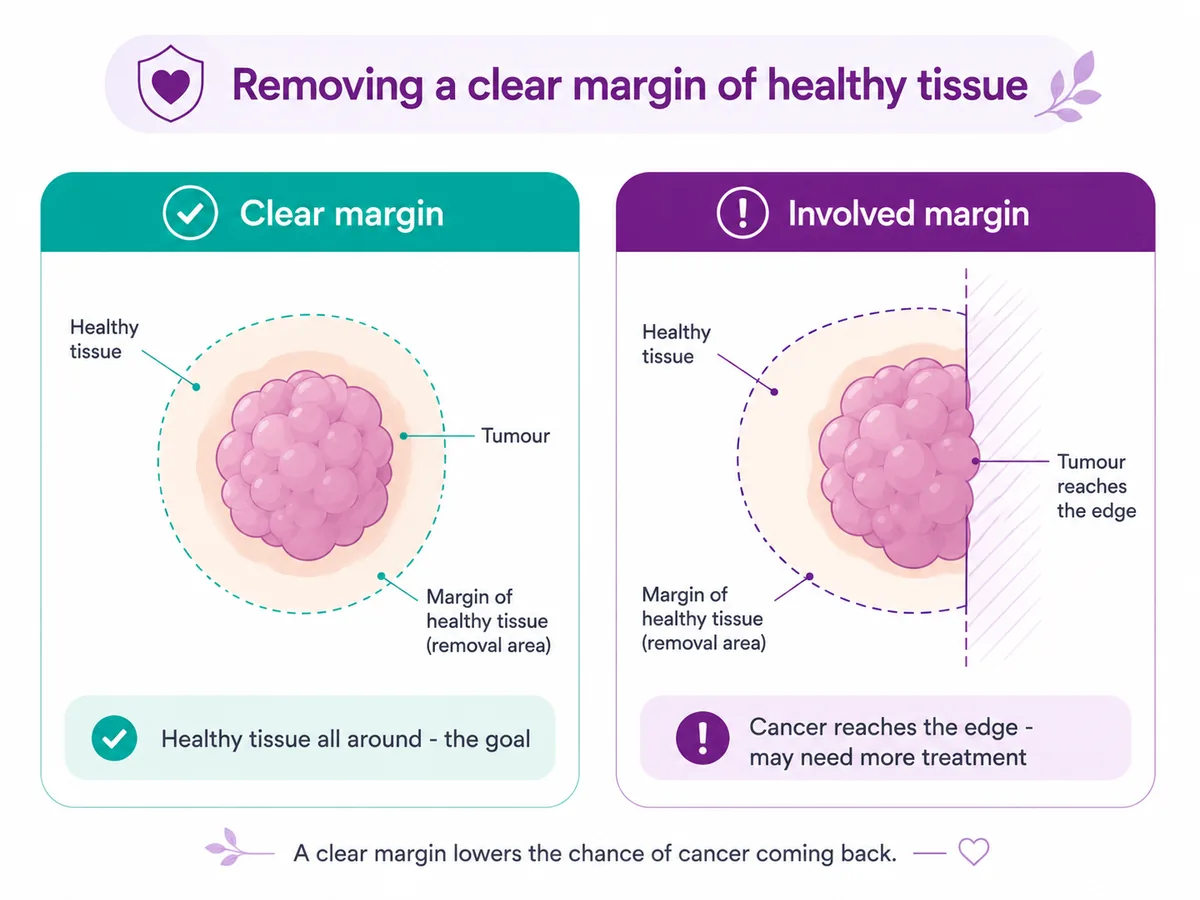
A "margin" is the border of healthy tissue removed around the cancer. When the tissue is examined afterwards and there is normal tissue all the way around the edge, the margin is "clear" — surgeons call this an R0 resection, and it is the goal, because it means no cancer was left at the cut edge. If cancer reaches the edge (an "involved" margin), it does not mean anything went wrong — it may simply mean a little more treatment to make sure the area is fully cleared.
A clear (R0) margin has healthy tissue all around the tumour; an involved margin reaches the edge and may need a little more treatment.
Why it matters
The completeness of removal is one of the strongest influences on how well treatment goes. A clear margin gives the best chance that the cancer will not return in that area.
Checked by pathology
The removed tissue is examined under the microscope to confirm the margins. Your team uses that result to decide whether any further step is needed.
Across the body
Which cancers, and what it involves
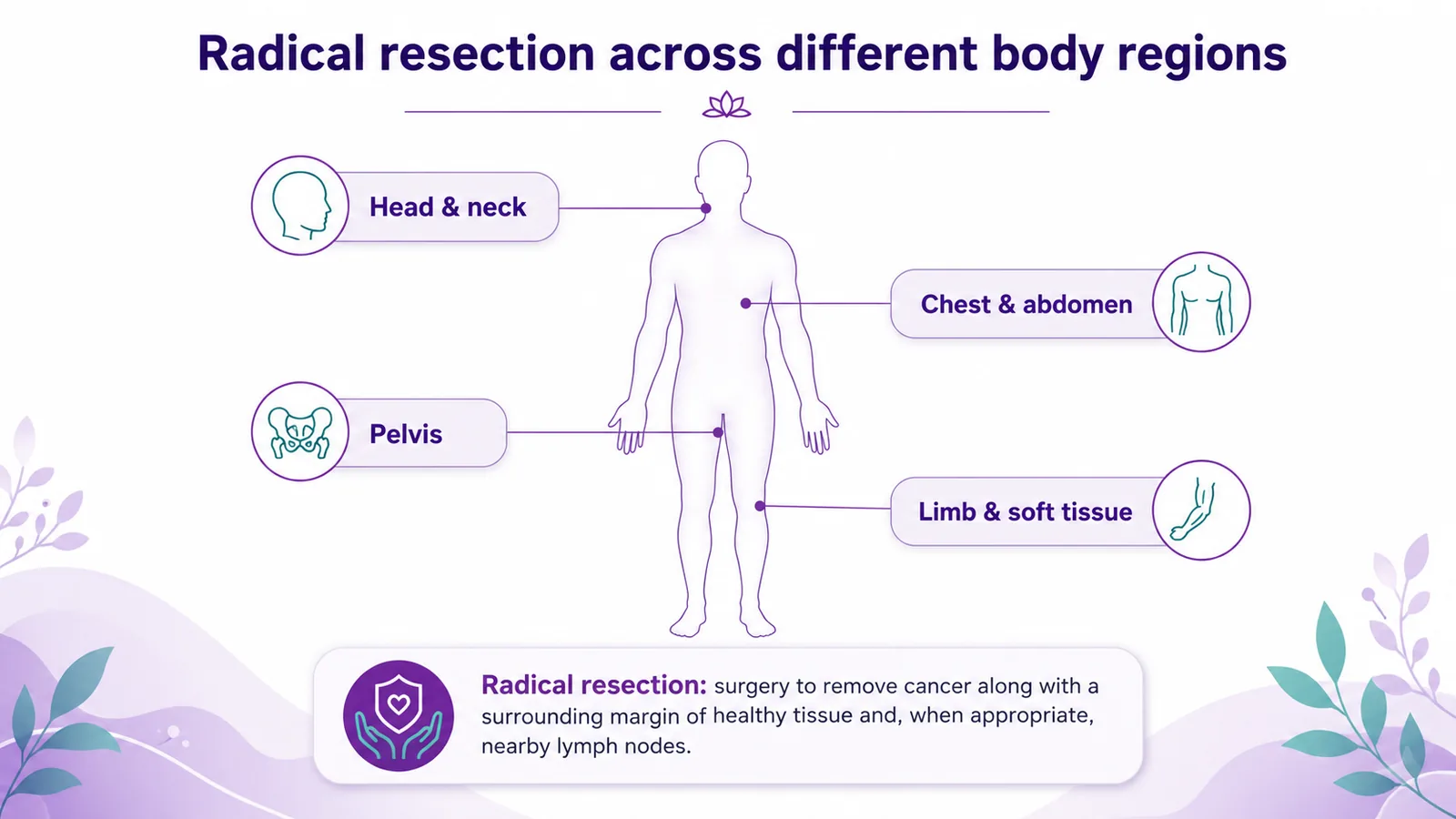
Radical resection is a principle used across many cancers — of the head and neck, the chest and abdomen (such as stomach and bowel), the pelvis (such as cervix and uterus), and the limbs and soft tissue (such as sarcomas). In each, the surgeon removes the tumour with a clear margin and, where needed, the regional lymph nodes as one piece (an en bloc removal). The operation is tailored to the cancer, but the goal is constant: complete removal with a clear margin.
Radical resection is used across the body — always with the same aim: remove the tumour with a clear margin, and the nearby nodes where needed.
Radical resection or debulking — an honest distinction
People sometimes confuse these, and they are almost opposites. Radical resection is for cancer that can be removed completely, with a clear margin — the aim is to leave none behind. Debulking surgery is for advanced cancer that cannot all be removed, where the surgeon removes as much as safely possible to help the treatment that follows work better. Which applies depends entirely on your cancer and how far it has spread — and the tumour board decides.
Radical resection
Debulking surgery
Aim
Remove the cancer completely, with a clear margin.
Remove as much as safely possible when it cannot all be removed.
Tests that confirm the diagnosis and plan the operation
Before any radical surgery, the cancer is confirmed and staged. A biopsy establishes what the cancer is and how it behaves; scans map exactly where it is and whether it has spread. That is how the surgeon knows whether the cancer can be removed completely with a clear margin — and plans the precise operation and margin. Your team decides the next step with you.
Diagnostic services we offer — book any of these:
Biopsy & pathology
A tissue sample confirms whether it is cancer and how it behaves — the basis of the whole surgical plan.
Complete removal is one part of a bigger plan — CION delivers the whole pathway. That means radical (complete) cancer surgery, minimally invasive technique where suitable, reconstruction to rebuild what is removed, and any radiation or medical treatment planned around the operation. Every plan is set by a multidisciplinary tumour board for your cancer and stage.
Services we deliver — book a consult for any of these:
Radical cancer surgery
Complete (R0) removal of the tumour with a clear margin and, where needed, the regional lymph nodes as one piece (en bloc).
Because radical resection removes the cancer with a margin — and sometimes lymph nodes or nearby structures — it is a significant operation, but how big depends entirely on the cancer, and much of it is now done by keyhole surgery with a quicker recovery. Your team explains exactly what your operation involves, what will be removed and what (if anything) reconstructed, so there are no surprises. The pathology result then guides whether any further treatment is needed.
1
Before surgery
Scans and tests plan the exact operation and margin; you hear clearly what is planned and why.
2
The operation
The tumour is removed with a clear margin, with lymph nodes or reconstruction where needed — often keyhole.
3
Hospital & pathology
A stay to recover while the removed tissue is examined to confirm the margins.
4
Recovery
Strength returns over the following weeks, with physiotherapy and support where needed.
5
Next steps & follow-up
Any further treatment is planned around your recovery, with ongoing surveillance.
Recovery is supported at every step. Most people build back to everyday activities over the following weeks — gradually and with guidance — and any further treatment is planned around your recovery, not rushed.
Cost & coverage
What does radical resection cost in Hyderabad? Indicative
The cost depends heavily on the cancer and the extent of the operation — a moderate resection costs far less than an extended, multi-structure one with reconstruction. The reassuring part: this is treatment for cancer, so it is generally covered under Aarogyasri / PMJAY at empanelled centres, and by most health-insurance policies. Our team checks your scheme eligibility and policy, and gives you a clear, written estimate for your specific operation.
Indicative cost estimator
Pick your situation for an indicative range, then request an exact estimate for your case.
Indicative range
₹1,50,000 – ₹3,50,000
for a moderate radical resection, general room, self-pay
Figures are indicative only and not a quotation. Aarogyasri / PMJAY may cover eligible cancer surgery at empanelled centres, subject to eligibility. Your actual cost depends on the cancer, the extent of surgery, hospital stay and any reconstruction or treatment around it.
Figures are indicative only, drawn from typical private-hospital ranges in India, and are not a quotation or a pricing guarantee. A written estimate is provided after consultation, based on your individual plan.
Free consultation
Told you need radical surgery? Talk to a specialist — free
The word "radical" is frightening, but the plan does not have to be. Book a free consultation and, if you already have a biopsy, a free written second opinion.
Your reports reviewed by a senior surgical oncologist
An honest answer on whether the cancer can be fully removed
Aarogyasri / PMJAY & insurance guidance
Support
Financial support & Aarogyasri
Cost should not delay treatment. Under Aarogyasri and PMJAY, eligible cancer surgery may be largely covered at empanelled centres, and private insurance is accepted cashless. Our counsellors help check eligibility, arrange approvals and map out what you will actually pay — often far less than families fear. Minimally invasive surgery also means a shorter stay.
9 clinics in Hyderabad · 35+ across Telangana & AP
CION cancer care is closer than you think.
We're never more than 30 minutes away. Same panel of specialists at every centre. Same tumour board reviews. Same NCCN protocols. Pick the closest one and call directly — or let us pick for you.
Don't see your city? Call
18002028726
— we'll find your nearest CION partner centre.
Meet the surgical oncology team
Your radical resection is planned by a team, not one doctor.
Radical, en-bloc cancer surgery is planned by a multidisciplinary tumour board and carried out by fellowship-trained surgical oncologists — part of 17 senior specialists across CION.
Share your name and number — we'll call you back within 30 minutes to schedule your consultation.
Advised radical surgery for a cancer? Don't decide alone.
Whether a cancer can be removed completely — and how — is a decision for a tumour board, not a single opinion. Let CION review your reports and give you an honest, cancer-first recommendation.
The word "radical" carries a lot of fear. Here are honest, respectful answers to the worries we hear most in Telangana.
“‘Radical’ surgery sounds terrifying — it must be huge and disfiguring.”
Fact: "Radical" refers to completeness of removal, not the size of the operation. Much radical surgery is now done by keyhole (minimally invasive) techniques, and it is planned to preserve as much function and appearance as possible, with reconstruction to rebuild what is removed.
“If they cut into the cancer, it will spread through my body.”
Fact: Removing a cancer under controlled surgical conditions does not make it spread — this is a common, harmful myth. What actually causes harm is delay, which lets a removable cancer grow. Radical resection is one of the most effective ways to clear a cancer completely.
“I’ll lose an organ or a body part and never be normal again.”
Fact: The operation is always planned to preserve as much function and appearance as possible — never at the cost of leaving cancer behind. Where something must be removed, reconstruction can often rebuild it, and rehabilitation supports your recovery.
“An operation this big — I might not survive the surgery itself.”
Fact: Your fitness for surgery is checked carefully beforehand, and much radical surgery is now keyhole with a quicker recovery. If you are not fit for a big operation, the tumour board will say so and offer a safer plan — you are assessed as an individual.
“The scar will be enormous and ugly.”
Fact: Where keyhole (laparoscopic) surgery is suitable, the cuts are small. When larger access is needed, the incision is planned as carefully as possible, and reconstruction helps restore appearance. Your surgeon shows you what to expect before the operation.
“Such a big operation means months bedridden.”
Fact: Recovery depends on the cancer and the operation, but most people are up and moving within days and build back to everyday activities over the following weeks — faster after keyhole surgery — with physiotherapy and support along the way.
“If any cancer is left at the edge, the surgery failed and I’m doomed.”
Fact: An involved margin does not mean anything went wrong. It may simply mean a little more treatment — further surgery or radiation — to make sure the area is fully cleared. Your team explains the pathology result and the best next step.
“Radical cancer surgery is only for the rich — we can’t afford it.”
Fact: This is treatment for cancer, so it is generally covered under Aarogyasri and PMJAY at empanelled centres, and private insurance is accepted cashless. Our counsellors help you check eligibility and map out what you will actually pay — often far less than families fear.
“I’m too old or too weak for a major cancer operation.”
Fact: Age alone does not decide it — fitness and overall health do. For some, a keyhole operation or a different plan is a better fit. Your team assesses you individually and recommends the option most likely to help you, rather than going by a number.
“Keyhole surgery can’t remove a cancer properly — only open surgery is safe.”
Fact: When it is suitable, minimally invasive surgery achieves the same complete removal with a clear margin, using small incisions with less blood loss and a quicker recovery. Whether keyhole surgery fits depends on the cancer and its location, which your surgeon assesses.
“Once they remove it, the cancer is sure to come back anyway.”
Fact: A clear (R0) margin gives the best chance the cancer will not return in that area, and for many people it stays controlled. No surgery promises zero risk, which is why follow-up surveillance matters — it catches any change early, when it is most treatable.
“If I need radiation or medicine after surgery, the operation was pointless.”
Fact: Sometimes further treatment is added after surgery for the best control — this is a planned part of care, not a sign the surgery failed. Removing the cancer completely and then supporting that with further treatment work together, not against each other.
“Removing lymph nodes will cause permanent swelling, so I should refuse it.”
Fact: Nodes are only removed when they may be involved, and only as far as needed. Swelling (lymphoedema) is not inevitable, and where there is a risk it is watched for and managed with physiotherapy. Leaving involved nodes behind is the greater risk.
“A second opinion will delay my surgery and offend my surgeon.”
Fact: A second opinion is normal and welcomed in cancer care — it confirms the plan and gives you confidence. At CION it is free when you have a biopsy report and can be arranged quickly, so it need not delay timely treatment.
“Home or herbal remedies can dissolve the tumour so I can avoid surgery.”
Fact: No home or herbal remedy is proven to remove a cancer, and relying on one wastes the window when it can still be fully removed. Tell your oncologist about anything you take so it can be used safely alongside proper treatment.
“General anaesthesia is dangerous — I might not wake up.”
Fact: Modern anaesthesia is very safe and closely monitored throughout. An anaesthetist assesses your fitness beforehand and cares for you the whole operation. Serious problems are rare, and you are looked after at every moment.
“If the tumour is big, it’s inoperable and there’s no point trying.”
Fact: Size alone does not decide whether a cancer can be removed. Sometimes treatment before surgery can shrink a tumour to make complete removal possible. Only a tumour-board assessment of your scans can tell you whether radical resection is an option.
“I should just wait and watch rather than rush into such a big operation.”
Fact: For a cancer that can be removed completely, timely surgery gives the best chance of long-term control, and delay lets it grow. Getting assessed is not the same as rushing — the tumour board tells you honestly when surgery is the right step and when it is not.
Why CION
Why choose CION for radical resection in Hyderabad
Clear margins, confirmed
The goal is a complete (R0) removal, with the margins checked by pathology — the completeness that matters most.
Often minimally invasive
Keyhole (laparoscopic) radical surgery where suitable — smaller cuts, quicker recovery, the same complete removal.
Complete removal, kept whole
Function-preserving surgery and reconstruction, so all the cancer is removed while keeping you as whole as possible.
A tumour-board plan
Every case is planned by a multidisciplinary tumour board, so surgery, margins and any further treatment fit together.
Aarogyasri & insurance help
Radical cancer surgery is covered under Aarogyasri at empanelled centres; our team helps with paperwork and estimates.
Care closer to home
35+ centres across Telangana & Andhra Pradesh, Telugu-speaking teams, and supportive care throughout.
Real stories · real courage
15,000+ patients chose CION. Hear from them directly.
These aren't paid endorsements or written reviews. These are video testimonials from real patients and families — recorded on their own phones, in their own words. Pick any one. Watch it. Then decide.
4.8★800+ Google reviews
50+video testimonials
15,000+patients treated
Successful Chemotherapy & Radiation Done by Dr. Owais Mohammed & Dr. Kirti Ranjan
Watch video →
Successful Chemotherapy Done by Dr. C Raghavendra Reddy
Watch video →
Surgery, Chemo & Radiation Done by Dr. Imaduddin, Dr. Vinay, Dr. Owais, Dr. Kirti
Watch video →
Successful Radical Thymectomy Done by Dr. Mohammed Imaduddin & Dr. Vinay Mamidala
Watch video →
Successful Surgery Done by Dr. Rajender Byshetty
Watch video →
Successful Chemo & Surgery Done by Dr. Imad, Dr. Vinay, Dr. Owais & Dr. Raghavendra
Watch video →
Successful Chemo & Surgery Done by Dr. Imad, Dr. Vinay, Dr. Owais & Dr. Raghavendra
Watch video →
Successful Chemo & Radiation Done by Dr. Owais Mohammed & Dr. Kirti Ranjan Mohanty
Watch video →
Successful Breast Cancer Surgery Done by Dr. Imaduddin Mohammed & Dr. Vinay Mamidala
Watch video →
Successful Chemotherapy Done by Dr. Bharati Devi Gorantla
Watch video →
Successful Chemo & Surgery Done by Dr. Owais Mohammed & Dr. Imaduddin Mohammed
Watch video →
Successful Chemotherapy Done by Dr. Gundu Naresh
Watch video →
Successful Bone Marrow Transplantation - Neuroblastoma
Watch video →
Successful Surgery & Chemo - Carcinoma of Caecum
Watch video →
Successful Oral chemotherapy & mastectomy surgery
Watch video →
Successful Oral chemotherapy & mastectomy surgery
Watch video →
Successful Chemotherapy
Watch video →
Successful Surgery by Dr. Mohammed Imaduddin
Watch video →
Successful Bone Marrow Transplantation
Watch video →
Successful Oral chemotherapy & mastectomy surgery
Watch video →
Successful Oral chemotherapy & mastectomy surgery
Watch video →
Successful Chemotherapy
Watch video →
Successful Buccal Mucosa Surgery
Watch video →
Successful Complex Surgery Mandibulectomy Reconstruction
Complete removal is one part of a bigger plan. At CION, nutrition, emotional support, genetic risk, comfort and rehabilitation are one coordinated pathway — so you are supported from diagnosis through recovery.
Nutrition counselling
Weight, strength and general health through surgery and recovery. Learn more
Psychology counselling
Support for you and your family with the fear that comes with a cancer operation. Learn more
Genetic counselling
Hereditary-risk guidance where a family or genetic pattern is suspected. Learn more
Rehabilitation
Physiotherapy and support to recover strength and function after surgery. Learn more
Palliative & comfort care
Comfort and symptom support at any stage, alongside treatment. Learn more
Financial counselling
Aarogyasri, PMJAY and cashless insurance guidance so cost never blocks care. Learn more
FAQ
Radical resection in Hyderabad — frequently asked questions
What is radical resection?
Radical resection is surgery to remove a cancer completely — the tumour together with a margin of healthy tissue all around it, and the nearby lymph nodes where they may be involved. Removing that clear margin (an R0 resection) gives the best chance that no cancer is left behind, and so the best chance of long-term control.
Does “radical” mean a huge or disfiguring operation?
No. Radical refers to completeness of removal, not the size of the operation. Much radical surgery is now done by keyhole (minimally invasive) techniques, and it is planned to preserve as much function and appearance as possible, with reconstruction to rebuild what is removed. The aim is complete removal while keeping you as whole as safely possible.
What are clear margins (R0), and why do they matter?
A margin is the border of healthy tissue removed around the cancer. When there is normal tissue all the way around the edge, the margin is clear — an R0 resection — meaning no cancer was left at the cut edge. The completeness of removal is one of the strongest influences on how well treatment goes, which is why a clear margin is the goal of every radical operation.
What happens if the margins are not clear?
If cancer reaches the edge (an involved or positive margin), it does not mean anything went wrong — it may simply mean a little more treatment, such as further surgery or radiation, to make sure the area is fully cleared. Your team explains the pathology result and the best next step for you.
Can radical resection be done by keyhole (minimally invasive) surgery?
Often, yes. Many radical operations are now done through minimally invasive (laparoscopic) techniques, with smaller cuts and a quicker recovery, while still achieving a clear margin. Whether keyhole surgery is suitable depends on the cancer and its location, which your surgeon assesses.
Will I lose an organ or function?
The operation is always planned to preserve as much function and appearance as possible — but never at the cost of leaving cancer behind. Where something must be removed, reconstruction can often rebuild it. Your surgeon explains clearly what will be removed, what can be preserved, and what can be reconstructed.
What is en bloc removal, and why are lymph nodes removed?
En bloc means removing the tumour and, where needed, the surrounding tissue and regional lymph nodes together as one piece, rather than in parts. Nearby lymph nodes are removed and tested when they may be involved, because they are the first place a cancer tends to travel — testing them helps plan any further treatment.
Which cancers can be treated with radical resection?
Radical resection is a principle used across many cancers — of the head and neck, the chest and abdomen (such as stomach and bowel), the pelvis (such as cervix and uterus), and the limbs and soft tissue (such as sarcomas). In each, the tumour is removed with a clear margin, and the nearby lymph nodes where needed. The exact operation is tailored to your cancer.
How is radical resection different from debulking surgery?
They are almost opposites. Radical resection is for cancer that can be removed completely, with a clear margin. Debulking surgery is for advanced cancer that cannot all be removed, where the surgeon removes as much as safely possible to help the treatment that follows work better. Which applies depends on your cancer and how far it has spread.
Will surgery make the cancer spread?
No. Removing a cancer under controlled surgical conditions does not spread it through the body — this is a common myth. What causes real harm is delay, which lets a removable cancer grow. Radical resection is one of the most effective ways to clear a localised cancer completely.
How long does recovery take after radical resection?
It depends on the cancer and the extent of the operation, but much radical surgery is now keyhole with a quicker recovery. Most people are up and moving within days and build back to everyday activities over the following weeks, gradually and with support. Your team gives you a recovery plan specific to your operation.
Will I need chemotherapy or radiation after radical resection?
Sometimes further treatment is added after surgery for the best control — for example, radiation if a margin is involved — and sometimes no further treatment is needed. This is a planned part of care guided by the pathology result, not a sign the surgery failed. Your tumour board decides based on your individual result.
How much does radical resection cost in Hyderabad?
It depends heavily on the cancer and the extent of the operation — a moderate resection costs far less than an extended, multi-structure one with reconstruction. As indicative private-hospital ranges, a radical resection is often in the region of ₹1,50,000 to ₹8,00,000. Under Aarogyasri / PMJAY, eligible cancer surgery at empanelled centres may be largely covered, and insurance is accepted cashless. CION gives a written estimate after assessment.
Is radical resection covered by Aarogyasri or insurance?
It is treatment for cancer, so it is generally covered under Aarogyasri and PMJAY at empanelled centres, and by most health-insurance policies. CION's counsellors check your policy and scheme eligibility, arrange approvals and provide a written estimate before anything is planned.
How do I know if my cancer can be removed completely (is it operable)?
Whether a cancer can be removed completely with a clear margin depends on its type, size and how far it has spread — not on size alone. A biopsy and scans, reviewed by a tumour board, answer this. Sometimes treatment before surgery can make complete removal possible. A second opinion can confirm whether radical resection is an option for you.
What is the difference between R0, R1 and R2 resection?
These describe how complete the removal was. R0 means no cancer was found at the cut edge — a clear margin, and the goal. R1 means microscopic cancer reaches the edge, and R2 means visible cancer remains. An R1 or R2 result may lead to a little more treatment, such as further surgery or radiation, to fully clear the area.
Should I get a second opinion before radical surgery?
A second opinion is normal and welcomed in cancer care — it confirms whether the cancer can be removed completely and whether surgery is the right step, and gives you confidence in the plan. At CION it is free when you have a biopsy report and can be arranged quickly, so it need not delay timely treatment.
Which is the best hospital for radical cancer surgery in Hyderabad?
Look for a cancer centre with fellowship-trained surgical oncologists, multidisciplinary tumour-board planning, minimally invasive surgery where suitable, reconstruction, and rehabilitation. CION Cancer Clinics offers these across 35+ centres in Telangana and Andhra Pradesh, with Aarogyasri and insurance counselling.
Explore
Explore cancer surgery at CION
Radical resection is used across many cancers. Explore the surgeries, the cancers they treat, and the tests and support around them.
Speak to a surgical oncologist about removing the cancer completely
Early answers change outcomes. Book a free consultation or second opinion at any of our 9 Hyderabad clinics — part of 35+ centres across Telangana & Andhra Pradesh.
Medical disclaimer: This page provides general information about radical resection (radical cancer surgery) and is not a substitute for professional medical advice, diagnosis or treatment. Costs shown are indicative only and not a quotation. "R0" and "clear margins" are surgical-quality terms; whether a cancer can be removed completely depends on your individual case. Always consult a qualified surgical oncologist about your care. Content is periodically reviewed by CION's medical team.

 CION Ameerpet