Jaw surgery for oral cancer · Hyderabad & Telangana
Mandibulectomy in Hyderabad
A mandibulectomy removes the part of the lower jawbone affected by an oral cancer. It sounds frightening — but two things matter most: often only a small rim of jaw needs removing, and where a segment is removed, the jaw is rebuilt so your face, your chewing and your speech are restored. Removal and reconstruction are planned together, by an experienced team, without judgement.
Bone-preserving (marginal) where possible
Jaw reconstruction & dental rehab to restore function
Aarogyasri for oral cancer & clear indicative costs
★★★★★Rated 4.8/5 · 800+ Google reviews
Bone-preserving where possible
Jaw reconstruction & dental rehab
Speech & swallow therapy
35+ centres · Aarogyasri help
SM
Written by Dr. Srinivasulu Mukta, Surgical Oncologist (MCh, Surgical Oncology), with CION's head & neck surgical oncology team. Medically reviewed by Dr. Muralidhar Muddusetty, MRCS (Edinburgh), AIIMS-trained, Surgical Oncology. · Reviewed 14 July 2026
Understanding the surgery
What is a mandibulectomy?
A mandibulectomy is surgery to remove the part of the lower jawbone (the mandible) affected by an oral cancer — most often a cancer of the gum, the floor of the mouth, or a tongue or cheek cancer that has reached the bone. How much jaw is removed depends entirely on how far the cancer has reached: sometimes only the upper rim (a marginal mandibulectomy), sometimes a full segment (a segmental mandibulectomy), which is then rebuilt. The goal is to remove all the cancer while restoring how you look and function.
Oral cancer is common in our region, and chewing tobacco, gutka and areca nut are the leading causes — which also means it is often preventable, and, when found and treated, very treatable. There is no judgement here: what matters now is getting the cancer removed safely and getting you back to eating, speaking and living well. Your surgeon plans the operation and the reconstruction as one, so both are considered from the very start.
What a mandibulectomy sets out to do
Removes the affected jaw
Only the part of the lower jaw reached by the cancer is removed — the rim, or a segment — with a clear margin around it.
Rebuilds where needed
Where a segment is removed, the jaw is reconstructed so that the face, chewing and speech are restored.
Planned by a team
A head & neck tumour board with reconstructive, dental and speech teams plan your care together.
How much jaw is removed
Marginal vs segmental mandibulectomy
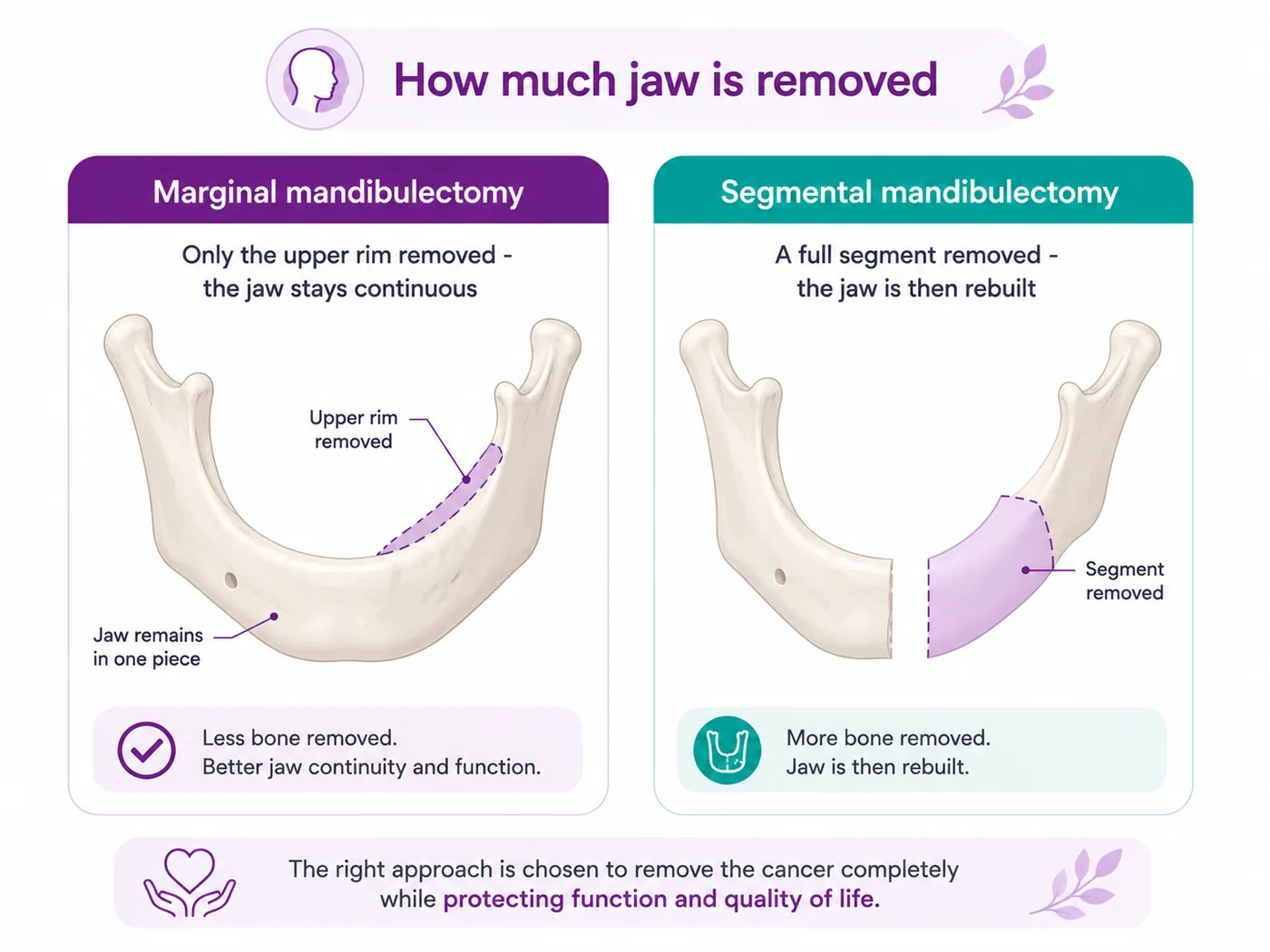
There are two main types, and which one you need depends on how deeply the cancer has reached the jawbone. In a marginal mandibulectomy, only the upper rim of the jaw is removed and the jaw stays in one continuous piece — used when the cancer is close to the bone but has not deeply invaded it. In a segmental mandibulectomy, a full-thickness segment is removed because the cancer has clearly invaded the bone — and the jaw is then rebuilt to restore its shape and function.
Marginal removes only the rim (the jaw stays continuous); segmental removes a full segment, which is then rebuilt.
Marginal mandibulectomy
Segmental mandibulectomy
What is removed
Only the upper rim of the jaw; the jaw stays in one continuous piece.
A full-thickness segment of the jaw, leaving a gap.
Used when
The cancer is close to the bone but has not deeply invaded it.
The cancer has clearly invaded the jawbone.
Reconstruction
Usually simpler; the jaw's continuity is preserved.
The segment is rebuilt, often with a fibula (leg bone) free flap.
What it means for you
Less bone removed, better jaw continuity — often a quicker recovery.
More bone removed, but a rebuilt jaw designed to restore chewing, speech and appearance.
Which one you need is decided from your scans and the surgeon's assessment — the least surgery that safely clears the cancer is always the aim. A second opinion from CION's head & neck team reviews it with you.
Tests that confirm the diagnosis and guide jaw surgery
Before any surgery, the cancer is confirmed and staged. A biopsy establishes whether it is cancer and its type, while an MRI and other scans show exactly how far it has reached the jawbone — which decides whether a marginal or a segmental mandibulectomy is needed, and how the jaw is rebuilt. Your team then agrees the plan with you.
Diagnostic services we offer — book any of these:
Oral exam & screening
A careful check of a non-healing mouth ulcer, a white or red patch, or restricted mouth opening — the first step to catching oral cancer early.
Rebuilding the jaw — restoring your face, chewing & speech
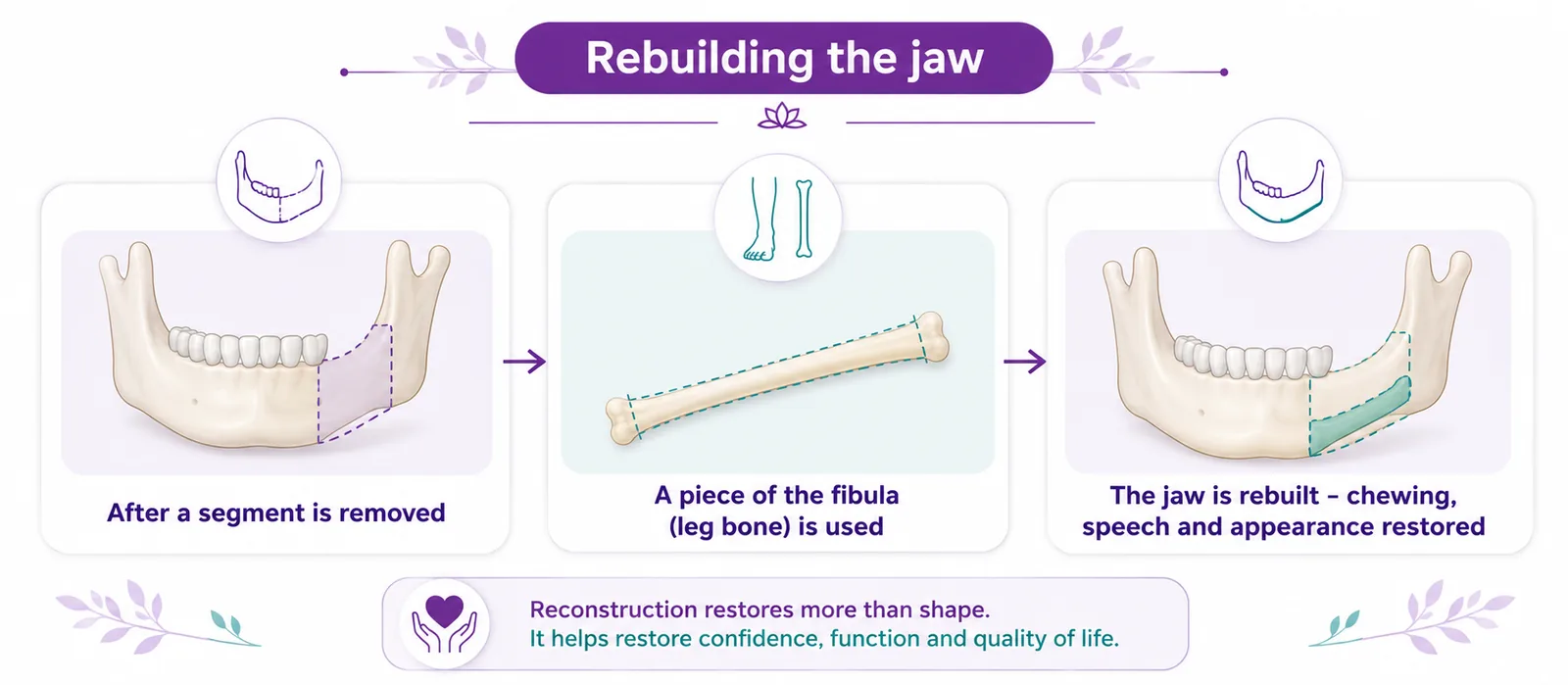
This is the part that reassures most people: when a segment of jaw is removed, it can be rebuilt in the same operation. The most common way is a fibula free flap — a piece of the fibula (a non-essential leg bone) is shaped to recreate the jaw, with its own blood supply reconnected, so it becomes living bone that heals and can later hold dental implants. Where a flap is not needed, a reconstruction plate may be used. The result is designed to restore the shape of your face and your ability to chew and speak as fully as possible.
A piece of the fibula (leg bone) is shaped to rebuild the jaw — restoring the face, chewing and speech.
Living bone that lasts
A fibula free flap becomes living bone with its own blood supply, so it heals well and can later hold dental implants for chewing. Read more about free-flap reconstruction after oral cancer.
Planned with the removal
Reconstruction is planned before surgery and, where possible, done in the same operation — so you wake with the jaw already rebuilt and healing.
Microvascular free-flap jaw reconstruction is a specialised procedure; at CION it is planned and coordinated with reconstructive specialists as part of one head & neck plan, so removing the cancer and restoring your face and function are never treated as separate problems.
Treatment
Oral cancer treatments we deliver around your surgery
Jaw surgery is one part of a complete oral-cancer plan — CION delivers the whole pathway. That means the mandibulectomy itself, jaw reconstruction and dental rehabilitation to restore function, neck-node surgery where needed, and radiation, chemotherapy or immunotherapy when they are part of the plan. Every case is set by a head & neck tumour board for your stage.
Treatments we deliver — book a consult for any of these:
Mandibulectomy (jaw surgery)
Marginal (bone-preserving) or segmental removal of the affected jaw with a clear margin — the least surgery that safely clears the cancer.
Getting back to eating and speaking is a journey, and it is supported at every step. In the early weeks, food starts as liquids and soft textures, and some people need a temporary feeding tube while the mouth heals. Speech-and-swallow therapy helps retrain these muscles, and dental rehabilitation — including implants that a fibula flap can hold — restores chewing over time. Most people return to a normal or near-normal diet and to clear speech. Your team sets realistic expectations and walks the whole path with you.
Eating again, step by step
Food progresses from liquids to soft textures to a normal diet as the mouth heals. A dietitian guides you, and any temporary feeding tube is removed as you recover. Eating after surgery
Speech & swallow therapy
Therapists retrain the muscles used to speak and swallow, so clear speech and comfortable swallowing return over the weeks after surgery. Speech rehab
Dental rehabilitation
Once healing allows, dental rehabilitation — including implants that a reconstructed jaw can hold — restores comfortable chewing. Dental implants
Adjusting to jaw surgery is emotional as well as physical. CION's psycho-oncology counsellors support you and your family with appearance, identity and confidence — because these things matter, and should be talked about, not left unsaid.
What to expect & recovery
What to expect and recovery after a mandibulectomy
A mandibulectomy — especially with reconstruction — is a significant operation, but it follows a clear, well-supported path. Expect a hospital stay, sometimes with a temporary breathing (tracheostomy) or feeding tube to let the mouth rest and heal safely — both usually removed as you recover. Eating progresses from liquids to soft foods, speech-and-swallow therapy begins early, and dental rehabilitation follows once healing allows. Your team explains each step in advance, so you and your family know what to expect.
1
Before surgery
Scans plan exactly how much jaw is involved and how it will be rebuilt; dental and nutrition assessments prepare you.
2
The operation
The affected jaw is removed with a clear margin and, where needed, rebuilt in the same operation.
3
In hospital
A hospital stay to recover, sometimes with a temporary feeding or breathing tube while the mouth heals.
4
Speech & swallow
Eating starts with liquids and soft foods; speech-and-swallow therapy begins early to retrain the muscles.
5
Dental & follow-up
Chewing, speech and strength improve over the weeks; dental rehabilitation restores chewing over time.
Recovery after a mandibulectomy with reconstruction is measured in weeks to a few months, and improves steadily with therapy. Follow-up focuses on healing, on your eating and speech, and on making sure the cancer stays controlled — with support at every step.
Cost & coverage
Mandibulectomy cost in Hyderabad Indicative
The cost depends on how much jaw is removed and whether free-flap reconstruction is needed — a marginal mandibulectomy costs less than a segmental one with reconstruction. The reassuring part: this is treatment for oral cancer, so it is generally covered under Aarogyasri at empanelled centres, and by most health-insurance policies. Our team checks your scheme eligibility and policy, and gives you a clear, written estimate before anything is planned. These are estimates, not a quotation.
Indicative cost estimator
Pick your situation for an indicative range, then request an exact estimate for your case.
Indicative range
₹1,20,000 – ₹2,50,000
for a marginal mandibulectomy, general room, self-pay
Figures are indicative only and not a quotation. Oral cancer surgery is generally covered under Aarogyasri at empanelled centres and by most health insurance, subject to eligibility. Your actual cost depends on the extent of surgery, any reconstruction, hospital stay and treatment around it.
Talk to a jaw-surgery & reconstruction specialist — free
A mouth cancer that involves the jaw shouldn't wait. Book a free consultation and, if you already have a biopsy, a free written second opinion — confidentially, and without judgement.
Your reports reviewed by a senior head & neck surgical oncologist
An honest plan for removal and jaw reconstruction, together
Aarogyasri & health-insurance guidance
Support
Financial support & Aarogyasri
Cost should not delay treatment. Because a mandibulectomy is treatment for oral cancer, eligible surgery — including reconstruction — is generally covered under Aarogyasri at empanelled centres, and most health-insurance policies are accepted cashless. Our counsellors help check eligibility, arrange approvals and map out what you will actually pay — often far less than families fear.
9 clinics in Hyderabad · 35+ across Telangana & AP
CION cancer care is closer than you think.
We're never more than 30 minutes away. Same panel of specialists at every centre. Same tumour board reviews. Same NCCN protocols. Pick the closest one and call directly — or let us pick for you.
Don't see your city? Call
18002028726
— we'll find your nearest CION partner centre.
Meet the head & neck surgical team
Your mandibulectomy is planned by a team, not one doctor.
Head & neck surgical oncologists, reconstructive, dental and speech-therapy teams plan every case together in a multidisciplinary tumour board — so removal and jaw reconstruction are one plan.
Share your name and number — we'll call you back within 30 minutes to schedule your consultation.
A mouth cancer that involves the jaw? Don't face it alone.
The jaw can be rebuilt so your face, chewing and speech return. Let CION's head & neck tumour board review your reports and give you an honest plan for removal and reconstruction — together, and without judgement.
Common fears about jaw surgery — answered honestly
The deepest fears about a mandibulectomy are about losing your face, your speech and your ability to eat. Here are honest, respectful answers to the ones we hear most in Telangana — without judgement.
“Will I lose my face — will I still look like myself?”
Fact: Modern jaw reconstruction is designed to restore the shape of your face as closely as possible. When a segment is removed, it is rebuilt — most often with a fibula free flap — so most people look like themselves again after healing. The reconstruction is planned before surgery, alongside removing the cancer.
“Will I ever eat normally again?”
Fact: Most people return to a normal or near-normal diet. It is a journey — liquids and soft foods first, guided by a dietitian — and dental rehabilitation, including implants a reconstructed jaw can hold, restores chewing over time.
“Will I be able to speak after jaw surgery?”
Fact: Most people return to clear speech. Speech-and-swallow therapy retrains the muscles used to speak and swallow, and it begins early. Your team supports every step and sets realistic expectations with you.
“The tobacco or gutka was my fault — will they judge me?”
Fact: There is no judgement here. Oral cancer from tobacco, gutka and areca nut is common in our region; what matters now is treating it safely. Help to stop — at your own pace — is offered kindly, as support, never as blame.
“Will I have to live with a feeding tube forever?”
Fact: A feeding tube, if it is used at all, is usually temporary — to let the mouth rest and heal safely — and is removed as you recover. Most people return to eating by mouth. Not everyone needs one; it depends on the extent of surgery.
“Will I need a hole in my neck to breathe?”
Fact: Sometimes a temporary breathing (tracheostomy) tube is used after a bigger operation to keep you safe while swelling settles, and it is usually removed as you heal. Many people do not need one at all.
“Taking bone from my leg sounds dangerous — will I still walk?”
Fact: The fibula is a non-essential leg bone; a piece can be removed to rebuild the jaw and most people walk normally again after recovery. The leg is carefully assessed beforehand to make sure this is safe for you.
“Won't the surgery spread the cancer?”
Fact: This is a common, harmful myth. Removing the cancer with a clear margin under controlled surgical conditions does not spread it. What actually causes harm is delay, which lets a treatable cancer grow.
“Can a middle-class family afford jaw surgery and reconstruction?”
Fact: Because it is oral cancer treatment, eligible surgery — including reconstruction — is generally covered under Aarogyasri at empanelled centres, and most health insurance is accepted cashless. Our counsellors check eligibility and map out what you will actually pay.
“It's just a mouth ulcer — I'll wait and see.”
Fact: A mouth ulcer, or a white or red patch, that does not heal within two to three weeks should be checked. Waiting can let an easily treatable cancer become one that needs bigger surgery — getting checked early keeps options open.
“I'm too old or too weak for such a big operation.”
Fact: Age alone does not decide it — fitness does. Your team assesses you individually, and the plan (marginal or segmental, and the type of reconstruction) is tailored to what your body can safely handle.
“Recovery will take years and I'll never work again.”
Fact: Recovery is measured in weeks to a few months, improving steadily with therapy. Many people return to work and daily life, and a phased return is planned with you rather than left to chance.
“If they remove a segment, my jaw will just be left missing.”
Fact: Where a segment is removed, it is rebuilt in the same operation wherever possible — so you wake with the jaw already reconstructed and healing, not with a gap.
“The whole jaw will have to come out.”
Fact: Only the part of the jaw the cancer has reached is removed. Often that is just the upper rim — a marginal mandibulectomy — which keeps the jaw in one continuous piece.
“A second opinion will offend my doctor or waste time.”
Fact: A second opinion is normal and welcomed in cancer care — it confirms the plan and gives you confidence. At CION it is free when you have a biopsy report, and it can be arranged quickly.
“Home or herbal remedies can shrink it instead.”
Fact: No home or herbal remedy is proven to cure oral cancer, and relying on one wastes the window when it is most treatable. Tell your team about anything you take so it can be managed safely alongside proper treatment.
“Will the cancer just come back after all this?”
Fact: Removing the cancer with a clear margin gives the best chance of control, and regular follow-up catches any change early. No surgery promises zero risk, but timely treatment and follow-up are how outcomes are protected.
“Talking about mouth cancer is shameful — better to stay quiet.”
Fact: These are normal, important medical questions, not a source of shame. Raising them early leads to better decisions and better support. Silence only delays care and deepens worry.
Why CION
Why choose CION for a mandibulectomy in Hyderabad
Removal & reconstruction, one plan
The cancer removal and the jaw reconstruction are planned together, so your face and function are considered from the very start.
Bone-preserving where possible
Where the cancer allows, a marginal mandibulectomy keeps the jaw continuous — the least surgery that safely clears the cancer.
Rehabilitation that matters
Speech-and-swallow therapy and dental rehabilitation to restore eating, speaking and chewing — not just the surgery.
A tumour-board approach
Every case is planned by a head & neck multidisciplinary tumour board, so surgery, reconstruction and any further treatment fit together.
Support without judgement
Compassionate, non-judgemental care — including kind help to stop tobacco, gutka and areca nut, at your own pace.
Aarogyasri & care close to home
Oral cancer surgery is covered under Aarogyasri at empanelled centres; 35+ centres and Telugu-speaking teams near you.
Real stories · real courage
15,000+ patients chose CION. Hear from them directly.
These aren't paid endorsements or written reviews. These are video testimonials from real patients and families — recorded on their own phones, in their own words. Pick any one. Watch it. Then decide.
4.8★800+ Google reviews
50+video testimonials
15,000+patients treated
Successful Chemotherapy & Radiation Done by Dr. Owais Mohammed & Dr. Kirti Ranjan
Watch video →
Successful Chemotherapy Done by Dr. C Raghavendra Reddy
Watch video →
Surgery, Chemo & Radiation Done by Dr. Imaduddin, Dr. Vinay, Dr. Owais, Dr. Kirti
Watch video →
Successful Radical Thymectomy Done by Dr. Mohammed Imaduddin & Dr. Vinay Mamidala
Watch video →
Successful Surgery Done by Dr. Rajender Byshetty
Watch video →
Successful Chemo & Surgery Done by Dr. Imad, Dr. Vinay, Dr. Owais & Dr. Raghavendra
Watch video →
Successful Chemo & Surgery Done by Dr. Imad, Dr. Vinay, Dr. Owais & Dr. Raghavendra
Watch video →
Successful Chemo & Radiation Done by Dr. Owais Mohammed & Dr. Kirti Ranjan Mohanty
Watch video →
Successful Breast Cancer Surgery Done by Dr. Imaduddin Mohammed & Dr. Vinay Mamidala
Watch video →
Successful Chemotherapy Done by Dr. Bharati Devi Gorantla
Watch video →
Successful Chemo & Surgery Done by Dr. Owais Mohammed & Dr. Imaduddin Mohammed
Watch video →
Successful Chemotherapy Done by Dr. Gundu Naresh
Watch video →
Successful Bone Marrow Transplantation - Neuroblastoma
Watch video →
Successful Surgery & Chemo - Carcinoma of Caecum
Watch video →
Successful Oral chemotherapy & mastectomy surgery
Watch video →
Successful Oral chemotherapy & mastectomy surgery
Watch video →
Successful Chemotherapy
Watch video →
Successful Surgery by Dr. Mohammed Imaduddin
Watch video →
Successful Bone Marrow Transplantation
Watch video →
Successful Oral chemotherapy & mastectomy surgery
Watch video →
Successful Oral chemotherapy & mastectomy surgery
Watch video →
Successful Chemotherapy
Watch video →
Successful Buccal Mucosa Surgery
Watch video →
Successful Complex Surgery Mandibulectomy Reconstruction
Recovering the ability to eat, speak and feel like yourself is as important as the surgery. At CION, reconstruction, nutrition, speech therapy, emotional support and rehabilitation are one coordinated plan — from diagnosis through to survivorship.
Jaw reconstruction
Rebuilding the jaw and restoring form and function — often in the same operation. Learn more
Speech & swallow therapy
Retraining the muscles used to speak and swallow, so clear speech returns. Learn more
Nutrition counselling
Soft-food and liquid diets while the mouth heals, and building strength. Learn more
Psychology counselling
Support with appearance, identity and the emotions of jaw surgery. Learn more
Palliative & comfort care
Comfort and symptom support at any stage, alongside treatment. Learn more
Financial counselling
Aarogyasri and cashless insurance guidance so cost never blocks care. Learn more
FAQ
Mandibulectomy in Hyderabad — frequently asked questions
What is a mandibulectomy?
A mandibulectomy is surgery to remove the part of the lower jawbone (the mandible) affected by an oral cancer. How much is removed depends on how far the cancer has reached the bone — sometimes only the upper rim (a marginal mandibulectomy), sometimes a full segment (a segmental mandibulectomy), which is then rebuilt. The goal is to remove all the cancer while restoring how you look and function.
What is the difference between marginal and segmental mandibulectomy?
In a marginal mandibulectomy, only the upper rim of the jaw is removed and the jaw stays in one continuous piece — used when the cancer is close to the bone but has not deeply invaded it. In a segmental mandibulectomy, a full-thickness segment is removed because the cancer has invaded the bone, and the jaw is then rebuilt, often with a fibula free flap.
Will I look normal after jaw surgery?
Modern jaw reconstruction is designed to restore the shape of your face as closely as possible. When a segment of jaw is removed, it is rebuilt — most often with a fibula free flap — so that most people look like themselves again after healing. Your team plans the reconstruction before surgery, alongside removing the cancer.
Will I be able to eat and speak again after a mandibulectomy?
Most people return to a normal or near-normal diet and to clear speech. It is a journey: food starts as liquids and soft textures, speech-and-swallow therapy retrains the muscles, and dental rehabilitation — including implants a reconstructed jaw can hold — restores chewing over time. Your team supports every step.
How is the jaw rebuilt after a mandibulectomy?
Most often with a fibula free flap — a piece of the fibula (a non-essential leg bone) is shaped to recreate the jaw, with its blood supply reconnected so it becomes living bone that heals and can later hold dental implants. Where a flap is not needed, a reconstruction plate may be used instead. This is planned with the removal, so both are considered together.
Will I need a feeding tube or a breathing tube?
Sometimes, temporarily. A temporary breathing (tracheostomy) or feeding tube may be used to let the mouth rest and heal safely after a bigger operation, and both are usually removed as you recover. Not everyone needs them — it depends on the extent of surgery, which your team explains beforehand.
How long is recovery after a mandibulectomy?
A mandibulectomy with reconstruction is a significant operation, so recovery is measured in weeks to a few months, starting with a hospital stay. Eating and speech improve gradually with therapy, and dental rehabilitation follows once healing allows. Your team sets realistic expectations and supports you throughout.
How much does a mandibulectomy cost in Hyderabad?
The cost depends on how much jaw is removed and whether free-flap reconstruction is needed. As an indicative guide, a marginal mandibulectomy starts around ₹1,20,000, while a segmental mandibulectomy with reconstruction can range higher, up to roughly ₹6,00,000, depending on the extent of surgery, hospital stay and treatment around it. These are indicative figures, not a quotation; CION gives a written estimate after assessment.
Is a mandibulectomy covered under Aarogyasri or insurance?
It is treatment for oral cancer, so eligible surgery — including reconstruction — is generally covered under Aarogyasri at empanelled centres and by most health-insurance policies. CION's counsellors help you check eligibility, arrange approvals and handle the paperwork, so cost is far less of a barrier than most families expect.
Is taking bone from my leg (fibula) safe — will I walk normally?
The fibula is a non-essential leg bone, and a piece of it can be removed to rebuild the jaw while most people walk normally again after recovery. The leg is carefully assessed beforehand to make sure this is safe for you, and a rehabilitation plan supports your recovery.
When is a mandibulectomy needed for oral cancer?
A mandibulectomy is considered when an oral cancer — of the gum, floor of the mouth, tongue or cheek — has reached or invaded the lower jawbone. Scans and the surgeon's assessment decide whether only the rim needs removing (marginal) or a full segment (segmental). The aim is always the least surgery that safely clears the cancer.
Will I need a neck dissection as well as jaw surgery?
Sometimes. If the cancer has spread, or may have spread, to the lymph nodes in the neck, a neck dissection to remove those nodes may be done alongside the jaw surgery. Whether it is needed is decided from your scans and node assessment, and your team explains this before surgery.
Will jaw surgery spread the cancer?
No. Removing the cancer with a clear margin under controlled surgical conditions does not spread it through the body — this is a common, harmful myth. What causes real harm is delay, which lets a treatable cancer grow. Surgery is one of the most effective ways to remove an oral cancer that has reached the jaw.
Which is the best hospital for a mandibulectomy in Hyderabad?
Look for a cancer centre with a head & neck surgical oncology team, multidisciplinary tumour-board planning, jaw reconstruction (coordinated with reconstructive specialists), and speech-and-swallow and dental rehabilitation. CION Cancer Clinics offers this across 35+ centres in Telangana and Andhra Pradesh, with Aarogyasri and insurance counselling.
Will I need radiation or chemotherapy after the surgery?
Sometimes further treatment such as radiation, or chemotherapy, is added after surgery to give the best control — a planned part of care, not a sign the surgery failed. Whether it is needed depends on the stage and the findings from surgery, and it is decided by the head & neck tumour board.
Can the oral cancer come back after a mandibulectomy?
Removing the cancer with a clear margin gives the best chance of control, and for most people it stays controlled. Regular follow-up checks catch any change early, when further treatment works best. No surgery promises zero risk, but timely treatment and follow-up are how outcomes are protected.
Which doctor should I see for jaw surgery for oral cancer in Hyderabad?
See a head & neck surgical oncologist who treats oral cancer involving the jaw. At CION your case is reviewed by a team — surgical, reconstructive, radiation and medical oncologists together — so you get a coordinated plan for removal and reconstruction rather than a single-doctor decision. You can request a specific surgeon when booking.
How do I prepare for a mandibulectomy?
Your team completes pre-operative checks, reviews your medicines and fitness for anaesthesia, and plans the reconstruction and dental rehabilitation in advance. Stopping tobacco, gutka and areca nut — with kind support — and staying nourished beforehand can help recovery. You will be given clear instructions on fasting and which medicines to pause before surgery.
Explore
Explore oral cancer & jaw-surgery care at CION
Surgery, reconstruction, tests, recovery and cost around oral cancer. Tap any topic to read more.
Talk to CION about mandibulectomy & reconstruction
Early answers change outcomes. Book a free consultation or second opinion at any of our 9 Hyderabad clinics — part of 35+ centres across Telangana & Andhra Pradesh. Confidential, and without judgement.
Medical disclaimer: This page provides general information about mandibulectomy (jaw surgery) for oral cancer and is not a substitute for professional medical advice, diagnosis or treatment. Costs shown are indicative only and not a quotation. Marginal (bone-preserving) surgery is used where possible; microvascular free-flap jaw reconstruction is coordinated with reconstructive specialists as part of one head & neck plan. Always consult a qualified head & neck surgical oncologist about your individual care. Content is periodically reviewed by CION's medical team.

 CION Ameerpet