Parotid / salivary gland surgery · Hyderabad & Telangana
Parotidectomy in Hyderabad
A parotidectomy removes a lump or tumour from the parotid — the salivary gland in front of the ear. Two worries usually come with it: is it cancer? and will surgery affect my face? The reassuring answers are that most parotid lumps are not cancer, and that protecting the facial nerve — which lets you smile and close your eye — is the heart of the operation. At CION it is done by an experienced head & neck team using facial-nerve monitoring, through a well-hidden scar.
Facial-nerve preservation with intra-operative monitoring
Most parotid lumps are benign · well-hidden facelift-style scar
Short stay · insurance & Aarogyasri help (for cancer)
★★★★★Rated 4.8/5 · 800+ Google reviews
35+ centres, close to home
Facial-nerve monitoring
Most lumps are benign
Insurance & Aarogyasri help
SM
Written by Dr. Srinivasulu Mukta, MCh (Surgical Oncology), 35+ years, with CION's head & neck surgical-oncology team. Medically reviewed by Dr. Muralidhar Muddusetty, MRCS (Edinburgh), AIIMS-trained. · Reviewed 14 July 2026
Understanding the surgery
What is a parotidectomy — and why is it done?
A parotidectomy is surgery to remove part or all of the parotid gland — the largest salivary gland, which sits just in front of and below the ear — usually to remove a lump or tumour. Most parotid lumps are benign (not cancer), but they are removed both to treat them and to confirm exactly what they are. Because the facial nerve passes right through the gland, the central aim is to remove the lump while carefully identifying and preserving that nerve, so your face keeps moving normally.
A parotid lump usually shows up as a slow-growing, painless swelling near the ear or the angle of the jaw. It is checked with a scan and a fine-needle test before surgery, so your team has a clear picture. The operation is done through an incision shaped like a facelift cut — placed around the ear and into the neck crease — so it heals to a discreet, well-hidden line. At CION the surgery is carried out by an experienced head & neck surgical-oncology team.
What a parotidectomy achieves
Removes the lump
The parotid lump is removed — usually with the outer lobe of the gland — as the treatment, and examined to confirm what it is.
Protects the facial nerve
The facial nerve is identified and preserved with intra-operative monitoring, so your smile, eyebrow and eye-close keep working. More below.
Confirms benign or cancer
The removed tissue is examined, giving a definite diagnosis — benign or cancer — and guiding any care that may be needed.
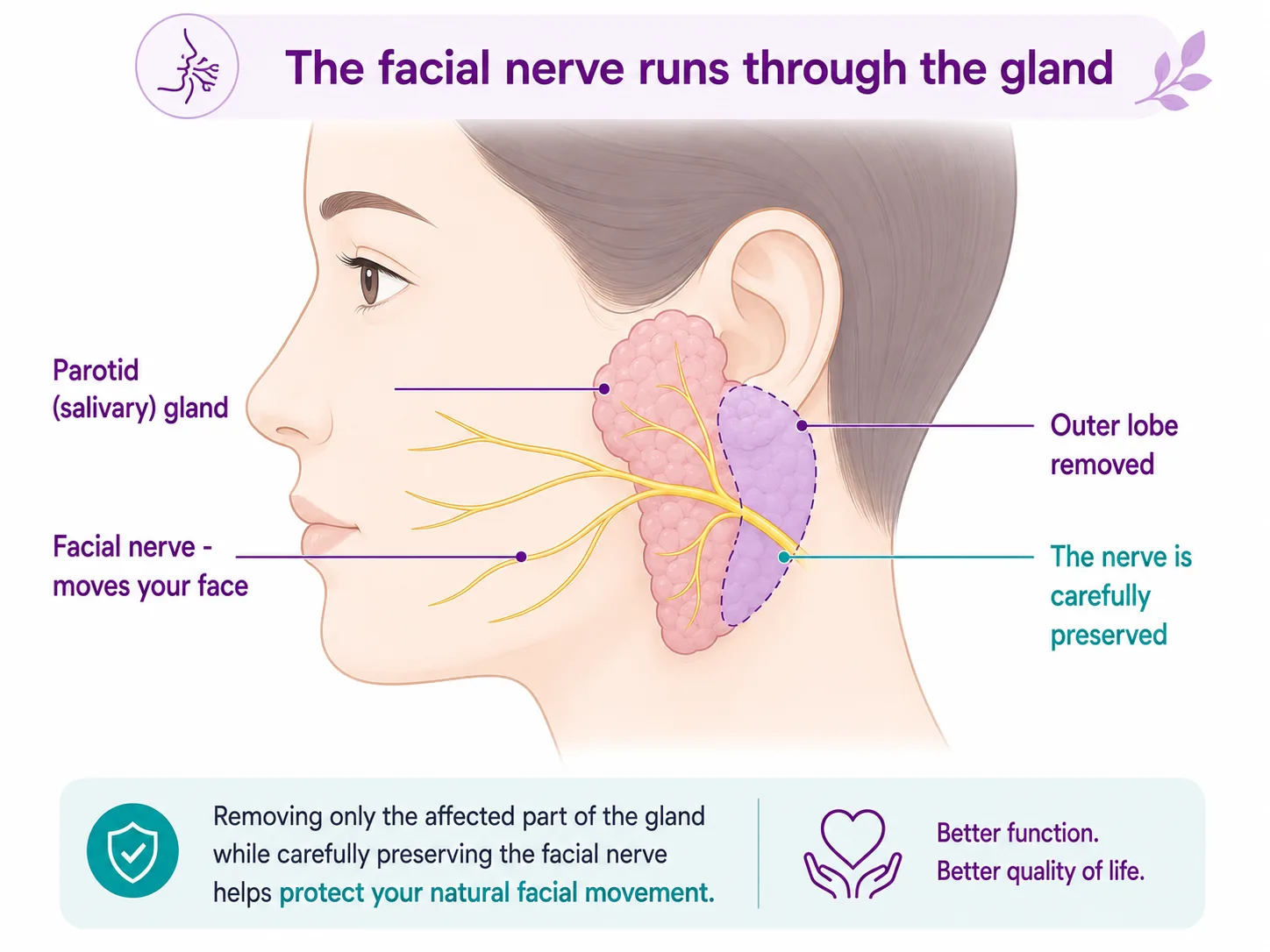
This is the fear that matters most, and the honest, reassuring answer is that protecting your face is the whole focus of the operation. The facial nerve — which lets you smile, raise your eyebrow and close your eye — runs directly through the parotid gland, branching across the cheek. The surgeon carefully identifies this nerve and works around it, using facial-nerve monitoring to confirm it stays safe as the lump is removed. Some people notice mild, temporary weakness afterwards that usually recovers over weeks; lasting weakness is uncommon in experienced hands, and is discussed honestly with you beforehand.
Nerve monitoring
A monitor signals the facial nerve and its branches during surgery, helping the surgeon keep it safe while the lump and gland tissue are removed.
An honest word on weakness
Temporary weakness of part of the face can happen and usually settles over weeks. Permanent weakness is uncommon; where a cancer directly involves the nerve, your team explains the plan — including nerve repair — clearly and in advance.
Earlobe numbness
Some numbness of the earlobe and nearby skin is common at first, because a small sensory nerve is disturbed. It usually improves over the following weeks and months.
Frey's syndrome
Sweating of the cheek when eating can develop months later in a minority of people. It is not dangerous, is usually manageable, and surgical techniques reduce the chance of it.
These are the questions people most want answered, and our team talks them through openly before anything is planned. Facial-nerve repair and reconstruction are available for the uncommon cases where a cancer involves the nerve.
The facial nerve runs through the parotid gland. The surgeon identifies and preserves it, using nerve monitoring, while removing the lump.
Diagnosis & work-up
Tests that check a parotid lump and plan the surgery
A slow-growing, painless swelling near the ear or jaw is the most common sign — and it should be checked without delay. An ultrasound and a fine-needle test point to what the lump is; a scan maps it around the facial nerve; and the parotidectomy itself gives the definite answer. Your team uses these to plan the least surgery that safely removes the lump.
Diagnostic services we offer — book any of these:
Ultrasound of the gland
A quick, painless scan of the parotid — usually the first test when a lump or swelling in front of the ear is found.
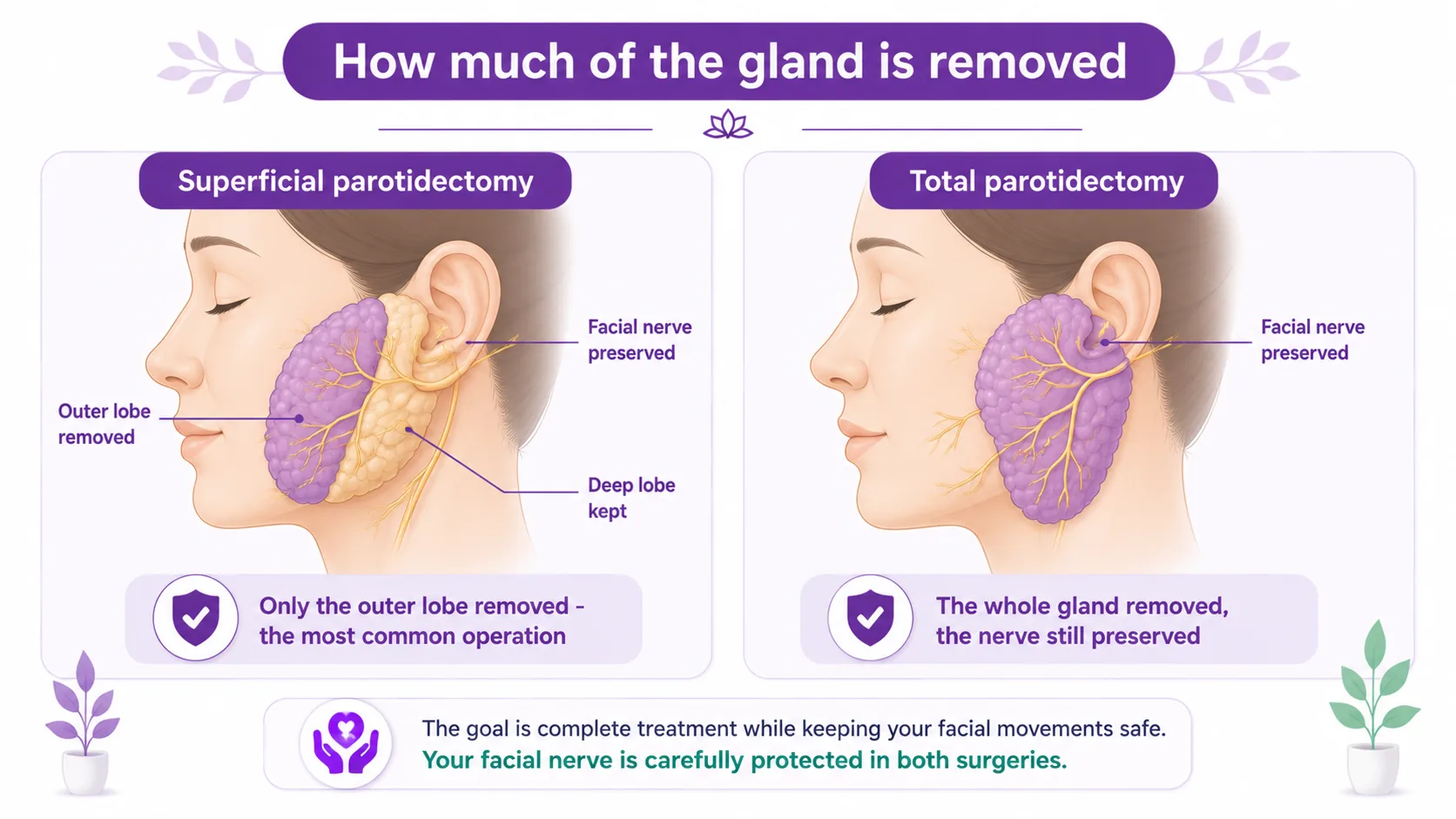
How much of the gland is removed depends on where the lump is and what it is. A superficial parotidectomy — the most common operation — removes only the outer (superficial) lobe, where most lumps sit, keeping the deeper part; the facial nerve is preserved. A total parotidectomy removes the whole gland, needed when a lump is in the deep lobe or a cancer needs a wider clearance; the facial nerve is still carefully preserved wherever it is not involved. Your surgeon recommends the least surgery that safely removes the lump.
Superficial (most common)
Only the outer lobe is removed, where most lumps sit — the usual operation for a benign parotid lump. The deep lobe is kept.
Total
The whole gland is removed for a deep-lobe lump or a cancer needing a wider clearance — with the facial nerve still carefully preserved.
A superficial parotidectomy removes only the outer lobe; a total parotidectomy removes the whole gland. The facial nerve is preserved in both.
Superficial parotidectomy
Total parotidectomy
What is removed
Only the outer (superficial) lobe, where most lumps sit; the deep part is kept.
The whole parotid gland (outer and deep lobes).
Usually used for
Most parotid lumps, usually benign — the most common operation.
Deep-lobe lumps, or a cancer needing a wider clearance.
The facial nerve
Identified and preserved with nerve monitoring.
Still carefully preserved wherever it is not involved by the cancer.
The scar
A discreet facelift-style incision around the ear and neck crease.
The same well-hidden facelift-style incision.
Treatment
Parotid surgery & related treatments we deliver
For most people the parotidectomy is the whole treatment — especially for a benign lump. Where the tissue turns out to be a cancer, the same operation treats it, the neck nodes may be assessed, and your team plans whether any further care (such as radiation) helps. CION delivers the full head & neck pathway and helps you choose.
Services we deliver — book a consult for any of these:
Superficial parotidectomy
Removal of the outer lobe with the lump — the most common operation for a benign parotid lump, with the facial nerve preserved.
A parotidectomy is a well-established operation with a straightforward recovery for most people. It is done under general anaesthetic and usually needs only a short hospital stay — often a day or two — with a small drain near the wound that is removed before you go home. The scar is placed like a facelift incision, so it heals discreetly. Most people are back to light activities within a week or two, and the final tissue result guides whether any further care is needed.
1
Before surgery
A scan and a fine-needle test check the lump; your surgeon explains the operation, the nerve and the scar.
2
The operation
Through a well-hidden incision, the lump is removed — usually with the outer lobe — with the nerve monitored.
3
In hospital
A short stay, often a day or two, with a small drain removed before discharge; pain is well controlled.
4
Home recovery (1–2 wks)
Back to light activities within a week or two; the scar fades over the following months.
5
Follow-up
The final tissue result guides any further care, and your team reviews you to check healing and facial movement.
Your team explains the few things to watch for — including temporary facial weakness, some numbness of the earlobe, and, less commonly, sweating of the cheek when eating (Frey's syndrome) — and how each is managed. For a benign lump, removing it is usually the whole story.
Cost & coverage
Parotidectomy cost in Hyderabad Indicative
The cost depends on how much of the gland is removed and whether it is for a benign lump or a cancer — a superficial parotidectomy for a benign lump costs less than a total parotidectomy with a neck clearance for cancer. On coverage: for a parotid cancer, this is cancer surgery and is generally covered under Aarogyasri at empanelled centres; for a benign tumour, it is usually covered by health insurance. Our team checks your policy and scheme eligibility and gives a written estimate before anything is planned.
Indicative cost estimator
Pick your situation for an indicative range, then request an exact estimate for your case.
Indicative range
₹90,000 – ₹2,00,000
for a superficial parotidectomy, general room, self-pay
Figures are indicative only and not a quotation. For a parotid cancer, Aarogyasri may cover eligible surgery at empanelled centres; a benign lump is usually covered by health insurance. Any further treatment is costed separately.
Figures are indicative only, drawn from typical private-hospital ranges in India, and are not a quotation or a pricing promise. A written estimate is provided after consultation, based on your individual plan.
Free consultation
Talk to a head & neck specialist — free
A lump you noticed near the ear, or a scan you've just had, shouldn't wait. Book a free, confidential consultation and, if you already have reports, a free second opinion on whether — and what — surgery is needed.
Your reports reviewed by a senior head & neck surgical oncologist
Honest answers on the facial nerve, the scar and whether it's cancer
Insurance & (for cancer) Aarogyasri guidance
Benign or cancer
Is it cancer — and what would it involve?
Most parotid lumps are benign — not cancer — but every lump is checked properly, because the small number that are cancer are very treatable when found early. Before surgery, a scan and a fine-needle test give a good idea of what the lump is; the operation removes it and provides the definite answer. If it is benign, removing it is usually the whole treatment. If it is a cancer, the same operation treats it, the neck nodes are assessed, and your team plans whether any further care helps — all reviewed by a head & neck tumour board.
If it's benign (most cases)
Removing the lump — usually with the outer lobe — is generally the whole treatment. No further cancer care is needed, and you are followed up to check healing and facial movement.
If it's a cancer
The operation treats it, the neck nodes may be cleared, and radiation is added only for selected cancers. It is planned by a tumour board so surgery and any further care fit together. See also removing a cancer with a clear margin.
Support
Insurance, Aarogyasri & financial support
Cost should never be the reason to delay getting a lump checked. For a benign parotid tumour, parotid surgery is usually covered by health insurance, accepted cashless. For a parotid cancer, eligible surgery may be largely covered under Aarogyasri and PMJAY at empanelled centres. Our counsellors check eligibility, arrange approvals and map out what you will actually pay, including any further treatment.
9 clinics in Hyderabad · 35+ across Telangana & AP
CION cancer care is closer than you think.
We're never more than 30 minutes away. Same panel of specialists at every centre. Same tumour board reviews. Same NCCN protocols. Pick the closest one and call directly — or let us pick for you.
Don't see your city? Call
18002028726
— we'll find your nearest CION partner centre.
Meet the head & neck surgical team
Your parotidectomy is performed by a team, not one doctor.
Fellowship-trained surgical oncologists who treat head & neck cancers day in, day out — part of 17 senior specialists across CION, with medical and radiation oncology in the same tumour board.
Share your name and number — we'll call you back within 30 minutes to schedule your consultation.
A lump near the ear? Get it checked — most turn out benign.
A slow-growing, painless swelling in front of or below the ear is worth checking early. It is quick and private, most parotid lumps are not cancer, and if surgery is needed your face is carefully protected. Let CION's head & neck team review it honestly.
These are the worries people carry into the clinic. Here are honest, respectful answers to the ones we hear most in Telangana.
“Will my face droop or be paralysed after the surgery?”
Fact: In most cases, no. The facial nerve runs through the parotid gland, so the surgeon carefully identifies and preserves it using intra-operative monitoring. Some people have mild, temporary weakness of part of the face that usually recovers over weeks. Lasting weakness is uncommon in experienced hands, and your surgeon discusses the risk honestly beforehand.
“A lump near my ear must be cancer.”
Fact: Most parotid lumps are benign (not cancer). They are still removed, both to treat them and to confirm the diagnosis with certainty. The small number that are cancer are very treatable, especially when found early — which is exactly why every lump is checked with a scan and a fine-needle test and then examined after removal.
“The scar will be big and obvious on my face.”
Fact: The scar is designed to be discreet. The incision is placed like a facelift cut — around the ear and into the natural neck crease — so it is well hidden and usually fades to a fine line over the following months. Most people find it is not noticeable in day-to-day life.
“If the lump is benign, why remove it at all?”
Fact: Even a benign parotid lump is usually removed, for two reasons: it tends to grow slowly over time, and removing it is the only way to be certain what it is. Taking it out while it is small keeps the operation simpler and the scar smaller, and gives you a definite answer.
“I'll have a permanent numb patch on my face and ear.”
Fact: Some numbness of the earlobe and the skin near the ear is common at first, because a small sensory nerve there is disturbed during surgery. It usually improves over the following weeks and months. This is different from the facial nerve, which controls movement and is carefully preserved.
“I'll sweat on my cheek whenever I eat, forever (Frey's syndrome).”
Fact: Frey's syndrome — sweating or flushing of the cheek when eating — develops in only a minority of people, months after surgery. It is not dangerous, is usually manageable, and surgical techniques during the operation reduce the chance of it happening at all.
“Only an ENT can do this — a cancer hospital can't.”
Fact: Parotid surgery is performed by both ENT and head & neck surgical oncologists. When a lump could be a cancer, having it done by a head & neck surgical-oncology team — with nerve monitoring, tumour-board review and, if needed, neck surgery and reconstruction — is a real advantage.
“I'll need a long hospital stay and weeks off work.”
Fact: A parotidectomy usually needs only a short hospital stay — often a day or two — with a small drain removed before you go home. Most people are back to light activities within a week or two, building up gradually. Your team guides your return to work.
“The surgery will change how I smile or talk permanently.”
Fact: Because the facial nerve is carefully preserved and monitored, most people keep normal movement of the face, smile and speech. Any weakness that does occur is usually temporary and settles over weeks. Permanent change is uncommon and is discussed honestly with you in advance.
“A painless, slow-growing lump is harmless, so I can wait.”
Fact: Most parotid lumps are painless and slow-growing, and that is exactly why they get ignored. The absence of pain is not reassurance. Any lump near the ear or jaw that lasts more than a couple of weeks should be checked — and rapid growth, pain or any facial weakness should be seen promptly.
“A needle test will make the cancer spread.”
Fact: A fine-needle (FNAC) test is a safe, standard step for a parotid lump. It uses a very thin needle to sample cells and does not make cancer spread. It helps your team tell benign from cancer and plan the right operation, so you avoid surprises.
“A middle-class family can't afford this surgery.”
Fact: Costs are indicative and there is help. For a benign lump, health insurance usually covers parotid surgery cashless; for a parotid cancer, Aarogyasri and PMJAY may cover eligible surgery at empanelled centres. Our counsellors check eligibility and map costs, so money is rarely the barrier families fear.
“Herbal or home remedies can shrink the lump instead.”
Fact: No home or herbal remedy is proven to remove a parotid lump, and relying on one lets a lump grow and delays a diagnosis. Please get any lump checked, and tell your surgeon about anything you take so it can be used safely alongside proper care.
“If it's cancer, I'll definitely lose my facial nerve.”
Fact: Not usually. Even for many parotid cancers the facial nerve can be preserved, because it is only removed where a cancer directly involves it. In those uncommon cases, nerve repair or grafting and reconstruction are planned and explained to you clearly in advance.
“I'll definitely need radiation or chemotherapy afterwards.”
Fact: For a benign lump, surgery is usually the whole treatment — nothing more is needed. Radiation is added only for selected parotid cancers when the tumour board advises it. Most people do not need any treatment beyond the operation.
“Getting a second opinion will offend my doctor or waste time.”
Fact: A second opinion is normal and welcomed in cancer and surgical care — it confirms the plan and gives you confidence. At CION it can be arranged quickly, reviewing your scan, fine-needle result and reports together, so you decide with clarity rather than fear.
“The whole gland always has to come out.”
Fact: No — most operations are a superficial parotidectomy, removing only the outer lobe where the lump sits and keeping the deeper part. The whole gland is removed only for a deep-lobe lump or a cancer that needs a wider clearance. Your surgeon recommends the least surgery that safely removes the lump.
“Removing a salivary gland will give me a permanently dry mouth.”
Fact: No. You have several salivary glands on both sides, so removing one parotid gland does not leave you with a dry mouth — the others more than make up for it. Your saliva and swallowing continue normally after surgery.
Why CION
Why choose CION for a parotidectomy in Hyderabad
Facial-nerve preservation
Facial-nerve monitoring and meticulous technique to protect your smile and eye — the concern people fear most.
Head & neck expertise
Parotid surgery by fellowship-trained head & neck surgical oncologists — led by Dr. Vinay Mamidala — who do it regularly.
Honest, careful diagnosis
Scan and fine-needle testing first, then the tissue examined after removal — a clear, definite answer, benign or cancer.
A well-hidden scar
A facelift-style incision placed around the ear and neck crease, so it heals to a discreet line.
A tumour-board approach
Any parotid cancer is planned by a head & neck multidisciplinary tumour board, so surgery and any further care fit together.
Care close to home
35+ centres and Telugu-speaking teams; insurance help and, for cancer, Aarogyasri support at empanelled centres.
Real stories · real reassurance
15,000+ patients chose CION. Hear from them directly.
These aren't paid endorsements or written reviews. These are video testimonials from real patients and families — recorded on their own phones, in their own words. Pick any one. Watch it. Then decide.
4.8★800+ Google reviews
50+video testimonials
15,000+patients treated
Successful Chemotherapy & Radiation Done by Dr. Owais Mohammed & Dr. Kirti Ranjan
Watch video →
Successful Chemotherapy Done by Dr. C Raghavendra Reddy
Watch video →
Surgery, Chemo & Radiation Done by Dr. Imaduddin, Dr. Vinay, Dr. Owais, Dr. Kirti
Watch video →
Successful Radical Thymectomy Done by Dr. Mohammed Imaduddin & Dr. Vinay Mamidala
Watch video →
Successful Surgery Done by Dr. Rajender Byshetty
Watch video →
Successful Chemo & Surgery Done by Dr. Imad, Dr. Vinay, Dr. Owais & Dr. Raghavendra
Watch video →
Successful Chemo & Surgery Done by Dr. Imad, Dr. Vinay, Dr. Owais & Dr. Raghavendra
Watch video →
Successful Chemo & Radiation Done by Dr. Owais Mohammed & Dr. Kirti Ranjan Mohanty
Watch video →
Successful Breast Cancer Surgery Done by Dr. Imaduddin Mohammed & Dr. Vinay Mamidala
Watch video →
Successful Chemotherapy Done by Dr. Bharati Devi Gorantla
Watch video →
Successful Chemo & Surgery Done by Dr. Owais Mohammed & Dr. Imaduddin Mohammed
Watch video →
Successful Chemotherapy Done by Dr. Gundu Naresh
Watch video →
Successful Bone Marrow Transplantation - Neuroblastoma
Watch video →
Successful Surgery & Chemo - Carcinoma of Caecum
Watch video →
Successful Oral chemotherapy & mastectomy surgery
Watch video →
Successful Oral chemotherapy & mastectomy surgery
Watch video →
Successful Chemotherapy
Watch video →
Successful Surgery by Dr. Mohammed Imaduddin
Watch video →
Successful Bone Marrow Transplantation
Watch video →
Successful Oral chemotherapy & mastectomy surgery
Watch video →
Successful Oral chemotherapy & mastectomy surgery
Watch video →
Successful Chemotherapy
Watch video →
Successful Buccal Mucosa Surgery
Watch video →
Successful Complex Surgery Mandibulectomy Reconstruction
From the first scan to full recovery, diagnosis, surgery, reconstruction where needed and any further care are one coordinated plan — with head & neck expertise throughout.
Reconstructive surgery
Nerve repair and soft-tissue reconstruction where a cancer needs a wider removal. Learn more
Psychology counselling
Confidence and body-image support before and after face surgery. Learn more
Nutrition counselling
Strength and general health through treatment and recovery. Learn more
Genetic counselling
Hereditary-risk guidance where a family pattern is suspected. Learn more
Rehabilitation
Physiotherapy and facial-recovery support to get you back to life. Learn more
Financial counselling
Insurance, Aarogyasri and PMJAY guidance so cost never blocks care. Learn more
FAQ
Parotidectomy in Hyderabad — frequently asked questions
What is a parotidectomy?
A parotidectomy is surgery to remove part or all of the parotid gland — the largest salivary gland, in front of and below the ear — usually to remove a lump or tumour. A superficial parotidectomy removes only the outer lobe (the most common operation); a total parotidectomy removes the whole gland. Because the facial nerve runs through the gland, protecting it is the central aim of the surgery.
Will my face droop after a parotidectomy?
In most cases, no. The facial nerve runs through the parotid gland, so the surgeon carefully identifies and preserves it using facial-nerve monitoring. Some people have mild, temporary weakness of part of the face that usually recovers over weeks. Lasting weakness is uncommon in experienced hands, and your surgeon discusses the risk honestly with you beforehand.
Are most parotid lumps cancer?
No — most parotid lumps are benign (not cancer). They are still removed, both to treat them and to confirm the diagnosis with certainty. The small number that are cancer are very treatable, especially when found early, which is why every lump is checked with a scan and a fine-needle test and then examined after removal.
What is the difference between a superficial and a total parotidectomy?
A superficial parotidectomy removes only the outer (superficial) lobe of the gland, where most lumps sit, and keeps the deeper part — it is the most common operation. A total parotidectomy removes the whole gland, and is needed when a lump is in the deep lobe or when a cancer needs a wider clearance. The facial nerve is carefully preserved in both.
Will the scar be visible after a parotidectomy?
The scar is designed to be discreet. The incision is placed like a facelift cut — around the ear and into the natural neck crease — so it is well hidden and usually fades to a fine line over the following months. Most people find it is not noticeable in day-to-day life.
What is facial-nerve monitoring?
Facial-nerve monitoring is a technique used during the operation that signals the facial nerve and its branches, helping the surgeon identify and keep it safe while the lump and gland tissue are removed. It is a key part of preserving your smile, eyebrow and eye-close, and is a core reason to have parotid surgery done by an experienced head and neck team.
What is Frey's syndrome (sweating when eating)?
Frey's syndrome is sweating or flushing of the cheek when eating, which can develop months after surgery as nerves that once fed the gland reconnect to the skin's sweat glands. It is not common, is not dangerous, and where it does occur it can usually be managed well. Techniques during surgery can reduce the chance of it happening.
Will my ear or face be numb after a parotidectomy?
Some numbness of the earlobe and the skin near the ear is common at first, because a small sensory nerve there is disturbed during surgery. It usually improves over the following weeks and months. This is different from the facial nerve, which controls movement and is carefully preserved.
Will a parotidectomy give me a dry mouth?
No. You have several salivary glands on both sides of the mouth, so removing one parotid gland does not cause a dry mouth — the other glands more than compensate. Your saliva and swallowing continue normally after surgery.
How long is recovery after a parotidectomy?
Recovery is usually quick. Most people need only a short hospital stay — often a day or two — and are back to light activities within a week or two, with fuller recovery over a few weeks. A small drain is removed before you go home, and your team guides you on wound care and follow-up.
Do I need any treatment after a parotidectomy?
For a benign lump, removing it is usually the whole treatment and nothing further is needed. If the tissue turns out to be a cancer, your team assesses the neck nodes and considers whether radiation helps for selected cancers, all planned by a head and neck tumour board. Most people need no treatment beyond the operation.
How much does a parotidectomy cost in Hyderabad?
It depends on how much of the gland is removed and whether it is for a benign lump or a cancer. As an indicative guide, a superficial parotidectomy for a benign lump is typically less than a total parotidectomy with a neck clearance for cancer. These are estimates, not a quotation; CION gives a written estimate after assessment, and any further treatment is costed separately.
Is a parotidectomy covered by Aarogyasri or insurance?
It depends on whether the lump is benign or cancer. For a parotid cancer, surgery is generally covered under Aarogyasri and PMJAY at empanelled centres, subject to eligibility; for a benign tumour, it is usually covered by health insurance, accepted cashless. CION's counsellors check your specific policy and scheme eligibility and provide a written estimate before anything is planned.
What tests are done before a parotidectomy?
A parotid lump is usually checked with an ultrasound and a fine-needle (FNAC) test, and often an MRI or CT scan to map the lump around the facial nerve and the deep lobe. These help tell benign from cancer and plan the least surgery that safely removes the lump. The removed tissue is then examined to confirm the exact diagnosis.
Is a fine-needle (FNAC) test safe — will it spread the cancer?
A fine-needle test is a safe, standard step for a parotid lump. It uses a very thin needle to sample cells and does not make cancer spread. It gives your team important information — helping tell benign from cancer — so the right operation can be planned in advance.
Is parotid surgery done by an ENT surgeon or a cancer surgeon?
Both ENT and head and neck surgical oncologists perform parotid surgery. When a lump could be a cancer, having it done by a head and neck surgical-oncology team offers real advantages — nerve monitoring, tumour-board review, and, if needed, neck surgery and reconstruction, all in one place. At CION the head and neck team is led by Dr. Vinay Mamidala.
If the lump is benign, why does it still need to be removed?
Even a benign parotid lump is usually removed, because it tends to grow slowly over time and because removing it is the only way to be certain what it is. Taking it out while it is small keeps the operation and the scar simpler, and gives you a definite diagnosis.
Which is the best hospital for a parotidectomy in Hyderabad?
Look for a centre with an experienced head and neck surgical-oncology team, intra-operative facial-nerve monitoring, tumour-board review for any cancer, and reconstruction available if needed. CION Cancer Clinics offers these across 35+ centres in Telangana and Andhra Pradesh, with insurance and Aarogyasri counselling.
How soon can I return to work after a parotidectomy?
Most people return to light activities and work within a week or two, building up gradually. Recovery from the operation itself is usually quick, and the scar fades over the following months. Your team advises on your specific return to work based on your job and how you heal.
Explore
Explore head & neck surgery & care at CION
Related surgery, tests, treatment and support around parotid and head & neck cancer. Tap any topic to read more.
Early answers bring peace of mind. Book a free consultation or second opinion at any of our 9 Hyderabad clinics — part of 35+ centres across Telangana & Andhra Pradesh.
Medical disclaimer: This page provides general information about parotidectomy (parotid / salivary gland surgery) and is not a substitute for professional medical advice, diagnosis or treatment. Most parotid lumps are benign, but only a proper assessment can confirm this for you. Costs shown are indicative only and not a quotation. Facial-nerve weakness after surgery is usually temporary but cannot be guaranteed against. Always consult a qualified head & neck surgical oncologist about your individual care. Content is periodically reviewed by CION\'s medical team.

 CION Ameerpet