NCCN-protocol care · 96.9% 1-yr breast cancer survival · ArogyaSri, CGHS & cashless insurance accepted · Free second opinion
1800 202 8726
Neck Lump & Thyroid Swelling — A CION Patient Guide

Goitre / thyroid swelling vs thyroid cancer

Found a swelling in your neck and worried it could be cancer? Here is the reassuring truth: the large majority of thyroid swellings are benign. A goitre simply means the thyroid is enlarged — it is a description, not a diagnosis. This guide explains how a benign thyroid swelling differs from thyroid cancer, the warning signs worth knowing, and exactly when to get a neck lump checked.

  • Most swellings are benign — goitres are common and usually not cancer
  • You can't tell by feel alone — an ultrasound is what confirms it
  • Warning signs matter — a firm, fixed or fast-growing lump needs review
  • Found early, it's very treatable — thyroid cancer has the best survival of all cancers
4.8 · 800+ Google reviews · 15,000+ patients treated
Limited Slots Today

Get Your Neck Swelling Checked

₹950   Today: FREE  ·  Free written second opinion

Free 45-minute oncology consultation
Ultrasound & biopsy under one roof
Confidential. No commitment to start treatment.
or
Call us
17+
Cancer Specialists
on Panel
96.9%
Breast Cancer
Survival Rate*
15,000+
Patients
Treated
4.8★
Google Rating
(800+ reviews)

Goitre, Thyroid Swelling, or Thyroid Cancer — What's the Difference?

Noticing a swelling at the front of your neck is unsettling, and the first fear for many people is cancer. So let's start with the most important fact: most thyroid swellings are benign — far more often a harmless goitre than a cancer.

A goitre is simply an enlargement of the thyroid gland. It describes what you can see or feel — a swelling — not why it is there. Many things can cause a goitre, and the great majority of them are not cancer. Thyroid cancer is something different: it is when cells in the gland grow abnormally and form a malignant nodule. A cancer can sometimes appear as a nodule within an otherwise benign-looking goitre, which is exactly why a swelling is assessed rather than assumed.

The honest, important truth is this: you cannot reliably tell a benign swelling from a cancerous one by looking or feeling alone — and neither can a doctor. That is what a neck ultrasound, and sometimes a small needle test, is for. It is a quick, painless way to either reassure you or guide the next step.

Did You Know? The large majority of thyroid nodules and swellings are benign, and most goitres never become cancer. When thyroid cancer is found, the most common type — papillary — has a five-year survival rate of over 99% at early stages, making it one of the most treatable cancers in all of oncology. (Source: NCCN guidance; ICMR–NCRP.)

What Actually Causes a Thyroid Swelling?

Most of these causes are benign. Knowing them helps explain why a swelling is so often not cancer — and why a scan is still the right next step.

Iodine Deficiency — The Classic Cause of a Simple Goitre
Benign

Iodine is essential for the thyroid to make its hormones. When the diet is low in iodine, the thyroid enlarges as it works harder to keep up — producing a simple goitre. Parts of Telangana and Andhra Pradesh have historically had lower iodine in soil and water, which is why iodine-deficiency goitre has been more common here. Widespread use of iodised salt has reduced this considerably. These goitres are benign, but a scan still confirms there is no separate suspicious nodule within the swelling.

Autoimmune Thyroid Disease — Hashimoto's and Graves'
Benign

In Hashimoto's thyroiditis, the immune system gradually attacks the thyroid, which can cause it to enlarge and become underactive. In Graves' disease, the gland becomes overactive and swollen. Both are common, benign causes of a thyroid swelling and are usually managed with medication and monitoring rather than surgery. They are diagnosed with blood tests and ultrasound, not by appearance alone.

Multinodular Goitre — Several Lumps in One Gland
Usually benign

A multinodular goitre is a thyroid containing several nodules. It is very common, especially with age, and the great majority of these nodules are benign. Occasionally, one nodule within a multinodular goitre can be different from the rest — which is why each significant nodule is assessed on ultrasound, and any with suspicious features may be sampled with a needle test for certainty.

A Single Thyroid Nodule or Cyst
Assess carefully

A single lump in the thyroid is also usually benign — many are fluid-filled cysts or harmless solid nodules. However, a solitary firm nodule is the presentation that warrants the most careful assessment, because it is the pattern in which thyroid cancer most often appears. This does not mean a single nodule is cancer — most are not — but it is the situation where an ultrasound and, if needed, a fine-needle biopsy are most clearly worthwhile.

Benign Goitre vs Thyroid Cancer — Side by Side

No single feature confirms or rules out cancer on its own — this table is a guide to what tends to be reassuring versus what tends to prompt closer review. Only a scan and, if needed, a biopsy give a definite answer.

Feature More Typical of a Benign Goitre More Concerning — Worth Review
How it feels Soft, diffuse, or several soft lumps A single firm or hard lump
Movement on swallowing Moves up and down freely with swallowing Fixed; does not move when swallowing
How fast it changed Stable or slowly changing over years Growing noticeably over weeks to months
Voice Normal voice New, persistent hoarseness or voice change
Lymph nodes No swollen neck nodes Firm, swollen lymph nodes in the neck
Background risk No special risk history Past head/neck radiation, or family history

This comparison is for general understanding only. It does not replace a clinical assessment — many cancers are found in lumps that felt entirely reassuring, and many alarming-feeling lumps turn out benign. An ultrasound is the reliable way to know.

Warning Signs Worth Getting Checked

If a thyroid swelling comes with any of the following, arrange a neck ultrasound and specialist review without delay. Having one of these does not mean cancer — it means it is worth confirming.

A single firm or hard lump

Especially a solitary nodule, rather than a soft, generalised swelling

A lump that is fixed

It does not move up and down when you swallow

Rapid growth

A swelling that is getting noticeably bigger over weeks to months

A change in your voice

New, persistent hoarseness that is not from a cold

Difficulty swallowing or breathing

A sense of pressure, food sticking, or breathlessness

Swollen neck lymph nodes

Firm nodes in the neck alongside the thyroid swelling

Past radiation to head or neck

Particularly during childhood — a known thyroid cancer risk

A family history of thyroid cancer

Especially medullary thyroid cancer, which can be inherited

Noticed a neck lump — even a painless one? Most turn out benign, and a simple ultrasound can confirm it quickly. Speak to a CION thyroid specialist if you have any of these signs or known risk factors.

Worried About a Neck Swelling? Talk to a Specialist

Same-week ultrasound and review across CION's Hyderabad locations. Free first consultation, free written second opinion.

or
Call us

By submitting, you consent to be contacted by CION about your enquiry.

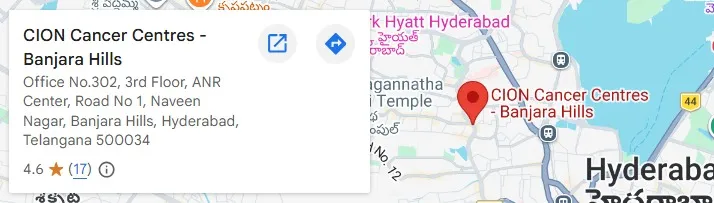
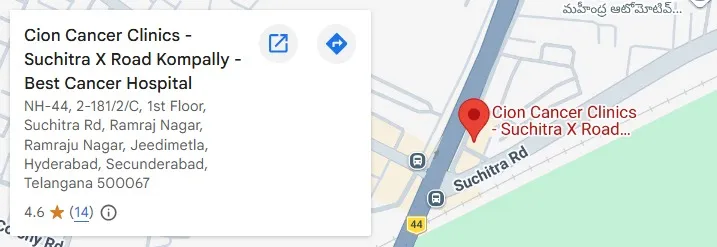
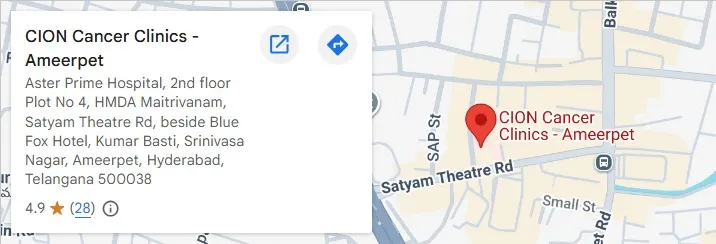
12+ Centres in Hyderabad · Pick yours

CION cancer care is closer than you think.

We're never more than 30 minutes away. Same panel of specialists at every centre. Same tumour board reviews. Same NCCN protocols. Pick the closest one and call directly — or let us pick for you.

Not sure which centre fits best? Tell us where you are — we'll suggest the closest one with the right specialists.

Help me pick the right centre
Meet the Specialists

17+ senior cancer specialists. One panel for your case.

Trained at AIIMS, Tata Memorial, and leading international centres. Combined 150+ years of experience. Every complex case is reviewed by 3+ of them — together.


Dr. Naresh Gundu
Medical Oncologist

Dr. Naresh Gundu

MBBS, DNB (Internal Medicine), DM (Medical Oncology)

View Profile
Dr. C. Raghavendra Reddy
Medical Oncologist

Dr. C. Raghavendra Reddy

MBBS(Gold Medal), DNB(General Medicine), DM(Medical Oncology)(Gold Medal)

View Profile
Dr. Bharati Devi Gorantla
Medical Oncologist

Dr. Bharati Devi Gorantla

MBBS, MD(General Medicine), DM(Medical Oncology)(Adyar,Chennai), ECMO, MRCP SCE(UK)

View Profile
Dr. Owais Mohammed
Medical Oncologist

Dr. Owais Mohammed

MBBS, MD (General Medicine), DrNB (Medical Oncology), ECMO, MRCP SCE (Medical Oncology) (UK)

View Profile
Dr. T. Raghavender Reddy
Medical Oncologist

Dr. T. Raghavender Reddy

MBBS, DM (Medical Oncology), MD (Radiation Oncology)

View Profile
Dr. N. Kiranmayee
Medical Oncologist

Dr. N. Kiranmayee

MBBS, DM (Medical Oncology), MD (Internal Medicine)

View Profile
Dr. Muralidhar Muddusetty
Surgical Oncologist

Dr. Muralidhar Muddusetty

MBBS (AIIMS), MS (Surgery) (AIIMS), DNB (Surgical Oncology), MRCS (Edinburgh)

View Profile
Dr. Raghavendra Naik
Surgical Oncologist

Dr. Raghavendra Naik

MBBS, MS (General Surgery), M.Ch (Surgical Oncology)

View Profile
Dr. Mohammed  Imaduddin
Surgical Oncologist

Dr. Mohammed Imaduddin

M.B.B.S, MS (General Surgery), M.Ch (Surgical Oncology)

View Profile
Dr. Vinay Mamidala
Surgical Oncologist

Dr. Vinay Mamidala

MBBS, MS(General Surgery), M.Ch(Surgical Oncology), FMAS, FARIS(Ongoing)

View Profile
Dr. Paila Gowri Naidu
Surgical Oncologist

Dr. Paila Gowri Naidu

MBBS, MS (General Surgery), M.Ch (Surgical Oncology), FMAS

View Profile
Dr. Venkata Sushma P
Radiation Oncologist

Dr. Venkata Sushma P

MBBS, MD (Radiation Oncology)

View Profile
Dr. Kirti Ranjan Mohanty
Radiation Oncologist

Dr. Kirti Ranjan Mohanty

MBBS, MD (Radiation Oncology)

View Profile
Dr. Gangadhar Vajrala
Radiation Oncologist

Dr. Gangadhar Vajrala

MBBS, MD (Radiation Oncology), MPH

View Profile
Dr. Basudev Pokhrel
Hematologist

Dr. Basudev Pokhrel

MBBS, M.D (Immunohematology & Blood Transfusion)

View Profile
Dr. Mohammed Imran
Interventional Radiologist

Dr. Mohammed Imran

View Profile
Dr. Vajja Sandeep Kumar
Surgical Oncologist

Dr. Vajja Sandeep Kumar

MBBS, MS (General Surgery), DrNB (Surgical Oncology), FALS Oncology

View Profile
Dr. Sridhar Kamani
Surgical Oncologist

Dr. Sridhar Kamani

MBBS, MS (General Surgery), DrNB (Surgical Oncology)

View Profile

Want a specific doctor for your case? Mention them when booking.

Book Free Consultation

A Neck Lump Deserves a Clear Answer — Not a Guess

CION's surgical and medical oncologists assess thyroid swellings with ultrasound and, where needed, a fine-needle biopsy — so you get certainty, whether the news is reassuring or needs action.

How a Thyroid Swelling Is Assessed — and How Cancer Is Ruled Out

The whole point of getting a swelling checked is to reach a clear answer efficiently — and to avoid unnecessary tests. CION's pathway for a neck swelling is simple and stepwise.

Step What It Is What It Tells You
1. Clinical examination A specialist feels the swelling and checks how it moves and whether neck nodes are involved Decides whether the swelling is from the thyroid and how urgently to scan
2. Neck ultrasound A painless scan that uses sound waves to image the thyroid and lymph nodes Shows whether a nodule has reassuring or suspicious features — the key test
3. Blood tests (TSH, T3, T4) Thyroid function tests from a simple blood sample Checks if the thyroid is under- or over-active — often the cause of a benign goitre
4. FNAC biopsy (if needed) A very thin needle takes a small cell sample under ultrasound guidance The definitive test that confirms whether a suspicious nodule is benign or cancer

For most people, the ultrasound alone is enough to be reassured. A biopsy is only added when a nodule has features that warrant it — and even then, the majority of biopsies come back benign.

Get Your Neck Ultrasound & Specialist Review

Book an assessment for your thyroid swelling at the CION centre nearest you. Free consultation, no commitment to treatment.

or
Call us

What Happens Next — Whichever Way the Result Goes

If your swelling is benign — which it most often is — you will be reassured and advised on whether any treatment or simple monitoring is needed. Many goitres need nothing more than periodic ultrasound checks. Underactive or overactive thyroid conditions are managed with medication. Surgery is only considered for a large goitre causing pressure symptoms or for cosmetic reasons, and that is a planned, unhurried decision.

If a nodule is found to be cancer, the outlook is genuinely reassuring for the great majority of people. Thyroid cancer has the best survival rates of almost any cancer, and finding it early gives the best possible result. Treatment is matched to the type — most often surgery, sometimes followed by radioactive iodine and a daily hormone tablet. At CION, every case is reviewed by a multidisciplinary tumour board before any plan is finalised, so the recommendation is never one doctor's opinion alone.

Either way, the value of getting checked is the same: certainty. You replace worry with a clear answer and, if anything is needed, a clear plan.

Did You Know? A thyroid swelling that moves when you swallow tells the doctor it comes from the thyroid gland — because the thyroid is attached to the windpipe. It does not, on its own, confirm whether the lump is benign or cancerous. That is why even a swelling that moves freely is still scanned. (Source: NCCN thyroid guidance.)

Why Have Your Thyroid Swelling Assessed at CION

A neck lump deserves an unrushed, expert answer — with everything you need under one roof.

Ultrasound & biopsy under one roof

No running between centres to get an answer about your swelling

45-minute detailed consultation

No rushed decisions — time to explain what your scan shows

Multidisciplinary tumour board

Every case reviewed by a team, not one doctor, if cancer is found

No unnecessary tests, ever

A stepwise pathway — a biopsy only when the ultrasound warrants it

Free first consultation

For all cancer patients, plus a free written second opinion

35+ centres across Telangana & AP

Care close to home — never more than 30 minutes away

From our patients

Hear From People Who Have Walked This Path

Real stories from patients treated at CION — from the first neck swelling to peace of mind.

Real Stories. Real Voices.

15,000+ patients chose CION. Hear from them directly.

These aren't paid endorsements or written reviews. These are video testimonials from real patients and families — recorded on their own phones, in their own words. Pick any one. Watch it. Then decide.


4.8★800+ Google reviews
50+video testimonials
15,000+patients treated
Successful Chemotherapy Done by Dr. C Raghavendra Reddy

Successful Chemotherapy Done by Dr. C Raghavendra Reddy

Watch video →
Surgery, Chemo & Radiation Done by  Dr. Imaduddin, Dr. Vinay, Dr. Owais, Dr. Kirti

Surgery, Chemo & Radiation Done by Dr. Imaduddin, Dr. Vinay, Dr. Owais, Dr. Kirti

Watch video →
 Successful Radical Thymectomy Done by  Dr. Mohammed Imaduddin & Dr. Vinay Mamidala

Successful Radical Thymectomy Done by Dr. Mohammed Imaduddin & Dr. Vinay Mamidala

Watch video →
Successful Surgery Done  by Dr. Rajender Byshetty

Successful Surgery Done by Dr. Rajender Byshetty

Watch video →
Successful Chemo & Surgery Done by  Dr. Imad, Dr. Vinay, Dr. Owais & Dr. Raghavendra

Successful Chemo & Surgery Done by Dr. Imad, Dr. Vinay, Dr. Owais & Dr. Raghavendra

Watch video →
Successful Chemo & Surgery Done by  Dr. Imad, Dr. Vinay, Dr. Owais & Dr. Raghavendra

Successful Chemo & Surgery Done by Dr. Imad, Dr. Vinay, Dr. Owais & Dr. Raghavendra

Watch video →
Successful Chemo & Radiation Done by Dr. Owais Mohammed & Dr. Kirti Ranjan Mohanty

Successful Chemo & Radiation Done by Dr. Owais Mohammed & Dr. Kirti Ranjan Mohanty

Watch video →
Successful Breast Cancer Surgery Done by Dr. Imaduddin Mohammed & Dr. Vinay Mamidala

Successful Breast Cancer Surgery Done by Dr. Imaduddin Mohammed & Dr. Vinay Mamidala

Watch video →
Successful Chemotherapy Done by Dr. Bharati Devi Gorantla

Successful Chemotherapy Done by Dr. Bharati Devi Gorantla

Watch video →
Successful Chemo & Surgery Done by Dr. Owais Mohammed & Dr. Imaduddin Mohammed

Successful Chemo & Surgery Done by Dr. Owais Mohammed & Dr. Imaduddin Mohammed

Watch video →
Successful Chemotherapy Done by Dr. Gundu Naresh

Successful Chemotherapy Done by Dr. Gundu Naresh

Watch video →
Successful Bone Marrow Transplantation - Neuroblastoma

Successful Bone Marrow Transplantation - Neuroblastoma

Watch video →
Successful Surgery & Chemo - Carcinoma of Caecum

Successful Surgery & Chemo - Carcinoma of Caecum

Watch video →
Successful Oral chemotherapy & mastectomy surgery

Successful Oral chemotherapy & mastectomy surgery

Watch video →
Successful Oral chemotherapy & mastectomy surgery

Successful Oral chemotherapy & mastectomy surgery

Watch video →
Successful Chemotherapy

Successful Chemotherapy

Watch video →
Successful Surgery by Dr. Mohammed Imaduddin

Successful Surgery by Dr. Mohammed Imaduddin

Watch video →
Successful Bone Marrow Transplantation

Successful Bone Marrow Transplantation

Watch video →
Successful Oral chemotherapy & mastectomy surgery

Successful Oral chemotherapy & mastectomy surgery

Watch video →
Successful Oral chemotherapy & mastectomy surgery

Successful Oral chemotherapy & mastectomy surgery

Watch video →
Successful Chemotherapy

Successful Chemotherapy

Watch video →
Successful Buccal Mucosa Surgery

Successful Buccal Mucosa Surgery

Watch video →
Successful Complex Surgery Mandibulectomy Reconstruction

Successful Complex Surgery Mandibulectomy Reconstruction

Watch video →

Frequently Asked Questions

Common questions about telling a goitre or thyroid swelling apart from thyroid cancer — answered by CION's oncology team.

What is the difference between a goitre and thyroid cancer?
A goitre simply means the thyroid gland is enlarged — it is a description of a swelling, not a diagnosis. Most goitres are benign and caused by iodine deficiency, autoimmune thyroid disease, or simple nodular enlargement. Thyroid cancer is when cells within the gland become malignant, and it usually appears as a single firm nodule. The important point is that you cannot reliably tell the two apart by looking or feeling alone — both can present as a neck swelling. An ultrasound scan, and a fine-needle biopsy if needed, is what confirms whether a swelling is benign or cancerous. The reassuring fact is that the large majority of thyroid swellings turn out to be benign.
Is a goitre always cancer?
No — most goitres are not cancer. The majority of thyroid swellings are benign, caused by iodine deficiency, Hashimoto's or Graves' disease, or simple multinodular enlargement. Only a small proportion of thyroid nodules turn out to be cancerous. However, because that small proportion cannot be identified by examination alone, any new or growing neck swelling should be assessed with an ultrasound. This is a quick, painless way to either reassure you or guide the next step. A neck lump is worth checking — but finding a goitre is far more often a benign result than a cancer diagnosis.
What are the warning signs that a thyroid swelling could be cancer?
Certain features make a thyroid swelling more concerning and worth prompt specialist review. These include a single firm or hard lump rather than a soft, generalised swelling; a lump that is fixed and does not move when you swallow; a swelling that is growing quickly; a hoarse or changed voice that persists; difficulty swallowing or breathing; and swollen lymph nodes in the neck alongside the thyroid swelling. A history of radiation to the head or neck, or a family history of thyroid cancer, also raises the level of concern. None of these features confirms cancer on their own — but if you have any of them, an ultrasound and specialist review are recommended without delay.
Does a thyroid swelling that moves when I swallow mean it is not cancer?
A swelling that moves up and down when you swallow tells the doctor that it is arising from the thyroid gland — because the thyroid is attached to the windpipe and moves with swallowing. It does not, by itself, confirm whether the swelling is benign or cancerous. Both benign goitres and cancerous nodules sit within the thyroid and can move on swallowing. A lump that is fixed and does not move is more concerning, because it may suggest the swelling has grown into surrounding tissue. The movement test is a useful clue about where a lump comes from, but only an ultrasound and, if needed, a biopsy can confirm what it actually is.
What tests are used to find out if a goitre is cancerous?
The first and most important test is a neck ultrasound, which is painless and shows the size, shape, and characteristics of the swelling and any nodules within it. Reassuring features may need no further action beyond monitoring. If a nodule looks suspicious, the next step is a fine-needle aspiration cytology (FNAC) — a quick test where a very thin needle takes a small cell sample under ultrasound guidance, examined under a microscope. Blood tests (TSH, T3, T4) check how the thyroid is functioning. Together, these tests reliably distinguish a benign goitre from thyroid cancer in the large majority of cases, often without any need for surgery to find the answer.
Can a long-standing goitre turn into thyroid cancer?
A simple goitre that has been stable for years is usually benign and most do not become cancerous. However, a long-standing multinodular goitre can occasionally develop a cancerous nodule within it, which is why any change — a nodule that starts growing, a new firm lump, voice change, or difficulty swallowing — should be reassessed. If you have a known goitre, periodic ultrasound monitoring as advised by your doctor is the safest approach. A new symptom in an old goitre is not a reason to panic, but it is a reason to get an updated scan rather than assume it is the same harmless swelling.
Should I worry about a painless lump in my neck?
A painless neck lump should not be ignored simply because it does not hurt — in fact, thyroid swellings are usually painless, including both benign goitres and cancerous nodules. Pain is more often a feature of infection or inflammation than of cancer. The right response to any new neck lump is not to panic but to get it checked with an ultrasound. Most painless neck lumps turn out to be benign, and a quick scan can confirm this and put your mind at rest. If a swelling is found to need further assessment, catching it early gives the best possible outcome — and thyroid cancer, when present, is one of the most treatable cancers there is.
Is thyroid cancer curable if it is found in a goitre?
Yes — thyroid cancer is one of the most curable cancers in oncology, and finding it early within a goitre gives the best possible outlook. Papillary thyroid cancer, the most common type, has a five-year survival rate exceeding 99% at early stages. Even when it has spread to nearby lymph nodes in the neck, it is usually still completely treatable with surgery and, where appropriate, radioactive iodine. This is exactly why getting a neck swelling assessed matters — not because most swellings are cancer (they are not), but because the small number that are can be treated extremely effectively when caught early.
Why is a goitre more common in Telangana and Andhra Pradesh?
Iodine is essential for the thyroid to make its hormones, and in regions where the diet has historically been low in iodine, the thyroid enlarges as it works harder — producing a goitre. Parts of Telangana and Andhra Pradesh, like several inland regions of India, have historically had lower iodine levels in soil and water, which is why iodine-deficiency goitre has been more common. Widespread use of iodised salt has reduced this considerably. Most iodine-related goitres are benign, but because a swelling cannot be assessed by appearance alone, a neck ultrasound remains the right step for any new or growing thyroid swelling.
Where can I get a thyroid swelling checked in Hyderabad?
CION Cancer Clinics offers neck ultrasound, specialist review, and fine-needle biopsy for thyroid swellings across its Hyderabad locations, with a multidisciplinary team of surgical and medical oncologists. If a swelling is found to be benign, you will be reassured and advised on monitoring; if it needs further assessment or treatment, you will be guided through every step. CION provides a free first consultation for all cancer patients and a free written second opinion. You can book an appointment online or call 1800 202 8726 to arrange an assessment at the centre nearest to you.

Disclaimer: This content is intended for informational purposes only and does not constitute medical advice, diagnosis, or treatment. Always consult a qualified oncologist for guidance specific to your medical condition. The information on this page is periodically reviewed and updated by CION's medical team in accordance with current clinical guidelines.

Call now Book free consultation