 Call Us

Skin Changes in the Treated Area
What helps
The skin may turn red or darker, dry or itchy. Wash gently with mild soap and pat dry, wear loose cotton, keep it out of the sun, and ask us before using any cream or oil.
First consultation free
Radiation oncology treats cancer with high-energy rays that destroy or shrink cancer cells, while protecting nearby healthy tissue as far as possible. It’s used alone or with surgery and cancer medicines.



 4 radiation oncologists
| Type | What it is | How sessions usually run | Often used for | What to expect |
|---|---|---|---|---|
 External Beam RadiationIncludes 3D-CRT, IMRT, IGRT and VMAT | A machine outside the body aims beams at the tumour, shaped to it and checked with imaging | Short sessions on weekdays, usually over several weeks | Many cancers, such as head and neck, breast, cervix and lung | You go home after each session |
 SRS and SBRTFocused radiation (stereotactic) | A focused form of external beam: high doses aimed at a small tumour from many angles | Only a few sessions |  Small tumours in the brain, lung, liver or spine | Extra care to keep you still, such as a mask or body mould |
 BrachytherapyInternal radiation | A radiation source placed inside or right next to the tumour | One or a few short sittings, sometimes after external beam | Cervix and womb, and sometimes prostate, breast or head and neck | Pain relief or anaesthesia, as needed, when the applicator is placed |
 Palliative RadiationSymptom relief, usually external beam | Treats the area causing symptoms, to help you feel more comfortable | A short course, sometimes a single session |  Pain from cancer in the bones, bleeding, or a blockage | Relief builds up over days or weeks, not straight away |
Your doctor chooses the type for your cancer, where it is and your health. Sources: US National Cancer Institute · American Cancer Society
You are not radioactive after external beam radiation. It’s safe to be with your family, including children. Some brachytherapy implants give off radiation for a while; your team explains any precautions. Sources: NCI: external beam · NCI: radiation therapy
More on each type and on what to expect: CION’s radiation therapy guides

Bring your reports. Your radiation oncologist may order more tests, which are paid separately.

Your doctor presents your case to CION's oncologists and haematologist. You don't attend.
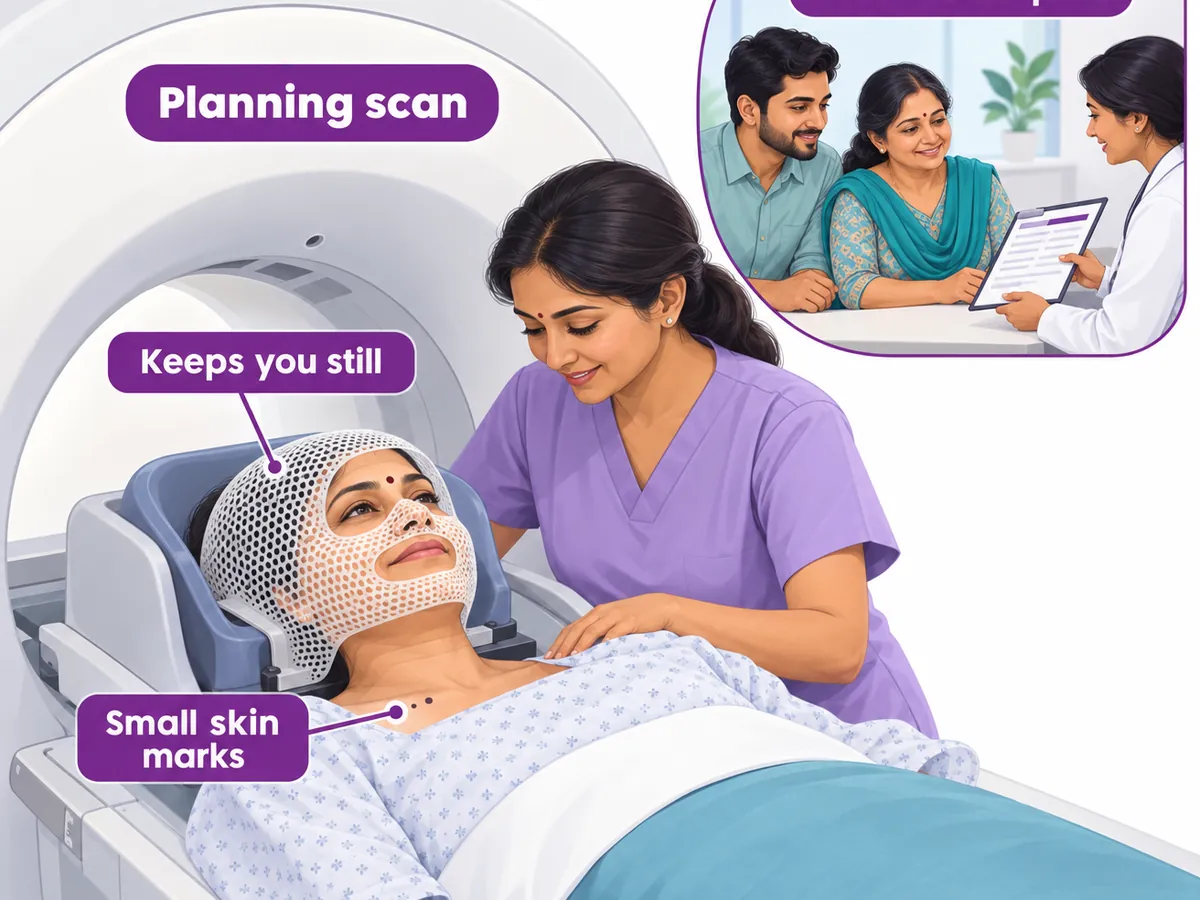
A CT planning scan, a mask or mould if you need one to keep still, and small marks on your skin or mask. Your team then takes some days to build your plan: the number of sessions and a cost estimate.
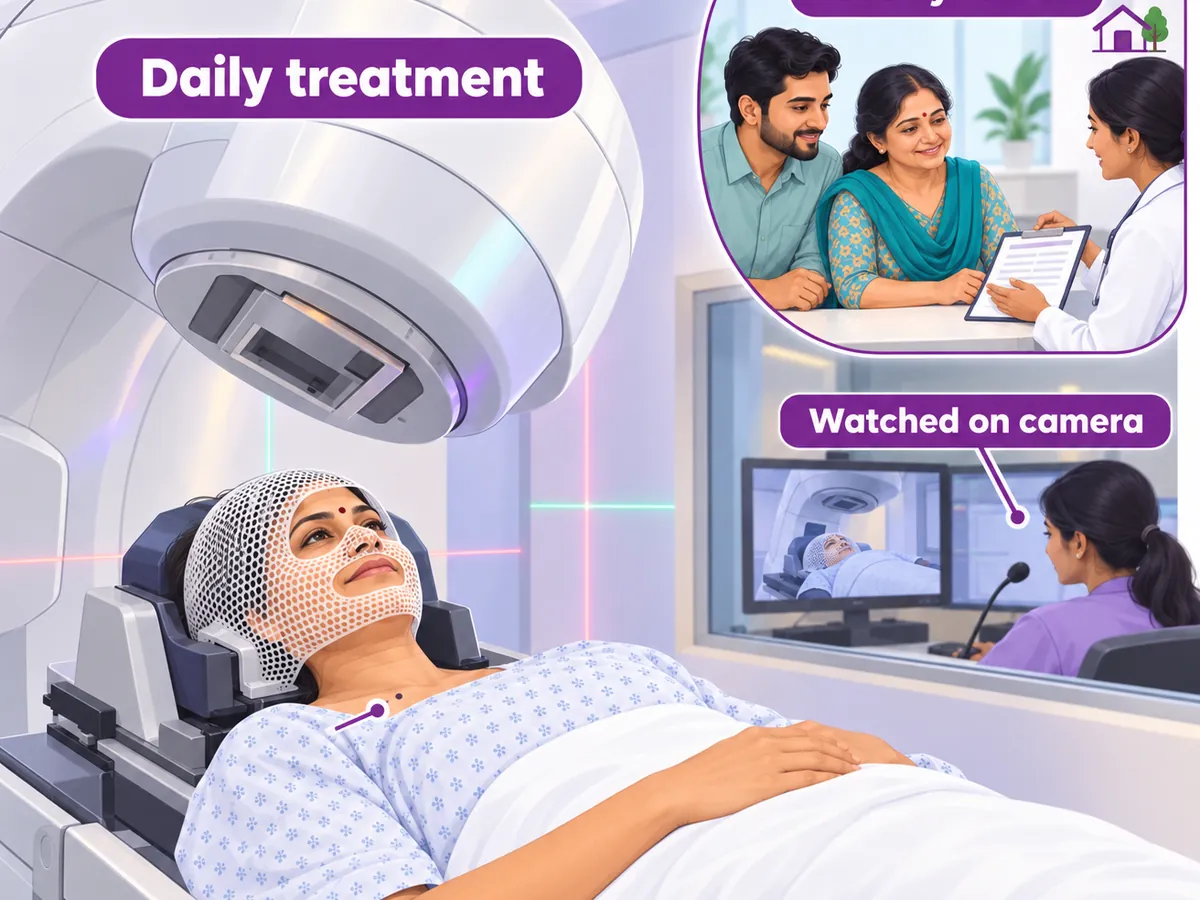
Sessions at a partner radiation centre CION arranges, a weekly review with your doctor, and follow-up at a CION centre near you.
What a Treatment Week Looks Like
Most courses run on weekdays, with weekends off so healthy cells can recover. Courses to ease symptoms are much shorter.
Book a free consultation to plan your radiotherapyRepeated for the number of weeks in your plan
Sources: American Cancer Society · NHS
Arrive: check in at the radiation centre; your first visit may take longer
Get into position: lie as you did for your planning scan, in your mask or mould if you have one
The team steps out: they watch you on a camera and can hear you, so raise a hand or speak if you need them
The machine moves around you: it doesn't touch you, and you don't feel the radiation, which takes only a few minutes
Go home: back to your day, as you feel able
Sources: US National Cancer Institute · Cancer Council NSW
Effects depend on the area treated, so you may have only some of these. Most settle in the weeks after treatment ends, a few can appear later, and your follow-up checks continue. Sources: NHS · Cancer Research UK · Macmillan · National Cancer Centre Singapore
The skin may turn red or darker, dry or itchy. Wash gently with mild soap and pat dry, wear loose cotton, keep it out of the sun, and ask us before using any cream or oil.
Common. It often builds up during the course and can last for some weeks after it ends. Rest when you need to, take a short walk most days, and accept help with chores.

Sip water often, choose soft, moist food, rinse your mouth gently as your team shows you, and avoid spicy food, tobacco and alcohol. Tell us if swallowing gets hard.
Loose stools, or needing to pass urine more often, can happen. Drink plenty of water and tell us early; your team can advise on food and medicine.

Hair falls out only in the area being treated, for example on the head for brain treatment. It usually starts to grow back a few weeks after treatment ends, but after a high dose it may not; your team tells you what to expect.

More likely when the belly or the brain is treated. Small, light meals help, and your doctor can give you anti-sickness medicine.

Talk to us before you start. Radiation to the pelvis, or near the pituitary gland in the brain, can affect fertility, so ask about storing eggs or sperm. Use contraception: don't get pregnant or father a child during treatment or for a while after (ask your doctor how long), and tell us at once if you might be pregnant.
Your doctor checks on effects at your weekly review. Ask us about diet advice and counselling.
Why patients choose CION
Radiotherapy planned with our tumour board, and follow-up near home.
Each holds an MD or DNB in Radiation Oncology: three years of specialist training in treating cancer with radiation.
Radiation, medical and surgical oncologists from all centres, and our haematologist, agree on your plan.
IMRT, IGRT, VMAT, SBRT and brachytherapy, chosen to fit your cancer and the area treated.
At a CION centre near you, or by video consultation.
A written estimate before you start, cashless insurance help and an EMI facility.
15+ years · MBBS, MD (Radiation Oncology)
10+ years · MBBS, MD (Radiation Oncology)
10+ years · MBBS, MD (Radiation Oncology), MPH
13+ years · MBBS, MD (General Physician), DNB (Radiation Oncology)
Get Your Radiotherapy Plan from One of These Doctors
Your first consultation at any CION centre is free.
A referral doesn’t mean you’ll need radiation: your doctor and the tumour board decide with you. Not sure? Call 1800 202 8726.
Your checklist
35+ CION centres
Still unsure? Call 1800 202 8726.
Yes. Your first consultation with a radiation oncologist is free at every CION centre. Tests, scans, the planning visit and the radiation sessions are paid for separately.
Our team helps with the insurer or TPA paperwork for cashless treatment, so check your policy and bring your insurance card. If you'd like to spread the cost, CION has an EMI facility: ask the team for details.
It depends on the cancer, the area treated and the aim of treatment. Some courses are short; others run every weekday for several weeks. Each visit is mostly getting you into position, and the radiation itself takes only a few minutes. Your written plan gives the number of sessions.
You don't feel the radiation itself, though effects such as sore skin or tiredness can build up over the weeks. Many people keep working, especially early in the course, and fit sessions around their day. Talk to your doctor before planning any travel during your course.
At a partner radiation centre that CION arranges; your consultations and follow-up can be at a CION centre near you. If you live far away, our care team helps you plan your daily sessions, whether you travel each day or stay nearby.
Sometimes. Some cancers are treated with radiation alone; others with chemotherapy at the same time (chemoradiation), or with surgery before or after. Your written plan says which treatments you need, and in what order.
Yes, including if you've been advised radiation at another hospital. Book a consultation and bring all your reports, scans and the plan you were given. Your CION radiation oncologist reviews them and explains what they would advise. There's no commitment to have your treatment through CION.
Mainly the type of radiation, the number of sessions, the planning scans, any brachytherapy sittings, and whether you also need chemotherapy or a hospital stay. Your doctor can work this out only after your planning visit, so you get a written cost estimate before you start.
Meet a CION radiation oncologist and get a clear plan for your radiotherapy.
This page explains radiation oncology at CION Cancer Clinics. It is general information, not medical advice. Your treatment plan is made only after a consultation and a review of your reports.
 18002028726
Follow Us:


