A craniotomy is surgery to remove a brain tumour, through a small “window” of skull that is replaced afterwards. Here is how CION helps — honestly: the operation itself is performed by an experienced neurosurgeon at an accredited partner neurosurgical centre, which CION coordinates. What CION brings is the whole pathway around it — an expert tumour board to plan your care, and in-house radiation, chemotherapy and molecular-guided treatment — because with a brain tumour, what happens around the surgery matters as much as the operation.
Surgery coordinated with accredited partner neurosurgeons — never overclaimed
In-house radiation (incl. radiosurgery), chemotherapy & molecular-guided care
Neuro-oncology tumour board · Aarogyasri help · clear indicative costs
★★★★★Rated 4.8/5 · 800+ Google reviews
One coordinated pathway
Surgery via accredited partner neurosurgeons
In-house radiation & molecular-guided care
35+ centres · Aarogyasri help
KM
Written by Dr. Kirti Ranjan Mohanty, MBBS, MD (Radiation Oncology) — neuro-oncology radiotherapy & radiosurgery, with CION’s neuro-oncology tumour board. Medically reviewed by Dr. Naresh Gundu, Medical Oncology. · Reviewed 16 July 2026
Understanding the surgery
What is a craniotomy?
A craniotomy is an operation to reach and remove a brain tumour. The surgeon temporarily removes a small “window” of skull bone to reach the brain, removes as much of the tumour as is safe (often using a microscope and image navigation), and then replaces and fixes the bone. The goal is to remove the tumour — or as much as can be removed safely — and to obtain tissue for testing, which guides the treatment that follows. It is the most common operation for a brain tumour, and the approach is matched to where the tumour is and what it is.
Being straight with you about who does what. CION is a cancer-care network, not a neurosurgical hospital — there are no neurosurgeons on our staff. The craniotomy itself is performed by an experienced neurosurgeon at an accredited partner neurosurgical centre, which CION coordinates. What CION delivers, in-house, is everything around it: the tumour board that plans your care, and the radiation, chemotherapy and molecular-guided treatment that follow. For a brain tumour, that coordinated plan is often what shapes the result — and we would rather tell you this plainly than imply otherwise.
A “window” in the skull
A small piece of bone is temporarily removed to reach the tumour, then replaced and fixed back in place at the end of the operation.
As much tumour as is safe
The surgeon removes as much as can be removed safely, and takes tissue for testing — which is what guides everything that follows.
Coordinated by CION
The surgery is arranged with an accredited partner neurosurgeon; CION plans and delivers the care around it.
How CION coordinates your surgery — and what happens around it
This is what CION is honest about, and good at: with a brain tumour, the craniotomy is one step — and the coordinated pathway around it is what CION runs. CION’s neuro-oncology tumour board reviews your scans and pathology, coordinates the operation with an accredited partner neurosurgical centre, and then delivers, in-house, the radiation (including precise stereotactic radiosurgery where suitable), chemotherapy and molecular-guided care that follow. You get one team guiding the whole journey — so the surgery, the radiation and the medical treatment are planned together from the start, not as disconnected steps.
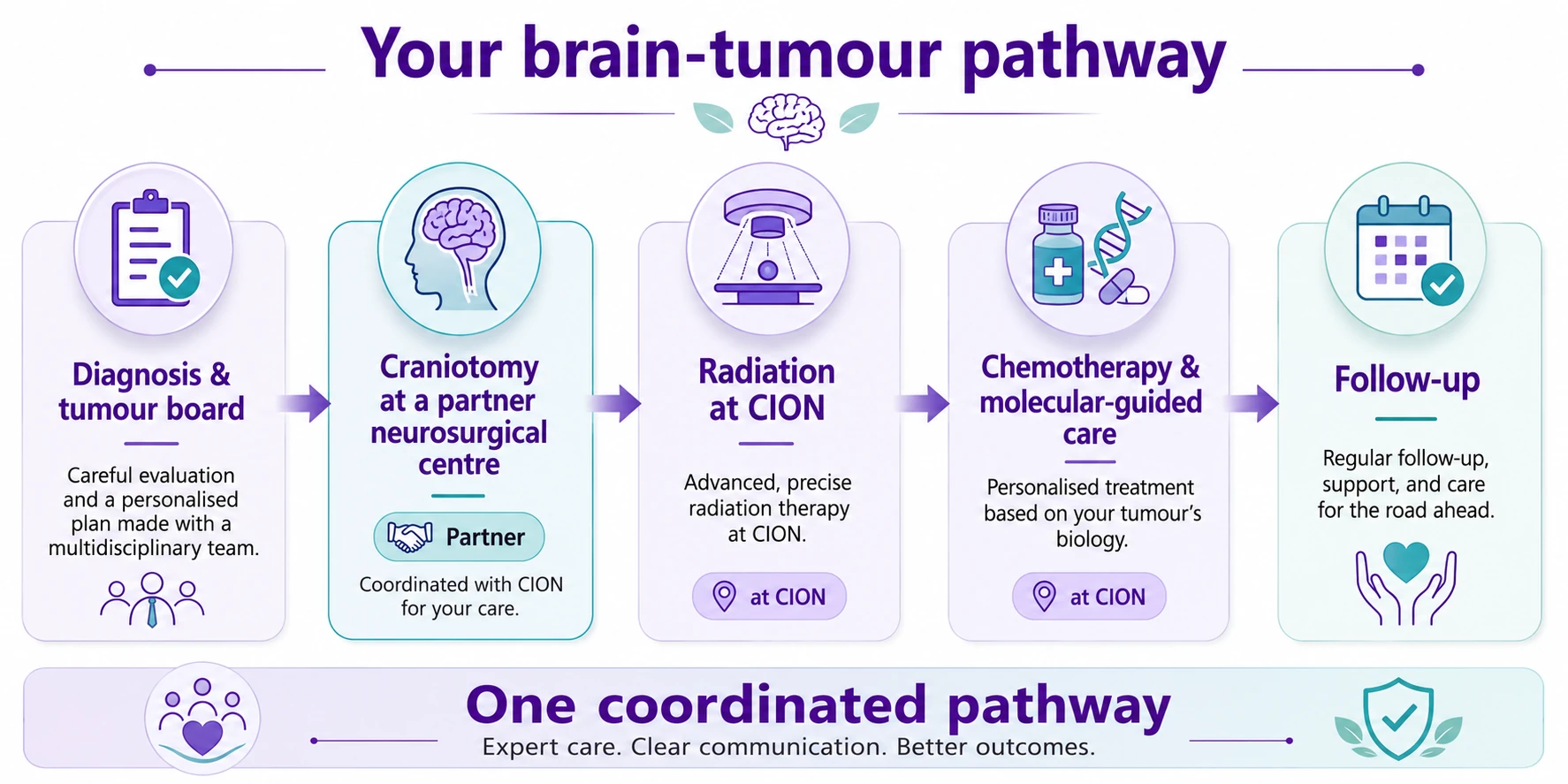
One coordinated pathway: diagnosis & tumour board → craniotomy at a partner neurosurgical centre → radiation, chemotherapy & molecular-guided care at CION → follow-up.
Why the coordination matters: for many brain tumours, the treatment after surgery — precise radiation and molecular-guided medical treatment — is decisive. Planning it alongside the surgery, with one tumour board, means no gaps and no time lost between steps.
The tumour board plans it
Radiation and medical oncologists review your scans and pathology together and set the plan before anything begins.
The surgery is arranged for you
CION coordinates the craniotomy with an accredited partner neurosurgical centre — you are not left to find a surgeon yourself.
CION delivers what follows
Radiation (including radiosurgery), chemotherapy and molecular-guided care in-house, to the plan already made.
See how the pathway applies to you
Pick where you are and what you’d like to understand for a plain-language picture — then talk it through with our team. This is educational, not a diagnosis or a personal recommendation.
Where are you?
What would you like to understand?
What this usually means
If a scan has just found a brain tumour, the first step is a clear plan. CION’s neuro-oncology tumour board reviews your scans, arranges the right tests, and — where surgery is needed — coordinates it with an accredited partner neurosurgical centre, then plans the radiation and other treatment around it. You have one team guiding the whole journey. How the coordination works: CION’s tumour board plans your care, arranges your craniotomy at an accredited partner neurosurgical centre, and integrates the surgical plan with CION’s own radiation, chemotherapy and molecular-guided treatment — one coordinated pathway rather than separate, disconnected steps. This is general information — your plan is made with CION’s neuro-oncology tumour board, who know your scans and pathology.
This tool is educational and not medical advice, a diagnosis or a personal recommendation. The craniotomy is performed by a partner neurosurgeon; your coordinated plan is made with CION’s neuro-oncology tumour board, who know your scans and pathology.
There are a few types of craniotomy, chosen to match the tumour. A standard craniotomy is the usual approach. An awake craniotomy is used when the tumour is near areas that control speech or movement: you are kept comfortably awake for part of the operation so the team can “map” and check those functions and protect them while removing as much tumour as possible. Image-guided and keyhole techniques use scans and navigation (and sometimes a smaller opening) to reach the tumour precisely. The neurosurgical team recommends the safest approach, and CION’s tumour board reviews the plan with you.
Type
What it is
Often used when
Standard craniotomy
A window of skull is removed to reach and remove the tumour, then replaced.
The tumour is near areas controlling speech or movement.
Image-guided / keyhole
Scans and navigation guide a precise, sometimes smaller, approach.
To reach the tumour accurately while disturbing less healthy brain.
All three share
The bone is replaced at the end; tissue is taken for histopathology and molecular testing; and at CION the operation is coordinated with an accredited partner neurosurgical centre, with the radiation and medical plan drawn up in advance.
Understand your craniotomy
Pick the type and what’s on your mind for a plain-language picture — then talk it through with the team. This is educational, not a diagnosis or a personal recommendation.
Type of craniotomy?
What’s on your mind?
What this usually means
A standard craniotomy means a small ‘window’ of skull is temporarily removed so the surgeon can reach and remove as much of the tumour as is safe; the bone is then replaced and fixed. It is the most common way to remove a brain tumour, chosen to match where the tumour is. In brief: a small window of skull is temporarily removed, the surgeon removes as much of the tumour as is safe (often helped by a microscope and navigation), and the bone is replaced; the removed tissue is then tested to guide the treatment that follows. This is general information — your neurosurgical team and CION’s tumour board explain what applies to you.
This tool is educational and not medical advice, a diagnosis or a personal recommendation. Only the neurosurgical team and CION’s tumour board, who know your scans, can advise what is right for you.
Tests that confirm the diagnosis and shape the plan
Before anything is decided, the tumour is imaged and the plan is made around it. A contrast MRI of the brain shows exactly where the tumour sits and how close it is to the areas controlling speech and movement — which is what decides whether a standard or an awake craniotomy is right. After surgery, the tissue itself is tested, including for molecular markers, and that is what guides the radiation and medical treatment. Every one of these tests and reviews is delivered by CION, and each is bookable below.
Diagnostic services we offer — book any of these:
At CION
MRI brain with contrast
The scan that shapes the operation: it shows where the tumour sits and how close it is to the areas controlling speech and movement.
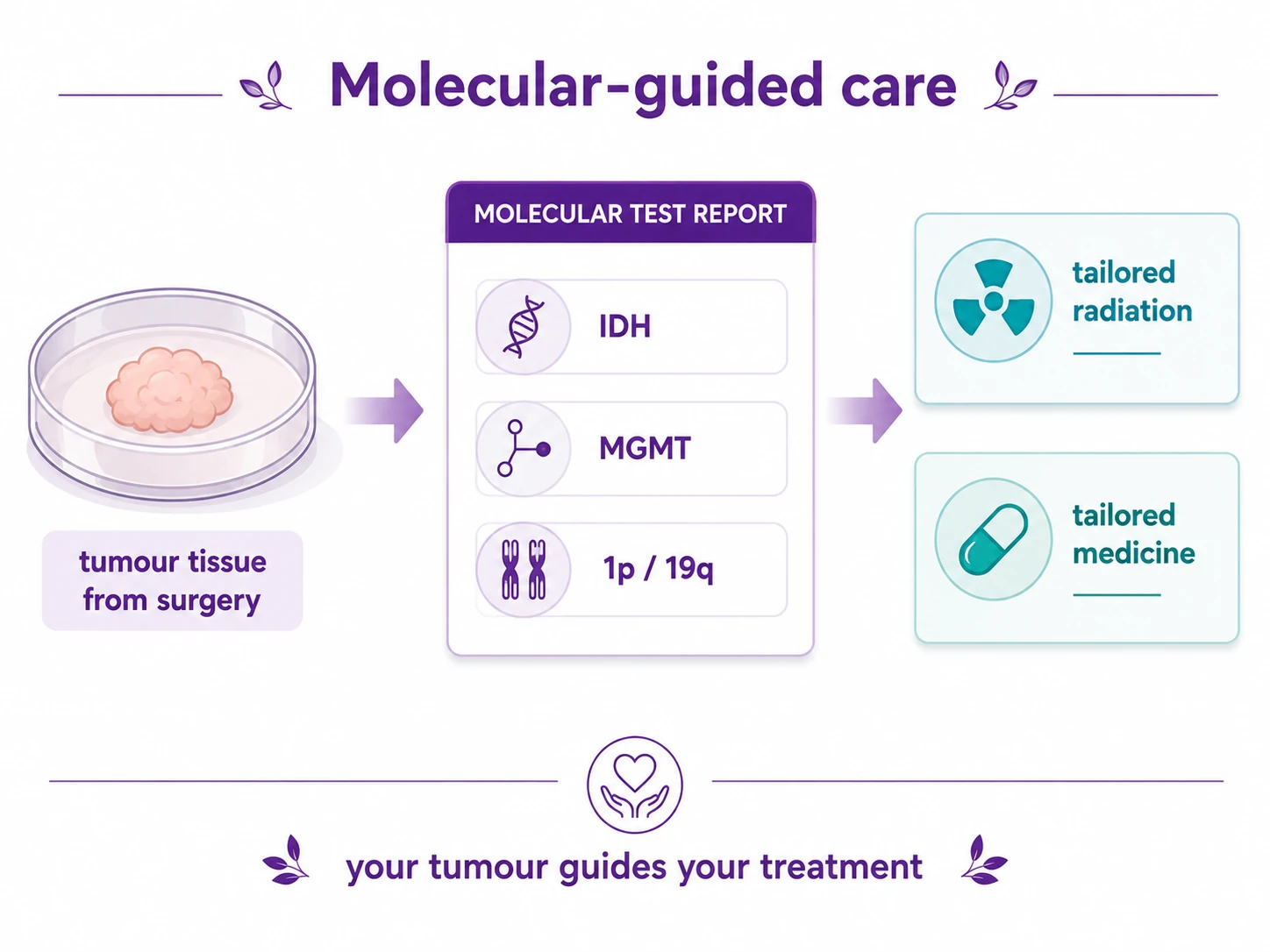
Here is one of the most important — and least understood — parts of modern brain-tumour care: the tissue removed at surgery is tested, and what it shows guides your treatment. CION uses molecular markers (such as IDH, MGMT and 1p/19q) that help predict how a tumour will behave and which treatments will work best. This means your radiation and medical treatment are tailored to your tumour, not one-size-fits-all. Combined with precise radiotherapy — including stereotactic radiosurgery (focused, high-precision radiation) where suitable — this molecular-guided, in-house care is what CION brings to the pathway after the craniotomy.
This is exactly why the coordinated pathway matters: the surgery provides the tissue, and CION’s in-house testing, radiation and medical oncology turn that into a treatment plan made for you. It is also why the operation and what follows it should never be planned by two teams who have not spoken to each other.
The markers
IDH, MGMT and 1p/19q are read from your own tumour tissue — they are diagnostic markers, not treatments.
What they change
They help predict how the tumour behaves and which treatments suit it, so your radiation and medicine are matched to it.
The tumour removed at surgery is tested for molecular markers (IDH, MGMT, 1p/19q) — so your radiation and medicine are tailored to your tumour.
Treatment
Brain-tumour treatments we deliver — and the one we coordinate
A craniotomy is one part of a complete plan. The cards below are marked honestly: the ones tagged “At CION” are delivered in-house by our own team, and the craniotomy is tagged “Partner centre” because CION coordinates it with an accredited partner neurosurgical centre rather than performing it. Every plan is set by the neuro-oncology tumour board. You can book a consult for any of them — including the surgery, which we will arrange for you.
Treatments — book a consult for any of these:
Partner centre · coordinated by CION
Craniotomy — coordinated for you
CION arranges your craniotomy with an experienced neurosurgeon at an accredited partner neurosurgical centre, and plans the radiation and medical treatment around it in advance.
Recovery after a craniotomy depends on the tumour and where it is, and it is honest to say it is a major operation. Typically you begin recovery in a closely monitored (ICU or high-dependency) bed, with a hospital stay of about five to ten days, wound healing over four to eight weeks, and fuller recovery over two to three months. Rehabilitation — for strength, speech or movement if they are affected — is an important part of it, and CION helps arrange this. Once you have recovered enough, your radiation and any medical treatment are started to the plan the tumour board has already made — so there is no delay in the next step. Your team supports you and your family throughout.
1
Before surgery
CION’s tumour board reviews your scans and coordinates the operation with an accredited partner neurosurgical centre; the radiation and medical plan for afterwards is drawn up in advance.
2
The craniotomy
Performed by an experienced partner neurosurgeon — removing as much tumour as is safe and taking tissue for testing, using the approach best suited to your tumour.
3
In hospital & early recovery
Usually starting in a closely monitored bed, with a stay of about five to ten days; rehabilitation begins early where needed, and CION helps arrange it.
4
Molecular testing
The removed tumour is tested for markers such as IDH, MGMT and 1p/19q — the results shape the radiation and medical treatment that follow.
5
Treatment & follow-up
Your in-house radiation and medical treatment start to plan once you have recovered enough, then ongoing follow-up with your CION team.
Recovery is a supported journey rather than a single day. A rehabilitation team, a dietitian and — where you want it — emotional support walk with you at every step.
The cost of the craniotomy itself depends mainly on the type — a standard operation, an image-guided one, or an awake craniotomy with brain mapping — plus the length of the hospital and intensive-care stay. Because CION coordinates the surgery at an accredited partner neurosurgical centre, that part of the cost sits with the partner hospital; CION’s radiation and medical treatment around it are planned and costed separately. The reassuring part: brain-tumour surgery and treatment are generally covered under Aarogyasri at empanelled centres and by most health-insurance policies, and CION helps you navigate the cover across the whole pathway. These are estimates, not a quotation.
Indicative cost estimator
Pick your situation for an indicative range for the surgery at a partner neurosurgical centre, then request an exact estimate for your case.
Indicative range
₹2,50,000 – ₹4,50,000
for a standard craniotomy, general room, self-pay, at a partner neurosurgical centre
Figures are indicative only and not a quotation, and cover the surgery at a partner neurosurgical centre. Brain-tumour surgery and treatment are generally covered under Aarogyasri at empanelled centres and by most health insurance, subject to eligibility. Your actual cost depends on the type of surgery, the length of the hospital and intensive-care stay, and the radiation and medical treatment planned around it, which is costed separately.
A scan that has found a brain tumour shouldn’t wait. Book a free consultation and, if you already have your MRI and any biopsy report, a free written second opinion — including an honest view on whether and when a craniotomy helps.
Your scans and reports reviewed by CION’s neuro-oncology tumour board
An honest answer on whether surgery helps — and we arrange it with a partner neurosurgeon if it does
A clear plan for the radiation and molecular-guided treatment around it
Aarogyasri & insurance guidance across the whole pathway
Support
Financial support & Aarogyasri
Cost should not delay treatment. Brain-tumour surgery and the treatment around it are generally covered under Aarogyasri at empanelled centres, and private insurance is accepted cashless. Because the surgery sits at a partner neurosurgical centre and the radiation and medical treatment are delivered at CION, our counsellors help you navigate the cover across the whole pathway — checking eligibility, arranging approvals and mapping out what you will actually pay, which is often far less than families fear.
9 clinics in Hyderabad · 35+ across Telangana & AP
CION cancer care is closer than you think.
We're never more than 30 minutes away. Same panel of specialists at every centre. Same tumour board reviews. Same NCCN protocols. Pick the closest one and call directly — or let us pick for you.
Don't see your city? Call
18002028726
— we'll find your nearest CION partner centre.
Meet the neuro-oncology coordination panel
Your brain-tumour care is planned by a team, not one doctor.
CION’s brain-tumour care is led by radiation and medical oncologists working as one neuro-oncology tumour board — part of 17 senior specialists across CION. To be clear: the craniotomy itself is performed by an accredited partner neurosurgeon that CION coordinates. There are no neurosurgeons on CION’s staff, and we would rather say so.
Share your name and number — we'll call you back within 30 minutes to schedule your consultation.
A scan has found a brain tumour? Do not let the next step be a guess.
Before you decide anything, let CION’s neuro-oncology tumour board review your MRI and give you an honest view on whether a craniotomy helps, when it should happen, and what treatment should follow. Free consultation and free written second opinion.
These are the worries people rarely say out loud. Here are honest, respectful answers to the ones we hear most in Telangana — without any judgement.
“A brain tumour means I’m going to die.”
Fact: Not all brain tumours are cancer, and many are slow-growing or benign. Even among the malignant ones, what a tumour is — its type, its grade and its molecular markers — varies enormously, and so does what can be done about it. The honest position is that outlook depends entirely on the individual tumour, which is why the first step is a clear diagnosis and a plan, not a search for statistics online.
“If CION doesn’t do the surgery themselves, they’re not a real option.”
Fact: We would rather be honest than lose you to a claim we can’t back. CION has no neurosurgeons on staff, so your craniotomy is performed by an experienced neurosurgeon at an accredited partner neurosurgical centre that we coordinate. What CION runs is everything around it — the tumour board that plans your care, and the radiation, chemotherapy and molecular-guided treatment that follow, all in-house. For a brain tumour, that surrounding plan is often what shapes the result.
“Brain surgery will change who I am — my personality, my memory.”
Fact: This is one of the most common fears, and it deserves a straight answer. Effects on memory, concentration or mood are possible and depend on where the tumour sits — but for most people they are far smaller than feared, and often improve as the brain recovers. Surgeons plan the approach specifically to protect these functions, and rehabilitation genuinely helps. Untreated, a growing tumour is itself a common cause of exactly these changes.
“An awake craniotomy sounds like torture — I’ll feel them cutting into my brain.”
Fact: The brain itself has no pain receptors, and the scalp is thoroughly numbed, so you do not feel the operation. You are kept comfortable and supported throughout, and awake only for the part where the team needs you to talk or move so they can map and protect those functions. People are consistently surprised by how manageable it is — and it exists precisely to protect your speech and movement.
“Operating on the tumour will make it spread.”
Fact: This is a common and harmful myth. Removing a brain tumour under controlled surgical conditions does not make it spread. What genuinely causes harm is delay, which lets a tumour grow and press on more of the brain, and can turn a straightforward operation into a much harder one.
“If they can’t remove all of it, the surgery is pointless.”
Fact: Not so. Removing as much as is safely possible relieves pressure, often improves symptoms, and gives the tissue needed for molecular testing that guides everything afterwards. Even when some tumour must be left to protect speech or movement, the radiation and medical treatment that follow are planned around exactly that. A partial removal is a real step forward, not a failure.
“They’ll shave my whole head and I’ll be disfigured.”
Fact: Usually only a small strip of hair around the incision is shaved, not the whole head, and hair grows back over it. The bone is replaced and fixed at the end of the operation, and the scar generally sits within the hairline. Most people, once healed, are not identifiable as having had brain surgery.
“Can a middle-class family really afford brain surgery?”
Fact: Brain-tumour surgery and treatment are generally covered under Aarogyasri at empanelled centres, and private insurance is accepted cashless. Because CION coordinates the surgery at a partner centre and delivers the radiation and medical treatment in-house, our counsellors help you navigate the cover across the whole pathway, and the out-of-pocket cost is often far less than families fear.
“Once they open the skull, you’re never the same again.”
Fact: A craniotomy is major surgery and recovery takes real time — typically a hospital stay of about five to ten days, wound healing over four to eight weeks and fuller recovery over two to three months. But the bone is replaced and fixed, the skull heals, and most people return to their normal life, work and family. “Never the same” is a fear, not a finding.
“I’ll definitely be paralysed or lose my speech.”
Fact: This is exactly what the whole approach is designed to prevent. Scans map the tumour against the areas controlling speech and movement, and where it sits close to them, an awake craniotomy lets the team check those functions while they operate. Risks depend on the tumour’s position and your surgeon will explain yours honestly — but protecting these functions is the central priority of the operation, not an afterthought.
“Needing radiation after surgery means the surgery failed.”
Fact: No — for many brain tumours, radiation after surgery is planned from the very start, before the operation even happens. It is part of the standard plan, not a rescue. In fact CION’s tumour board decides on it alongside the surgery precisely so it can begin without delay once you have recovered enough.
“Molecular testing is just an expensive extra they upsell.”
Fact: It is the opposite of an extra — it is what makes the treatment yours. Markers such as IDH, MGMT and 1p/19q are read from the tissue already removed at surgery, and they help predict how the tumour will behave and which treatments will work best. Without them, treatment is a best guess. This is genuinely one of the things CION does in-house and does well.
“I’m too old or too weak for brain surgery.”
Fact: Age alone does not decide it — fitness, the tumour and where it sits do. A pre-operative assessment optimises your health first, and for some people the right answer genuinely is radiation or medical treatment rather than an operation. That is a decision for the tumour board with you, based on your scans, not an assumption based on a birth year.
“It’s benign, so it doesn’t need treating.”
Fact: Benign does not always mean harmless in the brain. Because the skull is a closed space, even a non-cancerous tumour can press on important structures and cause real symptoms as it grows. Many benign tumours are simply watched with scans, and that is a valid plan — but the decision to watch should be a considered one, made with a specialist, not a default.
“I’ll have fits for the rest of my life.”
Fact: Seizures can happen with a brain tumour and sometimes after surgery, but they are usually well controlled with medication, and for many people the medication is later reduced or stopped. Removing the tumour often reduces seizures rather than causing them. Your team will explain what applies to you and support you with it.
“There’ll be a hole in my head — they never put the bone back.”
Fact: The bone is put back. That is what makes it a craniotomy: the “window” of skull is temporarily removed to reach the tumour and then replaced and fixed in place with small plates at the end of the operation, where it heals. In rare situations a surgeon may delay replacing it for a specific medical reason, and if so it would be explained to you clearly in advance.
“Home, herbal or ayurvedic remedies can shrink a brain tumour.”
Fact: No home or herbal remedy is proven to shrink a brain tumour, and relying on one wastes the window when it is most treatable. Please tell your oncologist about anything you are taking, so it can be checked for safety alongside proper treatment rather than quietly interfering with it.
“My headaches are just stress — a scan would be overreacting.”
Fact: The overwhelming majority of headaches are not a brain tumour, and worrying about every one is unnecessary. But a headache that is new and persistent, worse in the morning or on lying down, or comes with vomiting, vision changes, weakness or a first seizure deserves a scan. Getting it checked early is not overreacting — it is what makes treatment simpler if something is found.
“A second opinion will offend my doctor and waste precious time.”
Fact: A second opinion is normal and welcomed in cancer care, especially before major brain surgery. It either confirms the plan and gives you confidence, or it changes it for the better. At CION it can be arranged quickly, and it is free when you have your scans and any biopsy report — so it costs you very little time and nothing else.
“Being passed between hospitals means nobody is really in charge of my care.”
Fact: That is precisely the problem the coordinated pathway exists to solve. CION’s tumour board plans your care, arranges the surgery with the partner neurosurgical centre, and then delivers the radiation and medical treatment itself — so there is one team holding the whole plan, and one number to call. You should never be the person carrying your own scans between strangers.
Why CION
Why choose CION to coordinate your brain-tumour care
An honest, coordinated model
CION coordinates your craniotomy with an accredited partner neurosurgeon and runs the whole pathway around it — no overclaiming, ever.
An expert tumour board
A neuro-oncology tumour board plans surgery, radiation and medical treatment together, so nothing falls between the steps.
In-house precise radiation
Radiotherapy including stereotactic radiosurgery, planned to your tumour and to what the surgery shows.
Molecular-guided treatment
Markers such as IDH, MGMT and 1p/19q tailor your radiation and medicine to your own tumour.
One team, one plan
Coordination, radiation, medical oncology and supportive care under one roof — with your surgery arranged for you.
Aarogyasri & care close to home
Help navigating cover across the pathway; NABH-accredited, 9 clinics in Hyderabad and 35+ centres across Telangana & AP.
Real stories · real courage
15,000+ patients chose CION. Hear from them directly.
These aren't paid endorsements or written reviews. These are video testimonials from real patients and families — recorded on their own phones, in their own words. Pick any one. Watch it. Then decide.
4.8★800+ Google reviews
50+video testimonials
15,000+patients treated
Successful Chemotherapy & Radiation Done by Dr. Owais Mohammed & Dr. Kirti Ranjan
Watch video →
Successful Chemotherapy Done by Dr. C Raghavendra Reddy
Watch video →
Surgery, Chemo & Radiation Done by Dr. Imaduddin, Dr. Vinay, Dr. Owais, Dr. Kirti
Watch video →
Successful Radical Thymectomy Done by Dr. Mohammed Imaduddin & Dr. Vinay Mamidala
Watch video →
Successful Surgery Done by Dr. Rajender Byshetty
Watch video →
Successful Chemo & Surgery Done by Dr. Imad, Dr. Vinay, Dr. Owais & Dr. Raghavendra
Watch video →
Successful Chemo & Surgery Done by Dr. Imad, Dr. Vinay, Dr. Owais & Dr. Raghavendra
Watch video →
Successful Chemo & Radiation Done by Dr. Owais Mohammed & Dr. Kirti Ranjan Mohanty
Watch video →
Successful Breast Cancer Surgery Done by Dr. Imaduddin Mohammed & Dr. Vinay Mamidala
Watch video →
Successful Chemotherapy Done by Dr. Bharati Devi Gorantla
Watch video →
Successful Chemo & Surgery Done by Dr. Owais Mohammed & Dr. Imaduddin Mohammed
Watch video →
Successful Chemotherapy Done by Dr. Gundu Naresh
Watch video →
Successful Bone Marrow Transplantation - Neuroblastoma
Watch video →
Successful Surgery & Chemo - Carcinoma of Caecum
Watch video →
Successful Oral chemotherapy & mastectomy surgery
Watch video →
Successful Oral chemotherapy & mastectomy surgery
Watch video →
Successful Chemotherapy
Watch video →
Successful Surgery by Dr. Mohammed Imaduddin
Watch video →
Successful Bone Marrow Transplantation
Watch video →
Successful Oral chemotherapy & mastectomy surgery
Watch video →
Successful Oral chemotherapy & mastectomy surgery
Watch video →
Successful Chemotherapy
Watch video →
Successful Buccal Mucosa Surgery
Watch video →
Successful Complex Surgery Mandibulectomy Reconstruction
Living well after brain surgery is as important as the surgery itself. At CION, rehabilitation, nutrition and emotional support are part of one coordinated plan — from diagnosis through survivorship.
Rehabilitation
Physiotherapy and recovery support to rebuild strength, speech or movement if they are affected. Learn more
Nutrition counselling
Practical diet guidance to keep your strength up through surgery, radiation and recovery, built around familiar home cooking. Learn more
Psychology counselling
Emotional support for you and your family through diagnosis, surgery and the adjustment afterwards. Learn more
Caregiver guidance
Practical help for the family member holding everything together during a brain-tumour journey. Learn more
Second opinion
A confidential second opinion on whether and when a craniotomy helps, and the plan around it — free with your scans. Learn more
Financial counselling
Aarogyasri and cashless insurance guidance across the whole pathway, so cost never blocks care. Learn more
FAQ
Craniotomy in Hyderabad — frequently asked questions
What is a craniotomy?
A craniotomy is an operation to reach and remove a brain tumour. The surgeon temporarily removes a small window of skull bone to reach the brain, removes as much of the tumour as is safe (often using a microscope and image navigation), takes tissue for testing, and then replaces and fixes the bone. It is the most common operation for a brain tumour, and the approach — standard, awake, or image-guided/keyhole — is matched to where the tumour is and what it is.
Does CION perform the craniotomy itself?
No — and we are open about this. CION is a cancer-care network rather than a neurosurgical hospital, and there are no neurosurgeons on our staff, so the craniotomy itself is performed by an experienced neurosurgeon at an accredited partner neurosurgical centre, which CION coordinates. What CION provides is the whole pathway around the surgery: an expert neuro-oncology tumour board to plan your care, coordination of the operation, and in-house radiation, chemotherapy and molecular-guided treatment afterwards. For a brain tumour, that coordinated plan is often what shapes the outcome.
What are the types of craniotomy?
The main types are a standard craniotomy (the usual approach, a window of skull removed and replaced); an awake craniotomy (you are awake for part of it, for tumours near speech or movement areas, so the team can map and protect those functions); and image-guided or keyhole approaches (scans and navigation guide a precise, sometimes smaller, opening). The neurosurgical team recommends the safest approach for your tumour, and CION’s tumour board reviews the plan with you.
What is an awake craniotomy, and why might I need one?
An awake craniotomy is done with you comfortably awake for part of the operation (the scalp is numbed), used when the tumour is near areas that control speech or movement. Being awake lets the team map those areas — asking you to talk or move — and check them as they work, so they can remove as much tumour as possible while protecting those functions. The brain itself has no pain receptors, so you do not feel the operation, and the team supports you throughout. Whether it is needed depends on where your tumour is.
What happens after a craniotomy — radiation, chemotherapy, molecular testing?
Often the treatment after surgery is decisive. The tumour removed at surgery is tested, including for molecular markers (such as IDH, MGMT and 1p/19q) that help predict how it will behave and which treatments work best. Guided by this, CION delivers precise radiotherapy in-house — including stereotactic radiosurgery where suitable — and any chemotherapy, tailored to your tumour. Because CION’s tumour board plans this alongside the surgery, there are no gaps between the steps.
What is molecular testing (IDH, MGMT, 1p/19q) and why does it matter?
Molecular testing reads specific markers from the tumour tissue removed at surgery. IDH, MGMT and 1p/19q are diagnostic markers that help predict how a tumour will behave and which treatments are likely to work best, so your radiation and medical treatment can be matched to your particular tumour rather than being one-size-fits-all. It is done on tissue already taken during the operation, and it is one of the things CION genuinely delivers in-house.
Will the whole tumour be removed?
The aim is to remove as much of the tumour as can be removed safely — sometimes all of it, sometimes not. Where a tumour sits against areas controlling speech or movement, the surgeon may deliberately leave a small amount rather than risk those functions. This is not a failure: removing what is safe relieves pressure, often improves symptoms, and provides the tissue for molecular testing, and the radiation and medical treatment that follow are then planned around exactly what remains.
What is recovery like after a craniotomy?
A craniotomy is major surgery, so recovery is significant: you usually begin in a closely monitored (ICU or high-dependency) bed, with a hospital stay of about five to ten days, wound healing over four to eight weeks, and fuller recovery over two to three months. Rehabilitation — for strength, speech or movement if affected — is often part of it, and CION helps arrange it. Once you have recovered enough, your radiation and any medical treatment start to the plan already made, so no time is lost.
Is a craniotomy dangerous — what are the risks?
It is major surgery and it carries real risks, which depend mainly on where the tumour sits — including bleeding, infection, seizures, and effects on speech, movement, memory or vision. The team reduces them with careful planning, image navigation and, where the tumour is near speech or movement areas, awake mapping. Your neurosurgeon explains the specific risks for your tumour honestly so you can weigh them against the risk of leaving it untreated. Ask for that conversation — you are entitled to it.
Will I lose my speech, memory or movement?
Protecting these functions is the central priority of the operation, not an afterthought. Scans map the tumour against the areas controlling speech and movement, and where it sits close to them an awake craniotomy allows the team to check those functions while they operate. Some effects are possible and depend on the tumour’s position; many are temporary and improve as the brain recovers, and rehabilitation helps. Your surgeon will give you an honest, individual assessment rather than a general reassurance.
Will they shave my head, and will the bone be put back?
Usually only a small strip of hair around the incision is shaved, not the whole head, and it grows back. The bone is put back — that is what defines a craniotomy: the window of skull is temporarily removed to reach the tumour and then replaced and fixed in place with small plates at the end of the operation, where it heals. In rare situations a surgeon may delay replacing it for a specific medical reason, and this would be explained to you clearly in advance.
Is stereotactic radiosurgery an alternative to a craniotomy?
Sometimes, but not always — they do different jobs. Stereotactic radiosurgery is focused, high-precision radiation rather than an operation, and for certain small or hard-to-reach tumours it can be an alternative to surgery. For many other tumours it is used after a craniotomy rather than instead of it, and a craniotomy also provides the tissue needed for molecular testing, which radiosurgery cannot. Which suits you is a decision for the tumour board, based on your scans. CION delivers radiosurgery in-house.
Do I need a craniotomy if the tumour is benign?
Not always. Many benign brain tumours are simply monitored with regular scans, and that is a legitimate plan. But benign does not always mean harmless in the brain: because the skull is a closed space, even a non-cancerous tumour can press on important structures as it grows and cause real symptoms. Whether to watch or to operate is a considered decision made with a specialist who knows your scans — it should not be a default either way.
Will I have seizures after a craniotomy?
Seizures can occur with a brain tumour and sometimes after surgery, but they are usually well controlled with medication, and for many people the medication is later reduced or stopped. Removing the tumour often reduces seizures rather than causing them. Your team will tell you what applies in your case, what medication you need and for how long, and support you with it.
Can a brain tumour come back after a craniotomy?
It can, and the honest answer is that it depends heavily on the type, grade and molecular markers of the tumour — which is exactly why the testing done on the removed tissue matters so much. The radiation and medical treatment planned around the surgery are aimed at reducing that risk, and regular follow-up scans check so that anything is picked up early. Your CION team will explain what is realistic for your particular tumour rather than quoting a general figure.
Is a biopsy the same as a craniotomy?
No. A biopsy takes only a small tissue sample to establish the diagnosis — sometimes through a very small opening using stereotactic guidance — whereas a craniotomy opens a window of skull to remove as much of the tumour as is safe, and also provides tissue. A biopsy may be the right first step when a tumour cannot be safely removed or when the diagnosis is unclear. Both are coordinated by CION with an accredited partner neurosurgical centre.
Is brain-tumour surgery covered by Aarogyasri or insurance?
Brain-tumour surgery and treatment are generally covered under Aarogyasri at empanelled centres and by most health-insurance policies. Because CION coordinates the surgery at a partner neurosurgical centre and delivers the radiation and medical treatment in-house, CION helps you navigate the cover across the whole pathway and provides a written estimate before anything is planned. Costs shown on this page are indicative only, for the surgery at a partner centre; a personalised estimate is given after consultation.
How much does a craniotomy cost in Hyderabad?
The indicative cost depends mainly on the type of craniotomy — standard, image-guided, or awake with mapping — and on the length of the hospital and intensive-care stay. Because CION coordinates the surgery at an accredited partner neurosurgical centre, that part of the cost sits with the partner hospital, and CION’s radiation and medical treatment around it are planned and costed separately. Eligible cases are generally covered under Aarogyasri at empanelled centres, with insurance accepted cashless. Figures shown online are indicative only and not a quotation; a written estimate is given after consultation.
Should I get a second opinion before brain surgery?
It is always reasonable to seek a second opinion before major brain surgery, and it is welcomed rather than resented. CION can review your scans and pathology, give an honest view on whether and when a craniotomy helps, coordinate the operation with a partner neurosurgeon if it is the right step, and set out a coordinated plan for the radiation and medical treatment around it. It is free when you have your scans and any biopsy report, and a clear plan can bring real peace of mind at a frightening time.
Which doctor should I see for a brain tumour in Hyderabad?
For a brain tumour, the decision should not rest with a single doctor. At CION your case is reviewed by a neuro-oncology tumour board — radiation and medical oncologists together — which sets the plan, coordinates the craniotomy with an accredited partner neurosurgeon where surgery is needed, and then delivers the radiation, chemotherapy and molecular-guided care in-house. Look for that multidisciplinary approach, honest capability claims and molecular testing wherever you go. You can request a specific specialist when booking.
Explore
Explore brain-tumour care at CION
The surgery, the treatment around it, the tests, the cost and the support — everything about brain-tumour care in one place. Tap any topic to read more.
One team to plan it, arrange the surgery with an accredited partner neurosurgeon, and deliver the radiation and molecular-guided care around it. Book a free consultation or second opinion at any of our 9 Hyderabad clinics — part of 35+ centres across Telangana & Andhra Pradesh.
Medical disclaimer: This page provides general information about craniotomy (surgery to remove a brain tumour) and is not a substitute for professional medical advice, diagnosis or treatment. The craniotomy is performed by a neurosurgeon at an accredited partner neurosurgical centre that CION coordinates; CION does not perform neurosurgery itself and has no neurosurgeons on its staff. CION delivers the radiation, chemotherapy and molecular-guided care around the surgery in-house. Whether a craniotomy helps, which type is appropriate, and what recovery looks like are individual and depend on your tumour and where it sits; costs shown are indicative only, relate to the surgery at a partner centre, and are not a quotation. Always consult a qualified specialist about your individual care. Content is periodically reviewed by CION’s medical team.

 CION Ameerpet