Rebuilding with your own tissue · Hyderabad & Telangana
Flap reconstruction in Hyderabad — rebuilt with your own tissue
Flap reconstruction rebuilds an area after cancer surgery using your own living tissue — moved with its own blood supply, which is what lets it heal and look and feel natural. The two questions it raises are usually the same: will it look natural? and will the flap take? The honest, hopeful answers — flaps heal reliably and are watched closely early on, and the rebuild is planned together with removing the cancer, by one team.
Your own tissue, with its own blood supply — not an implant
Local, pedicled & free flaps (microsurgery) for breast & head & neck
Planned with your cancer surgery · Aarogyasri for eligible cases
★★★★★Rated 4.8/5 · 800+ Google reviews
Your own living tissue
Microsurgery for free flaps
Close flap monitoring
35+ centres · Aarogyasri help
SM
Written by Dr. Srinivasulu Mukta, Surgical Oncologist (MCh, Surgical Oncology), with CION's reconstructive surgical oncology team. Medically reviewed by Dr. Muralidhar Muddusetty, MRCS (Edinburgh), AIIMS-trained. · Reviewed 14 July 2026
Understanding the surgery
What is flap reconstruction?
Flap reconstruction rebuilds a part of the body after cancer surgery using a flap — a piece of your own living tissue (skin, fat, sometimes muscle or bone) moved from one area to another together with its own blood supply. That blood supply is the key: it keeps the tissue alive in its new place, so the rebuilt area heals well and looks and feels natural. It is most often used to rebuild the breast after a mastectomy and the head & neck (mouth, tongue, jaw) after cancer removal.
A flap is different from the two other ways of rebuilding: an implant is an artificial device, and a graft is tissue moved without its own blood supply, so it must take from the tissue beneath it. A flap brings its blood supply with it, which is why it can rebuild larger or more complex areas and stands up better to healing — including after radiation. Wherever possible, the rebuild is done in the same operation as removing the cancer, so you wake up with the area already rebuilt.
Your own living tissue
Skin, fat and sometimes muscle or bone from your own body rebuild the area, for a natural result.
It brings its blood supply
The tissue is moved with its own blood vessels, which keep it alive and healing in its new place.
Often in one operation
Where possible, the rebuild is done at the same time as removing the cancer, by one coordinated team.
The principle
What makes a flap different — its own blood supply
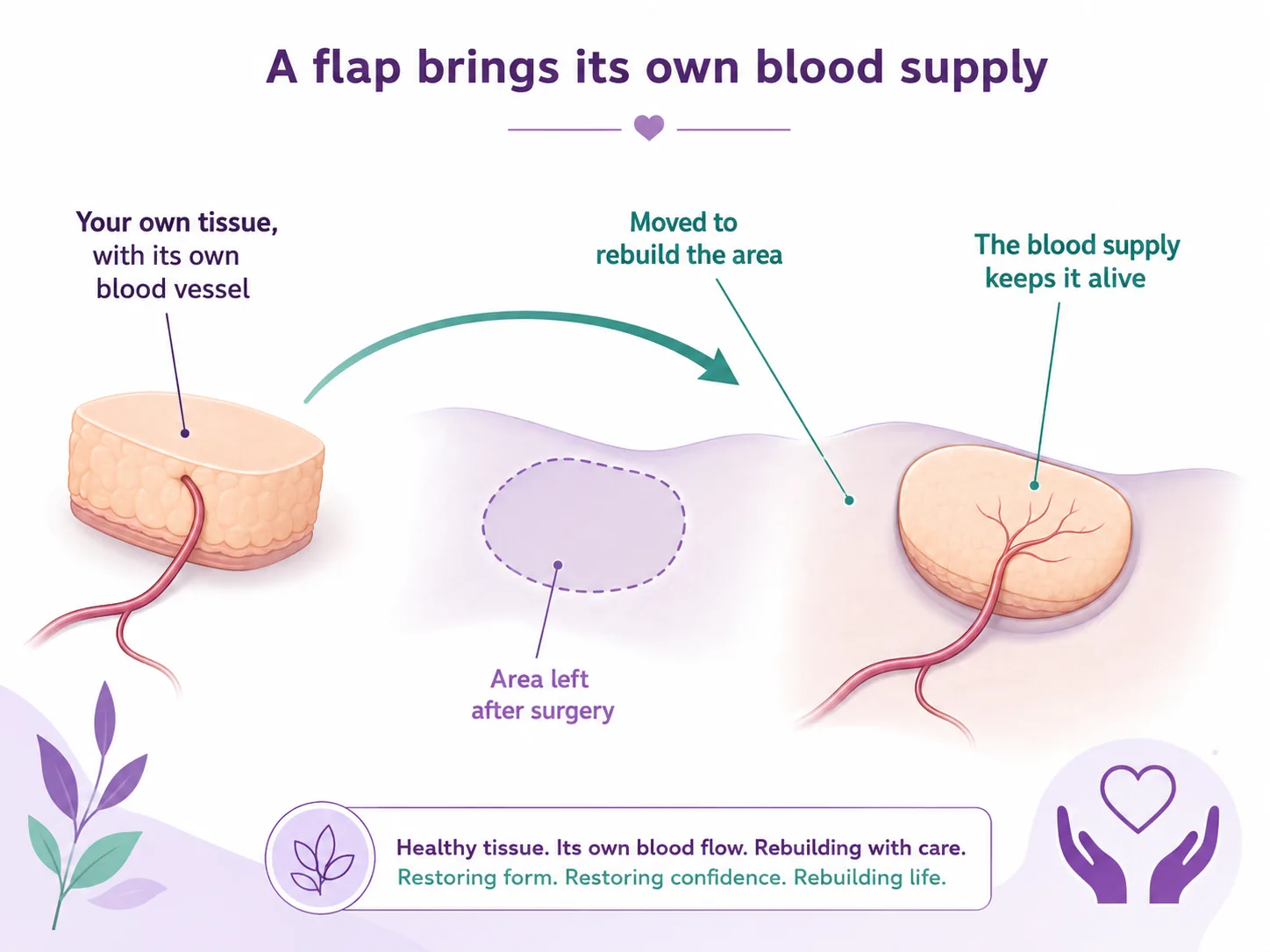
The one idea that explains everything about flaps is the blood supply. A flap is moved together with its own blood vessels, so from the moment it reaches its new place it has living circulation keeping it healthy — that is why it heals, softens and settles into a natural part of you. An implant has no blood supply because it is artificial; a graft has none of its own and can only survive on small, well-supplied areas. A flap's built-in blood supply is what lets it rebuild bigger, more complex areas — a whole breast, or part of the mouth or jaw — and cope with healing and any radiation that follows.
A flap is your own tissue moved with its own blood vessel, which keeps it alive and healing in its new place — unlike an implant or a graft.
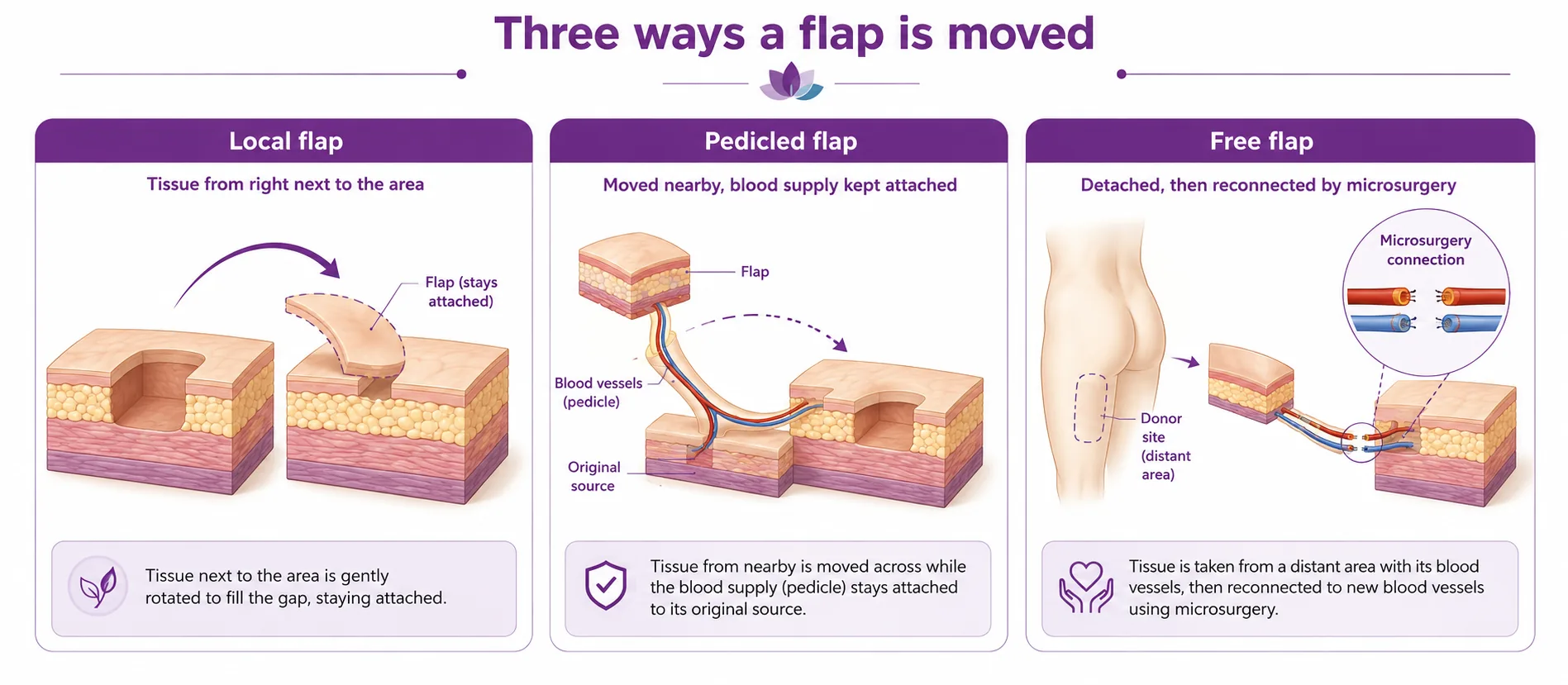
Flaps differ in how far the tissue travels and how its blood supply is handled. A local flap uses tissue right next to the area, gently shifted to fill it while staying attached. A pedicled flap takes tissue from nearby and moves it across while it stays attached to its original blood vessels (for example the latissimus dorsi from the back). A free flap takes tissue from a more distant part, completely detaches it with its blood vessels, and reconnects those vessels by microsurgery under a microscope at the new site (for example tissue from the abdomen for a breast, or the forearm, thigh or fibula for the head & neck). Your surgeon chooses the one that rebuilds your area best.
A local flap uses tissue right next to the area; a pedicled flap keeps its blood supply attached; a free flap is detached and reconnected by microsurgery.
Local flap
Pedicled flap
Free flap
Where the tissue comes from
Right next to the area.
Nearby (e.g. back, chest).
A more distant part (e.g. abdomen, forearm, thigh, fibula).
The reconstruction is planned alongside removing the cancer, from the start. A consultation and scans work out which flap suits your area and your body, how the donor site is handled, and how the rebuild fits with your cancer surgery. Every case is reviewed by a multidisciplinary tumour board, so removal and reconstruction are decided together — not one after the other.
Assessment & planning services — book any of these:
Reconstruction consultation
A dedicated consultation on rebuilding with your own tissue — which flap suits you, and how it fits your cancer surgery.
Flap reconstruction is used wherever cancer surgery leaves an area to rebuild. For the breast, after a mastectomy, a flap rebuilds the breast with your own tissue — often from the abdomen (a soft, natural result and no implant) or the back — sometimes combined with an implant. For the head & neck, after removing cancer of the mouth, tongue or jaw, a free flap from the forearm, thigh or fibula rebuilds the area so speech, swallowing and appearance are restored. The same principle — your own tissue with its own blood supply — applies throughout.
Breast reconstruction
Rebuilding the breast with your own tissue after a mastectomy, often in the same operation, for a soft, natural result. Flap breast reconstruction
Head & neck reconstruction
A free flap rebuilds the mouth, tongue or jaw so speech, swallowing and appearance are restored. Free-flap reconstruction
Rebuilding with your own tissue — planned together with removing the cancer, by one experienced team.
Removing the cancer and rebuilding the area are one coordinated plan. That means the cancer surgery, the flap that rebuilds the area, and the rehabilitation around it are all considered together — with radiation or chemotherapy added where the stage calls for it. Every plan is set by a multidisciplinary tumour board.
Surgeries & reconstruction we deliver — book a consult for any of these:
Breast reconstruction (flap)
Rebuilding the breast with your own tissue — often from the abdomen or back — frequently in the same operation as the mastectomy.
Two honest points matter here. The donor site — where the tissue is taken from — has its own scar, and depending on the flap there can be some change in strength or shape; your surgeon chooses muscle-sparing techniques where possible and explains what to expect. And flap survival: flaps heal reliably, and for free flaps there is a small chance in the first days that the reconnected blood vessels need attention — which is exactly why the flap is monitored very closely early on, so any issue is caught and put right quickly. Recovery is longer than for an implant alone, but most people heal well and are glad to have their own tissue.
1
Planning
Your surgeon plans which flap suits your area and body, and how it fits with your cancer surgery.
2
The operation
The cancer is removed and the flap is raised with its blood supply and shaped into place — reconnected by microsurgery for a free flap — often in the same operation.
3
Early monitoring
A hospital stay while the flap settles, with close monitoring of its blood supply in the first days. Both the rebuilt area and the donor site are cared for.
4
Recovery
Recovery over the following weeks, with scars and any donor-site change settling over months.
5
Refinement & follow-up
Small refinements can be made later if you wish, and your team follows up as part of your cancer care.
Recovery is a supported journey rather than a single day. Your surgical, reconstructive and rehabilitation team — and a nutritionist and counsellor where you want them — walk with you at every step.
Cost & coverage
Flap reconstruction cost in Hyderabad Indicative
The cost depends on the type of flap — a local flap is a smaller procedure than a free flap, which involves microsurgery and a longer operation. The reassuring part: when reconstruction is part of cancer treatment, eligible cases are generally covered under Aarogyasri at empanelled centres, and by most health-insurance policies, often together with your cancer surgery. These are estimates, not a quotation.
Indicative cost estimator
Pick your situation for an indicative range, then request an exact estimate for your case.
Indicative range
₹80,000 – ₹1,80,000
for a local flap, general room, self-pay
Figures are indicative only and not a quotation. When reconstruction is part of cancer treatment, eligible cases are generally covered under Aarogyasri at empanelled centres and by most health insurance, subject to eligibility. Your actual cost depends on the type of flap, whether it is part of your cancer surgery, and the treatment around it.
Cancer surgery planned, and want to understand rebuilding with your own tissue? Book a free consultation and, if you already have a plan or reports, a free written second opinion.
Your reports reviewed by a reconstructive surgical oncologist
An honest answer on flap vs implant, the donor site and how natural it looks
Aarogyasri & insurance guidance
Support
Financial support & Aarogyasri
Cost should not delay treatment. Because flap reconstruction is generally part of cancer treatment, eligible surgery is often covered under Aarogyasri at empanelled centres, and private insurance is accepted cashless — frequently together with your cancer surgery. Our counsellors help check eligibility, arrange approvals and map out what you will actually pay — often far less than families fear.
9 clinics in Hyderabad · 35+ across Telangana & AP
CION cancer care is closer than you think.
We're never more than 30 minutes away. Same panel of specialists at every centre. Same tumour board reviews. Same NCCN protocols. Pick the closest one and call directly — or let us pick for you.
Don't see your city? Call
18002028726
— we'll find your nearest CION partner centre.
Meet the reconstructive surgical team
Your reconstruction is planned by a team, not one doctor.
Surgical, reconstructive, radiation and medical oncologists plan every case together in a multidisciplinary tumour board — part of 17 senior specialists across CION.
Share your name and number — we'll call you back within 30 minutes to schedule your consultation.
Rebuilding is part of getting better — not an afterthought
When reconstruction is planned together with your cancer surgery, you can wake up with the area already rebuilt with your own tissue. Let CION's team review your plan and give you an honest, compassionate answer.
These are the worries people rarely say out loud. Here are honest, respectful answers to the ones we hear most in Telangana.
“Will the reconstruction look and feel like part of me?”
Fact: Usually, yes. Because a flap uses your own living tissue, it looks and feels natural, softens over time and warms like the rest of you — one of the main reasons people choose it. It settles over the following months, and small refinements can be made later if you wish.
“Will the flap survive, or will it fail?”
Fact: Flaps heal reliably. For a free flap there is a small chance in the first days that the reconnected blood vessels need attention — which is exactly why the flap is monitored very closely early on, so anything is caught and put right quickly. Most flaps heal well and become a natural part of you.
“The donor site will leave me weak or badly scarred.”
Fact: The donor site has its own scar, and depending on the flap there can be some change in strength or shape. Surgeons choose muscle-sparing techniques where possible to limit this, and place the donor site so it heals well and stays as hidden as possible — and explain exactly what to expect for your flap.
“A flap is the same as an implant.”
Fact: They are different. A flap is your own living tissue with its own blood supply, so it feels natural and copes with healing and radiation. An implant is an artificial device. Many people choose a flap precisely because it is their own tissue — but your team explains both so you can decide.
“Reconstruction is cosmetic — it's not really necessary.”
Fact: Reconstruction is about function and wholeness first. In the head & neck it restores speech, swallowing and chewing; for the breast it restores shape and balance. It is planned as part of your cancer care because it matters to how you live afterwards, not just how you look.
“Rebuilding at the same time will make the cancer surgery less safe.”
Fact: The opposite is usually true. Planning removal and reconstruction together, by one coordinated team, means the cancer is removed completely first and the area rebuilt in the same, well-planned operation. The cancer is always the priority; reconstruction is fitted around it safely.
“Can a middle-class family afford this kind of surgery?”
Fact: Because flap reconstruction is generally part of cancer treatment, eligible cases are often covered under Aarogyasri at empanelled centres, and private insurance is accepted cashless. Our counsellors help you check eligibility and map out what you will actually pay — often far less than families fear.
“Free-flap microsurgery is too risky for me.”
Fact: Free-flap surgery is a well-established, carefully monitored technique. The blood vessels are reconnected under a microscope and then watched closely in the first days — the monitoring is built in precisely to keep the flap safe. Your team assesses your fitness and chooses the safest approach for you.
“I'll have to choose between treating the cancer and rebuilding.”
Fact: You don't. At CION, removal and reconstruction are one coordinated plan, often in the same operation. Treating the cancer is never traded off against rebuilding — the two are planned together so you get both.
“Recovery from a flap takes forever.”
Fact: Recovery is longer than for an implant alone, because both the rebuilt area and the donor site heal — but it follows a clear, supported path. Most people are back to normal activities over the following weeks, with scars settling over months, guided by their team at each step.
“I'm too old or too weak for reconstruction.”
Fact: Age alone does not decide it — fitness and the situation do. Your team assesses you individually and may choose a simpler local or pedicled flap, or another approach, to rebuild safely. The right plan is chosen for you, not by a number.
“If I need radiation, the reconstruction will be ruined.”
Fact: A flap's own blood supply is exactly what helps it cope with radiation better than an implant alone — which is one reason own-tissue reconstruction is often chosen when radiation is expected. Your team plans the timing and type of reconstruction around any radiation you need.
“Reconstruction will hide a cancer coming back.”
Fact: It does not. Follow-up after reconstruction is planned so the area and your health are checked regularly, and a flap does not stop a recurrence being found. Rebuilding with your own tissue and staying under follow-up work together, not against each other.
“Only huge hospitals abroad can do free flaps.”
Fact: Own-tissue and free-flap reconstruction for breast and head & neck cancer are done here in Hyderabad, planned by a multidisciplinary tumour board, with Aarogyasri and insurance counselling and Telugu-speaking teams. Care close to home does not mean lesser care.
“I'll be left with a feeding tube or unable to speak after head & neck reconstruction.”
Fact: A temporary feeding or breathing tube is sometimes used to let the area heal, and is usually removed as you recover. A free flap rebuilds a moving surface, and speech-and-swallow therapy retrains talking and eating — most people return to speaking and eating well.
“A second opinion will offend my doctor and waste time.”
Fact: A second opinion is normal and welcomed in cancer care — it confirms the plan and gives you confidence. At CION it can be arranged quickly, and it is free when you have a diagnosis or reports.
“Home or herbal remedies can heal the area instead of surgery.”
Fact: No home or herbal remedy rebuilds tissue or treats cancer, and relying on one wastes the window when treatment works best. Tell your oncologist about anything you take so it can be used safely alongside proper treatment.
“Talking about how I'll look afterwards is vain or shameful.”
Fact: How you will look and function afterwards is a normal, important part of cancer care — not vanity. Raising it early means reconstruction can be planned from the start, which gives the best result. Our team listens without judgement.
Why CION
Why choose CION for flap reconstruction in Hyderabad
Reconstruction with your own tissue
Rebuilding with your own living tissue for a natural, lasting result — the outcome people most want.
Microsurgery for free flaps
Free-flap tissue transfer with the blood vessels reconnected under a microscope, for breast and head & neck.
Close flap monitoring
Careful monitoring of the flap's blood supply in the early days, so anything is caught and addressed quickly.
One team, one operation
Removing the cancer and rebuilding are planned together, often in the same operation, by one coordinated team.
A tumour-board approach
Every case is planned by a multidisciplinary tumour board, so the cancer surgery and reconstruction fit together.
Aarogyasri & care close to home
Reconstruction as part of cancer care is covered under Aarogyasri for eligible cases; 35+ centres and Telugu-speaking teams.
Real stories · real courage
15,000+ patients chose CION. Hear from them directly.
These aren't paid endorsements or written reviews. These are video testimonials from real patients and families — recorded on their own phones, in their own words. Pick any one. Watch it. Then decide.
4.8★800+ Google reviews
50+video testimonials
15,000+patients treated
Successful Chemotherapy & Radiation Done by Dr. Owais Mohammed & Dr. Kirti Ranjan
Watch video →
Successful Chemotherapy Done by Dr. C Raghavendra Reddy
Watch video →
Surgery, Chemo & Radiation Done by Dr. Imaduddin, Dr. Vinay, Dr. Owais, Dr. Kirti
Watch video →
Successful Radical Thymectomy Done by Dr. Mohammed Imaduddin & Dr. Vinay Mamidala
Watch video →
Successful Surgery Done by Dr. Rajender Byshetty
Watch video →
Successful Chemo & Surgery Done by Dr. Imad, Dr. Vinay, Dr. Owais & Dr. Raghavendra
Watch video →
Successful Chemo & Surgery Done by Dr. Imad, Dr. Vinay, Dr. Owais & Dr. Raghavendra
Watch video →
Successful Chemo & Radiation Done by Dr. Owais Mohammed & Dr. Kirti Ranjan Mohanty
Watch video →
Successful Breast Cancer Surgery Done by Dr. Imaduddin Mohammed & Dr. Vinay Mamidala
Watch video →
Successful Chemotherapy Done by Dr. Bharati Devi Gorantla
Watch video →
Successful Chemo & Surgery Done by Dr. Owais Mohammed & Dr. Imaduddin Mohammed
Watch video →
Successful Chemotherapy Done by Dr. Gundu Naresh
Watch video →
Successful Bone Marrow Transplantation - Neuroblastoma
Watch video →
Successful Surgery & Chemo - Carcinoma of Caecum
Watch video →
Successful Oral chemotherapy & mastectomy surgery
Watch video →
Successful Oral chemotherapy & mastectomy surgery
Watch video →
Successful Chemotherapy
Watch video →
Successful Surgery by Dr. Mohammed Imaduddin
Watch video →
Successful Bone Marrow Transplantation
Watch video →
Successful Oral chemotherapy & mastectomy surgery
Watch video →
Successful Oral chemotherapy & mastectomy surgery
Watch video →
Successful Chemotherapy
Watch video →
Successful Buccal Mucosa Surgery
Watch video →
Successful Complex Surgery Mandibulectomy Reconstruction
Recovering form and function is as important as the surgery. At CION, reconstruction, rehabilitation, nutrition and emotional support are one coordinated plan — from diagnosis through survivorship.
Speech & swallow therapy
After head & neck reconstruction, retraining talking and eating from early on. Learn more
Nutrition counselling
Guidance on healing well and building strength while the area recovers. Learn more
Psychology counselling
Emotional support for you and your family through diagnosis and recovery. Learn more
Breast reconstruction
The full picture of rebuilding the breast — flap or implant — after cancer surgery. Learn more
Cancer rehabilitation
Physiotherapy and recovery support to rebuild strength after surgery. Learn more
Financial counselling
Aarogyasri and cashless insurance guidance so cost never blocks care. Learn more
FAQ
Flap reconstruction in Hyderabad — frequently asked questions
What is flap reconstruction?
Flap reconstruction rebuilds a part of the body after cancer surgery using a flap — a piece of your own living tissue (skin, fat, sometimes muscle or bone) moved together with its own blood supply. That blood supply keeps the tissue alive in its new place, so the rebuilt area heals well and looks and feels natural. It is most often used for the breast after a mastectomy and for the head and neck after cancer removal.
What is the difference between a flap, a graft and an implant?
A flap is your own tissue moved with its own blood supply, which keeps it alive and lets it rebuild larger, more complex areas. A graft is a thin layer of tissue moved without its own blood supply, so it can only survive on small, well-supplied areas. An implant is an artificial device with no blood supply. A flap's built-in blood supply is why it heals and settles into a natural part of you.
Will the flap survive and take?
Flaps heal reliably. For a free flap, there is a small chance in the first days that the reconnected blood vessels need attention, which is exactly why the flap is monitored very closely early on — so anything is caught and put right quickly. Most flaps heal well and become a natural part of you; your team explains what to watch for and supports you throughout.
What is a free flap and microsurgery?
A free flap is tissue taken from a more distant part of the body — such as the abdomen for a breast, or the forearm, thigh or fibula for the head and neck — completely detached with its blood vessels, then moved to the new area where those tiny vessels are reconnected under a microscope. This reconnection is called microsurgery, and it restores the flap's blood supply so it lives and heals in its new place.
What is the difference between a local, pedicled and free flap?
A local flap uses tissue right next to the area, shifted to fill it while staying attached. A pedicled flap takes tissue from nearby and moves it across while its blood vessels stay attached to their original source. A free flap takes tissue from a more distant part, detaches it with its blood vessels, and reconnects those vessels by microsurgery at the new site. Your surgeon chooses the one that rebuilds your area best.
What about the donor site — where the tissue is taken from?
The donor site has its own scar, and depending on the flap there can be some change in strength or shape (for example at the abdomen or back). Surgeons choose muscle-sparing techniques where possible to limit this, and plan the donor site so it heals well and is as hidden as possible. Your surgeon explains exactly what to expect for the flap you are having.
Will the reconstruction look and feel natural?
Because a flap uses your own living tissue, it usually looks and feels natural, softens over time and warms like the rest of you — one of the main reasons people choose it. It settles over the following months, and small refinements can be made later if wished. Your team talks through the likely result for your area before surgery.
Can flap reconstruction be done at the same time as the cancer surgery?
Very often, yes. Wherever possible the rebuild is done in the same operation as removing the cancer, by one coordinated team, so you wake up with the area already rebuilt. Sometimes reconstruction is planned as a later, separate stage — your surgeon and the tumour board advise which is right and safest for your situation.
How is the breast rebuilt with a flap?
After a mastectomy, a flap rebuilds the breast with your own tissue — often from the lower abdomen, which gives a soft, natural result without an implant, or from the back, sometimes combined with an implant. It can frequently be done in the same operation as the mastectomy. Which flap suits you depends on your body and your treatment, which your team plans with you.
How is the mouth, tongue or jaw rebuilt with a flap?
After removing head and neck cancer, a free flap from the forearm, thigh or fibula rebuilds the area — recreating a moving surface for speech and swallowing, or rebuilding the jaw so face, chewing and speech return. The blood vessels are reconnected by microsurgery, and speech-and-swallow therapy retrains talking and eating as you heal.
How long is the surgery and recovery for a flap?
Flap surgery — especially a free flap with microsurgery — takes longer than an implant alone, and recovery is a little longer too, because both the rebuilt area and the donor site heal. Most people stay in hospital while the flap settles and are back to normal activities over the following weeks, with the scars settling over months. Your team gives you a clear timeline for your operation.
Is flap reconstruction safe if I need radiation afterwards?
A flap's own blood supply is exactly what helps it cope with radiation better than an implant alone, which is one reason own-tissue reconstruction is often chosen when radiation is expected. Your team plans the timing and type of reconstruction around any radiation you need, so the two work together. This is decided by the tumour board based on your treatment plan.
Does flap reconstruction increase the chance of cancer coming back or hide it?
No. Reconstruction does not make cancer more likely to return, and a flap does not hide a recurrence — follow-up is planned so the area and your health are checked regularly. The cancer is always removed completely first, and rebuilding with your own tissue and staying under follow-up work together, not against each other.
Am I too old or unfit for flap reconstruction?
Age alone does not decide it — your fitness and situation do. Your team assesses you individually and may choose a simpler local or pedicled flap, or another approach, to rebuild safely. The right plan is chosen for you, not by a number, and the cancer surgery always takes priority.
Is flap reconstruction covered by Aarogyasri or insurance?
When reconstruction is part of cancer treatment, eligible cases are generally covered under Aarogyasri at empanelled centres and by most health-insurance policies, often together with your cancer surgery. CION's team checks your policy and scheme eligibility and provides a written estimate — covering the reconstruction and the cancer surgery — before anything is planned.
How much does flap reconstruction cost in Hyderabad?
The indicative cost depends on the type of flap — a local flap is a smaller procedure than a free flap, which involves microsurgery and a longer operation — as well as room category and length of stay. When it is part of cancer treatment, eligible cases are generally covered under Aarogyasri at empanelled centres, with insurance accepted cashless. CION gives an accurate written estimate after assessment; figures on this page are indicative only.
Which is the best hospital for flap reconstruction in Hyderabad?
Look for a cancer centre with fellowship-trained surgical oncologists, reconstructive and free-flap (microsurgery) capability, multidisciplinary tumour-board planning, and dedicated rehabilitation. CION Cancer Clinics offers own-tissue reconstruction for breast and head and neck cancer across 35+ centres in Telangana and Andhra Pradesh, with Aarogyasri and insurance counselling and Telugu-speaking teams.
Which doctor should I see for flap reconstruction in Hyderabad?
See a surgical oncologist with reconstructive and microsurgical (free-flap) expertise, working within a head and neck or breast cancer team. At CION your case is reviewed by a team — surgical, reconstructive, radiation and medical oncologists together — so removal and reconstruction are planned as one coordinated, cancer-first plan. You can request a specific surgeon when booking.
Explore
Explore reconstruction & cancer surgery at CION
Rebuilding after breast and head & neck cancer surgery, plus planning, cost and support. Tap any topic to read more.
Talk to a reconstructive surgeon about rebuilding with your own tissue
Early answers change outcomes — and reconstruction can restore form and function with your own tissue. Book a free consultation or second opinion at any of our 9 Hyderabad clinics — part of 35+ centres across Telangana & Andhra Pradesh.
Medical disclaimer: This page provides general information about flap reconstruction (rebuilding with your own tissue) and is not a substitute for professional medical advice, diagnosis or treatment. Flaps heal reliably, but recovery is an individual journey; free flaps carry a small early risk that is why they are monitored closely, and the donor site has its own scar. Costs shown are indicative only and not a quotation. Always consult a qualified reconstructive surgical oncologist about your individual care. Content is periodically reviewed by CION's medical team.

 CION Ameerpet