What are the symptoms of breast cancer?
The most common symptom is a new lump or thickening in the breast or armpit that feels different from the surrounding tissue. Other symptoms include: a change in the size or shape of one breast; dimpling, puckering, or an orange-peel texture on the breast skin; a nipple that has turned inward, or nipple discharge that is not breast milk; scaling or crusting of the nipple skin; persistent unexplained breast or nipple pain; and redness or warmth of the breast skin. Most breast lumps are benign — but any new lump or change that persists for more than 2 to 4 weeks should be evaluated with ultrasound and specialist assessment.
Is breast cancer curable?
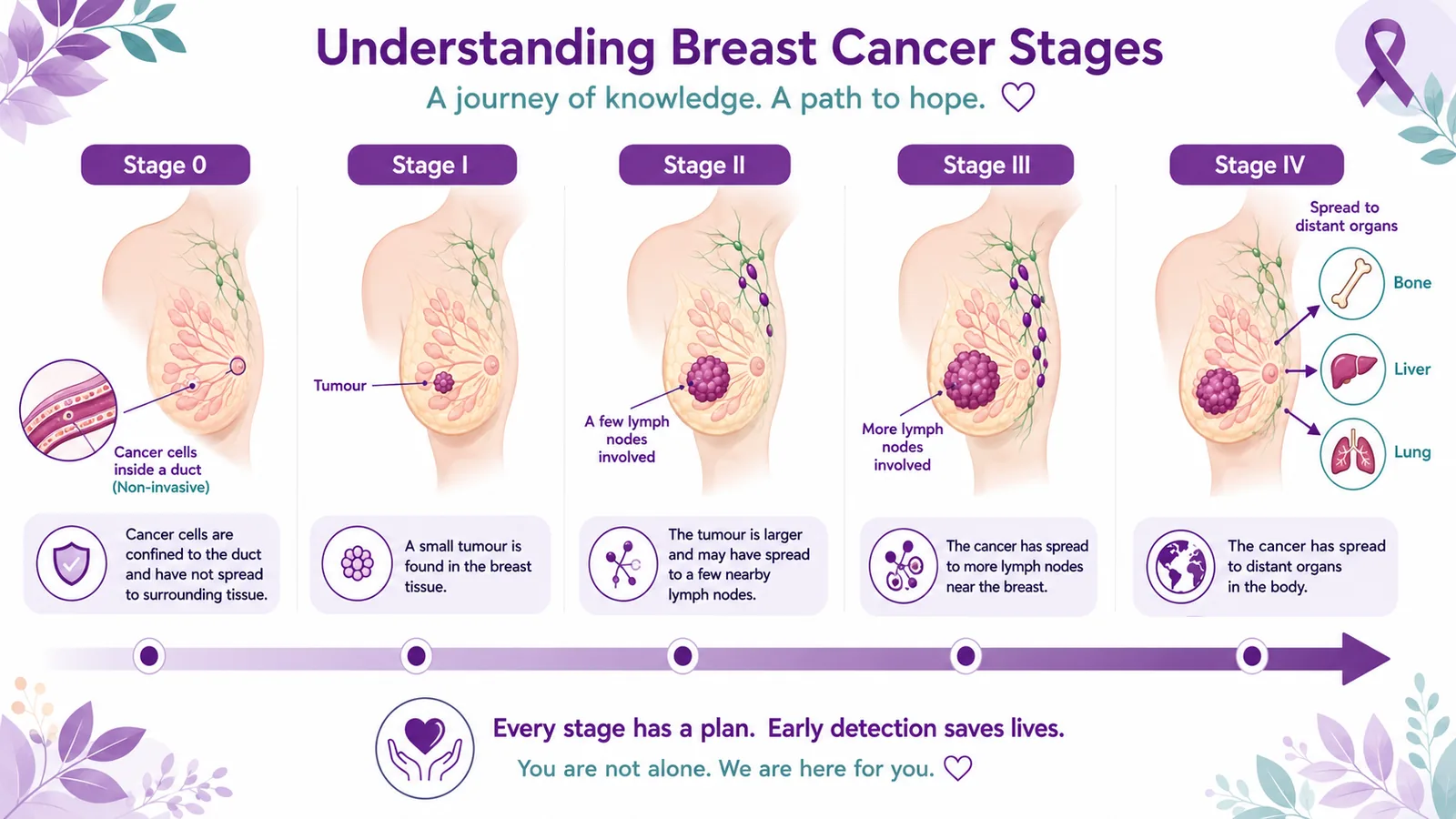
For early-stage breast cancer (Stage I and II), cure rates are very high: 95 to 99% for Stage I and 75 to 90% for Stage II. Stage III breast cancer has 50 to 75% 5-year survival with comprehensive treatment. Stage IV (metastatic) breast cancer is generally not curable, but it is increasingly manageable for prolonged periods — particularly ER-positive breast cancer (controlled for years with hormone therapy and CDK4/6 inhibitor tablets) and HER2-positive breast cancer (where targeted treatment has transformed long-term outcomes). HER2-positive breast cancer achieving a complete response to neoadjuvant chemotherapy has excellent 10-year survival rates approaching those of hormone receptor-positive breast cancer.
What is the difference between lumpectomy and mastectomy?
A lumpectomy (breast-conserving surgery) removes only the tumour and a small margin of surrounding tissue, preserving the rest of the breast. It is followed by radiation therapy to reduce the risk of local recurrence. A mastectomy removes the entire breast. Clinical evidence from decades of trials shows that for eligible early-stage patients, lumpectomy plus radiation achieves the same long-term survival as mastectomy. The choice between them depends on tumour size, location, patient preference, genetic factors (BRCA status), and willingness to have radiation. Many women who initially assume they need mastectomy discover after specialist consultation that lumpectomy is a safe and suitable option.
What is HER2-positive breast cancer?
HER2-positive breast cancer overproduces a protein on the cell surface called HER2 (Human Epidermal Growth Factor Receptor 2) that drives rapid cell division. It accounts for approximately 20% of all breast cancers. Twenty years ago, it was one of the most aggressive subtypes. Today, targeted antibody medicines that specifically attach to and block the HER2 protein — trastuzumab and pertuzumab — given alongside chemotherapy have transformed its outlook. Complete response rates in the breast and lymph nodes before surgery now exceed 60% with dual HER2-blockade, making HER2-positive breast cancer one of the most treatment-responsive subtypes.
What is triple-negative breast cancer?
Triple-negative breast cancer (TNBC) is negative for all three receptor markers: oestrogen receptor (ER-), progesterone receptor (PR-), and HER2. It cannot be treated with hormone therapy or HER2-targeted medicines. It accounts for 10 to 15% of breast cancers and grows faster than hormone receptor-positive breast cancer. However, TNBC responds very well to chemotherapy — and when a complete response to neoadjuvant chemotherapy is achieved before surgery (no cancer cells remaining), long-term outcomes are excellent. For eligible patients, adding an immunotherapy medicine alongside chemotherapy improves the complete response rate and overall outcomes. BRCA mutation testing is recommended for all TNBC patients.
What is neoadjuvant chemotherapy for breast cancer?
Neoadjuvant chemotherapy means giving chemotherapy before surgery rather than after. For HER2-positive and triple-negative breast cancers, this sequence offers significant advantages: it shows whether the chemotherapy is working (by monitoring tumour shrinkage on examination and imaging); it can shrink a large tumour to allow breast-conserving surgery where mastectomy would otherwise be needed; and it creates a "test result" — if all cancer is gone from the breast and lymph nodes before surgery (a pathological complete response), this predicts excellent long-term outcomes. If response is incomplete, additional treatment after surgery reduces recurrence risk.
Do I need to remove my breast if I have breast cancer?
Not necessarily. For most women with early-stage breast cancer, a lumpectomy — removing the tumour while keeping the breast — combined with radiation therapy achieves the same long-term survival as mastectomy. Mastectomy is recommended when: the tumour is large relative to breast size; there are multiple separate tumours in the breast; inflammatory breast cancer is present; the patient carries a BRCA1 or BRCA2 mutation; or the patient prefers mastectomy. The decision is made in a shared discussion between the patient and surgical oncologist, taking into account both clinical factors and the patient's own priorities and preferences.
What is BRCA testing and who needs it?
BRCA1 and BRCA2 are genes that normally repair damaged DNA. An inherited fault in either gene dramatically increases lifetime risk of breast cancer (up to 70% for BRCA1) and ovarian cancer. BRCA testing uses a blood or saliva sample. It is recommended for: breast cancer diagnosed under 45; triple-negative breast cancer under 60; a family history of breast cancer in a first-degree relative, particularly under 50; a family history of ovarian cancer; bilateral breast cancer; or both breast and ovarian cancer in the family. BRCA-positive patients may be eligible for PARP inhibitor treatment after primary therapy, and the result has important implications for first-degree relatives who can be offered testing.
What is the cost of breast cancer treatment in Hyderabad?
Lumpectomy: ₹80,000–₹2,50,000. Mastectomy: ₹1,50,000–₹3,50,000. Implant-based breast reconstruction: ₹1,50,000–₹4,00,000. Radiation therapy (whole breast): ₹1,20,000–₹2,50,000. Chemotherapy (per cycle): ₹30,000–₹80,000. HER2-targeted therapy (trastuzumab per cycle, biosimilar): ₹60,000–₹1,50,000. Hormone therapy (monthly): ₹500–₹5,000 for generics. CDK4/6 inhibitors (monthly): ₹80,000–₹2,00,000. PET-CT: ₹9,999–₹16,000. BRCA testing: ₹15,000–₹40,000. A personalised estimate is provided after your initial CION consultation. EMI options are available.
Can I get a second opinion for breast cancer?
Absolutely — and for breast cancer, a second opinion is valuable in three situations: if mastectomy has been recommended without a discussion of whether lumpectomy is feasible for your tumour size and location; if you have HER2-positive breast cancer and have not been offered dual HER2-blockade (trastuzumab + pertuzumab) alongside chemotherapy before surgery — this combination is the standard of care; and if you have triple-negative breast cancer or a diagnosis under 45 and BRCA testing has not been discussed — this testing has direct implications for treatment choice and your family. CION offers a dedicated Second Opinion service.