Surgery for recurrent pelvic cancer · Hyderabad & Telangana
Pelvic exenteration in Hyderabad
A pelvic exenteration removes the organs a cancer involves in the pelvis, together, in one piece. It is considered for a cancer that has come back or persisted in the pelvis — most often cervical cancer after radiation — when it is still confined to the pelvis and other treatments are no longer options. It is a big decision and a big operation. But for the right person it offers the best chance of long-term control, and a whole team — surgeons to a stoma-care nurse — is beside you at every step.
A multidisciplinary pelvic team · reconstruction & stoma care
Anterior, posterior & total types explained — honestly
Covered under Aarogyasri & insurance · clear indicative costs
★★★★★Rated 4.8/5 · 800+ Google reviews
A multidisciplinary pelvic team
Reconstruction & stoma care
For cancer confined to the pelvis
35+ centres · Aarogyasri help
MM
Written by Dr. Muralidhar Muddusetty, Surgical Oncologist — MRCS (Edinburgh), AIIMS-trained — with CION's pelvic surgical oncology team. Medically reviewed by Dr. Raghavendra Naik, MCh (Surgical Oncology). · Reviewed 14 July 2026
Understanding the surgery
What is a pelvic exenteration?
A pelvic exenteration is surgery to remove the organs of the pelvis that a cancer involves — which can include the bladder, the lower bowel (rectum) and the reproductive organs (womb and vagina) — taken out together in one piece with a clear margin. It is a major operation, reserved for a cancer that has come back or persisted in the pelvis and is still confined there, when treatments like radiation and chemotherapy are no longer options. New openings called stomas are made to pass urine and/or bowel motions, and the pelvis is reconstructed. For the right person, it offers the best chance of long-term control of the cancer.
This is never a routine or rushed decision. It is offered only after careful scans confirm the cancer has not spread beyond the pelvis, and after an unhurried, honest conversation about what it involves and what life is like afterwards. Every case is reviewed by a multidisciplinary team — surgical oncology, bowel and urology surgeons, reconstructive surgeons, a stoma-care nurse and supportive care — so the whole journey is planned and supported together, with you and your family at the centre.
Removes the cancer completely
The pelvic organs the cancer involves are removed together, with a clear margin — for a cancer confined to the pelvis.
Reroutes & reconstructs
Small stomas are made to pass urine and/or bowel motions, and the pelvis and vagina are reconstructed where needed.
A whole team beside you
A multidisciplinary team and a stoma-care nurse support you through the decision, the surgery and recovery.
The three types
Anterior, posterior & total exenteration
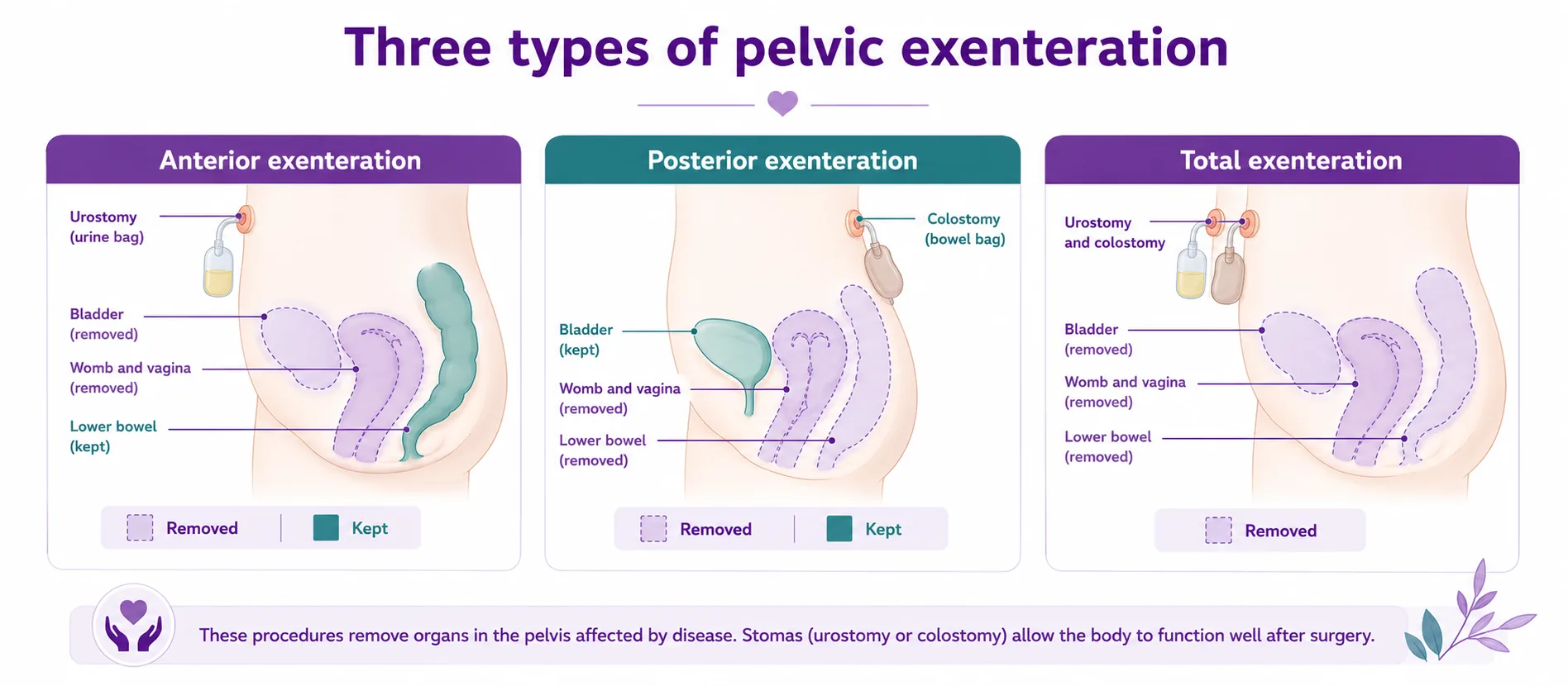
Which organs are removed depends on where the cancer sits in the pelvis, and this shapes daily life afterwards. An anterior exenteration removes the bladder and reproductive organs but keeps the bowel, so urine is rerouted to a small stoma (a urostomy). A posterior exenteration removes the lower bowel and reproductive organs but keeps the bladder, so bowel motions are rerouted to a stoma (a colostomy). A total exenteration removes the bladder, the bowel and the reproductive organs together — needed when the cancer involves both front and back — and both are rerouted to small stomas, with the pelvis reconstructed. Your surgeon explains exactly which would apply for you.
Anterior removes the bladder (a urostomy); posterior removes the lower bowel (a colostomy); total removes both, with the pelvis reconstructed.
Anterior
Posterior
Total
What is removed
Bladder + reproductive organs; bowel kept.
Lower bowel + reproductive organs; bladder kept.
Bladder, bowel + reproductive organs.
Stoma
A urostomy (urine).
A colostomy (bowel).
Both a urostomy and a colostomy.
Reconstruction
Pelvis / vagina reconstructed where needed.
Pelvis / vagina reconstructed where needed.
Pelvis and vagina reconstructed.
Often used for
A cancer involving the front of the pelvis (bladder side).
A cancer involving the back of the pelvis (bowel side).
Tests that confirm it's confined — and guide the surgery
Everything turns on one question: is the cancer still confined to the pelvis? Detailed scans — an MRI of the pelvis and a PET-CT — confirm whether the cancer has spread beyond the pelvis, and sometimes a smaller operation to look inside is done first. Your fitness for major surgery is assessed, and a multidisciplinary tumour board reviews it all so the plan is right for you. Only when the cancer is confined and can be fully removed is an exenteration offered.
Diagnostic services we offer — book any of these:
Pelvic examination & assessment
A careful clinical review of a recurrent or persistent pelvic cancer by a surgical oncologist, with your history and reports.
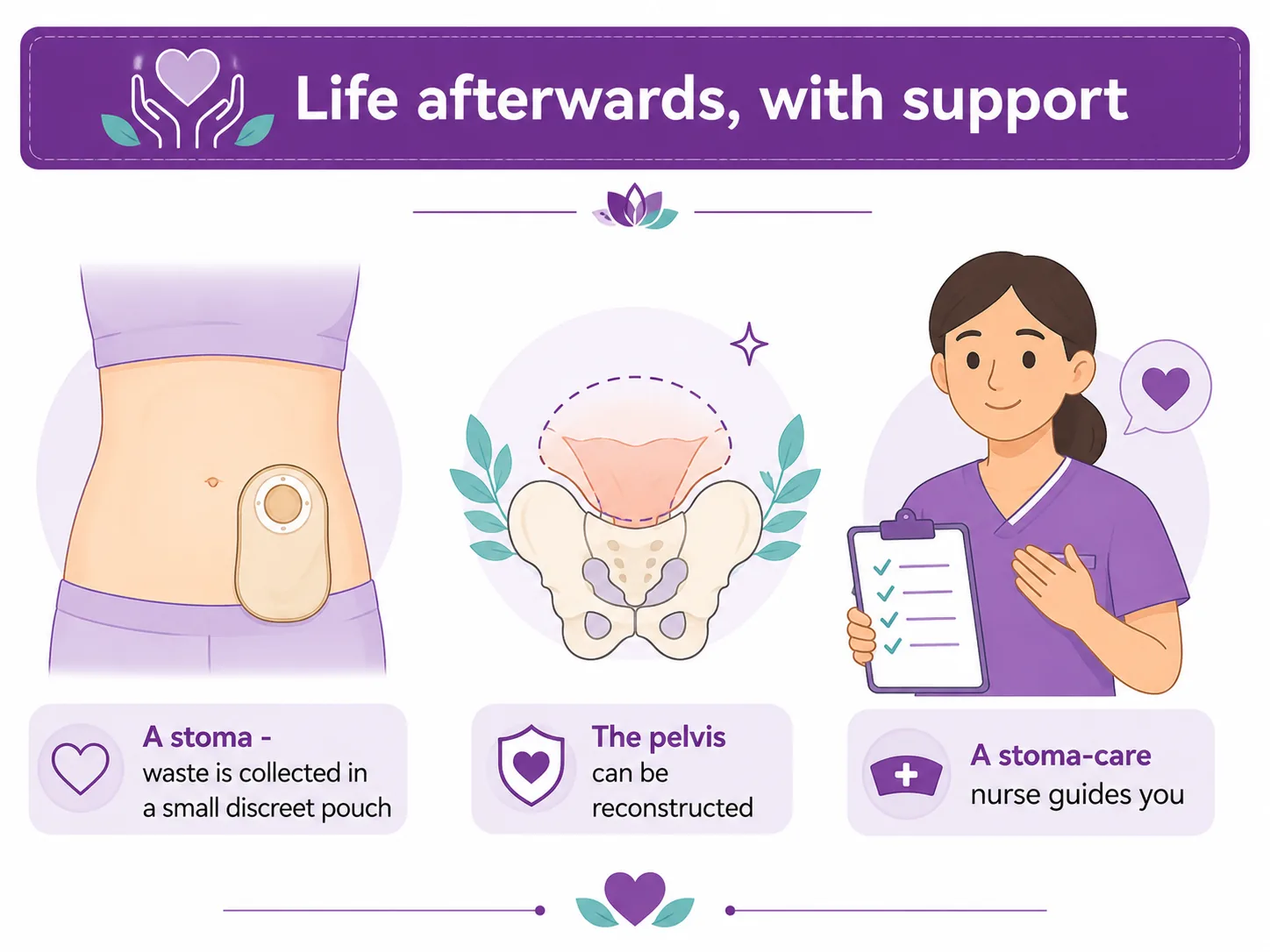
This is what weighs most, and the honest answer is that life afterwards is different, but it can be full and active. After surgery, urine and/or bowel motions pass into a small, discreet pouch (a stoma bag) on the tummy — not visible under clothes. It sounds daunting, but a specialist stoma-care nurse teaches you to manage it, and most people find it becomes routine and return to family life, work and the things they enjoy. The pelvis and, where needed, the vagina can be reconstructed, often with a flap of your own tissue, to restore form and function. Emotional and sexual wellbeing are part of the care, not an afterthought.
Stoma care, made manageable
A specialist stoma-care nurse teaches you to manage a urostomy or colostomy step by step, until it becomes routine. Bowel surgery & stoma care
Reconstruction & wellbeing
The pelvis and vagina can be reconstructed with your own tissue, and emotional and sexual wellbeing are supported for as long as you need. Emotional support
A stoma collects waste in a small, discreet pouch; the pelvis can be reconstructed; and a stoma-care nurse guides you — most people return to a full life.
A pelvic exenteration is carried out by a combined surgical team in a single planned operation. The pelvic organs the cancer involves are removed together with a clear margin (an en-bloc removal), the stoma or stomas are formed to reroute urine and/or bowel, and the pelvis and vagina are reconstructed where needed — often with a flap of your own tissue. Surgical oncology, bowel and urology surgeons and a reconstructive surgeon work side by side, so removal, rerouting and rebuilding are done in one sitting rather than several. Every step is planned in advance by the tumour board, so nothing is left to chance.
En-bloc removal
The affected pelvic organs are removed together in one piece with a clear margin — the principle that gives the best chance of removing the cancer completely.
Stoma formation
Small stomas are formed to reroute urine (a urostomy) and/or bowel motions (a colostomy), depending on which organs are removed.
Reconstruction
The pelvis and, where needed, the vagina are rebuilt with your own tissue in the same operation, to restore form, function and healing.
Because it is such a major operation, an exenteration is only recommended when the cancer is confined to the pelvis and can be fully removed, and when you are fit enough for surgery. Every case is planned by a multidisciplinary tumour board so that removal, reconstruction and the support around it fit together — and so that a gentler path is chosen instead where that is the better option for you.
Treatment
Pelvic cancer surgery & reconstruction we deliver
Surgery is planned alongside everything needed to restore life afterwards. For a recurrent pelvic cancer that means the right type of exenteration, stoma formation and stoma care, and reconstruction of the pelvis and vagina — with supportive and, where suitable, further cancer treatment coordinated around it. Every plan is set by a multidisciplinary tumour board, and a gentler path is offered where it is the better option.
Procedures & care we deliver — book a consult for any of these:
Anterior exenteration
Removing the bladder and reproductive organs while keeping the bowel — urine rerouted to a urostomy — for a cancer at the front of the pelvis.
A pelvic exenteration is one of the biggest operations in cancer surgery, and it is honest to say the recovery is a journey. It is a long operation, followed by a stay in intensive care and then on the ward while you heal, learn to care for the stoma and gradually build strength. Full recovery is usually measured in weeks to a few months, and the whole team — surgeons, stoma-care nurse, physiotherapy, dietitian and counsellors — supports you throughout. It is a demanding path, but people do come through it and return to a full life, and you are never asked to walk it alone.
1
Before surgery
Scans confirm the cancer is confined and can be fully removed, your fitness is assessed, and the team explains everything honestly — with time to decide.
2
The operation
The affected pelvic organs are removed together with a clear margin, the stoma(s) are formed, and the pelvis is reconstructed — by a combined team in one planned operation.
3
Intensive care
A stay in intensive care, then the ward, with strong pain control and close support. A stoma-care nurse begins teaching you to manage the stoma.
4
On the ward
You grow steadier, eating and moving return with physiotherapy and a dietitian, and stoma care becomes more familiar day by day.
5
Recovery & support
Strength returns over weeks to months at home, with ongoing physiotherapy, nutrition and emotional support, and follow-up that keeps the team alongside you.
Recovery is a supported journey rather than a single day. A stoma-care nurse, a physiotherapist, a dietitian and counsellors walk with you at every step — and your family is supported too.
Cost & coverage
Pelvic exenteration cost in Hyderabad Indicative
A pelvic exenteration is a large, complex operation — a long surgery, intensive care, reconstruction and stoma care — so it costs more than most cancer operations, and a total exenteration more than an anterior or posterior one. The reassuring part: as major cancer surgery it is generally covered under Aarogyasri at empanelled centres and by most health-insurance policies. These are estimates, not a quotation.
Indicative cost estimator
Pick your situation for an indicative range, then request an exact written estimate for your case.
Indicative range
₹3,50,000 – ₹7,00,000
for an anterior pelvic exenteration, general room, self-pay
Figures are indicative only and not a quotation. As major cancer surgery, a pelvic exenteration is generally covered under Aarogyasri at empanelled centres and by most health insurance, subject to eligibility. Your actual cost depends on the type of surgery, intensive care, reconstruction, stoma care and length of stay.
A pelvic cancer that has come back can feel like the end of the road — but for cancer confined to the pelvis, it need not be. Book a free consultation and, if you already have scans or a biopsy, a free written second opinion — unhurried, honest, and without pressure.
Your scans and reports reviewed by a pelvic surgical oncology team
An honest answer on whether an exenteration is right for you
Aarogyasri & insurance guidance and a clear written estimate
Support
Financial support & Aarogyasri
Cost should not decide whether a treatable cancer is removed. Because a pelvic exenteration is major cancer surgery, eligible cases are generally covered under Aarogyasri at empanelled centres, and private insurance is accepted cashless. Our counsellors help check eligibility, arrange approvals and map out what you will actually pay — covering the surgery, reconstruction and stoma care — before anything is planned.
9 clinics in Hyderabad · 35+ across Telangana & AP
CION cancer care is closer than you think.
We're never more than 30 minutes away. Same panel of specialists at every centre. Same tumour board reviews. Same NCCN protocols. Pick the closest one and call directly — or let us pick for you.
Don't see your city? Call
18002028726
— we'll find your nearest CION partner centre.
Meet the pelvic surgical team
Your exenteration is planned by a team, not one doctor.
Surgical, gynae, bowel, urology and reconstructive oncologists plan every case together in a multidisciplinary tumour board — part of 17+ senior specialists across CION.
Share your name and number — we'll call you back within 30 minutes to schedule your consultation.
Has a pelvic cancer come back? Don't lose hope — or time.
If a cancer is confined to the pelvis, removing it completely can offer real, lasting control. Let CION's pelvic team review your scans and give you an honest, compassionate answer — with no pressure.
The fears people carry about this surgery — answered
These are the worries people rarely say out loud. Here are honest, respectful answers to the ones we hear most — with dignity and without pressure.
“Removing all these organs means I’ll no longer be myself.”
Fact: You are still you. This surgery changes some functions, not who you are — and reconstruction, stoma care and emotional support are all planned to help you live fully and with dignity afterwards. Many people return to family life, work and the things they love.
“Living with a stoma bag will be unbearable, and everyone will know.”
Fact: A stoma pouch is small, discreet and not visible under clothes. It sounds daunting, but a specialist stoma-care nurse teaches you to manage it, and most people find it becomes routine and return to work, travel and social life.
“This operation is so big I won’t survive it.”
Fact: It is a major operation, which is exactly why it is done by a combined, experienced team in one carefully planned sitting, with intensive-care support afterwards. Your fitness is assessed first, and it is only recommended when the benefit is real. People do come through it and return to a full life.
“If the cancer came back once, surgery is pointless — it’ll just return.”
Fact: For a cancer that has come back but is still confined to the pelvis, removing it completely with a clear margin gives the best chance of long-term control. Careful scans confirm it has not spread beyond the pelvis before surgery is offered — that is the whole point of the assessment.
“I’m too old or too weak for such a big operation.”
Fact: Age alone does not decide it — your fitness and the cancer do. Your team assesses you individually and only recommends surgery when you are well enough for it and the benefit is genuine. Where surgery is not right, a gentler path is chosen with you.
“I’ll never have intimacy or a normal relationship again.”
Fact: Emotional and sexual wellbeing are part of the care, not an afterthought. The vagina can be reconstructed where needed, and honest counselling and support are offered for as long as you want them. Many people go on to fulfilling relationships and intimacy.
“Two stoma bags (a total) means I can never leave the house.”
Fact: Both a urostomy and a colostomy can be managed with the training a stoma-care nurse gives you. People with two stomas travel, work and socialise. It takes practice at first, but it becomes part of daily life rather than a limit on it.
“Recovery will take forever and I’ll be a burden on my family.”
Fact: Full recovery is usually measured in weeks to a few months, supported at every step by the surgical team, stoma-care nurse, physiotherapy and a dietitian. Your family is supported too, and most people return to caring for themselves and their households.
“Can a middle-class family ever afford an operation this big?”
Fact: Because it is major cancer surgery, an eligible pelvic exenteration is generally covered under Aarogyasri at empanelled centres, and private insurance is accepted cashless. Our counsellors help you check eligibility and give a clear written estimate — often far less out of pocket than families fear.
“There’s no point — recurrent cancer can’t be cured.”
Fact: Honestly, for a recurrence confined to the pelvis, removing it completely offers the best chance of long-term control when other treatments are no longer options — a genuine chance, not a false promise. Where the cancer has spread, gentler treatments are the kinder, better path, and your team is honest about which applies to you.
“Reconstruction is just cosmetic — it’s not really needed.”
Fact: Reconstruction is about function and healing first. Rebuilding the pelvis and vagina restores form and helps the area heal, which is why it is planned as part of the same operation. It is core to the surgery, not an optional extra.
“I’ll be in unbearable pain.”
Fact: Pain is managed closely with modern, strong pain control from the operation onwards, in intensive care and on the ward. Your comfort is a priority the whole team plans for, and pain eases steadily as you heal.
“I have to decide right now, under pressure.”
Fact: This is never a rushed decision. You are given the time, information and honesty to weigh it up with your family and your team, and choosing a different path is always respected. There is no pressure — only support to decide what is right for you.
“If they need to do a ‘total’, I’ve lost everything.”
Fact: A total exenteration is chosen only when the cancer involves both the front and back of the pelvis. Even then, both stomas are managed with training, the pelvis is reconstructed, and a full, active life is possible. Your surgeon explains exactly what would apply for you.
“A stoma means I can’t eat normally or enjoy anything.”
Fact: Most people eat a normal or near-normal diet after recovery, guided at first by a dietitian, and return to hobbies, work and family life. A stoma reroutes waste — it does not stop you living and enjoying the things you love.
“Home, herbal or alternative remedies would be safer than surgery.”
Fact: No home or herbal remedy is proven to control a recurrent pelvic cancer, and relying on one lets the cancer grow — sometimes beyond the pelvis, where an exenteration is no longer possible. Tell your oncologist about anything you take so it can be considered safely.
“Asking for a second opinion will offend my doctor.”
Fact: A second opinion is normal and welcomed in cancer care — for a decision this big, it is wise. It confirms the plan and gives you confidence. At CION it can be arranged quickly, and it is free when you have scans or a biopsy report.
“Talking about the bladder, bowel or private organs is embarrassing — better to stay quiet.”
Fact: These are normal, important medical questions, and our team hears them every day without a flicker of judgement. Raising your worries openly leads to better care and less fear. Silence only delays the decision and deepens worry.
Why CION
Why choose CION for a pelvic exenteration in Hyderabad
A multidisciplinary pelvic team
Surgical oncology, bowel and urology surgeons, reconstructive surgeons and a stoma-care nurse — planning and operating together.
Reconstruction on hand
Flap reconstruction of the pelvis and vagina where needed, to restore form and function in the same operation.
Honest, unhurried counselling
The time, information and honesty to weigh a big decision — with no pressure, and other paths respected.
Stoma care & rehabilitation
A specialist stoma-care nurse, plus physiotherapy, nutrition and emotional support through recovery and beyond.
A tumour-board approach
Every case reviewed by a multidisciplinary tumour board, so surgery and supportive care fit together.
Aarogyasri & care close to home
Covered as cancer surgery under Aarogyasri at empanelled centres; 35+ centres and Telugu-speaking teams.
Real stories · real courage
15,000+ patients chose CION. Hear from them directly.
These aren't paid endorsements or written reviews. These are video testimonials from real patients and families — recorded on their own phones, in their own words. Pick any one. Watch it. Then decide.
4.8★800+ Google reviews
50+video testimonials
15,000+patients treated
Successful Chemotherapy & Radiation Done by Dr. Owais Mohammed & Dr. Kirti Ranjan
Watch video →
Successful Chemotherapy Done by Dr. C Raghavendra Reddy
Watch video →
Surgery, Chemo & Radiation Done by Dr. Imaduddin, Dr. Vinay, Dr. Owais, Dr. Kirti
Watch video →
Successful Radical Thymectomy Done by Dr. Mohammed Imaduddin & Dr. Vinay Mamidala
Watch video →
Successful Surgery Done by Dr. Rajender Byshetty
Watch video →
Successful Chemo & Surgery Done by Dr. Imad, Dr. Vinay, Dr. Owais & Dr. Raghavendra
Watch video →
Successful Chemo & Surgery Done by Dr. Imad, Dr. Vinay, Dr. Owais & Dr. Raghavendra
Watch video →
Successful Chemo & Radiation Done by Dr. Owais Mohammed & Dr. Kirti Ranjan Mohanty
Watch video →
Successful Breast Cancer Surgery Done by Dr. Imaduddin Mohammed & Dr. Vinay Mamidala
Watch video →
Successful Chemotherapy Done by Dr. Bharati Devi Gorantla
Watch video →
Successful Chemo & Surgery Done by Dr. Owais Mohammed & Dr. Imaduddin Mohammed
Watch video →
Successful Chemotherapy Done by Dr. Gundu Naresh
Watch video →
Successful Bone Marrow Transplantation - Neuroblastoma
Watch video →
Successful Surgery & Chemo - Carcinoma of Caecum
Watch video →
Successful Oral chemotherapy & mastectomy surgery
Watch video →
Successful Oral chemotherapy & mastectomy surgery
Watch video →
Successful Chemotherapy
Watch video →
Successful Surgery by Dr. Mohammed Imaduddin
Watch video →
Successful Bone Marrow Transplantation
Watch video →
Successful Oral chemotherapy & mastectomy surgery
Watch video →
Successful Oral chemotherapy & mastectomy surgery
Watch video →
Successful Chemotherapy
Watch video →
Successful Buccal Mucosa Surgery
Watch video →
Successful Complex Surgery Mandibulectomy Reconstruction
A pelvic exenteration is one part of caring for a recurrent pelvic cancer. At CION, the surgery, reconstruction, stoma care, nutrition and emotional support are one coordinated plan — with you and your family at the centre.
Stoma care & training
A specialist stoma-care nurse teaches you to manage a urostomy or colostomy with confidence. Learn more
Pelvic & vaginal reconstruction
Rebuilding the pelvis and vagina with your own tissue, to restore form and function. Learn more
Nutrition counselling
Guidance on diet through recovery and building strength around a stoma. Learn more
Psychology & emotional support
Emotional and sexual-wellbeing support for you and your family through diagnosis and recovery. Learn more
Cancer rehabilitation
Physiotherapy and recovery support to rebuild strength after major surgery. Learn more
Financial counselling
Aarogyasri and cashless insurance guidance so cost never blocks care. Learn more
FAQ
Pelvic exenteration in Hyderabad — frequently asked questions
What is a pelvic exenteration?
A pelvic exenteration is a major operation that removes the pelvic organs a cancer involves — which can include the bladder, the lower bowel and the reproductive organs — together in one piece with a clear margin. New openings (stomas) are made to pass urine and/or bowel motions, and the pelvis is reconstructed. It is reserved for a cancer that has come back or persisted in the pelvis and is still confined there, when other treatments are no longer options.
When is a pelvic exenteration needed, and who is it for?
It is considered for a cancer that has returned or not gone away in the pelvis and is still confined to the pelvis, when other treatments cannot be used or have not worked. The most common reason is cervical cancer that has come back after radiation, but it is also used for some recurrent cancers of the vagina, vulva, rectum and bladder. Scans first confirm the cancer has not spread beyond the pelvis.
What are the three types of pelvic exenteration?
There are three. An anterior exenteration removes the bladder and reproductive organs but keeps the bowel, so urine is rerouted to a urostomy. A posterior exenteration removes the lower bowel and reproductive organs but keeps the bladder, so bowel motions are rerouted to a colostomy. A total exenteration removes the bladder, bowel and reproductive organs together, needed when the cancer involves both front and back, and both are rerouted to stomas with the pelvis reconstructed.
Will I have a stoma (a bag)? Will I have one or two?
Usually yes. An anterior exenteration needs a urostomy for urine; a posterior exenteration needs a colostomy for bowel motions; a total exenteration needs both. Waste passes into a small, discreet pouch on the tummy, not visible under clothes, and a specialist stoma-care nurse teaches you to manage it. Most people find it becomes routine and return to their usual activities.
Can the pelvis and vagina be reconstructed?
Yes. The pelvis and, where needed, the vagina can be reconstructed — often with a flap of your own tissue — to restore form and function and to help healing. Reconstruction is planned as part of the operation, and your team discusses what it would involve and what to expect for you.
Can a pelvic exenteration control or clear the cancer?
For a cancer that has come back and is confined to the pelvis, a pelvic exenteration aims to remove it completely with a clear margin, and for the right person it offers the best chance of long-term control when other treatments are no longer options. It is not right for everyone — if the cancer has spread beyond the pelvis, gentler treatments are usually better. Careful scans and honest discussion guide the decision.
How big is the operation, and how long is recovery?
It is one of the biggest operations in cancer surgery — a long operation followed by a stay in intensive care, then the ward. Full recovery is usually measured in weeks to a few months, as you heal, learn stoma care and rebuild strength, supported by the whole team. It is a demanding path, but people come through it and return to a full life.
What is life like after a pelvic exenteration?
Life afterwards is different, but it can be full and active. Most people learn to manage a stoma comfortably, return to family life and work, and take up things they enjoy. Reconstruction, physiotherapy, nutrition, and emotional and sexual-wellbeing support are all part of the care, for as long as you need them — you are supported well beyond the operation itself.
Is a pelvic exenteration covered by Aarogyasri or insurance?
As major cancer surgery, it is generally covered under Aarogyasri at empanelled centres and by most health-insurance policies. Because it is a complex operation with intensive care, reconstruction and stoma care, CION's team checks your specific policy and scheme eligibility carefully and provides a written estimate before anything is planned.
How much does a pelvic exenteration cost in Hyderabad?
The indicative cost depends on the type of exenteration and whether reconstruction is needed — a total exenteration costs more than an anterior or posterior one because it involves more organs, both stomas and more reconstruction, and room category and length of stay also affect it. Because it is major cancer surgery, eligible cases are generally covered under Aarogyasri at empanelled centres, with insurance accepted cashless. CION gives an accurate written estimate after assessment.
Which cancers is a pelvic exenteration used for?
It is used for a recurrent or advanced cancer that is confined to the pelvis. The most common is cervical cancer that has come back after radiation, but it is also used for some recurrent cancers of the vagina, vulva, rectum and bladder. In every case, the deciding factor is whether the cancer is limited to the pelvis and can be fully removed.
How do doctors know the cancer is confined to the pelvis?
Detailed scans — an MRI of the pelvis and a PET-CT — show how far the cancer reaches and whether it has spread beyond the pelvis. Sometimes a smaller operation to look inside (a laparoscopy) is done first. Only when the scans confirm the cancer is confined and can be fully removed is an exenteration offered, because that is what makes it worthwhile.
What is the difference between a urostomy and a colostomy?
A urostomy reroutes urine to a small pouch on the tummy when the bladder is removed; a colostomy reroutes bowel motions to a pouch when the lower bowel is removed. An anterior exenteration needs a urostomy, a posterior exenteration needs a colostomy, and a total exenteration needs both. A stoma-care nurse teaches you to manage whichever you have.
Will I be able to have a normal, active life afterwards?
For most people, yes — different, but full and active. After recovery, people manage their stoma comfortably, eat a normal or near-normal diet, and return to work, travel, family life and the things they enjoy. Reconstruction and emotional and sexual-wellbeing support are part of the care, so life beyond the surgery is supported, not left to chance.
Is it a very risky operation, and what is the hospital stay like?
It is one of the biggest operations in cancer surgery, so it carries real risks, which is why it is done by an experienced combined team in one planned operation, with intensive-care support afterwards. Expect a stay in intensive care and then the ward, with strong pain control, a stoma-care nurse and physiotherapy. Your team explains the risks and what to expect honestly before you decide.
Can I get a second opinion before deciding?
Absolutely — for a decision this big, a second opinion is wise and welcomed. It confirms the plan and gives you confidence, and it never offends a good doctor. At CION a confidential second opinion can be arranged quickly, and it is free when you already have scans or a biopsy report.
Which is the best hospital for pelvic exenteration in Hyderabad?
Look for a cancer centre with a multidisciplinary pelvic team — surgical, gynae, bowel, urology and reconstructive oncologists — tumour-board planning, reconstruction and dedicated stoma care, and honest, unhurried counselling. CION Cancer Clinics offers these across 35+ centres in Telangana and Andhra Pradesh, with Aarogyasri and insurance counselling and Telugu-speaking teams.
Which doctor should I see for a pelvic exenteration in Hyderabad?
A pelvic exenteration is not one surgeon's operation — it is planned and carried out by a combined team. At CION your case is reviewed by a multidisciplinary tumour board — surgical, gynae, bowel, urology and reconstructive oncologists together — so you get a coordinated, honest plan rather than a single-doctor decision. You can request a consultation and the right team is arranged for you.
Explore
Explore pelvic cancer care at CION
A pelvic exenteration is considered for several cancers, and it sits within a wider circle of surgery, reconstruction and support. Tap any topic to read more.
Talk to CION about recurrent pelvic cancer surgery
A big decision deserves an honest, unhurried conversation. Book a free consultation or second opinion at any of our 9 Hyderabad clinics — part of 35+ centres across Telangana & Andhra Pradesh. Dignity and compassion, first and always.
Medical disclaimer: This page provides general information about pelvic exenteration and is not a substitute for professional medical advice, diagnosis or treatment. A pelvic exenteration is a major operation reserved for a cancer confined to the pelvis, and it is not right for everyone; recovery is an individual journey; costs shown are indicative only and not a quotation. Always consult a qualified pelvic surgical oncology team about your individual care. Content is periodically reviewed by CION's medical team.

 CION Ameerpet