For people at high inherited risk, removing an at-risk organ before cancer ever develops can lower that risk dramatically. It is a big, personal decision — and it is not the only option: careful surveillance suits many people. At CION, this choice always begins with genetic counselling, so it is made with clear information, never out of fear.
Genetics-led — surveillance or surgery, honestly weighed
Family (cascade) testing & counselling
Menopause & fertility support built in
★★★★★Rated 4.8/5 · 800+ Google reviews
Genetics-led decisions
Surveillance or surgery
Family testing & support
35+ centres · Aarogyasri help
SM
Written by Dr. Srinivasulu Mukta, Surgical Oncologist (MCh, Surgical Oncology · 35+ years), with CION's genetic counselling team. Medically reviewed by Dr. Muralidhar Muddusetty, MRCS (Edinburgh), Surgical Oncology. · Reviewed 10 July 2026
Understanding prevention
What is prophylactic (risk-reducing) surgery — and who is it for?
Prophylactic surgery — also called risk-reducing surgery — removes a healthy organ that carries a high inherited risk of cancer, before any cancer develops, to lower that risk substantially. It is only for people whose risk is genuinely high, usually because of an inherited gene change or a strong family history. It is never routine, never rushed, and always weighed against the alternative of careful surveillance.
Only a small share of cancers — roughly 5 to 10 in every 100 — are strongly inherited, so most people never need this. But for those at high risk, it can be one of the most powerful ways to protect their health, and their family's. Whether it is right for you depends entirely on your specific risk, which is why every decision starts with genetic counselling, not with surgery.
When it may apply — and when it does not
A known inherited gene change
Where testing has found a gene change linked to hereditary cancer in you or your family.
A strong family history
Several close relatives with the same or related cancers, or diagnoses at a young age.
Not for most people
Most cancers are not inherited — for the majority, this surgery is neither needed nor advised.
A gentle starting point
Could your family history mean high inherited risk?
Three quick questions give a sense of whether it's worth talking to a genetic counsellor. This is not a diagnosis or a risk score — just a nudge toward the right conversation.
Family-history self-check
Answer for your close blood relatives (parents, siblings, children, aunts, uncles, grandparents).
What this suggests
It helps to find out your family's cancer history — ask older relatives; even a rough picture makes your risk much clearer. None of this is a diagnosis. The clear, sensible next step is a conversation with a genetic counsellor, who can assess your risk properly, arrange testing if appropriate, and explain every option — including that surgery is only one of them.
This is a general prompt, not medical advice, a diagnosis or a risk score. Only a genetic counsellor can assess your inherited risk. If you're worried, please reach out — there's no wrong reason to ask.
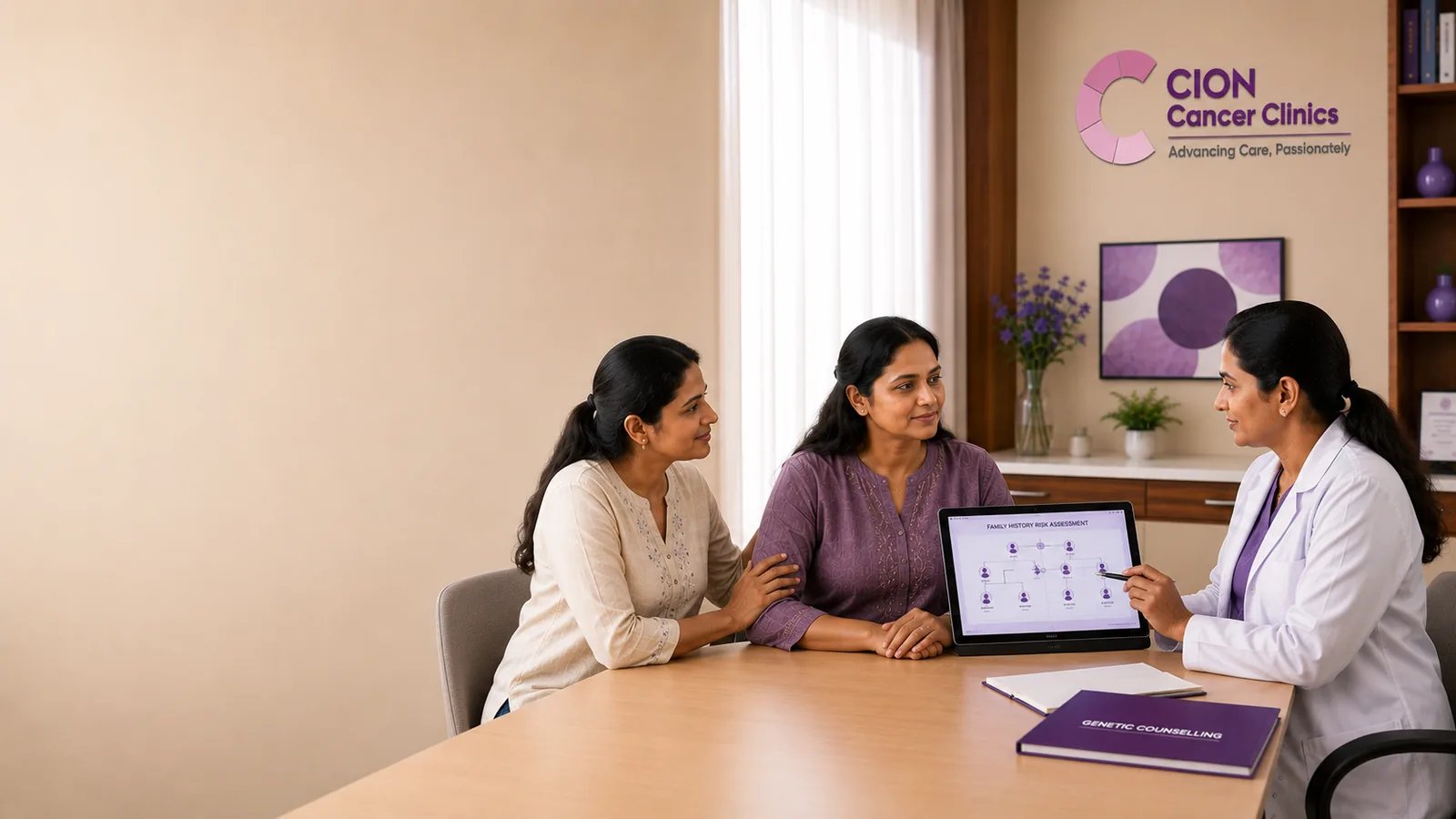
Every risk-reducing decision starts here, not in the operating theatre. A genetic counsellor reviews your personal and family history, explains whether genetic testing is worthwhile, and — if you choose it — arranges a simple blood or saliva test. They talk you through what a result means before and after, so nothing comes as a shock, and they help you understand your real level of risk. Only then, with clear information, do you and your team consider whether surveillance or surgery fits you.
Genetics services we offer — book any of these:
Genetic risk assessment
A counsellor reviews your personal and family history to work out whether your inherited risk is genuinely high — the essential first step.
If a gene change is confirmed, close relatives can be offered testing too — so those who share the risk can protect themselves, and those who don't are reassured.
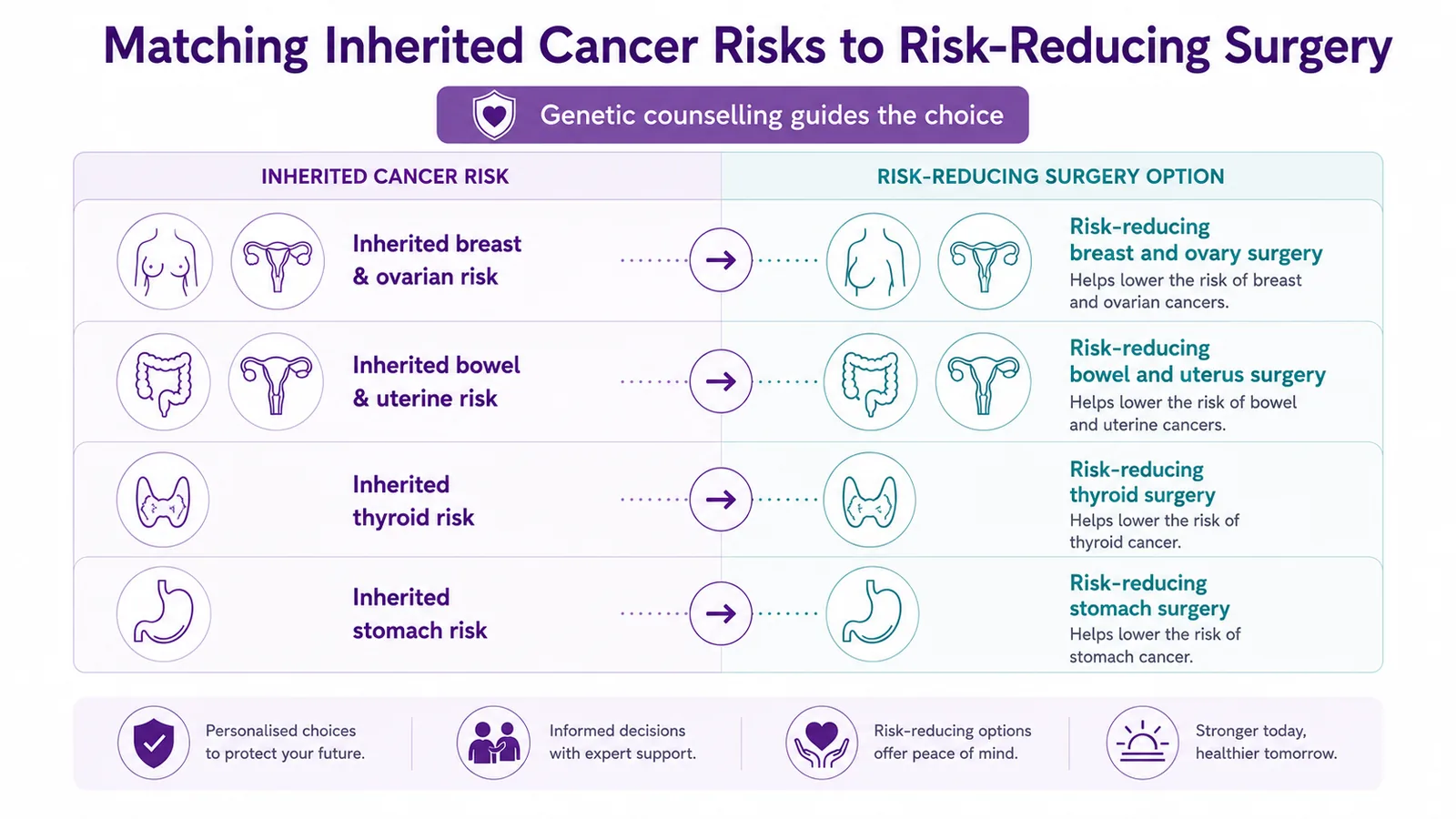
Different inherited risks point to different risk-reducing surgeries. Which one — if any — is right for you depends on your specific gene change or family history, and is decided with genetic counselling. Here are the main ones. Each is a considered choice, never a default, and each links to the detailed page for that operation.
Genetic counselling guides which — if any — risk-reducing surgery fits your inherited risk.
Risk-reducing surgeries we perform — book a consult for any of these:
Risk-reducing mastectomy
Removing breast tissue to lower a high inherited breast-cancer risk (e.g. BRCA). Reconstruction is planned alongside.
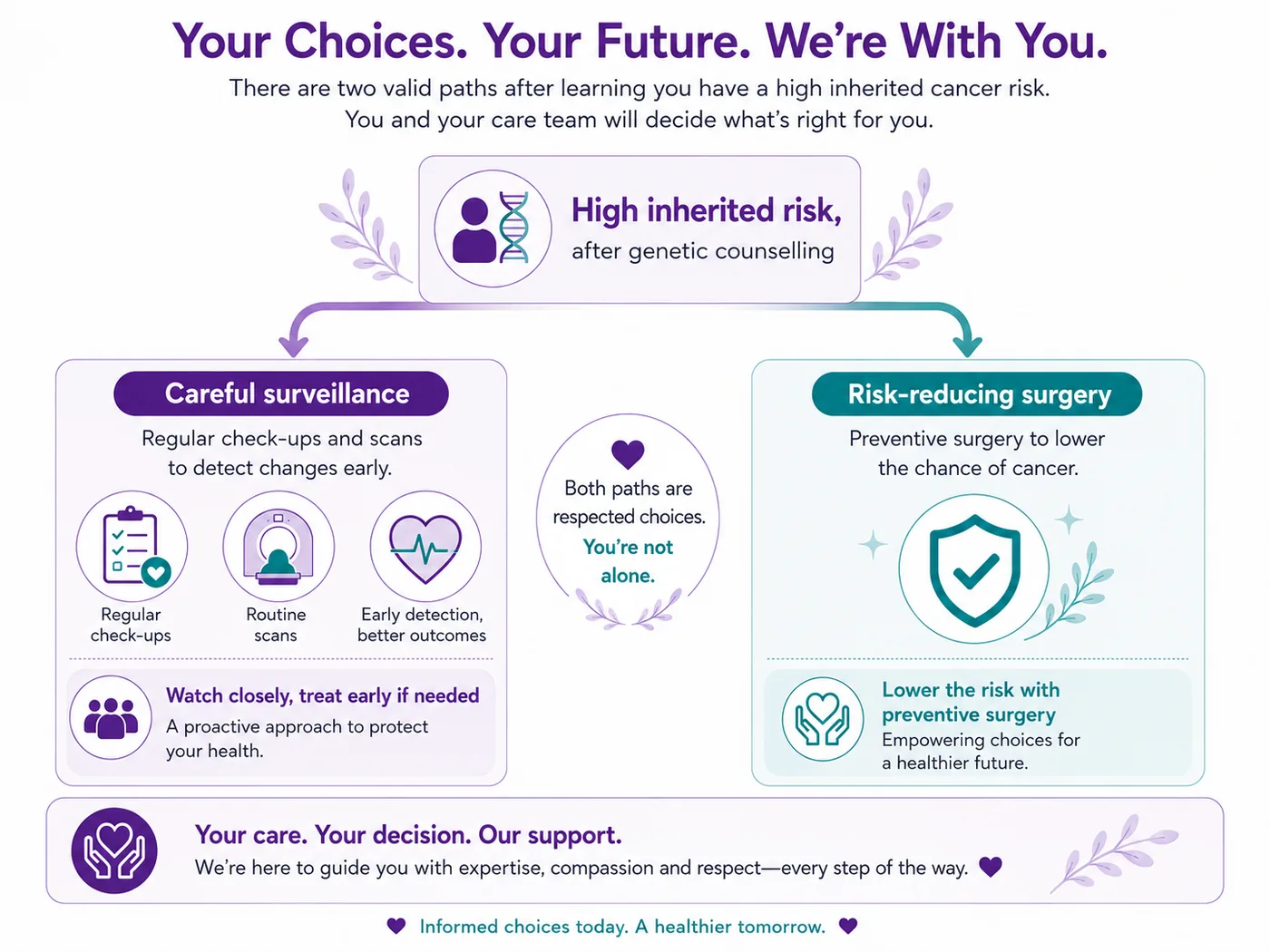
Risk-reducing surgery is powerful, but it is not the only path, and a good team will tell you so. For many people at high risk, careful surveillance — regular check-ups, scans and tests designed to catch anything very early — is a completely reasonable choice, especially while deciding, or where surgery would mean major changes like early menopause. The right answer depends on how high your risk is, which organ is involved, your age and your priorities. Both are respected choices, made with you after genetic counselling.
After genetic counselling, both careful surveillance and risk-reducing surgery are valid choices — weighed together with your team.
Careful surveillance
Risk-reducing surgery
What it involves
A schedule of regular scans, tests and check-ups to catch any cancer very early.
An operation to remove the at-risk organ before cancer develops.
Often suits
People still deciding, younger people, or where surgery would mean big changes (like early menopause).
People with very high risk who want to lower it decisively, once they've weighed the trade-offs.
Main trade-offs
Avoids surgery now; needs lifelong discipline, and does not lower the risk itself.
Lowers the risk substantially; a one-time operation with its own consequences (e.g. menopause, fertility).
The trade-offs, honestly
What surgery means: menopause, fertility & recovery
Because risk-reducing surgery removes a healthy organ, its consequences deserve honest attention — and full support. Removing both ovaries before natural menopause brings on menopause, so hormone and symptom support is planned. Where fertility could be affected, options to preserve it are discussed before surgery. Recovery depends on the operation, and is usually quicker for keyhole procedures. None of this is faced alone: it is planned, supported and, for many people, followed by real peace of mind.
Surgical menopause
If both ovaries are removed before menopause, it begins suddenly — with symptom and hormone support planned as part of your care.
Fertility, planned early
Where surgery could affect fertility, preservation options are discussed before the operation, and timing can often wait until your family is complete.
Recovery & support
Recovery varies by operation and is quicker for keyhole surgery. Emotional and practical support runs through the whole journey.
Cost & coverage
Risk-reducing surgery cost in Hyderabad Indicative
Cost depends entirely on which operation applies to your inherited risk, the surgical approach and your hospital stay. Below are indicative ranges only. An important honesty note: Aarogyasri and PMJAY are designed mainly for treating cancer, and coverage for preventive (risk-reducing) surgery can be limited or vary case by case — some private insurance may help. Our counsellors check your specific policy and situation so there are no surprises.
Indicative cost estimator
Pick the surgery for an indicative range, then request an exact estimate for your case.
Indicative range
₹1,50,000 – ₹2,40,000
for a risk-reducing mastectomy, open surgery, general room
Careful surveillance is a valid, lower-cost alternative for many people — your genetic counsellor will weigh both with you.
Figures are indicative only and not a quotation. Aarogyasri / PMJAY are designed mainly for treating cancer; coverage for preventive surgery can be limited or vary case by case. Your actual cost depends on your diagnosis and plan.
A strong family history or a known gene change deserves clear answers, not worry. Book a free, confidential conversation — it starts with genetic counselling and commits you to nothing.
Your family history reviewed by CION's genetics & surgical-oncology team
An honest look at both paths — surveillance and surgery
Testing, cascade family testing & coverage guidance
Support
Cost, coverage & being honest about it
Cost should be part of an informed decision, not a hidden shock. Here we are honest: government schemes such as Aarogyasri and PMJAY are designed mainly for treating cancer, and coverage for preventive (risk-reducing) surgery can be limited or vary case by case. Some private insurance policies may help. Rather than leave you guessing, our counsellors check your specific policy and situation, explain what is and isn't covered, and map out the real costs and options — so you can plan clearly.
9 clinics in Hyderabad · 35+ across Telangana & AP
CION cancer care is closer than you think.
We're never more than 30 minutes away. Same panel of specialists at every centre. Same tumour board reviews. Same NCCN protocols. Pick the closest one and call directly — or let us pick for you.
Don't see your city? Call
18002028726
— we'll find your nearest CION partner centre.
Meet the surgical oncology team
Risk-reducing surgery is planned by a team, not one doctor.
Genetic counsellors and fellowship-trained surgical oncologists plan every risk-reducing case together in a multidisciplinary team — part of 17 senior specialists across CION.
Share your name and number — we'll call you back within 30 minutes to schedule your consultation.
Worried about a family history of cancer? Don't carry it alone.
Whether surgery is ever right for you — or careful surveillance is the better path — starts with genetic counselling. Let CION's team assess your risk and explain every option, calmly and confidentially.
Common fears about prophylactic surgery — answered
Preventive surgery is an unfamiliar idea for many families here. Here are honest, gentle answers to the questions we hear most in Telangana.
“Why would I remove a healthy organ to prevent cancer?”
Fact: It is a completely fair question, and risk-reducing surgery is only ever considered for people whose inherited risk is genuinely high. For them the risk is much greater than average, and some of these cancers are hard to catch early — so removing the at-risk organ before cancer develops can be one of the most effective ways to protect health. It is never routine, never rushed, and never the only option: surveillance is always on the table.
“Does a ‘cancer gene’ in the family bring shame or affect marriage prospects?”
Fact: An inherited gene change is not a fault, a shame or anyone's doing — it is simply part of some families' biology, and far more common than people realise. Knowing about it is a strength, not a weakness: it lets a whole family protect itself. Genetic information is private and confidential, shared only as you choose. Understanding your risk and acting on it is a responsible, caring thing to do.
“Isn't surveillance enough — am I overreacting by considering surgery?”
Fact: You are not overreacting by asking, and you may well conclude that surveillance is right for you — for many people it is. Neither choice is ‘over’ or ‘under’ reacting; they are two valid ways to manage a high risk. A good team will never push you toward surgery. The point of genetic counselling is exactly this: a calm, informed choice you feel at peace with.
“Will insurance or Aarogyasri pay for preventive surgery?”
Fact: Here we are honest — government schemes such as Aarogyasri and PMJAY are designed mainly for treating cancer, and coverage for preventive (risk-reducing) surgery can be limited or vary case by case. Some private insurance may help. Rather than leave you guessing, our counsellors check your specific policy and map out the real costs, so cost is part of an informed decision, not a hidden shock.
“If I test positive for a gene change, does it mean I'll definitely get cancer?”
Fact: No. A gene change raises your risk — sometimes a lot — but it is not a certainty. Many people who carry one never develop cancer, and the whole point of knowing is that you can lower the risk further, through surveillance or surgery, and catch anything early if it ever appears. A positive result is information that puts you in control, not a sentence.
“Should I get my children or siblings tested too?”
Fact: If an inherited gene change is confirmed in you, close blood relatives may each carry the same risk — so offering them counselling and testing (cascade testing) can be genuinely protective. Adult relatives then make their own informed choices; testing of children is approached carefully and only where it would change their care. CION guides families through it sensitively, at everyone's own pace.
“A gene change means it's hopeless — why bother with any of this?”
Fact: The opposite is true. Knowing you carry a high inherited risk is one of the most empowering things you can learn, because it is exactly what lets you act — through surveillance that catches anything early, or surgery that lowers the risk. Families who understand their risk protect more than one generation. Knowledge here is power, not despair.
“Removing my ovaries will ruin my health and my marriage.”
Fact: If both ovaries are removed before natural menopause, menopause can begin suddenly — but it is manageable, with hormone and symptom support planned from the start. It does not change who you are or your relationships. Many women feel real peace of mind afterwards, and support for intimacy and wellbeing is part of the care.
“Preventive surgery will spread or cause the cancer.”
Fact: Risk-reducing surgery removes a healthy organ before cancer develops — it does not cause or spread cancer. It is planned, controlled and carried out only after genetic counselling shows the risk is genuinely high. The far greater danger for a high-risk person is doing nothing at all.
“I'm too old — or too young — for this.”
Fact: Age alone does not decide it. What matters is your level of risk, which organ is involved, your fitness and your priorities. For younger people, fertility and timing are weighed carefully; for older people, other health factors are considered. Your team assesses you individually rather than going by a number.
“Home or herbal remedies can lower my inherited risk instead.”
Fact: No home or herbal remedy is proven to lower an inherited cancer risk. Relying on one can give false reassurance and delay proper care. A healthy lifestyle helps everyone, but for a genuinely high inherited risk the effective options are careful surveillance and, where appropriate, risk-reducing surgery — both guided by genetic counselling.
“Talking about a family cancer history is unlucky — better to stay quiet.”
Fact: A family history is medical information, not an omen. Talking about it — with your relatives and a genetic counsellor — is exactly what allows a family to protect itself. Silence only hides a risk that could be managed. There is nothing unlucky about knowledge used well.
“If I have risk-reducing surgery, my cancer risk becomes zero.”
Fact: Risk-reducing surgery lowers the risk substantially, but no operation makes it exactly zero, because a small amount of at-risk tissue can remain. That is why follow-up still matters. Your team explains honestly how much your risk falls for your specific situation — a big reduction, not an absolute guarantee.
“I must decide immediately, without a second opinion.”
Fact: There is almost never a rush with risk-reducing surgery — it is preventive, so you have time to think, ask questions and get a second opinion. Taking that time is welcomed, not resented. A calm, informed decision you feel settled about is exactly what good genetic counselling is for.
“Getting tested will make it harder to get insurance later.”
Fact: This is a real, practical worry, and you deserve a straight answer. A genetic counsellor can explain what testing does and does not mean for you before you decide — nothing is done without your informed consent. The benefit of knowing, for your health and your family's, is weighed openly, and your genetic information stays confidential.
“My family will be blamed if a gene change is found.”
Fact: A gene change is nobody's fault — it is simply part of a family's biology, passed down like eye colour. There is no blame in it. What it offers is a chance for the whole family to understand and manage a shared risk. CION handles these conversations sensitively and privately, at each person's own pace.
“Surgery will leave me weak and in pain for months.”
Fact: Recovery depends on the operation, and is usually quicker for keyhole (laparoscopic) surgery — often a short hospital stay and a return to normal activities over a few weeks. Pain is managed carefully. Your team explains exactly what to expect for your specific operation, and support runs through the whole recovery.
“A cancer in the family means the worst — there's no point trying to prevent it.”
Fact: For people at high inherited risk, prevention genuinely works — careful surveillance catches cancers early when they are most treatable, and risk-reducing surgery lowers the risk substantially. Understanding and acting on your risk is one of the most hopeful, protective things you can do, for yourself and the next generation.
Why CION
Why choose CION for risk-reducing surgery in Hyderabad
Genetics-led, not surgery-led
Every decision starts with genetic counselling and an honest look at surveillance — so surgery is a choice, never a default.
All the surgeries, one team
Breast, ovary, bowel, uterus, thyroid and stomach risk-reducing surgery under one multidisciplinary roof.
Family testing & counselling
Cascade testing and counselling for relatives — protecting more than one generation.
Menopause & fertility support
Hormone, symptom and fertility-preservation support planned around any surgery.
Honest about cost & cover
Clear guidance on what Aarogyasri and insurance do and don't cover for preventive surgery — no surprises.
Care closer to home
35+ centres across Telangana & AP, Telugu-speaking teams, and confidential support throughout.
Real stories · real courage
15,000+ patients chose CION. Hear from them directly.
These aren't paid endorsements or written reviews. These are video testimonials from real patients and families — recorded on their own phones, in their own words. Pick any one. Watch it. Then decide.
4.8★800+ Google reviews
50+video testimonials
15,000+patients treated
Successful Chemotherapy & Radiation Done by Dr. Owais Mohammed & Dr. Kirti Ranjan
Watch video →
Successful Chemotherapy Done by Dr. C Raghavendra Reddy
Watch video →
Surgery, Chemo & Radiation Done by Dr. Imaduddin, Dr. Vinay, Dr. Owais, Dr. Kirti
Watch video →
Successful Radical Thymectomy Done by Dr. Mohammed Imaduddin & Dr. Vinay Mamidala
Watch video →
Successful Surgery Done by Dr. Rajender Byshetty
Watch video →
Successful Chemo & Surgery Done by Dr. Imad, Dr. Vinay, Dr. Owais & Dr. Raghavendra
Watch video →
Successful Chemo & Surgery Done by Dr. Imad, Dr. Vinay, Dr. Owais & Dr. Raghavendra
Watch video →
Successful Chemo & Radiation Done by Dr. Owais Mohammed & Dr. Kirti Ranjan Mohanty
Watch video →
Successful Breast Cancer Surgery Done by Dr. Imaduddin Mohammed & Dr. Vinay Mamidala
Watch video →
Successful Chemotherapy Done by Dr. Bharati Devi Gorantla
Watch video →
Successful Chemo & Surgery Done by Dr. Owais Mohammed & Dr. Imaduddin Mohammed
Watch video →
Successful Chemotherapy Done by Dr. Gundu Naresh
Watch video →
Successful Bone Marrow Transplantation - Neuroblastoma
Watch video →
Successful Surgery & Chemo - Carcinoma of Caecum
Watch video →
Successful Oral chemotherapy & mastectomy surgery
Watch video →
Successful Oral chemotherapy & mastectomy surgery
Watch video →
Successful Chemotherapy
Watch video →
Successful Surgery by Dr. Mohammed Imaduddin
Watch video →
Successful Bone Marrow Transplantation
Watch video →
Successful Oral chemotherapy & mastectomy surgery
Watch video →
Successful Oral chemotherapy & mastectomy surgery
Watch video →
Successful Chemotherapy
Watch video →
Successful Buccal Mucosa Surgery
Watch video →
Successful Complex Surgery Mandibulectomy Reconstruction
A risk-reducing journey is as much emotional as medical. At CION, genetic counselling, psychological support, nutrition, comfort and rehabilitation are one coordinated plan — so you are supported from the first question through to survivorship.
Genetic counselling
The gateway — risk assessment, testing and cascade testing for your family. Learn more
Psychology counselling
Support with a heavy decision, identity, and family conversations. Learn more
Nutrition counselling
Bone, heart and general-health nutrition, important after early menopause. Learn more
Rehabilitation
Physiotherapy and wellbeing support to recover strength and bone health. Learn more
Palliative & comfort care
Comfort and symptom support at any stage, alongside treatment. Learn more
Financial counselling
Insurance and coverage guidance so cost never blocks an informed decision. Learn more
FAQ
Prophylactic (risk-reducing) surgery — frequently asked questions
What is prophylactic (risk-reducing) surgery?
It is surgery to remove a healthy organ that carries a high inherited risk of cancer, before any cancer develops, to lower that risk substantially. It is only for people at genuinely high risk — usually an inherited gene change or strong family history — and is always weighed against careful surveillance, after genetic counselling.
Who should consider it?
People with a known inherited gene change linked to hereditary cancer (breast, ovarian, bowel, uterine, thyroid or stomach), or a strong family history of these cancers. Only a small share of cancers are strongly inherited, so most people never need it. A genetic counsellor assesses whether it applies to you.
Is surgery the only option, or can I just be monitored?
Surgery is not the only option. Careful surveillance — regular scans, tests and check-ups to catch anything early — is a valid choice for many people, especially while deciding or where surgery would mean big changes like early menopause. The right path depends on your risk, the organ, your age and your priorities.
Will Aarogyasri or insurance cover preventive surgery?
Government schemes such as Aarogyasri and PMJAY are designed mainly for treating cancer, and coverage for preventive (risk-reducing) surgery can be limited or vary case by case; some private insurance may help. CION's counsellors check your specific policy and situation and explain what is and isn't covered, so there are no surprises.
If I carry a gene change, will I definitely get cancer?
No. A gene change raises your risk — sometimes considerably — but it is not a certainty. Many people who carry one never develop cancer. Knowing lets you lower the risk further through surveillance or surgery, and act early if anything ever appears. Your genetic counsellor explains what your specific result means.
How much does risk-reducing surgery cost in Hyderabad?
It varies by the operation, from roughly ₹80,000 for a thyroidectomy up to around ₹4,00,000 for a total gastrectomy, depending on the surgical approach, room category and length of stay. These are indicative figures, not a quotation. Note that Aarogyasri and PMJAY are designed mainly for treating cancer, so coverage for preventive surgery can be limited — our counsellors check your specific case.
What does genetic counselling involve?
A genetic counsellor reviews your personal and family history, explains whether genetic testing is worthwhile, and if you choose it arranges a simple blood or saliva test. They talk you through what a result means before and after testing, and help you understand your real level of risk — before any decision about surveillance or surgery. It is confidential and commits you to nothing.
Will removing my ovaries cause menopause?
If both ovaries are removed before you have naturally reached menopause, menopause begins straight away (surgical menopause), with symptoms that are managed and supported. Whether hormone therapy is suitable depends on your situation. Fertility-preservation options are discussed before surgery where relevant.
Which risk-reducing surgeries does CION offer?
CION offers the full range under one team: risk-reducing mastectomy for high breast-cancer risk, salpingo-oophorectomy for ovarian and breast risk, prophylactic colectomy for high bowel-cancer risk, risk-reducing hysterectomy for uterine risk, prophylactic thyroidectomy for MEN2, and prophylactic gastrectomy for rare CDH1-related stomach risk — each chosen only after genetic counselling.
Should my relatives be tested?
If an inherited gene change is confirmed in you, close blood relatives may share the risk, so they can be offered genetic counselling and testing (cascade testing). Adults then make their own informed choices; children are tested only carefully and where it changes their care. CION guides families through this sensitively.
Does risk-reducing surgery mean my cancer risk becomes zero?
It lowers the risk substantially, but no operation makes it exactly zero, because a small amount of at-risk tissue can remain. That is why follow-up still matters. Your team explains honestly how much your risk falls for your specific gene change and situation — a large reduction, not an absolute guarantee.
How long is recovery after risk-reducing surgery?
It depends on the operation and is usually quicker for keyhole (laparoscopic) surgery — often a short hospital stay and a return to normal activities over a few weeks, avoiding heavy lifting at first. A gastrectomy or colectomy needs longer than an oophorectomy. Your team explains exactly what to expect for your specific operation.
Is there a rush to decide?
Almost never. Risk-reducing surgery is preventive, so you have time to think, ask questions, get a second opinion and involve your family. Timing can often wait until, for example, your family is complete. A calm, informed decision you feel settled about is exactly what genetic counselling is for.
Will genetic testing affect my ability to get insurance?
It is a fair, practical worry. A genetic counsellor explains what testing does and does not mean for you before you decide, and nothing is done without your informed consent. The benefit of knowing — for your health and your family's — is weighed openly with you, and your genetic information stays confidential.
Can fertility be preserved before risk-reducing surgery?
Where an operation could affect fertility, preservation options are discussed before surgery, and timing can often wait until your family is complete. For some risks, surveillance may bridge the gap until you are ready. Raise fertility early, so every option can be considered before anything is planned.
Is a family history of cancer something to be ashamed of?
Not at all. An inherited gene change or family history is simply part of some families' biology — it is nobody's fault, and far more common than people realise. Genetic information is private and shared only as you choose. Understanding your risk and acting on it is a responsible, caring thing to do for yourself and the next generation.
Do I have to have surgery if I test positive?
No. Testing positive gives you information and options — it never obligates you to have surgery. Many people at high inherited risk choose careful surveillance instead, at least for a time. Your genetic counsellor and oncologist help you weigh both paths, and the choice is always yours.
Which is the best hospital for risk-reducing surgery in Hyderabad?
Look for a cancer centre with genetic counselling, a multidisciplinary team that offers the full range of risk-reducing surgeries, honest surveillance-vs-surgery guidance, and menopause and fertility support. CION Cancer Clinics offers these across 35+ centres in Telangana and Andhra Pradesh, with Telugu-speaking teams.
Explore
Explore hereditary-cancer prevention at CION
The risk-reducing surgeries, the cancers they help prevent, and the genetics and support around the decision. Tap any topic to read more.
It is the first, no-pressure step — and it does not commit you to anything. Book at any of our 9 Hyderabad clinics, part of 35+ centres across Telangana & Andhra Pradesh.
Medical disclaimer: This page provides general information about prophylactic (risk-reducing) surgery for hereditary cancer risk and is not a substitute for professional medical advice, diagnosis or treatment. Surgery is one option; careful surveillance is a valid alternative — only a qualified genetic counsellor and oncologist who know your history can advise what is right for you. Costs shown are indicative only and not a quotation; Aarogyasri and PMJAY are designed mainly for treating cancer, and coverage for preventive surgery varies. Content is periodically reviewed by CION's medical team.

 CION Ameerpet