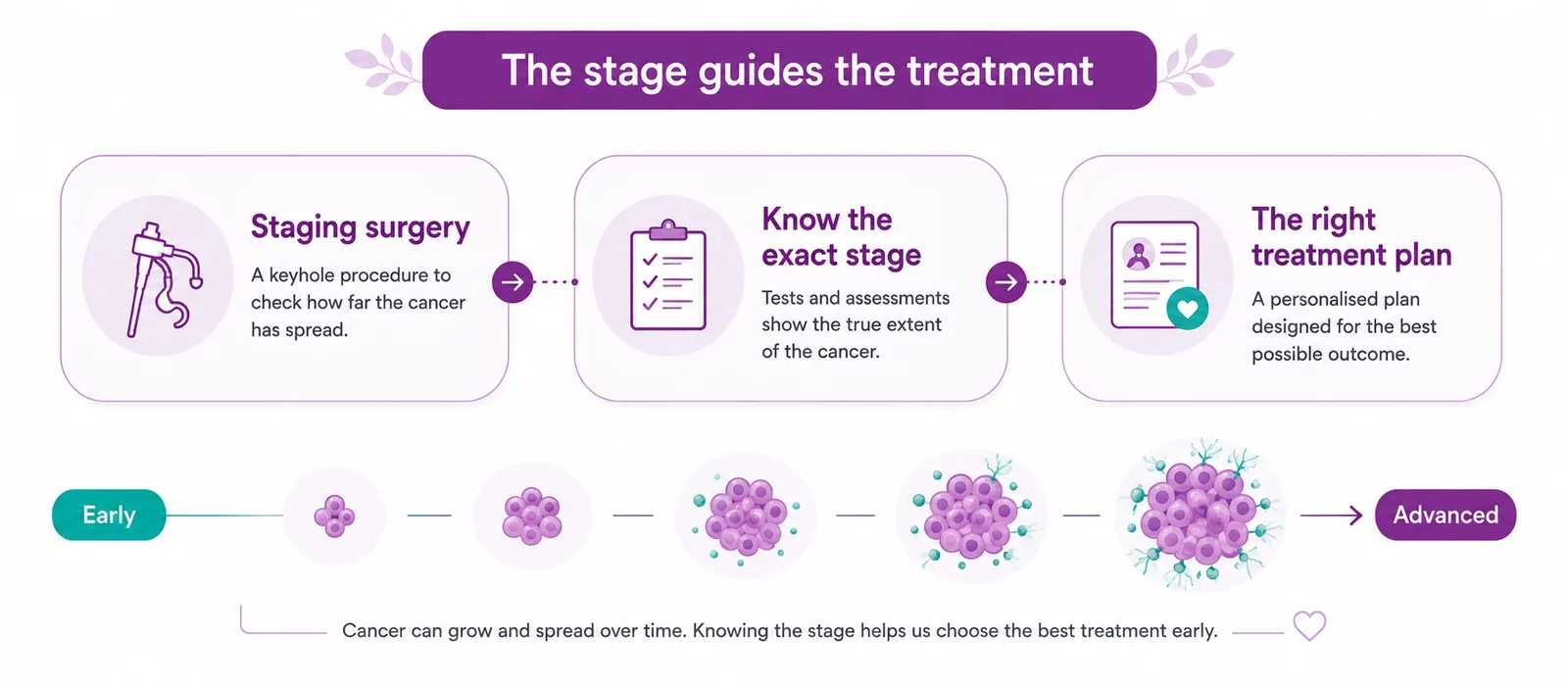
Before treatment can be planned well, the team needs to know exactly how far a cancer has spread — its stage. Staging surgery finds that out, often by keyhole surgery or a small sentinel-node procedure. It is not about removing the cancer yet; it is about a clear, trustworthy answer — so your treatment is exactly right, neither too much nor too little.
An accurate stage → the right treatment, planned by a tumour board
Staging is covered cancer care under Aarogyasri
★★★★★Rated 4.8/5 · 800+ Google reviews
Keyhole (minimally invasive) staging
Accurate stage, right treatment
Multidisciplinary tumour board
35+ centres · Aarogyasri help
SM
Written by Dr. Srinivasulu Mukta, Surgical Oncologist (MCh, Surgical Oncology · 35+ years), with CION's surgical oncology team. Medically reviewed by Dr. Muralidhar Muddusetty, MRCS (Edinburgh), AIIMS-trained, Surgical Oncology. · Reviewed 14 July 2026
Understanding staging
What is staging (cancer) surgery?
Staging surgery is an operation to find out how far a cancer has spread — its stage — rather than to remove the cancer itself. Surgeons take small tissue or lymph-node samples, or look inside with a keyhole camera, to check areas that scans cannot see clearly. Knowing the true stage is what allows the team to choose exactly the right treatment. It is often done by minimally invasive (keyhole) surgery, and for some cancers it is a small day-care procedure.
Scans such as CT, MRI and PET are an essential first step, and often give most of the picture. But scans cannot always tell whether tiny amounts of cancer have reached the lymph nodes or the lining of the abdomen. Staging surgery answers those specific questions directly, by testing the tissue itself — which is why it can change and sharpen the treatment plan, sometimes sparing people treatment they do not need. It sits within CION's wider cancer surgery service and, for the lymph nodes, links closely to sentinel lymph node biopsy.
Finds the true extent
Checks areas scans cannot see clearly — the lymph nodes and the lining of the abdomen — by testing the tissue.
Guides the right treatment
The exact stage decides the plan — so treatment is neither more nor less than you need.
Often keyhole surgery
Usually minimally invasive, and for some cancers a small day-care procedure with a quick recovery.
Why it matters
Why staging matters — the stage guides the treatment
Staging is the step that makes everything after it precise. Once the team knows the true stage, they can match the treatment to it exactly: an early stage may need much less treatment, while a more advanced stage needs a fuller plan. Getting the stage right protects you from being over-treated for a cancer that is smaller than it looked, and from being under-treated for one that has spread further than a scan suggested. Staging is never “extra” — it is the foundation of a good plan.
Staging surgery → knowing the exact stage → the right treatment plan, matched to how far the cancer has spread.
Not over-treated
If the cancer is more limited than it appeared, accurate staging can mean a gentler plan — and being spared treatment you do not need.
Not under-treated
If it has spread further than a scan suggested, staging catches that early, so your plan is strong enough from the start.
The main approaches
The types of staging surgery
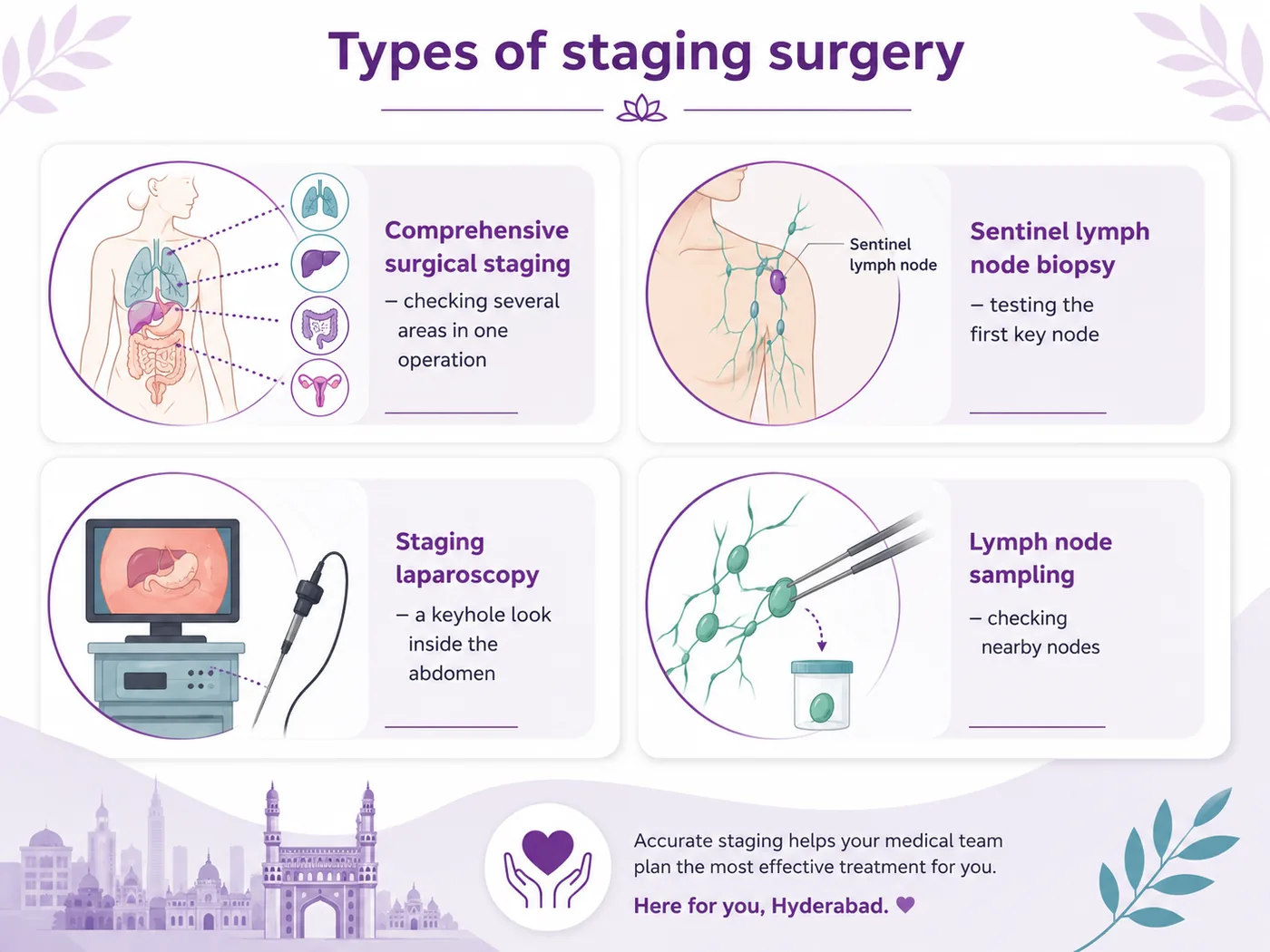
Staging surgery takes a few forms, depending on the cancer: comprehensive surgical staging (checking several areas in one operation, common for ovarian and uterine cancers), sentinel lymph node biopsy (testing the first key node rather than removing them all), staging laparoscopy (a keyhole look inside the abdomen for cancers like stomach and pancreas), and lymph node sampling or dissection. Your team chooses the one that gives a reliable answer with the least surgery.
The main types of staging surgery — the team picks the one that gives a reliable stage with the least surgery.
What staging usually applies to your situation?
Pick the cancer and what matters most for a plain-language picture of the likely staging approach. This is educational — not a diagnosis or a personal recommendation.
What this usually means
For ovarian and uterine (endometrial) cancers, staging is often done as comprehensive surgical staging — frequently by keyhole (laparoscopic) surgery — checking several areas and the lymph nodes in one operation, and a sentinel lymph node biopsy is increasingly used for the uterus. Your surgical oncologist will recommend the approach that balances a reliable answer with the least surgery for your situation. This is general information — the right plan is made with your team, who know your scans and your situation.
This tool is educational and not medical advice, a diagnosis or a personal recommendation. Only a surgical oncologist who knows your scans and health can advise what is right for you.
Sentinel node biopsy & keyhole staging — less surgery, the same answers
The best modern staging aims to get a reliable answer with the smallest possible operation. A sentinel lymph node biopsy is a good example: instead of removing every lymph node just to find out, the surgeon uses a harmless dye or tracer to find the first key node the cancer would reach, and tests that one. Far fewer nodes are removed, which greatly lowers the risk of long-term arm or leg swelling (lymphoedema). Keyhole (laparoscopic) staging follows the same principle — a clear answer, a smaller operation, a quicker recovery.
Sentinel lymph node biopsy
Removing all the nodes (full dissection)
What it involves
Finding and testing the first key node, using a harmless dye or tracer.
Removing a whole group of lymph nodes to test them.
Main advantage
Far fewer nodes removed, so much less risk of lasting swelling (lymphoedema).
Sometimes needed when nodes are already known to be involved.
Recovery
Usually quicker and gentler, often day-care or a short stay.
A little more involved, with more attention to arm or leg care.
For the full detail on breast sentinel node biopsy — how the node is mapped, and what the result means — see our dedicated sentinel lymph node biopsy page.
Finding the stage
Staging tests & investigations we offer
Staging brings together scans, tissue tests and, where needed, a small surgical procedure to build one accurate picture. Here are the staging investigations we offer — each planned by your surgical oncologist and reviewed by a multidisciplinary tumour board. Book any of these.
Surgical staging consultation
A surgical oncologist reviews your diagnosis and scans and plans exactly which staging is needed — the essential first step.
These are the staging operations themselves — most of them minimally invasive (keyhole), several done as day-care or a short stay. Which one — if any — you need depends on your cancer and scans, and is decided with your surgical oncologist. Book a consult for any of these.
Sentinel lymph node biopsy
Finding and testing the first key node the cancer would reach, using a harmless dye or tracer — so all the nodes need not be removed. Widely used in breast cancer and melanoma.
A short keyhole look inside the abdomen to find spread that scans miss — for cancers such as stomach and pancreas, sometimes avoiding a bigger operation.
Because staging surgery is often minimally invasive, recovery is usually quicker than for a major operation — and for smaller procedures like a sentinel node biopsy, it can be day-care or a short overnight stay. A comprehensive surgical staging operation is a little more involved, but still often done by keyhole surgery with a shorter recovery than open surgery. Your team explains exactly what your procedure involves, and the results guide the next step in your plan.
1
Before the procedure
Scans and tests help the team plan, and you hear clearly what the staging procedure involves and why, with time to ask questions.
2
The procedure
Often keyhole surgery or a small sentinel-node procedure. Many staging operations are day-care or a short stay.
3
The results
The tissue is examined to confirm the stage. Your team then explains what it means and how it shapes your treatment.
4
The next step
With an accurate stage, treatment is planned precisely — any further surgery or treatment arranged with the full picture clear.
Cost & coverage
What does staging surgery cost — and is it covered? Indicative
The cost depends on the type of staging procedure — a sentinel lymph node biopsy or a staging laparoscopy costs less than a comprehensive surgical staging operation. The reassuring part: staging is part of your cancer diagnosis and treatment, so it is generally covered under Aarogyasri at empanelled centres, and by most health-insurance policies. Our team checks your scheme eligibility and policy, and gives you a clear, written estimate before anything is planned.
Indicative cost estimator
Pick the procedure for an indicative range, then request an exact estimate for your case.
Indicative range
₹40,000 – ₹1,00,000
for a sentinel lymph node biopsy, general ward, self-pay
Staging is part of covered cancer care — generally supported under Aarogyasri at empanelled centres and by most health insurance. Our team confirms a written estimate before anything is planned.
Figures are indicative only and not a quotation, drawn from typical private-hospital ranges in India. Your actual cost depends on the exact procedure, hospital stay and any surgery or treatment planned around it.
A recent diagnosis and the wait to know your stage is an anxious time. Book a free, confidential conversation with our surgical oncology team — usually the same day, and it commits you to nothing.
Your scans and diagnosis reviewed by CION's surgical-oncology team
The least surgery that gives a reliable stage — explained clearly
Aarogyasri & insurance coverage guidance and a written estimate
Waiting to know your stage? Let's get you a clear answer.
An accurate stage is the foundation of the right treatment — neither too much nor too little. Let CION's surgical oncology team plan the least surgery that gives a reliable answer, calmly and confidentially.
9 clinics in Hyderabad · 35+ across Telangana & AP
CION cancer care is closer than you think.
We're never more than 30 minutes away. Same panel of specialists at every centre. Same tumour board reviews. Same NCCN protocols. Pick the closest one and call directly — or let us pick for you.
Don't see your city? Call
18002028726
— we'll find your nearest CION partner centre.
Meet the surgical oncology team
Staging is planned by a team, not one doctor.
A multidisciplinary tumour board and fellowship-trained surgical oncologists plan every staging case together — part of 17 senior specialists across CION.
Share your name and number — we'll call you back within 30 minutes to schedule your consultation.
Why CION
Why choose CION for staging surgery in Hyderabad
Minimally invasive staging
Keyhole (laparoscopic) staging and sentinel lymph node biopsy — a reliable answer with the smallest operation.
An accurate stage, the right plan
Staging is planned to guide treatment precisely — so you are neither over- nor under-treated.
A tumour-board approach
Every case is planned by a multidisciplinary tumour board, so staging and treatment fit together from the start.
Staging across cancers
Surgical staging for gynaecologic, breast, abdominal and other cancers, under one roof.
Aarogyasri & insurance help
Staging is covered cancer care under Aarogyasri at empanelled centres; our team helps with paperwork and estimates.
Care closer to home
35+ centres across Telangana & AP, Telugu-speaking teams, and supportive care throughout.
Real stories · real courage
15,000+ patients chose CION. Hear from them directly.
These aren't paid endorsements or written reviews. These are video testimonials from real patients and families — recorded on their own phones, in their own words. Pick any one. Watch it. Then decide.
4.8★800+ Google reviews
50+video testimonials
15,000+patients treated
Successful Chemotherapy & Radiation Done by Dr. Owais Mohammed & Dr. Kirti Ranjan
Watch video →
Successful Chemotherapy Done by Dr. C Raghavendra Reddy
Watch video →
Surgery, Chemo & Radiation Done by Dr. Imaduddin, Dr. Vinay, Dr. Owais, Dr. Kirti
Watch video →
Successful Radical Thymectomy Done by Dr. Mohammed Imaduddin & Dr. Vinay Mamidala
Watch video →
Successful Surgery Done by Dr. Rajender Byshetty
Watch video →
Successful Chemo & Surgery Done by Dr. Imad, Dr. Vinay, Dr. Owais & Dr. Raghavendra
Watch video →
Successful Chemo & Surgery Done by Dr. Imad, Dr. Vinay, Dr. Owais & Dr. Raghavendra
Watch video →
Successful Chemo & Radiation Done by Dr. Owais Mohammed & Dr. Kirti Ranjan Mohanty
Watch video →
Successful Breast Cancer Surgery Done by Dr. Imaduddin Mohammed & Dr. Vinay Mamidala
Watch video →
Successful Chemotherapy Done by Dr. Bharati Devi Gorantla
Watch video →
Successful Chemo & Surgery Done by Dr. Owais Mohammed & Dr. Imaduddin Mohammed
Watch video →
Successful Chemotherapy Done by Dr. Gundu Naresh
Watch video →
Successful Bone Marrow Transplantation - Neuroblastoma
Watch video →
Successful Surgery & Chemo - Carcinoma of Caecum
Watch video →
Successful Oral chemotherapy & mastectomy surgery
Watch video →
Successful Oral chemotherapy & mastectomy surgery
Watch video →
Successful Chemotherapy
Watch video →
Successful Surgery by Dr. Mohammed Imaduddin
Watch video →
Successful Bone Marrow Transplantation
Watch video →
Successful Oral chemotherapy & mastectomy surgery
Watch video →
Successful Oral chemotherapy & mastectomy surgery
Watch video →
Successful Chemotherapy
Watch video →
Successful Buccal Mucosa Surgery
Watch video →
Successful Complex Surgery Mandibulectomy Reconstruction
The wait to know your stage is one of the most anxious parts of a cancer journey. Here are honest, gentle answers to the questions we hear most in Telangana.
“If they operate to stage it, won't that make the cancer spread?”
Fact: This is one of the most common fears, and the answer is no. Staging surgery is careful, controlled and done by experienced surgical oncologists — taking small samples or a keyhole look does not make cancer spread. The far bigger risk is not knowing the true stage, which can lead to the wrong treatment. Modern staging is designed to get a reliable answer with the least surgery possible.
“Why do I need surgery to stage it — can't a scan tell you everything?”
Fact: Scans such as CT, MRI and PET are essential and often give most of the picture, but they cannot always tell whether tiny amounts of cancer have reached the lymph nodes or the abdominal lining. Staging surgery answers those specific questions by testing the tissue itself — which can sharpen the plan and sometimes spare you treatment you do not need.
“Staging surgery must be a big, frightening operation.”
Fact: Usually it is not. Much staging is done by keyhole (laparoscopic) surgery, and some procedures — like a sentinel lymph node biopsy — are small and may be day-care. Comprehensive surgical staging is a little more involved but is still frequently done by keyhole surgery, with a quicker recovery than open surgery. Your team explains exactly what yours involves.
“Will they remove all my lymph nodes and leave me with a swollen arm or leg?”
Fact: Not usually. Modern staging aims to remove as few nodes as possible — a sentinel lymph node biopsy tests only the first key node, which greatly lowers the risk of long-term swelling (lymphoedema). A wider node removal is done only when it is genuinely needed. Your team always chooses the least surgery that gives a reliable answer.
“Staging is just an extra procedure to run up the bill.”
Fact: Staging is never “extra” — it is the foundation of the whole treatment plan. Getting the stage right protects you from being over-treated for a smaller cancer, or under-treated for one that has spread further than a scan suggested. It often saves unnecessary treatment. And as covered cancer care, it is generally supported under Aarogyasri and insurance.
“Won't waiting for staging delay my treatment dangerously?”
Fact: Staging is what makes treatment right, and it is planned to happen promptly. For many cancers, staging and the first part of treatment are arranged closely together — sometimes in one operation. A short, purposeful step to get an accurate stage leads to better, faster-targeted treatment than rushing in without the full picture.
“Is staging surgery covered by Aarogyasri or my insurance?”
Fact: Staging is part of your cancer diagnosis and treatment, so it is generally covered under Aarogyasri at empanelled centres and by most health-insurance policies. CION's team checks your policy and scheme eligibility and provides a written estimate before anything is planned, so cost is clear from the start.
“A sentinel node biopsy sounds experimental — is it safe?”
Fact: It is a well-established, widely-used technique, especially in breast cancer and melanoma. Using a harmless dye or tracer, the surgeon finds and tests the first key node rather than removing them all — a smaller, gentler operation with a very reliable answer. It is one of the biggest advances in staging precisely because it does more with less surgery.
“If they need to look inside, they might as well do everything in one big surgery.”
Fact: Sometimes a staging laparoscopy — a short keyhole look inside — actually finds spread that scans missed, and shows that a bigger operation would not help. Staging first can spare you a major surgery you don't need, or confirm that surgery is the right move. The point is the smallest step that gives a reliable answer.
“How accurate is staging surgery really?”
Fact: Because it tests the tissue directly, staging surgery is a very reliable way to confirm the stage, and it can find spread that scans miss. No test is perfect, and your team combines the surgical findings with scans and pathology to build the most complete and accurate picture of your cancer.
“I'm too old or too weak for any kind of surgery.”
Fact: Many staging procedures are minimally invasive and gentle — a sentinel node biopsy or keyhole laparoscopy is far less demanding than major surgery, and is often suitable even when a big operation would not be. Your team assesses your fitness individually and chooses the safest, smallest approach for you.
“Home remedies or reports from another lab mean I can skip staging.”
Fact: No home remedy can tell you a cancer's true stage, and reports vary in what they can show. Staging surgery answers questions that scans and blood tests cannot, by testing the tissue itself. Skipping it risks the wrong treatment. If you already have reports, bring them — our team reviews everything before advising any further step.
“Talking about how far it has spread feels like giving up hope.”
Fact: The opposite is true. Knowing the exact stage is what lets your team fight the cancer precisely and effectively — an early stage often needs much less treatment, and even advanced stages are treated far better when the picture is clear. Staging is a hopeful, empowering step, not a verdict.
“Will I need to travel far or stay in hospital for a long time?”
Fact: CION has 35+ centres across Telangana and Andhra Pradesh, so care is usually close to home. Many staging procedures are day-care or a short stay, especially keyhole ones. Your team tells you clearly beforehand how long yours is likely to take and what to plan for.
“Is staging done at the same time as treatment, or separately?”
Fact: It depends on your cancer. For some, staging and the first part of treatment happen in one operation; for others, staging comes first so treatment can then be planned precisely. Your surgical oncologist and tumour board decide the best sequence for you — and explain it clearly before anything is done.
“I'm scared the staging will find it has spread everywhere.”
Fact: That fear is completely understandable. But staging often brings reassuring news — that a cancer is more limited than feared — and even when it finds spread, knowing early means the treatment can be made strong enough from the start. Whatever it shows, an accurate stage puts your team in the best position to help you.
“A cancer diagnosis in the family is shameful — better not to investigate.”
Fact: Cancer is a medical condition, never a source of shame, and investigating it properly is one of the most caring things you can do — for yourself and your family. Your information stays confidential. Accurate staging leads to the right treatment and the best chance of a good outcome; silence only delays help.
“Can't the surgeon just decide the treatment without all this staging?”
Fact: Good cancer care is never one person guessing. Staging gives the whole multidisciplinary tumour board — surgeons, oncologists, radiologists — the same accurate picture to plan from together. That shared, evidence-based plan is far safer and more effective than treatment chosen without knowing the true extent.
“What if I want a second opinion on my stage before agreeing to treatment?”
Fact: You are always welcome to. A second opinion on your stage and plan is a normal, sensible step, and a good team welcomes it rather than resents it. CION offers a confidential second opinion — taking the time to feel settled about your stage and treatment is exactly the right thing to do.
FAQ
Staging surgery — frequently asked questions
What is staging surgery?
Staging surgery is an operation to find out how far a cancer has spread — its stage — rather than to remove the cancer. Surgeons take small tissue or lymph-node samples, or look inside with a keyhole camera, to check areas scans cannot see clearly. Knowing the true stage lets the team choose exactly the right treatment.
Why do I need surgery to stage my cancer — can't a scan tell you?
Scans such as CT, MRI and PET are essential and often give most of the picture, but they cannot always tell whether tiny amounts of cancer have reached the lymph nodes or the abdominal lining. Staging surgery answers those specific questions by testing the tissue itself, which can sharpen the plan and sometimes spare you treatment you do not need.
Is staging surgery minimally invasive?
Often, yes. Much staging is done by keyhole (laparoscopic) surgery, and some procedures like a sentinel lymph node biopsy are small and may be day-care. Comprehensive surgical staging is a little more involved but is still frequently done by keyhole surgery, with a quicker recovery than open surgery.
Will staging surgery make my cancer spread?
No. Staging surgery is careful and controlled, and taking small samples or a keyhole look does not make cancer spread. It is performed by experienced surgical oncologists to answer specific questions the scans could not. The greater risk is not knowing the true stage, which can lead to the wrong treatment.
What is a sentinel lymph node biopsy?
It is a way of staging the lymph nodes with the least surgery. Using a harmless dye or tracer, the surgeon finds and tests the first key node the cancer would reach, instead of removing them all. Far fewer nodes are removed, which greatly lowers the risk of long-term arm or leg swelling (lymphoedema).
Will all my lymph nodes be removed?
Not usually. Modern staging aims to remove as few nodes as possible — a sentinel lymph node biopsy tests only the first key node. A wider node removal is done only when it is needed, for example when nodes are already known to be involved. Your team always chooses the least surgery that gives a reliable answer.
What is staging laparoscopy, and which cancers is it used for?
Staging laparoscopy is a short keyhole look inside the abdomen to find spread that scans miss — used for cancers such as stomach and pancreas. It can sometimes show that a bigger operation would not help, sparing you surgery you do not need, or confirm that surgery is the right next step.
What is comprehensive surgical staging?
It is checking several areas — and the lymph nodes — in one operation, often by keyhole surgery. It is common for ovarian and uterine (endometrial) cancers, where the stage depends on carefully assessing more than one site. It gives the tumour board a complete, reliable picture to plan treatment.
How accurate is staging surgery?
Because it tests the tissue directly, staging surgery is a very reliable way to confirm the stage, and it can find spread that scans miss. No test is perfect, and your team combines the surgical findings with scans and pathology to build the most complete and accurate picture of your cancer.
Is staging done at the same time as treatment?
Sometimes. For some cancers, staging and the first part of treatment happen in one operation; for others, staging comes first so treatment can then be planned precisely. Which applies depends on your cancer, and your surgical oncologist and tumour board decide the best sequence.
How long is recovery after staging surgery?
It depends on the procedure and is usually quicker for keyhole surgery. A sentinel lymph node biopsy can be day-care or a short overnight stay; a staging laparoscopy is typically a short stay; comprehensive surgical staging needs a little longer but is still often done by keyhole surgery. Your team explains exactly what to expect for your procedure.
How much does staging surgery cost in Hyderabad?
It depends on the procedure — a sentinel lymph node biopsy or staging laparoscopy costs less than a comprehensive surgical staging operation, with typical indicative private-hospital ranges from about ₹40,000 upward. These are indicative figures, not a quotation. Importantly, staging is covered cancer care, so it is generally supported under Aarogyasri and insurance — our team confirms a written estimate for your case.
Is staging surgery covered by Aarogyasri or insurance?
Staging is part of your cancer diagnosis and treatment, so it is generally covered under Aarogyasri at empanelled centres and by most health-insurance policies. CION's team checks your policy and scheme eligibility and provides a written estimate before anything is planned.
Does staging surgery mean my cancer is advanced?
Not at all. Staging is done for cancers at every stage, including very early ones — it is simply how the team finds out the true extent so treatment is exactly right. It often brings reassuring news that a cancer is more limited than feared. The stage is information that guides care, not a verdict.
Can I get a second opinion on my stage before starting treatment?
Yes, and it is a sensible step that a good team welcomes. CION offers a confidential second opinion on your stage and the treatment plan built on it. Taking the time to feel settled about your stage before treatment is exactly the right thing to do.
Which cancers commonly need staging surgery?
Ovarian and uterine (endometrial) cancers often need comprehensive surgical staging; breast cancer and melanoma commonly use sentinel lymph node biopsy; and stomach and pancreatic cancers may need a staging laparoscopy. Your surgical oncologist advises whether and which staging surgery applies to your specific cancer.
Do I have to stop my current medicines before staging surgery?
Your team will give you clear, personalised instructions before the procedure, including whether to pause any medicines (such as blood thinners) and when. Always share your full medicine list at the consultation so the plan is safe and tailored to you.
What happens after staging — what are the next steps?
The tissue is examined to confirm the stage, and your case is reviewed by a multidisciplinary tumour board. Your team then explains what the stage means and plans your treatment precisely around it, arranging any further surgery or treatment with the complete picture clear.
Which is the best hospital for staging surgery in Hyderabad?
Look for a cancer centre with an experienced surgical-oncology team, minimally invasive (keyhole) capability, sentinel lymph node biopsy, and a multidisciplinary tumour board that plans staging alongside treatment. CION Cancer Clinics offers surgical staging across 35+ centres in Telangana and Andhra Pradesh, with Telugu-speaking teams.
Explore
Explore cancer staging & surgery at CION
The staging procedures, the cancers they help stage, and the diagnosis and support around them. Tap any topic to read more.
Staging is the start of a bigger journey. At CION, surgery, diagnosis, nutrition and emotional support are one coordinated plan — so you are supported from the first test through treatment and recovery.
Sentinel node biopsy
The detailed breast sentinel lymph node biopsy guide — mapping, results and recovery. Learn more
Second opinion
A confidential second opinion on your stage and treatment plan. Learn more
Nutrition counselling
Nutrition to support you through diagnosis, surgery and treatment. Learn more
Psychology counselling
Support with the anxiety of diagnosis and waiting for results. Learn more
Rehabilitation
Physiotherapy and wellbeing support to recover strength after surgery. Learn more
Financial counselling
Aarogyasri and insurance guidance so cost never blocks the right care. Learn more
Get a clear, accurate stage — and the right treatment
Start with a consultation with CION's surgical oncology team. Book at any of our 9 Hyderabad clinics, part of 35+ centres across Telangana & Andhra Pradesh.
Medical disclaimer: This page provides general information about staging (surgical staging) surgery for cancer and is not a substitute for professional medical advice, diagnosis or treatment. Only a qualified surgical oncologist who knows your scans and history can advise what is right for you. Costs shown are indicative only and not a quotation; staging is generally covered cancer care under Aarogyasri and most insurance, and our team confirms a written estimate for your case. Content is periodically reviewed by CION's medical team.

 CION Ameerpet