
Understand your Tumour Grade and Ki-67
Grade is not stage, and grade 3 is not the worst line on your report. Here is what a pathologist actually scores, and why a faster-behaving cancer is not automatically the harder one to treat.

Grade is not Stage
Grade 3 does not mean stage 3. You are usually handed both numbers on the same day, they sound alike, and they answer completely different questions.
- Stage — how far it has spread.
- Grade — how the cells look and behave close up.
Stage is how far the fire has spread through the building. Grade is how hot it is burning. Two different questions, answered separately.
They also do not move together. An early cancer can be grade 3, and a later one can be grade 1. How staging works →
What your grade actually means
This is the whole of it. Three possible answers, and yours is one of them.
Still much like healthy cells
The cells look and behave close to normal breast cells, and are growing slowly.
Somewhere in between
Not close to normal, not far from it. The most common of the three.
Least like healthy cells
The cells look least like normal ones and are growing faster. Why that is not automatically worse news ↓
It does not tell you how far the cancer has spread — that is the stage. It does not tell you what treatment you will have. And it does not tell you what will happen to you.
How they work the grade out
The grade is not one doctor’s opinion. A pathologist — the doctor who examines your tissue under a microscope — checks three things separately. Each gets a score. The three are added up.
1 · Are the cells still doing their job? tubule formation
Healthy breast cells form tiny tubes. That is their job. The more the cancer cells have stopped doing it, the higher this score.
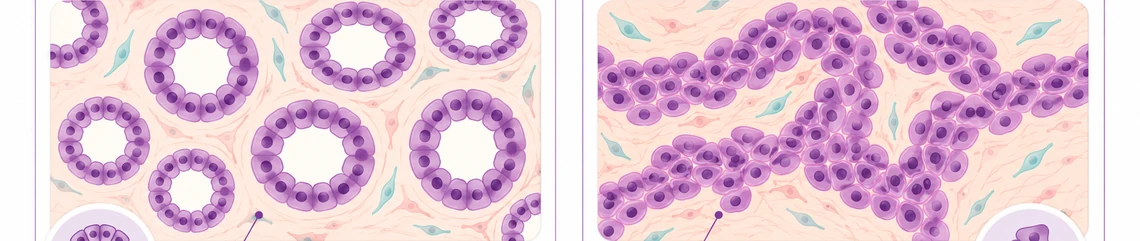

2 · Do the cells look alike? nuclear pleomorphism
A frightening word for a simple question. If the cells look much the same as each other, this scores low. If they are a mixed bag of shapes and sizes, it scores high.
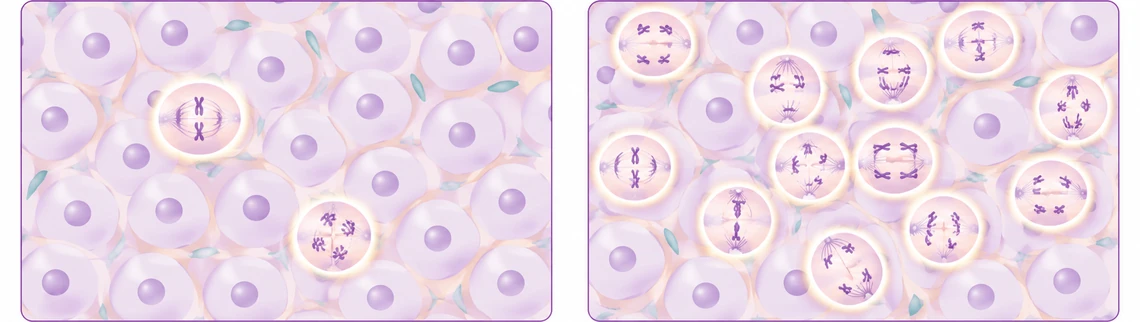
3 · How many were dividing? mitotic count
Cells grow by splitting in two. This counts how many were caught doing it.
A photograph of a busy road tells you how many cars were moving at that instant. It does not tell you the total traffic for the day. The mitotic count is that photograph.
It is a count at one moment — not a growth rate, and not a prediction.
See how the score adds up
If your report lists the three scores, set them here. It is a sum, not an opinion — which is why two different labs looking at the same tissue should land on the same grade. The sum is fixed. What the grade means for you is not.
Many reports show only the final grade and not the three parts. That is normal.
Grade 1
The cells still look and behave much like normal breast tissue.
What this does not tell you: what will happen to you. Grade is one piece, read together with the stage, the ER/PR/HER2 line and your general health.
This only shows how the sum works. It is not a diagnosis, it says nothing about what will happen to you, and it is no substitute for your oncologist reading your case.
How the total maps to a grade
- Lowest totals
- Grade 1 — the cells still look and behave much like healthy breast cells.
- Middle totals
- Grade 2 — in between, on all three features or on some of them.
- Highest totals
- Grade 3 — the cells look least like healthy ones, and more were caught dividing.
- Still forming tubes?
- Scores low when most cells still form tubes, high when few do.
- Cells look alike?
- Scores low when the cells look much the same, high when they vary a lot.
- Caught dividing?
- Scores low when few cells were caught dividing, high when many were.

What is Ki-67?
Cells grow by splitting in two. Ki-67 is a marker that only shows up in cells getting ready to split.
- The lab stains your tissue. Cells preparing to divide light up.
- Ki-67 is simply the count of how many lit up.
- A higher number means more were getting ready to divide when the sample was taken.
It gives your team a second read on how fast the cancer is behaving, alongside the grade.
It is a photograph, not a speedometer. It counts what was happening in one moment. It does not tell you how fast things will go from here.
Labs do not agree on where low ends and high begins. A number that looks frightening against something you read online may be perfectly ordinary against the scale your lab uses. Ask what your number meant to the doctor who read it.
A higher grade is not automatically worse news
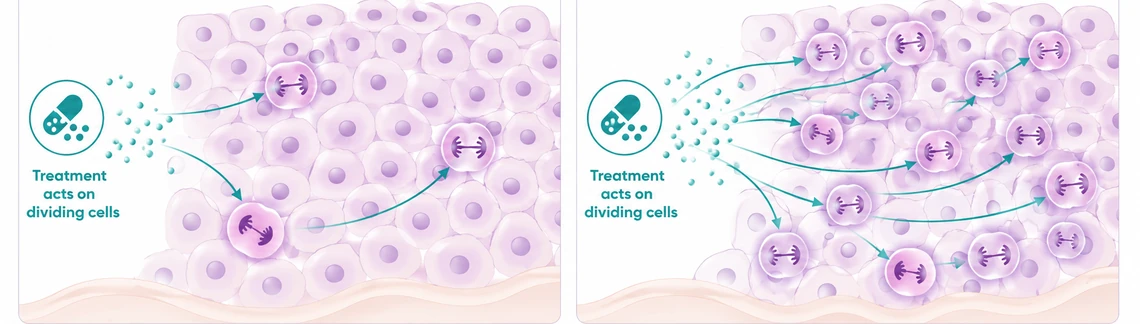
A higher grade does mean the cells are growing faster. But that cuts both ways, and almost nobody is told this part.
- Treatments that act on dividing cells have more to act on when more cells are dividing.
- Grade is one piece of several — weighed with the stage, the ER/PR/HER2 line and your general health.
A faster-growing cancer is not automatically the harder one to treat. It often gives treatment more to work with.
That is not a promise about outcome. It is a reason not to read this one line as a sentence.
Worried about a grade 3 result? Send us the report. An oncologist will tell you what it means alongside everything else on the page.
Get my grade explainedPrefer to watch it explained?
Short explainers covering the same ground as this page. Nothing loads or plays until you press it.
Awaiting URL
Awaiting URL
Questions people ask us
The six we hear most often about grade and Ki-67. Tap any question to open the answer.
Does grade 3 mean my cancer is more advanced?
No. That is stage, and it is a separate question.
Grade describes how the cells look and behave under the microscope. Stage describes how far the cancer has travelled. They are measured differently, and they do not move together. An early-stage cancer can be grade 3. A later-stage one can be grade 1. Your oncologist reads them alongside the receptor result and your general health rather than reacting to either in isolation. If your report gives you both, they are answering two different questions and neither is the whole picture on its own.
How is the grade actually decided?
By scoring three features separately and adding them up.
The lab scores three things. How much the cells still form tubes. How alike they look. And how many were caught dividing. Each gets its own score, the three are added into a single total, and the total decides whether the grade is 1, 2 or 3. It is arithmetic applied to defined features rather than one person's impression, which is worth knowing because it makes the number reproducible. Ask your oncologist which of the three drove your total if you want to understand it further.
What does my Ki-67 number mean?
It counts cells dividing at one moment, not a growth speed.
Ki-67 measures what proportion of cells were dividing at the instant your sample was taken. It is a snapshot rather than a rate, which is why it should not be read as how fast the cancer will grow. This matters: labs do not agree on where low ends and high begins. A number that looks frightening against something you read online may be perfectly ordinary against the scale your lab uses. Ask your oncologist how your specific result was interpreted rather than comparing it to a figure from a search result.
Is a higher grade always worse news?
Not straightforwardly, and this surprises most people.
A higher grade does indicate a faster-behaving cancer. But treatments that act on dividing cells have more to act on when more cells are dividing. So a faster-growing cancer is not automatically the harder one to treat. Grade is also only one input among several, weighed alongside the stage, the receptor status and your general health. It is a real factor and worth understanding. But it is not the line that decides everything, and reading it on its own causes a great deal of unnecessary fear.
Can my grade change?
It can be re-checked, and it may shift slightly.
The grade describes the tissue that was examined. If a small needle sample was taken first, and more tissue is removed at surgery, the lab may look again at the larger piece. The grade can move. That is a change in the accuracy of the information rather than a change in the cancer. It is the same principle as a stage being confirmed after surgery. If your grade has changed between reports, ask whether the plan changes with it, because often it does not.
Does grade decide my treatment?
It influences it. It does not decide it alone.
Grade feeds into the discussion, particularly around whether treatment that acts on dividing cells is worth adding. But the receptor result usually has more influence on which treatments are suitable, and the stage shapes the overall approach. Two people with the same grade can be given quite different plans because everything else about their reports differs. If you want to understand your own plan, ask which factor was the deciding one in your case rather than assuming it was the grade.
Want your report read properly?
Bring the lab report and the slides if you have them. An oncologist will explain what your grade and Ki-67 mean alongside the stage and the ER/PR/HER2 line. That is the only way either number means anything.
Or call 1800 202 8726 — toll free, no obligation.
Support that comes with your treatment
At CION these run alongside treatment, not as afterthoughts.
Nutrition
Appetite, weight and strength through treatment.
Psychology
Support for patient and family.
Genetic counselling
Hereditary risk for you and close relatives.
Palliative care
Comfort and symptom support at any stage.
Pain management
Dedicated pain control as part of the plan.
Rehabilitation
Shoulder mobility and lymphoedema care.
Your grade means something only alongside everything else
An oncologist will read the grade, the Ki-67, the stage and the ER/PR/HER2 line together, and tell you what follows from them. Bring the printout, and the slides and wax block if you have them.
Toll free 1800 202 8726 · Advancing Care. Passionately.