

Medical Oncologist
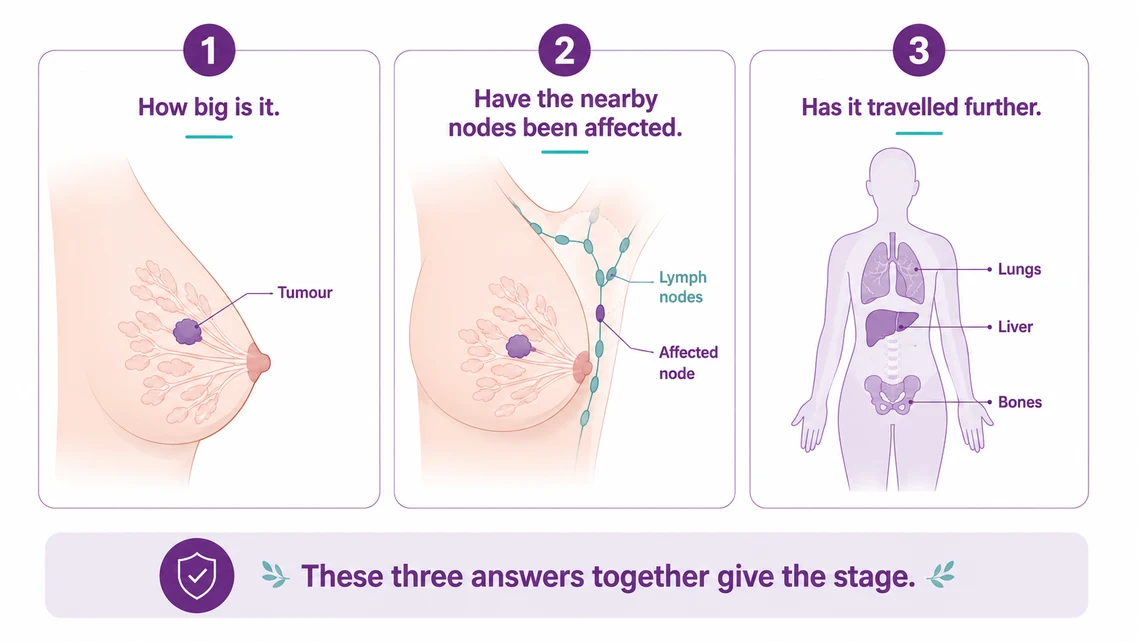
A stage is not a verdict and not a score out of four. It is the answer to three specific questions — and it describes something quite different from what most people assume.
A stage is not decided by one person looking at one thing. It is assembled from three separate answers.
Three questions. How big is it. Have the neighbours been affected. Has it travelled. Put the three answers together and you have the stage.
This is also why the stage is often not final until after surgery — two of the three answers get more accurate once the tissue has been examined.
Each stage describes how far the cancer has reached — nothing more and nothing less.
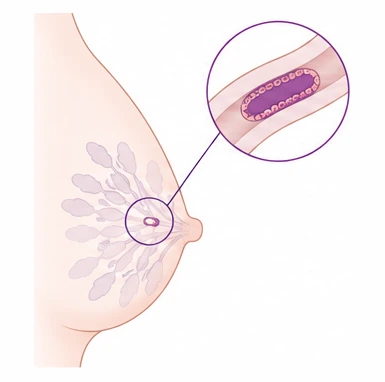
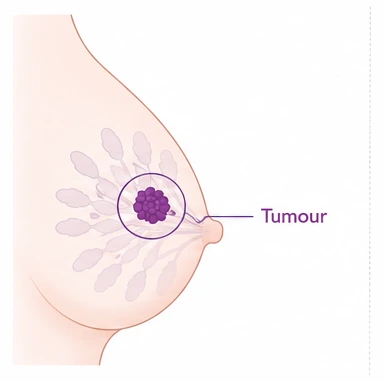
Small, and crossed into breast tissue. Nodes clear or barely involved.
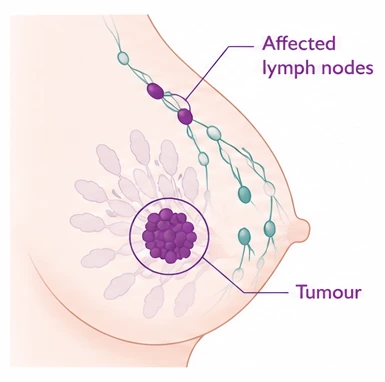
Larger, or some nodes involved. Still confined to the breast and nearby nodes.
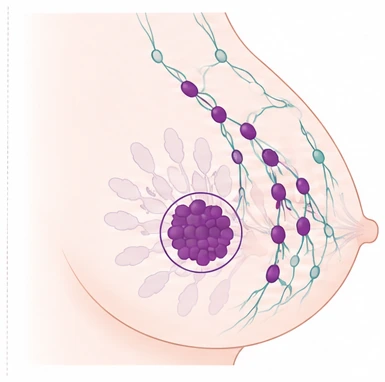
More extensive locally — but not in distant organs.
Two people can share a stage and be given genuinely different plans, because stage answers only one of the questions. Grade answers how the cells behave and receptor status answers what fuels it — the plan follows all of them together.
A different plan from someone else’s is individualisation, not inconsistency. Grade → · Receptor status →
Not sure which stage you have been given? Send us your reports. An oncologist will tell you what they say and what usually follows.
Get my stage explainedPick what your report says for each of the three. This explains the notation — it does not calculate a stage group.
A lower-case p in front (pT, pN) means it was measured on tissue after surgery rather than estimated from scans.
T1 — a small tumour. N0 — no cancer found in the nearby nodes. M0 — no evidence it has travelled elsewhere.
What this does not tell you: the stage group. That comes from combining all three along with other factors, and it is your oncologist who assigns it.
This decodes notation only. It does not calculate your stage, and it is not a diagnosis. Staging also takes account of grade and receptor status, which is why a table alone cannot give you the answer.
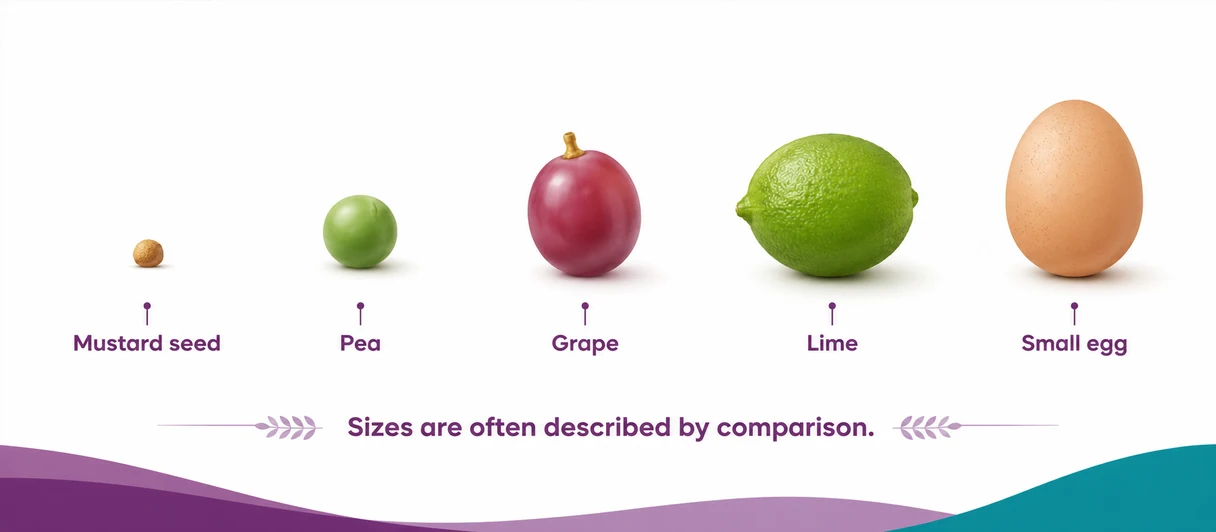
The measurement in centimetres is the figure most people fix on, and it is the hardest one to picture. Comparing it to something familiar helps more than the number does.
Mustard seed, pea, grape, lime, small egg. That is usually enough to make the figure mean something.
But size is only one of the three questions. A small cancer that has reached the nodes can stage higher than a larger one that has not — so do not read the centimetres as the whole answer.
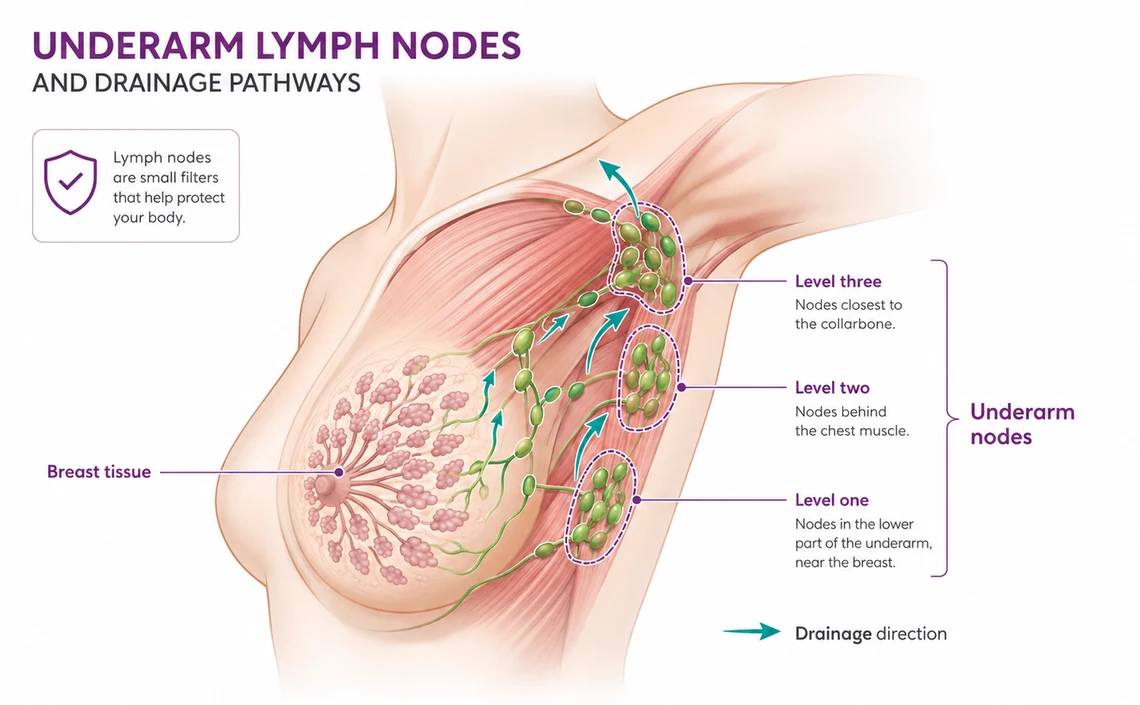
The breast drains into a chain of lymph nodes in the armpit. Checking them is how the team works out whether anything has left the immediate area — which is why the armpit is involved at all, and that surprises most people.
Node involvement is not the same as spread to distant organs. Nodes are the checkpoints next door; distant spread is another building entirely.
Confusing the two is how a stage 2 gets read as a stage 4.
Talk to our team
Call the helpline or leave your details, and someone will help you arrange a consultation at the CION centre nearest you. One helpline serves every CION centre.
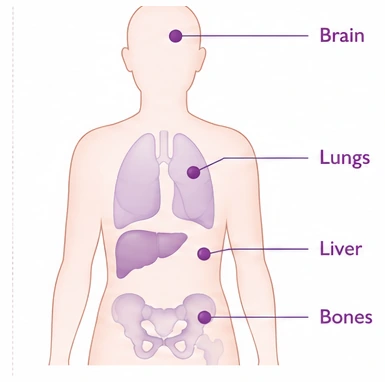
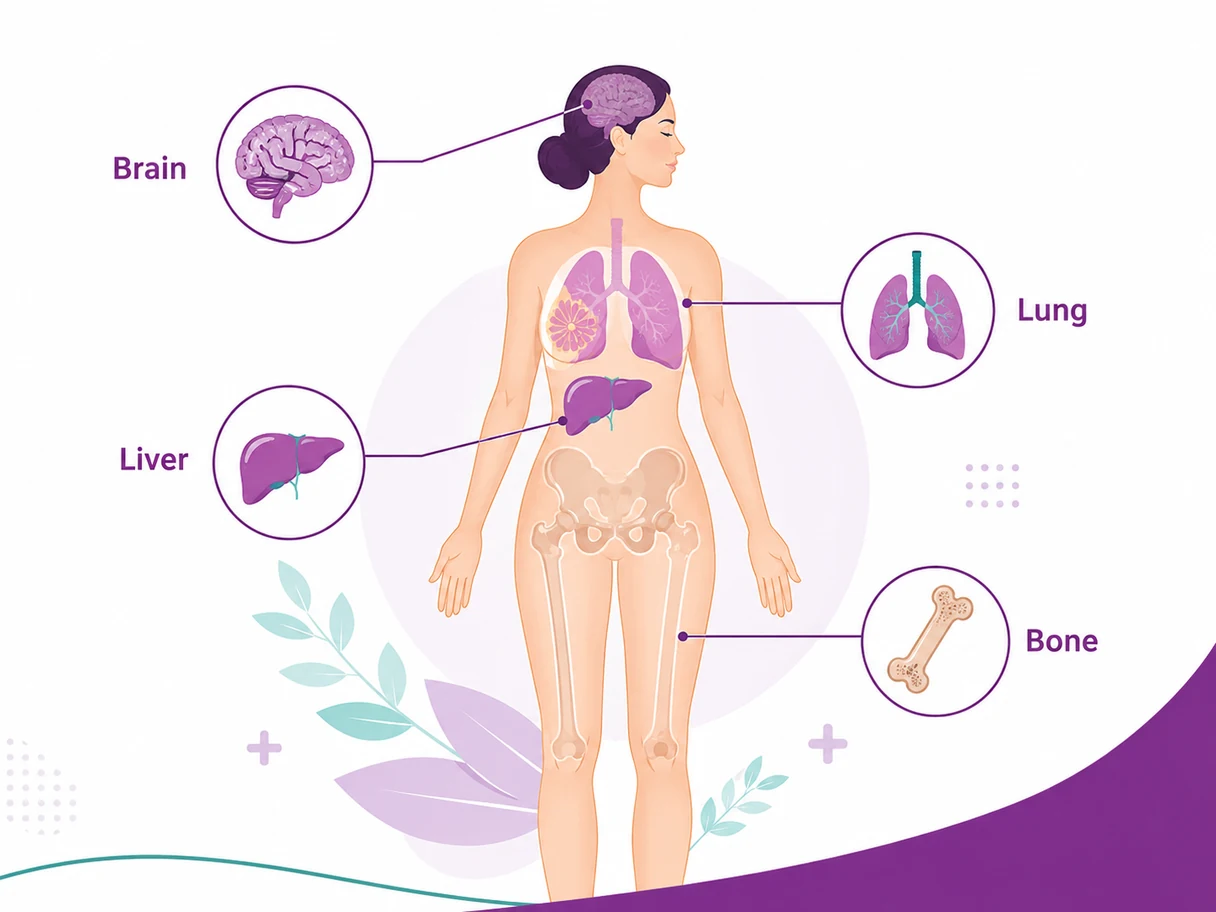
Stage 4 means the cancer has travelled beyond the breast and the nearby lymph nodes to another part of the body.
The goal of treatment changes accordingly. Rather than removing it, the plan is to control it — often continuing over a long period, and adjusted as things change.
Breast cancer tends to travel to a small number of places rather than anywhere at all. That is why follow-up asks about particular symptoms and why certain scans are chosen.
New symptoms in those areas are worth reporting rather than waiting out — not because they are likely to be serious, but because checking is quick.
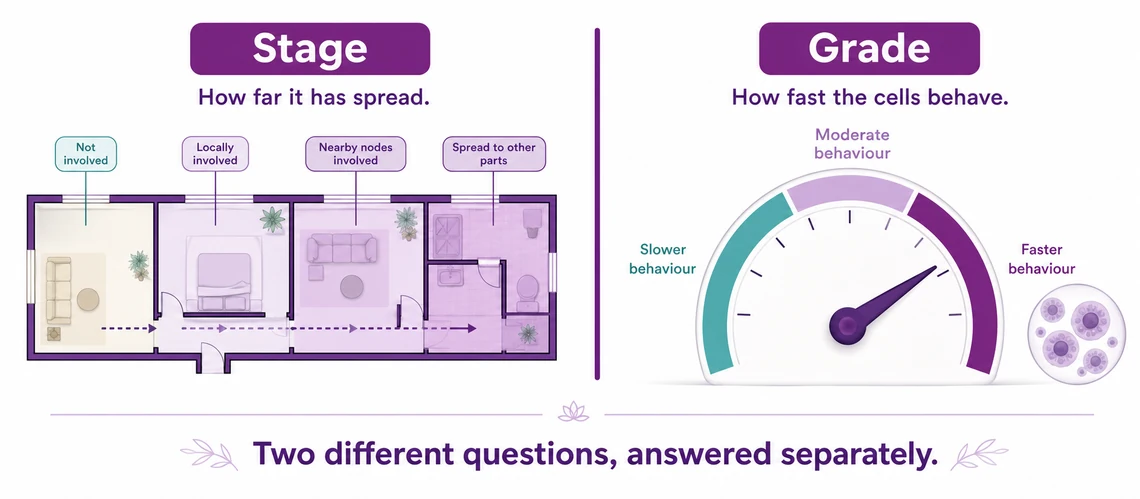
This is the most persistent confusion in the whole diagnosis, and the two words get used almost interchangeably by people who have just been given both.
Stage is how far the fire has spread through the building — one room, the next room, or another building. Grade is how hot it is burning. Two different questions, answered separately.
And stage is set at diagnosis. It does not climb over time. If cancer returns it is described as a recurrence, not renumbered to a higher stage. Grade explained →
Bring the scans, the report and the slides. A specialist will read them and tell you whether we reach the same stage — and whether the plan that follows is the one we would advise.
Or call 1800 202 8726 — toll free, no obligation.
Short explainers covering the same ground as this page. Nothing loads or plays until you press it.
Awaiting URL
Awaiting URL
Trained at AIIMS, Tata Memorial, and leading international centres. Combined 150+ years of experience. Every complex case is reviewed by 3+ of them — together.

MBBS(Gold Medal), DNB(General Medicine), DM(Medical Oncology)(Gold Medal)

MBBS, MD(General Medicine), DM(Medical Oncology)(Adyar,Chennai), ECMO, MRCP SCE(UK)

MBBS, MD (General Medicine), DrNB (Medical Oncology), ECMO, MRCP SCE (Medical Oncology) (UK)



MBBS (AIIMS), MS (Surgery) (AIIMS), DNB (Surgical Oncology), MRCS (Edinburgh)



MBBS, MS(General Surgery), M.Ch(Surgical Oncology), FMAS, FARIS(Ongoing)






MBBS, MS (General Surgery), DrNB (Surgical Oncology), FALS Oncology

Want a specific doctor for your case? Mention them when booking.
Book Free ConsultationShare your name and number — we'll call you back within 30 minutes to schedule your consultation.
Where to find us
Addressed by landmark, because that is how this city navigates. Each centre also names the areas it serves, so you can place it without a map. Consultation and day-care Chemotherapy run at every one of them.
Talk to our team
Call the helpline or leave your details, and someone will help you arrange a consultation at the CION centre nearest you. One helpline serves every CION centre.
The six we hear most often about staging. Tap any question to open the answer.
Stage answers how far the cancer has travelled. Grade answers how the cells are behaving under the microscope. They are separate questions and they do not move together: an early-stage cancer can be high grade, and a later-stage one can be low grade. Your oncologist reads them alongside the receptor result and your general health, and the plan follows all of them together rather than any single line. If your report gives you both a stage and a grade, they are telling you two different things and neither one is the whole picture.
The first stage is worked out from scans, which estimate size and node involvement from the outside. After surgery the tissue is examined directly, so the size is measured and the nodes are actually counted. A change between the two is a change in the accuracy of the information, not in the cancer itself. It can move in either direction, and moving up does not mean the wait caused harm. If it has changed, ask which parts changed and whether the plan changes with it.
Staging combines size, node involvement and whether it has travelled further. A small tumour that has reached the underarm nodes can stage higher than a larger one that has not. This surprises people who have fixed on the measurement in centimetres as the thing that matters most. It is also why the node result is worth understanding rather than skipping over. Ask your oncologist which of the three factors is driving your stage, because that tells you more than the number by itself.
Stage 4 means the cancer has travelled beyond the breast and the nearby lymph nodes to another part of the body. The goal of treatment changes accordingly: rather than removing it, the plan is to control it, often continuing over a long period and adjusted as things change. That is an active plan rather than the absence of one. What to expect varies a great deal between individuals and depends on factors specific to your case, so it is a conversation to have with your oncologist rather than a number to look up online.
Stage is assigned once, at diagnosis, and it is not renumbered afterwards. If cancer returns it is described as a recurrence, and where it has returned to is recorded separately. People often assume their stage climbs over time, which is not how the system works and causes unnecessary alarm. If you are told about a recurrence, ask where it is and what the plan is, rather than asking what stage you are now — that question does not have the answer you are expecting.
Stage tells the team how far the cancer has travelled. It does not tell them how the cells behave, which is grade, or what fuels the cancer, which is the receptor result. Two people can share a stage and differ on both of those, and the plan follows all of them together along with age, general health and personal preference. A different plan is individualisation rather than inconsistency, and it is not a sign that one of you is receiving better care than the other.
Still not sure what your stage means? Bring the reports. We would rather you asked than guessed.
Talk to an oncologistAt CION these run alongside treatment, not as afterthoughts.
Appetite, weight and strength through treatment.
Support for patient and family.
Hereditary risk for you and close relatives.
Comfort and symptom support at any stage.
Dedicated pain control as part of the plan.
Shoulder mobility and lymphoedema care.
An oncologist will read your scans and reports together and tell you what the stage means for your plan — including what is still provisional. Bring the films or CD, the biopsy report, and the slides and block if you have them.
Toll free 1800 202 8726 · Advancing Care. Passionately.