Laryngectomy (voice box cancer surgery) in Hyderabad
A laryngectomy removes part or all of the larynx — the voice box — to treat cancer. The fear it raises is profound: will I ever speak again? The honest, hopeful answer is that even when the whole voice box is removed, your voice can be restored — most often with a small voice prosthesis — and swallowing is usually kept. And for many early cancers, often signalled by lasting hoarseness, the voice box can be saved altogether.
Voice restoration after the voice box is removed
Voice-preserving options for early cancers · speech & swallow therapy
Aarogyasri for cancer · clear indicative costs
★★★★★Rated 4.8/5 · 800+ Google reviews
Voice restoration
Voice-preserving options
Speech & swallow therapy
35+ centres · Aarogyasri help
SM
Written by Dr. Srinivasulu Mukta, Surgical Oncologist (MCh, Surgical Oncology), with CION's head & neck surgical oncology team, led by Dr. Vinay Mamidala. Medically reviewed by Dr. Muralidhar Muddusetty, MRCS (Edinburgh), AIIMS-trained. · Reviewed 14 July 2026
Understanding the surgery
What is a laryngectomy?
A laryngectomy is surgery to remove part or all of the larynx (the voice box) to treat cancer. The larynx does three jobs — it makes your voice, keeps food out of the airway when you swallow, and carries air to the lungs. A partial laryngectomy removes only the affected part and can keep some natural voice; a total laryngectomy removes the whole voice box, after which you breathe through a small permanent opening in the neck (a stoma). The reassuring part is that even after a total laryngectomy, your voice can be restored, and swallowing is usually preserved.
Voice-box cancer very often announces itself early, as a hoarse voice that does not settle — which is why a voice change lasting more than two or three weeks should always be checked. Caught early, these cancers are highly treatable, and the voice box can frequently be saved with voice-preserving surgery or radiation. In our region, tobacco and smoking are the leading causes, so care here is practical and without judgement — the focus is on treating the cancer and getting you back to speaking and living well.
Removes the voice-box cancer
Part or all of the larynx is removed with a margin of healthy tissue, plus neck nodes where needed.
Your voice can be restored
After a total laryngectomy, a voice prosthesis or other methods let you speak again, guided by a therapist.
Early cancers keep the voice
Lasting hoarseness caught early can often be treated while keeping the voice box.
How much of the voice box is removed
Partial vs total laryngectomy — and can the voice box be saved?
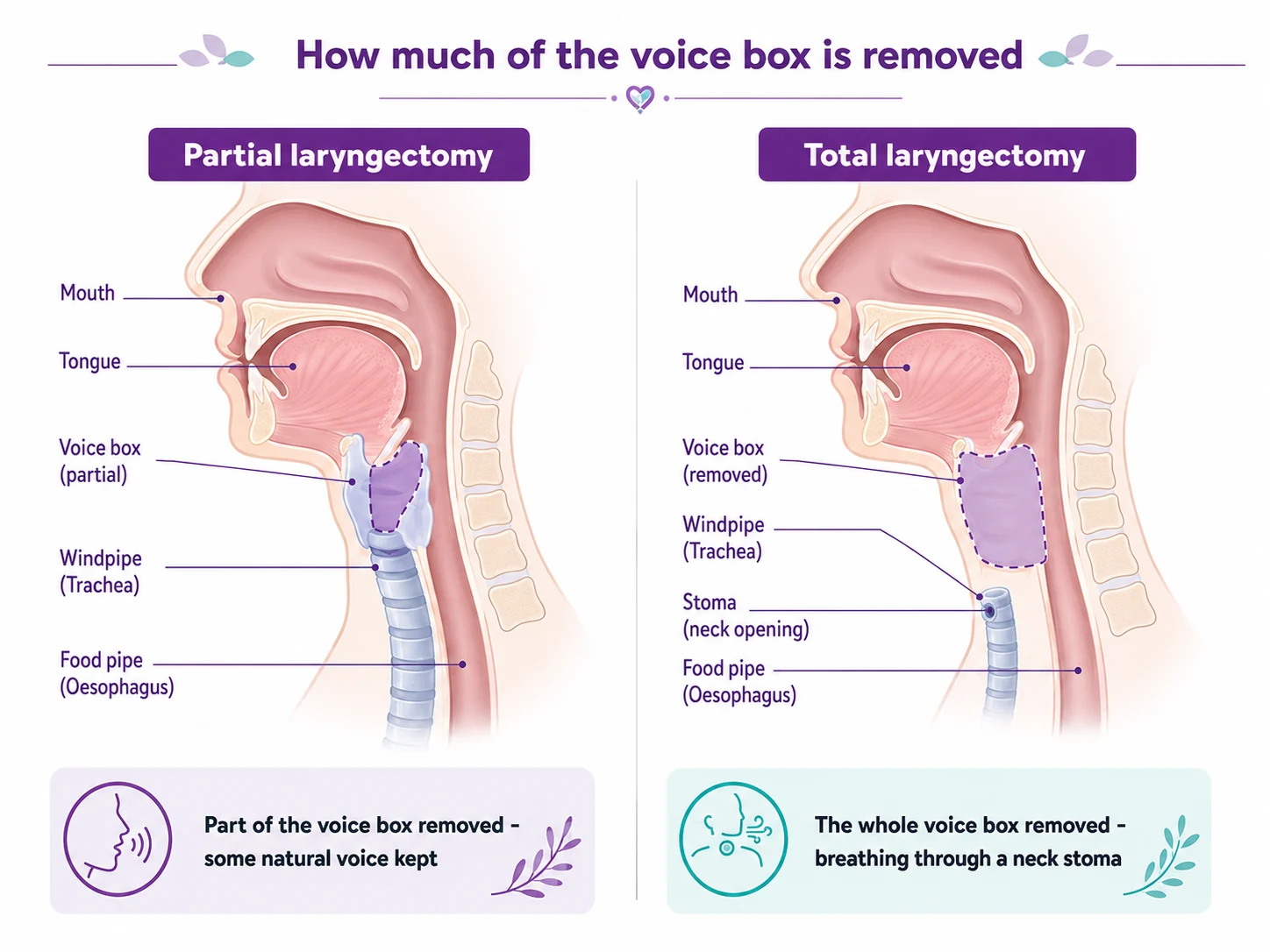
How much of the voice box is removed depends on the size and position of the cancer. For an early cancer, the voice box can frequently be saved — with voice-preserving surgery (including transoral laser), or with radiation — keeping your natural voice. A partial laryngectomy removes only the affected part and can keep some voice. A total laryngectomy removes the whole voice box, needed for advanced cancers, with a permanent neck stoma and the voice restored afterwards. For some advanced cancers, chemoradiation (radiation with chemotherapy) can be an alternative that aims to preserve the voice box, with surgery kept in reserve.
A partial laryngectomy keeps some natural voice; a total laryngectomy removes the whole voice box, with breathing through a neck stoma and the voice restored afterwards.
Partial laryngectomy
Total laryngectomy
What is removed
Only the affected part of the voice box; the rest is kept.
The whole voice box (larynx).
Used for
Early or limited voice-box cancers.
Advanced cancers, or where partial surgery is not safe.
Voice & breathing
Some natural voice is usually kept; you breathe normally through the mouth and nose.
You breathe through a neck stoma; the voice is restored with a voice prosthesis or other methods.
Tests that confirm the diagnosis and guide surgery
Before any surgery, the cancer is confirmed and staged. A specialist examination and a look at the voice box (laryngoscopy) with a biopsy establish whether it is cancer, and a CT/MRI and a PET-CT scan show how far it reaches and whether the neck lymph nodes are involved. Your head & neck team then plans — with you — how much of the voice box must be removed, whether the voice can be preserved, and how the neck will be treated.
Diagnostic services we offer — book any of these:
Head & neck / voice examination
A careful specialist check of a hoarse voice that won't settle, a lump in the neck or trouble swallowing, by a head & neck team.
Restoring your voice — speaking again after a total laryngectomy
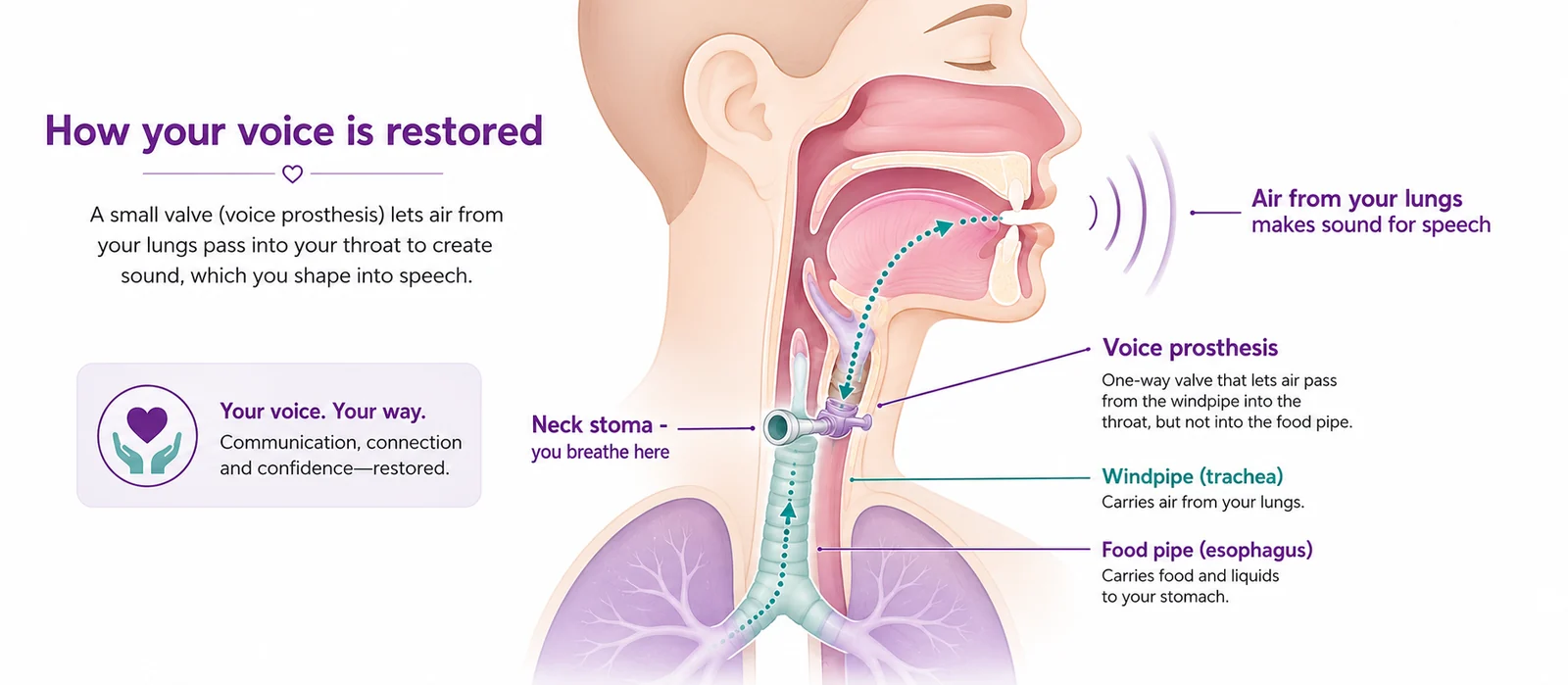
This is the fear that matters most, and the honest, hopeful answer is that you can speak again even after the whole voice box is removed. The most common method is a small voice prosthesis: a one-way valve placed between the windpipe and the food pipe, so that when you breathe out and gently cover the neck stoma, air from your lungs passes through it and makes sound, which your mouth shapes into speech. Other options are esophageal speech and a handheld electrolarynx. A speech-and-language therapist guides you from early on, and most people communicate clearly and confidently again.
A voice prosthesis
A small valve lets air from your lungs make sound for fluent, natural-sounding speech — the most common method today, fitted and looked after with your team's guidance.
Speech & swallow therapy
A therapist works with you from before surgery through recovery — teaching voice restoration, and esophageal speech or an electrolarynx as alternatives. Speech rehabilitation
A voice prosthesis lets air from your lungs make sound, which your mouth shapes into speech — while you breathe through the neck stoma.
Voice-preserving surgery, partial & total laryngectomy, neck nodes
The approach is chosen to remove the cancer completely while keeping as much voice and function as possible. For a very early cancer, a transoral laser or voice-preserving surgery — or radiation — can treat it while keeping the voice box. For a limited cancer, a partial laryngectomy removes only the affected part and can keep some voice. A total laryngectomy is used for advanced cancers, with the voice restored afterwards. The neck lymph nodes are usually removed and tested where the cancer can spread to them, which both treats and stages the cancer. Your surgeon and the tumour board plan which approach is safest and most function-preserving for you.
Voice-preserving (early)
For an early cancer, voice-preserving surgery (including transoral laser) or radiation can treat the cancer while keeping the voice box and your natural voice.
Partial laryngectomy
Only the affected part of the voice box is removed, keeping some natural voice, with normal breathing through the mouth and nose.
Neck node clearance
The neck lymph nodes are removed and tested where the cancer can spread to them — this treats and stages the cancer in the same operation.
CION does not use robotic surgery for voice-box cancer; the voice-preserving, transoral-laser and reconstructive techniques above are what protect function. Every case is planned by a head & neck multidisciplinary tumour board so removal, voice restoration and rehabilitation fit together.
Treatment
Voice-box & head & neck cancer treatments we deliver
Surgery is planned alongside everything needed to restore your voice and function. For voice-box cancer that means voice-preserving surgery or partial/total laryngectomy, voice restoration, neck node clearance and speech-and-swallow rehabilitation — with radiation or chemoradiation (radiation with chemotherapy) added where the stage calls for it. Every plan is set by a head & neck tumour board.
Treatments we deliver — book a consult for any of these:
Voice-preserving surgery (early)
For an early cancer, transoral laser or voice-preserving surgery removes it while keeping the voice box and your natural voice.
A total laryngectomy is a significant operation, but it follows a clear, well-supported path. It is done under general anaesthetic and needs a hospital stay while the neck heals and the stoma settles. Eating begins with a short period of tube feeding, then progresses from soft foods to a normal diet — and because the airway and food pipe are now separate, choking is no longer a worry. Voice restoration and stoma care are taught by your speech therapist and nursing team, step by step. Most people are back to home life within a few weeks.
1
Before surgery
Scans plan the extent of surgery, and a speech-and-language therapist meets you to explain voice restoration and answer your questions.
2
The operation
The voice box is removed with a margin, the neck stoma is formed, and — where suitable — a voice prosthesis is placed. Neck nodes are cleared where appropriate.
3
In hospital
A hospital stay while the neck heals, with a short period of tube feeding. The team teaches stoma care and humidification, and eating restarts with soft foods.
4
Voice & rehab
Speech therapy builds your restored voice, the diet returns to normal, and stoma care becomes routine as you regain confidence.
5
Back to life
Most people return to speaking, working and family life, with follow-up checks that catch anything early, when it is most treatable.
Recovery is a supported journey rather than a single day. A speech-and-swallow therapist, specialist nurses and — where you want it — compassionate help to stop tobacco and smoking walk with you at every step.
Cost & coverage
Laryngectomy cost in Hyderabad Indicative
The cost depends on how much of the voice box is removed and whether a neck node clearance and voice restoration are part of it — a partial laryngectomy costs less than a total laryngectomy with a neck dissection. The reassuring part: this is cancer surgery, so it is generally covered under Aarogyasri at empanelled centres, and by most health-insurance policies. These are estimates, not a quotation.
Indicative cost estimator
Pick your situation for an indicative range, then request an exact estimate for your case.
Indicative range
₹1,20,000 – ₹2,50,000
for a partial laryngectomy, general room, self-pay
Figures are indicative only and not a quotation. Voice-box cancer surgery is generally covered under Aarogyasri at empanelled centres and by most health insurance, subject to eligibility. Your actual cost depends on the extent of surgery, voice restoration and the treatment around it.
Talk to a voice-box cancer surgery specialist — free
A hoarse voice that won't settle, or a biopsy report, shouldn't wait. Book a free consultation and, if you already have a biopsy, a free written second opinion — with no judgement about tobacco or smoking.
Your reports reviewed by a head & neck surgical oncologist
An honest answer on saving the voice box, and speaking after surgery
Aarogyasri & insurance guidance
Support
Financial support & Aarogyasri
Cost should not delay treatment. Because a laryngectomy is treatment for cancer, eligible surgery is generally covered under Aarogyasri at empanelled centres, and private insurance is accepted cashless. Our counsellors help check eligibility, arrange approvals and map out what you will actually pay — often far less than families fear.
9 clinics in Hyderabad · 35+ across Telangana & AP
CION cancer care is closer than you think.
We're never more than 30 minutes away. Same panel of specialists at every centre. Same tumour board reviews. Same NCCN protocols. Pick the closest one and call directly — or let us pick for you.
Don't see your city? Call
18002028726
— we'll find your nearest CION partner centre.
Meet the head & neck surgical team
Your laryngectomy is planned by a team, not one doctor.
Head & neck surgical, reconstructive, radiation and medical oncologists plan every case together in a multidisciplinary tumour board — led by Dr. Vinay Mamidala, part of 17 senior specialists across CION.
Share your name and number — we'll call you back within 30 minutes to schedule your consultation.
A hoarse voice that won't settle? Don't wait.
A voice change lasting more than two or three weeks is the commonest early sign of voice-box cancer — and caught early, the voice box can often be saved. Let CION's head & neck team review your reports and give you an honest, compassionate answer — with no judgement.
Common fears about voice-box cancer surgery — answered
These are the worries people rarely say out loud. Here are honest, respectful answers to the ones we hear most in Telangana — without any judgement.
“Will I ever be able to speak again after my voice box is removed?”
Fact: Yes — this is the most important reassurance. Even after a total laryngectomy, voice can be restored, most often with a small voice prosthesis that lets air from your lungs make sound. Esophageal speech and a handheld electrolarynx are other options, and a speech therapist guides you. Most people communicate clearly and confidently again.
“I'll have to breathe through a hole in my neck for the rest of my life.”
Fact: After a total laryngectomy you do breathe through a small permanent stoma — we say that plainly — but most people manage it comfortably with simple daily care and a heat-and-moisture exchanger that warms and filters the air. After a partial laryngectomy, you usually breathe normally through the nose and mouth.
“Everyone will judge me because it came from smoking or tobacco.”
Fact: There is no judgement here — only a focus on treating the cancer. Tobacco and smoking are the leading causes of voice-box cancer in our region, and our team offers compassionate help to stop, at your own pace, alongside your treatment.
“I'll never be able to eat normally again.”
Fact: Eating is usually preserved. After a total laryngectomy the airway and food pipe are separated, so choking is no longer a worry. Eating starts with a short period of tube feeding while the neck heals, then progresses from soft foods to a normal diet. Most people return to eating a normal or near-normal diet.
“I'll lose my sense of smell and taste forever.”
Fact: Smell can be dampened at first, because air no longer passes through the nose, but it can often be regained with a simple technique your speech therapist teaches. Taste, which is closely linked to smell, usually improves alongside it.
“A total laryngectomy is the only option — the whole voice box always comes out.”
Fact: Not at all. How much is removed depends on the size and position of the cancer. Early cancers can frequently be treated with voice-preserving surgery or radiation, keeping the voice box. A partial laryngectomy keeps some voice. A total laryngectomy is reserved for advanced cancers.
“Removing the voice-box cancer will make it spread.”
Fact: This is a common and harmful myth. Removing the cancer under controlled surgical conditions does not spread it. What actually causes harm is delay, which lets a treatable cancer grow. Surgery is one of the most effective ways to remove a voice-box cancer completely.
“Can a middle-class family afford voice-box cancer surgery?”
Fact: Because a laryngectomy is cancer surgery, it is generally covered under Aarogyasri at empanelled centres, and private insurance is accepted cashless. Our counsellors help you check eligibility and map out what you will actually pay — often far less than families fear.
“A voice prosthesis or electrolarynx will make me sound like a robot and no one will understand me.”
Fact: A voice prosthesis produces fluent, natural-sounding speech that people understand well — it is the most common method today. An electrolarynx sounds more mechanical but is clear and reliable. A speech therapist helps you find what works best, and most people are understood without difficulty.
“I'm too old or too weak for such a big operation.”
Fact: Age alone does not decide it — fitness and the cancer do. Your team assesses you individually and plans the safest approach, which may be voice-preserving surgery or, for a very early cancer, radiation. The right plan is chosen for you, not by a number.
“If I need radiation after surgery, it means the surgery failed.”
Fact: Not so. For some cancers a planned course of radiation (sometimes with chemotherapy) is added to give the best control — it is part of the plan decided by the tumour board, not a sign that anything went wrong. And for some cancers, chemoradiation is used first to try to preserve the voice box.
“A hoarse voice for a few weeks is nothing to worry about.”
Fact: Most hoarseness is not cancer, but a hoarse voice that lasts more than two or three weeks should always be checked, because it is the commonest early sign of voice-box cancer. Caught early, these cancers are highly treatable and the voice box can often be saved.
“Home, herbal or ayurvedic remedies can cure it instead.”
Fact: No home or herbal remedy is proven to cure voice-box cancer, and relying on one wastes the window when it is most treatable. Tell your oncologist about anything you take so it can be used safely alongside proper treatment.
“A second opinion will offend my doctor and waste time.”
Fact: A second opinion is normal and welcomed in cancer care — it confirms the plan and gives you confidence. At CION it can be arranged quickly, and it is free when you have a biopsy report.
“I'll be stuck with a feeding tube forever.”
Fact: A feeding tube, when needed, is a temporary step to let the neck heal safely, and it is usually removed as eating restarts. Because the airway and food pipe are separated after a total laryngectomy, swallowing is usually preserved and most people return to a normal diet.
“Talking about throat cancer is shameful — better to stay quiet.”
Fact: These are normal, important medical questions, not a source of shame. Raising a lasting hoarse voice or a neck lump early leads to smaller surgery and a better chance of keeping the voice box. Silence only delays care — and our team listens without judgement.
“The stoma will always get infected, and I'll never be able to bathe or go out.”
Fact: With simple daily care and a heat-and-moisture exchanger, most people keep the stoma healthy and return to bathing (with care), work, travel and family life. Your nursing team teaches stoma care step by step, and support continues after you go home.
“Surgery is pointless — the cancer will just come back.”
Fact: Removing the cancer completely, with a clear margin, is exactly what gives the best chance of long-term control. Regular follow-up checks the voice box, neck and stoma so anything is caught early. Stopping tobacco and smoking lowers the risk of a new cancer, and CION supports you to do so.
Why CION
Why choose CION for a laryngectomy in Hyderabad
Voice restoration
A voice prosthesis and speech-and-language therapy to bring back speech after the voice box is removed — the concern people fear most.
Voice-preserving options
For early cancers, voice-preserving surgery or radiation that treats the cancer while keeping your natural voice.
Speech & swallow rehabilitation
Dedicated therapy from before surgery through recovery — for voice, swallowing and stoma care.
A tumour-board approach
Every case is planned by a head & neck multidisciplinary tumour board, so surgery, any radiation and rehabilitation fit together.
Support without judgement
Compassionate, non-judgemental care — including help to stop tobacco and smoking, at your own pace.
Aarogyasri & care close to home
Voice-box cancer surgery is covered under Aarogyasri at empanelled centres; 35+ centres and Telugu-speaking teams.
Real stories · real courage
15,000+ patients chose CION. Hear from them directly.
These aren't paid endorsements or written reviews. These are video testimonials from real patients and families — recorded on their own phones, in their own words. Pick any one. Watch it. Then decide.
4.8★800+ Google reviews
50+video testimonials
15,000+patients treated
Successful Chemotherapy & Radiation Done by Dr. Owais Mohammed & Dr. Kirti Ranjan
Watch video →
Successful Chemotherapy Done by Dr. C Raghavendra Reddy
Watch video →
Surgery, Chemo & Radiation Done by Dr. Imaduddin, Dr. Vinay, Dr. Owais, Dr. Kirti
Watch video →
Successful Radical Thymectomy Done by Dr. Mohammed Imaduddin & Dr. Vinay Mamidala
Watch video →
Successful Surgery Done by Dr. Rajender Byshetty
Watch video →
Successful Chemo & Surgery Done by Dr. Imad, Dr. Vinay, Dr. Owais & Dr. Raghavendra
Watch video →
Successful Chemo & Surgery Done by Dr. Imad, Dr. Vinay, Dr. Owais & Dr. Raghavendra
Watch video →
Successful Chemo & Radiation Done by Dr. Owais Mohammed & Dr. Kirti Ranjan Mohanty
Watch video →
Successful Breast Cancer Surgery Done by Dr. Imaduddin Mohammed & Dr. Vinay Mamidala
Watch video →
Successful Chemotherapy Done by Dr. Bharati Devi Gorantla
Watch video →
Successful Chemo & Surgery Done by Dr. Owais Mohammed & Dr. Imaduddin Mohammed
Watch video →
Successful Chemotherapy Done by Dr. Gundu Naresh
Watch video →
Successful Bone Marrow Transplantation - Neuroblastoma
Watch video →
Successful Surgery & Chemo - Carcinoma of Caecum
Watch video →
Successful Oral chemotherapy & mastectomy surgery
Watch video →
Successful Oral chemotherapy & mastectomy surgery
Watch video →
Successful Chemotherapy
Watch video →
Successful Surgery by Dr. Mohammed Imaduddin
Watch video →
Successful Bone Marrow Transplantation
Watch video →
Successful Oral chemotherapy & mastectomy surgery
Watch video →
Successful Oral chemotherapy & mastectomy surgery
Watch video →
Successful Chemotherapy
Watch video →
Successful Buccal Mucosa Surgery
Watch video →
Successful Complex Surgery Mandibulectomy Reconstruction
Getting your voice, breathing and eating back is as important as the surgery. At CION, voice restoration, speech therapy, nutrition and emotional support are one coordinated plan — from diagnosis through survivorship.
Speech & swallow therapy
Voice restoration and retraining talking and eating from early on, step by step. Learn more
Nutrition counselling
Guidance on soft diets while the neck heals, and building strength for recovery. Learn more
Psychology counselling
Emotional support for you and your family through diagnosis and recovery. Learn more
Reconstruction
Where a larger removal needs it, rebuilding the throat and food pipe with your own tissue. Learn more
Cancer rehabilitation
Physiotherapy and recovery support to rebuild strength after surgery. Learn more
Financial counselling
Aarogyasri and cashless insurance guidance so cost never blocks care. Learn more
FAQ
Laryngectomy in Hyderabad — frequently asked questions
What is a laryngectomy?
A laryngectomy is surgery to remove part or all of the larynx (the voice box) to treat cancer. A partial laryngectomy removes only the affected part and can keep some natural voice; a total laryngectomy removes the whole voice box, after which you breathe through a small permanent opening in the neck (a stoma). Even after a total laryngectomy, your voice can be restored, and swallowing is usually preserved.
Will I be able to speak again after my voice box is removed?
Yes. Even after a total laryngectomy, voice can be restored, most often with a small voice prosthesis that lets air from your lungs make sound for speech. Esophageal speech and a handheld electrolarynx are other options. A speech-and-language therapist guides you from early on, and most people communicate clearly and confidently again.
Will I breathe through an opening in my neck (a stoma)?
After a total laryngectomy, yes — you breathe through a small permanent stoma at the base of the neck rather than through the nose and mouth. Most people manage it comfortably with simple daily care and a heat-and-moisture exchanger that warms and filters the air. After a partial laryngectomy, you usually breathe normally through the nose and mouth.
Is hoarseness a sign of voice-box or throat cancer?
Hoarseness is usually not cancer, but a hoarse voice that lasts more than two or three weeks should always be checked, because it is the most common early sign of voice-box cancer. Caught early, these cancers are highly treatable and the voice box can often be saved — so a lasting voice change is worth seeing a specialist about promptly.
Can my voice box be saved?
Often, yes — especially for early cancers. Early voice-box cancers can frequently be treated with voice-preserving surgery (including transoral laser) or radiation, keeping your natural voice. For some advanced cancers, chemoradiation (radiation with chemotherapy) can aim to preserve the voice box. A total laryngectomy is reserved for when it is the safest way to remove the cancer.
What is the difference between a partial and total laryngectomy?
A partial laryngectomy removes only the affected part of the voice box and can keep some natural voice, with normal breathing through the mouth and nose — used for early or limited cancers. A total laryngectomy removes the whole voice box, needed for advanced cancers, after which you breathe through a neck stoma and the voice is restored with a voice prosthesis or other methods. Your surgeon recommends the right extent for your cancer.
Will I be able to eat and swallow after a laryngectomy?
Yes. After a total laryngectomy the airway and food pipe are separated, so choking is no longer a worry. Eating usually starts with a short period of tube feeding while the neck heals, then progresses from soft foods to a normal diet, guided by your team. Most people return to eating a normal or near-normal diet.
Will I lose my sense of smell and taste?
Smell can be dampened at first, because air no longer passes through the nose. The good news is that it can often be regained with a simple technique your speech therapist teaches to draw air through the nose again. Taste, which is closely linked to smell, usually improves alongside it.
How is the voice restored — what is a voice prosthesis?
A voice prosthesis is a small one-way valve placed between the windpipe and the food pipe. When you breathe out and gently cover the neck stoma, air from your lungs passes through it and makes sound, which your mouth shapes into speech. It is the most common method of voice restoration today and produces fluent, natural-sounding speech. Esophageal speech and a handheld electrolarynx are alternatives, guided by a speech therapist.
Will I need radiation or chemotherapy as well?
Sometimes. For some cancers a planned course of radiation — occasionally with chemotherapy (chemoradiation) — is used to preserve the voice box, or added after surgery to give the best control. This is decided by the head and neck tumour board based on the stage and pathology, and it is part of the plan, not a sign the surgery failed.
How long does recovery take after a laryngectomy?
A total laryngectomy needs a hospital stay while the neck heals and the stoma settles, with a short period of tube feeding before eating restarts. Speech-and-swallow therapy begins early and voice restoration and stoma care are taught step by step. Most people are back to home life within a few weeks and to their usual routine over the following months. Recovery is a supported journey, and your team explains each step in advance.
Is a laryngectomy covered by Aarogyasri or insurance?
It is cancer surgery, so it is generally covered under Aarogyasri at empanelled centres and by most health-insurance policies. CION's team checks your policy and scheme eligibility and provides a written estimate — including voice-restoration costs — before anything is planned.
How much does a laryngectomy cost in Hyderabad?
The indicative cost depends on how much of the voice box is removed and whether a neck node clearance and voice restoration are part of it — a partial laryngectomy costs less than a total laryngectomy with a neck dissection, and room category and length of stay affect it too. Because it is cancer surgery, eligible cases are generally covered under Aarogyasri at empanelled centres, with insurance accepted cashless. CION gives an accurate written estimate after assessment.
Will my neck lymph nodes be removed too?
Often, yes. Voice-box cancer can spread to the neck lymph nodes, so they are usually removed and tested at the same operation (a neck dissection) where indicated. This both treats the cancer and stages it accurately, which guides whether any further treatment is needed. Your team explains whether this applies to you before surgery.
Does removing the voice-box cancer make it spread?
No. Removing the cancer under controlled surgical conditions does not spread it — this is a common myth. What causes real harm is delay, which lets a treatable cancer grow. A laryngectomy that removes the cancer with a clear margin is one of the most effective ways to treat voice-box cancer.
Can voice-box cancer come back after a laryngectomy?
Removing the cancer completely with a clear margin gives the best chance of long-term control, and for most people it stays controlled. Regular follow-up checks the voice box, neck and stoma so that anything is caught early, when it is most treatable. Stopping tobacco and smoking also lowers the risk of a new cancer, and CION supports you to do so.
Which is the best hospital for voice-box cancer surgery in Hyderabad?
Look for a cancer centre with fellowship-trained head and neck surgical oncologists, multidisciplinary tumour-board planning, a voice-restoration (voice-prosthesis) programme, and dedicated speech-and-swallow rehabilitation. CION Cancer Clinics offers these across 35+ centres in Telangana and Andhra Pradesh, with Aarogyasri and insurance counselling and Telugu-speaking teams.
Which doctor should I see for voice-box cancer surgery in Hyderabad?
For voice-box cancer surgery, see a head and neck surgical oncologist who performs laryngectomy and voice restoration. At CION your case is reviewed by a team — surgical, reconstructive, radiation and medical oncologists together, led by Dr. Vinay Mamidala — so you get a coordinated, cancer-first plan rather than a single-doctor decision. You can request a specific surgeon when booking.
Explore
Explore head & neck cancer care at CION
Surgery, voice restoration, speaking and eating, tests and cost around voice-box and head & neck cancer. Tap any topic to read more.
Speak to a head & neck surgeon about voice-box cancer surgery
Early answers change outcomes — and your voice can be restored. Book a free consultation or second opinion at any of our 9 Hyderabad clinics — part of 35+ centres across Telangana & Andhra Pradesh.
Medical disclaimer: This page provides general information about laryngectomy (voice box cancer surgery) and is not a substitute for professional medical advice, diagnosis or treatment. Your voice can be restored and swallowing is usually preserved, but recovery is an individual journey; costs shown are indicative only and not a quotation. CION does not use robotic surgery for voice-box cancer. Always consult a qualified head & neck surgical oncologist about your individual care. Content is periodically reviewed by CION's medical team.

 CION Ameerpet