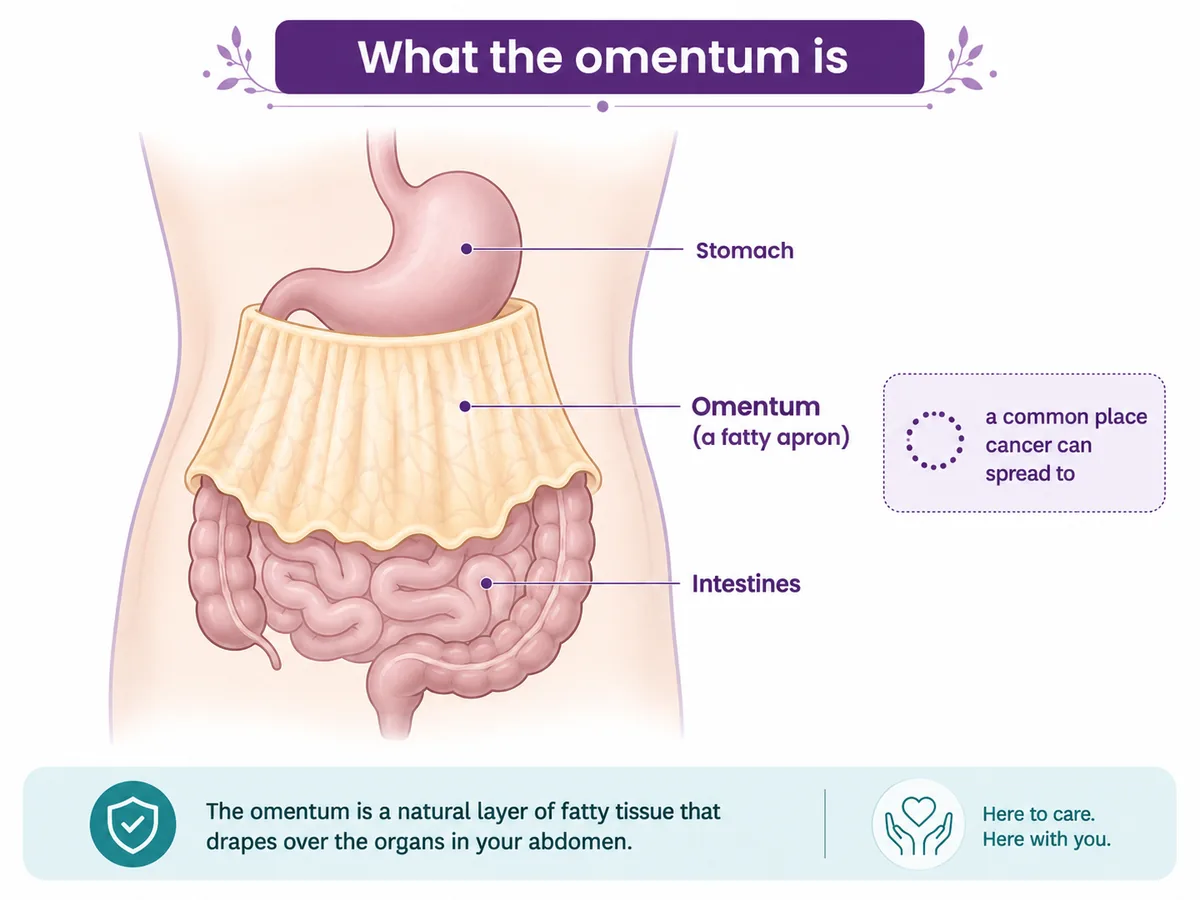
An omentectomy removes the omentum — a fatty “apron” of tissue that hangs from the stomach and drapes over your abdominal organs. It is usually done as part of a larger cancer operation, most often for ovarian cancer. Two things are worth knowing straight away: the omentum is a favourite place cancer spreads to, so removing it helps clear all the visible disease — and you can live perfectly well without it.
You live perfectly well without it — it is not a vital organ
Removes a key site of cancer spread, as part of clearing all of it
Keyhole where suitable · every case planned by a tumour board
★★★★★Rated 4.8/5 · 800+ Google reviews
You live perfectly well without it
17 oncologists, one tumour board
35+ centres, close to home
Aarogyasri & insurance help
MM
Written by Dr. Muralidhar Muddusetty, MBBS & MS Surgery (AIIMS), DNB (Surgical Oncology), MRCS (Edinburgh), with CION’s surgical oncology team. Medically reviewed by Dr. Paila Gowri Naidu, MCh (Surgical Oncology), FMAS. · Reviewed 16 July 2026
Understanding the surgery
What is an omentectomy?
An omentectomy is an operation to remove the omentum — a large, fatty “apron” of tissue that hangs down from the stomach and drapes over the intestines and other organs in the tummy. The whole apron can be removed (a total omentectomy), or just a part of it (a partial omentectomy), or a small piece taken for testing (an omental biopsy). It can be done by keyhole (laparoscopic) or open surgery. The omentum plays a part in the body’s defences, but it is not a vital organ — you can live perfectly well without it.
An omentectomy is rarely done on its own. In cancer care it is almost always part of a larger operation: most often for ovarian cancer — where it is removed together with the ovaries, tubes and uterus as part of clearing all the visible disease — and sometimes for stomach cancer, as part of removing the stomach. Every case at CION is planned by a multidisciplinary tumour board, so the omentectomy fits the whole cancer plan rather than being decided on the day.
A fatty “apron” removed
The omentum drapes over the abdominal organs; all of it, part of it, or a biopsy is taken.
You live well without it
The omentum is not a vital organ — the body copes, and most people never notice it is gone.
Part of a bigger operation
Usually done with ovarian surgery (or stomach surgery), planned by the tumour board.
Why it’s removed
The omentum & why cancer spreads there
Here is the key idea: the omentum is a favourite place for cancer to spread to. In ovarian cancer especially, cells shed into the tummy and settle on the omentum, sometimes forming a thickened layer doctors call “omental caking”. Because the omentum collects disease this way, removing it is an important part of clearing all the visible cancer — and in ovarian cancer, taking out every bit of visible disease is the surgical step that most shapes the result. The same logic applies in stomach cancer, where the omentum lies right beside the stomach. So an omentectomy is not “extra” surgery — it targets a place the cancer likes to hide.
The omentum is a fatty “apron” draped over the abdominal organs — and a common place ovarian and stomach cancer spread to.
In ovarian cancer
The most common reason. Cells shed into the abdomen and settle on the omentum, so it is removed as a standard part of the operation to clear all the visible disease. Ovarian cancer treatment
In stomach cancer
The omentum lies right beside the stomach and shares its blood supply, so it is removed together with the stomach as part of a gastrectomy. The omentum, removed with the stomach
When cancer has settled on it
When scans or surgery show disease on the omentum (“omental caking”), removing it is an important part of clearing the cancer — and it can be removed safely, because life does not depend on it.
To check & stage the cancer
Sometimes a piece is taken (an omental biopsy) to check whether cancer has reached it — which helps stage the cancer accurately and guides treatment. Omental biopsy for staging
Where an omentectomy fits — part of clearing all the cancer
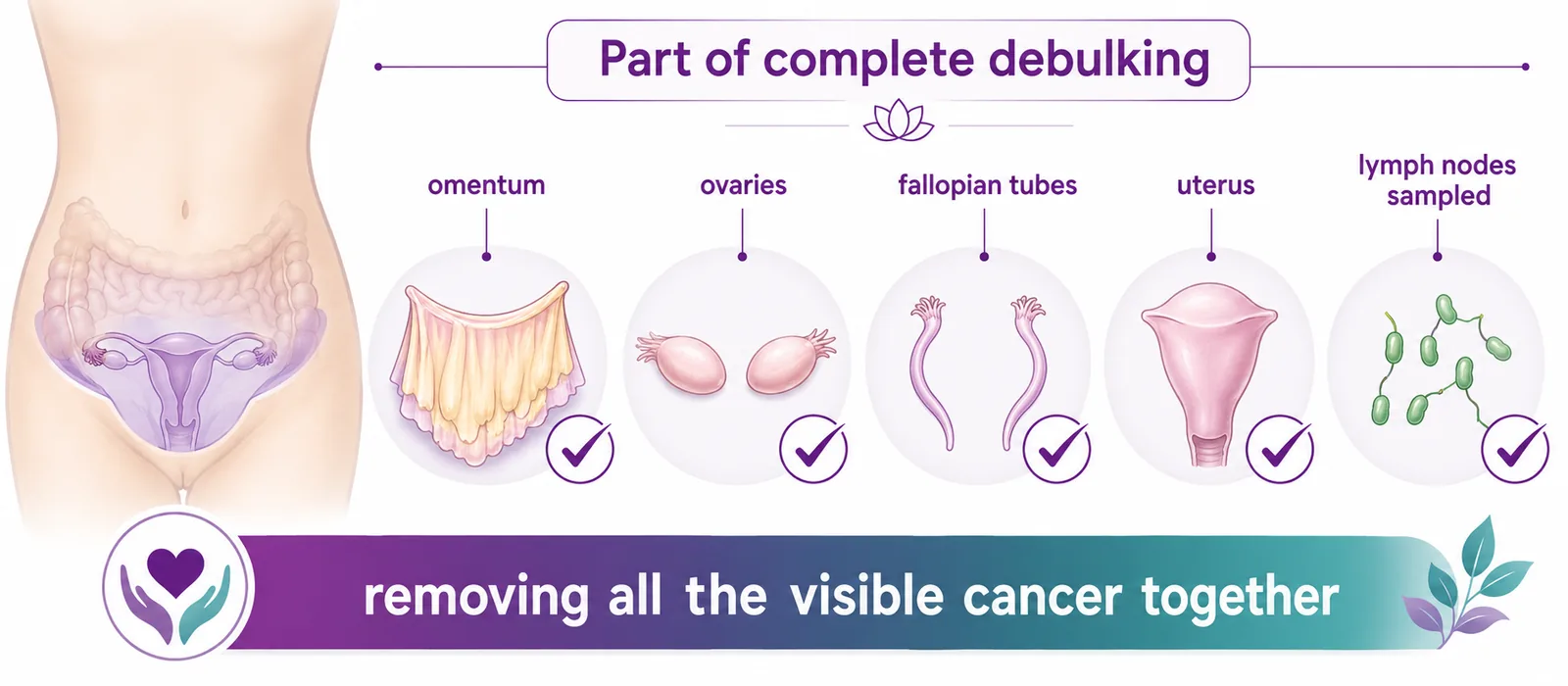
In ovarian cancer, an omentectomy is one part of a bigger operation whose goal is to remove all the visible cancer in the tummy — often called debulking or cytoreductive surgery. Alongside the omentum, the surgeon usually removes the ovaries and fallopian tubes and the uterus, and samples the lymph nodes, checking the whole abdomen and removing any deposits found. The reason this matters: the more completely the visible cancer is removed, the better the outcome tends to be — so the omentectomy is a meaningful part of that goal, not an add-on.
In ovarian surgery the omentum is removed alongside the ovaries, tubes, uterus and sampled nodes — clearing all the visible cancer together.
Tests that confirm the diagnosis and plan the surgery
Before any operation, the cancer is confirmed and its spread mapped. Scans show whether the omentum is involved — sometimes the thickened “caking” is visible on a CT scan before surgery — and a biopsy establishes what the cancer is. Your surgical-oncology team then decides, with you, the right operation, how much of the omentum to remove, and what else the operation involves.
Diagnostic services we offer — book any of these:
Biopsy & histopathology
A tissue sample that confirms whether it is cancer, the exact type, and how it is likely to behave — the foundation of the plan.
An omentectomy is one component of a plan — CION delivers the whole plan. That usually means the larger operation the omentectomy is part of, plus any chemotherapy or maintenance therapy planned around it. Every plan is set by a tumour board for your cancer and your situation, so surgery and the treatment around it fit together.
Treatments we deliver — book a consult for any of these:
Omentectomy (total or partial)
Removing the omentum — the whole apron, part of it, or a biopsy — as part of your cancer operation, by keyhole or open surgery.
This is the reassurance many people are looking for: you can live a completely normal life without your omentum. It is not a vital organ — the body copes without it, and most people are not even aware it is gone. Removing it does not change how you digest food, your weight, or your day-to-day living, and it places no special limits on you. Because an omentectomy is almost always part of a bigger operation, whatever recovery and adjustments you have come from that larger surgery — not from losing the omentum itself.
The simple truth: the omentum can be removed safely because life does not depend on it — so an omentectomy adds little to your recovery on its own, while removing an important site of cancer spread.
Eating & digestion
Removing the omentum does not affect how you digest food. If your operation also involves the stomach or bowel, any eating changes come from that part — and a dietitian supports you. Nutrition counselling
Your immunity
The omentum plays a part in the body’s defences, but it is one of many — losing it does not leave you defenceless or prone to infection in daily life. Your immune system carries on.
Getting back to normal
Most people return to their usual activities as they recover from the overall operation, building up gradually. Life without the omentum places no special limits on you.
How much is removed
Total omentectomy, partial, or a biopsy?
Not everyone has the whole apron removed. A total omentectomy takes the entire omentum; a partial omentectomy takes only a portion; and sometimes just a small piece is taken as an omental biopsy to check for cancer. How much is removed depends on the type of cancer and on what the surgeon finds during the operation — for example, in ovarian cancer the whole omentum is often removed, whereas for staging a biopsy may be enough. Your surgeon decides based on your scans and what they see.
What is removed
What it means
Often chosen when
Total omentectomy
The whole fatty apron is removed.
Cancer has settled on the omentum, or the operation aims to clear all visible disease — common in ovarian cancer.
Partial omentectomy
Only a portion of the omentum is removed.
A defined part is involved, or the omentum is removed alongside another organ — for example with the stomach.
Omental biopsy
A small piece is taken and examined under the microscope.
The omentum looks normal, and the aim is to check whether cancer has reached it — part of accurate staging.
There is no single right answer for everyone — the aim is to remove what needs to come out, and no more. Because the omentum is not a vital organ, removing all of it does not cost you anything in day-to-day life, which is why surgeons can be thorough where the cancer demands it. If you want that judgement reviewed, a second opinion is always welcome.
What to expect
How it’s done & recovery
An omentectomy can be done by keyhole (laparoscopic) surgery — a few small cuts, a camera and fine instruments — or by open surgery, depending on the operation it is part of and how much needs to be done. On its own, removing the omentum is relatively straightforward; in practice your recovery is shaped by the larger operation (such as ovarian debulking or removing the stomach) rather than by the omentectomy itself. That usually means a hospital stay of a few days to about a week — longer after a big open operation — and a gradual return to activity over a few weeks, avoiding heavy lifting at first.
1
Before surgery
Scans and tests plan the whole operation; the tumour board decides how much of the omentum to remove and what else is involved.
2
The operation
The omentum is removed — all of it, part of it, or a biopsy — as part of the larger operation, by keyhole or open surgery.
3
In hospital
A stay guided by the overall operation — a few days to about a week — with early help to move and to eat again.
4
Recovery & ongoing care
A gradual return to normal life over a few weeks; any further treatment and follow-up planned by your team.
The care does not stop when the operation is over. Any chemotherapy is timed around your recovery, and nutrition, physiotherapy and emotional support continue through the whole journey.
Because an omentectomy is almost always part of a larger operation, its cost is really the cost of that whole operation — for example ovarian debulking surgery, or removing the stomach — rather than a separate charge for the omentum. So what shapes it is how big the operation is, whether it is keyhole or open, and the length of your hospital stay. Indicatively, an omentectomy as part of ovarian cancer surgery sits around ₹2,00,000 – ₹5,00,000. The reassuring part: this is cancer surgery, so it is generally covered under Aarogyasri / PMJAY at empanelled centres and by most health-insurance policies. Our team checks your scheme eligibility and policy and gives you a clear, written estimate before anything is planned.
Indicative cost estimator
Pick your situation for an indicative range, then request an exact estimate for your case.
Indicative range
₹2,00,000 – ₹5,00,000
for an omentectomy as part of ovarian cancer surgery, general room, self-pay
Figures are indicative only and not a quotation. They reflect the whole operation the omentectomy is part of, not a separate charge for the omentum. Cancer surgery is generally covered under Aarogyasri / PMJAY at empanelled centres and by most insurance. Your actual cost depends on the extent of surgery, your hospital stay, and any cancer treatment around it.
Being told a part of you is being removed is unsettling — especially one you had never heard of. Book a free consultation and, if you already have a biopsy or scan report, a free written second opinion on the operation planned for you.
Your reports reviewed by a senior surgical oncologist
A plain answer on why the omentum is being removed — and what life is like without it
Aarogyasri / PMJAY & insurance guidance
Support
Financial support & Aarogyasri
Cost should not delay cancer surgery. Under Aarogyasri and PMJAY, eligible cancer surgery may be largely covered at empanelled centres, and private insurance is accepted cashless. Because the omentectomy is part of a larger operation, it is covered as part of that operation rather than billed separately. Our counsellors help check eligibility, arrange approvals and map out what you will actually pay — often far less than families fear.
9 clinics in Hyderabad · 35+ across Telangana & AP
CION cancer care is closer than you think.
We're never more than 30 minutes away. Same panel of specialists at every centre. Same tumour board reviews. Same NCCN protocols. Pick the closest one and call directly — or let us pick for you.
Don't see your city? Call
18002028726
— we'll find your nearest CION partner centre.
Meet the surgical oncology team
Your operation is planned by a team, not one doctor.
Surgical, medical and radiation oncologists plan every case together in a multidisciplinary tumour board — part of 17 senior specialists across CION. An omentectomy is performed as part of ovarian and upper-GI cancer surgery by an experienced surgical oncology team.
Share your name and number — we'll call you back within 30 minutes to schedule your consultation.
Told the omentum is coming out? Ask why — you deserve a clear answer.
How much of the omentum is removed, and what else the operation involves, depends on your cancer and your scans. Let CION’s tumour board review your reports and explain the plan in plain language.
These worries are real, and some are made heavier by what people say. Here are honest, gentle answers to the fears we hear most from families in Telangana.
“They’re removing an organ I’ve never even heard of — it must be serious.”
Fact: Most people have never heard of the omentum, and that is exactly why it feels alarming. It is a fatty apron that drapes over your abdominal organs — not a vital organ, and not something life depends on. It is removed because cancer commonly spreads to it, so taking it out helps clear all the visible disease. The operation is planned; the omentum is simply one part of it.
“If they take out the omentum, my immune system will be wrecked.”
Fact: The omentum does play a part in the body’s defences, but it is one of many — your immune system does not depend on it. People live normal lives after it is removed, without becoming prone to infection in daily life. If you are having chemotherapy, any temporary effect on your immunity comes from that treatment, not from losing the omentum.
“Removing a fatty apron will change my digestion, or make me put on weight.”
Fact: It does not. The omentum has no role in digesting food, and removing it does not change your weight or your diet. If your operation also involves the stomach or bowel, any eating changes come from that part — and a dietitian supports you through it. The omentectomy itself does not change how you eat.
“Cutting into the cancer will make it spread.”
Fact: This is a common and harmful myth. Removing cancer under controlled surgical conditions does not spread it through the body. What actually causes harm is delay, which lets a treatable cancer grow. Removing the omentum, where cancer has often settled, is one of the ways surgeons clear disease rather than spread it.
“‘Omental caking’ sounds terrible — it means I’m beyond help.”
Fact: It is a frightening phrase, but it simply describes cancer that has settled on the omentum and thickened it. It is a well-recognised pattern, especially in ovarian cancer, and it is precisely what the operation is designed to remove. Finding it does not mean nothing can be done — for many people it is a reason surgery is offered, not a reason to give up.
“It’s an extra operation on top of everything else.”
Fact: It is not a separate operation. An omentectomy is almost always done within the same operation — the same anaesthetic, the same incisions — as the surgery you are already having. It does not add a second procedure, a second admission, or a second recovery.
“I’ll be left with a huge scar — it must be a huge operation.”
Fact: Removing the omentum on its own is relatively straightforward, and it can often be done by keyhole surgery through a few small cuts. Whether you have keyhole or open surgery — and therefore what scar you have — is decided by the larger operation, not by the omentectomy. Your surgeon explains the approach planned for you before the day.
“Removing the omentum means my cancer is everywhere.”
Fact: Not necessarily. Sometimes the omentum is removed because cancer has visibly settled on it; often it is removed, or a piece taken, simply to check — because it is the place cancer would go first, and examining it is how the stage is confirmed accurately. Removing it is frequently a precaution and a check, not proof of widespread disease. Your team will tell you what your scans actually show.
“Can a middle-class family afford this?”
Fact: Cost should not be the reason care is delayed. This is cancer surgery, so Aarogyasri and PMJAY generally cover eligible operations at empanelled centres, and private insurance is accepted cashless. The omentectomy is covered as part of the larger operation, not billed as an extra. Our counsellors help map out what you will actually pay — often far less than families fear.
“I’m too old for this operation.”
Fact: Age alone does not decide it — your fitness, the cancer type and its spread do. Older patients are assessed individually, with other health conditions taken into account, and the team recommends the option most likely to help you rather than going by a number. Because the omentum is not a vital organ, removing it adds very little to the operation you are already having.
“Recovery from an omentectomy will take months.”
Fact: Removing the omentum adds little to your recovery on its own. Your recovery is shaped by the larger operation — usually a hospital stay of a few days to about a week, longer after a big open operation, and a gradual return to activity over a few weeks. Nobody recovers “from an omentectomy”; you recover from the operation it was part of.
“If they can’t remove everything, the operation was pointless.”
Fact: Removing as much visible cancer as possible has value even when a complete clearance is not achieved — the less that is left, the better the treatment that follows tends to work. Surgery is one step in a longer plan, not an all-or-nothing event. Your team will be honest with you about what was removed and what comes next.
“Keyhole surgery isn’t as thorough as open surgery.”
Fact: Keyhole surgery is used when the surgeon judges it can do the job properly — it is chosen for suitability, never for convenience. Where a big cancer operation needs open surgery to remove everything safely, open surgery is what you are offered. Thoroughness decides the approach, not the other way round.
“A biopsy of the omentum would be enough — why take the whole thing?”
Fact: Sometimes a biopsy is enough, and that is what is done — for example when the omentum looks normal and the aim is to check the stage. The whole apron is removed when cancer has settled on it, or when the operation aims to clear all visible disease. The surgeon removes what needs to come out and no more, based on your scans and what they see.
“Home or herbal remedies could shrink it instead of surgery.”
Fact: No home or herbal remedy is proven to treat cancer on the omentum, and relying on one wastes the window when treatment can help most. Tell your oncologist about anything you take so it can be used safely alongside proper treatment — but do not let it replace treatment.
“They’re removing extra tissue just to inflate the bill.”
Fact: The omentum is removed for a clinical reason — it is the place ovarian and stomach cancer most commonly spread to, and clearing it is part of removing all the visible disease. It is not billed as an extra procedure; it is part of the operation you are already having. Your surgeon will explain exactly why it is planned in your case, and a second opinion is always welcome.
“Asking for a second opinion will offend my doctor.”
Fact: A second opinion is normal and welcomed in cancer care — it confirms the plan and gives you confidence, especially when you are being told an unfamiliar part of you is being removed. At CION it is free when you have a biopsy or scan report, and it can be arranged quickly, without offending anyone.
“A tumour board is just extra delay — I should decide quickly.”
Fact: A tumour board is not a delay — it is several specialists deciding your plan together, which leads to safer, better decisions than one doctor alone. It is arranged quickly and gives you a coordinated, honest recommendation on the operation and its timing.
“Once the omentum is out, I’m cured.”
Fact: Removing it is a meaningful step, but it is one part of a larger operation and a larger plan. Cancer of this kind is usually treated with surgery and chemotherapy together, and follow-up matters. No treatment promises zero risk, which is why the plan continues after the operation — to keep the cancer under control and catch any change early. Follow-up is a safety net, not a sign of doubt.
“I’ll have to travel far from home for this kind of surgery.”
Fact: CION provides cancer surgery and care across 35+ centres in Telangana and Andhra Pradesh, with Telugu-speaking teams and Aarogyasri support — so specialist care is closer to home than most families expect. Your consultation, planning and follow-up can be coordinated near you.
Why CION
Why choose CION for an omentectomy in Hyderabad
Complete-removal focus
The omentum removed as part of clearing all the visible cancer — the surgical goal that most shapes the result of ovarian cancer surgery.
Keyhole where suitable
Laparoscopic surgery for the right cases — smaller cuts, less pain and a quicker recovery, chosen for suitability rather than convenience.
Honest, reassuring guidance
A clear explanation that you live perfectly well without the omentum, and that your recovery comes from the larger operation.
Experienced gynae & GI surgeons
A surgical oncology team performing ovarian debulking and upper-GI cancer surgery, of which the omentectomy is a part.
A tumour-board plan
Every case reviewed by a multidisciplinary tumour board, so surgery and the treatment around it fit together.
Aarogyasri & care close to home
Cancer surgery is generally covered under Aarogyasri at empanelled centres; 35+ centres across Telangana & AP with Telugu-speaking teams.
Real stories · real courage
15,000+ patients chose CION. Hear from them directly.
These aren't paid endorsements or written reviews. These are video testimonials from real patients and families — recorded on their own phones, in their own words. Pick any one. Watch it. Then decide.
4.8★800+ Google reviews
50+video testimonials
15,000+patients treated
Successful Chemotherapy & Radiation Done by Dr. Owais Mohammed & Dr. Kirti Ranjan
Watch video →
Successful Chemotherapy Done by Dr. C Raghavendra Reddy
Watch video →
Surgery, Chemo & Radiation Done by Dr. Imaduddin, Dr. Vinay, Dr. Owais, Dr. Kirti
Watch video →
Successful Radical Thymectomy Done by Dr. Mohammed Imaduddin & Dr. Vinay Mamidala
Watch video →
Successful Surgery Done by Dr. Rajender Byshetty
Watch video →
Successful Chemo & Surgery Done by Dr. Imad, Dr. Vinay, Dr. Owais & Dr. Raghavendra
Watch video →
Successful Chemo & Surgery Done by Dr. Imad, Dr. Vinay, Dr. Owais & Dr. Raghavendra
Watch video →
Successful Chemo & Radiation Done by Dr. Owais Mohammed & Dr. Kirti Ranjan Mohanty
Watch video →
Successful Breast Cancer Surgery Done by Dr. Imaduddin Mohammed & Dr. Vinay Mamidala
Watch video →
Successful Chemotherapy Done by Dr. Bharati Devi Gorantla
Watch video →
Successful Chemo & Surgery Done by Dr. Owais Mohammed & Dr. Imaduddin Mohammed
Watch video →
Successful Chemotherapy Done by Dr. Gundu Naresh
Watch video →
Successful Bone Marrow Transplantation - Neuroblastoma
Watch video →
Successful Surgery & Chemo - Carcinoma of Caecum
Watch video →
Successful Oral chemotherapy & mastectomy surgery
Watch video →
Successful Oral chemotherapy & mastectomy surgery
Watch video →
Successful Chemotherapy
Watch video →
Successful Surgery by Dr. Mohammed Imaduddin
Watch video →
Successful Bone Marrow Transplantation
Watch video →
Successful Oral chemotherapy & mastectomy surgery
Watch video →
Successful Oral chemotherapy & mastectomy surgery
Watch video →
Successful Chemotherapy
Watch video →
Successful Buccal Mucosa Surgery
Watch video →
Successful Complex Surgery Mandibulectomy Reconstruction
An omentectomy is one part of a larger cancer operation. At CION, the surgery, any chemotherapy, and your recovery and support are one coordinated plan — so you are supported medically, emotionally and physically from diagnosis through recovery.
Ovarian cancer care
Full diagnosis and treatment for ovarian cancer, of which the omentectomy is usually part. Learn more
Nutrition counselling
Nutrition to build strength before surgery and support recovery after. Learn more
Psychology counselling
Emotional support for you and your family through a hard diagnosis. Learn more
Rehabilitation
Physiotherapy and recovery support to rebuild strength after major surgery. Learn more
Palliative & comfort care
Comfort and symptom support at any stage, alongside active treatment. Learn more
Financial counselling
Aarogyasri, PMJAY and cashless insurance guidance so cost never blocks care. Learn more
FAQ
Omentectomy in Hyderabad — frequently asked questions
What is an omentectomy?
An omentectomy is an operation to remove the omentum — a large, fatty “apron” of tissue that hangs from the stomach and drapes over the intestines and other organs in the tummy. The whole apron can be removed (a total omentectomy), or part of it (a partial omentectomy), or a small piece taken for testing (an omental biopsy). It can be done by keyhole (laparoscopic) or open surgery, and it is almost always part of a larger cancer operation rather than done on its own.
What does the omentum actually do?
The omentum is a fatty layer of tissue that hangs from the stomach and drapes over the abdominal organs. It stores fat, helps pad the organs, and plays a part in the body’s defences — it can wall off infection or inflammation inside the abdomen. Useful as those roles are, they are not roles you depend on: the omentum is not a vital organ, and the body copes perfectly well without it.
Why is the omentum removed in cancer surgery?
The omentum is a favourite place for cancer to spread to — especially ovarian cancer, where cells settle on it and can form a thickened layer called “omental caking”, and stomach cancer, which lies right beside it. Because the omentum collects disease this way, removing it is an important part of clearing all the visible cancer. In ovarian cancer especially, taking out every bit of visible disease — including the omentum — is the surgical step that most shapes the result, so an omentectomy targets a place the cancer likes to hide.
Can I live without my omentum?
Yes, completely normally. The omentum is not a vital organ — the body copes without it, and most people are not even aware it is gone. Removing it does not change how you digest food, your weight, or your day-to-day living, and it places no special limits on you. Because an omentectomy is almost always part of a bigger operation, any recovery and adjustments come from that larger surgery, not from losing the omentum itself.
Is an omentectomy done on its own, or with other surgery?
Almost always with other surgery. In cancer care an omentectomy is a component of a larger operation — most often ovarian cancer surgery, where it is removed together with the ovaries, tubes and uterus as part of clearing all the visible disease, and sometimes stomach cancer surgery, as part of removing the stomach. It is rarely done alone. Your surgeon explains the full operation planned for you and where the omentectomy fits in.
What is the difference between a total and a partial omentectomy?
A total omentectomy removes the whole omentum (the entire apron), while a partial omentectomy removes only a portion of it; sometimes just a small piece is taken as an omental biopsy to check for cancer. How much is removed depends on the type of cancer and what is found during surgery — for example, in ovarian cancer the whole omentum is often removed, whereas for staging a biopsy may be enough. Your surgeon decides based on your scans and what they see at the operation.
What is an omental biopsy?
An omental biopsy is when a small piece of the omentum is taken and examined under the microscope, rather than the whole apron being removed. It is usually done when the omentum looks normal and the aim is to check whether cancer has reached it. Because the omentum is the place cancer would commonly go first, examining it is an important part of staging the cancer accurately, which in turn guides the right treatment afterwards.
What is “omental caking”?
“Omental caking” is the term doctors use when cancer cells settle on the omentum and thicken it into a firm layer, so that on a scan it looks like a cake or a mat of tissue. It is a well-recognised pattern, seen most often in ovarian cancer. It sounds alarming, but it describes exactly the kind of disease an omentectomy is designed to remove — finding it is often a reason surgery is offered, not a reason to give up.
Which cancers need an omentectomy?
Most often ovarian cancer, where removing the omentum is a standard part of debulking and staging surgery. It is also removed as part of stomach cancer surgery, because the omentum lies right beside the stomach and shares its blood supply. Less commonly it is removed when other cancers within the abdomen have spread to it. Whether an omentectomy is right for you is decided by the tumour board, based on your cancer type and your scans.
Is the omentum removed in stomach cancer surgery?
Yes, usually. The omentum hangs from the stomach and shares its blood supply, so it is removed together with the stomach as part of a gastrectomy. This helps clear cancer that may have spread to it and gives a fuller picture of the disease. As with ovarian surgery, the omentectomy is a component of the larger operation rather than a separate procedure.
Is an omentectomy done by keyhole (laparoscopic) surgery?
It can be. An omentectomy can be done by keyhole (laparoscopic) surgery — a few small cuts, a camera and fine instruments — or by open surgery, depending on the larger operation it is part of and how much needs to be done. A keyhole approach usually means a shorter hospital stay and quicker recovery, but a big cancer operation may need open surgery. Your surgeon recommends the approach that is safest and most effective for your situation.
What is recovery like after an omentectomy?
Removing the omentum on its own is relatively straightforward, so your recovery is shaped mainly by the larger operation it is part of — such as ovarian debulking or removing the stomach — rather than by the omentectomy itself. That usually means a hospital stay of a few days to about a week (longer after a big open operation), a gradual return to activity over a few weeks avoiding heavy lifting at first, and any further treatment planned around surgery. Life without the omentum is completely normal.
Will removing the omentum affect my digestion or my weight?
No. The omentum has no role in digesting food, so removing it does not change how you eat, how you digest, or your weight. If your operation also involves the stomach or bowel, any eating changes come from that part of the surgery, not from the omentectomy — and a dietitian supports you through those changes where needed.
Will removing the omentum weaken my immunity?
The omentum does play a part in the body’s defences inside the abdomen, but it is one of many — your immune system does not depend on it. People live normal lives after it is removed without becoming prone to infection in daily life. If you are having chemotherapy, any temporary effect on your immunity comes from that treatment rather than from the omentectomy.
Does needing an omentectomy mean my cancer is advanced?
Not necessarily. Sometimes the omentum is removed because cancer has visibly settled on it. Often it is removed, or a piece taken, simply to check — because it is the place cancer would go first, and examining it is how the stage is confirmed accurately. So an omentectomy is frequently a precaution and a check rather than proof of widespread disease. Your team will explain what your scans actually show and what the plan is.
Will I need chemotherapy as well as surgery?
Often, yes. For ovarian and stomach cancers, chemotherapy is commonly given before or after surgery — and sometimes maintenance therapy afterwards — as part of the plan, not as a sign the surgery failed. The tumour board decides the combination and timing that treats your cancer most thoroughly, and any chemotherapy is planned around your recovery from the operation.
How much does an omentectomy cost in Hyderabad?
Because an omentectomy is almost always part of a larger operation, its cost is really the cost of that whole operation rather than a separate charge for the omentum. Indicatively, an omentectomy as part of ovarian cancer surgery is around ₹2,00,000 to ₹5,00,000, with a more extensive cytoreduction costing more and a limited or laparoscopic procedure less. The actual cost depends on the extent of surgery, your hospital stay, and any cancer treatment around it. As it is cancer surgery, it is generally covered under Aarogyasri / PMJAY at empanelled centres, and CION gives an accurate written estimate after assessment. Figures are indicative only, not a quotation.
Is an omentectomy covered by Aarogyasri or insurance?
It is cancer surgery, so it is generally covered under Aarogyasri and PMJAY at empanelled centres and by most health-insurance policies — as part of the larger operation, and alongside any chemotherapy or other treatment around it, rather than billed as an extra. CION’s counsellors check your policy and scheme eligibility, arrange approvals, and provide a written estimate before anything is planned.
Should I get a second opinion before ovarian cancer surgery?
A second opinion is normal and welcomed in cancer care, especially when you are being told that an unfamiliar part of you is being removed — it confirms the plan and gives you confidence. At CION it is free when you have a biopsy or scan report, and it can be arranged quickly. It confirms whether the operation planned for you is right, how much of the omentum needs to come out, and the safest timing.
Which is the best hospital for an omentectomy in Hyderabad?
Look for a cancer centre with an experienced surgical-oncology team that regularly performs ovarian debulking and upper-GI cancer surgery, multidisciplinary tumour-board planning, the ability to offer keyhole surgery where it is suitable, and honest guidance on why the omentum is being removed and what life is like without it. CION Cancer Clinics offers cancer surgery across 35+ centres in Telangana and Andhra Pradesh, with Telugu-speaking teams and Aarogyasri counselling.
Explore
Explore the rest of your operation & your care
The omentectomy is one part of a bigger plan. These pages explain the other parts, the cancers involved, and the support around them. Tap any topic to read more.
Speak to a surgical oncologist about your operation
Clear answers change how a diagnosis feels. Book a free consultation or second opinion at any of our 9 Hyderabad clinics — part of 35+ centres across Telangana & Andhra Pradesh.
Medical disclaimer: This page provides general information about omentectomy (surgery to remove the omentum) and is not a substitute for professional medical advice, diagnosis or treatment. An omentectomy is usually part of a larger cancer operation, and how much of the omentum is removed is decided by your surgeon based on your scans and what is found at surgery. Costs shown are indicative only and not a quotation. Always consult a qualified surgical oncologist about your individual care. Content is periodically reviewed by CION’s medical team.

 CION Ameerpet