A bilateral salpingo-oophorectomy (BSO) removes both ovaries and both fallopian tubes. It is done either as part of treating an ovarian, tubal or womb cancer, or to reduce a high inherited risk — for example with a BRCA gene change. Two things are worth understanding early: the tubes are removed too, because many “ovarian” cancers actually begin there, and removing both ovaries brings on menopause — which is expected, and managed. At CION it is usually done by keyhole surgery, by an experienced gynae-oncology team.
Both ovaries & both tubes · keyhole (laparoscopic) where suitable
Germline BRCA testing & genetic counselling before any risk-reducing decision
Surgical-menopause support · gynae-oncology tumour board
★★★★★Rated 4.8/5 · 800+ Google reviews
35+ centres, close to home
17 oncologists, one team
BRCA testing & genetic counselling
Aarogyasri & insurance help
VM
Written by Dr. Vinay Mamidala, MCh (Surgical Oncology), FMAS — gynae & laparoscopic surgical oncology. Medically reviewed by Dr. Paila Gowri Naidu, MCh (Surgical Oncology), FMAS. · Reviewed 15 July 2026
Understanding the surgery
What is a bilateral salpingo-oophorectomy?
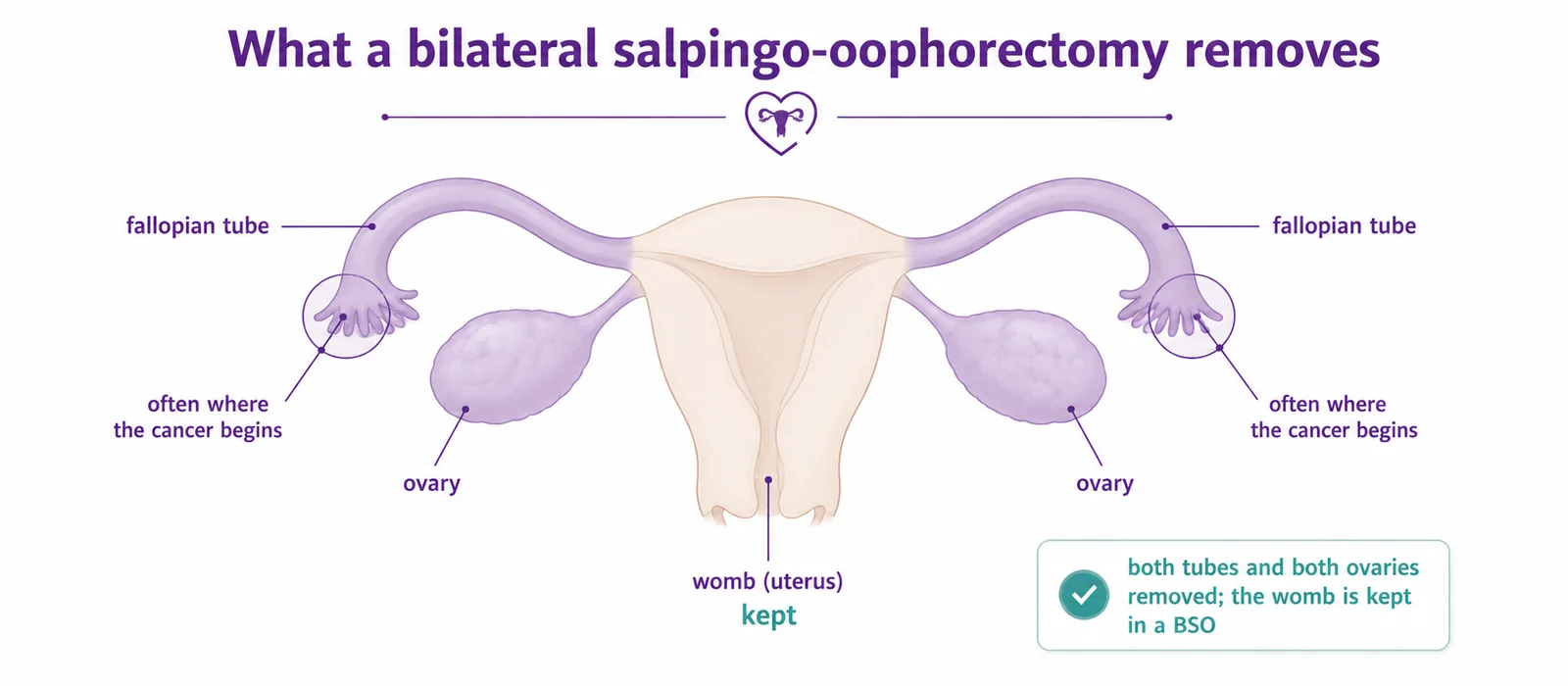
A bilateral salpingo-oophorectomy — often shortened to BSO — removes both ovaries (oophorectomy) together with both fallopian tubes (salpingectomy). The womb (uterus) is usually kept, unless it is being removed as well for another reason. It is done for two main reasons: as part of treating a cancer of the ovary, fallopian tube or womb, or to lower a high inherited risk of ovarian and tubal cancer — for example in women who carry a BRCA gene change. At CION it is most often performed by keyhole (laparoscopic) surgery.
Because it removes both ovaries, a BSO differs from a one-sided ovary removal in two important ways, and this page is built around them: the fallopian tubes are removed (many ovarian cancers begin in the tubes), and, in a woman who has not yet reached menopause, it brings on menopause straight away. Whether this operation is right for you — and, if you have a high inherited risk, exactly when — is decided together with genetic counselling and your gynae-oncology team. See also our pages on oophorectomy (how a one-sided operation differs) and risk-reducing (prophylactic) surgery.
What a BSO does
Both ovaries & both tubes
Removed together; the womb is usually kept unless it is being removed for another reason.
Two reasons
As part of treating a cancer, or to lower a high inherited (BRCA) risk of ovarian and tubal cancer.
Usually keyhole
Most often done by laparoscopic (keyhole) surgery — small cuts, and a quicker recovery.
A surprising, important fact
Why remove both fallopian tubes too?
Here is something many people do not know: a large share of high-grade “ovarian” cancers do not actually start in the ovary at all — they begin in the far (fimbrial) end of the fallopian tube, and then involve the ovary. That is why a salpingo-oophorectomy removes the tubes as well as the ovaries — taking the tubes removes a key place these cancers begin, which matters both when treating a cancer and when reducing a high inherited risk. It is not an “extra”; it is central to why the operation works.
A BSO removes both ovaries and both fallopian tubes (the womb is kept) — the tubes are removed because many ovarian cancers begin at their far end.
The fimbrial end
The fringed far end of the tube, closest to the ovary, is where many high-grade serous cancers are now understood to begin.
Why it changes the operation
Removing the tubes takes away that starting point — so the tubes come out with the ovaries, in both cancer and risk-reducing surgery.
They are examined closely
The tubes and ovaries are sent for careful pathology, with the fimbrial ends examined in detail — occasionally this finds a very early change.
Why it might be advised
Two reasons it is done: cancer, or reducing a high inherited risk
A BSO is advised in two quite different situations, and it helps to know which applies to you. As part of cancer treatment, it removes the ovaries and tubes affected by (or at risk from) an ovarian, tubal or womb cancer, usually alongside other surgery and treatment. To reduce a high inherited risk — risk-reducing, or “prophylactic” surgery — it is offered to women who carry a gene change such as BRCA1 or BRCA2, or who have a strong family history: removing the tubes and ovaries markedly lowers the chance of ever developing ovarian or tubal cancer. That decision, and its timing, is always made after genetic counselling, weighing your risk, your age and your plans.
As part of cancer treatment
To reduce a high inherited risk
Who it is for
Women with an ovarian, tubal or womb cancer.
Women with a BRCA (or similar) gene change or a strong family history, without cancer.
The aim
To remove and treat the cancer, alongside other surgery and treatment.
To lower the future chance of ovarian and tubal cancer.
Planned as part of your cancer treatment, without unnecessary delay.
A planned, personal choice — usually considered after childbearing, around an age range that depends on your gene change.
Cover
Generally covered under Aarogyasri / PMJAY at empanelled centres, and by most insurance.
Preventive surgery in a woman without cancer — cover depends on your policy; the scheme generally does not apply.
If your reason is to reduce an inherited risk, our page on risk-reducing (prophylactic) surgery explains the wider decision — including genetic testing and the choices around it — in more depth. If only one ovary is involved, our oophorectomy page explains how a one-sided operation differs, and why it does not cause menopause.
Tests that guide a bilateral salpingo-oophorectomy
What you need depends on your reason. If a cancer or a mass is being investigated, scans and blood tests establish what it is and how far it reaches, so the right operation is planned. If you are weighing risk-reducing surgery, the pathway is different — it starts with genetic testing and counselling, not a scan. CION offers germline BRCA testing, and every cancer case is reviewed by a gynae-oncology tumour board.
Tests and services we offer — book any of these:
Germline BRCA & genetic testing
A blood test for inherited gene changes such as BRCA1 and BRCA2 — the starting point for any risk-reducing decision, and offered to ovarian-cancer patients.
A BSO is rarely the whole story — CION delivers the care around it. That means the operation itself, by keyhole where suitable; the wider ovarian-cancer surgery it may form part of; the genetics that guide a risk-reducing decision; and the surgical-menopause support afterwards. Every cancer plan is set by a gynae-oncology tumour board.
Treatments we deliver — book a consult for any of these:
Bilateral salpingo-oophorectomy
Both ovaries and both tubes removed, by keyhole (laparoscopic) surgery where suitable — as part of cancer treatment or to reduce a high inherited risk.
Surgical menopause — what to expect & how it is managed
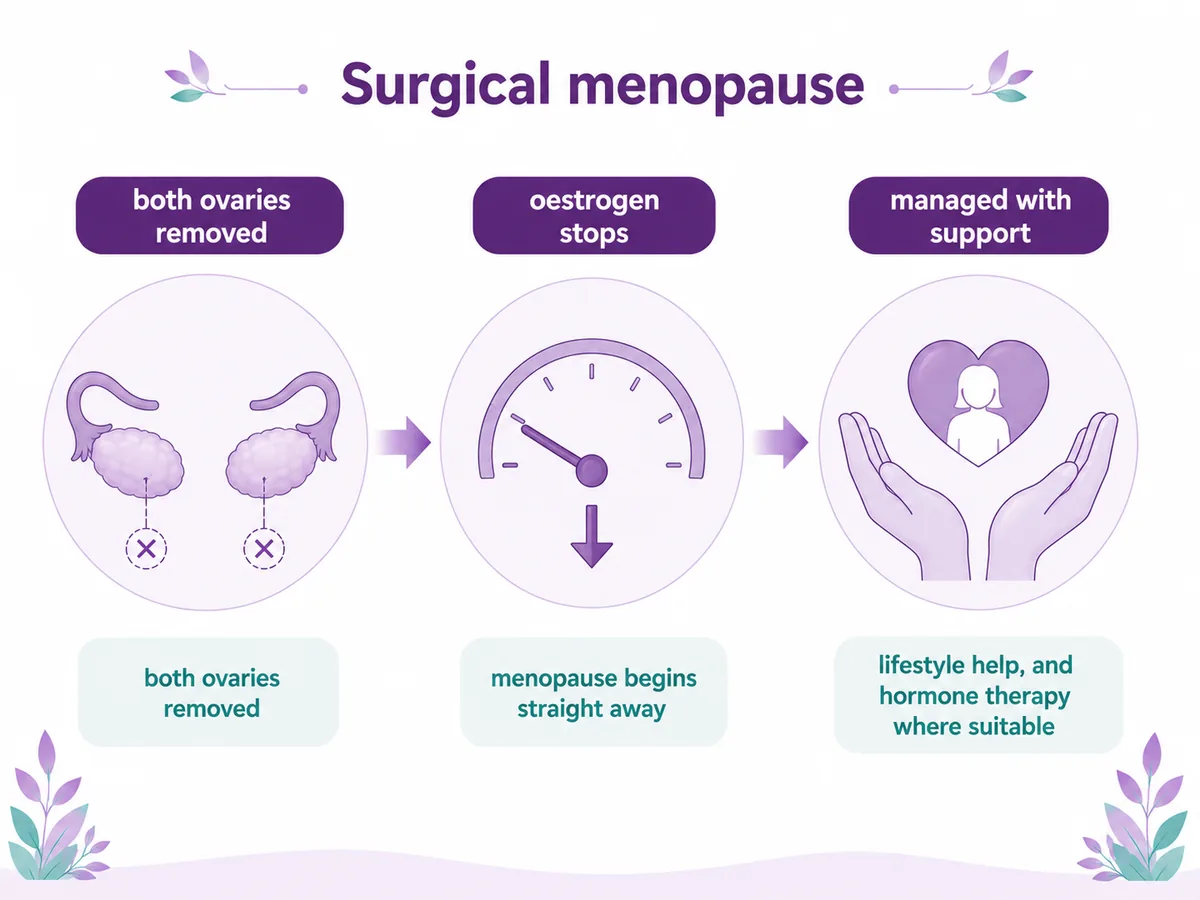
Because a BSO removes both ovaries, a woman who has not yet reached menopause will go into menopause straight after surgery — this is called surgical menopause. Because it is sudden rather than gradual, symptoms such as hot flushes, sleep changes and mood or intimacy changes can come on quickly. The reassuring part: this is expected, and managed. Lifestyle measures help, and for many women — especially younger women having risk-reducing surgery, and where it is safe for them — hormone therapy (HRT) can ease symptoms and help protect bone and heart health. Whether HRT suits you depends on your situation, particularly the type of cancer if any, and is discussed carefully with you. If you have already been through menopause, a BSO does not cause these changes.
Removing both ovaries stops the body’s oestrogen, so menopause begins straight away — expected, and managed with support and, where suitable, hormone therapy.
Why it is sudden
Natural menopause happens over years, as the ovaries slow down gradually. When both ovaries are removed, that change happens at once — which is why symptoms can arrive quickly, and why it helps to plan for it before surgery rather than after.
The hormone therapy (HRT) question
For many women — particularly younger women having risk-reducing surgery — hormone therapy can ease symptoms and help protect bone and heart health, where it is safe for them. Whether it suits you depends on your situation, especially the type of cancer if any.
What helps day to day
Sleep, exercise, bone and heart health, and practical measures for flushes all make a real difference. Our nutrition and rehabilitation teams support this side of recovery, not just the operation.
The emotional side
Menopause arriving early or unexpectedly can be a real loss, and those feelings are valid. CION’s psycho-oncology counsellors support you and your partner through it — feeling like yourself again is part of the care.
Whether hormone therapy (HRT) is suitable after a BSO depends on your individual situation — particularly the type of cancer, if any. It is a decision to make with your gynae-oncologist, not from general information.
When a BSO is done on its own — for example as risk-reducing surgery — it is usually a keyhole (laparoscopic) operation with a short stay, often just a day or overnight, and a return to normal activities over about two to four weeks. When it is part of larger cancer surgery (with a hysterectomy, omentectomy or staging), the operation and the recovery are bigger and take longer. Either way, your team prepares you for surgical menopause if it applies, arranges support, and — where relevant — plans any further cancer treatment around the surgery.
1
Before surgery
The reason (cancer or risk reduction), the approach, and — if you have not yet reached menopause — a plan for it. For inherited risk, genetic counselling comes first.
2
The operation
Both ovaries and both tubes removed, usually by keyhole; if it is part of cancer surgery, other steps are done at the same time.
3
In hospital
For a keyhole BSO alone, often just a day or overnight, with good pain control and early mobilisation.
4
Early recovery
Normal activities over about two to four weeks, avoiding heavy lifting at first; longer after larger cancer surgery.
5
Afterwards
Surgical-menopause support (and hormone therapy where suitable), any further cancer treatment, and follow-up.
The pathology on the removed tubes and ovaries is reviewed carefully, and your team explains what it shows. Where the operation was risk-reducing, follow-up is lighter and focuses on menopause support and your general health; where it treated a cancer, follow-up is planned around the rest of your treatment. Emotional support is available throughout — the care does not stop when the operation is over.
Cost & coverage
Bilateral salpingo-oophorectomy cost in Hyderabad Indicative
The cost depends mainly on whether the BSO is done on its own or as part of larger surgery — a keyhole BSO alone costs less than a BSO with a hysterectomy, and a BSO as part of ovarian-cancer surgery costs more again. In Hyderabad a keyhole BSO alone is typically an indicative ₹80,000 – ₹1,80,000. On cover, it matters why it is done: when it treats a cancer, it is generally covered under Aarogyasri / PMJAY at empanelled centres and by most insurance; when it is risk-reducing surgery in a woman without cancer, cover depends on your policy, so it is worth checking early.
Indicative cost estimator
Pick your situation for an indicative range, then request an exact estimate for your case.
Indicative range
₹80,000 – ₹1,80,000
for a keyhole BSO on its own, general room, self-pay
Figures are indicative only and not a quotation. When a BSO treats a cancer it is generally covered under Aarogyasri / PMJAY at empanelled centres, subject to eligibility. For risk-reducing surgery in a woman without cancer, cover depends on your insurance policy. Your actual cost depends on your diagnosis and plan.
Whether you are facing ovarian-cancer surgery or weighing a risk-reducing operation after a BRCA result, you should not decide alone. Book a free consultation — and if you already have reports, a free written second opinion.
Your reports or family history reviewed by a senior gynae-oncology surgeon
An honest answer on the operation — and on surgical menopause and HRT
Aarogyasri / PMJAY & insurance guidance, including what is covered and what is not
Support
Financial support & Aarogyasri
Cost should not delay treatment. Where a BSO is part of treating a cancer, it may be largely covered under Aarogyasri and PMJAY at empanelled centres, and private insurance is accepted cashless. Where it is risk-reducing surgery in a woman without cancer, cover depends on your policy — so it is worth checking early, and our counsellors will help you do exactly that. Either way, you get a clear, written estimate before anything is planned.
9 clinics in Hyderabad · 35+ across Telangana & AP
CION cancer care is closer than you think.
We're never more than 30 minutes away. Same panel of specialists at every centre. Same tumour board reviews. Same NCCN protocols. Pick the closest one and call directly — or let us pick for you.
Don't see your city? Call
18002028726
— we'll find your nearest CION partner centre.
Meet the surgical oncology team
Your surgery is planned by a team, not one doctor.
Surgical, radiation and medical oncologists plan every ovarian and gynae-cancer case together in a multidisciplinary tumour board — part of 17 senior specialists across CION.
Share your name and number — we'll call you back within 30 minutes to schedule your consultation.
A BRCA result, or a mass on the ovary? Don’t decide alone.
Whether both ovaries and tubes should come out — and if so, when — is a decision to make with genetic counselling and a gynae-oncology tumour board, not from a search result. Let CION review your reports and give you an honest recommendation.
Common fears about a bilateral salpingo-oophorectomy — answered
These worries are real, and some are made heavier by what people say. Here are honest, gentle answers to the fears we hear most in Telangana.
“If both my ovaries are removed, I’ll age overnight and stop being a woman.”
Fact: Removing both ovaries does bring on menopause if you have not yet reached it — that part is true, and we will not pretend otherwise. But menopause is a stage of life that every woman reaches; having it arrive sooner does not make you less of a woman, and it does not make you old. It is expected, planned for, and managed — with lifestyle support and, where it is safe for you, hormone therapy. Millions of women live full, active lives after this operation.
“Surgical menopause will ruin my life — I’ve heard it’s unbearable.”
Fact: It is a real change, and because it is sudden rather than gradual, symptoms can come on quickly. But “sudden” is not the same as “unmanageable”. This is one of the best-understood parts of the operation: your team prepares you before surgery, not after, and hormone therapy where suitable, along with practical measures for sleep, flushes and bone health, makes a very real difference. You will not be left to cope alone.
“HRT causes cancer — so I can never take it.”
Fact: This is far too broad a statement to be useful. For many women, especially younger women having risk-reducing surgery, hormone therapy eases surgical-menopause symptoms and helps protect bone and heart health. Whether it is right for you depends on your individual situation — particularly the type of cancer, if any. It is a decision to make with your gynae-oncologist based on your circumstances, not on general advice or what a relative was told years ago.
“Why remove the tubes? The cancer is in the ovary.”
Fact: This is the most important thing on this page. A large share of high-grade “ovarian” cancers do not begin in the ovary at all — they start at the far (fimbrial) end of the fallopian tube and then involve the ovary. Removing the tubes takes away a key place these cancers begin. It is not an extra or an over-cautious add-on; it is central to why the operation works, in both cancer surgery and risk reduction.
“Removing healthy ovaries when I don’t even have cancer is madness — I’d be tempting fate.”
Fact: For a woman with a high inherited risk, this is a considered, evidence-based choice, not a drastic one — removing the tubes and ovaries markedly lowers the chance of ever developing ovarian or tubal cancer, which is hard to find early. That said, it is genuinely your decision, it is not urgent, and it is not the only option — surveillance and other approaches are discussed too. Nothing is decided without genetic counselling and time to think.
“Once my ovaries and tubes are out, I’m completely safe from ovarian cancer forever.”
Fact: We have to be honest here rather than reassuring: it markedly lowers the chance, but it does not reduce it to zero. A small risk of a related cancer in the lining of the abdomen (the peritoneum) remains, because that tissue is not removed. This is exactly why the decision is made with genetic counselling and why follow-up still matters. Anyone who promises you a guarantee is not telling you the truth.
“Surgery will make the cancer spread.”
Fact: This is a common and harmful myth. Removing a cancer under controlled surgical conditions does not spread it through the body. What genuinely causes harm is delay, which lets a treatable cancer grow. In ovarian-cancer surgery, removing the tubes and ovaries — and, where needed, more — is one of the most effective steps in treatment.
“My husband will leave me, and intimacy will be over.”
Fact: A BSO does not remove the ability to be close to your partner. Surgical menopause can affect comfort and desire — usually through dryness — and these are common, treatable issues that your team is entirely used to discussing. Where hormone therapy is suitable it helps a great deal, and simple measures work well too. Most women return to a satisfying intimate life; counselling is there for you and your partner.
“A cancer like this must be my fault — something I did, or bad karma.”
Fact: Nothing you did caused this, and nothing you failed to do could have prevented it. Ovarian and tubal cancers are not a punishment, and an inherited gene change is simply something you were born with — it is not a flaw or a fault. Blame and shame only delay care and isolate you at the moment support matters most. You deserve treatment and respect, not judgement.
“My family will say a woman without ovaries is incomplete.”
Fact: People say things out of fear and misunderstanding, not medical knowledge. Your ovaries are organs; they are not your identity, your worth or your place in your family. Removing them to treat a cancer, or to protect your life, is an act of care — for yourself and the people who need you. Our counsellors are happy to speak to your family too, in Telugu, and explain why this operation is being done.
“Can a middle-class family afford this?”
Fact: Cost should not be why care is delayed — but be clear on the difference. Where the BSO treats a cancer, Aarogyasri and PMJAY cover it at empanelled centres and private insurance is accepted cashless. Where it is risk-reducing surgery in a woman without cancer, the scheme generally does not apply and cover depends on your policy. Our counsellors check exactly where you stand and give you a written estimate before anything is planned.
“Being offered risk-reducing surgery means they think I already have cancer.”
Fact: No — it means the opposite. Risk-reducing surgery is offered to women who do not have cancer, precisely so it stays that way. It is a planned, unhurried, preventive decision made after genetic counselling, usually considered after childbearing and around an age range that depends on your particular gene change. If a cancer were suspected, the conversation would be a completely different one.
“Keyhole surgery is a shortcut — open surgery must be safer.”
Fact: For removing the ovaries and tubes, keyhole (laparoscopic) surgery is a well-established approach and is what CION uses where it is suitable — smaller cuts, less pain and a quicker recovery, done by the same experienced surgeons. Where a cancer needs more extensive surgery, an open operation may be the right choice. Your surgeon recommends the approach that suits your situation, not the one that sounds most impressive.
“I’m too young for menopause, so I should just keep postponing the decision.”
Fact: Timing genuinely matters here, and it is a real balance — which is why it is decided with genetic counselling rather than alone. Risk-reducing surgery is usually considered after childbearing and around an age range that depends on your particular gene change and family history, weighing how much it lowers your risk against surgical menopause. Waiting is a valid choice to discuss; drifting without a plan is not.
“Herbal or home remedies can shrink an ovarian cyst or cancer instead.”
Fact: No home or herbal remedy is proven to treat ovarian or tubal cancer, and relying on one wastes the window when treatment works best. Do tell your oncologist about anything you take, so it can be used safely alongside proper treatment — but please do not let it replace treatment.
“A big scar and months in bed are unavoidable.”
Fact: For a keyhole BSO on its own, there is no big scar — just a few small cuts — and the stay is often just a day or overnight, with normal activities returning over about two to four weeks. Where the BSO is part of larger cancer surgery, the operation and recovery are bigger and take longer, and your team will tell you honestly what to expect for your situation.
“If I get genetic testing, it will harm my daughters’ marriage prospects.”
Fact: This worry is common and we take it seriously. Your genetic result is confidential medical information — it is yours, and it is not disclosed to anyone without your consent. What testing actually does is give the women in your family the chance to know, to be watched carefully, and to act early if they choose. Knowledge protects your daughters; silence does not. Genetic counselling covers exactly how, when and whether to share results within a family.
“I must decide immediately, without a second opinion.”
Fact: A second opinion is normal and welcomed in cancer care — it confirms the plan and gives you confidence. For risk-reducing surgery in particular there is usually no emergency at all: it is a planned decision, and taking time to think is part of doing it properly. At CION a second opinion is free when you have a report, and can be arranged quickly, without offending anyone.
“If I need chemotherapy after surgery, the surgery must have failed.”
Fact: Not at all. For many ovarian and tubal cancers, treatment around surgery is planned from the start as part of the strategy — surgery removes what can be removed, and the treatment around it deals with what surgery cannot reach. It is one plan working together, not a rescue after a failure. Your tumour board decides the order that treats your cancer most thoroughly.
“A cancer diagnosis means the worst — there’s no point in surgery.”
Fact: Ovarian and tubal cancers are treatable, and surgery is one of the most effective steps in that treatment — for many women it is decisive. Even where a cancer is advanced, surgery combined with the treatment around it offers real, meaningful benefit. A tumour board gives you an honest picture of what treatment can achieve in your situation, and the team walks with you through every step of it.
Why CION
Why choose CION for a bilateral salpingo-oophorectomy in Hyderabad
Keyhole gynae surgery
Bilateral salpingo-oophorectomy by keyhole (laparoscopic) surgery where suitable — small cuts, and a quicker recovery.
BRCA testing & genetic counselling
Germline BRCA testing and genetic counselling, so a risk-reducing decision is made with the full picture — never rushed.
Surgical-menopause support
Preparation and support for surgical menopause, including the hormone-therapy decision where it is suitable for you.
Full ovarian-cancer care
Where it is part of cancer surgery, the same team provides staging, debulking and the treatment around it.
A tumour-board approach
Every cancer case reviewed by a gynae-oncology multidisciplinary tumour board, so surgery and treatment fit together.
Care closer to home + Aarogyasri
35+ centres across Telangana & AP, Telugu-speaking teams, and full Aarogyasri / insurance counselling.
Real stories · real courage
15,000+ patients chose CION. Hear from them directly.
These aren't paid endorsements or written reviews. These are video testimonials from real patients and families — recorded on their own phones, in their own words. Pick any one. Watch it. Then decide.
4.8★800+ Google reviews
50+video testimonials
15,000+patients treated
Successful Chemotherapy & Radiation Done by Dr. Owais Mohammed & Dr. Kirti Ranjan
Watch video →
Successful Chemotherapy Done by Dr. C Raghavendra Reddy
Watch video →
Surgery, Chemo & Radiation Done by Dr. Imaduddin, Dr. Vinay, Dr. Owais, Dr. Kirti
Watch video →
Successful Radical Thymectomy Done by Dr. Mohammed Imaduddin & Dr. Vinay Mamidala
Watch video →
Successful Surgery Done by Dr. Rajender Byshetty
Watch video →
Successful Chemo & Surgery Done by Dr. Imad, Dr. Vinay, Dr. Owais & Dr. Raghavendra
Watch video →
Successful Chemo & Surgery Done by Dr. Imad, Dr. Vinay, Dr. Owais & Dr. Raghavendra
Watch video →
Successful Chemo & Radiation Done by Dr. Owais Mohammed & Dr. Kirti Ranjan Mohanty
Watch video →
Successful Breast Cancer Surgery Done by Dr. Imaduddin Mohammed & Dr. Vinay Mamidala
Watch video →
Successful Chemotherapy Done by Dr. Bharati Devi Gorantla
Watch video →
Successful Chemo & Surgery Done by Dr. Owais Mohammed & Dr. Imaduddin Mohammed
Watch video →
Successful Chemotherapy Done by Dr. Gundu Naresh
Watch video →
Successful Bone Marrow Transplantation - Neuroblastoma
Watch video →
Successful Surgery & Chemo - Carcinoma of Caecum
Watch video →
Successful Oral chemotherapy & mastectomy surgery
Watch video →
Successful Oral chemotherapy & mastectomy surgery
Watch video →
Successful Chemotherapy
Watch video →
Successful Surgery by Dr. Mohammed Imaduddin
Watch video →
Successful Bone Marrow Transplantation
Watch video →
Successful Oral chemotherapy & mastectomy surgery
Watch video →
Successful Oral chemotherapy & mastectomy surgery
Watch video →
Successful Chemotherapy
Watch video →
Successful Buccal Mucosa Surgery
Watch video →
Successful Complex Surgery Mandibulectomy Reconstruction
A bilateral salpingo-oophorectomy is one part of ovarian-cancer care, or of reducing an inherited risk. At CION, surgery, genetics, menopause support, nutrition and emotional care are one coordinated plan — so you are supported medically, emotionally and physically.
Genetic counselling & BRCA
Hereditary-risk testing and counselling for you and your relatives. Learn more
Psychology counselling
Identity, intimacy and family support for you and your partner. Learn more
Nutrition counselling
Strength, bone health and general wellbeing through treatment and recovery. Learn more
Rehabilitation
Physiotherapy and recovery support to rebuild strength after surgery. Learn more
Palliative & comfort care
Comfort and symptom support at any stage, alongside treatment. Learn more
Financial counselling
Aarogyasri, PMJAY and cashless insurance guidance so cost never blocks care. Learn more
FAQ
Bilateral salpingo-oophorectomy in Hyderabad — frequently asked questions
What is a bilateral salpingo-oophorectomy?
A bilateral salpingo-oophorectomy (BSO) is an operation that removes both ovaries and both fallopian tubes; the womb is usually kept unless it is being removed for another reason. It is done either as part of treating a cancer of the ovary, fallopian tube or womb, or to lower a high inherited risk of ovarian and tubal cancer — for example in women who carry a BRCA gene change. It is most often done by keyhole surgery.
Why are the fallopian tubes removed, not just the ovaries?
Because a large share of high-grade ovarian cancers actually begin in the far (fimbrial) end of the fallopian tube and then involve the ovary. Removing the tubes takes away a key place these cancers start, which is why a salpingo-oophorectomy removes both the tubes and the ovaries — it is central to how the operation treats a cancer, or lowers the chance of one, rather than an optional extra.
Will a BSO put me into menopause?
If you have not yet reached menopause, yes — because it removes both ovaries, a BSO brings on menopause straight away (surgical menopause). Because it is sudden, symptoms such as hot flushes and sleep changes can come on quickly, but this is expected and managed, with lifestyle support and, where it is safe for you, hormone therapy. If you have already been through menopause, a BSO does not cause these changes.
Can I take HRT after a bilateral salpingo-oophorectomy?
Often, yes — for many women, particularly younger women having risk-reducing surgery, hormone therapy (HRT) can ease surgical-menopause symptoms and help protect bone and heart health. Whether it is suitable for you depends on your individual situation, especially the type of cancer if any. It is an important decision to make with your gynae-oncologist, based on your circumstances rather than general advice.
What is the difference between an oophorectomy and a salpingo-oophorectomy?
An oophorectomy removes an ovary (or both ovaries); a salpingo-oophorectomy removes the ovary together with its fallopian tube. Bilateral means both sides — so a bilateral salpingo-oophorectomy removes both ovaries and both tubes. Because it removes both ovaries, it also brings on menopause if you have not yet reached it, which a one-sided ovary removal does not.
Is my womb removed in a bilateral salpingo-oophorectomy?
No — a BSO removes both ovaries and both fallopian tubes, and the womb (uterus) is usually kept. The womb is only removed if there is a separate reason to remove it, in which case a hysterectomy is done at the same time, under the same anaesthetic. Your surgeon explains exactly what is planned for you before the operation, so there are no surprises.
Can I still have children after a BSO?
No — removing both ovaries and both tubes ends natural fertility, because there are no eggs and no route for them to travel. This is why fertility is discussed before surgery, not after: if having children matters to you, raise it early, as fertility-preservation options may be possible beforehand and the timing of risk-reducing surgery is usually planned for after childbearing. Your team will talk this through honestly and without pressure.
Does a BSO completely prevent ovarian cancer?
It markedly lowers the chance of developing ovarian and tubal cancer, which is why it is offered to women at high inherited risk — but it does not reduce the risk to zero. A small risk remains of a related cancer in the lining of the abdomen (the peritoneum), because that tissue is not removed. This is discussed openly during genetic counselling, and follow-up continues afterwards. No operation offers a guarantee.
I have a BRCA gene change — when should I consider risk-reducing surgery?
Risk-reducing salpingo-oophorectomy is usually considered after childbearing and around an age range that depends on your particular gene change and family history — decided together with genetic counselling, weighing how much it lowers your risk against surgical menopause. It markedly lowers the chance of ovarian and tubal cancer. There is no single right time for everyone; see our risk-reducing (prophylactic) surgery page and speak with our team.
Do I need genetic testing and counselling before risk-reducing surgery?
Yes. Risk-reducing surgery is never done on the basis of worry alone — it follows germline genetic testing and genetic counselling, which establish your actual level of risk and what it means for you and your relatives. Counselling also covers the alternatives, the timing, surgical menopause, and how and whether to share results within your family. CION offers both testing and counselling.
Is a bilateral salpingo-oophorectomy keyhole or open surgery?
At CION it is most often done by keyhole (laparoscopic) surgery, which means a few small cuts, less pain and a quicker recovery — this is well established for removing the ovaries and tubes. Where the BSO is part of larger cancer surgery, such as staging or debulking, an open operation may be the right choice. Your surgeon recommends the approach that suits your situation.
How long is recovery after a keyhole BSO?
When a BSO is done on its own by keyhole, it is usually a short stay — often a day or overnight — with a return to normal activities over about two to four weeks. When it is part of larger cancer surgery (with a hysterectomy, omentectomy or staging), the operation and recovery are bigger and take longer. Your team explains what to expect for your situation and arranges surgical-menopause support if it applies.
What are the risks of a bilateral salpingo-oophorectomy?
As with any operation there are general risks such as bleeding, infection and anaesthetic risks, which are low for a keyhole BSO and are managed carefully. The main consideration specific to this operation is surgical menopause in a woman who has not yet reached it, along with its longer-term effects on bone and heart health — which is why hormone therapy is considered where it is safe. Your surgeon explains the risks that apply to you before you consent.
Will a BSO affect my sex life?
The operation itself does not remove the ability to be intimate. Surgical menopause can affect comfort and desire, most often through dryness, and these are common and treatable issues. Where hormone therapy is suitable it helps considerably, and simple measures work well too. Most women return to a satisfying intimate life, and your team is used to discussing this openly and without embarrassment.
Will the surgery spread the cancer?
No. Removing a cancer under controlled surgical conditions does not spread it through the body — this is a common myth. What causes real harm is delay, which lets a treatable cancer grow. In ovarian and tubal cancer, removing the ovaries and tubes, and where needed more, is one of the most effective steps in treatment.
Is a bilateral salpingo-oophorectomy covered by Aarogyasri or insurance?
When it treats a cancer, it is generally covered under Aarogyasri and PMJAY at empanelled centres and by most health-insurance policies, usually alongside any treatment around it. When it is risk-reducing (preventive) surgery in a woman without cancer, the scheme generally does not apply and cover depends on your policy, so it is worth checking early. CION is Aarogyasri empanelled; the team checks your eligibility and provides a written estimate before anything is planned.
How much does a bilateral salpingo-oophorectomy cost in Hyderabad?
In Hyderabad, a keyhole BSO on its own is typically an indicative ₹80,000 to ₹1,80,000. A BSO with a hysterectomy costs more, and a BSO as part of ovarian-cancer staging or debulking surgery costs more again, depending on room category and length of stay. Where it treats a cancer, Aarogyasri / PMJAY at empanelled centres may cover most of it and insurance is accepted cashless; for risk-reducing surgery, cover depends on your policy. CION gives an accurate written estimate after assessment.
Can I have a BSO if I have already been through menopause?
Yes — and if you have already been through natural menopause, the operation does not cause the hormonal changes described on this page, because your ovaries have already stopped producing oestrogen. The reasons for doing it are the same: treating a cancer, or lowering a high inherited risk. The operation itself, and the recovery, are much the same.
Which hospital and doctor should I choose for a BSO in Hyderabad?
Look for a cancer centre with fellowship-trained gynae-oncology surgeons, laparoscopic gynae surgery, germline BRCA testing and genetic counselling on site, multidisciplinary tumour-board planning, and honest surgical-menopause support. CION Cancer Clinics offers these across 35+ centres in Telangana and Andhra Pradesh, with Aarogyasri and insurance counselling. Your case is reviewed by a team rather than one doctor, and you can request a specific surgeon when booking.
Explore
Explore ovarian, gynae & inherited-risk care at CION
Treatment, surgery, genetics, tests and support around ovarian and gynae cancer. Tap any topic to read more.
Speak to a gynae-oncology surgeon about your options
Whether it is a cancer to treat or a risk to lower, the right answer is a considered one. Book a free consultation or second opinion at any of our 9 Hyderabad clinics — part of 35+ centres across Telangana & Andhra Pradesh.
Medical disclaimer: This page provides general information about bilateral salpingo-oophorectomy and is not a substitute for professional medical advice, diagnosis or treatment. Costs shown are indicative only and not a quotation. Removing both tubes and ovaries markedly lowers the chance of ovarian and tubal cancer but does not reduce it to zero — a small peritoneal risk remains. Removing both ovaries before natural menopause causes surgical menopause, which is expected and managed; whether hormone therapy (HRT) is suitable depends on your individual situation, particularly the type of cancer if any, and is a decision for your gynae-oncologist. Decisions about risk-reducing surgery are made with genetic counselling. Always consult a qualified gynae-oncology surgeon about your individual care. Content is periodically reviewed by CION’s medical team.

 CION Ameerpet