A splenectomy removes the spleen — usually for a blood cancer, an enlarged spleen dragging your blood counts down, or as part of a larger operation. The question everyone asks first is understandable, and the answer is reassuring: you can live a full life without a spleen. Other organs take over most of its work. Because the spleen helps fight certain infections, life afterwards includes one simple, lifelong protection plan — vaccinations, standby antibiotics, and acting fast on any fever.
A full life without a spleen · a clear infection-protection plan for life
Keyhole (laparoscopic) surgery where possible · planned with your haematologist
Aarogyasri for cancer · clear indicative costs
★★★★★Rated 4.8/5 · 800+ Google reviews
A full life without a spleen
A clear infection-protection plan
Keyhole (laparoscopic) surgery
35+ centres · Aarogyasri help
MM
Written by Dr. Muralidhar Muddusetty, MRCS (Edinburgh), AIIMS-trained, GI & surgical oncology lead, with CION’s surgical oncology team. Medically reviewed by Dr. Basudev Pokhrel, Haematology (blood-cancer physician), for the blood-cancer and infection-protection guidance. · Reviewed 16 July 2026
Understanding the surgery
What is a splenectomy?
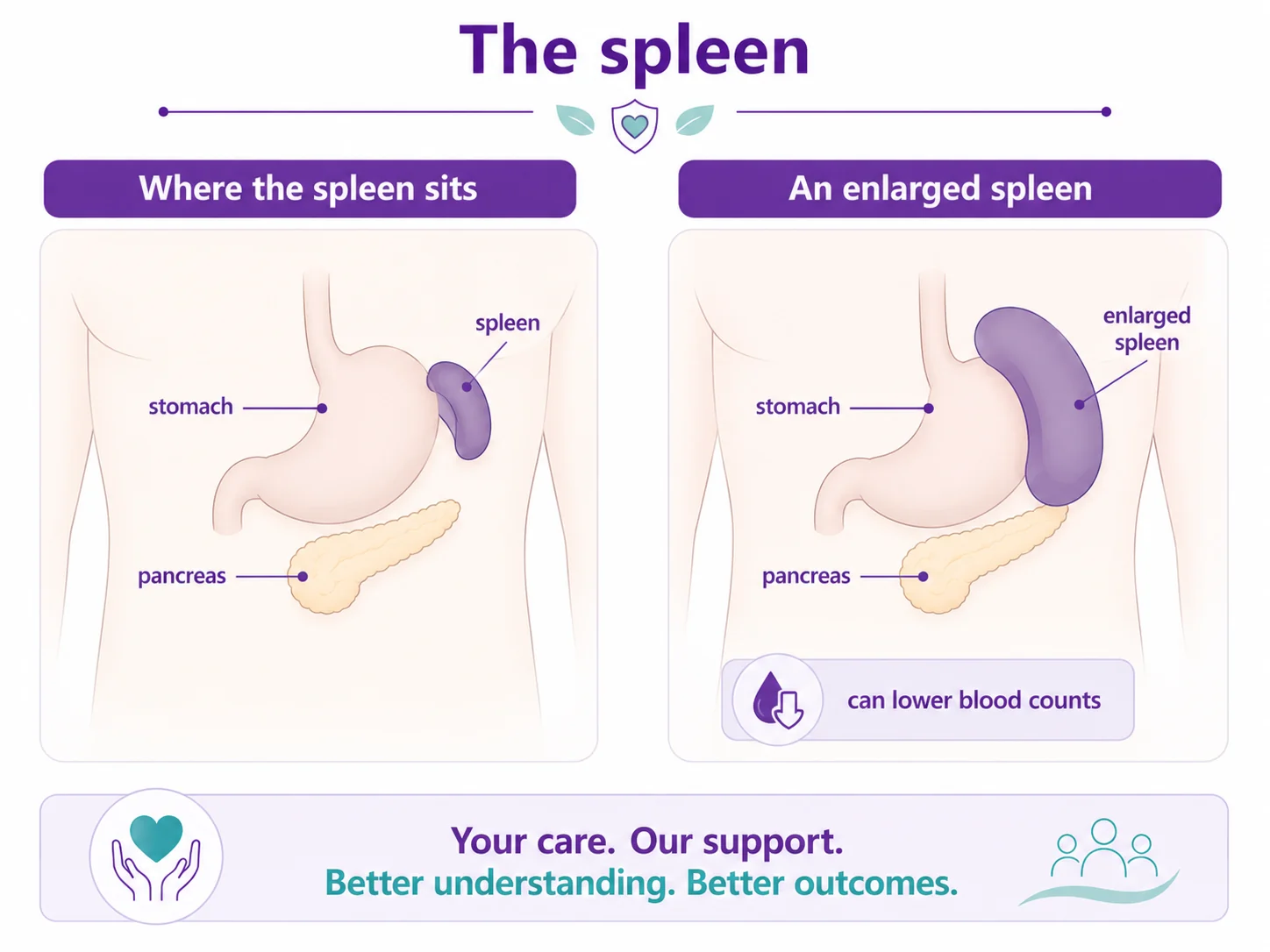
A splenectomy is an operation to remove the spleen — a fist-sized organ in the upper-left part of the tummy, near the stomach and the tail of the pancreas. The spleen helps filter the blood and is part of the body’s infection-fighting system. Most often the whole spleen is removed (a total splenectomy); in selected cases part of it can be kept. It is usually done by keyhole (laparoscopic) surgery — small cuts, a quicker recovery — while a very large spleen may need open surgery.
The most important thing to understand is that you can live a full life without a spleen — the liver and other tissues take over most of its jobs. Because the spleen helps fight certain serious infections, life afterwards includes a simple, lifelong infection-protection plan. In cancer care, a splenectomy is done for a blood cancer or an enlarged spleen, to help make a diagnosis, or as part of a larger operation — and it is planned together by your surgical and haematology teams. Primary cancer of the spleen itself is rare.
The spleen is removed
A fist-sized organ in the upper-left tummy, beside the stomach and the tail of the pancreas — usually all of it, sometimes part.
You can live without it
The liver and other tissues take over most of the spleen’s work. Most people go back to a full, active life.
One simple protection plan
Vaccinations, standby antibiotics and acting fast on any fever keep you protected — for life, and it becomes routine.
In cancer care there are a few clear reasons. Most often it is because of a blood cancer — some lymphomas and leukaemias involve the spleen, and removing it can treat disease that is concentrated there, ease symptoms from a large spleen, or lift low blood counts caused by an overactive spleen. An enlarged spleen (splenomegaly) can be uncomfortable and can trap too many blood cells. Sometimes the spleen is removed as part of a larger operation on a neighbouring organ (such as the tail of the pancreas or the stomach), or occasionally to make a diagnosis when other tests cannot. Cancer starting in the spleen itself is rare.
The spleen sits in the upper-left tummy, beside the stomach and the pancreas. An enlarged spleen can trap blood cells and lower your blood counts.
A blood cancer
Some lymphomas and leukaemias involve the spleen. Removing it can help when the disease is concentrated there.
An enlarged spleen
A big spleen can be uncomfortable and can trap blood cells, dragging your counts down. Removing it can let them recover.
Part of a larger operation
The spleen shares blood vessels with the pancreas tail and the stomach, so it is sometimes removed alongside them.
To make a diagnosis
Occasionally, examining the whole spleen is the only way to get a definite answer that guides the right treatment.
An honest point worth making: removing the spleen is not the main treatment for a blood cancer. Lymphoma and leukaemia are treated with medicines that travel through the whole body — chemotherapy, immunotherapy or targeted therapy — because blood cancer is not confined to one place. A splenectomy is added for a specific reason: disease concentrated in the spleen, a spleen causing symptoms, or counts being dragged down. If nobody has explained which of these applies to you, that is a fair question to ask.
Explore what usually applies to your situation
Pick the reason and your main concern for a plain-language picture — then talk it through with our team. This is educational, not a diagnosis or a personal recommendation.
The reason?
What worries you most?
What this usually means
In some blood cancers — certain lymphomas and leukaemias — removing the spleen can help: it may treat disease that is concentrated in the spleen, ease symptoms from a large spleen, or improve low blood counts caused by an overactive spleen. It sits alongside your main treatment rather than replacing it, and is decided together by your haematologist and surgeon. On whether you really need it: a splenectomy is advised when it clearly helps, and because the spleen has a role in fighting infection your team weighs that carefully with you — a second opinion is always reasonable. This is general information — the right plan is made with your surgical and haematology team, who know your scans and blood tests.
This tool is educational and not medical advice, a diagnosis or a personal recommendation. Only your surgical and haematology team, who know your scans and blood tests, can advise what is right for you.
Life without a spleen — your infection-protection plan
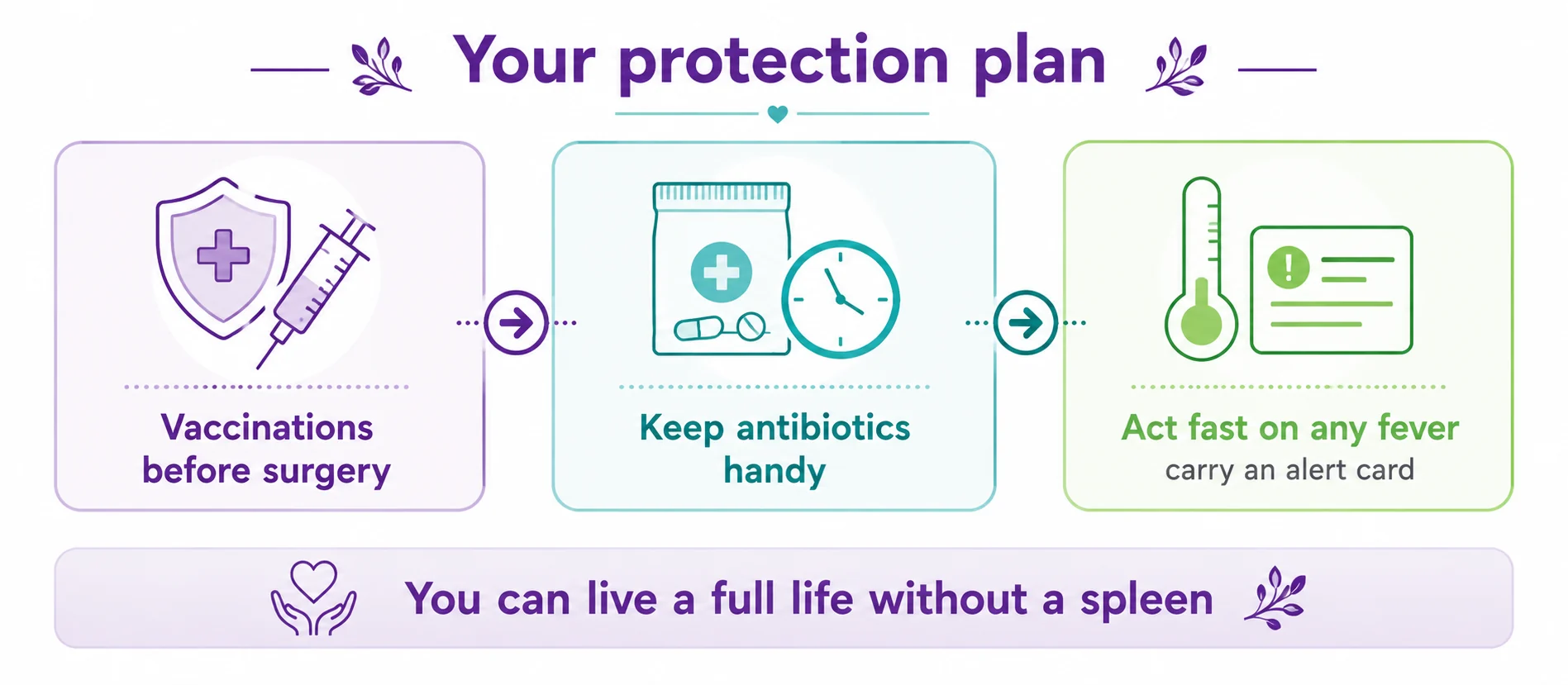
Here is the honest, reassuring truth: you can live a full, active life without a spleen — but because the spleen helps fight certain serious infections, you carry a higher, lifelong risk of a rare but serious infection, so you follow a simple plan. It has three parts. Vaccinations — ideally given about two weeks before a planned operation (or afterwards if surgery is urgent), against the main bacteria the spleen would normally help fight, with boosters over time and a yearly flu vaccine. Antibiotics — a standby supply to start if you become unwell, and regular preventive antibiotics for some people, especially children. And acting fast on any fever — treating fever, chills or feeling very unwell as urgent, and carrying an alert card so any doctor knows at once. Followed simply, this plan keeps you well.
Your protection plan: vaccinations (ideally before surgery), a standby antibiotic supply, and acting fast on any fever — with an alert card in your wallet.
1 · Vaccinations, ideally before surgery
Against the main bacteria the spleen would normally help fight — pneumococcus, Hib and meningococcus — plus a yearly flu vaccine, with boosters over the years. Best given about two weeks before a planned operation, so protection is already building.
2 · Antibiotics kept handy
A standby supply to start straight away if you become unwell, and regular preventive antibiotics for some people — especially children, and often in the first years after surgery. Your doctor advises what is right for you.
3 · Act fast on any fever
Without a spleen an infection can move quickly, so any fever, chills or feeling very unwell is treated as urgent — the same day. Carry an alert card so any doctor knows at once that you have no spleen.
When to act urgently: once your spleen has been removed, treat any fever, chills or suddenly feeling very unwell as an emergency. Start your standby antibiotics if you have been advised to, and seek medical care the same day — do not wait until morning to see how it goes. It is always better to be checked and reassured.
Before any spleen surgery, the reason for it is confirmed — so the operation is planned around your exact situation, not a guess. Blood tests show how your counts are behaving and whether an overactive spleen is dragging them down. A scan shows how big the spleen is and what sits around it, which is what decides keyhole versus open surgery. Where a blood cancer is suspected, a bone-marrow test and expert tissue reading confirm the diagnosis. A biopsy is safe and does not spread cancer.
Diagnostic services we offer — book any of these:
Blood counts & blood tests
The first step: a full blood count shows whether your platelets, red cells or white cells are being dragged down — often the very reason the spleen is being discussed.
Your scans and blood tests reviewed together by the surgical and haematology teams, so the decision to remove the spleen is a joint one — not one person’s call.
Pick your situation and what you want to know for a plain-language picture — then confirm your own plan with your team. This is educational, not a diagnosis or a personal medical plan.
Life without a spleen — what applies to you
Two quick questions. Your answer updates instantly, and nothing you pick is stored.
Your situation?
What do you want to know?
Your protection-plan picture
With a planned splenectomy, the key step is timing your vaccinations before surgery — ideally about two weeks beforehand — so your body builds protection while your spleen is still there. Your team arranges this, and plans the rest of your protection with you before you go home. Vaccinations are the foundation: you are protected against the main bacteria the spleen would normally help fight (such as pneumococcus, Hib and meningococcus), plus a yearly flu vaccination, with booster doses over time; where possible these are given before surgery, and if not they are started afterwards. This is general guidance, not a personal medical plan — your own protection plan is set by your team, who know your health.
This tool is educational and not medical advice, a diagnosis or a personal protection plan. Your vaccinations, antibiotics and what to do about a fever are decided by your own care team, who know your health and history.
Most splenectomies are done by keyhole (laparoscopic) surgery — a few small cuts, a camera and fine instruments — which usually means less pain, a shorter hospital stay and a quicker return to normal. When the spleen is very enlarged, or when it is being removed as part of a larger operation, open surgery (one larger cut) may be the safer choice — and it is not a lesser option. In selected cases a partial, spleen-preserving operation may be possible, keeping some of the spleen’s infection-fighting role. Your surgeon recommends what is safest for your spleen and your condition, and explains why.
Keyhole (laparoscopic)
Open surgery
How it is done
A few small cuts, a camera and fine instruments.
A single larger cut in the upper tummy.
Often suits
A normal or moderately enlarged spleen.
A very large spleen, or a splenectomy done as part of a bigger operation.
Recovery
Usually shorter — less pain, quicker return to activity.
A little longer, guided by your team.
The cancer part
Identical. The spleen is removed completely either way — the approach changes your recovery, not the thoroughness of the operation.
Both share
Vaccinations are planned around the operation — ideally about two weeks before — so your protection is in place from the start.
Keyhole where possible
The usual approach — smaller cuts, less pain, a shorter stay and a quicker recovery, with the spleen removed just as completely.
Open when it is safer
For a massively enlarged spleen or a combined operation, open surgery is the safer, more controlled route — chosen on merit.
Spleen-preserving where it fits
In selected cases — more often in younger people or for certain non-cancer reasons — part of the spleen can be kept, keeping some infection-fighting role.
A splenectomy is one part of a complete plan — rarely the whole of it. For a blood cancer, the main treatment is medicine that travels through the body — chemotherapy, immunotherapy or targeted therapy — and the spleen is removed when it is specifically causing trouble or holding disease. Around that sit your vaccinations and protection plan, nutrition, and follow-up. Every plan is set jointly by the surgical and haematology teams. Below are the surgeries and treatments you can book a consult for.
Treatments we deliver — book a consult for any of these:
Laparoscopic (keyhole) splenectomy
The usual operation: the spleen removed through a few small cuts — less pain, a shorter stay and a quicker recovery, with your protection plan set up before you go home.
Compared with the major cancer resections, a splenectomy on its own is a more contained operation, and recovery is often quicker — especially after keyhole surgery. Expect a hospital stay of a few days (longer after open surgery or a bigger combined operation), and a return to most normal activities over a few weeks, avoiding heavy lifting and hard exertion at first. Your blood counts are checked as they settle — platelets often rise for a while afterwards, and your team advises if anything is needed. Most importantly, your infection-protection plan is set up before you go home, and it continues for life.
1
Before surgery
Scans and blood tests confirm the plan. Where possible your vaccinations are given about two weeks beforehand, so your protection is already building while the spleen is still there.
2
The operation
The spleen is removed by keyhole surgery where possible — or open surgery for a very large spleen or a combined operation — by an experienced surgical team.
3
In hospital
Usually a few days (longer after open or combined surgery). You are helped to move early, pain is managed, and your blood counts are watched as they settle.
4
Home & for life
Back to most activity over a few weeks. Your protection plan — boosters, antibiotics, the fever rule, the alert card — is yours for life, alongside treatment for the underlying condition.
Recovery is a supported journey rather than a single day. Your surgical team, your haematologist, a dietitian and — where you want it — emotional support walk with you at every step.
The cost depends mainly on how the operation is done — a keyhole operation, an open operation for a very large spleen, or a splenectomy done as part of a larger cancer operation (which reflects the bigger procedure) — plus the length of your hospital stay. The reassuring part: where this is cancer-related surgery, it is generally covered under Aarogyasri at empanelled centres and by most health-insurance policies, usually alongside treatment for the underlying condition. Your vaccinations are a small, worthwhile part of preparing for surgery. These are estimates, not a quotation.
Indicative cost estimator
Pick your situation for an indicative range, then request an exact estimate for your case.
Indicative range
₹1,50,000 – ₹3,00,000
for a keyhole (laparoscopic) splenectomy, general room, self-pay
Figures are indicative only and not a quotation. Cancer-related spleen surgery is generally covered under Aarogyasri at empanelled centres and by most health insurance, subject to eligibility. Aarogyasri cover applies to cancer treatment — if your spleen is being removed for a non-cancer reason, cover depends on the condition and your own policy, and our counsellors will tell you honestly where you stand. Your actual cost depends on how the operation is done, the hospital stay and any treatment for the underlying condition.
Being told your spleen has to come out raises one big question — and it deserves a proper answer, not a rushed one. Book a free consultation and, if you already have your scans and blood reports, a free written second opinion on whether the spleen really needs removing.
Your reports reviewed by a surgical oncologist, together with a haematologist
An honest answer on whether you need it, keyhole versus open, and life afterwards
Your infection-protection plan explained — and Aarogyasri & insurance guidance
Support
Financial support & Aarogyasri
Cost should not delay treatment. Where a splenectomy is part of cancer treatment, eligible surgery is generally covered under Aarogyasri at empanelled centres, and private insurance is accepted cashless — usually alongside the treatment for the underlying blood cancer. If the spleen is being removed for a non-cancer reason, it becomes an insurance question rather than an Aarogyasri one, and our counsellors will say so plainly. Either way they help check eligibility, arrange approvals and map out what you will actually pay — often far less than families fear.
9 clinics in Hyderabad · 35+ across Telangana & AP
CION cancer care is closer than you think.
We're never more than 30 minutes away. Same panel of specialists at every centre. Same tumour board reviews. Same NCCN protocols. Pick the closest one and call directly — or let us pick for you.
Don't see your city? Call
18002028726
— we'll find your nearest CION partner centre.
Meet the team behind your surgery
Your splenectomy is planned by two teams, not one doctor.
Surgical oncologists and haematologists plan every spleen case together — so the operation fits the blood cancer or the spleen condition behind it. Part of 17 senior specialists across CION.
Share your name and number — we'll call you back within 30 minutes to schedule your consultation.
Worried about living without a spleen? The honest answer is more reassuring than you think.
You can live a full life without a spleen — with one simple plan to protect you. Before you decide anything, let a surgical oncologist and a haematologist review your reports and tell you honestly what is needed. Free consultation and free written second opinion.
These are the worries people rarely say out loud. Here are honest, respectful answers to the ones we hear most in Telangana — without any judgement.
“You can’t live without a spleen.”
Fact: You can — a full, active life. The liver and other tissues take over most of the spleen’s work, and people without a spleen work, travel, raise families and play sport. The one real difference is that the spleen helps fight certain serious infections, so you follow a simple lifelong protection plan: vaccinations, standby antibiotics and acting fast on any fever. That plan is the whole difference — and it becomes routine.
“Without a spleen I’ll be sick all the time.”
Fact: No. Most people without a spleen are not ill more often day to day — they don’t catch more colds or ordinary bugs. The honest risk is different and narrower: a rare but serious infection from certain bacteria, which can move fast. That is exactly what the vaccinations, standby antibiotics and the act-fast-on-fever rule are for. The risk is real, and it is manageable.
“A fever is just a fever — I’ll wait and see how I feel in the morning.”
Fact: This is the one belief we would most like to change. Without a spleen, a serious infection can develop quickly, so any fever, chills or suddenly feeling very unwell should be treated as urgent — start your standby antibiotics if you have been advised to, and seek care the same day. It is always better to be checked and reassured than to wait. This single habit protects you more than anything else.
“The vaccinations are optional — just an extra bill.”
Fact: They are the foundation of your protection, not an add-on. They cover the main bacteria the spleen would normally help fight, and they work best when given before a planned operation — ideally about two weeks beforehand — so protection is already building while your spleen is still there. Boosters and a yearly flu vaccine keep it up. Compared with what they prevent, this is a small, worthwhile part of preparing for surgery.
“If they’re removing my spleen, my blood cancer must be out of control.”
Fact: Not at all. The spleen is removed for a specific, practical reason — disease concentrated in the spleen, a large spleen causing symptoms, or an overactive spleen dragging your blood counts down. It is a targeted step within a plan, not a sign of defeat. Your haematologist and surgeon decide it together, and they should be able to tell you in one sentence which reason applies to you.
“Removing the spleen with surgery will make the cancer spread.”
Fact: This is a common and harmful myth. Removing the spleen under controlled surgical conditions does not spread cancer. What genuinely causes harm is delay — waiting while an enlarged spleen keeps dragging your counts down, or while treatable disease progresses. Your team explains the reason for the operation, and it is always fair to ask.
“They’re taking out a healthy organ for no good reason.”
Fact: A splenectomy is advised only when it clearly helps, and precisely because the spleen has a role in fighting infection, your team weighs that decision carefully with you. If the reason has not been explained clearly, ask for it in plain language — and a second opinion is always reasonable and never taken as an insult.
“Can a middle-class family really afford this surgery?”
Fact: Where a splenectomy is part of cancer treatment, it is generally covered under Aarogyasri at empanelled centres, and private insurance is accepted cashless — usually alongside treatment for the underlying condition. If the reason is not cancer, it becomes an insurance question, and our counsellors will tell you honestly where you stand. Either way, the out-of-pocket cost is often far less than families fear.
“Keyhole surgery isn’t as thorough as open surgery.”
Fact: For a suitable spleen, keyhole (laparoscopic) surgery removes it just as completely as open surgery — with less pain, a shorter stay and a quicker recovery. The approach changes your recovery, not the thoroughness of the operation. For a massively enlarged spleen or a combined operation, open surgery is the safer route — chosen on merit for your case, not as a lesser option.
“I’m too old or too weak for an operation like this.”
Fact: Age alone does not decide it — fitness and the condition do. A splenectomy is a more contained operation than the major cancer resections, a pre-operative assessment optimises your health first, and keyhole surgery where suitable means less strain and a quicker recovery. Your surgeon discusses your individual risks honestly beforehand.
“Once my spleen is out, my blood counts will never be normal again.”
Fact: Often the opposite is true — an overactive or enlarged spleen traps and destroys blood cells, so removing it is frequently what lets your counts recover. Platelets commonly rise for a while afterwards, which is expected; your team checks your counts as they settle and advises if anything is needed.
“Antibiotics for life will wreck my body or stop working for me.”
Fact: Not everyone needs long-term preventive antibiotics — they are advised particularly for children, often in the first years after surgery, and for some higher-risk people. Many adults simply keep a standby supply to start if they become unwell. Your doctor decides what is right for you, reviews it over time, and explains the reasoning rather than leaving you on something indefinitely without discussion.
“I’ll never be able to travel or play sport again.”
Fact: You can do both. Without a spleen you simply take infections more seriously: keep vaccinations (including travel vaccines) up to date, be careful with malaria precautions when travelling, clean animal or tick bites and get them checked, and always carry your alert card. After you heal, sport and exercise are encouraged — your team will guide you on the first few weeks.
“My spleen was already removed and nobody told me about vaccinations — it’s too late.”
Fact: It is not too late, and this is worth acting on now. If vaccinations were not given before surgery, they are started afterwards — usually from about two weeks after the operation — and boosters are kept up over the years. Ask your doctor to set up your full protection plan: vaccinations, antibiotics advice, the fever rule and an alert card. You can start today.
“Diabetes or blood pressure means I can’t have this surgery.”
Fact: Controlled conditions like diabetes and blood pressure rarely rule out surgery. A pre-operative assessment optimises your health first, and anaesthesia is given by specialists. Your team plans the safest approach for you individually — and diabetes makes the infection-protection plan more important, not the surgery impossible.
“Home, herbal or ayurvedic remedies can shrink the spleen instead.”
Fact: No home or herbal remedy is proven to shrink an enlarged spleen or treat the blood cancer behind it, and relying on one wastes the window when treatment works best. Please do tell your haematologist about anything you take, so it can be checked for safety alongside proper treatment rather than quietly interacting with it.
“A second opinion will offend my doctor and waste time.”
Fact: A second opinion is normal and welcomed in cancer care — and for a decision like removing an organ that helps fight infection, it is entirely reasonable. It usually confirms the plan and gives you confidence. At CION it can be arranged quickly, and it is free when you have your reports.
“If the spleen is being removed with another operation, the cancer must be everywhere.”
Fact: No. The spleen sits right beside the tail of the pancreas and the stomach and shares blood vessels with them, so it is sometimes removed simply because of where it is — to clear the cancer completely and safely. It is about anatomy, not about the cancer having spread everywhere. Your surgeon can explain exactly why it is included in your operation.
“My child can’t live a normal life without a spleen.”
Fact: Children do live normal lives without a spleen — school, play, sport, growing up. Protection is simply taken more seriously: a full vaccination schedule with boosters, and preventive antibiotics are usually advised (often through childhood, sometimes longer). Parents are guided closely, including exactly what to do if the child develops a fever, so you are never left guessing.
“An alert card is unnecessary drama — I’ll remember to tell them.”
Fact: The card is for the moment when you may not be able to tell them — when you are very unwell, or being seen by a doctor who has never met you. It means anyone treating you knows within seconds that you have no spleen and can act immediately. Tell your family doctor, your dentist and any new doctor too. It is a small step that makes a real difference.
Why CION
Why choose CION for a splenectomy in Hyderabad
Surgery + haematology together
The operation is planned jointly by the surgical oncology and haematology teams, so it fits the blood cancer or spleen condition behind it.
Keyhole surgery where possible
Most splenectomies done laparoscopically — smaller cuts, less pain and a quicker recovery, with the spleen removed just as completely.
A proper protection plan
Vaccinations timed around surgery, antibiotics guidance, the fever rule and an alert card — set up before you go home, and yours for life.
Spleen-preserving where it is safe
Where it fits your condition, a partial operation to keep some of the spleen’s infection-fighting role is considered honestly.
A tumour-board approach
Every case reviewed by a multidisciplinary team, so surgery and any other treatment fit together rather than being decided in isolation.
Aarogyasri & care close to home
Cancer surgery is covered under Aarogyasri at empanelled centres; NABH-accredited, 35+ centres and Telugu-speaking teams.
Real stories · real courage
15,000+ patients chose CION. Hear from them directly.
These aren't paid endorsements or written reviews. These are video testimonials from real patients and families — recorded on their own phones, in their own words. Pick any one. Watch it. Then decide.
4.8★800+ Google reviews
50+video testimonials
15,000+patients treated
Successful Chemotherapy & Radiation Done by Dr. Owais Mohammed & Dr. Kirti Ranjan
Watch video →
Successful Chemotherapy Done by Dr. C Raghavendra Reddy
Watch video →
Surgery, Chemo & Radiation Done by Dr. Imaduddin, Dr. Vinay, Dr. Owais, Dr. Kirti
Watch video →
Successful Radical Thymectomy Done by Dr. Mohammed Imaduddin & Dr. Vinay Mamidala
Watch video →
Successful Surgery Done by Dr. Rajender Byshetty
Watch video →
Successful Chemo & Surgery Done by Dr. Imad, Dr. Vinay, Dr. Owais & Dr. Raghavendra
Watch video →
Successful Chemo & Surgery Done by Dr. Imad, Dr. Vinay, Dr. Owais & Dr. Raghavendra
Watch video →
Successful Chemo & Radiation Done by Dr. Owais Mohammed & Dr. Kirti Ranjan Mohanty
Watch video →
Successful Breast Cancer Surgery Done by Dr. Imaduddin Mohammed & Dr. Vinay Mamidala
Watch video →
Successful Chemotherapy Done by Dr. Bharati Devi Gorantla
Watch video →
Successful Chemo & Surgery Done by Dr. Owais Mohammed & Dr. Imaduddin Mohammed
Watch video →
Successful Chemotherapy Done by Dr. Gundu Naresh
Watch video →
Successful Bone Marrow Transplantation - Neuroblastoma
Watch video →
Successful Surgery & Chemo - Carcinoma of Caecum
Watch video →
Successful Oral chemotherapy & mastectomy surgery
Watch video →
Successful Oral chemotherapy & mastectomy surgery
Watch video →
Successful Chemotherapy
Watch video →
Successful Surgery by Dr. Mohammed Imaduddin
Watch video →
Successful Bone Marrow Transplantation
Watch video →
Successful Oral chemotherapy & mastectomy surgery
Watch video →
Successful Oral chemotherapy & mastectomy surgery
Watch video →
Successful Chemotherapy
Watch video →
Successful Buccal Mucosa Surgery
Watch video →
Successful Complex Surgery Mandibulectomy Reconstruction
Living well without a spleen is as important as the operation itself. At CION, your protection plan, the treatment for the underlying condition, nutrition, rehabilitation and emotional support are one coordinated plan — from diagnosis through survivorship.
Vaccination & infection support
Your protection plan — vaccinations timed around surgery, antibiotics guidance, the fever rule and your alert card. Ask us
Nutrition counselling
Practical diet guidance to keep your strength up before and after surgery, built around familiar home cooking. Learn more
Psychology counselling
Emotional support for you and your family through diagnosis, surgery and the adjustment afterwards. Learn more
Cancer rehabilitation
Physiotherapy and recovery support to rebuild strength and get back to normal activity after surgery. Learn more
Second opinion
A confidential second opinion on whether the spleen really needs removing, and on the plan — free with your reports. Learn more
Financial counselling
Aarogyasri and cashless insurance guidance so cost never blocks care. Learn more
FAQ
Splenectomy (spleen removal surgery) in Hyderabad — frequently asked questions
What is a splenectomy?
A splenectomy is an operation to remove the spleen — a fist-sized organ in the upper-left tummy, near the stomach and the tail of the pancreas, which helps filter the blood and fight infection. Usually the whole spleen is removed, though part can sometimes be kept. It is most often done by keyhole (laparoscopic) surgery, with a very large spleen sometimes needing open surgery. In cancer care it is usually done for a blood cancer, an enlarged spleen, or as part of a larger operation, and is planned by the surgical and haematology teams together.
Can I live a normal life without a spleen?
Yes. You can live a full, active life without a spleen — the liver and other tissues take over most of its work. The one important difference is that the spleen helps fight certain serious infections, so afterwards you follow a simple, lifelong infection-protection plan: vaccinations (ideally before surgery), a standby supply of antibiotics (and regular preventive antibiotics for some people, especially children), and acting quickly on any fever while carrying an alert card. Followed simply, this plan keeps most people well.
What infections am I at risk of without a spleen, and how do I protect myself?
Without a spleen you carry a higher, lifelong risk of a rare but serious infection from certain bacteria the spleen would normally help fight. You are not generally ill more often day to day. Protection has three parts: vaccinations against those bacteria (such as pneumococcus, Hib and meningococcus) plus a yearly flu vaccine, with boosters over time; antibiotics — a standby supply to start if you become unwell, and regular preventive antibiotics for some people; and acting fast on any fever, treating it as urgent and seeking care the same day. Carry an alert card so any doctor knows at once.
Why is my spleen being removed for a blood cancer or an enlarged spleen?
Some lymphomas and leukaemias involve the spleen, and removing it can treat the disease when it is concentrated there, ease symptoms from a large spleen, or lift low blood counts caused by an overactive spleen. An enlarged spleen (splenomegaly) can be uncomfortable and can trap too many blood cells, so removing it can help your counts recover. The decision is made together by your haematologist and surgeon, who weigh the benefit against the spleen’s role in fighting infection and explain the reasoning to you.
Does removing the spleen cure a blood cancer?
Usually not on its own, and it is important to be honest about this. Blood cancers such as lymphoma and leukaemia are not confined to one place, so the main treatment is medicine that travels through the whole body — chemotherapy, immunotherapy or targeted therapy. A splenectomy is added for a specific reason: disease concentrated in the spleen, a large spleen causing symptoms, or an overactive spleen dragging blood counts down. It is a targeted step within your plan, and your haematologist should be able to tell you exactly which reason applies to you.
Is a splenectomy done by keyhole (laparoscopic) surgery?
Usually, yes. Most splenectomies are done by keyhole (laparoscopic) surgery — a few small cuts, a camera and fine instruments — which typically means less pain, a shorter hospital stay and a quicker recovery. A very large (enlarged) spleen, or a spleen removed as part of a larger operation, may need open surgery with a single larger cut. In selected cases a partial, spleen-preserving operation may be possible. Your surgeon recommends the approach that is safest for your spleen and your condition.
Can part of my spleen be kept (a partial splenectomy)?
Sometimes. In selected cases — more often in younger people, or for certain non-cancer reasons — a partial, spleen-preserving operation may be possible, keeping some of the spleen’s infection-fighting role. Whether it is safe depends on your condition and on why the spleen is being removed; when disease involves the whole spleen, removing all of it is usually the right answer. Your surgeon advises honestly on what is possible for you.
What is an enlarged spleen (splenomegaly), and why does it lower my blood counts?
An enlarged spleen is one that has grown bigger than normal, often because of a blood cancer or another condition. Because the spleen filters blood, a large or overactive spleen traps and destroys too many blood cells as they pass through — so your platelets, red cells or white cells fall. This is called hypersplenism. It can also cause discomfort or a full feeling in the upper-left tummy. When it is significant, removing the spleen relieves the pressure symptoms and often lets your blood counts recover.
What is recovery like after a splenectomy?
A splenectomy on its own is a fairly contained operation, and recovery is often quicker than after the major cancer resections — especially after keyhole surgery. Expect a hospital stay of a few days (longer after open or combined surgery), and a return to most normal activities over a few weeks, avoiding heavy lifting at first. Your blood counts are checked as they settle; platelets often rise for a while afterwards, which is expected. Your infection-protection plan is set up before you go home and continues for life, and follow-up covers any further treatment for the underlying condition.
Do I need vaccinations before or after the operation?
Where the operation is planned, vaccinations are best given before surgery — ideally about two weeks beforehand — so your body builds protection while the spleen is still there. If surgery is urgent and cannot wait, the vaccinations are given afterwards, usually from about two weeks after the operation. You will have boosters over the years and a yearly flu vaccine. Your care team arranges all of this and gives you a clear schedule, so your protection is in place and kept up to date.
What should I do if I get a fever after my spleen has been removed?
Treat it as urgent. Without a spleen, a serious infection can develop quickly, so any fever, chills or suddenly feeling very unwell should be acted on the same day — do not wait overnight to see how it goes. If you have been given a standby supply of antibiotics and advised to start them, start them, and seek medical care straight away. Carry your alert card so any doctor knows immediately that you have no spleen. It is always better to be checked and reassured.
Do I need antibiotics for life after a splenectomy?
Not everyone. Regular preventive antibiotics are usually advised for children, often in the first years after surgery, and for some higher-risk adults. Many adults instead keep a standby supply to start straight away if they become unwell, alongside seeking medical help. Your doctor advises what is right for you, reviews it over time, and explains the reasoning — it is a decision made with you, not an indefinite prescription handed over without discussion.
What is an alert card, and do I really need one?
An alert card (or bracelet) is a small card you carry stating that you have no spleen. It matters for the moment when you may not be able to explain it yourself — when you are very unwell, or being seen by a doctor who has never met you — because it means anyone treating you knows within seconds and can act immediately. Tell your family doctor, your dentist and any new doctor too. It is a small step that makes a real difference if you ever become unwell.
Can I travel, play sport or drink alcohol without a spleen?
Yes, with sensible precautions. Once you have healed, sport and exercise are encouraged — your team will guide you through the first few weeks. For travel, keep your vaccinations (including travel vaccines) up to date, be careful with malaria precautions, and get any animal or tick bite cleaned and checked. Always carry your alert card. On alcohol, follow the general advice your team gives you for your overall condition and any treatment you are having.
Why is my spleen being removed as part of another operation?
The spleen sits right beside the tail of the pancreas and the stomach and shares blood vessels with them. So when a cancer is being removed from one of those neighbouring organs, the spleen is sometimes taken with it — either because it lies in the way of clearing the cancer completely, or because its blood supply is involved. It is about where the spleen is, not a sign that the cancer is everywhere, and your surgeon can explain exactly why it is included in your operation.
Is a splenectomy major surgery — how safe is it?
It is a real operation, and it is done regularly in experienced hands. Compared with the major cancer resections it is more contained, and keyhole surgery where suitable means less strain and a quicker recovery. A pre-operative assessment optimises your health first, and anaesthesia is given by specialists. Age alone does not rule it out — fitness and the condition do. As with any surgery there are risks, plus the lifelong infection risk afterwards, and your surgeon discusses all of this honestly with you beforehand.
Can a splenectomy be done for a child?
Yes, when it is needed. Children live normal lives without a spleen — school, play, sport and growing up. Protection is simply taken more seriously: a full vaccination schedule with boosters, and preventive antibiotics are usually advised, often through childhood and sometimes longer. The care team guides parents closely, including exactly what to do if the child develops a fever, so families are never left guessing. Where the spleen can safely be partly preserved in a child, that is considered.
Is a splenectomy covered by Aarogyasri or insurance?
Where it is cancer-related surgery, it is generally covered under Aarogyasri at empanelled centres and by most health-insurance policies, usually alongside treatment for the underlying condition. CION is Aarogyasri empanelled and NABH-accredited. Note that Aarogyasri cover applies to cancer treatment — if your spleen is being removed for a non-cancer reason, cover depends on the condition and your own policy. The team checks your policy and scheme eligibility and provides a written estimate before anything is planned.
How much does a splenectomy cost in Hyderabad?
The indicative cost depends mainly on how the operation is done — a keyhole (laparoscopic) splenectomy, an open operation for a very large spleen, or a splenectomy done as part of a larger cancer operation — along with the length of your hospital stay and the treatment around the surgery. Because cancer-related surgery is generally covered under Aarogyasri at empanelled centres, with insurance accepted cashless, most families pay far less than the headline figure. CION gives an accurate written estimate after assessment. Figures shown online are indicative only and not a quotation.
Which doctor should I see for a splenectomy in Hyderabad?
For a splenectomy, see a GI or surgical oncologist who performs laparoscopic spleen surgery — and, where the reason is a blood cancer, a haematologist alongside them. At CION your case is reviewed by both teams together, so you get a coordinated plan rather than a single-doctor decision, and an honest answer on whether the spleen needs removing at all. You can request a specific surgeon when booking.
Which is the best hospital for spleen surgery in Hyderabad?
Look for a cancer centre with fellowship-trained surgical oncologists who do laparoscopic spleen surgery, haematology on the same team, multidisciplinary tumour-board planning, and — crucially — a proper post-splenectomy protection plan with vaccinations timed around your operation. CION Cancer Clinics offers these across 35+ centres in Telangana and Andhra Pradesh, with Aarogyasri and insurance counselling and Telugu-speaking teams.
Explore
Explore blood cancer & spleen care at CION
The surgery, the blood cancers behind it, the tests, the cost and life afterwards. Tap any topic to read more.
Speak to a surgical oncologist about spleen removal surgery
You can live a full life without a spleen — and the plan that protects you is simpler than you fear. Book a free consultation or second opinion at any of our 9 Hyderabad clinics — part of 35+ centres across Telangana & Andhra Pradesh.
Medical disclaimer: This page provides general information about splenectomy (surgery to remove the spleen) and is not a substitute for professional medical advice, diagnosis or treatment. Whether your spleen needs removing, and whether keyhole, open or a partial operation is right, is decided by your surgical and haematology team, who know your scans and blood tests. If you have had your spleen removed, you carry a lifelong risk of a rare but serious infection: keep your vaccinations up to date, follow your team’s antibiotic advice, carry an alert card, and treat any fever as urgent and seek care the same day. Recovery is individual; costs shown are indicative only and not a quotation. Always consult a qualified surgical oncologist or haematologist about your individual care. Content is periodically reviewed by CION’s medical team.

 CION Ameerpet