A liver resection removes the part of the liver that holds the cancer — for a cancer that starts in the liver, or one that has spread to the liver from elsewhere. Here is what makes it hopeful: the liver is the one organ that grows back, so a large part can be removed and the healthy liver regrows. For a tumour that can be removed, surgery offers the best chance of long-term control. At CION it is done in-house — open or by keyhole — by an experienced HPB (liver & pancreatic) team with intensive-care support.
Open & keyhole liver resection in-house · ICU support
An honest answer on whether your tumour can be removed
Clear indicative costs & Aarogyasri help
★★★★★Rated 4.8/5 · 800+ Google reviews
Open & keyhole resection in-house
Intensive-care support
Honest, scan-based assessment
35+ centres · Aarogyasri help
GN
Written by Dr. Paila Gowri Naidu, MCh Surgical Oncology (BHU Varanasi), FMAS — HPB (liver & pancreatic) surgery lead, with CION's HPB surgical oncology team. Medically reviewed by Dr. Sridhar Kamani, DrNB (Surgical Oncology). · Reviewed 15 July 2026
Understanding the surgery
What is a liver resection?
A liver resection (hepatectomy) is an operation that removes the part of the liver containing the cancer, with a rim of healthy tissue around it (a clear margin). It is used both for cancers that start in the liver — such as hepatocellular carcinoma (HCC) and bile-duct cancer — and for cancers that have spread to the liver from elsewhere, most often from the bowel. How much is removed can range from a small wedge to a whole half of the liver. For a tumour that can be fully removed while leaving enough healthy liver behind, resection is the treatment that offers the best chance of long-term control.
What makes the liver unusual — and this operation possible — is that it regenerates: the healthy liver left behind regrows to close to its original size within weeks. At CION, liver resection is performed in-house, either as open surgery or, for suitable tumours, by keyhole (laparoscopic) surgery, by an experienced HPB team with intensive-care support. Not every liver tumour is best removed, though — whether resection is right depends on the tumour and on how well your liver is working, which is assessed carefully and honestly first. Every case is planned by a multidisciplinary tumour board, and chemotherapy or other treatments may be planned around the surgery.
The best chance for a removable tumour
When a liver tumour can be removed with enough healthy liver left, surgery offers the best chance of long-term control.
The liver grows back
The one internal organ that regenerates — so a large part can be removed and the healthy liver regrows within weeks.
Open or keyhole, in-house
Done at CION as open or laparoscopic surgery, by an experienced HPB team with intensive-care support.
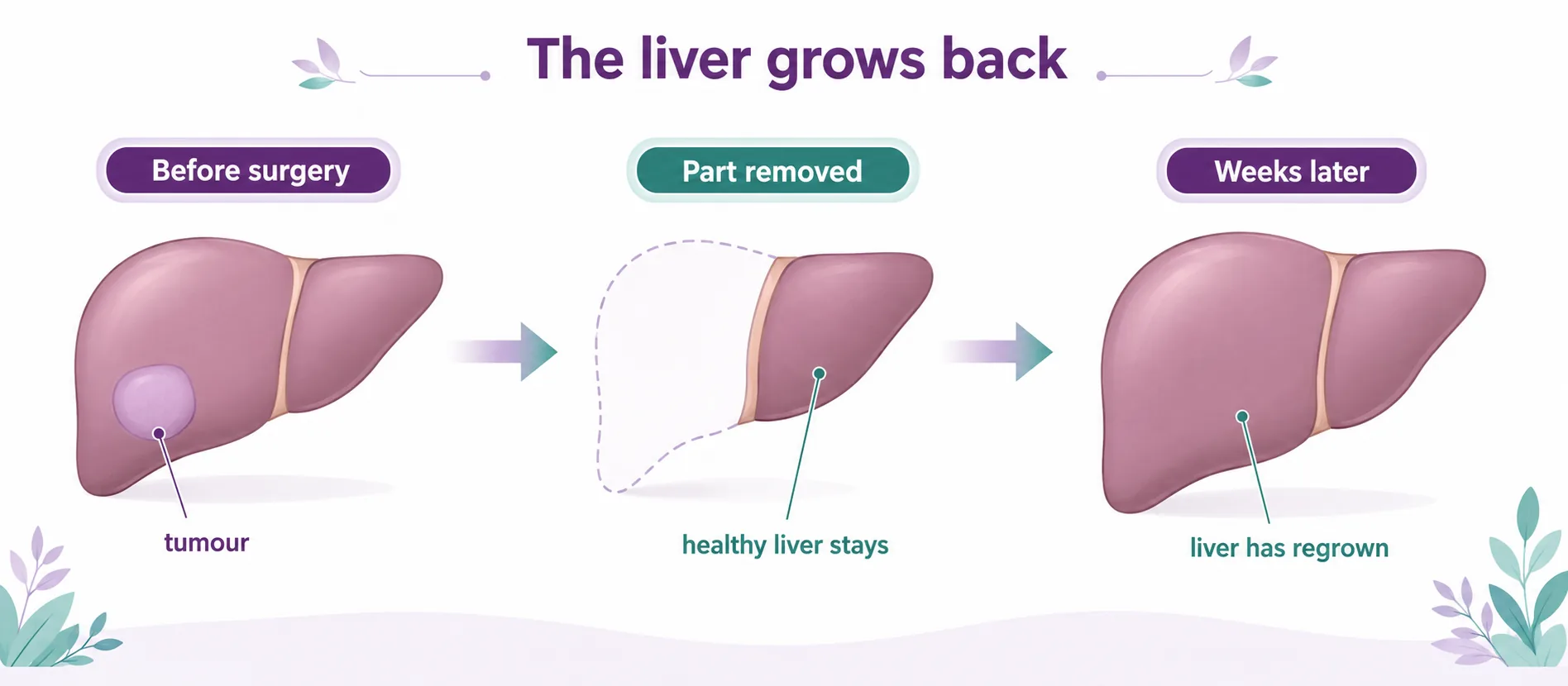
Here is the fact that changes how frightening this operation sounds: the liver is the only internal organ that regenerates. After a resection removes the part with the tumour, the healthy liver that remains regrows — returning to close to its original size within a matter of weeks. This is why a surgeon can safely remove a large portion of the liver, even a whole half, provided enough healthy liver is left behind to keep you well while it regrows. Understanding this one thing takes much of the fear out of the words “removing part of your liver”.
Before surgery, part removed with the tumour, and weeks later — the remaining healthy liver regrows to near its original size.
Regeneration is also why the liver can sometimes be operated on more than once — for example if bowel-cancer deposits come back in the liver later, a further resection may still be possible. The healthy remnant does the work of the whole liver almost immediately, and then grows to meet the demand. The key question the surgeon works out beforehand is simply whether enough good-quality liver will remain — and if not, there are ways to grow it first.
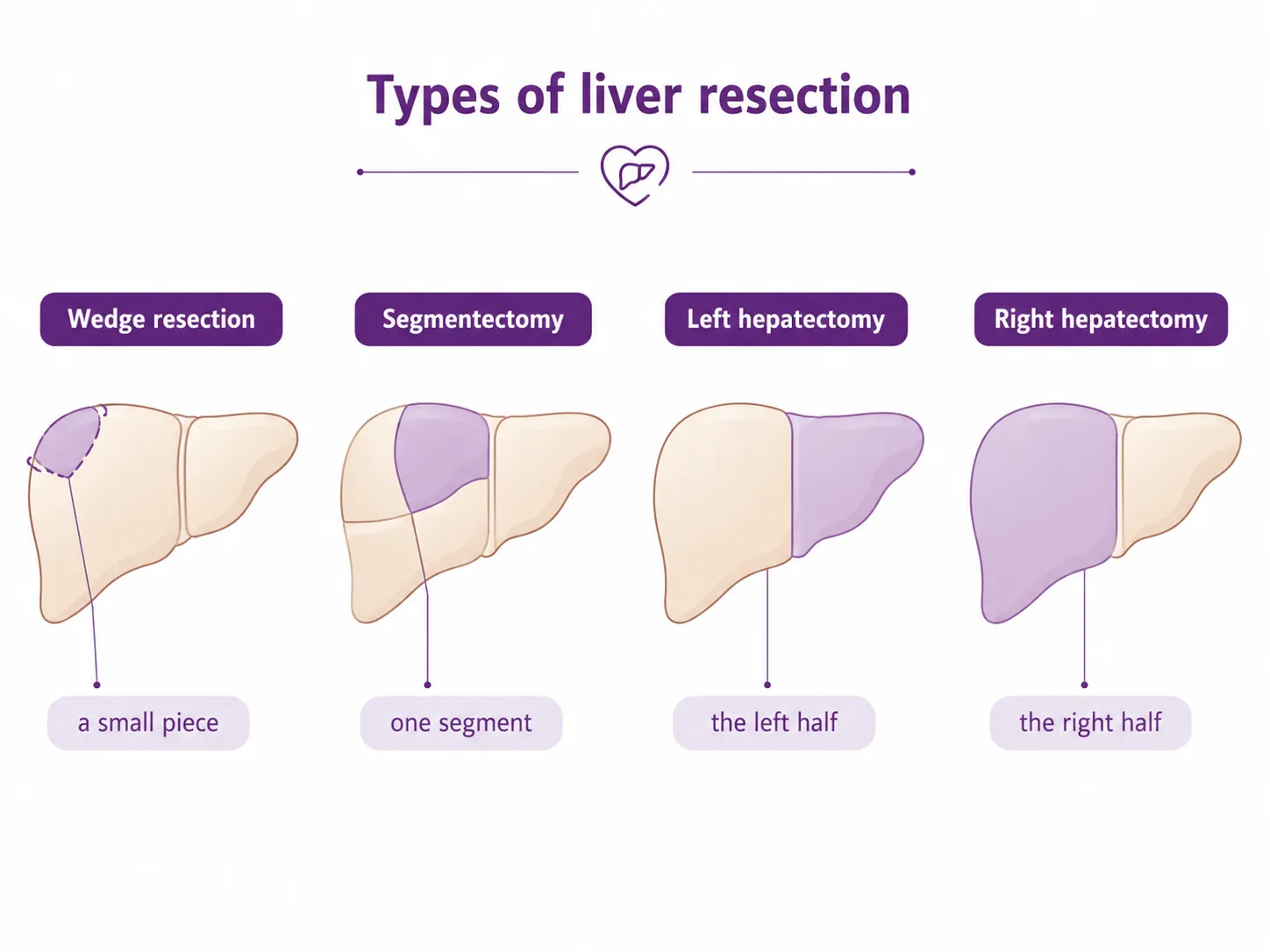
“How much of my liver will they take?” is one of the first questions people ask, and the honest answer is that it depends entirely on the tumour's size and position — it ranges from a tiny piece to a whole half. A wedge resection removes a small piece; a segmentectomy removes one of the liver's segments; a major hepatectomy (a right or left hepatectomy) removes a whole half of the liver. The surgeon takes as much as is needed to remove the cancer with a clear margin, while leaving enough working liver behind — no more than necessary.
From a small wedge, to a single segment, to a whole half (a major right or left hepatectomy) — how much is removed depends on the tumour.
Wedge / segment
Major hepatectomy
Extended / complex
What is removed
A small piece, or one segment of the liver.
A whole half — a right or left hepatectomy.
A half plus more, or with blood-vessel or bile-duct reconstruction.
Often suits
Small or single tumours away from the main vessels.
Larger or more central tumours.
Larger tumours, or ones needing the remnant grown first.
This is the question that decides how much can be safely removed. The part of the liver left behind is called the future liver remnant, and it must be both big enough and healthy enough to keep you well while the liver regrows. In a healthy liver, surgeons can remove a large portion safely because the remnant does the work immediately and then regenerates. If the remnant would be too small, a step called portal vein embolisation can make the healthy side grow first, over a few weeks, so that surgery becomes possible. And if the liver is affected by cirrhosis, it can spare less — so how well your liver is working is checked as carefully as the tumour itself.
Big enough
Enough liver must remain to keep you well in the days after surgery, before it regrows. This is measured on your scans, not guessed.
Healthy enough
A liver affected by cirrhosis or under strain can spare less — so liver function is tested as carefully as the tumour is measured.
Grown first, if too small
Where the remnant would be too small, portal vein embolisation can grow the healthy side over a few weeks — turning a “no” into a “possible”.
This is the honest counterweight to the good news that the liver regrows. The regeneration is real — but it is not unlimited, and it depends on the health of the liver doing the regrowing. That is exactly why the assessment matters, and why the answer is worked out on your scans and your liver-function tests rather than assumed from the tumour alone.
Is the tumour removable — and is surgery the right choice?
Not every liver tumour is best treated by removing it, and being honest about that matters. Whether a resection is right depends on the type of tumour, its size and position near the main blood vessels, how many deposits there are, and how well your liver is working. Where a tumour can be removed with enough healthy liver left, resection offers the best chance of long-term control. Where it cannot, there are other good options — ablation (destroying small tumours with heat), treatments delivered directly through the liver's artery, targeted radiation, or, for early liver cancer in a cirrhotic liver, referral for a liver-transplant assessment. A careful, scan-based judgement, reviewed by the tumour board, finds the right path — and it is reassessed as things change.
Liver resection
Ablation / artery treatments
Liver transplant
Often suits
A tumour that can be removed with enough healthy liver left.
Small tumours, several tumours, or a liver that can spare less.
Early liver cancer in a cirrhotic liver meeting set criteria.
The idea
Remove the cancer with a clear margin; the liver regrows.
Destroy or starve the tumour without removing liver.
Replace the whole liver, treating the cancer and the cirrhosis together.
At CION
Done in-house — open or keyhole.
Coordinated with specialist partner centres.
Assessment referred to a transplant centre.
These are not either/or in a simple way — sometimes they are combined or used in sequence (for example, shrinking a tumour first, or growing the healthy liver before surgery). What matters is that the plan is made honestly, for your tumour and your liver, by a team that reviews every case together. Where a transplant assessment is the right path, we say so and refer you — rather than pushing an operation that is not right for you.
Tests that decide whether a liver resection is possible
Two things are measured before any liver surgery: the tumour, and the liver itself. Detailed scans map the tumour's size and position against the liver's blood vessels and show how much healthy liver would remain, while blood tests show how well your liver is working — which decides how much it can spare. For cancer that has spread to the liver, imaging also checks whether anything else is active elsewhere. Your team then decides, with you, whether a resection can go ahead now, after the remnant is grown or the tumour shrunk, or whether another treatment fits better. These tests are how the honest answer is reached.
Diagnostic services we offer — book any of these:
CT scan (liver protocol)
Detailed, timed imaging that maps the tumour against the liver’s blood vessels and shows how much healthy liver would remain — the key to whether a resection is possible.
A tissue sample where the diagnosis is not already clear from the scans — for many primary liver cancers, imaging alone is enough and no biopsy is needed.
Whole-body imaging that checks for disease elsewhere before liver surgery is planned — especially where a cancer has spread to the liver from the bowel.
Liver resection is performed at CION in-house — open or, for suitable tumours, by keyhole — and we are straight with you about what sits elsewhere. Chemotherapy and other treatments are planned around the surgery by the tumour board. Where a resection is not the right path, ablation and artery-directed treatments are coordinated with specialist partner centres, and a liver-transplant assessment is referred to a transplant centre. Each card below says plainly whether it is done in-house or coordinated for you.
Treatments we deliver or coordinate — book a consult for any of these:
In-house
Open liver resection
Removing the part of the liver with the cancer, with a clear margin — from a wedge to a major hepatectomy — by an experienced HPB team with intensive-care support.
For suitable tumours — especially smaller or more accessible ones — keyhole surgery can mean smaller cuts and a quicker recovery. Your surgeon advises whether it suits your tumour.
Where the liver left behind would be too small, portal vein embolisation can grow the healthy side over a few weeks so a resection becomes possible — arranged with specialist partner centres.
Destroying small tumours with heat, or treating them through the liver’s artery, where a resection is not the best choice — coordinated with specialist partner centres.
For early liver cancer in a cirrhotic liver meeting set criteria, a transplant may be the better path — we say so honestly and refer you to a transplant centre for assessment.
A liver resection is major surgery, and it is honest to say recovery takes time — though most people are surprised how well they feel once the liver regrows. A minor resection may be done by keyhole surgery with a shorter stay; a major hepatectomy is a bigger operation. Expect a hospital stay of about five days to a week (longer for major or open surgery), often with a day or two of close monitoring afterwards, and fuller recovery over about six to eight weeks as the liver regenerates. Blood tests track how the liver is working in the early days. Because the liver regrows, most people return to normal activities and a good quality of life, and chemotherapy or other treatments may be planned around the surgery depending on the tumour.
1
Before surgery
Scans and liver-function tests decide whether the tumour is removable and how much liver can be spared. If the remnant would be small, it may be grown first. You are told honestly what to expect.
2
The operation
The part of the liver with the cancer is removed — open or by keyhole — by an experienced HPB team, with intensive-care support ready for major resections.
3
In hospital
About five days to a week (longer for major or open surgery), often with close monitoring at first while blood tests confirm the liver is working well. Eating and moving restart quickly.
4
Recovery & ongoing care
Fuller recovery over roughly six to eight weeks as the liver regrows, with any chemotherapy planned around surgery, and close follow-up with scans to watch for recurrence.
Follow-up focuses on how the liver is regenerating, on the pathology and any treatment planned around it, and on regular scans — because if anything does come back in the liver, finding it early is what keeps a further resection possible.
The cost of a liver resection depends mainly on how much is removed and how complex the operation is — a small keyhole resection costs less than a major open hepatectomy with intensive care, and a resection that also needs blood-vessel or bile-duct reconstruction costs more again. The reassuring part: this is cancer surgery, so it is generally covered under Aarogyasri at empanelled centres, and by most health-insurance policies, usually alongside any treatment planned around it. Our team checks your scheme eligibility and policy, and gives you a clear, written estimate before anything is planned. These are estimates, not a quotation.
Indicative cost estimator
Pick your situation for an indicative range, then request an exact estimate for your case.
Indicative range
₹2,50,000 – ₹4,50,000
for a minor liver resection (wedge or segment), general room, self-pay
Figures are indicative only and not a quotation. Liver cancer surgery is generally covered under Aarogyasri at empanelled centres, subject to eligibility. Your actual cost depends on how much liver is removed, whether it is open or keyhole, intensive care, hospital stay and any treatment around the surgery.
A liver tumour shouldn't wait. Book a free consultation and, if you already have scans or reports, a free written second opinion on whether a liver resection is possible for you.
Your scans reviewed by an experienced liver & HPB surgical oncologist
An honest answer — removable, removable after growing the remnant, or better treated another way
Aarogyasri & insurance guidance
Support
Financial support & Aarogyasri
Cost should not delay treatment — and with a liver tumour, delay can turn a removable tumour into one that is harder to remove. Because a liver resection is treatment for cancer, it is generally covered under Aarogyasri at empanelled centres, and private insurance is accepted cashless — usually alongside any treatment planned around it. Our counsellors help check eligibility, arrange approvals and map out what you will actually pay — often far less than families fear.
9 clinics in Hyderabad · 35+ across Telangana & AP
CION cancer care is closer than you think.
We're never more than 30 minutes away. Same panel of specialists at every centre. Same tumour board reviews. Same NCCN protocols. Pick the closest one and call directly — or let us pick for you.
Don't see your city? Call
18002028726
— we'll find your nearest CION partner centre.
Meet the HPB surgical oncology team
Your liver surgery is planned by a team, not one doctor.
Surgical, radiation and medical oncologists plan every case together in a multidisciplinary tumour board — part of 17 senior specialists across CION, with liver resection performed by an experienced HPB (liver & pancreatic) team with intensive-care support.
Share your name and number — we'll call you back within 30 minutes to schedule your consultation.
A liver tumour found on a scan? Don't decide alone.
Whether your tumour can be removed, whether enough healthy liver would be left, and whether surgery is the right choice at all — let CION's tumour board review your scans and give you an honest, clear answer.
These are the worries families rarely say out loud. Here are honest, respectful answers to the ones we hear most in Telangana.
“They’re removing part of my liver — I can’t live without it.”
Fact: You can, and here is why: the liver is the only internal organ that regenerates. The healthy part left behind does the work of the whole liver almost immediately, and regrows to close to its original size within weeks. That is exactly why surgeons can safely remove a large portion — even a whole half.
“It has spread to my liver, so it’s over.”
Fact: Not so. Cancer that has spread to the liver — most often from the bowel — is one of the situations where removing the liver deposits can offer a real chance of long-term control, often alongside chemotherapy. Many people are told this is hopeless when it is not. It is worth asking whether surgery is possible.
“Surgery will spread the cancer.”
Fact: This is a common, harmful myth. Removing a liver tumour under controlled surgical conditions does not spread it. What actually causes harm is delay, which can let a removable tumour grow into one that is harder to remove.
“My liver is cirrhotic, so nothing can be done.”
Fact: Cirrhosis limits how much liver can be spared — it does not automatically rule out treatment. A smaller resection may still be possible, and where it is not, ablation, artery-directed treatments or a transplant assessment may suit better. How well your liver works is tested, not assumed.
“They said the liver left behind would be too small — so I’m inoperable.”
Fact: Often that is not the final answer. Where the future liver remnant would be too small, a step called portal vein embolisation can grow the healthy side over a few weeks, so that a resection becomes possible. Ask specifically whether growing the remnant first is an option for you.
“Can a middle-class family afford liver cancer surgery?”
Fact: Liver cancer surgery is generally covered under Aarogyasri at empanelled centres, and private insurance is accepted cashless. Our counsellors help you check eligibility and map out what you will actually pay — often far less than families fear.
“Recovery will take years and I’ll never be independent.”
Fact: Recovery takes time — a hospital stay of about five days to a week, and fuller recovery over roughly six to eight weeks as the liver regrows — but most people return to independent, normal life. Because the liver regenerates, people are often surprised how well they feel.
“Liver cancer is a death sentence, so why put me through an operation?”
Fact: For a tumour that can be removed with enough healthy liver left, resection offers the best chance of long-term control — it is the treatment with the most to offer, not a token gesture. Outcomes vary with the tumour and the liver, which is why the assessment is done honestly first.
“Keyhole surgery can’t be as thorough as open surgery.”
Fact: For suitable tumours, a keyhole (laparoscopic) resection removes the cancer with the same clear margin as open surgery, with smaller cuts and often a quicker recovery. It is not right for every tumour — larger, more central or more complex ones are usually removed open. The surgeon chooses on your tumour, always prioritising removing the cancer completely.
“I’m too old or too weak for liver surgery.”
Fact: Age alone does not decide it — your fitness and your liver function do. Your team assesses you individually and builds your strength beforehand. The decision is matched to you, not to a number.
“I drank alcohol, so this is my fault and I don’t deserve treatment.”
Fact: Nobody deserves cancer, and no one at CION will judge you. Liver cancer has many causes — hepatitis, fatty liver, and others — and plenty of people who develop it never drank heavily. What matters now is what can be done, and shame that delays a scan is the only thing that genuinely makes it worse.
“If the cancer comes back in the liver, that’s the end — you only get one operation.”
Fact: Not necessarily. Because the liver regenerates, it can sometimes be operated on more than once — if bowel-cancer deposits return in the liver later, a further resection may still be possible. This is precisely why follow-up scans matter: finding it early keeps that option open.
“I’ll need a transplant, and I’ll never get one.”
Fact: Most people who need liver cancer surgery do not need a transplant. A resection removes the part with the cancer and leaves the rest — it is usually preferred when the tumour can be removed and the rest of the liver is healthy enough. A transplant is mainly considered for early liver cancer in a cirrhotic liver meeting set criteria; where that is the right path, we refer you to a transplant centre.
“Home or herbal remedies can shrink the tumour instead.”
Fact: No home or herbal remedy is proven to cure liver cancer, and relying on one wastes the window when the tumour may still be removable. Some supplements are also processed by the liver and can strain it further. Tell your oncologist about anything you take so it can be used safely alongside proper treatment.
“A second opinion will offend my doctor or waste time.”
Fact: A second opinion is normal and welcomed in cancer care — especially for a liver tumour, where the question of whether it can be removed is so consequential and opinions genuinely differ. At CION it can be arranged quickly, and it is free when you already have your scans or reports.
“I’ll be in unbearable pain after such a big operation.”
Fact: Pain is expected but well controlled with modern methods, and the team manages it closely in the early days. Most people are helped to get up and moving soon after surgery, which itself speeds recovery.
“I’ll have to live on a special diet forever with less liver.”
Fact: No. Once the liver has regrown, most people eat normally. A dietitian supports you through the recovery weeks to keep your strength up while the liver regenerates, but a permanent restrictive diet is not part of life after a liver resection for most people.
“The cancer will just come back after surgery anyway.”
Fact: A resection is done to remove the cancer completely with a clear margin, and treatment around it can lower the chance of it returning. Outcomes depend on the tumour and your liver, and follow-up scans catch any change early — and if something does return, the liver’s ability to regrow sometimes allows a further operation.
“Only a huge open operation can remove a liver tumour.”
Fact: Not always. How much is removed ranges from a small wedge to a whole half, and it is decided by the tumour, not by a default. Many tumours need only a small piece of liver taken, and for suitable ones this can be done by keyhole surgery. The surgeon takes what is needed for a clear margin — no more.
“Chemotherapy and the dietitian are extras I can skip.”
Fact: The surgery is central, but treatment planned around it and dietitian-led nutrition are part of what makes it work and recovery smoother — especially where a cancer has spread to the liver from the bowel. Skipping them can affect your control of the cancer and how well you heal.
Why CION
Why choose CION for a liver resection in Hyderabad
Liver resection in-house
Open and keyhole (laparoscopic) liver resection performed in-house by an experienced HPB team — not referred elsewhere.
Intensive-care support
ICU support at the operating centres for major resections and the critical early days of recovery.
Honest, scan-based assessment
A careful judgement of whether the tumour can be removed and how much liver can be spared — with a straight answer, either way.
A tumour-board approach
Every case reviewed by a multidisciplinary tumour board, so surgery and the treatments around it fit together.
Aarogyasri & insurance help
Financial counsellors handle scheme eligibility, approvals and cashless insurance so cost never blocks care.
Care closer to home
35+ centres across Telangana & Andhra Pradesh, with Telugu-speaking teams for follow-up near where you live.
Real stories · real courage
15,000+ patients chose CION. Hear from them directly.
These aren't paid endorsements or written reviews. These are video testimonials from real patients and families — recorded on their own phones, in their own words. Pick any one. Watch it. Then decide.
4.8★800+ Google reviews
50+video testimonials
15,000+patients treated
Successful Chemotherapy & Radiation Done by Dr. Owais Mohammed & Dr. Kirti Ranjan
Watch video →
Successful Chemotherapy Done by Dr. C Raghavendra Reddy
Watch video →
Surgery, Chemo & Radiation Done by Dr. Imaduddin, Dr. Vinay, Dr. Owais, Dr. Kirti
Watch video →
Successful Radical Thymectomy Done by Dr. Mohammed Imaduddin & Dr. Vinay Mamidala
Watch video →
Successful Surgery Done by Dr. Rajender Byshetty
Watch video →
Successful Chemo & Surgery Done by Dr. Imad, Dr. Vinay, Dr. Owais & Dr. Raghavendra
Watch video →
Successful Chemo & Surgery Done by Dr. Imad, Dr. Vinay, Dr. Owais & Dr. Raghavendra
Watch video →
Successful Chemo & Radiation Done by Dr. Owais Mohammed & Dr. Kirti Ranjan Mohanty
Watch video →
Successful Breast Cancer Surgery Done by Dr. Imaduddin Mohammed & Dr. Vinay Mamidala
Watch video →
Successful Chemotherapy Done by Dr. Bharati Devi Gorantla
Watch video →
Successful Chemo & Surgery Done by Dr. Owais Mohammed & Dr. Imaduddin Mohammed
Watch video →
Successful Chemotherapy Done by Dr. Gundu Naresh
Watch video →
Successful Bone Marrow Transplantation - Neuroblastoma
Watch video →
Successful Surgery & Chemo - Carcinoma of Caecum
Watch video →
Successful Oral chemotherapy & mastectomy surgery
Watch video →
Successful Oral chemotherapy & mastectomy surgery
Watch video →
Successful Chemotherapy
Watch video →
Successful Surgery by Dr. Mohammed Imaduddin
Watch video →
Successful Bone Marrow Transplantation
Watch video →
Successful Oral chemotherapy & mastectomy surgery
Watch video →
Successful Oral chemotherapy & mastectomy surgery
Watch video →
Successful Chemotherapy
Watch video →
Successful Buccal Mucosa Surgery
Watch video →
Successful Complex Surgery Mandibulectomy Reconstruction
A liver resection is one part of treating a liver cancer, or a cancer that has spread to the liver. At CION, nutrition, emotional care, genetic risk, comfort and rehabilitation are one coordinated plan.
Nutrition & diet
Dietitian support to keep your strength up and help the liver recover and regrow after surgery. Learn more
Psychology counselling
Emotional support for you and your family through diagnosis and recovery. Learn more
Genetic counselling
Hereditary-risk guidance where a family or genetic pattern is suspected. Learn more
Rehabilitation
Physiotherapy and recovery support to rebuild strength after surgery. Learn more
Palliative & comfort care
Comfort and symptom support at any stage, alongside treatment. Learn more
Financial counselling
Aarogyasri and cashless insurance guidance so cost never blocks care. Learn more
FAQ
Liver resection in Hyderabad — frequently asked questions
How much does a liver resection cost in Hyderabad?
In Hyderabad, a liver resection is typically an indicative ₹2,50,000 to ₹4,50,000 for a minor resection (a wedge or a segment), and roughly ₹4,00,000 to ₹7,50,000 for a major hepatectomy, depending on how much liver is removed, whether it is open or keyhole, intensive-care needs, room category and length of stay. A resection needing blood-vessel or bile-duct reconstruction costs more. Under Aarogyasri, eligible liver-cancer surgery at empanelled centres may be largely covered, and insurance is accepted cashless. CION gives an accurate written estimate after assessment.
Is a liver resection covered under Aarogyasri or insurance?
Yes — because a liver resection is treatment for cancer, it is generally covered under Aarogyasri at empanelled centres, subject to eligibility, and by most health-insurance policies, usually alongside any treatment planned around it. CION is Aarogyasri empanelled, and our counsellors help you check whether you qualify, arrange approvals and handle the paperwork, so cost is far less of a barrier than most families expect.
What is a liver resection (hepatectomy)?
A liver resection, or hepatectomy, is an operation that removes the part of the liver containing a cancer, along with a rim of healthy tissue (a clear margin). It is used for cancers that start in the liver, such as hepatocellular carcinoma (HCC) and bile-duct cancer, and for cancer that has spread to the liver from elsewhere — most often from the bowel. How much is removed ranges from a small wedge to a whole half of the liver.
Does the liver really grow back after surgery?
Yes. The liver is the only internal organ that regenerates. After a resection, the healthy liver that remains regrows to close to its original size within weeks. This is why a surgeon can safely remove a large portion of the liver — even a whole half — as long as enough healthy liver is left behind to keep you well while it regrows. It is the single most reassuring thing to understand about this operation.
How much of my liver can be safely removed?
It depends on how much healthy liver would be left behind — the future liver remnant — and how well your liver is working. In a healthy liver, surgeons can remove a large portion safely because the remnant does the work immediately and then regrows. If the remnant would be too small, a step called portal vein embolisation can grow the healthy side first. If the liver is affected by cirrhosis, less can be spared, so liver function is checked carefully.
Can my liver tumour be removed with surgery?
It depends on the type of tumour, its size and position near the main blood vessels, how many deposits there are, and how well your liver is working. Where a tumour can be removed with enough healthy liver left, resection offers the best chance of long-term control. Where it cannot, other options — ablation, artery-directed treatments, targeted radiation, or referral for a transplant assessment — may be better. A scan-based assessment, reviewed by the tumour board, decides honestly.
Can bowel cancer that has spread to the liver be removed?
Often, yes — and this surprises many people who are told that spread to the liver means nothing can be done. When cancer has spread to the liver from the bowel, removing the liver deposits can offer a real chance of long-term control, frequently alongside chemotherapy. Whether it is possible depends on how many deposits there are, where they sit relative to the main blood vessels, and how much healthy liver would remain. It is worth asking specifically whether a liver resection is possible.
What is the future liver remnant, and what if mine is too small?
The future liver remnant is the part of the liver that will be left behind after surgery. It must be both big enough and healthy enough to keep you well in the days after the operation, before it regrows. If it would be too small, that is often not the final answer: a step called portal vein embolisation can make the healthy side grow over a few weeks, so that a resection becomes possible afterwards. Ask your team specifically whether growing the remnant first is an option for you.
Can a liver resection be done if I have cirrhosis?
Sometimes, but cirrhosis limits how much liver can be safely spared, because a liver under strain regenerates less well. A smaller resection may still be possible where liver function is well preserved. Where it is not, ablation, artery-directed treatments, or — for early liver cancer meeting set criteria — a transplant assessment may suit better. This is why how well your liver is working is tested as carefully as the tumour is measured.
Do I need a liver resection or a liver transplant?
A resection removes the part of the liver with the cancer and leaves the rest; a transplant replaces the whole liver. Resection is usually preferred when the tumour can be removed and the rest of the liver is healthy enough. A transplant is mainly considered for early liver cancer in a liver affected by cirrhosis, when set criteria are met. At CION, liver resection is performed in-house, and where a transplant assessment is the right path, you are referred to a transplant centre.
Can a liver resection be done by keyhole (laparoscopic) surgery?
Often, yes — for suitable tumours, especially smaller or more accessible ones, CION performs laparoscopic (keyhole) liver resection, which can mean smaller cuts and a quicker recovery. Larger, more central or more complex tumours are usually removed by open surgery. Which approach is right is decided by the surgeon based on the tumour's size and position and your liver, always prioritising removing the cancer safely and completely.
How long is recovery after a liver resection?
A minor keyhole resection may mean a hospital stay of a few days; a major hepatectomy is bigger, with a stay of about a week and often close monitoring at first. Fuller recovery takes roughly six to eight weeks as the liver regrows. Blood tests track liver function in the early days. Because the liver regenerates, most people return to normal activities and a good quality of life, with any further treatment planned around the surgery.
What are the main risks of a liver resection?
As major surgery there are real risks, including bleeding (the liver has a rich blood supply), a bile leak, infection, and — for larger resections — the remaining liver struggling in the early days before it regrows. These are watched for closely and managed, which is why intensive-care support matters for major resections. The risks are weighed against how much a resection has to offer, and your surgeon discusses them honestly with you beforehand.
Can the liver be operated on more than once if the cancer comes back?
Sometimes, yes — and this is a direct consequence of the liver regenerating. If deposits return in the liver later, for example from a bowel cancer, a further resection may still be possible provided enough healthy liver would remain. This is one of the strongest reasons to keep up with follow-up scans: finding a recurrence early is what keeps a second operation on the table.
Do I need chemotherapy as well as the liver resection?
It depends on the type of cancer. For cancer that has spread to the liver from the bowel, chemotherapy is commonly planned around the surgery — sometimes before it, sometimes after — to improve control. For some primary liver cancers, surgery alone may be the plan, with other treatments considered depending on the tumour. The tumour board decides what fits your cancer, and times it around your surgery and recovery.
Will I be able to live normally with part of my liver removed?
Yes, for most people. Because the liver regrows to close to its original size within weeks, it goes back to doing its full job, and there is no permanent restrictive diet for most people after a liver resection. A dietitian supports you through the recovery weeks while the liver regenerates. Work, travel and family life continue, with follow-up scans as part of ongoing care.
Which is the best hospital for a liver resection in Hyderabad?
Look for a cancer centre that performs liver resection in-house — open and, for suitable tumours, keyhole — with an experienced HPB (liver and pancreatic) team, intensive-care support, multidisciplinary tumour-board planning, and an honest, scan-based assessment of whether your tumour can be removed. CION Cancer Clinics offers these across 35+ centres in Telangana and Andhra Pradesh, with Aarogyasri and insurance counselling, and refers transplant assessment to a transplant centre where that is the right path.
Can I get a second opinion on whether my liver tumour can be removed?
Yes, and it is welcomed — whether a liver tumour can be removed is exactly the kind of question where a second opinion helps, because it depends on a careful judgement of both the tumour and your liver function, and opinions can genuinely differ. A second opinion reviews your scans and reports and gives you a straight answer on whether a resection is possible, whether the remnant could be grown first, or whether another treatment fits better. At CION it can be arranged quickly and is free when you already have your scans or reports.
Explore
Explore liver cancer care at CION
Treatment, surgery, tests and cost around liver cancer — plus bowel cancer, the most common source of cancer that spreads to the liver, and the related GI/HPB cancers. Tap any topic to read more.
Speak to a liver & HPB surgical oncologist about your options
Early answers change outcomes — and with a liver tumour, the question of whether it can be removed deserves an expert, honest answer. Book a free consultation or second opinion at any of our 9 Hyderabad clinics — part of 35+ centres across Telangana & Andhra Pradesh.
Medical disclaimer: This page provides general information about liver resection (hepatectomy) and is not a substitute for professional medical advice, diagnosis or treatment. Costs shown are indicative only and not a quotation. A liver resection is possible only where the tumour can be removed with enough healthy liver left behind; not every liver tumour is best removed, and how well your liver is working matters as much as the tumour itself. CION performs open and laparoscopic liver resection in-house; ablation and artery-directed treatments are coordinated with specialist partner centres, and liver-transplant assessment is referred to a transplant centre. Every case is planned through a multidisciplinary tumour board. Always consult a qualified liver / HPB surgical oncologist about your individual care. Content is periodically reviewed by CION's medical team.

 CION Ameerpet