Whipple procedure (pancreaticoduodenectomy) in Hyderabad
A Whipple is the main operation for a cancer in the head of the pancreas, and for nearby periampullary cancers. It removes the affected part and rebuilds the digestive system — and for a cancer that can be removed, it offers the best chance of long-term control. It is one of the most complex abdominal operations, so it matters greatly that it is done by an experienced, high-volume team with intensive-care support. At CION it is led by a dedicated pancreatic surgeon.
Led by a dedicated pancreatic surgeon · ICU support
An honest answer on whether your cancer can be removed
Clear indicative costs & Aarogyasri help
★★★★★Rated 4.8/5 · 800+ Google reviews
Led by a dedicated pancreatic surgeon
Intensive-care support
Honest resectability assessment
35+ centres · Aarogyasri help
GN
Written by Dr. Paila Gowri Naidu, MCh Surgical Oncology (BHU Varanasi), FMAS — pancreatic surgery lead, with CION's pancreatic surgical oncology team. Medically reviewed by Dr. Sridhar Kamani, DrNB (Surgical Oncology). · Reviewed 14 July 2026
Understanding the surgery
What is a Whipple procedure?
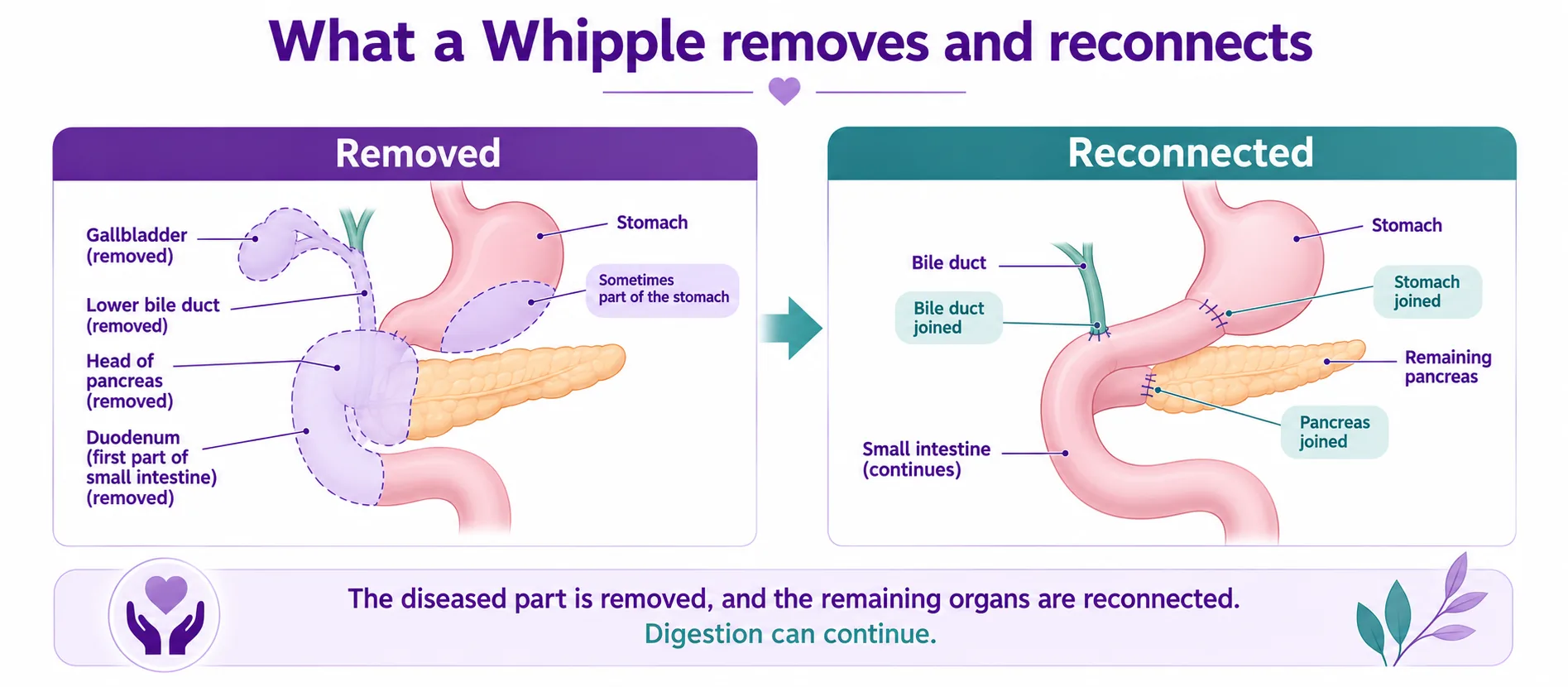
A Whipple procedure (pancreaticoduodenectomy) removes the head of the pancreas together with the first part of the small intestine (the duodenum), the gallbladder and the lower bile duct — and sometimes part of the stomach. The surgeon then reconnects the remaining pancreas, the bile duct and the stomach to the small intestine, so digestion continues. It is the main operation for a cancer in the head of the pancreas, and for nearby periampullary cancers. For a cancer that can be removed, it is the only treatment that can potentially clear it — the best chance of long-term control.
It is also one of the most complex operations in abdominal surgery, which is why experience and hospital volume matter so much — outcomes are meaningfully better when it is done by a dedicated team that performs it regularly, with intensive-care support. Not every pancreatic cancer can have a Whipple; whether yours can depends on where the cancer is and whether it is clear of the nearby major blood vessels, which is assessed carefully and honestly first. Every case is planned by a multidisciplinary tumour board, and chemotherapy is usually part of the plan — before surgery for borderline cancers, and after surgery for most.
Removes & rebuilds
The head of the pancreas, duodenum, gallbladder and lower bile duct are removed, and the digestive system is reconnected.
The best chance for removable cancer
For a cancer that can be removed, surgery is the only treatment that can potentially clear it.
Experience matters
A complex operation, done best by a dedicated, high-volume team with intensive-care support.
The operation
What a Whipple removes & reconnects
The Whipple sounds daunting because it involves several organs, but the idea is straightforward: remove the part where the cancer sits, then rebuild the plumbing. The surgeon removes the head of the pancreas, the duodenum, the gallbladder and the lower bile duct (and sometimes the lower part of the stomach). Then the remaining pancreas, the bile duct and the stomach are each reconnected to the small intestine, so food, bile and digestive juices flow as they should. A classic Whipple removes part of the stomach; a pylorus-preserving Whipple keeps the whole stomach where suitable, which can help it empty more normally.
The head of the pancreas, duodenum, gallbladder and lower bile duct are removed; then the pancreas, bile duct and stomach are reconnected to the small intestine — digestion can continue.
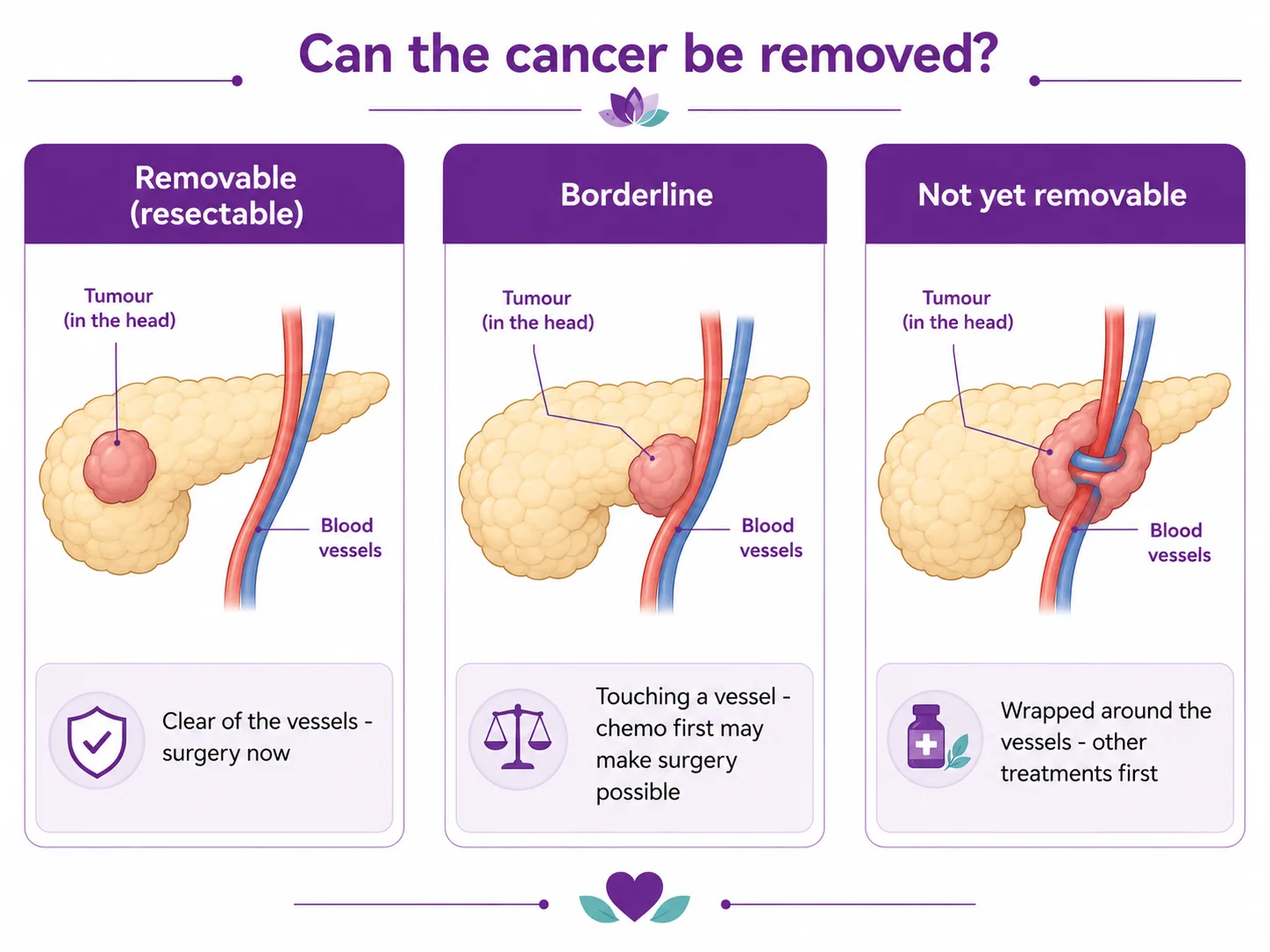
This is the most important question, and the honest answer is that a Whipple is only possible when the cancer can be fully removed — which depends on whether it is clear of the nearby major blood vessels and has not spread. Doctors describe cancers as resectable (clear of the vessels — surgery can go ahead), borderline (just touching a vessel — chemotherapy first can sometimes shrink it enough to make surgery possible), or not yet removable (wrapped around the vessels or spread — treated first with other therapies). It is honest to say not every pancreatic cancer can have a Whipple; a careful scan-based assessment, reviewed by the tumour board, decides — and where surgery is not possible now, other treatments help, and the situation is reassessed.
Whether a Whipple is possible depends on the cancer's relationship to the nearby blood vessels — resectable, borderline (chemotherapy first may help), or not yet removable.
Resectable
Borderline
Not yet removable
The cancer
Clear of the major blood vessels.
Just touching a vessel.
Wrapped around vessels, or spread.
Usual first step
Surgery (a Whipple).
Chemotherapy first, then re-assess for surgery.
Chemotherapy and other treatments; reassessed.
The aim
Remove the cancer completely, with a clear margin.
Before any surgery, the cancer is confirmed and its relationship to the blood vessels is mapped. A pancreatic-protocol CT (and often an endoscopic ultrasound with a biopsy) shows whether the cancer is clear of the vessels, and a PET-CT and a staging laparoscopy check for spread. Your team then decides — with you — whether a Whipple can go ahead now, after chemotherapy, or whether other treatment comes first. These tests are how the honest answer is reached.
Diagnostic services we offer — book any of these:
Endoscopic ultrasound (EUS) & biopsy
A scope with an ultrasound tip looks at the pancreas from inside and takes a tissue sample to confirm the cancer.
The Whipple is the main operation — and CION delivers the full pathway around it. Depending on where the cancer is, that means a Whipple for the head of the pancreas, a distal or total pancreatectomy for other locations, and — for a borderline cancer that has shrunk with chemotherapy — a Whipple with blood-vessel (vascular) resection. Chemotherapy and, where useful, chemoradiation are planned around the surgery, and jaundice is relieved with our gastroenterology team. Every plan is set by a tumour board.
Treatments we deliver — book a consult for any of these:
Whipple procedure
Pancreaticoduodenectomy for cancer in the head of the pancreas and periampullary cancers — led by a dedicated pancreatic surgeon with ICU support.
For a Whipple, who does it, and where, genuinely affects the result. It is a long, complex operation with a real risk of complications — the most common being a leak from where the pancreas is rejoined — and the evidence is clear that outcomes are meaningfully better at centres that perform it regularly, with a dedicated pancreatic surgeon, an anaesthetic and critical-care team used to these patients, and intensive-care support ready for recovery. At CION the Whipple is led by a dedicated pancreatic surgeon and planned by a multidisciplinary tumour board, with ICU support at the operating centres — so the operation, and the days after it, are in experienced hands.
A dedicated pancreatic surgeon
The Whipple is led by a surgeon who performs pancreatic surgery regularly — the experience that most affects outcome.
Intensive-care support
ICU support at the operating centres for the operation itself and the critical early days of recovery.
An honest tumour-board plan
Every case reviewed by a pancreatic multidisciplinary board, with a straight answer on whether a Whipple is possible.
A Whipple is major surgery, and it is honest to say the recovery takes time. The operation is followed by a hospital stay of about a week to ten days, often starting in intensive care, and fuller recovery over three to six months. Because part of the pancreas is removed, digestion changes: many people take enzyme capsules with meals to digest food, and some develop diabetes that is managed with support. A dietitian guides you through eating well and rebuilding strength, and chemotherapy is usually part of the plan afterwards. Most people return to a good quality of life.
1
Before surgery
Scans decide whether the cancer is removable; for borderline cancers, chemotherapy first. You are prepared honestly for what to expect.
2
The operation
The head of the pancreas and nearby organs are removed and the digestive system rebuilt, by a dedicated pancreatic team with ICU support ready.
3
In hospital
About a week to ten days, often starting in intensive care, with close watch for a pancreatic leak. Eating restarts gradually, and enzyme support begins if needed.
4
Recovery & ongoing care
Fuller recovery over three to six months, with a dietitian's help for digestion, diabetes support if needed, and usually chemotherapy afterwards.
Follow-up focuses on your nutrition and strength, on the pathology and any chemotherapy planned around it, and on regular reviews to confirm the cancer stays controlled — with support at every step.
Cost & coverage
Whipple procedure cost in Hyderabad Indicative
A Whipple is a large, complex operation with intensive-care support, so it costs more than most cancer surgeries, and a Whipple that also needs a blood-vessel (vascular) resection costs more again. The reassuring part: this is cancer surgery, so it is generally covered under Aarogyasri at empanelled centres, and by most health-insurance policies, usually alongside the chemotherapy around it. Our team checks your scheme eligibility and gives a clear, written estimate before anything is planned. These are estimates, not a quotation.
Indicative cost estimator
Pick your situation for an indicative range, then request an exact estimate for your case.
Indicative range
₹3,50,000 – ₹6,50,000
for a Whipple procedure, general room, self-pay
Figures are indicative only and not a quotation. Pancreatic cancer surgery is generally covered under Aarogyasri at empanelled centres, subject to eligibility. Your actual cost depends on the type of surgery, intensive care, hospital stay and the chemotherapy around it.
Talk to a pancreatic cancer surgery specialist — free
A pancreatic cancer diagnosis shouldn't wait. Book a free consultation and, if you already have scans or a biopsy report, a free written second opinion on whether a Whipple is possible for you.
Your scans reviewed by a dedicated pancreatic surgical oncologist
An honest answer — resectable, borderline or not yet removable
Aarogyasri & insurance guidance
Support
Financial support & Aarogyasri
Cost should not delay treatment. Because a Whipple is treatment for pancreatic cancer, it is generally covered under Aarogyasri at empanelled centres, and private insurance is accepted cashless — usually alongside the chemotherapy around it. Our counsellors help check eligibility, arrange approvals and map out what you will actually pay — often far less than families fear.
9 clinics in Hyderabad · 35+ across Telangana & AP
CION cancer care is closer than you think.
We're never more than 30 minutes away. Same panel of specialists at every centre. Same tumour board reviews. Same NCCN protocols. Pick the closest one and call directly — or let us pick for you.
Don't see your city? Call
18002028726
— we'll find your nearest CION partner centre.
Meet the pancreatic surgical oncology team
Your Whipple is planned by a team, not one doctor.
Surgical, radiation and medical oncologists plan every case together in a multidisciplinary tumour board — part of 17 senior specialists across CION, led for pancreatic surgery by a dedicated pancreatic surgeon with intensive-care support.
Share your name and number — we'll call you back within 30 minutes to schedule your consultation.
A pancreatic cancer diagnosis? Don't decide alone.
Whether your cancer can be removed, whether chemotherapy first could make a Whipple possible, and what recovery really involves — let CION's tumour board review your scans and give you an honest, clear plan.
These are the worries families rarely say out loud. Here are honest, respectful answers to the ones we hear most in Telangana.
“A Whipple is too big an operation — I won’t survive it.”
Fact: A Whipple is major surgery, but it is a well-established, well-supported one. Your fitness is assessed and improved beforehand, and outcomes are meaningfully safer in experienced, high-volume hands with intensive-care support — which is exactly how it is done at CION.
“If my pancreatic cancer can’t be removed, nothing can be done.”
Fact: Not so. When a Whipple is not possible now, chemotherapy and other treatments can control the cancer, relieve symptoms and — for borderline cancers — sometimes shrink it enough that surgery becomes possible later. The situation is reassessed, not written off.
“The surgery will spread the cancer.”
Fact: This is a common, harmful myth. Removing a pancreatic cancer under controlled surgical conditions does not spread it. What actually causes harm is delay, which can let a removable cancer become unremovable.
“I’ll never be able to eat or digest food again.”
Fact: You can eat and enjoy food again — digestion just needs help. Because part of the pancreas is removed, many people take enzyme capsules with meals, and a dietitian guides you. Within a few months a new normal settles in.
“I’ll definitely become diabetic after a Whipple.”
Fact: Not everyone does. A Whipple removes only part of the pancreas, so many people keep normal blood sugar. Some develop diabetes, which is managed with support — and it is watched for, not left to chance.
“Recovery will take years and I’ll never be independent.”
Fact: Recovery takes time — a hospital stay of about a week to ten days and fuller recovery over three to six months — but most people return to independent, normal life, with the team supporting you the whole way.
“Can a middle-class family afford a Whipple procedure?”
Fact: Pancreatic cancer surgery is generally covered under Aarogyasri at empanelled centres, and private insurance is accepted cashless. Our counsellors help you check eligibility and map out what you will actually pay — often far less than families fear.
“It’s pancreatic cancer — it’s a death sentence, so why operate?”
Fact: For a cancer that can be removed, a Whipple is the only treatment that can potentially clear it and offers the best chance of long-term control. Outcomes vary by stage, but removing it completely, by an experienced team, gives the strongest chance — which is exactly why it is worth doing.
“A pancreatic leak after surgery will be fatal.”
Fact: A leak from where the pancreas is rejoined is the most common complication, but it is watched for closely and managed — and it is less frequent in experienced, high-volume hands with intensive-care support. Your surgeon discusses the risks honestly beforehand.
“I’m too old or too weak for a Whipple.”
Fact: Age alone does not decide it — fitness does. Your team assesses you individually and builds your strength beforehand. The decision is matched to you, not to a number.
“If it’s ‘borderline’, I’ve missed my chance for surgery.”
Fact: Borderline does not mean too late. For a cancer just touching a blood vessel, chemotherapy first can sometimes shrink it enough that a Whipple — occasionally with a vessel repair — becomes possible. Your team reassesses with scans afterwards.
“Any surgeon can do a Whipple — it doesn’t matter where.”
Fact: For a Whipple, who does it and where genuinely affects the result. The evidence is clear that outcomes are meaningfully better at centres that perform it regularly, with a dedicated pancreatic surgeon and ICU support. Choosing an experienced team is one of the most important things you can do.
“Home or herbal remedies can shrink the tumour instead.”
Fact: No home or herbal remedy is proven to cure pancreatic cancer, and relying on one wastes the window when it may still be removable. Tell your oncologist about anything you take so it can be used safely alongside proper treatment.
“A second opinion will offend my doctor or waste time.”
Fact: A second opinion is normal and welcomed in cancer care — especially for a Whipple, where the resectability decision is so important. At CION it can be arranged quickly, and it is free when you already have your scans or a biopsy report.
“Chemotherapy and the dietitian are extras I can skip.”
Fact: The surgery is central, but chemotherapy before or after it and dietitian-led nutrition are part of what makes treatment work and recovery smoother. Skipping them can affect your control of the cancer and how well you eat and heal.
“Jaundice means it’s already too late.”
Fact: Not at all. Jaundice from a head-of-pancreas cancer is often what leads to an early diagnosis. It is relieved with a small stent, and many of these cancers turn out to be removable with a Whipple. Acting quickly on jaundice helps.
“The cancer will just come back after surgery anyway.”
Fact: A Whipple is done to remove the cancer completely, with a clear margin, and chemotherapy around it lowers the chance of it returning. Outcomes depend on the stage, and regular follow-up catches any change early — but for many people, surgery gives real, lasting control.
“I’ll be in unbearable pain after such a huge operation.”
Fact: Pain is expected but well controlled with modern methods, and the critical-care team manages it closely in the early days. Most people are helped to get up and moving soon after surgery, which speeds recovery.
“Losing part of my pancreas means I can never live normally.”
Fact: People live full, active lives after a Whipple. Digestion is supported with enzyme capsules and, for some, diabetes care, but work, travel and family life continue — with a dietitian helping you settle into a new normal.
“If the scan shows the vessels are involved, surgery is impossible forever.”
Fact: Vessel involvement is why the honest resectable/borderline/not framing exists — but it is not always permanent. Chemotherapy can shrink some borderline cancers back from the vessels, and a repeat scan decides. The tumour board reviews it, not a single first impression.
Why CION
Why choose CION for a Whipple procedure in Hyderabad
Led by a dedicated pancreatic surgeon
The Whipple is led by a surgeon who performs pancreatic surgery regularly — the experience that most affects outcome.
Intensive-care support
ICU support at the operating centres for the operation and the critical early days of recovery.
Honest resectability assessment
A careful, scan-based judgement of whether the cancer can be removed — and a straight answer, either way.
Chemotherapy planned around surgery
Chemotherapy before surgery for borderline cancers and after surgery for most, coordinated with the operation.
Aarogyasri & insurance help
Financial counsellors handle scheme eligibility, approvals and cashless insurance so cost never blocks care.
Care closer to home
35+ centres across Telangana & Andhra Pradesh, with Telugu-speaking teams for follow-up near where you live.
Real stories · real courage
15,000+ patients chose CION. Hear from them directly.
These aren't paid endorsements or written reviews. These are video testimonials from real patients and families — recorded on their own phones, in their own words. Pick any one. Watch it. Then decide.
4.8★800+ Google reviews
50+video testimonials
15,000+patients treated
Successful Chemotherapy & Radiation Done by Dr. Owais Mohammed & Dr. Kirti Ranjan
Watch video →
Successful Chemotherapy Done by Dr. C Raghavendra Reddy
Watch video →
Surgery, Chemo & Radiation Done by Dr. Imaduddin, Dr. Vinay, Dr. Owais, Dr. Kirti
Watch video →
Successful Radical Thymectomy Done by Dr. Mohammed Imaduddin & Dr. Vinay Mamidala
Watch video →
Successful Surgery Done by Dr. Rajender Byshetty
Watch video →
Successful Chemo & Surgery Done by Dr. Imad, Dr. Vinay, Dr. Owais & Dr. Raghavendra
Watch video →
Successful Chemo & Surgery Done by Dr. Imad, Dr. Vinay, Dr. Owais & Dr. Raghavendra
Watch video →
Successful Chemo & Radiation Done by Dr. Owais Mohammed & Dr. Kirti Ranjan Mohanty
Watch video →
Successful Breast Cancer Surgery Done by Dr. Imaduddin Mohammed & Dr. Vinay Mamidala
Watch video →
Successful Chemotherapy Done by Dr. Bharati Devi Gorantla
Watch video →
Successful Chemo & Surgery Done by Dr. Owais Mohammed & Dr. Imaduddin Mohammed
Watch video →
Successful Chemotherapy Done by Dr. Gundu Naresh
Watch video →
Successful Bone Marrow Transplantation - Neuroblastoma
Watch video →
Successful Surgery & Chemo - Carcinoma of Caecum
Watch video →
Successful Oral chemotherapy & mastectomy surgery
Watch video →
Successful Oral chemotherapy & mastectomy surgery
Watch video →
Successful Chemotherapy
Watch video →
Successful Surgery by Dr. Mohammed Imaduddin
Watch video →
Successful Bone Marrow Transplantation
Watch video →
Successful Oral chemotherapy & mastectomy surgery
Watch video →
Successful Oral chemotherapy & mastectomy surgery
Watch video →
Successful Chemotherapy
Watch video →
Successful Buccal Mucosa Surgery
Watch video →
Successful Complex Surgery Mandibulectomy Reconstruction
A Whipple is one part of treating a pancreatic cancer. At CION, nutrition, digestion support, genetic risk, emotional care, comfort and rehabilitation are one coordinated plan.
Nutrition & digestion
Dietitian support for enzyme capsules, blood-sugar care and eating well after a Whipple. Learn more
Psychology counselling
Emotional support for you and your family through diagnosis and recovery. Learn more
Genetic counselling
Hereditary-risk guidance where a family or genetic pattern is suspected. Learn more
Rehabilitation
Physiotherapy and recovery support to rebuild strength after surgery. Learn more
Palliative & comfort care
Comfort and symptom support at any stage, alongside treatment. Learn more
Financial counselling
Aarogyasri and cashless insurance guidance so cost never blocks care. Learn more
FAQ
Whipple procedure in Hyderabad — frequently asked questions
How much does a Whipple procedure cost in Hyderabad?
In Hyderabad, a Whipple procedure is typically an indicative ₹3,50,000 to ₹6,50,000, depending on the extent of surgery, intensive-care needs, room category and length of stay. A Whipple that also needs a blood-vessel (vascular) resection costs more. Under Aarogyasri, eligible pancreatic-cancer surgery at empanelled centres may be largely covered, and insurance is accepted cashless. CION gives an accurate written estimate after assessment.
Is a Whipple covered under Aarogyasri or insurance?
Yes — because a Whipple is treatment for pancreatic cancer, it is generally covered under Aarogyasri at empanelled centres, subject to eligibility, and by most health-insurance policies, usually alongside the chemotherapy around it. CION's counsellors help you check whether you qualify, arrange approvals and handle the paperwork, so cost is far less of a barrier than most families expect.
What is a Whipple procedure?
A Whipple procedure (pancreaticoduodenectomy) removes the head of the pancreas, the duodenum (first part of the small intestine), the gallbladder and the lower bile duct — and sometimes part of the stomach — then reconnects the remaining pancreas, bile duct and stomach to the small intestine so digestion continues. It is the main operation for a cancer in the head of the pancreas and for nearby periampullary cancers.
Can my pancreatic cancer be removed with a Whipple?
Only if the cancer can be fully removed, which depends on whether it is clear of the nearby major blood vessels and has not spread. Cancers are described as resectable (surgery can go ahead), borderline (chemotherapy first may make surgery possible), or not yet removable (treated first with other therapies). Not every pancreatic cancer can have a Whipple — a careful scan-based assessment, reviewed by the tumour board, decides.
What is the difference between a classic and a pylorus-preserving Whipple?
A classic Whipple removes the lower part of the stomach along with the other organs; a pylorus-preserving Whipple keeps the whole stomach and its outlet where suitable, which can help the stomach empty more normally afterwards. Both remove the head of the pancreas and rebuild the digestive system. Your surgeon recommends whichever is right for your cancer.
Is a Whipple the best chance of controlling the cancer?
For a pancreatic cancer that can be removed, a Whipple is the only treatment that can potentially clear it, and it offers the best chance of long-term control — usually together with chemotherapy. It is honest to say pancreatic cancer is serious and outcomes vary, which is why removing it completely, by an experienced team, matters so much. Your team explains what to expect for your situation.
Why does the surgeon's experience and hospital volume matter for a Whipple?
The Whipple is one of the most complex abdominal operations, and the evidence is clear that outcomes are meaningfully better at centres that perform it regularly, with a dedicated pancreatic surgeon and intensive-care support. Choosing an experienced, high-volume team is one of the most important things you can do. At CION the Whipple is led by a dedicated pancreatic surgeon with ICU support.
What are the main risks of a Whipple?
As a major operation there are real risks, the most common being a leak from where the pancreas is rejoined (a pancreatic fistula), as well as delayed stomach emptying, bleeding and infection. These are watched for closely and managed, and they are less frequent in experienced, high-volume hands with intensive-care support. Your surgeon discusses the risks honestly with you beforehand.
How long is recovery, and will my digestion change?
Recovery takes time — a hospital stay of about a week to ten days, often starting in intensive care, and fuller recovery over three to six months. Because part of the pancreas is removed, digestion changes: many people take enzyme capsules with meals, and some develop diabetes that is managed with support. A dietitian helps you eat well, and most people return to a good quality of life.
Will I need enzyme capsules or become diabetic after a Whipple?
Many people take enzyme capsules with meals to help digest food after a Whipple, because part of the pancreas is removed. Some develop diabetes, which is managed with support — but not everyone does, since a Whipple removes only part of the pancreas. Both are watched for and managed as a routine part of aftercare, with a dietitian guiding you.
What is the difference between a Whipple and a distal or total pancreatectomy?
A Whipple removes the head of the pancreas and nearby organs and is used for cancers in the head and periampullary region. A distal pancreatectomy removes the body or tail of the pancreas (sometimes with the spleen) for cancers away from the head. A total pancreatectomy removes the whole pancreas when the cancer requires it. Which operation is right depends on where the cancer is, decided by your surgeon and the tumour board.
My cancer is “borderline” — can chemotherapy make a Whipple possible?
Often, yes. For a borderline cancer that is just touching a major blood vessel, chemotherapy is usually given first, and if it shrinks the cancer enough, a Whipple — sometimes with a short blood-vessel (vascular) resection — may then become possible. Your team reassesses with scans after the chemotherapy to decide.
Do I need chemotherapy as well as the Whipple?
Usually, yes. Chemotherapy is given before surgery for borderline cancers and after surgery for most removable cancers, to lower the chance of the cancer returning. It is timed around your surgery and recovery by the tumour board. Whether you need it, and when, depends on the stage and type of your cancer.
What is a periampullary cancer, and is a Whipple used for it?
A periampullary cancer is one near where the bile duct and pancreatic duct meet the small intestine — of the ampulla, the lower bile duct or the duodenum. A Whipple is the main operation for these cancers too, and they often have a more favourable outlook than pancreatic cancer itself. The same careful check of whether the cancer can be removed applies.
How long can you live after a Whipple procedure?
People can live for years after a Whipple, especially when the cancer is removed completely with a clear margin and treated with chemotherapy around it, and periampullary cancers often do better than pancreatic cancer itself. Long-term outlook depends on the stage and type of cancer, so your team gives you an honest picture for your situation rather than a single number.
Which is the best hospital for a Whipple procedure in Hyderabad?
Look for a cancer centre with a dedicated, high-volume pancreatic surgeon, intensive-care support, multidisciplinary tumour-board planning, and an honest resectability assessment — for a Whipple, experience and volume matter more than for almost any other operation. CION Cancer Clinics offers these across 35+ centres in Telangana and Andhra Pradesh, with Aarogyasri and insurance counselling.
Which doctor should I see for a Whipple in Hyderabad?
For a Whipple, see a surgical oncologist who performs pancreatic surgery regularly. At CION the Whipple is led by a dedicated pancreatic surgeon, and your case is reviewed by a team — surgical, radiation and medical oncologists together — so you get a coordinated, cancer-first plan rather than a single-doctor decision. You can request a specific surgeon when booking.
Can I get a second opinion on whether a Whipple is possible?
Yes, and it is welcomed — the resectability decision is exactly the kind of question a second opinion helps with. A second opinion reviews your scans and biopsy and confirms whether your cancer is resectable, borderline or not yet removable, and whether a Whipple can go ahead. At CION it can be arranged quickly and is free when you already have your scans or a biopsy report.
Explore
Explore pancreatic cancer care at CION
Treatment, surgery, tests and cost around pancreatic cancer, plus the related GI/HPB cancers. Tap any topic to read more.
Speak to a pancreatic surgical oncologist about your options
Early answers change outcomes. Book a free consultation or second opinion at any of our 9 Hyderabad clinics — part of 35+ centres across Telangana & Andhra Pradesh.
Medical disclaimer: This page provides general information about the Whipple procedure (pancreaticoduodenectomy) and is not a substitute for professional medical advice, diagnosis or treatment. Costs shown are indicative only and not a quotation. A Whipple is possible only for a cancer that can be fully removed; not every pancreatic cancer can have one. CION plans every case through a multidisciplinary tumour board, led for pancreatic surgery by a dedicated pancreatic surgeon with intensive-care support. Always consult a qualified pancreatic surgical oncologist about your individual care. Content is periodically reviewed by CION's medical team.

 CION Ameerpet