Gastrostomy (Feeding Tube) in Hyderabad — a bridge, not the end
A gastrostomy is a small feeding tube that gives nutrition, fluids and medicines straight into the stomach when eating or swallowing is hard — most often during head & neck or food-pipe cancer treatment. Here is what matters most: a feeding tube is not giving up. For most people it is a temporary bridge that keeps you strong so treatment can continue on schedule — and it is often removed once you can eat well again.
Written by Dr. Muralidhar Muddusetty, MBBS & MS Surgery (AIIMS), DNB (Surgical Oncology), GI surgery lead, with CION’s onco-nutrition and supportive-care team. Medically reviewed by Dr. Vinay Mamidala, MCh (Surgical Oncology), FMAS. · Reviewed 15 July 2026
Understanding feeding tubes
What is a gastrostomy (feeding tube)?
A gastrostomy is a soft feeding tube placed through the skin of the tummy directly into the stomach, so that nutrition, fluids and medicines can be given even when eating or swallowing by mouth isn’t enough. In cancer care it is used most often when the mouth or throat is too sore during head & neck chemoradiation, or when a tumour in the throat or food-pipe makes swallowing difficult. It keeps you well nourished and strong so treatment can go ahead on time — and for many people it is temporary.
You may also hear about a Ryle’s (nasogastric) tube, which passes through the nose and is used for shorter periods. A gastrostomy is often preferred when feeding support is needed for several weeks or more, because it is more comfortable and more discreet. A gastrostomy can be placed in a few different ways — by endoscopy (PEG), by imaging guidance (RIG), or by a small operation — all explained below. At CION it is arranged as part of dietitian-led onco-nutrition support.
Nutrition straight to the stomach
Feeds, fluids and medicines go directly into the stomach when eating by mouth isn’t enough.
Often temporary
For many people — especially during head & neck treatment — it is a bridge that is removed once they can eat again.
Keeps you strong for treatment
Staying well nourished helps treatment stay on schedule, and helps you recover better.
The thing people fear most
A feeding tube is not giving up
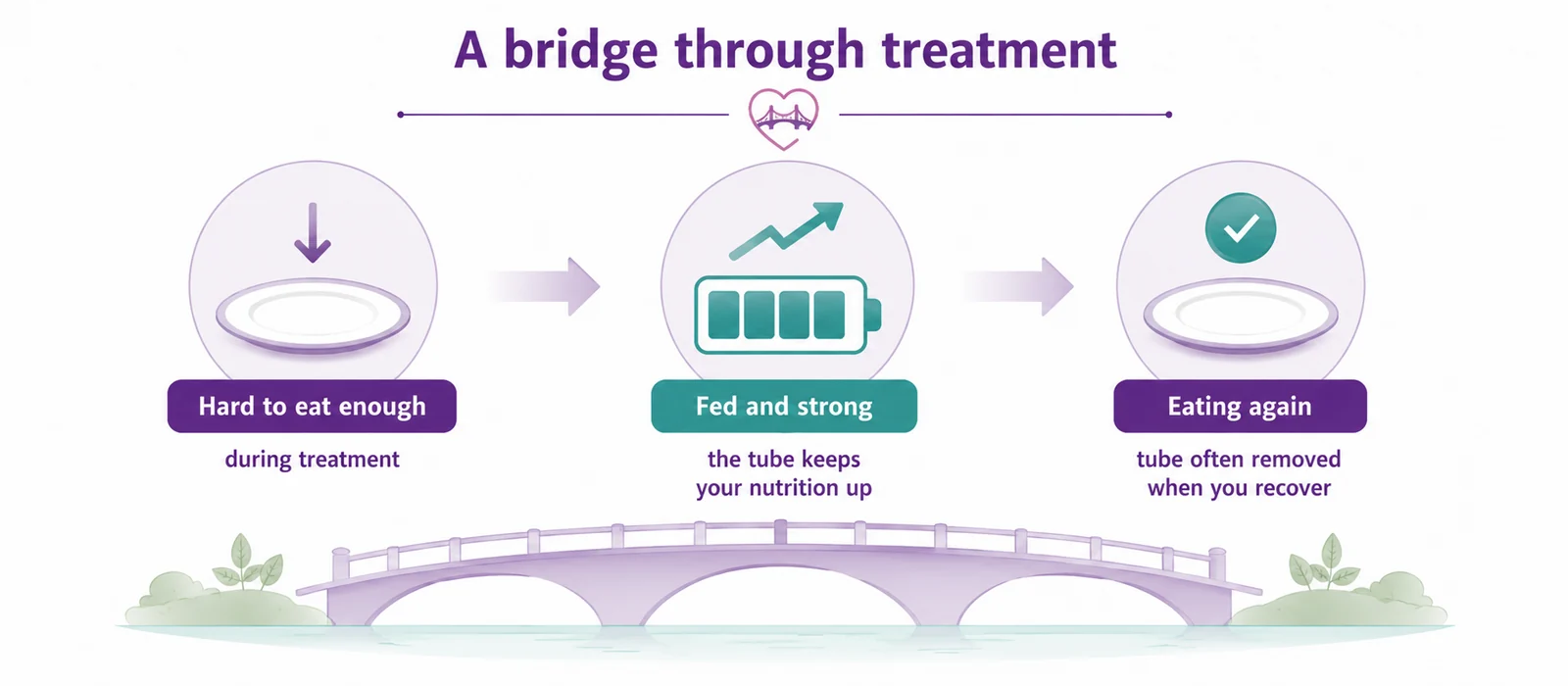
The most common fear — and the most important one to answer honestly — is that a feeding tube means giving up, or the end. For most cancer patients, it is the opposite. A feeding tube is a practical tool to keep you nourished and strong so treatment can work and continue on schedule, and to stop weight loss from interrupting it. Very often it is a temporary bridge through the hardest few weeks — for example during head & neck chemoradiation — and is removed once you can eat well again.
We will also be straight with you, because you deserve the full picture: some people do need a feeding tube for longer, and for a few it is there to support comfort in advanced illness. But for the majority of people offered one during cancer treatment, it is a positive step that helps them get through — not a sign that anyone has stopped trying.
For many people a feeding tube is a bridge: hard to eat during treatment → kept strong by the tube → eating again, tube often removed, on recovery.
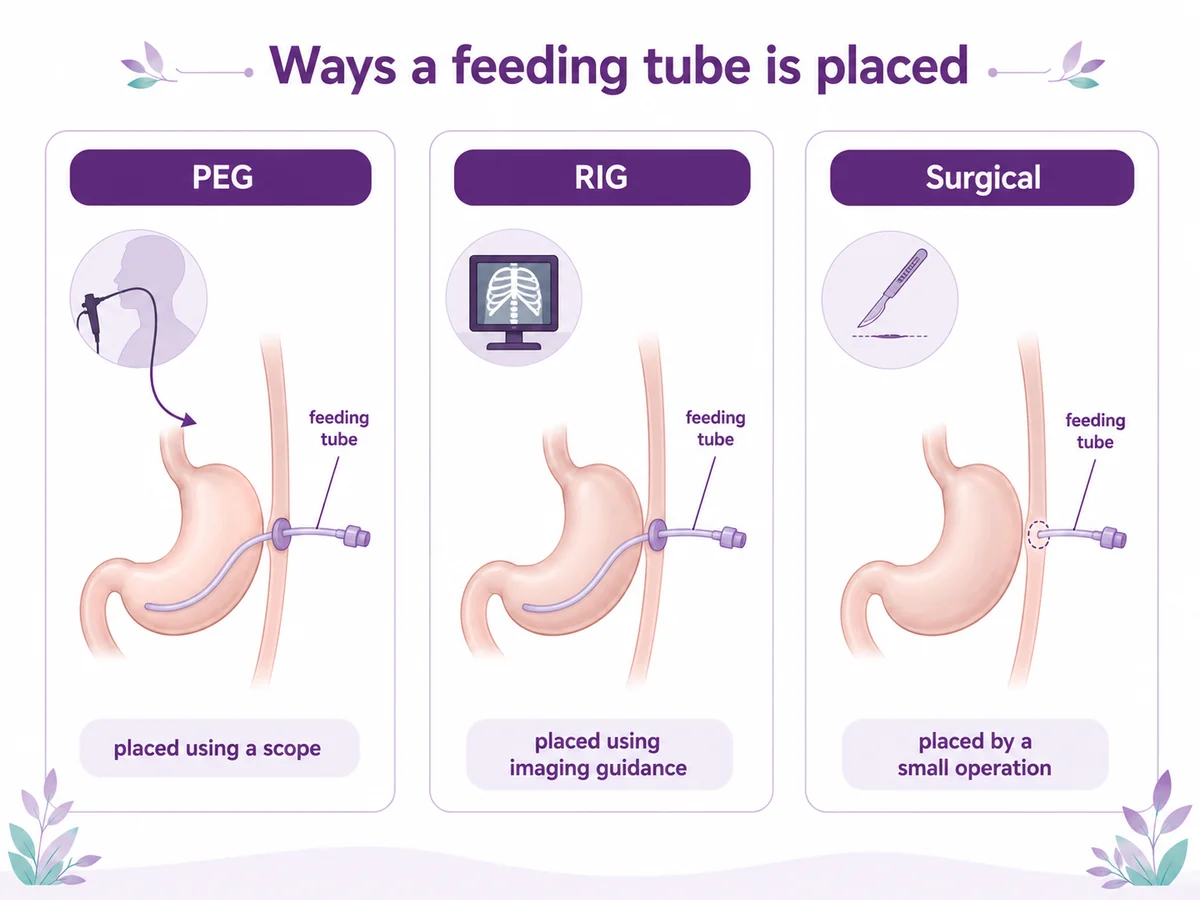
A gastrostomy can be placed in three main ways, and the right one depends on your situation. A PEG (percutaneous endoscopic gastrostomy) is placed using a thin camera passed through the mouth to guide the tube into place — the most common method, usually under sedation. A RIG (radiologically inserted gastrostomy) is placed using imaging (X-ray) guidance, and is used when a tumour in the throat or food-pipe means a scope can’t pass. A surgical (or keyhole) gastrostomy is a small operation, used when the other routes aren’t suitable or during another planned operation. All three end with the same thing: a discreet, comfortable feeding tube into the stomach.
Comparison of PEG, RIG and surgical gastrostomy placement routes
PEG (endoscopic)
RIG (image-guided)
Surgical / keyhole
How
Guided by a scope through the mouth.
Guided by X-ray imaging.
A small operation.
Often used when
The scope can pass safely — the common choice.
A throat or food-pipe tumour stops a scope passing.
The other routes aren’t suitable, or during another operation.
Anaesthetic
Usually sedation.
Usually local, with sedation.
Sedation or general.
Typical stay
Often a day case or short stay.
Often a day case or short stay.
Usually a short stay.
Whichever route is used, your feeding tube is arranged and coordinated by your CION team as part of your nutrition plan, so it fits your treatment rather than being a separate errand — and your dietitian picks up your feeding plan from day one.
Three routes to the same result — a comfortable feeding tube into the stomach.
What applies to you
Is a feeding tube right for me — and which one?
Whether a feeding tube would help depends on how well you can eat and swallow through your treatment, and how much your weight and strength are holding up. It is often suggested before or early in head & neck chemoradiation, so support is in place before the sorest weeks — a positive, planned step, not a last resort. Your dietitian and team talk it through and recommend what fits your situation.
Explore what applies to your situation
Pick your situation and your main concern for a plain-language picture. This is educational — not a diagnosis or a personal recommendation.
What is your situation?
What worries you most?
What this usually means
During chemoradiation for head & neck cancer, the mouth and throat often become too sore to eat enough, and losing weight can interrupt treatment. A feeding tube keeps you nourished and strong so treatment can continue on schedule — and for many people it is temporary, removed once the soreness settles and swallowing recovers. On whether it means giving up: it does not — for most cancer patients it is the opposite, a practical way to stay strong so treatment can work. This is general information — the right plan is made with your team and dietitian, who know your situation.
This tool is educational and not medical advice, a diagnosis or a personal recommendation. Only your treating team and dietitian, who know your situation, can advise what is right for you.
Assessments & tests
How we work out whether you need a feeding tube
The decision starts with a nutrition assessment, not a scan. Your dietitian looks at your weight, what you are managing to eat, and how your swallowing is holding up, alongside the treatment you are about to have. Where swallowing is the problem, a swallow assessment and — if needed — a look at the throat or food-pipe helps show why. Nothing is decided for you: you are told what the team sees and what they would suggest, and you decide.
Assessments we offer — book any of these directly:
Dietitian nutrition assessment
A full review of your weight, intake and strength by our onco-nutrition team — the first step before any feeding tube is considered.
A feeding tube is never just a tube — it comes with a plan, training and someone to call. At CION, tube placement is arranged and coordinated as part of dietitian-led onco-nutrition care, and everything around it — your feed plan, teaching your family, reviewing the tube, and removing it when you no longer need it — is part of the same service.
Book a consult for any of these:
PEG (endoscopic) feeding tube
The most common route — the tube is guided into place using a thin camera, usually under sedation, often as a day case.
Feeding tubes are arranged as part of your cancer care at CION, coordinated by your treating team and onco-nutrition dietitians. Which placement route suits you is decided with you — you are never sent away to work it out alone.
Everyday life
Living with a feeding tube — eating, taste & home care
Life with a feeding tube is more normal than most people expect. You can usually still eat and taste by mouth whatever you safely can — many people take small amounts for pleasure and use the tube to top up nutrition, fluids and medicines. The tube is discreet under clothing, and most people bathe, move around and go out as usual. If swallowing is unsafe for a time, that is guided carefully by your team, and eating by mouth is reintroduced as you recover.
Eat & taste too
Usually you keep enjoying by mouth whatever you safely can — the tube tops up the rest.
Discreet & everyday
The tube sits flat under clothing; most people bathe, move about and go out as usual.
Trained & supported
You and your family are taught to feed and care for the tube at home, with a helpline for questions.
Before you go home, a nurse and dietitian teach you and your family how to give feeds, take medicines through the tube, and keep the skin around it clean — with written instructions and a number to call. Most families find that, after a little practice, managing the tube at home becomes straightforward. Read more on tube feeding after cancer surgery and nutrition after surgery.
What to expect
What to expect: placement, aftercare & removal
Having a gastrostomy placed is usually a short procedure, often a day case or a short stay, under sedation. There may be some tenderness around the site for a few days, which settles. Feeding usually starts within a day. If the tube is temporary — as it often is after head & neck treatment — it is removed simply once you are eating enough by mouth again, and the small opening closes over on its own.
Before
Your team and dietitian decide a feeding tube would help, choose the route (PEG, RIG or surgical), and explain what to expect — so you decide with a full picture.
Placement
A short procedure, often a day case or short stay, usually under sedation. The tube is placed into the stomach and checked.
Learning & home care
Feeding usually starts within a day. A nurse and dietitian teach you and your family to feed and care for the tube, with a helpline for questions.
Ongoing & removal
Your dietitian adjusts feeds as you recover. If the tube is temporary, it is removed simply once you can eat enough by mouth again, and the opening closes over.
What does a feeding tube cost — and is it covered?
A gastrostomy is a much smaller procedure than cancer surgery, and the cost depends mainly on how it is placed — an endoscopic PEG, an image-guided RIG, or a surgical gastrostomy — and on any hospital stay. The reassuring part: because it is part of your cancer treatment, it is usually covered as part of your treatment package — under Aarogyasri at empanelled centres and by most health-insurance policies.
Estimate an indicative range
Indicative only — not a quotation, and not linked to any pricing promise.
Indicative range
₹15,000 – ₹40,000
Indicative hospital range for a PEG (endoscopic) feeding tube as a day case, self-pay. Your actual cost depends on how the tube is placed, any hospital stay, and whether it is part of a wider treatment package.
A feeding tube is usually covered as part of your cancer-treatment package — under Aarogyasri at empanelled centres and by most health insurance. Our team checks your policy and scheme eligibility and confirms a written estimate before anything is arranged.
Figures are indicative only, drawn from typical private-hospital ranges in India, and are not a quotation or a pricing promise. A written estimate is provided after consultation, based on your individual plan.
Free consultation
Talk to our onco-nutrition team — free
If eating is getting harder, or a feeding tube has been suggested and you are frightened by the idea, talk it through with someone who does this every day. No pressure, no judgement.
An honest answer on whether you need a tube at all
A dietitian-led nutrition plan, tube or no tube
Aarogyasri & insurance guidance, with a written estimate
Support
Financial support & Aarogyasri
Nobody should stay hungry through treatment because of cost. Because a feeding tube is part of your cancer treatment, it is usually covered as part of your treatment package — under Aarogyasri at empanelled centres and by most health-insurance policies. CION is Aarogyasri empanelled, and our team checks your scheme eligibility and policy and gives you a clear, written estimate before anything is arranged.
9 clinics in Hyderabad · 35+ across Telangana & AP
CION cancer care is closer than you think.
We're never more than 30 minutes away. Same panel of specialists at every centre. Same tumour board reviews. Same NCCN protocols. Pick the closest one and call directly — or let us pick for you.
Don't see your city? Call
18002028726
— we'll find your nearest CION partner centre.
Meet the team
Feeding support is planned by a team, not one doctor.
CION’s onco-nutrition dietitians, the surgical & GI team who place and manage feeding tubes, and your treating oncologists plan nutrition alongside your treatment — part of 17 senior specialists across CION.
Share your name and number — we'll call you back within 30 minutes to schedule your consultation.
Losing weight through treatment? Don’t wait until you’re weak.
Nutrition support works best when it starts early — often before the hardest weeks, and often without a tube at all. Talk to CION’s onco-nutrition team for an honest answer, with no judgement and no pressure.
Fear and stigma stop people accepting nutrition support that would help them. These are the things we hear most — and the honest answers.
“A feeding tube means the doctors have given up on me.”
Fact: For most cancer patients it is the opposite. A tube is suggested precisely because the team intends to treat you and wants you strong enough for it. Giving up would mean not bothering with your nutrition at all.
“If I need a tube, my cancer must be very advanced.”
Fact: Not so. Feeding tubes are most often used in head & neck cancers that are being treated with intent — the tube is there because chemoradiation makes the mouth and throat sore, not because the cancer has spread.
“Once a tube goes in, it never comes out.”
Fact: Many feeding tubes are temporary and removed once swallowing recovers and you can eat enough by mouth; the small opening then closes over on its own. Some people do need one for longer — but “permanent” is not the default.
“I’ll never taste food again.”
Fact: Usually you can still eat and taste by mouth whatever is safe — many people take small amounts for pleasure and use the tube to top up the rest. If swallowing is unsafe for a time, your team guides it carefully and reintroduces eating as you recover.
“Agreeing to a tube means I’ve stopped fighting.”
Fact: Staying nourished is fighting. Weight loss is one of the commonest reasons cancer treatment gets interrupted or delayed. Accepting a tube is often what allows treatment to finish on schedule.
“If I just try harder to eat, I won’t need it.”
Fact: When the mouth and throat are raw from chemoradiation, this is not about willpower — and blaming yourself only delays support. Your dietitian will try everything by mouth first; a tube is suggested when that genuinely isn’t enough.
“Managing it at home will be impossible for my family.”
Fact: Before you go home, a nurse and dietitian teach you and your family to give feeds, use the tube for medicines and care for the skin — with written instructions and a helpline. Most families find it becomes routine within days.
“Everyone will see it and know I’m ill.”
Fact: A gastrostomy tube sits flat against the tummy, under your clothes. Most people find it far less visible than a nose (Ryle’s) tube — which is one of the reasons it is preferred when support is needed for more than a few weeks.
“It will be very painful to put in.”
Fact: Placement is usually a short procedure under sedation, so it is not painful at the time. Afterwards there can be some tenderness around the site for a few days, which settles, and your team checks the skin and teaches you to care for it.
“A tube is only for people who are unconscious or at the very end.”
Fact: Most people with a feeding tube in cancer care are awake, walking about and getting on with treatment and daily life. Many are working, attending functions and looking after their families with a tube in place.
“Feeding through a tube is unnatural — real food is better.”
Fact: Tube feeds are properly balanced nutrition, planned by a dietitian for your needs. And it isn’t either/or — where it is safe, most people keep eating by mouth as well and use the tube to top up.
“A feeding tube will stop me going out, working or travelling.”
Fact: Most people bathe, move about, go out and continue much of normal life with a tube. Feeds are planned around your day — not the other way round — and your dietitian will work with your routine.
“Tube feed is expensive and we can’t afford it.”
Fact: Because a feeding tube is part of your cancer treatment, it is usually covered as part of your treatment package — under Aarogyasri at empanelled centres and by most insurance policies. Our team checks your eligibility and gives you a written estimate first.
“The tube will get infected and cause more problems than it solves.”
Fact: Like any procedure it has risks, and the skin around the site needs simple daily care — which you are taught. Problems are usually minor and manageable, and you have a number to call. The risk of going through treatment badly nourished is generally the bigger one.
“Having a tube means my treatment isn’t working.”
Fact: A feeding tube says nothing about whether your treatment is working. It is a response to the side effects of treatment — a sore mouth and throat, or a tumour making swallowing hard — not to how the cancer is responding.
“I can’t do my prayers, rituals or fasting with a tube.”
Fact: Most people continue their religious and family life with a tube in place. If fasting or a particular observance matters to you, tell your dietitian — feeds can often be timed around it, and they would far rather plan with you than find out afterwards.
“It’s better to refuse the tube and keep my dignity.”
Fact: There is no dignity lost in staying nourished. What most people find undignified is the weakness, exhaustion and interrupted treatment that come from not eating enough — and a tube is often what prevents exactly that.
“Nobody asked me — it’s being done to me.”
Fact: It is your decision, and you can say no. Your team’s job is to explain honestly what they see, what a tube would and wouldn’t do, and what the alternatives are. If you have been told you need one and are unsure, a second opinion is completely reasonable.
Why CION
Why choose CION for feeding-tube & nutrition support
Dietitian-led onco-nutrition
Feeding support is part of dedicated onco-nutrition care — not an afterthought — so your nutrition is planned alongside your treatment.
The right route for you
PEG, RIG or surgical — the route is matched to your situation and coordinated by your team, so support is in place before the hardest weeks.
Home-feeding training
You and your family are taught to feed and care for the tube at home, with a helpline for questions.
Part of your cancer team
Nutrition, surgery, chemotherapy and radiation are coordinated together, so feeding support fits your overall plan.
Often temporary — and reviewed
Where the tube is a bridge, it is removed once you can eat again, and your plan is reviewed honestly as you recover.
Aarogyasri & care close to home
Usually covered as part of your treatment package at empanelled centres; 35+ centres and Telugu-speaking teams.
Real stories · real courage
15,000+ patients chose CION. Hear from them directly.
These aren't paid endorsements or written reviews. These are video testimonials from real patients and families — recorded on their own phones, in their own words. Pick any one. Watch it. Then decide.
4.8★800+ Google reviews
50+video testimonials
15,000+patients treated
Successful Chemotherapy & Radiation Done by Dr. Owais Mohammed & Dr. Kirti Ranjan
Watch video →
Successful Chemotherapy Done by Dr. C Raghavendra Reddy
Watch video →
Surgery, Chemo & Radiation Done by Dr. Imaduddin, Dr. Vinay, Dr. Owais, Dr. Kirti
Watch video →
Successful Radical Thymectomy Done by Dr. Mohammed Imaduddin & Dr. Vinay Mamidala
Watch video →
Successful Surgery Done by Dr. Rajender Byshetty
Watch video →
Successful Chemo & Surgery Done by Dr. Imad, Dr. Vinay, Dr. Owais & Dr. Raghavendra
Watch video →
Successful Chemo & Surgery Done by Dr. Imad, Dr. Vinay, Dr. Owais & Dr. Raghavendra
Watch video →
Successful Chemo & Radiation Done by Dr. Owais Mohammed & Dr. Kirti Ranjan Mohanty
Watch video →
Successful Breast Cancer Surgery Done by Dr. Imaduddin Mohammed & Dr. Vinay Mamidala
Watch video →
Successful Chemotherapy Done by Dr. Bharati Devi Gorantla
Watch video →
Successful Chemo & Surgery Done by Dr. Owais Mohammed & Dr. Imaduddin Mohammed
Watch video →
Successful Chemotherapy Done by Dr. Gundu Naresh
Watch video →
Successful Bone Marrow Transplantation - Neuroblastoma
Watch video →
Successful Surgery & Chemo - Carcinoma of Caecum
Watch video →
Successful Oral chemotherapy & mastectomy surgery
Watch video →
Successful Oral chemotherapy & mastectomy surgery
Watch video →
Successful Chemotherapy
Watch video →
Successful Surgery by Dr. Mohammed Imaduddin
Watch video →
Successful Bone Marrow Transplantation
Watch video →
Successful Oral chemotherapy & mastectomy surgery
Watch video →
Successful Oral chemotherapy & mastectomy surgery
Watch video →
Successful Chemotherapy
Watch video →
Successful Buccal Mucosa Surgery
Watch video →
Successful Complex Surgery Mandibulectomy Reconstruction
A feeding tube is one part of staying strong through cancer treatment. At CION, nutrition, the treatment itself, and emotional and practical support are one coordinated plan.
Onco-nutrition & diet
Dietitian-led nutrition support through every stage of cancer treatment. Learn more
Head & neck / oral cancer
The cancers most often needing feeding support during chemoradiation. Oral cancer care
Oesophageal (food-pipe) cancer
When a tumour makes swallowing hard, a feeding tube keeps nutrition up. Learn more
Speech & swallowing rehab
Therapy to rebuild safe swallowing after head & neck treatment. Learn more
Supportive & palliative care
Comfort-focused care, including nutrition, at every stage. Learn more
Counselling support
Emotional support for you and your family through treatment. Learn more
A gastrostomy is a soft feeding tube placed through the skin of the tummy directly into the stomach, so nutrition, fluids and medicines can be given when eating or swallowing by mouth isn’t enough. In cancer care it is used most often during head and neck chemoradiation, or when a throat or food-pipe tumour makes swallowing hard. It keeps you well nourished and strong for treatment, and for many people it is temporary.
Does a feeding tube mean I’m giving up or dying?
No. For most cancer patients a feeding tube is the opposite of giving up — it is a practical way to stay nourished and strong so treatment can work and continue on schedule. Very often it is a temporary bridge through the hardest weeks of treatment, removed once you can eat well again. Some people do need one for longer, and for a few it supports comfort in advanced illness, but for the majority it is a positive step to get through treatment.
Is a feeding tube permanent, or can it be removed?
Often it is not permanent. Many feeding tubes — especially during head and neck chemoradiation — are temporary and are removed once swallowing recovers and you can eat enough by mouth; the small opening then closes over on its own. Some people need one for longer. Either way, it is chosen to keep you well nourished, and it is reviewed regularly as your situation changes.
What is the difference between a PEG and a RIG?
Both are gastrostomy feeding tubes into the stomach; the difference is how they are placed. A PEG (percutaneous endoscopic gastrostomy) is guided into place using a thin camera passed through the mouth — the most common method. A RIG (radiologically inserted gastrostomy) is placed using X-ray imaging guidance, and is used when a tumour in the throat or food-pipe means a scope can’t pass. Your team recommends whichever suits your situation.
What is the difference between a feeding tube and a Ryle’s (nasogastric) tube?
A Ryle’s or nasogastric tube passes through the nose and down into the stomach, and is generally used for shorter periods. A gastrostomy goes directly through the tummy wall into the stomach and is usually preferred when feeding support is needed for several weeks or more, because it is more comfortable, more discreet under clothing, and does not irritate the nose and throat.
Will I still be able to eat and taste food?
Usually, yes. A feeding tube does not normally stop you eating or tasting by mouth — many people take small amounts of food and drink for pleasure and use the tube to top up nutrition, fluids and medicines. Your dietitian helps you keep tasting and eating safely alongside the tube. If swallowing is unsafe for a time, that is guided carefully, and eating is reintroduced as you recover.
Who needs a feeding tube during cancer treatment?
Most often it is people having chemoradiation for head and neck cancer, where the mouth and throat become too sore to eat enough, and people whose throat or food-pipe tumour makes swallowing difficult. It may also be suggested if you are losing weight and strength during treatment despite trying everything by mouth. It is not decided by the type or stage of your cancer alone — it is decided by how well you can actually eat.
Is having a feeding tube placed painful, and how is it done?
Placement is usually a short procedure under sedation, so it is not painful at the time. It is done in one of three ways: by endoscopy (PEG, using a scope through the mouth), by imaging guidance (RIG), or by a small operation (surgical). Afterwards there can be some tenderness around the site for a few days, which settles, and the team checks the skin and teaches you to care for it.
How long does a feeding tube stay in?
It depends on why you needed it. Where a tube supports you through head and neck chemoradiation, it is often needed for a number of weeks to a few months, and is removed once swallowing recovers and you are eating enough by mouth. Some people need one for longer. Your dietitian and team review it regularly rather than leaving it in by default.
Can a feeding tube be placed before treatment starts?
Yes, and this is often deliberate. Where a course of head and neck chemoradiation is very likely to make eating difficult, placing a tube before or early in treatment means support is already in place before the sorest weeks — instead of waiting for weight loss to interrupt treatment. It is a planned, positive step, not a last resort.
How do I feed and care for the tube at home?
Before you go home, a nurse and dietitian teach you and your family how to give feeds, take medicines through the tube, and keep the skin around it clean, with written instructions and a helpline to call. Feeds are planned to fit your day, and your dietitian adjusts them as you recover. Most families find that, after a little practice, managing the tube at home becomes straightforward.
What goes into a feeding tube — can I use home-cooked food?
Feeds are usually specially prepared, nutritionally balanced liquid formulas planned by your dietitian for your needs, along with water and medicines. Some blended home foods can sometimes be used, but only where your dietitian has advised it — the wrong consistency can block the tube, and home blends can miss the nutrition you need. Always ask your dietitian before putting anything new down the tube.
Can I bathe, travel and go out with a feeding tube?
In most cases, yes. The tube sits flat against the tummy under clothing, and most people bathe, move about, go out and continue much of their normal routine. Feeds can usually be timed around your day, work and family commitments. Your team will tell you about anything specific to avoid while the site is still healing.
Will people be able to see my feeding tube?
Generally not. A gastrostomy tube is discreet and sits flat under clothes — this is one of the main reasons it is preferred over a nose (Ryle’s) tube when feeding support is needed for more than a short period. Most people find it far less noticeable than they feared before it was placed.
What problems can happen with a feeding tube, and what do I do?
Like any procedure, a gastrostomy carries some risk. The commonest issues are minor and manageable: tenderness or irritation of the skin around the site, or the tube becoming blocked. You are taught simple daily care to prevent these and given a helpline number, so you can call rather than worry. Tell your team promptly about pain, redness, leakage, fever or a tube that has come out or won’t flush.
Will a feeding tube stop me losing weight during treatment?
It gives you a reliable way to get nutrition, fluids and medicines in when eating by mouth isn’t enough, which is what usually drives weight loss during treatment. Many people stabilise their weight and strength this way, so treatment can continue on schedule. Some weight change during cancer treatment is still common, and your dietitian adjusts your feeds as you go.
What happens when the tube is removed — will there be a hole or scar?
Removing a temporary tube is usually simple and quick. Afterwards the small opening closes over on its own, generally within a short time, and what is left is a small mark. Your team explains what to expect at the time and checks the site afterwards.
Is a gastrostomy covered by Aarogyasri or insurance?
Usually, yes — because a feeding tube is part of your cancer treatment, it is generally covered as part of the treatment package, under Aarogyasri at empanelled centres and by most health-insurance policies. CION is Aarogyasri empanelled; the team checks your policy and scheme eligibility and provides a written estimate before anything is arranged.
Explore
Explore nutrition & supportive care
Feeding tubes sit inside a bigger picture — nutrition through treatment, the cancers that most often need feeding support, and the care around them. Tap any topic to read more.
For most people it is the bridge that gets them through. Talk to CION’s onco-nutrition team — free — at any of our 9 Hyderabad clinics, part of 35+ centres across Telangana & Andhra Pradesh.
Medical disclaimer: This page provides general information about gastrostomy (feeding tube) and nutrition support and does not replace professional medical advice, diagnosis or treatment. Whether a feeding tube is right for you can only be decided by your treating team and dietitian, who know your situation. Costs shown are indicative only and not a quotation. Content is periodically reviewed by CION’s medical team.

 CION Ameerpet