

Medical Oncologist
Tamoxifen is a daily tablet that blocks oestrogen from feeding hormone-receptor-positive breast cancer. For many women, especially before menopause, it lowers the chance of the cancer coming back. Here is what it does, the side effects you may feel, and how our oncologists help you take it for the full 5 to 10 years.
It is prescribed for breast cancers that are hormone-receptor-positive — meaning the tumour cells carry oestrogen receptors (ER-positive) and/or progesterone receptors (PR-positive). Roughly 7 in 10 breast cancers are hormone-receptor-positive, so tamoxifen is one of the most widely used breast cancer medicines in the world.
It is most often used after surgery (adjuvant therapy) to lower the chance the cancer returns. It is also used to treat DCIS, to treat advanced or returned hormone-positive breast cancer, and sometimes to reduce risk in women with a strong family history. Your oncologist confirms hormone-receptor status from your biopsy report before starting it. At CION Cancer Clinics, this is reviewed by our tumor board.
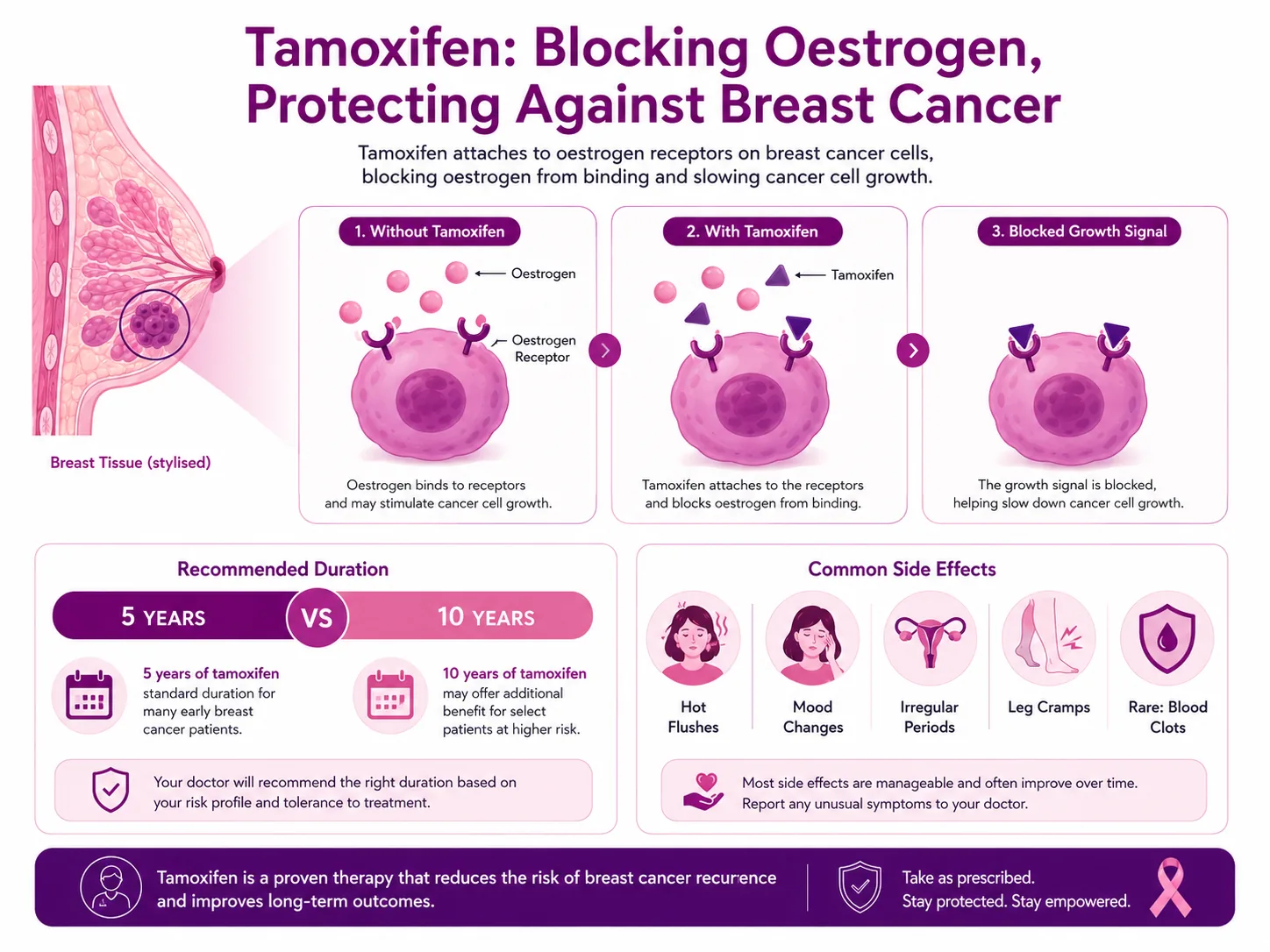
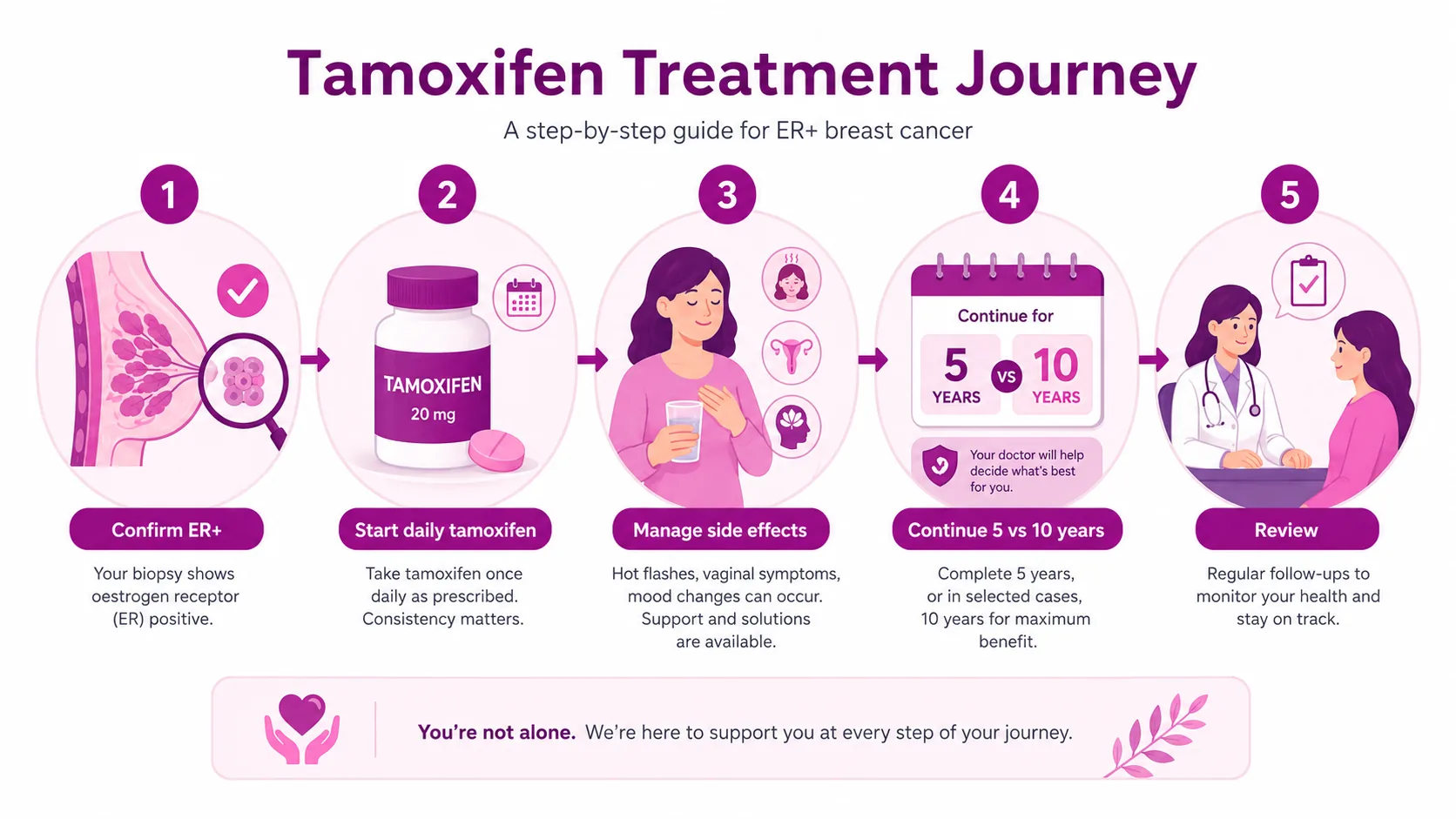
What tamoxifen does in the body:
Binds the oestrogen receptors on cancer cells so circulating oestrogen cannot switch them on — the core of how it works.
Starves hormone-driven cells of their fuel, reducing the chance of recurrence after surgery.
A daily tablet reaches cancer cells anywhere, including the microscopic ones imaging cannot see.
One tablet a day, at about the same time, with or without food. Never double up a missed dose — take the next one as usual.
Simplified for understanding. Your duration and dose are decided by your oncology team for your individual case.
The standard course for early hormone-positive breast cancer, and the usual duration for DCIS and risk reduction.
The ATLAS trial showed fewer recurrences and deaths with 10 years versus 5. Offered when your recurrence risk warrants it and you tolerate treatment well.
Here is what to watch for and what we do about it — the common, menopause-like effects first, then the uncommon but important ones.
The most common effect, usually settling with time. Layered clothing, a cool bedroom and avoiding triggers help; if severe, we suggest non-hormonal options — never HRT.
Large studies did not clearly link tamoxifen itself to weight gain — it often changes from reduced activity, chemo or menopause. Our nutritionist and regular walking help.
A small increase in clot risk. Seek urgent care for a hot, swollen, painful calf or sudden breathlessness. Tell us before any surgery or long flight; stay mobile and hydrated.
A slightly raised endometrial cancer risk, mainly in postmenopausal women — premenopausal women are not affected the same way. Report any abnormal bleeding promptly for a gynae review.
Periods may become irregular or stop, but tamoxifen is not a contraceptive. Low mood, reduced libido or dryness are common and treatable — our psycho-oncology team can help.
Rarely, tamoxifen can affect the eyes (including cataracts) or liver. Have an eye check if your vision changes; your liver function is monitored through routine blood tests.
Talk to our team
Call the helpline or leave your details, and someone will help you arrange a consultation at the CION centre nearest you. One helpline serves every CION centre.
Strong CYP2D6 blockers — fluoxetine, paroxetine, bupropion — can reduce how well tamoxifen works. Safer alternatives exist; tell us so we can adjust, not stop, your treatment.
Not taken at the same time as anastrozole, letrozole or exemestane. These are sequenced, never combined with tamoxifen.
Tamoxifen can increase the effect of warfarin and similar anticoagulants, raising bleeding risk. Extra monitoring is needed.
Grapefruit may interfere with how tamoxifen is processed; heavy alcohol can worsen hot flushes. Moderation is sensible.
Avoid oestrogen-containing products, and discuss any herbal supplement (including phyto-oestrogens) with us before starting it.
Tick anything that describes your situation. This is an awareness guide, not a diagnosis or a treatment decision.
This tool doesn't decide your treatment or replace a specialist opinion. Whether tamoxifen suits you is confirmed by your oncology team from your reports.
If you hope to have children, raise it before you start. Fertility preservation can often be arranged, and the recent POSITIVE trial showed that some women can safely pause hormone therapy for a defined period to try for a pregnancy, then resume — a decision made carefully with your oncologist. At CION we discuss fertility openly at the first consultation, because it is far easier to plan ahead than to react later.
Risk of birth defects. Use reliable non-hormonal contraception during treatment and for about 2 months after stopping.
Egg or embryo preservation can often be done before starting. Tell us at the first visit if you may want children.
The POSITIVE trial supports a carefully timed break to attempt pregnancy for selected women — only under specialist guidance.
Worried about a side effect, or unsure whether 5 or 10 years is right for you? Book a free consultation and, if you already have a biopsy report, a free written second opinion.

Free first consultation for all cancer patients — confidential, doctor-led, and never rushed. We help you take tamoxifen for the full course, with side effects managed.
Worry and misinformation keep people from the least invasive option. Here are the beliefs we hear most, and the facts.
CION treats cancer and only cancer — focused, patient-specific care, not a general hospital's approach.
Medical, surgical and radiation oncologists agree your tamoxifen plan and duration together — never one opinion.
9 clinics across Hyderabad and 35+ centres across Telangana & AP, so years of follow-up don't mean long journeys.
Regular check-ins catch and treat hot flushes, mood changes and other effects early, so you can keep taking the tablet.
Prompt gynaecology review for any abnormal vaginal bleeding, with clear advice on what to watch for at home.
Nutrition and psycho-oncology help you manage weight, energy and mood across the full 5 to 10 years.
Trained at AIIMS, Tata Memorial, and leading international centres. Combined 150+ years of experience. Every complex case is reviewed by 3+ of them — together.

MBBS(Gold Medal), DNB(General Medicine), DM(Medical Oncology)(Gold Medal)

MBBS, MD(General Medicine), DM(Medical Oncology)(Adyar,Chennai), ECMO, MRCP SCE(UK)

MBBS, MD (General Medicine), DrNB (Medical Oncology), ECMO, MRCP SCE (Medical Oncology) (UK)



MBBS (AIIMS), MS (Surgery) (AIIMS), DNB (Surgical Oncology), MRCS (Edinburgh)



MBBS, MS(General Surgery), M.Ch(Surgical Oncology), FMAS, FARIS(Ongoing)






MBBS, MS (General Surgery), DrNB (Surgical Oncology), FALS Oncology

Want a specific doctor for your case? Mention them when booking.
Book Free ConsultationShare your name and number — we'll call you back within 30 minutes to schedule your consultation.
Where to find us
Addressed by landmark, because that is how this city navigates. Each centre also names the areas it serves, so you can place it without a map. Consultation and day-care Chemotherapy run at every one of them.
Talk to our team
Call the helpline or leave your details, and someone will help you arrange a consultation at the CION centre nearest you. One helpline serves every CION centre.
No. Tamoxifen is hormone (endocrine) therapy, not chemotherapy. It works by blocking oestrogen from feeding hormone-receptor-positive breast cancer cells, rather than by destroying fast-dividing cells the way chemotherapy does. That is why it is taken as a daily tablet at home and does not cause the hair loss or low blood counts typical of chemo. Some women have chemotherapy first and then take tamoxifen afterwards to lower the chance of the cancer returning. Your oncologist will explain exactly where tamoxifen fits in your overall treatment plan.
It depends on your individual risk of recurrence. Five years is the proven minimum for early hormone-positive breast cancer. The ATLAS trial showed that continuing to 10 years further reduced both recurrence and deaths from breast cancer, with the benefit growing in the years after treatment. For premenopausal women, guidelines support starting with 5 years and continuing to 10 if you remain premenopausal and are tolerating it well. At CION this decision is reviewed by our tumor board, weighing your recurrence risk against side effects, so you get a team recommendation rather than a one-size answer.
Although weight gain is sometimes listed as a side effect, good research does not show a strong link between tamoxifen itself and gaining weight. One study of over 3,000 breast cancer survivors found tamoxifen was not clearly associated with weight gain, while chemotherapy was. Weight often changes during treatment because of reduced activity, menopause or other medicines rather than the tamoxifen tablet. Regular walking, a balanced diet rich in vegetables and lean protein, and support from our nutritionist all help. If you are gaining weight and it worries you, tell your oncologist so other causes can be checked.
Tamoxifen can thicken the lining of the womb and slightly increases the risk of endometrial cancer, but this risk mainly applies to postmenopausal women; premenopausal women are not affected in the same way. The overall risk is small and is far outweighed by tamoxifen's benefit in preventing breast cancer recurrence. The key safety step is simple: report any abnormal vaginal bleeding to your doctor promptly so it can be investigated early. At CION we arrange a gynaecology review for any unexpected bleeding, because problems found early are the most treatable.
Tell your oncologist about every medicine and supplement you take, because some interact with tamoxifen. Certain antidepressants (fluoxetine, paroxetine, bupropion) can make it less effective, so these should be reviewed rather than stopped on your own. Avoid taking tamoxifen at the same time as aromatase inhibitors. Grapefruit and grapefruit juice may interfere with how the drug is processed, and heavy alcohol can worsen hot flushes. Avoid oestrogen-containing products and discuss any herbal remedy before using it. Do not get pregnant while taking tamoxifen, as it can cause birth defects.
No. Tamoxifen can cause birth defects, so you must not be pregnant or breastfeed while taking it. Because it does not act as a contraceptive and you can still conceive, use non-hormonal contraception (such as condoms or a copper IUD) during treatment and for about two months after stopping. If you hope to have children, raise it before you start so fertility preservation can be arranged. The recent POSITIVE trial showed that some women can safely pause hormone therapy for a planned time to try for a pregnancy and then resume — a decision made carefully with your oncologist.
Common side effects such as hot flushes, night sweats or mild nausea often begin within the first few weeks and frequently ease over the first few months as your body adjusts. Some effects, like changes to periods, may persist while you are on treatment. Serious effects such as blood clots or abnormal womb bleeding are uncommon but need prompt attention at any point. The most important thing is not to suffer in silence: most side effects can be reduced through simple measures, dose timing or supportive care. Tell your CION oncologist about anything new at your follow-up visits.
Yes — tamoxifen is the main hormone therapy for premenopausal women with hormone-receptor-positive breast cancer. This is because aromatase inhibitors do not work on their own before menopause. Depending on your risk, your oncologist may combine tamoxifen with ovarian suppression for added protection. Premenopausal women also do not carry the same endometrial cancer risk that postmenopausal women do. Because younger women face issues around periods, fertility and pregnancy, we discuss all of this openly at your first 45-minute consultation so your plan fits your life as well as your cancer.
Our complete guide to breast cancer — surgery, diagnosis, treatment, types, symptoms and recovery. Tap any topic to read more.
Staying the course is easier with a team beside you. Book a free consultation or second opinion at any of our 9 Hyderabad clinics — part of 35+ centres across Telangana & Andhra Pradesh.