Chemotherapy uses medicines that travel through the bloodstream to kill fast-dividing cancer cells anywhere in the body. In breast cancer it is one of the main pillars of breast cancer treatment — given before surgery to shrink a tumour, after surgery to lower the chance of return, or to control advanced disease. Not every woman needs it, and the right chemotherapy regimen depends on your subtype and stage. At CION, a woman-headed, tumour-board-led team decides who truly benefits — and supports you through every side effect.
Chemotherapy ("chemo") is treatment with cell-killing medicines that travel in the bloodstream and reach cancer cells throughout the body. Unlike surgery or radiation, which treat one area, chemotherapy is a systemic treatment — which is why it is the main tool for stopping cancer cells that may have escaped the breast and travelled elsewhere, even when they are too small to see on a scan.
It works by targeting cells that divide rapidly. Cancer cells divide far more often than most healthy cells, so they are hit hardest — but some normal fast-growing cells (hair, the lining of the gut, blood-forming marrow) are affected too, which is why side effects such as hair loss and low blood counts can occur. Chemotherapy is one part of a wider plan that may also include surgery, radiation, hormone therapy and targeted therapy — sequenced by your tumour board.
Chemo medicines circulate through the whole body, so they can reach hidden cancer cells beyond the breast — something local treatments like surgery cannot do.
It works on rapidly dividing cells. Cancer cells divide most, so they are hit hardest — but fast-growing normal cells explain the temporary side effects.
Chemotherapy rarely stands alone. It is combined and sequenced with surgery, radiation, hormone or targeted therapy, chosen by the tumour board for your case.
When chemotherapy is given before surgery (neoadjuvant), doctors can watch how the cancer responds. If the cancer disappears completely — a pathologic complete response (pCR) — long-term outcomes are markedly better, especially in triple-negative and HER2-positive breast cancers. That is why chemo is often given first in these subtypes. Source: NCCN Breast Cancer guidance.
We're never more than 30 minutes away. Same panel of specialists at every centre. Same tumour board reviews. Same NCCN protocols. Pick the closest one and call directly — or let us pick for you.
Not sure which centre fits best? Tell us where you are — we'll suggest the closest one with the right specialists.
Help me pick the right centreTravelling for treatment? We may have a centre right where you are.
Don't see your city? Call 18002028726 — we'll find your nearest CION partner centre.
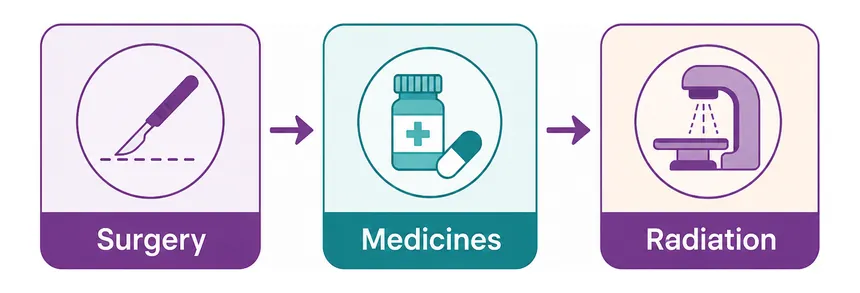
The same medicines can be given at different points in your treatment, and the timing has a real purpose. Whether chemotherapy comes before surgery, after surgery, or as the main treatment for advanced disease is decided by your subtype, your stage, and what the team wants to learn from your response.
Understanding these labels helps you follow your own plan and ask the right questions about why chemo is timed the way it is.
Chemo is given first to shrink the tumour — sometimes enough to allow breast-conserving surgery instead of mastectomy — and to show the team how responsive the cancer is. It is standard for most triple-negative and HER2-positive cancers.
Chemo is given after surgery to destroy any cancer cells that may remain and lower the risk of the cancer returning. It is common when the tumour was larger, the lymph nodes were involved, or the biology suggests higher risk.
When cancer has spread beyond the breast and nearby nodes (metastatic breast cancer), chemotherapy is used to control the disease, ease symptoms and extend good-quality life rather than to cure.
Giving chemo first lets the team measure response and adjust later treatment. Giving it after surgery uses the full pathology to decide if it is needed at all. Both are evidence-based — the choice is individual.
Chemotherapy is powerful but not always necessary. One of the most important jobs of a good oncology team is to decide who truly benefits — sparing women who do not need it from side effects, while making sure those who do need it receive it. The decision rests on the cancer's subtype, stage, grade and, sometimes, a gene-expression test.
TNBC has no hormone or HER2 target, so chemotherapy is the backbone of treatment — and it is usually very responsive to it, often given before surgery.
HER2-positive cancers are treated with chemotherapy paired with HER2-targeted therapy, which together dramatically improve outcomes.
For hormone-receptor-positive cancers, chemo is added when the tumour is larger, node-positive, high-grade, or a gene-expression score predicts real benefit.
Many small, low-grade, node-negative hormone-positive cancers do well with surgery and hormone therapy alone. Gene-expression tests help confirm chemo can be avoided without raising the risk.
Chemotherapy is not given continuously — it is delivered in cycles, each made up of a treatment day (or days) followed by a rest period that lets healthy cells recover before the next dose. The number and spacing of cycles is set by the regimen your oncologist chooses for your subtype and stage.
A cycle is one round of treatment plus a recovery gap — often every 1, 2 or 3 weeks. Most breast cancer plans run 4 to 8 cycles, spread across roughly 12 to 24 weeks.
Some regimens give cycles closer together (every 2 weeks instead of 3) with growth-factor support. This "dose-dense" approach can improve results for certain higher-risk cancers.
Many plans run in two parts — one group of medicines for a few cycles, then a different group for the next few — to use complementary mechanisms and spread out side effects.
Doses and timing can be modified based on blood counts and how you tolerate treatment. Delaying a cycle to recover is common and safe — the plan flexes to protect you.
Whether you need chemotherapy — and which regimen, in what order — is too important for a single opinion. CION is a woman-headed, tumour-board-led organisation built for these decisions: accurate subtyping, evidence-based selection, and active management of side effects so you can complete treatment safely.
Trained at AIIMS, Tata Memorial, and leading international centres. Combined 150+ years of experience. Every complex case is reviewed by 3+ of them — together.

MBBS(Gold Medal), DNB(General Medicine), DM(Medical Oncology)(Gold Medal)

MBBS, MD(General Medicine), DM(Medical Oncology)(Adyar,Chennai), ECMO, MRCP SCE(UK)

MBBS, MD (General Medicine), DrNB (Medical Oncology), ECMO, MRCP SCE (Medical Oncology) (UK)

MBBS (AIIMS), MS (Surgery) (AIIMS), DNB (Surgical Oncology), MRCS (Edinburgh)

MBBS, MS(General Surgery), M.Ch(Surgical Oncology), FMAS, FARIS(Ongoing)

MBBS, MS (General Surgery), DrNB (Surgical Oncology), FALS Oncology

Want a specific doctor for your case? Mention them when booking.
Book Free ConsultationShare your name and number — we'll call you back within 30 minutes to schedule your consultation.
Woman-led, tumour-board-reviewed chemotherapy planning across 35+ centres in Telangana & AP. Call 1800-202-8726.
Most breast cancer chemotherapy is given as a day-care infusion through a vein — you come in, receive the medicines over a few hours, and go home the same day. Many women continue to work and run their homes during treatment, with planned rest around the days they feel most tired. Knowing the rhythm in advance takes away much of the fear.
Side effects vary by regimen and from person to person. Most are temporary and controllable, and our team treats them actively rather than asking you to simply endure them — see our detailed guides to chemotherapy side effects and hair loss.
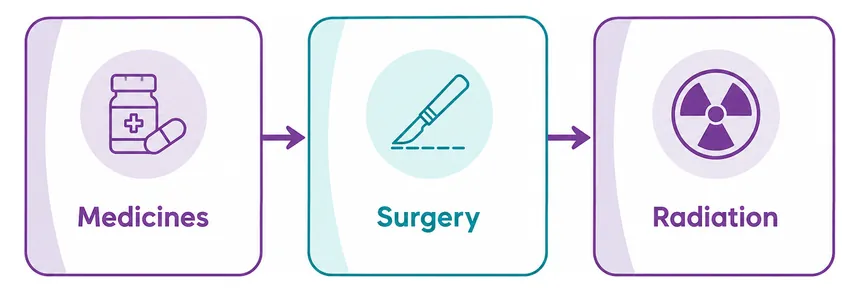
Chemotherapy almost never works alone. Its real strength is how it combines with the other pillars of treatment — surgery to remove the tumour, radiation to clear the local area, and drug therapies aimed at the cancer's specific biology. The order is chosen by the tumour board so each treatment supports the next.
For many women, chemotherapy is the bridge that makes the rest of the plan more effective — and for some subtypes, it is given hand-in-hand with targeted or immune-based medicines.
For the cancers that need it, chemotherapy meaningfully lowers the chance of breast cancer returning and improves survival — this is among the best-established findings in cancer medicine. In early-stage breast cancer it is used with the goal of cure, and a large proportion of women treated are cured. In advanced disease it is generally not curative but is treatable, controlling the cancer and extending good-quality life.
The benefit is largest when the right women get the right regimen at the right time — which is exactly what a tumour board is designed to ensure. Early diagnosis and an accurate, team-based plan are the biggest levers on outcome.
CION breast cancer 1-year survival: 96.9% vs national average 85.4% (+11.5%). *1-year survival. Source: ICMR / National Cancer Registry Programme (NCRP).
The cost of breast cancer chemotherapy in India varies widely with the regimen, the number of cycles, the subtype, and whether targeted drugs are added. As an indicative guide, a full course of standard chemotherapy commonly falls in a typical range of around ₹1–4 lakh, while regimens that include HER2-targeted therapy can be considerably higher. These are broad estimates only — your actual cost depends on your plan, your centre and your insurance.
You should never make a treatment decision on price alone, and you should not have to. Several routes can ease the burden, and our team helps you navigate them.
If chemotherapy has been suggested for you, the most valuable first step is to confirm it is truly needed and planned correctly for your subtype and stage. CION offers a clear, woman-led pathway from first consultation through treatment — with your first consultation free.
A specialist reviews your biopsy and reports in full, explains whether chemotherapy is needed for your cancer, and outlines the likely plan — no rushed decisions, no unnecessary tests.
We verify your ER/PR/HER2 status, grade and stage — and arrange a gene-expression test where it helps decide whether chemo can be safely avoided — with up to 50% discounts on diagnostics.
3+ oncologists agree the right regimen, sequence and number of cycles for your case — including any targeted or immune therapy and the place of surgery and radiation.
Chemotherapy delivered with active side-effect management, nutrition, psycho-oncology and transparent costs — so you complete treatment safely and on schedule.
Hear from patients treated at CION — diagnosis, treatment path, and where they are today.
These aren't paid endorsements or written reviews. These are video testimonials from real patients and families — recorded on their own phones, in their own words. Pick any one. Watch it. Then decide.
Read all 800+ reviews on Google
Start Your Story. Book Free Consultation.Chemotherapy uses cell-killing medicines that travel through the bloodstream to reach cancer cells anywhere in the body. Because it is a systemic treatment, it can destroy cancer cells that may have spread beyond the breast — including cells too small to see on a scan — which surgery and radiation cannot do. In breast cancer it is used before surgery to shrink a tumour, after surgery to lower the chance of the cancer returning, or to control advanced disease. It targets rapidly dividing cells, which is why it works against cancer but also causes temporary side effects such as hair loss and low blood counts. Whether you need it depends on your subtype, stage and grade.
Both use the same kinds of medicines — the difference is the timing. Neoadjuvant chemotherapy is given before surgery. It shrinks the tumour (sometimes enough to allow breast-conserving surgery instead of mastectomy) and lets the team see how well the cancer responds, which guides later treatment. It is standard for most triple-negative and HER2-positive cancers. Adjuvant chemotherapy is given after surgery to destroy any cancer cells that may remain and reduce the risk of recurrence; it is common when the tumour was larger, the lymph nodes were involved, or the biology suggests higher risk. Your tumour board decides which order is best for your specific cancer.
Chemotherapy is given in cycles — each a treatment day (or days) followed by a rest period that lets healthy cells recover. Most breast cancer plans run between 4 and 8 cycles, spread across roughly 12 to 24 weeks, though this varies with the regimen chosen for your subtype and stage. Some plans use "dose-dense" scheduling, giving cycles every 2 weeks instead of 3 with growth-factor support, for certain higher-risk cancers. Many plans also run in two phases, using one group of medicines first and a different group next. Doses and timing can be adjusted based on your blood counts and how you tolerate treatment — delaying a cycle to recover is common and safe.
No. One of the most important jobs of a good oncology team is deciding who truly benefits — and sparing those who do not from unnecessary side effects. Triple-negative and HER2-positive cancers almost always need chemotherapy, and it is added for higher-risk hormone-positive cancers (larger tumours, node-positive, high-grade). But many small, low-grade, node-negative hormone-positive cancers do very well with surgery and hormone therapy alone. Gene-expression tests can confirm when chemotherapy can be safely skipped without raising the risk of recurrence. At CION, the decision to give — or safely avoid — chemotherapy is made by a tumour board on evidence, not habit.
The common side effects are tiredness, nausea, hair thinning or loss, mouth soreness, and low blood counts, which can raise infection risk. Most are temporary and resolve after treatment ends — hair, for example, usually regrows. Modern supportive care has made chemotherapy far easier to tolerate than in the past: anti-nausea medicines, growth factors to protect blood counts, scalp cooling to reduce hair loss, and good nutrition all help. Our team manages side effects actively rather than asking you to simply endure them. You can read our detailed guides on chemotherapy side effects, hair loss and diet during chemotherapy for practical, day-to-day advice.
Chemotherapy can affect fertility, sometimes temporarily and sometimes permanently, depending on the drugs used and your age. This is why fertility should be discussed before treatment starts, not after — especially for younger women. Options such as egg or embryo freezing, and medicines to help protect the ovaries during chemo, may be possible if planned in advance. Many women do go on to have children after breast cancer treatment, but the conversation needs to happen early. At CION, we raise fertility preservation up front for younger patients and connect you with the right specialists. See our pages on chemotherapy and fertility and fertility preservation for more detail.
The cost varies widely with the regimen, the number of cycles, the subtype, and whether targeted or immune drugs are added. As a broad, indicative range only, a full course of standard chemotherapy often falls around ₹1–4 lakh, while plans that include HER2-targeted therapy can be considerably higher. Your actual cost depends on your specific plan, your centre and your insurance, so treat any figure as an estimate. Most health insurance policies cover cancer chemotherapy, and eligible patients in Telangana and Andhra Pradesh may be covered under schemes such as Aarogyasri or Ayushman Bharat. CION discusses likely costs up front, offers up to 50% discounts on diagnostics, and helps with insurance paperwork.
Yes. CION offers a free first consultation for all cancer patients, including women who have been told they need chemotherapy or want a second opinion before starting. It is a full 45-minute consultation — a specialist reviews your biopsy and reports, confirms whether chemotherapy is genuinely needed for your subtype and stage, and explains the right regimen, order and duration. Because the plan is reviewed by a tumour board, you can be confident you are not receiving chemotherapy you do not need. There are no rushed decisions and no unnecessary tests, and CION offers up to 50% discounts on diagnostics. You can book on 1800-202-8726 or request a callback through the form on this page.
Browse our complete guide to breast cancer — types, symptoms, tests and treatments. Tap any topic to read more.