

Medical Oncologist
Noticed a small dent, pucker or orange-peel patch on your breast skin? Most dimpling is harmless — but new skin dimpling can also be an early sign of breast cancer, sometimes before any lump is felt, so it deserves a calm check.
Breast skin dimpling and puckering are the same thing described two ways: a small indentation, dent or wrinkle on the skin of the breast. Some people describe it as the skin being pulled inward, others as a patch that looks pitted or textured like the peel of an orange (doctors call this peau d'orange). It may sit anywhere on the breast, including near the nipple or towards the armpit.
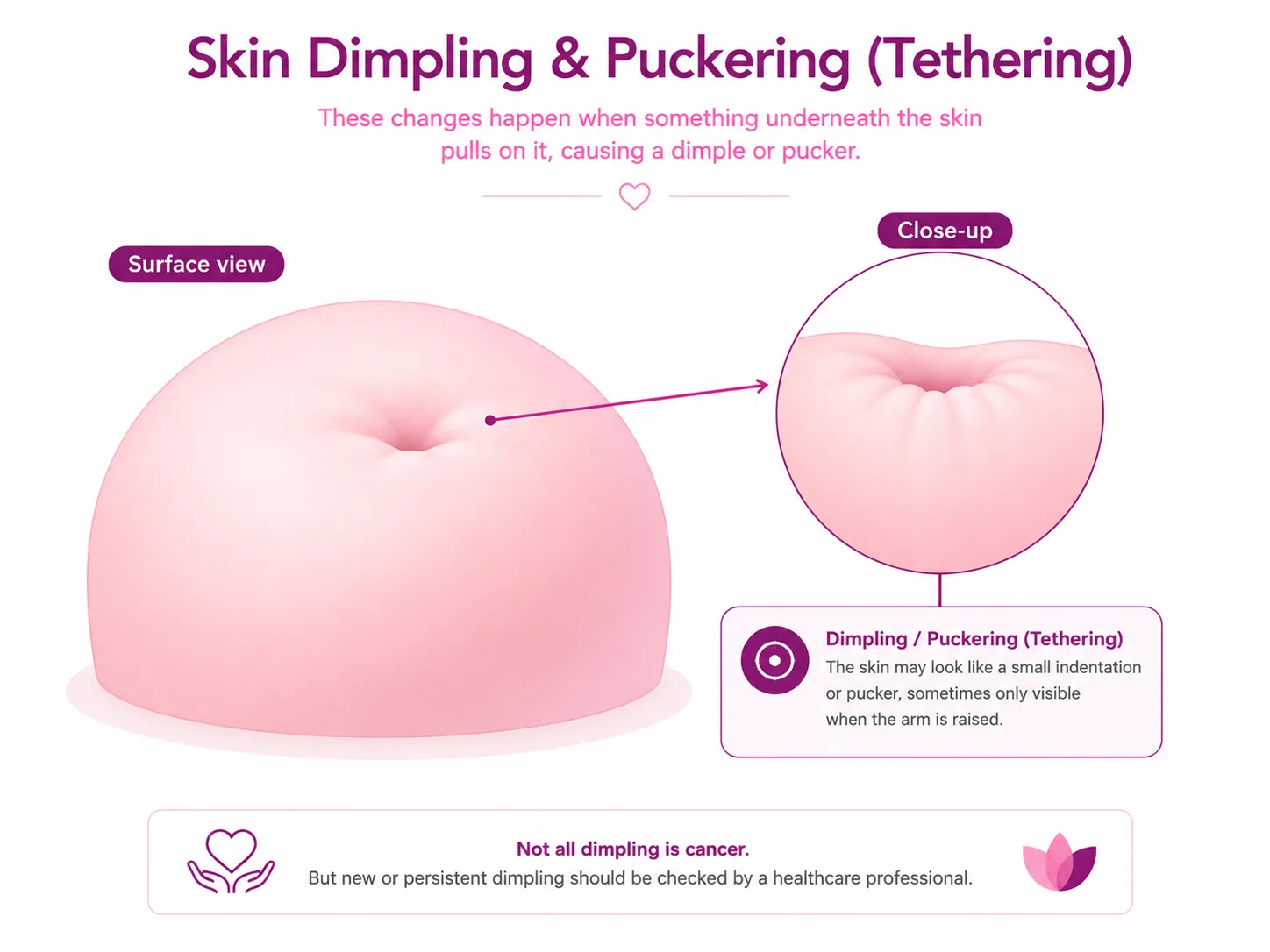
Skin is tethered inward over a fixed point, often most visible when you raise your arms or lean forward.
Pitted, thickened skin (peau d'orange) caused by blocked lymph channels, sometimes with redness or warmth.
Concerning dimpling tends to affect only one breast; symmetrical changes in both are far less likely to be cancer.
In India, more than half of breast cancers are diagnosed at an advanced stage, partly because skin changes like dimpling are watched at home instead of checked early. A new, persistent dimple is a reason to be seen, not to panic. Source: ICMR-NCRP / Indian Council of Medical Research, National Cancer Registry Programme.
No. Breast dimpling is not automatically a sign of cancer, and most causes are harmless. We mention the benign causes first on purpose, because worry helps no one and the calm, honest picture matters more than alarm. That said, only an examination can tell these apart, so the safe path is always to have a new change looked at rather than to assume.
When fatty tissue is bruised or damaged, it can scar and pull the skin into a firm dimple. It commonly follows an injury, a biopsy or surgery and is completely benign, though it can mimic cancer on imaging and sometimes needs a biopsy to confirm.
Scar tissue from a lumpectomy, biopsy, reduction or reconstruction can tether the skin and create a stable dimple over the scar line. If the dimple has been there since a past procedure and is not changing, it is usually nothing to worry about.
Lumpy, sometimes tender breast tissue that fluctuates with the menstrual cycle is very common and benign. The lumpiness can occasionally pull the skin slightly. Changes that come and go with your period are reassuring, but anything new and persistent still deserves a check.
Inflammation or infection, especially during breastfeeding, can cause swelling, redness and skin changes that resemble dimpling. This usually settles with treatment, but infection that does not improve must be re-examined to rule out inflammatory breast cancer.
A fixed inward pull on the skin from a tumour tugging Cooper's ligaments, often clearer on the arm-raise check.
Understanding breast lumps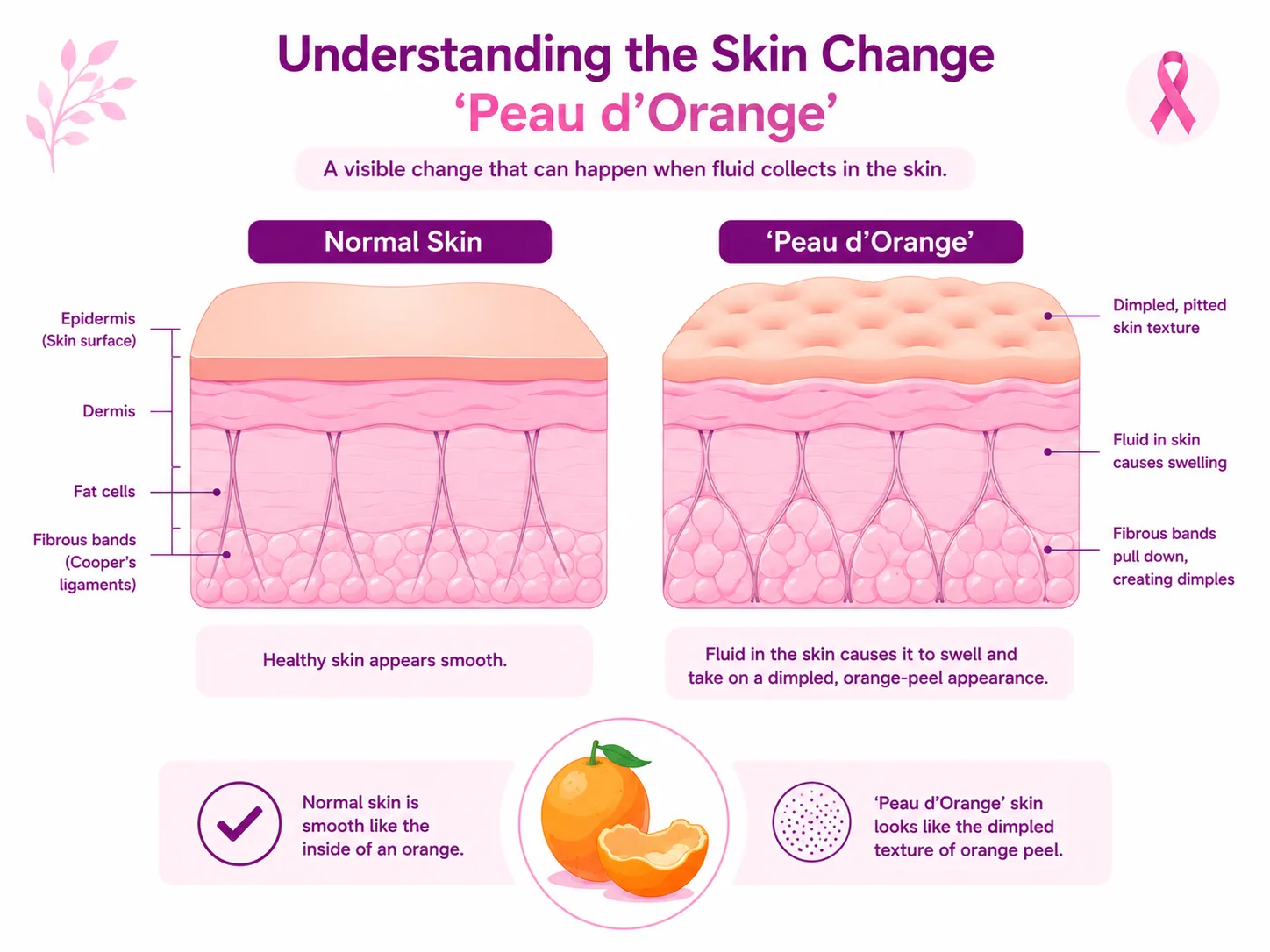
Pitted, swollen, orange-peel skin from blocked lymph channels, a hallmark of inflammatory breast cancer.
Orange-peel breast skin explained
Invasive ductal carcinoma, invasive lobular carcinoma and inflammatory breast cancer can all cause skin dimpling.
Inflammatory breast cancerBook your consultation today and clear the doubt.
You should not have to sit with “is this something?” for weeks. A CION breast specialist can see you the same day, examine the skin change with your arms raised, and tell you plainly whether it looks harmless or needs imaging — with the cost of any test given to you upfront.
Confidential. Your details are only used to contact you about your consultation.
You can check for dimpling at home in a few minutes. Do it once a month, a few days after your period when breasts are least tender. This is a self-awareness step, not a diagnosis, but it helps you notice change early and describe it clearly to a doctor.
Stand in front of a mirror with arms relaxed at your sides. A light source overhead casts gentle shadows that make any indentation or texture change easier to see.
Lifting your arms stretches the skin and reveals tethering. Watch whether both breasts move and rise smoothly and evenly. A spot that pulls in, dimples or does not move with the rest is the change to note.
Pressing firmly on your hips tightens the chest muscles and can make subtle puckering more obvious. Turn slowly side to side and check the lower curve and the area near the armpit.
Lie on your back with a pillow under one shoulder. Using the flat pads of the opposite hand, move in small circles over the whole breast and up into the armpit, feeling for lumps or thickened areas under any dimple.
Record where the change is, how long it has been there, and whether it is growing or changing with your cycle. A simple phone photo over time helps your doctor judge whether it is new.
Talk to our team
Call the helpline or leave your details, and someone will help you arrange a consultation at the CION centre nearest you. One helpline serves every CION centre.
Most breast dimples are harmless, but the only way to be sure is an expert evaluation. Call us on 1800-202-8726 or request a callback, we will guide your next step.
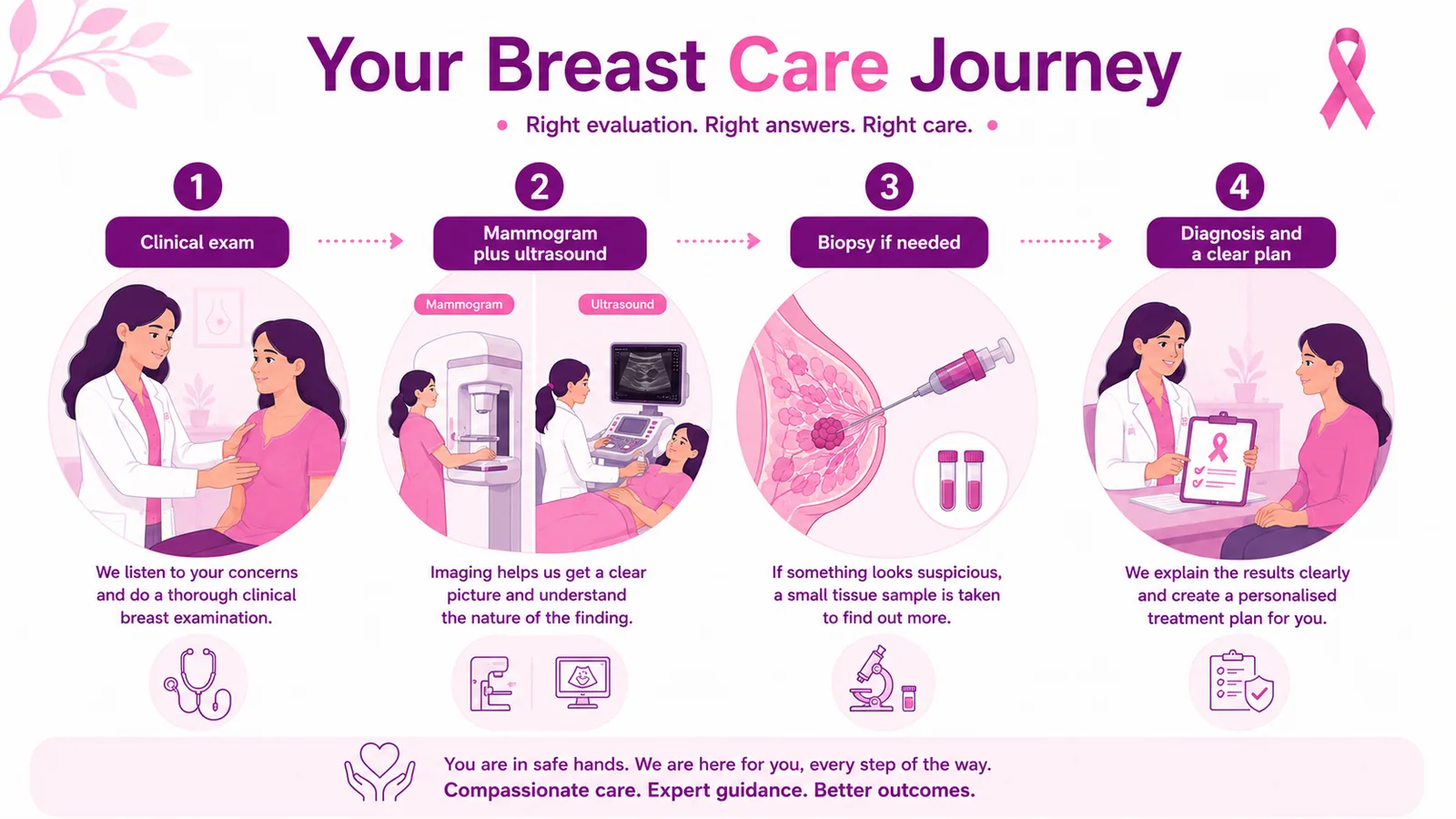
A specialist examines both breasts and the armpits, looks at the dimple with your arms raised, and checks the skin for tethering, redness, warmth or peau d'orange. Your history, including any past surgery, injury or breastfeeding, often explains a benign dimple straight away.
A mammogram images the breast tissue, and ultrasound is added, especially for younger or denser breasts, to look at any underlying mass and the lymph nodes. Note that inflammatory breast cancer can be present even when the mammogram looks normal, so the skin findings are weighed alongside the scans, not ignored.
If imaging or examination raises concern, a core needle biopsy takes a small tissue sample for the pathologist. For suspected inflammatory breast cancer a skin punch biopsy may be added. This is the definitive step that tells us whether cells are benign or cancerous, and what type.
At CION, every confirmed cancer case is reviewed by a tumour board, medical, surgical and radiation oncologists together, so the plan reflects a team's judgement rather than a single opinion. If the result is benign, you are simply reassured and guided on what to watch for.
A red, swollen, warm or orange-peel breast, particularly if it appears over days to weeks and does not settle with antibiotics, needs urgent assessment to rule out inflammatory breast cancer.
Any firm lump or area of thickening in the breast or armpit alongside the dimple should be examined promptly.
A nipple that newly turns inward, or any discharge that is not breast milk (especially if bloodstained), warrants a quick check.
A new dimple that persists beyond a normal menstrual cycle, enlarges, or appears without any past injury or surgery should not be watched indefinitely at home.
Every consultation lasts a full 45 minutes. No rushed decisions, no unnecessary tests, decisions made for healing, not billing.
Medical, surgical and radiation oncologists review each case together, so your plan is a team's judgement, not one doctor's opinion.
Clinical exam, mammogram, ultrasound and biopsy across 35+ centres in Telangana and AP, with up to 50% off on diagnostics.
96.9% CION 1-year breast-cancer survival vs 85.4% national*, backed by 150+ years of combined specialist experience.
*1-year survival. CION internal outcomes vs national average. Source: ICMR / National Cancer Registry Programme (NCRP).
Trained at AIIMS, Tata Memorial, and leading international centres. Combined 150+ years of experience. Every complex case is reviewed by 3+ of them — together.

MBBS(Gold Medal), DNB(General Medicine), DM(Medical Oncology)(Gold Medal)

MBBS, MD(General Medicine), DM(Medical Oncology)(Adyar,Chennai), ECMO, MRCP SCE(UK)

MBBS, MD (General Medicine), DrNB (Medical Oncology), ECMO, MRCP SCE (Medical Oncology) (UK)



MBBS (AIIMS), MS (Surgery) (AIIMS), DNB (Surgical Oncology), MRCS (Edinburgh)



MBBS, MS(General Surgery), M.Ch(Surgical Oncology), FMAS, FARIS(Ongoing)






MBBS, MS (General Surgery), DrNB (Surgical Oncology), FALS Oncology

Want a specific doctor for your case? Mention them when booking.
Book Free ConsultationShare your name and number — we'll call you back within 30 minutes to schedule your consultation.
Where to find us
Addressed by landmark, because that is how this city navigates. Each centre also names the areas it serves, so you can place it without a map. Consultation and day-care Chemotherapy run at every one of them.
Talk to our team
Call the helpline or leave your details, and someone will help you arrange a consultation at the CION centre nearest you. One helpline serves every CION centre.
Yes, and most of the time the cause is not cancer. Benign reasons for breast dimpling include fat necrosis (bruised or damaged fatty tissue), scar tissue from a previous biopsy, surgery or injury, fibrocystic breast changes that come and go with your period, and inflammation or infection such as mastitis. Because these can look similar to a cancer-related dimple, the only reliable way to tell them apart is a clinical examination and, if needed, imaging or a biopsy. New, persistent dimpling should always be evaluated, but a benign result is the more likely outcome.
There is no real difference, they describe the same skin change. Both refer to an indentation or pulling-in of the breast skin, where the surface looks dented, wrinkled or pitted instead of smooth. Some people use puckering for a finer, gathered look and dimpling for a single dent, but doctors treat the terms as the same finding. A related term is peau d'orange, meaning orange-peel skin, which describes a swollen, pitted texture caused by blocked lymph channels. Whatever you call it, a new and lasting change in your breast skin is worth having checked.
No. Dimpling is a symptom, not a diagnosis. While it can be an early sign of breast cancer, including inflammatory breast cancer, it is more often caused by harmless conditions such as fat necrosis, surgical scarring or fibrocystic change. Cancer-related dimpling tends to affect only one breast, persist or worsen over time, and may come with redness, warmth, a lump or nipple change. If both breasts show the same change, it is far less likely to be cancer. The safe approach is not to panic but to have any new dimpling evaluated by a specialist so you know for certain.
Yes. Skin dimpling can sometimes be the first visible sign of breast cancer, appearing before any lump is large enough to feel. This is because a small tumour can tether the internal Cooper's ligaments and pull the skin inward, or block lymph channels to cause orange-peel skin, while the tumour itself is still too deep or too small to detect by touch. Inflammatory breast cancer in particular may show skin changes without a distinct lump, and may not appear on a mammogram. That is why a new, unexplained dimple should be examined even if you cannot feel anything underneath it.
Dimpling that is linked to breast cancer almost always affects just one breast, in one specific spot. Changes that appear symmetrically in both breasts are much less likely to be cancer and are more often due to normal tissue, weight change or skin texture. That said, one-sided dimpling is not proof of cancer either, fat necrosis and surgical scars are also one-sided. The pattern simply guides the doctor. Any new, persistent dimple, on one side or both, is best evaluated so the cause can be confirmed rather than guessed.
Evaluation is stepwise. A specialist first does a clinical breast examination, looking at the dimple with your arms raised and feeling for lumps in the breast and armpit, and asks about any past surgery, injury or breastfeeding. If needed, a mammogram and ultrasound image the tissue underneath and the lymph nodes. The definitive step is a biopsy, where a small tissue sample is checked under a microscope; this is the only test that can confirm or rule out cancer. For suspected inflammatory breast cancer, a skin biopsy may be added because the mammogram can look normal. At CION, confirmed cancers are then reviewed by a tumour board before any treatment plan is made.
See a specialist quickly, rather than waiting, if your dimpling comes with redness, warmth or swelling of the breast, an orange-peel texture, a new lump in the breast or armpit, a nipple turning inward, or any discharge that is not breast milk. A breast that becomes red and warm over days to weeks and does not settle with antibiotics needs prompt assessment to rule out inflammatory breast cancer, which can progress fast. In India, more than half of breast cancers are still found at a late stage, so getting a changing breast checked early genuinely improves outcomes. You can reach CION on 1800-202-8726 to arrange a same-day consultation.
In most cases we can offer you a same-day appointment, so you are not left waiting and worrying, and the consultation itself lasts a full 45 minutes. A specialist examines your breast change, reviews your history, and explains whether it looks benign or needs imaging or a biopsy, with clear costs given upfront for any test recommended. We do not order unnecessary tests, and no decision is rushed. If everything is reassuring, you leave with guidance on what to watch for. If further evaluation is needed, examination, mammogram, ultrasound and biopsy are available together across our 35+ centres in Telangana and Andhra Pradesh, and every confirmed cancer is reviewed by our tumour board.
Browse our complete guide to breast cancer — types, symptoms, tests and treatments. Tap any topic to read more.