
NCCN-protocol care · 96.9% 1-yr breast cancer survival · ArogyaSri, CGHS & cashless insurance accepted · Free second opinion
1800 202 8726
Breast Diagnostics · Biopsy

Breast Biopsy: — Types, Procedure, Cost and Results

A breast biopsy is the only test that can confirm — or rule out — cancer for certain. A doctor removes a tiny sample of breast tissue so a pathologist can examine it under a microscope. Most biopsies are a short, day-care procedure done under local anaesthetic, and most results turn out non-cancerous. At CION Cancer Clinics in Hyderabad, every biopsy is image-guided for accuracy and reviewed by a tumor board — so you get a clear answer, not just a report. Your first consultation is free.

  • Day-care, local anaesthetic — A core needle biopsy is over in 15 to 20 minutes — you go home the same day, no general anaesthesia.
  • Image-guided accuracy — Ultrasound or mammographic guidance places the needle precisely on the target lesion.
  • Most results are benign — Around 75 to 80 percent of breast biopsies turn out to be non-cancerous — a biopsy brings clarity, not a verdict.
  • Tumor-board backed — Your pathology report is reviewed by our panel — no rushed decisions, no unnecessary tests.
4.8 · 800+ Google reviews · 15,000+ patients treated
Limited Slots Today

Talk to a Breast Specialist - Free

₹950   Today: FREE  ·  Including free written second opinion

Free 1st consultation for all cancer patients
Confidential, doctor-led - decisions for healing, not billing
Confidential. No commitment to start treatment.
or
Call 18002028726
17+
Cancer Specialists
on Panel
96.9%
Breast Cancer
Survival Rate*
15,000+
Patients
Treated
4.8★
Google Rating
(800+ reviews)
Start here

What a breast biopsy is and why it's needed

A breast biopsy is a procedure in which a doctor removes a small sample of tissue or cells from a suspicious area in the breast so that a pathologist can examine it under a microscope. It is the only test that can definitively confirm whether a breast change is cancer or not — a mammogram or ultrasound can point to a problem, but only a biopsy gives a certain answer.

Your doctor will recommend a biopsy when something needs to be checked closely: a lump you or a doctor can feel, a suspicious finding on a mammogram (such as a mass or microcalcifications), an abnormal area on a breast ultrasound or MRI (often a BI-RADS 4 or 5 result), persistent nipple discharge, or skin changes like dimpling or thickening.

It is important to keep this in perspective. Being sent for a biopsy is not a cancer diagnosis — about 75 to 80 percent of all breast biopsies turn out to be benign (non-cancerous). The purpose of the biopsy is to replace uncertainty with a clear answer, so that if treatment is needed it can start early, and if it is not needed you can be reassured for good.

The only definitive test

Scans can flag a concern, but only a biopsy confirms or rules out cancer for certain by examining the actual tissue.

Why it's recommended

A felt lump, microcalcifications, a BI-RADS 4 or 5 scan, persistent nipple discharge or skin changes all warrant a closer look.

Most turn out benign

About 75 to 80 percent of breast biopsies are non-cancerous — a biopsy most often replaces worry with reassurance.

Did you know?

Being referred for a breast biopsy is not a cancer diagnosis. Across breast clinics, roughly 75 to 80 percent of all breast biopsies turn out to be benign — non-cancerous. A biopsy exists to settle uncertainty: for most women it ends in reassurance, and for the minority who do have cancer, it enables an early, accurate diagnosis — the single biggest advantage for successful treatment. Source: NCCN guidelines / peer-reviewed breast-clinic data.

Choosing the right method

Types of breast biopsy

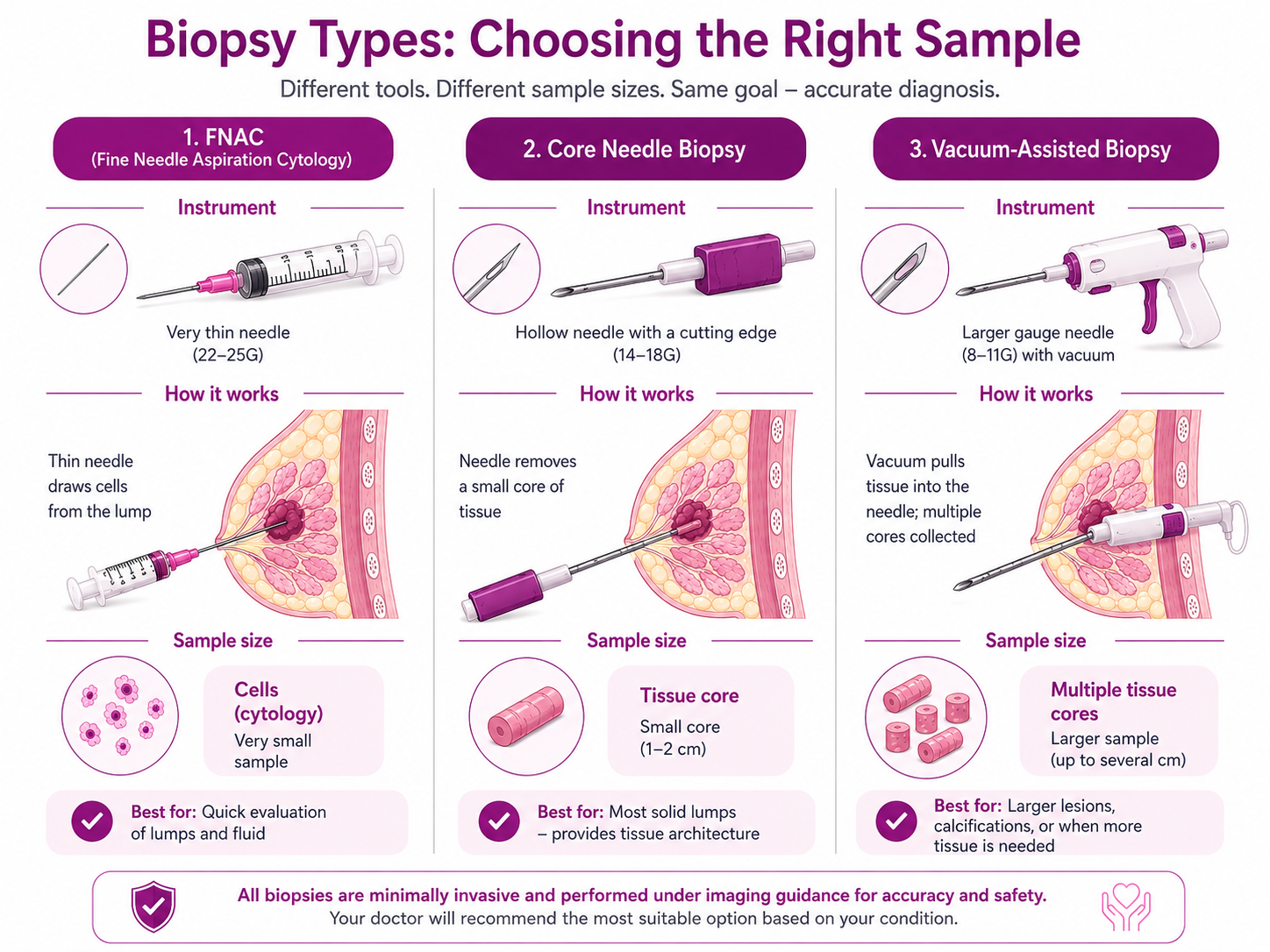
There is no single "breast biopsy" — the right method depends on the size, location and nature of the finding. Your specialist chooses the least invasive technique that will still give a reliable answer. These are the main types, from the simplest needle test to a surgical biopsy.

Core needle biopsy (CNB)

The most common and preferred method. A hollow needle removes one or more small cylinders (cores) of tissue, usually under ultrasound guidance and local anaesthetic. Because it samples actual tissue, not just cells, it can tell invasive from non-invasive cancer and allows ER, PR and HER2 testing — so it is the workhorse for diagnosing a breast lump.

Vacuum-assisted biopsy (VAB)

A gentle vacuum draws tissue into the needle, so several samples are collected through a single small insertion. It removes more tissue than a standard core needle, which improves accuracy for tricky targets like microcalcifications, and is often done under stereotactic (mammographic) or ultrasound guidance.

Excisional biopsy

A minor surgical procedure that removes the entire lump or abnormal area, sometimes with a margin of normal tissue. It is used when needle biopsies are inconclusive or when a lesion needs to be fully removed. It is done in an operating theatre, often under local or light sedation.

FNAC (fine needle aspiration cytology)

A very thin needle draws out cells (not a tissue core) for cytology. It is quick, low-cost and useful for draining a cyst or sampling an enlarged lymph node, but it cannot tell invasive from in-situ cancer — so for a solid breast lump a core needle biopsy is usually preferred over FNAC.

Step by step

How a core needle biopsy is done

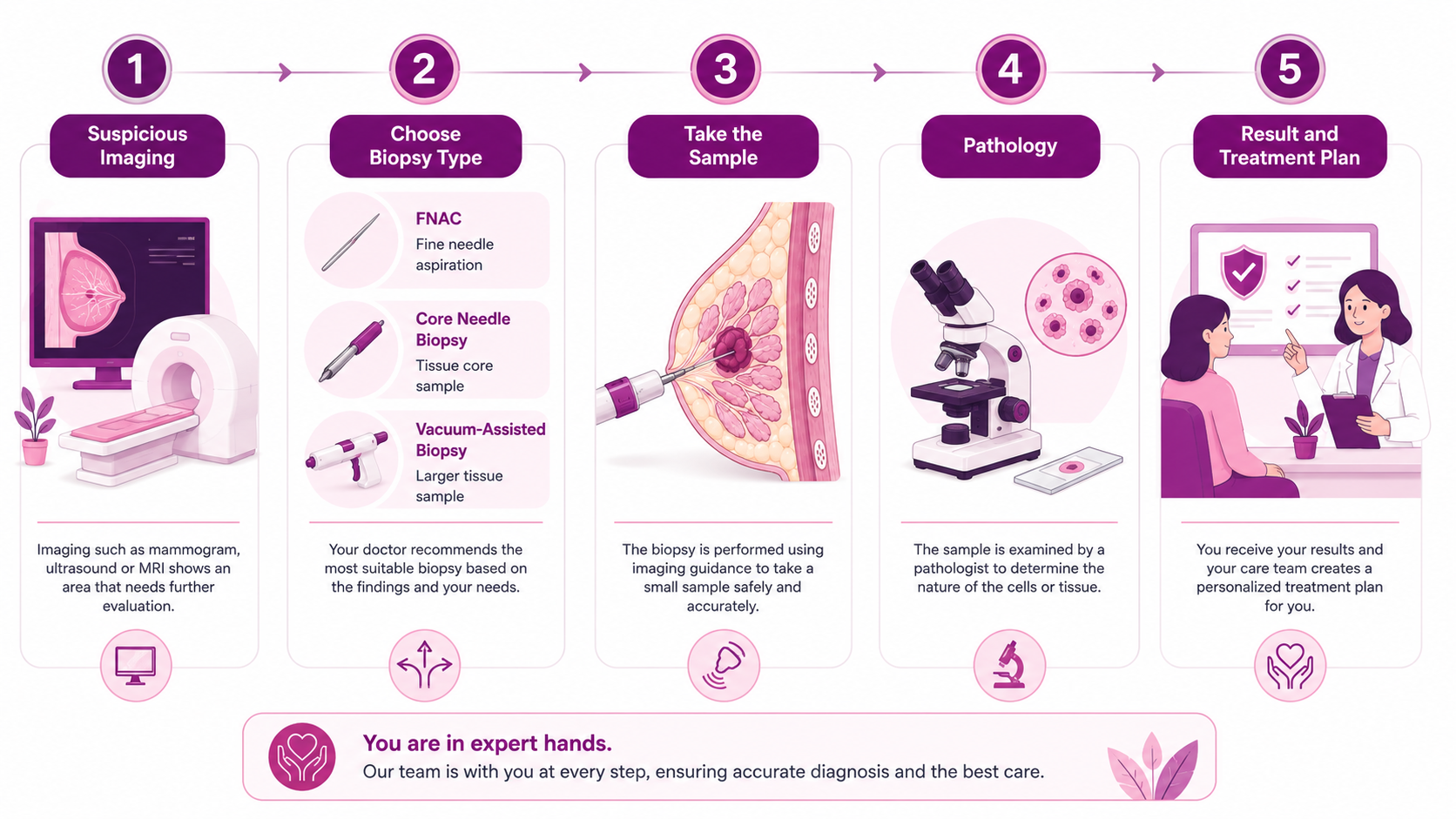
A core needle biopsy is a same-day procedure — there is no general anaesthesia, no overnight stay, and most people are back to normal the next day. The needle insertion itself takes only a minute or two; the whole appointment, including imaging, usually runs 30 to 60 minutes. Here is exactly what happens, step by step.

1

Positioning and imaging

You lie down and the radiologist uses ultrasound (or a mammogram for stereotactic biopsy) to locate the exact spot to be sampled and to guide the needle in real time.

2

Local anaesthetic

The skin and breast tissue over the target are numbed with a local anaesthetic injection. You stay fully awake, but the area is numb — you should feel pressure, not pain.

3

Taking the cores

A tiny nick is made in the skin and the biopsy needle is guided to the lesion. Several small cores of tissue are taken. You may hear a soft click or snapping sound from the spring-loaded device — this is normal.

4

Marker clip (if needed)

A tiny, painless titanium marker clip may be placed at the site so the exact spot can be found again later if treatment or further imaging is needed. It is harmless and stays in place.

5

Pressure, dressing and home

Pressure is applied to stop any bleeding, the small wound is closed with a steri-strip or small dressing (no stitches needed), and you rest briefly before going home. You can usually drive yourself if only local anaesthetic was used.
Been advised a breast biopsy? Get a clear, second opinion first.

Talk to a CION breast specialist in a free, 45-minute consultation. We'll review your scan or report and recommend only the biopsy you actually need - nothing more.

or
Call 18002028726

By submitting, you consent to be contacted by CION about your enquiry.

12+ Centres in Hyderabad · Pick yours

CION cancer care is closer than you think.

We're never more than 30 minutes away. Same panel of specialists at every centre. Same tumour board reviews. Same NCCN protocols. Pick the closest one and call directly — or let us pick for you.

Not sure which centre fits best? Tell us where you are — we'll suggest the closest one with the right specialists.

Help me pick the right centre
Beyond Hyderabad

35+ centres across Telangana & Andhra Pradesh

Travelling for treatment? We may have a centre right where you are.

Don't see your city? Call 18002028726 — we'll find your nearest CION partner centre.

Meet the Specialists

17+ senior cancer specialists. One panel for your case.

Trained at AIIMS, Tata Memorial, and leading international centres. Combined 150+ years of experience. Every complex case is reviewed by 3+ of them — together.

Dr. Naresh Gundu
Medical Oncologist

Dr. Naresh Gundu

MBBS, DNB (Internal Medicine), DM (Medical Oncology)

View Profile
Dr. C. Raghavendra Reddy
Medical Oncologist

Dr. C. Raghavendra Reddy

MBBS(Gold Medal), DNB(General Medicine), DM(Medical Oncology)(Gold Medal)

View Profile
Dr. Bharati Devi Gorantla
Medical Oncologist

Dr. Bharati Devi Gorantla

MBBS, MD(General Medicine), DM(Medical Oncology)(Adyar,Chennai), ECMO, MRCP SCE(UK)

View Profile
Dr. Owais Mohammed
Medical Oncologist

Dr. Owais Mohammed

MBBS, MD (General Medicine), DrNB (Medical Oncology), ECMO, MRCP SCE (Medical Oncology) (UK)

View Profile
Dr. T. Raghavender Reddy
Medical Oncologist

Dr. T. Raghavender Reddy

MBBS, DM (Medical Oncology), MD (Radiation Oncology)

View Profile
Dr. N. Kiranmayee
Medical Oncologist

Dr. N. Kiranmayee

MBBS, DM (Medical Oncology), MD (Internal Medicine)

View Profile
Dr. Muralidhar Muddusetty
Surgical Oncologist

Dr. Muralidhar Muddusetty

MBBS (AIIMS), MS (Surgery) (AIIMS), DNB (Surgical Oncology), MRCS (Edinburgh)

View Profile
Dr. Raghavendra Naik
Surgical Oncologist

Dr. Raghavendra Naik

MBBS, MS (General Surgery), M.Ch (Surgical Oncology)

View Profile
Dr. Mohammed  Imaduddin
Surgical Oncologist

Dr. Mohammed Imaduddin

M.B.B.S, MS (General Surgery), M.Ch (Surgical Oncology)

View Profile
Dr. Vinay Mamidala
Surgical Oncologist

Dr. Vinay Mamidala

MBBS, MS(General Surgery), M.Ch(Surgical Oncology), FMAS, FARIS(Ongoing)

View Profile
Dr. Paila Gowri Naidu
Surgical Oncologist

Dr. Paila Gowri Naidu

MBBS, MS (General Surgery), M.Ch (Surgical Oncology), FMAS

View Profile
Dr. Venkata Sushma P
Radiation Oncologist

Dr. Venkata Sushma P

MBBS, MD (Radiation Oncology)

View Profile
Dr. Kirti Ranjan Mohanty
Radiation Oncologist

Dr. Kirti Ranjan Mohanty

MBBS, MD (Radiation Oncology)

View Profile
Dr. Gangadhar Vajrala
Radiation Oncologist

Dr. Gangadhar Vajrala

MBBS, MD (Radiation Oncology), MPH

View Profile
Dr. Basudev Pokhrel
Hematologist

Dr. Basudev Pokhrel

MBBS, M.D (Immunohematology & Blood Transfusion)

View Profile
Dr. Mohammed Imran
Interventional Radiologist

Dr. Mohammed Imran

View Profile
Dr. Vajja Sandeep Kumar
Surgical Oncologist

Dr. Vajja Sandeep Kumar

MBBS, MS (General Surgery), DrNB (Surgical Oncology), FALS Oncology

View Profile
Dr. Sridhar Kamani
Surgical Oncologist

Dr. Sridhar Kamani

MBBS, MS (General Surgery), DrNB (Surgical Oncology)

View Profile

Want a specific doctor for your case? Mention them when booking.

Book Free Consultation

A lump, a suspicious scan, or a biopsy report to review? Take the first step today.

Confidential, doctor-led, and free for your first consultation. Call us on 1800-202-8726 or request a callback - we'll guide your next step.

Book Free Consultation Call 18002028726
Understanding your report

What the pathology report tells you (type, grade, ER/PR/HER2)

The pathology report is the heart of the biopsy — it turns a tissue sample into the information your team needs to plan care. If the result is benign, the report names the harmless condition (such as a fibroadenoma or fibrocystic change) and usually that is the end of it. If cancer is found, the report describes it in detail, and these details directly shape treatment. Here is what each part means, in plain language.

Benign or malignant

The first and most important line: is the tissue non-cancerous (benign) or cancerous (malignant)? Most reports are benign. A clear benign result means no cancer treatment is needed — though your doctor may still advise follow-up depending on the finding.

Invasive vs in-situ

If cancer is present, the report states whether it is in-situ (such as DCIS - ductal carcinoma in situ, contained within the duct and very treatable) or invasive (it has grown beyond the duct or lobule). This distinction is central to how the cancer is staged and treated.

Histologic type

The kind of cancer - most commonly invasive ductal carcinoma (IDC), which begins in a milk duct, or invasive lobular carcinoma (ILC), which begins in a milk-producing lobule. The type helps predict how the cancer tends to behave.

Grade (Nottingham, 1 to 3)

How abnormal the cells look and how fast they appear to be dividing. Grade 1 is slow-growing and looks close to normal tissue; grade 3 is faster-growing and more abnormal. Grade guides how aggressively the cancer is treated - it is not the same as stage.

ER and PR (hormone receptors)

Whether the cancer cells carry estrogen (ER) and progesterone (PR) receptors. If positive, the cancer is fuelled by these hormones - which is good news, because it means hormone (endocrine) therapy can be used as an effective, well-tolerated treatment.

HER2 status

Whether the cells over-produce the HER2 protein. HER2-positive cancers can grow faster but respond to powerful targeted anti-HER2 drugs. It is tested by IHC and, if borderline, confirmed by FISH - so a clear HER2 result is essential before treatment is planned.

Ki-67 proliferation index

An estimate of how many cells are actively dividing, given as a percentage. A higher Ki-67 (often above 30 percent) suggests a faster-growing tumour. It is one of several factors - alongside grade and receptor status - used to fine-tune the treatment plan.

Have a biopsy report to understand? Let a specialist explain it.

Share a few details and our team will call you to arrange your free, 45-minute consultation — with up to 50% off diagnostics and a tumor-board review of your report.

or
Call 18002028726

By submitting, you consent to be contacted by CION about your enquiry.

Pain, safety & recovery

Is a biopsy painful? Risks and recovery

This is the question most people worry about, and the honest answer is reassuring: a needle breast biopsy is not a painful procedure. Because the area is numbed with local anaesthetic, most patients describe feeling pressure rather than pain while the samples are taken. Tell your radiologist if you do feel any sharp pain — more anaesthetic can be given. Afterwards there may be mild soreness, easily managed with paracetamol.

Breast biopsy is a very safe, low-risk procedure, but like any procedure it has minor risks worth knowing about.

Bruising and soreness

The most common after-effects. Core needle biopsies bruise more than fine needle ones, and a bruise can take a couple of weeks to fade. Soreness usually settles within a day or two.

Minor bleeding

A small amount of bleeding at the site is normal and stops with brief pressure. A larger collection of blood (haematoma) is uncommon and usually resolves on its own.

Low infection risk

Infection is rare because the wound is tiny. Keeping the dressing clean and dry as advised keeps the risk very low; tell your team if the area becomes red, hot or increasingly painful.

Recovery and activity

Most people return to normal activities the same or next day. After a core needle biopsy it is sensible to avoid strenuous activity, heavy lifting and vigorous exercise for about 48 hours to limit bruising.

Does a biopsy spread cancer?

No. This is a common and understandable fear, but it is not supported by evidence. Modern biopsy techniques are safe and do not cause cancer to spread — and delaying a needed biopsy is far riskier than having one.

The waiting time

How long results take

Waiting for results is often the hardest part, so it helps to know the timeline. For a routine breast biopsy, the pathology report is usually ready in about 3 to 7 days — sometimes sooner. The reason it is not instant is that the tissue has to be carefully processed, stained and examined by a pathologist; rushing this step risks an inaccurate answer, and getting it right matters more than getting it fast.

Some results take a little longer for good reason. If special tests are needed — such as immunohistochemistry (IHC) for ER, PR and HER2, or molecular and FISH testing — these add a few days because they are run as a second stage on a confirmed cancer. A clear, complete report that includes receptor status is far more useful for planning treatment than a quick, partial one.

At CION, we believe waiting in silence is not acceptable. Your report is not simply handed over — it is reviewed by our tumor board and explained to you by a specialist, so you understand exactly what it means and what the next step is. If anything is urgent, we fast-track it.

Transparent costs

Breast biopsy cost in Hyderabad

Cost is a fair and common question, and we believe in answering it openly. In Hyderabad, a breast biopsy typically costs between Rs. 3,500 and Rs. 15,000, depending on the type of biopsy, whether image guidance is used, and the pathology testing required. As a rough guide, a core needle biopsy sits at the lower end, while a vacuum-assisted or surgical (excisional) biopsy costs more because it involves more equipment or theatre time.

Two things are worth knowing. First, the histopathology (lab analysis) is usually charged separately from the procedure — and special tests like ER/PR/HER2 immunohistochemistry add to that. Second, the cheapest option is not always the right one: an accurate, complete result the first time avoids the cost and delay of a repeat. We practise transparent costs and no unnecessary tests — you will know what your biopsy involves and why before you commit to anything.

Transparent pricing

A clear, up-front cost for the biopsy and the pathology — no hidden add-ons, no tests you don't need.

Up to 50% off diagnostics

Concessional diagnostic pricing for cancer patients, with expert-reviewed pathology reporting.

Insurance & cashless

Cashless private insurance and EMI support available — our team helps you with the paperwork.

Free first consultation

Your first consultation is free, so you can understand your options and costs before deciding.

Free first consultation

CION image-guided biopsy + free consultation

A biopsy is only as good as the accuracy of the sample and the team that reads it. At CION Cancer Clinics, every breast biopsy is image-guided — ultrasound or stereotactic guidance places the needle exactly on the target — so we sample the right tissue the first time and reduce the chance of a repeat. The pathology is then reviewed by our tumor board, where medical, surgical and radiation oncologists look at your case together. That means decisions made by a team, not a single opinion, explained to you in an unhurried 45-minute consultation.

As a woman-headed organisation, breast and women's-health care sits at the heart of what we do, and our outcomes reflect it. CION patients see a 1-year breast cancer survival of 96.9 percent versus the national average of 85.4 percent — an 11.5 percentage-point difference.* If your biopsy is benign, we will tell you clearly and reassure you. If it shows cancer, we will walk every step of the path with you — calmly, transparently, and together.

150+ years combined experience

A panel of 17 super-specialist oncologists across medical, surgical and radiation oncology.

Tumor board for every patient

Complex cases reviewed by 3+ specialists together — not one doctor's opinion.

35+ centres, 15,000+ patients

A trusted network across Telangana and AP, rated 4.8/5 by patients on Google.

Decisions for healing, not billing

No unnecessary tests, transparent costs, and a free first consultation for all cancer patients.

*1-year survival. Source: ICMR / National Cancer Registry Programme (NCRP), compared with CION patient outcomes. CION figures are network outcomes; national figures are population averages and do not predict an individual's result.
Real patients, real outcomes

Women who trusted CION for clarity and care

From a worrying lump to a clear diagnosis and full breast cancer care - hear how our patients were guided with honesty, not pressure.

Book Free Consultation Call 18002028726
Real Stories. Real Voices.

15,000+ patients chose CION. Hear from them directly.

These aren't paid endorsements or written reviews. These are video testimonials from real patients and families — recorded on their own phones, in their own words. Pick any one. Watch it. Then decide.

4.8★800+ Google reviews
50+video testimonials
15,000+patients treated
Successful Chemotherapy Done by Dr. C Raghavendra Reddy

Successful Chemotherapy Done by Dr. C Raghavendra Reddy

Watch video →
Surgery, Chemo & Radiation Done by  Dr. Imaduddin, Dr. Vinay, Dr. Owais, Dr. Kirti

Surgery, Chemo & Radiation Done by Dr. Imaduddin, Dr. Vinay, Dr. Owais, Dr. Kirti

Watch video →
 Successful Radical Thymectomy Done by  Dr. Mohammed Imaduddin & Dr. Vinay Mamidala

Successful Radical Thymectomy Done by Dr. Mohammed Imaduddin & Dr. Vinay Mamidala

Watch video →
Successful Surgery Done  by Dr. Rajender Byshetty

Successful Surgery Done by Dr. Rajender Byshetty

Watch video →
Successful Chemo & Surgery Done by  Dr. Imad, Dr. Vinay, Dr. Owais & Dr. Raghavendra

Successful Chemo & Surgery Done by Dr. Imad, Dr. Vinay, Dr. Owais & Dr. Raghavendra

Watch video →
Successful Chemo & Surgery Done by  Dr. Imad, Dr. Vinay, Dr. Owais & Dr. Raghavendra

Successful Chemo & Surgery Done by Dr. Imad, Dr. Vinay, Dr. Owais & Dr. Raghavendra

Watch video →
Successful Chemo & Radiation Done by Dr. Owais Mohammed & Dr. Kirti Ranjan Mohanty

Successful Chemo & Radiation Done by Dr. Owais Mohammed & Dr. Kirti Ranjan Mohanty

Watch video →
Successful Breast Cancer Surgery Done by Dr. Imaduddin Mohammed & Dr. Vinay Mamidala

Successful Breast Cancer Surgery Done by Dr. Imaduddin Mohammed & Dr. Vinay Mamidala

Watch video →
Successful Chemotherapy Done by Dr. Bharati Devi Gorantla

Successful Chemotherapy Done by Dr. Bharati Devi Gorantla

Watch video →
Successful Chemo & Surgery Done by Dr. Owais Mohammed & Dr. Imaduddin Mohammed

Successful Chemo & Surgery Done by Dr. Owais Mohammed & Dr. Imaduddin Mohammed

Watch video →
Successful Chemotherapy Done by Dr. Gundu Naresh

Successful Chemotherapy Done by Dr. Gundu Naresh

Watch video →
Successful Bone Marrow Transplantation - Neuroblastoma

Successful Bone Marrow Transplantation - Neuroblastoma

Watch video →
Successful Surgery & Chemo - Carcinoma of Caecum

Successful Surgery & Chemo - Carcinoma of Caecum

Watch video →
Successful Oral chemotherapy & mastectomy surgery

Successful Oral chemotherapy & mastectomy surgery

Watch video →
Successful Oral chemotherapy & mastectomy surgery

Successful Oral chemotherapy & mastectomy surgery

Watch video →
Successful Chemotherapy

Successful Chemotherapy

Watch video →
Successful Surgery by Dr. Mohammed Imaduddin

Successful Surgery by Dr. Mohammed Imaduddin

Watch video →
Successful Bone Marrow Transplantation

Successful Bone Marrow Transplantation

Watch video →
Successful Oral chemotherapy & mastectomy surgery

Successful Oral chemotherapy & mastectomy surgery

Watch video →
Successful Oral chemotherapy & mastectomy surgery

Successful Oral chemotherapy & mastectomy surgery

Watch video →
Successful Chemotherapy

Successful Chemotherapy

Watch video →
Successful Buccal Mucosa Surgery

Successful Buccal Mucosa Surgery

Watch video →
Successful Complex Surgery Mandibulectomy Reconstruction

Successful Complex Surgery Mandibulectomy Reconstruction

Watch video →
Common questions

Breast biopsy — your questions answered

Is a breast biopsy painful?

No, a needle breast biopsy is not painful. The area is numbed with a local anaesthetic injection, so during the procedure most people feel pressure rather than pain. You stay awake and can tell the radiologist if you feel any sharp sensation, in which case more anaesthetic is given. Afterwards there may be mild soreness and some bruising for a few days, which is easily managed with simple painkillers like paracetamol. A surgical (excisional) biopsy involves a small cut and may use sedation, but it too is designed to keep you comfortable throughout.

How long do breast biopsy results take?

For a routine breast biopsy, the pathology report is usually ready within about 3 to 7 days, and sometimes sooner. The tissue has to be carefully processed, stained and examined by a pathologist, which cannot be safely rushed. If special tests are needed — such as ER, PR and HER2 immunohistochemistry, or FISH and molecular testing on a confirmed cancer — these add a few more days. At CION, your report is reviewed by our tumor board and explained to you by a specialist rather than simply handed over, and anything urgent is fast-tracked.

What is the difference between a core needle biopsy and FNAC?

A core needle biopsy (CNB) uses a hollow needle to remove small cylinders of actual tissue, while FNAC (fine needle aspiration cytology) uses a very thin needle to draw out individual cells. The key difference is that a core needle biopsy samples intact tissue, so it can tell invasive cancer from non-invasive (in-situ) disease and allows ER, PR and HER2 testing. FNAC is quicker and cheaper and is useful for draining a cyst or checking a lymph node, but for diagnosing a solid breast lump, a core needle biopsy is usually preferred because it gives more complete and reliable information.

Does a breast biopsy spread cancer?

No. This is a very common worry, but it is not supported by medical evidence. Modern biopsy techniques are safe and do not cause cancer to spread through the body. In fact, delaying or refusing a recommended biopsy is far riskier, because it can delay a diagnosis and the start of effective treatment. A biopsy simply removes a tiny sample so doctors can identify exactly what they are dealing with. The benefit of an accurate, early diagnosis vastly outweighs this unfounded fear.

How much does a breast biopsy cost in Hyderabad?

In Hyderabad, a breast biopsy typically costs between Rs. 3,500 and Rs. 15,000, depending on the type of biopsy, whether image guidance is used, and the pathology testing required. A core needle biopsy is usually at the lower end, while vacuum-assisted and surgical biopsies cost more. The histopathology (lab analysis) is generally charged separately, and special tests such as ER/PR/HER2 add to the total. At CION we keep costs transparent and offer up to 50 percent off diagnostics for cancer patients, with expert-reviewed reports. Your first consultation is free — request a callback for an exact estimate.

What does my breast biopsy pathology report mean?

The report first states whether the tissue is benign (non-cancerous) or malignant. Most are benign. If cancer is found, the report describes whether it is in-situ or invasive, the histologic type (such as invasive ductal carcinoma), the grade (1 to 3, how aggressive it looks), and the receptor status — ER, PR and HER2 — which decides whether hormone therapy or targeted anti-HER2 therapy will help. It may also include a Ki-67 score showing how fast cells are dividing. These details together guide your personalised treatment plan, which is why our team explains every part of the report to you.

Is a biopsy a day-care procedure, and can I drive home afterwards?

Yes, a needle breast biopsy is a day-care procedure. It is done under local anaesthetic, takes only 15 to 20 minutes for the needle part, and you go home the same day with no overnight stay. If only local anaesthetic was used, you can usually drive yourself home. If you are given sedation — more common with a surgical biopsy — you should arrange for someone to drive you. It is sensible to avoid strenuous activity and heavy lifting for about 48 hours afterwards to limit bruising, but most people return to normal life the same or next day.

How do I prepare for a breast biopsy?

Preparation is usually simple. For a needle biopsy under local anaesthetic you do not normally need to fast. Tell your doctor about all medicines you take, especially blood thinners such as aspirin or warfarin, as you may be advised to pause them for a few days beforehand. On the day, avoid applying deodorant, powder, lotion or perfume to the breast and underarm, and wear a comfortable two-piece outfit and a supportive bra. If sedation or general anaesthesia is planned for a surgical biopsy, you will be told how long to fast. Your CION team will give you exact instructions for your specific procedure.

Will I definitely have cancer if I'm sent for a breast biopsy?

No. Being referred for a breast biopsy does not mean you have cancer. It simply means a finding needs to be checked to be certain. In fact, around 75 to 80 percent of all breast biopsies turn out to be benign — that is, non-cancerous. Doctors recommend a biopsy because imaging and examination alone cannot give a definite answer, and the only responsible step is to confirm one way or the other. For most women, a biopsy ends in reassurance. For the minority who do have cancer, an early, accurate diagnosis is the single best advantage for successful treatment.

Call now Book free consultation
















