

Medical Oncologist
Feeling a lump in your armpit? Here's the reassuring reality —
most armpit lumps are not cancer, usually just a lymph node reacting
to an infection. But a hard, fixed or persistent lump —
especially with a breast lump — does deserve a check.
The armpit contains a cluster of lymph nodes — small, bean-shaped glands that are part of your immune system. Their job is to filter fluid and fight infection, and they swell whenever there is something to fight nearby: a sore throat, a cut or infection on the hand or arm, a skin condition, or an infection in the breast. So the most common reason for a tender armpit lump is simply a reactive lymph node — a normal, temporary response that usually settles within a couple of weeks once the trigger clears.
Other harmless causes include a blocked or infected sweat gland or hair follicle, a cyst, or a benign fatty lump (lipoma). Because the armpit nodes are also the first place breast cancer tends to spread, a lump that is hard, fixed, painless, growing, or accompanied by a breast lump deserves prompt evaluation — but for most people, the answer turns out to be reassuringly ordinary. Including the armpit in your breast self-exam helps you notice changes early.
A tender, mobile node that came on with a cold, cut or skin infection is the typical, benign picture — and usually settles within a couple of weeks.
The armpit nodes drain the breast, so they are always checked alongside it — and they matter for breast cancer staging if cancer is found.
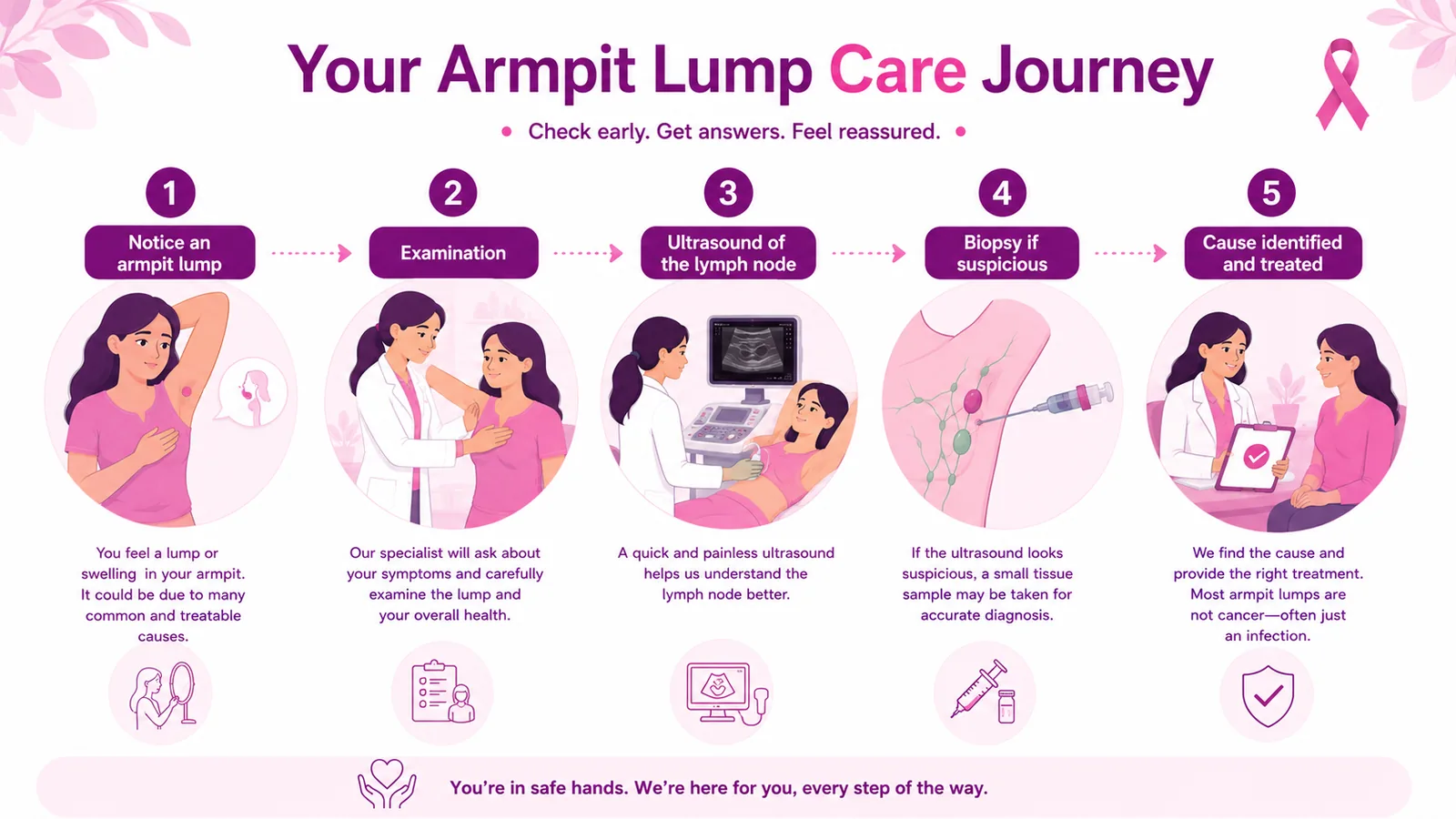
An examination and an ultrasound of the armpit usually clarify the cause quickly, with a needle test added only when a node looks abnormal.
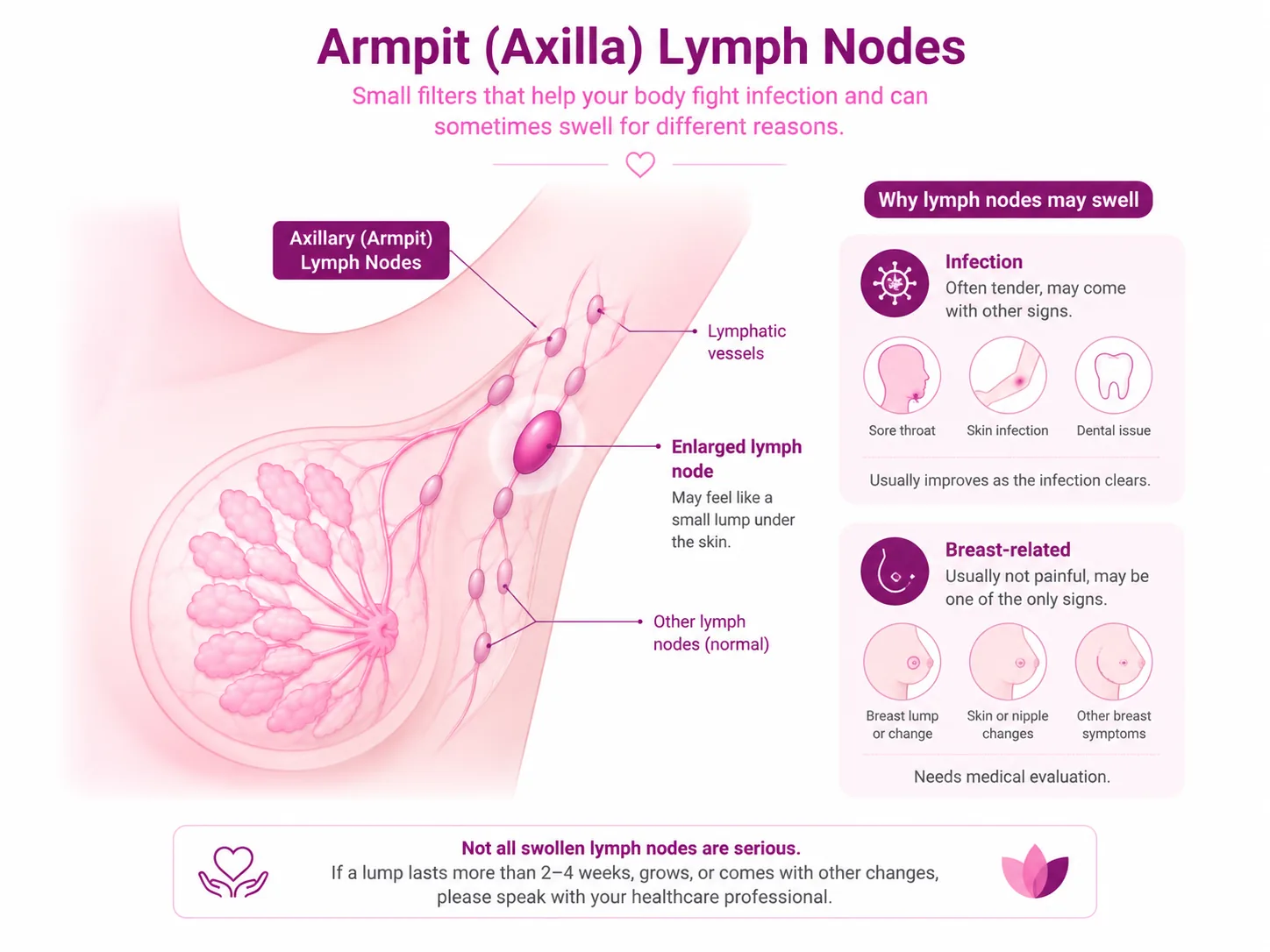
The armpit (axillary) lymph nodes are the first place breast cancer usually spreads to — which is exactly why they are examined alongside the breast and why, when breast cancer is diagnosed, the nodes are assessed to determine the stage. It is also why a temporary, tender armpit swelling after a vaccination or a minor arm infection is so common and harmless: those same nodes are simply doing their immune job. Source: NCCN Breast Cancer guidance; AJCC staging.
Most armpit lumps have an everyday explanation. Knowing the common benign causes helps put a new lump in perspective — though, as always, a hard, fixed or persistent lump should still be confirmed.
A node swollen in response to an infection somewhere it drains — the arm, hand, breast, chest or even a sore throat. Usually tender, soft-to-firm and mobile, and it settles within a couple of weeks as the infection clears.
An infected hair follicle, a boil, or a blocked sweat gland (hidradenitis) can form a tender lump in the armpit skin. These are benign and treated as skin or infection problems, not as breast disease.
A harmless fluid-filled cyst or a soft, movable fatty lump (lipoma) can occur in the armpit. Both are benign and confirmed with imaging, then simply monitored or removed if they bother you.
A tender, swollen armpit node is a well-recognised, temporary reaction after some vaccinations (typically on the same side as the injection). It reflects a healthy immune response and settles on its own within a few weeks.
Some women have a small amount of extra breast tissue in the armpit. It can become more noticeable around periods, pregnancy or breastfeeding — usually benign, but a new lump within it is checked like any other.
Less commonly, an armpit node is enlarged by breast cancer spreading to it, or by lymphoma or another cancer. This is the group that examination, imaging and a needle test are designed to identify early.
No single feature proves what a lump is, but some characteristics make an armpit lump more concerning and mean you should get it checked rather than wait. A tender lump that came with an obvious infection and settles within two weeks is usually fine; the features below point the other way.
Understanding why the armpit matters in breast cancer takes the mystery out of why your doctor always checks it. The armpit (axillary) nodes are the breast's main drainage point, so they are central both to diagnosis and to working out the stage of any breast cancer.
Lymph fluid from the breast flows first to the armpit nodes. That is why breast cancer, if it spreads beyond the breast, tends to reach these nodes first — and why the armpit is examined whenever the breast is.
Occasionally a swollen armpit node is the first sign of a breast cancer that is too small to feel. This is why an unexplained, persistent armpit node prompts a careful look at the breast as well, including imaging.
If breast cancer is diagnosed, whether and how many armpit nodes are involved is a key part of staging — it influences treatment decisions and is one of the most important pieces of information in the plan.
To assess the nodes accurately with minimal surgery, a sentinel lymph node biopsy samples the first one or two nodes the breast drains to — sparing the rest when they are clear and reducing the risk of lymphedema.
Because the armpit is so closely tied to the breast, it deserves evaluation by a team that understands both. CION is a woman-headed, tumour-board-led organisation that assesses the armpit and breast together — reassuring the many and finding the few early.
Talk to our team
Call the helpline or leave your details, and someone will help you arrange a consultation at the CION centre nearest you. One helpline serves every CION centre.
Woman-led assessment of the armpit and breast together across 35+ centres in Telangana & AP. Most armpit lumps are benign — let's confirm yours. Call 1800-202-8726.
An armpit lump is assessed step by step, starting with the simplest. The same careful approach used in any breast diagnosis applies here — examination, imaging, and a needle test only when needed — and because the armpit drains the breast, the breast is examined too. The aim is a quick, reassuring answer for most people, with thorough investigation reserved for nodes that look abnormal.
If an armpit lump does turn out to be linked to breast cancer, the armpit nodes become an important part of working out the stage and the right treatment. Modern surgery is designed to get this information with the least possible harm. Here is how it works.
Whether cancer has reached the armpit nodes, and how many are involved, is a key part of the stage. It helps decide whether chemotherapy, radiation or other treatments are recommended after surgery.
Rather than removing all the armpit nodes, surgeons identify and sample the first one or two nodes the breast drains to — the "sentinel" nodes. If they are clear, the rest are usually left alone. Learn more on the sentinel node biopsy page.
Sampling only the sentinel nodes, when appropriate, spares healthy nodes and substantially lowers the risk of lymphedema (long-term arm swelling) compared with removing all the armpit nodes.
How the nodes are managed is decided by the tumour board, based on imaging, biopsy results and the rest of your situation — so the approach is tailored, not one-size-fits-all.
Most armpit lumps are benign and many settle on their own, so there is no need to panic. But some situations call for a prompt check rather than waiting. If any of these apply, book sooner rather than later.
You don't have to keep wondering about an armpit lump. CION offers a clear, woman-led pathway that assesses the armpit and breast together and turns concern into a confident answer — usually reassurance — with your first consultation free.
A specialist asks about infections and other clues, examines the armpit, arm and both breasts, and explains what is most likely — calmly and without rushing.
A same-visit scan, with up to 50% discounts on diagnostics, shows whether a node looks reactive or abnormal — confirming a benign cause for most people.
If a node looks abnormal, a quick sample gives a definite answer — reserved for the lumps that genuinely require it.
For most people the answer is a reactive node or a benign cause. For the few where it's breast-cancer-related, a tumour board sets the staging and plan immediately.
Trained at AIIMS, Tata Memorial, and leading international centres. Combined 150+ years of experience. Every complex case is reviewed by 3+ of them — together.

MBBS(Gold Medal), DNB(General Medicine), DM(Medical Oncology)(Gold Medal)

MBBS, MD(General Medicine), DM(Medical Oncology)(Adyar,Chennai), ECMO, MRCP SCE(UK)

MBBS, MD (General Medicine), DrNB (Medical Oncology), ECMO, MRCP SCE (Medical Oncology) (UK)



MBBS (AIIMS), MS (Surgery) (AIIMS), DNB (Surgical Oncology), MRCS (Edinburgh)



MBBS, MS(General Surgery), M.Ch(Surgical Oncology), FMAS, FARIS(Ongoing)






MBBS, MS (General Surgery), DrNB (Surgical Oncology), FALS Oncology

Want a specific doctor for your case? Mention them when booking.
Book Free ConsultationShare your name and number — we'll call you back within 30 minutes to schedule your consultation.
Where to find us
Addressed by landmark, because that is how this city navigates. Each centre also names the areas it serves, so you can place it without a map. Consultation and day-care Chemotherapy run at every one of them.
Talk to our team
Call the helpline or leave your details, and someone will help you arrange a consultation at the CION centre nearest you. One helpline serves every CION centre.
No — most armpit lumps are not cancer. The armpit is full of lymph nodes that swell whenever the body fights an infection, so the commonest cause is a reactive lymph node from something like a cold, a cut or infection on the arm or hand, a skin condition, a breast infection, or a recent vaccination. Other benign causes include cysts, fatty lumps (lipomas) and infected sweat glands. Cancer-related armpit lumps are the minority. However, because the armpit nodes are the first place breast cancer tends to spread, a hard, fixed, painless or persistent lump — especially with a breast change — should be checked.
Get a prompt check if the lump is hard, fixed in place or painless; if it persists beyond two to three weeks or keeps growing; if there is no infection or vaccination to explain it; if you also have a breast lump, skin dimpling or a nipple change; if several nodes are enlarged or you also have swollen glands in the neck or groin; or if you have unexplained fever, drenching night sweats or weight loss. Concern is also higher with increasing age, after menopause, and if you carry a BRCA mutation or have a strong family history. A tender lump that came with an obvious infection and settles within two weeks is usually benign.
A reactive lymph node — the most common cause — usually starts to shrink within a week or two once the underlying infection clears. As a general rule, an armpit lump that lasts longer than about two to three weeks, or that is growing rather than settling, should be assessed. You do not need to wait that long if the lump has worrying features from the start — such as being hard, fixed or painless, or appearing alongside a breast lump or change. In those situations, get it checked promptly rather than watching and waiting.
It can be, though it usually is not. The armpit (axillary) nodes are the breast's main drainage point and the first place breast cancer tends to spread, so an enlarged armpit node is taken seriously and the breast is always examined alongside it. Occasionally a swollen armpit node is the first sign of a breast cancer too small to feel, which is why an unexplained, persistent node prompts breast imaging as well. That said, the great majority of swollen armpit nodes are reactive — caused by infection — and benign. The way to tell is examination, ultrasound and, if a node looks abnormal, a needle test.
An armpit lump is evaluated in steps. First, the specialist takes a history (recent infections, vaccinations, how long the lump has been there, whether it is tender) and examines the armpit, the arm it drains and both breasts. Next, an ultrasound of the armpit shows whether a node looks reactive (benign) or abnormal, and checks the breast; a mammogram may be added depending on your age. If a node looks suspicious on imaging, a quick needle test (FNAC or core biopsy) confirms exactly what it is. For most people, examination and ultrasound give a reassuring answer without any biopsy.
A sentinel lymph node biopsy is a way of checking the armpit nodes in breast cancer with the least possible surgery. The breast drains first to one or two specific "sentinel" nodes, and the surgeon identifies and samples just those. If they are clear of cancer, the remaining armpit nodes are usually left in place, which substantially reduces the risk of lymphedema (long-term arm swelling) compared with removing all the nodes. Whether the sentinel nodes contain cancer is a key part of staging and guides treatment decisions. It is one of the most important advances in making breast cancer surgery gentler while still accurate.
Yes. Men have armpit lymph nodes too, and the same benign causes apply — reactive nodes from infection, cysts, lipomas and infected sweat glands are common and harmless. As with women, the lumps to get checked are those that are hard, fixed, painless or persistent, that have no clear infection to explain them, or that come with other symptoms such as unexplained fever, night sweats or weight loss. Persistent or unexplained nodes are evaluated the same way in men — examination, ultrasound and, if needed, a needle test — to identify the cause and rule out lymphoma or other conditions.
Yes. CION offers a free first consultation for all cancer patients, including people who have found an armpit lump and want it assessed. It is a full 45-minute consultation — a specialist examines the armpit, arm and both breasts, arranges an ultrasound of the armpit (and breast imaging if needed), and only recommends a needle test if a node looks abnormal. Because the armpit and breast are closely linked, both are assessed together so nothing is missed. CION offers up to 50% discounts on diagnostics, and most people leave with reassurance. Book on 1800-202-8726 or request a callback through the form on this page.
Browse our complete guide to breast cancer — types, symptoms, tests and treatments. Tap any topic to read more.