A duodenectomy removes the duodenum — the first part of the small intestine — to treat a tumour or growth there. Here is the hopeful part many people don’t realise: because the duodenum wraps around the pancreas, a growth at the ampulla usually needs a Whipple, but when the disease is away from there, surgeons can often remove the duodenum while keeping the pancreas — a smaller operation with an easier recovery. And many duodenal growths are not even cancer. At CION it is done by an experienced HPB team.
Pancreas kept where the growth allows it — a smaller operation than a Whipple
An honest, scan-based answer on which operation you actually need
Clear indicative costs & Aarogyasri help
★★★★★Rated 4.8/5 · 800+ Google reviews
Pancreas-sparing where possible
Whipple-capable HPB team
Honest, scan-based assessment
35+ centres · Aarogyasri help
GN
Written by Dr. Paila Gowri Naidu, MCh Surgical Oncology (BHU Varanasi), FMAS — HPB (liver, biliary & pancreatic) surgery lead, with CION’s HPB surgical oncology team. Medically reviewed by Dr. Sridhar Kamani, DrNB (Surgical Oncology). · Reviewed 15 July 2026
Understanding the surgery
What is a duodenectomy?
A duodenectomy is an operation that removes the duodenum — the C-shaped first part of the small intestine, just after the stomach — either a segment of it or the whole duodenum. It is used to treat growths in the duodenum: some are cancers, but many are benign or pre-cancerous — large polyps or adenomas (including in familial polyposis, FAP), neuroendocrine tumours (NETs) or GISTs. After the affected part is removed, the digestive tract is reconnected so food passes normally.
The duodenum wraps closely around the head of the pancreas, and the bile and pancreatic ducts drain into it at a point called the ampulla. This is why where the growth sits matters so much: a growth at the ampulla usually needs a Whipple procedure (removing the pancreatic head too), while one away from the ampulla can often be removed with a pancreas-sparing duodenectomy — a smaller operation, explained below. At CION this is done by an experienced HPB team, and every case is planned by a multidisciplinary tumour board.
Pancreas often kept
When the growth is away from the ampulla, the duodenum can often be removed while keeping the pancreas.
Not always cancer
Many duodenal growths are benign or pre-cancerous — polyps, adenomas, NETs or GISTs.
Experienced HPB team
Delicate surgery near the pancreas and bile duct, done by a dedicated hepatobiliary team.
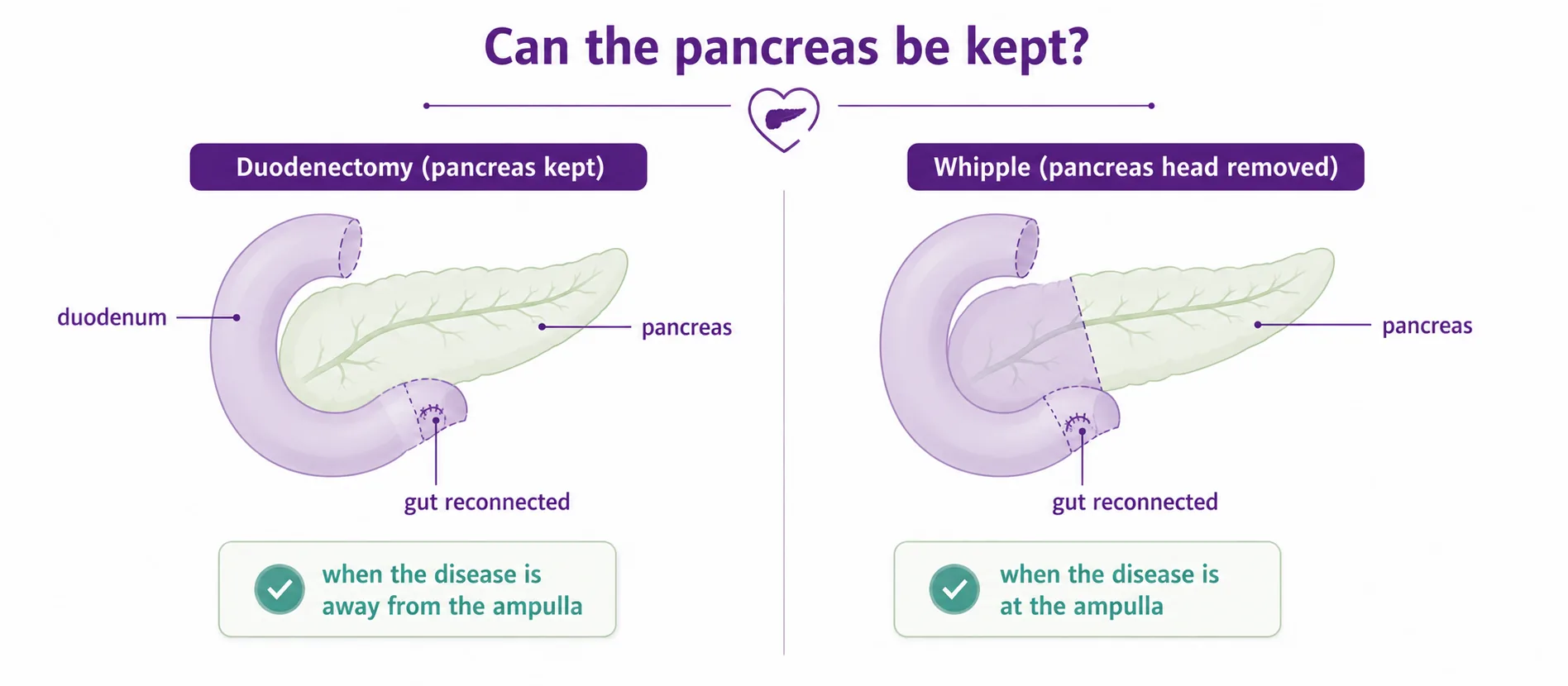
For most people the biggest question is: do I need a full Whipple, or can I keep my pancreas? The honest answer depends on where the growth sits. If it is at or very near the ampulla (where the bile and pancreatic ducts enter) or involves the pancreas, a Whipple — which removes the head of the pancreas as well — is usually needed. But if the growth is away from the ampulla and confined to the duodenum, surgeons can often remove the duodenum while leaving the pancreas in place. Keeping the pancreas avoids the digestion (enzyme) and diabetes changes that come with removing it, and usually means an easier recovery. It is a genuinely smaller operation — when the position allows it.
When the growth is away from the ampulla, a duodenectomy can keep the pancreas; at the ampulla, a Whipple removes the pancreatic head too.
Pancreas-sparing duodenectomy
Whipple procedure
When
Growth confined to the duodenum, away from the ampulla.
Growth at or near the ampulla, or involving the pancreas.
What’s removed
The duodenum (a segment or all of it); the pancreas is kept.
The duodenum and the head of the pancreas (plus gallbladder and bile duct).
Usually means
A smaller operation, no pancreatic-loss effects, easier recovery.
A bigger operation; enzyme support and sometimes diabetes afterwards.
Types: segmental vs pancreas-preserving total duodenectomy
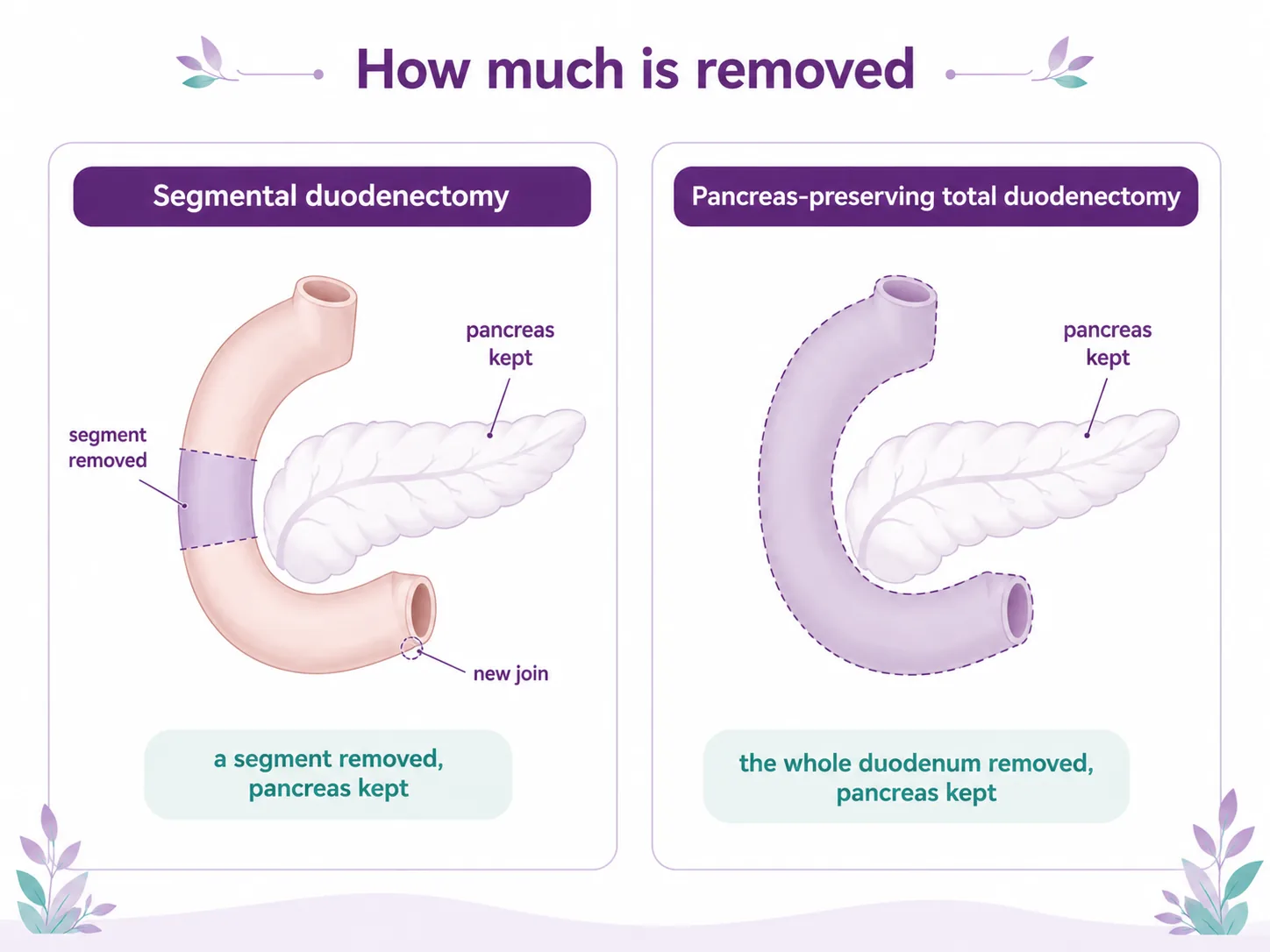
Among the pancreas-sparing operations, how much of the duodenum is removed depends on the growth. A segmental (or sleeve) duodenectomy removes just the affected part of the duodenum and rejoins the ends — suited to a single, localised growth away from the ampulla. A pancreas-preserving total duodenectomy removes the whole duodenum while carefully leaving the pancreas in place — used when growths affect the whole duodenal lining, for example numerous polyps in familial polyposis (FAP). Both keep the pancreas; the surgeon chooses based on how much of the duodenum is involved.
A segmental duodenectomy removes just the affected part; a pancreas-preserving total duodenectomy removes the whole duodenum — both keep the pancreas.
Segmental duodenectomy
Pancreas-preserving total
Removes
Just the affected part of the duodenum.
The whole duodenum (pancreas kept).
Often for
A single, localised growth away from the ampulla.
Growths affecting the whole lining — e.g. FAP polyposis.
Recovery
The smaller of the two; about five days to a week in hospital.
More involved than a segmental one, but still avoids removing the pancreas.
Diagnosis & staging
Tests that decide which operation you need
Two questions decide the plan: what is the growth, and exactly where does it sit? An endoscopy with biopsies shows whether it is benign (a polyp or adenoma), pre-cancerous, a neuroendocrine tumour or GIST, or a cancer — and how deep it goes. Scans, and often an endoscopic ultrasound, then map its exact position relative to the ampulla and the pancreas — which is what decides whether the pancreas can be kept or a Whipple is needed. The tumour board weighs both, and gives you an honest answer.
Diagnostic services we offer — book any of these:
Upper GI endoscopy & biopsy
A camera passed through the mouth looks directly at the duodenum and takes a tissue sample — this is what shows whether the growth is benign, pre-cancerous or a cancer.
A scope with an ultrasound tip shows how deep the growth goes and how close it sits to the ampulla and the pancreas — key to whether the pancreas can be kept.
Your scans and biopsy reviewed together by surgical, radiation & medical oncologists to decide which operation is right — and whether the pancreas can be spared.
Where duodenal polyps suggest familial polyposis (FAP) or a family pattern, genetic counselling guides testing and surveillance for you and your relatives.
The right operation is matched to the growth — and CION delivers the full range around it. That means a segmental duodenectomy for a single, localised growth away from the ampulla; a pancreas-preserving total duodenectomy where the whole lining is affected, as in FAP; and a Whipple when the growth sits at the ampulla and the pancreatic head must come out too. Small or early polyps can sometimes be removed with an endoscope, with no operation at all. Where the growth is a cancer, a NET or a GIST, chemotherapy or targeted therapy is planned around the surgery. Every plan is set by a tumour board.
Treatments we deliver — book a consult for any of these:
Segmental (pancreas-sparing) duodenectomy
Removing just the affected part of the duodenum and rejoining the ends — keeping the pancreas, for a single growth away from the ampulla.
Duodenal surgery is delicate work in a crowded space. The duodenum is wrapped around the head of the pancreas, and the bile and pancreatic ducts drain into it — so removing it while leaving the pancreas intact and working takes an experienced hepatobiliary (HPB) team. Experience matters twice over: first in judging honestly whether the pancreas can be spared or a Whipple is genuinely needed, and second in doing the sparing operation well when it is possible. At CION, duodenal surgery is handled by the same HPB team that performs the Whipple, and every case is planned by a multidisciplinary tumour board — so whichever operation you need, you are covered by the same experienced hands.
A dedicated HPB team
Surgeons who work regularly around the pancreas and bile duct — the experience that pancreas-sparing surgery demands.
An honest judgement
A careful, scan-based call on whether the pancreas can be kept — and a straight answer when a Whipple is genuinely needed.
Whipple-capable either way
The same team performs the Whipple, so you are covered whichever operation your scans point to.
What recovery looks like depends on the operation. A pancreas-sparing duodenectomy is generally a smaller operation than a Whipple, with a hospital stay of about five days to a week and fuller recovery over roughly four to six weeks — and because the pancreas is kept, you usually avoid the enzyme and diabetes changes that follow pancreatic removal. A pancreas-preserving total duodenectomy is more involved than a segmental one. If a Whipple is needed, recovery is longer. Your digestion settles as you heal, a dietitian helps you eat well, and any further treatment (for a cancer, sometimes chemotherapy) is planned around the surgery.
1
Before surgery
Endoscopy, biopsies and scans show what the growth is and exactly where it sits — deciding whether the pancreas can be kept or a Whipple is needed. You are told honestly what to expect.
2
The operation
The affected duodenum (a segment or all of it) is removed and the digestive tract reconnected — keeping the pancreas where the position allows — by an experienced HPB team.
3
In hospital
Usually about five days to a week for a pancreas-sparing operation; longer if a Whipple is needed. Eating restarts gradually as the join heals.
4
Recovery & ongoing care
Fuller recovery over roughly four to six weeks for a pancreas-sparing operation, with a dietitian’s help, any further treatment planned around surgery, and follow-up to keep an eye on things.
Follow-up focuses on your nutrition and strength, on the pathology and any treatment planned around it, and — where the growth was part of a polyposis condition such as FAP — on regular surveillance for you and, where relevant, your family.
Cost & coverage
Duodenectomy cost in Hyderabad Indicative
The cost of a duodenectomy depends mainly on which operation is needed — a segmental (pancreas-sparing) resection differs from a pancreas-preserving total duodenectomy, and a Whipple (when the pancreas must be removed) costs more again. The reassuring part: when it treats a cancer, it is generally covered under Aarogyasri at empanelled centres and by most health-insurance policies, usually alongside any treatment around it. Cover for surgery on benign or pre-cancerous growths depends on your policy. Our team checks your scheme eligibility and gives you a clear, written estimate before anything is planned. These are estimates, not a quotation.
Indicative cost estimator
Pick your situation for an indicative range, then request an exact estimate for your case.
Indicative range
₹2,20,000 – ₹4,20,000
for a segmental (pancreas-sparing) duodenectomy, general room, self-pay
Figures are indicative only and not a quotation. When it treats a cancer, duodenal surgery is generally covered under Aarogyasri at empanelled centres, subject to eligibility; cover for benign or pre-cancerous growths depends on your policy. Your actual cost depends on the operation, the hospital stay and any treatment around it.
Being told you may need a Whipple is frightening — and it is not always the answer. Book a free consultation and, if you already have your endoscopy, scan or biopsy reports, a free written second opinion on which operation you actually need.
Your scans and biopsy reviewed by an experienced HPB surgical oncologist
An honest answer — pancreas-sparing duodenectomy, or a Whipple
Aarogyasri & insurance guidance
Support
Financial support & Aarogyasri
Cost should not delay treatment. When duodenal surgery treats a cancer, it is generally covered under Aarogyasri at empanelled centres, and private insurance is accepted cashless — usually alongside any treatment around it. Cover for surgery on benign or pre-cancerous growths depends on your policy. Our counsellors help check eligibility, arrange approvals and map out what you will actually pay — often far less than families fear.
9 clinics in Hyderabad · 35+ across Telangana & AP
CION cancer care is closer than you think.
We're never more than 30 minutes away. Same panel of specialists at every centre. Same tumour board reviews. Same NCCN protocols. Pick the closest one and call directly — or let us pick for you.
Don't see your city? Call
18002028726
— we'll find your nearest CION partner centre.
Meet the HPB surgical oncology team
Your operation is planned by a team, not one doctor.
Surgical, radiation and medical oncologists plan every case together in a multidisciplinary tumour board — part of 17 senior specialists across CION, with duodenal surgery handled by the same experienced HPB (liver, biliary & pancreatic) team that performs the Whipple.
Share your name and number — we'll call you back within 30 minutes to schedule your consultation.
Told you need a Whipple? Get a second opinion first.
Whether your pancreas can be kept, whether a smaller operation would clear the growth — and whether it is even a cancer — depends on details only your scans and biopsy can settle. Let CION’s HPB team and tumour board review them and give you an honest, clear answer.
These are the worries families rarely say out loud. Here are honest, respectful answers to the ones we hear most in Telangana.
“A growth in my duodenum means I have cancer.”
Fact: Not necessarily. Many duodenal growths are benign or pre-cancerous — adenomas and polyps, including in familial polyposis — while others are neuroendocrine tumours (NETs) or GISTs, and some are cancers. A biopsy is what settles it, so wait for the answer rather than assuming the worst.
“I’ve been told duodenum surgery — so my pancreas is coming out too.”
Fact: Often it is not. If the growth is away from the ampulla and confined to the duodenum, surgeons can frequently remove the duodenum while keeping the pancreas. A Whipple is needed when the growth sits at the ampulla or involves the pancreas. Where yours sits is what decides — and your scans answer it.
“The surgery will spread the cancer.”
Fact: This is a common, harmful myth. Removing a duodenal growth under controlled surgical conditions does not spread it. What actually causes harm is delay, which can let a small, easily removable growth become a bigger problem.
“Without a duodenum I’ll never eat or digest food properly again.”
Fact: You can eat normally again. After the affected duodenum is removed, the surgeon rejoins the digestive tract so food passes as it should. Eating restarts gradually as the joins heal, a dietitian guides you, and within weeks a new normal settles in.
“I’ll definitely become diabetic after this operation.”
Fact: When the pancreas is kept — as it is in a pancreas-sparing duodenectomy — you usually avoid the diabetes and enzyme changes altogether. That is precisely the advantage of sparing it. Those changes are associated with removing pancreatic tissue, which this operation is designed to avoid.
“Recovery will take years and I’ll never be independent.”
Fact: A pancreas-sparing duodenectomy is a smaller operation than a Whipple — about five days to a week in hospital and fuller recovery over roughly four to six weeks. Most people return to independent, normal life, with the team supporting you the whole way.
“Can a middle-class family afford duodenal surgery?”
Fact: When it treats a cancer, duodenal surgery is generally covered under Aarogyasri at empanelled centres, and private insurance is accepted cashless. Cover for benign growths depends on your policy. Our counsellors help you check eligibility and map out what you will actually pay — often far less than families fear.
“They’re offering a smaller operation because they’re cutting corners.”
Fact: The opposite. A pancreas-sparing operation is chosen because the growth’s position allows the whole of it to be removed without taking the pancreas — not to do less. The aim is always to clear the growth completely, with a clear margin. Where sparing the pancreas would compromise that, your surgeon will tell you honestly and recommend a Whipple.
“Removing my whole duodenum must be worse than a Whipple.”
Fact: It is generally the smaller of the two. A pancreas-preserving total duodenectomy removes the whole duodenum but carefully leaves the pancreas in place — so it avoids the enzyme and diabetes changes that follow removing pancreatic tissue. It is more involved than a segmental resection, but it is not a bigger operation than a Whipple.
“With FAP, surgery is pointless — the polyps will just come back.”
Fact: A pancreas-preserving total duodenectomy removes the whole duodenal lining where the polyps grow, which is exactly why it is used for FAP rather than removing them one by one. FAP is a lifelong condition needing ongoing surveillance elsewhere in the gut, but the duodenal problem is genuinely dealt with.
“I’m too old or too weak for this operation.”
Fact: Age alone does not decide it — fitness does. Your team assesses you individually and builds your strength beforehand. And a pancreas-sparing operation is smaller than a Whipple, which matters for people who are less fit. The decision is matched to you, not to a number.
“Any surgeon can do this — it doesn’t matter where.”
Fact: The duodenum is wrapped around the head of the pancreas, with the bile and pancreatic ducts draining into it. Removing it while leaving the pancreas intact and working is delicate surgery that needs an experienced HPB team — both to judge honestly whether sparing is possible, and to do it well.
“Home or herbal remedies can shrink the growth instead.”
Fact: No home or herbal remedy is proven to remove a duodenal tumour or polyp, and relying on one wastes the window when a small growth is easiest to treat — sometimes even through an endoscope. Tell your doctor about anything you take so it can be used safely alongside proper treatment.
“A second opinion will offend my doctor or waste time.”
Fact: A second opinion is normal and welcomed — especially here, where the whole question is whether you need a Whipple or a smaller pancreas-sparing operation. At CION it can be arranged quickly, and it is free when you already have your scans, endoscopy or biopsy reports.
“If they can’t save my pancreas, I’ve lost.”
Fact: Not at all. A Whipple is a well-established operation and, for a growth at the ampulla, it is the right one — and periampullary cancers often have a more favourable outlook than pancreatic cancer itself. Digestion is supported with enzyme capsules, diabetes is managed where it appears, and people live full lives afterwards.
“A NET or a GIST means it’s cancer and it’s hopeless.”
Fact: Neuroendocrine tumours and GISTs are their own kinds of growth, behave differently from adenocarcinoma, and are often slow-growing and very treatable — frequently with a limited, pancreas-sparing operation when they sit away from the ampulla. Your team explains what your specific type means.
“The join will leak and I won’t survive it.”
Fact: A leak from a new join is a recognised risk of any bowel surgery, and it is watched for closely and managed. It is less frequent in experienced hands, and a pancreas-sparing operation avoids the pancreatic join that carries most of the leak risk in a Whipple. Your surgeon discusses the risks honestly beforehand.
“I’ll be in unbearable pain after abdominal surgery.”
Fact: Pain is expected but well controlled with modern methods, and the team manages it closely in the early days. Most people are helped to get up and moving soon after surgery, which itself speeds recovery.
“I’ll definitely need chemotherapy afterwards.”
Fact: Not necessarily. For a benign or pre-cancerous growth removed completely, surgery is often the whole treatment. Where the growth is a cancer, chemotherapy or targeted therapy may be planned around the surgery — decided by the tumour board from your pathology, not assumed in advance.
“Losing part of my gut means I can never live normally.”
Fact: People live full, active lives after a duodenectomy. The digestive tract is rebuilt so food passes normally, a dietitian helps you settle in, and — when the pancreas is kept — you avoid the digestion and blood-sugar changes altogether. Work, travel and family life continue.
Why CION
Why choose CION for a duodenectomy in Hyderabad
Pancreas-sparing where possible
Where the position allows, the duodenum is removed while keeping the pancreas — a smaller operation with an easier recovery.
Whipple-capable HPB team
The same experienced hepatobiliary team performs the Whipple when it is needed — so you are covered either way.
Honest, scan-based assessment
A careful judgement of what the growth is and exactly where it sits — and a straight answer on the right operation.
Care for benign & FAP disease
Pancreas-preserving total duodenectomy for numerous polyps, including familial polyposis (FAP), with genetic counselling for your family.
A tumour-board approach
Every case reviewed by a multidisciplinary tumour board, so surgery and any other treatment fit together.
Aarogyasri & care close to home
Cancer surgery is covered under Aarogyasri at empanelled centres; 35+ centres and Telugu-speaking teams for follow-up.
Real stories · real courage
15,000+ patients chose CION. Hear from them directly.
These aren't paid endorsements or written reviews. These are video testimonials from real patients and families — recorded on their own phones, in their own words. Pick any one. Watch it. Then decide.
4.8★800+ Google reviews
50+video testimonials
15,000+patients treated
Successful Chemotherapy & Radiation Done by Dr. Owais Mohammed & Dr. Kirti Ranjan
Watch video →
Successful Chemotherapy Done by Dr. C Raghavendra Reddy
Watch video →
Surgery, Chemo & Radiation Done by Dr. Imaduddin, Dr. Vinay, Dr. Owais, Dr. Kirti
Watch video →
Successful Radical Thymectomy Done by Dr. Mohammed Imaduddin & Dr. Vinay Mamidala
Watch video →
Successful Surgery Done by Dr. Rajender Byshetty
Watch video →
Successful Chemo & Surgery Done by Dr. Imad, Dr. Vinay, Dr. Owais & Dr. Raghavendra
Watch video →
Successful Chemo & Surgery Done by Dr. Imad, Dr. Vinay, Dr. Owais & Dr. Raghavendra
Watch video →
Successful Chemo & Radiation Done by Dr. Owais Mohammed & Dr. Kirti Ranjan Mohanty
Watch video →
Successful Breast Cancer Surgery Done by Dr. Imaduddin Mohammed & Dr. Vinay Mamidala
Watch video →
Successful Chemotherapy Done by Dr. Bharati Devi Gorantla
Watch video →
Successful Chemo & Surgery Done by Dr. Owais Mohammed & Dr. Imaduddin Mohammed
Watch video →
Successful Chemotherapy Done by Dr. Gundu Naresh
Watch video →
Successful Bone Marrow Transplantation - Neuroblastoma
Watch video →
Successful Surgery & Chemo - Carcinoma of Caecum
Watch video →
Successful Oral chemotherapy & mastectomy surgery
Watch video →
Successful Oral chemotherapy & mastectomy surgery
Watch video →
Successful Chemotherapy
Watch video →
Successful Surgery by Dr. Mohammed Imaduddin
Watch video →
Successful Bone Marrow Transplantation
Watch video →
Successful Oral chemotherapy & mastectomy surgery
Watch video →
Successful Oral chemotherapy & mastectomy surgery
Watch video →
Successful Chemotherapy
Watch video →
Successful Buccal Mucosa Surgery
Watch video →
Successful Complex Surgery Mandibulectomy Reconstruction
A duodenectomy is one part of treating a duodenal growth. At CION, nutrition, genetic risk, emotional care, comfort and rehabilitation are one coordinated plan.
Nutrition & diet
Dietitian support to eat well and rebuild strength after upper-GI surgery. Learn more
Psychology counselling
Emotional support for you and your family through diagnosis and recovery. Learn more
Genetic counselling
Guidance on FAP and hereditary risk — for you and for relatives who may need screening. Learn more
Rehabilitation
Physiotherapy and recovery support to rebuild strength after surgery. Learn more
Palliative & comfort care
Comfort and symptom support at any stage, alongside treatment. Learn more
Financial counselling
Aarogyasri and cashless insurance guidance so cost never blocks care. Learn more
FAQ
Duodenectomy in Hyderabad — frequently asked questions
What is a duodenectomy?
A duodenectomy is an operation that removes the duodenum — the C-shaped first part of the small intestine, just after the stomach — either a segment of it or the whole duodenum, then reconnects the digestive tract so food passes normally. It is used for growths in the duodenum, which may be cancers but are often benign or pre-cancerous, such as large polyps or adenomas (including in familial polyposis), neuroendocrine tumours or GISTs.
Do I need a Whipple, or can I have a smaller duodenectomy?
It depends on where the growth sits. If it is at or near the ampulla (where the bile and pancreatic ducts enter) or involves the pancreas, a Whipple — which removes the head of the pancreas too — is usually needed. If it is away from the ampulla and confined to the duodenum, a pancreas-sparing duodenectomy can often remove it while keeping the pancreas, which is a smaller operation. Your team decides from your scans.
Can my pancreas be saved?
Often, yes — when the growth is confined to the duodenum and clear of the ampulla and pancreatic head, surgeons can remove the duodenum while keeping the pancreas (a segmental or pancreas-preserving total duodenectomy). Keeping the pancreas avoids the enzyme and diabetes changes that follow removing it, and usually means an easier recovery. Where the growth is at the ampulla, a Whipple is needed instead. The exact position decides.
How much does a duodenectomy cost in Hyderabad?
In Hyderabad, a segmental (pancreas-sparing) duodenectomy is typically an indicative ₹2,20,000 to ₹4,20,000, and a pancreas-preserving total duodenectomy more, depending on the extent of surgery, room category and length of stay. A Whipple, where the pancreas must be removed, costs more again. When it treats a cancer, eligible surgery at Aarogyasri-empanelled centres may be largely covered, and insurance is accepted cashless. CION gives an accurate written estimate after assessment.
Is a duodenectomy covered by Aarogyasri or insurance?
When it treats a cancer, it is generally covered under Aarogyasri at empanelled centres, subject to eligibility, and by most health-insurance policies, usually alongside any treatment around it. Cover for surgery on benign or pre-cancerous growths depends on your policy. CION is Aarogyasri empanelled; the team checks your policy and scheme eligibility and provides a written estimate before anything is planned.
What is a segmental duodenectomy?
A segmental (or sleeve) duodenectomy removes just the affected part of the duodenum and rejoins the ends, leaving the rest of the duodenum and the pancreas in place. It suits a single, localised growth that sits away from the ampulla. It is the smallest of the duodenal operations, with a hospital stay of about five days to a week and fuller recovery over roughly four to six weeks.
What is a pancreas-preserving total duodenectomy?
It is an operation that removes the whole duodenum while carefully leaving the pancreas in place. It is used when growths affect the entire duodenal lining — for example numerous polyps in familial adenomatous polyposis (FAP) — where removing just a segment would not be enough, but the pancreas does not need to be removed. It avoids a full Whipple while still clearing the duodenal disease.
What is the ampulla, and why does it decide my operation?
The ampulla is the small opening where the bile duct and the pancreatic duct drain into the duodenum, right where the duodenum meets the head of the pancreas. A growth sitting at the ampulla cannot be removed without taking the pancreatic head with it — which is a Whipple. A growth away from the ampulla can often be removed while leaving the pancreas untouched. That is why your surgeon looks so carefully at the exact position on your scans and endoscopy.
Are all duodenal tumours cancer?
No. Many duodenal growths are benign or pre-cancerous — such as adenomas and polyps (including in familial polyposis) — while others are neuroendocrine tumours (NETs) or GISTs, and some are cancers (adenocarcinoma). Biopsies, scans and the tumour board determine what the growth is and how deep it goes, which guides whether surgery is needed and how much of the duodenum to remove.
Can duodenal polyps be removed with an endoscope instead of surgery?
Sometimes, yes. Where a polyp is small and early enough, it can often be removed through an endoscope, with no operation at all. Surgery is considered when polyps are too large, too numerous or too deep to remove that way, when they are at risk of becoming cancer, or when a biopsy shows a cancer. Your team advises which applies to you after an endoscopy and biopsies.
What is FAP, and why might it need a total duodenectomy?
Familial adenomatous polyposis (FAP) is an inherited condition in which many polyps develop through the digestive tract, including throughout the duodenal lining. When the polyps are too numerous or advanced to keep removing one by one through an endoscope, a pancreas-preserving total duodenectomy removes the whole duodenal lining where they grow — while keeping the pancreas. Genetic counselling is offered for you and for relatives who may need screening.
How is the gut reconnected after a duodenectomy?
After the affected duodenum is removed, the surgeon rejoins the digestive tract so food passes normally — reconnecting the stomach or the remaining bowel to the small intestine, and, in a total duodenectomy, carefully re-attaching the bile and pancreatic ducts. The reconnection is designed so digestion continues, and eating restarts gradually as the joins heal, guided by your team and a dietitian.
How long is recovery, and how does it compare to a Whipple?
A pancreas-sparing duodenectomy is generally a smaller operation than a Whipple, with a hospital stay of about five days to a week and fuller recovery over roughly four to six weeks — and because the pancreas is kept, you usually avoid the enzyme and diabetes changes that follow pancreatic removal. A pancreas-preserving total duodenectomy is more involved than a segmental one, and a Whipple, when needed, has a longer recovery.
Will I need enzyme capsules or become diabetic after a duodenectomy?
Usually not, when the pancreas is kept. The enzyme capsules and diabetes that people associate with this kind of surgery follow removing pancreatic tissue — which a pancreas-sparing duodenectomy is specifically designed to avoid. That is the main advantage of sparing the pancreas. Where a Whipple is needed instead, many people do take enzyme capsules with meals and some develop diabetes, both managed with support.
What are the main risks of a duodenectomy?
As with any abdominal surgery there are real risks, including a leak from a new join, bleeding, infection and delayed stomach emptying. These are watched for closely and managed, and they are less frequent in experienced hands. A pancreas-sparing operation also avoids the pancreatic join that carries much of the leak risk in a Whipple. Your surgeon discusses the risks honestly with you beforehand.
Will I need chemotherapy after a duodenectomy?
Not always. For a benign or pre-cancerous growth that is removed completely, surgery is often the whole treatment. Where the growth is a cancer, chemotherapy — or, for some neuroendocrine tumours and GISTs, targeted therapy — may be planned around the surgery. What you need is decided by the tumour board from your pathology and stage, not assumed in advance.
Which is the best hospital for a duodenectomy in Hyderabad?
Look for a cancer centre with an experienced hepatobiliary (HPB) team that performs pancreatic surgery regularly, multidisciplinary tumour-board planning, and an honest, scan-based assessment of whether your pancreas can be spared — because removing the duodenum while leaving the pancreas intact is delicate work. CION Cancer Clinics offers these across 35+ centres in Telangana and Andhra Pradesh, with Aarogyasri and insurance counselling.
Can I get a second opinion on whether my pancreas can be saved?
Yes, and it is welcomed — this is exactly the kind of question a second opinion helps with, since whether you need a Whipple or a smaller pancreas-sparing operation turns on where the growth sits. A second opinion reviews your endoscopy, scans and biopsy and gives you an honest answer. At CION it can be arranged quickly and is free when you already have your reports.
Explore
Explore duodenal, GI & HPB cancer care at CION
Surgery, treatment, tests and cost around duodenal and small-intestine growths, plus the related pancreatic, GI and HPB cancers. Tap any topic to read more.
Talk to an HPB surgical oncologist about duodenal surgery
Early answers change outcomes. Book a free consultation or second opinion at any of our 9 Hyderabad clinics — part of 35+ centres across Telangana & Andhra Pradesh.
Medical disclaimer: This page provides general information about duodenectomy (duodenal surgery) and is not a substitute for professional medical advice, diagnosis or treatment. Costs shown are indicative only and not a quotation. Keeping the pancreas is possible only when the growth is confined to the duodenum and clear of the ampulla; where it sits at the ampulla or involves the pancreas, a Whipple procedure is needed. Many duodenal growths are benign or pre-cancerous, but only a biopsy and your team can say what yours is. CION plans every case through a multidisciplinary tumour board with an experienced HPB surgical team. Always consult a qualified HPB surgical oncologist about your individual care. Content is periodically reviewed by CION’s medical team.

 CION Ameerpet