

Medical Oncologist
Pembrolizumab (brand name Keytruda) is an immunotherapy that helps your own immune system find and attack triple-negative breast cancer (TNBC). Used with chemotherapy, it is now part of standard care for high-risk early-stage TNBC and for many advanced cases. Here is how it works, who it suits, how it is given, what side effects to watch for, and what it costs in India — explained by CION's medical oncology team.
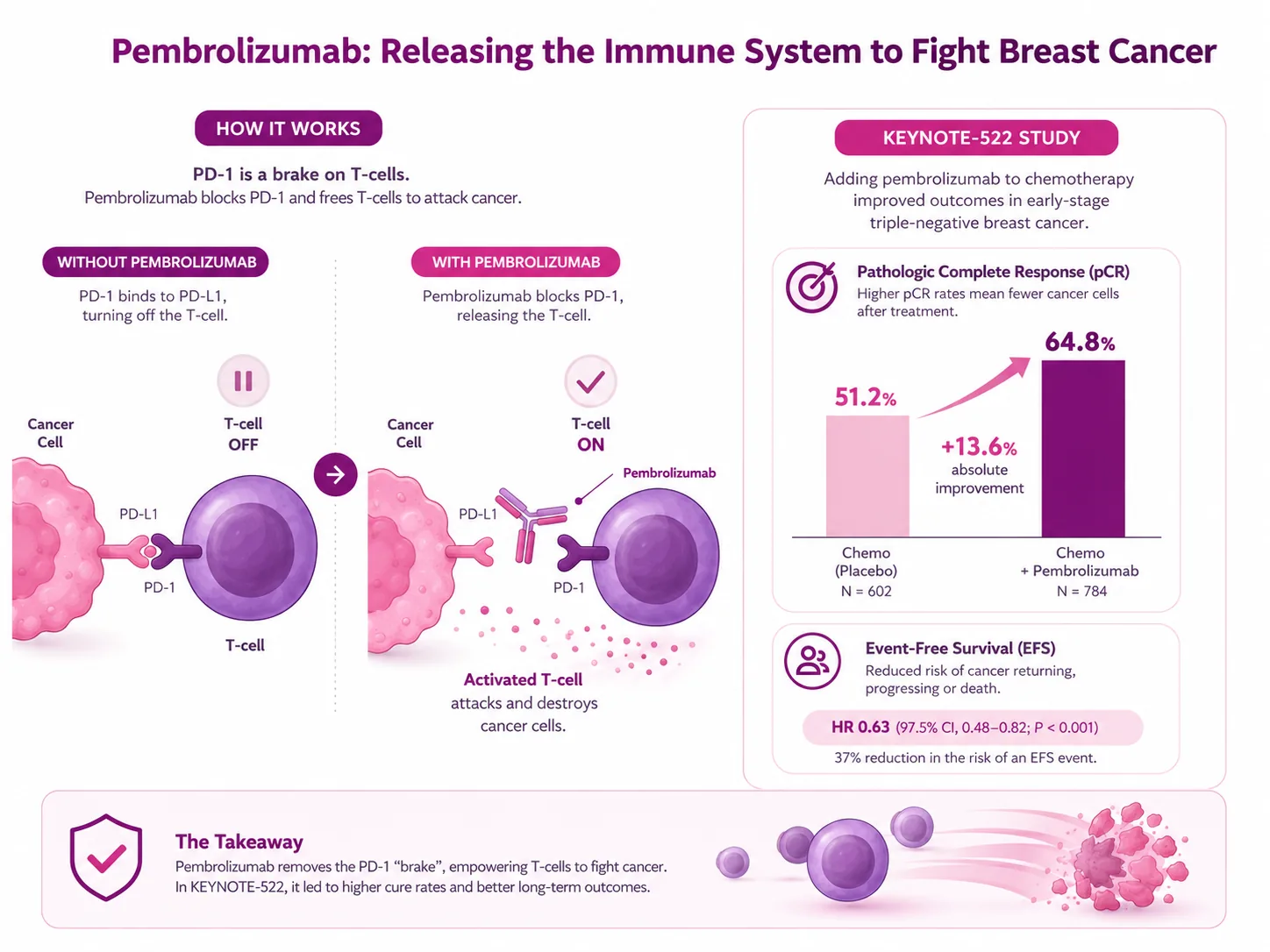
Cancer cells often hide from the immune system by switching on a matching protein called PD-L1. When PD-L1 connects to PD-1, it acts like a brake — telling your T-cells to leave the cancer alone. Pembrolizumab releases that brake, so your immune system can recognise and attack the cancer again.
It is not chemotherapy and it does not kill cancer cells directly. Instead, it re-activates your body's own defences. For triple-negative breast cancer it is almost always given together with chemotherapy, because the two work better as a team than either does alone.
Anti-PD-1 immune checkpoint inhibitor (monoclonal antibody).
Keytruda, the only brand currently approved for breast cancer.
Unblocks your immune system so T-cells can attack the tumour.
1. High-risk early-stage TNBC (Stage II–III). Pembrolizumab is given before surgery (neoadjuvant) alongside chemotherapy to shrink the tumour, then continued after surgery (adjuvant) on its own to lower the chance of the cancer coming back. This neoadjuvant-then-adjuvant approach is based on the landmark KEYNOTE-522 trial.
2. Advanced or metastatic TNBC. For locally recurrent inoperable or metastatic TNBC whose tumour expresses PD-L1 (a CPS score of 10 or more), pembrolizumab is combined with chemotherapy as a first-line option, based on the KEYNOTE-355 trial.
Whether pembrolizumab is right for you depends on your stage, PD-L1 status and overall health. At CION, this is never one doctor's call — every case goes to the tumour board.
Pembrolizumab + chemotherapy shrinks high-risk early TNBC. In KEYNOTE-522, pathological complete response rose to 64.8% vs 51.2% with chemo alone.
Pembrolizumab continues alone for up to a year to reduce recurrence. Event-free survival improved (hazard ratio 0.63), and updated data showed a survival benefit (HR 0.66).
For PD-L1-positive metastatic TNBC, pembrolizumab + chemo extended median overall survival to 23.0 months vs 16.1 months in KEYNOTE-355.
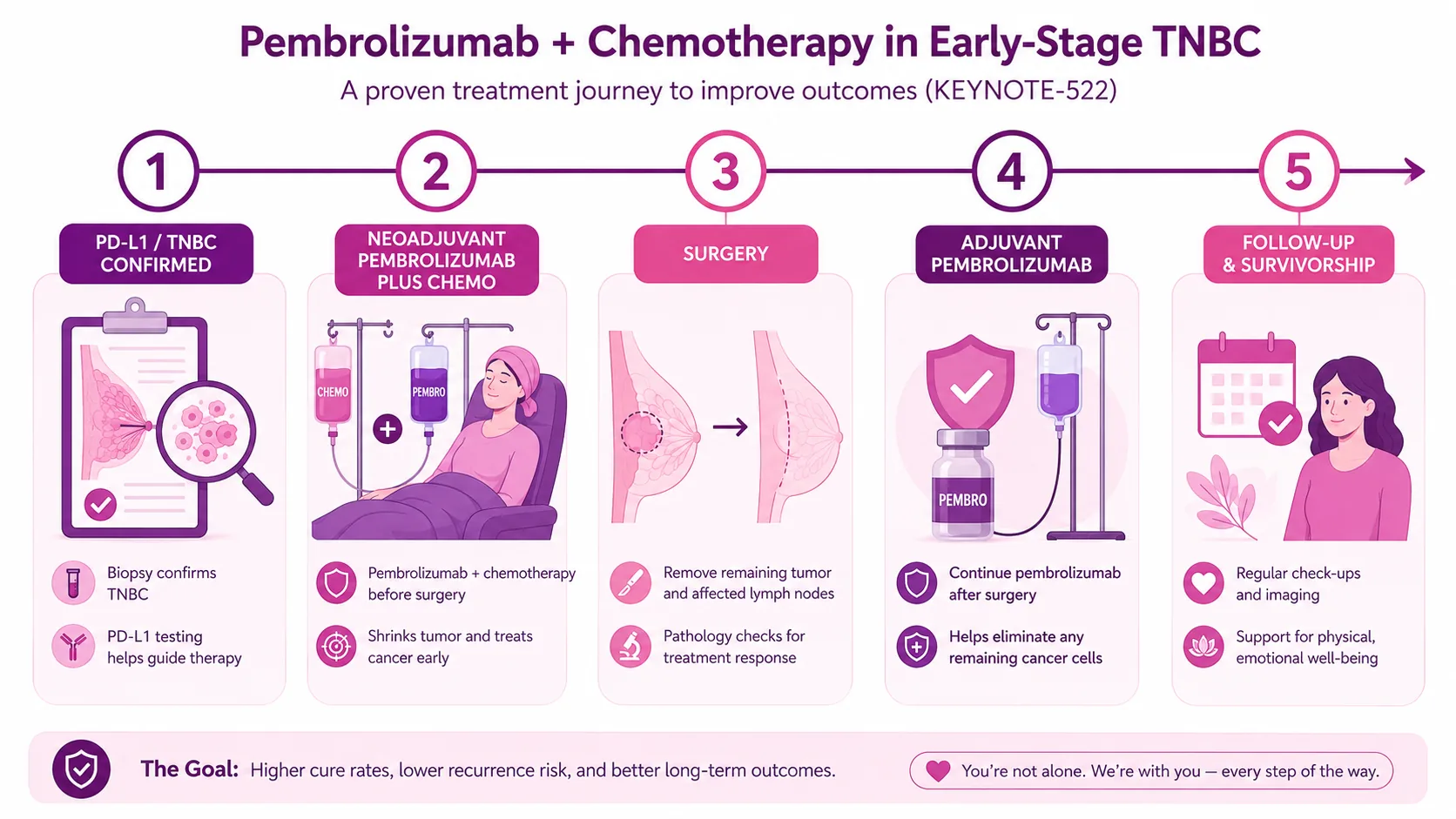
The schedule depends on your situation:
Before each cycle, your team checks your blood counts, thyroid, liver and kidney function, and asks about new symptoms. These checks are how immune-related side effects are caught early.
Intravenous (IV) drip — about 30 minutes per infusion, as a day-care procedure.
Once every 3 weeks, or every 6 weeks at a higher dose.
Up to ~1 year for early-stage TNBC; ongoing while effective for metastatic disease.
Common, usually mild effects include tiredness, skin rash or itching, nausea, loss of appetite, diarrhoea, cough and joint pain. When pembrolizumab is given with chemotherapy you may also have low blood counts, higher infection risk and hair loss from the chemotherapy part. Tell your team straight away if you notice any of the warning signs below — even between cycles. Immune side effects can appear weeks or months after a dose. They are treated by pausing pembrolizumab and giving steroids to calm the immune reaction.
Warning signs to report straight away — by organ system:
New or worsening cough, breathlessness or chest pain. Report immediately — lung inflammation needs prompt steroid treatment and a pause in therapy.
Diarrhoea (more frequent or watery stools), blood or mucus in stool, or severe tummy pain. Do not treat it as ordinary food poisoning — tell your oncologist.
Unusual tiredness, weight change, feeling cold, dizziness or very low blood pressure. Thyroid problems are common and are managed with hormone tablets.
Yellow skin or eyes, dark urine, pain on the right side of the tummy, or unusual bruising. Blood tests before each cycle help catch this early.
Rash, severe itching, or blistering and peeling skin. Most rashes are mild, but widespread or blistering skin reactions need urgent review.
Fever, chills, flushing, dizziness, wheezing or trouble breathing during or soon after the drip. Staff monitor you and can slow or stop the infusion.
Talk to our team
Call the helpline or leave your details, and someone will help you arrange a consultation at the CION centre nearest you. One helpline serves every CION centre.
PD-L1 is the protein cancer cells use to switch off the immune response. A pathologist measures it on a sample of your tumour (from a biopsy or surgery) and reports a Combined Positive Score (CPS). A CPS of 10 or more is the cut-off used to decide who benefits most in metastatic TNBC.
The rules differ by setting:
Patients with active autoimmune disease, those on long-term high-dose steroids, or those who have had an organ transplant need careful assessment, because immunotherapy can worsen these conditions. Your CION tumour board weighs all of this before recommending treatment.
PD-L1 immunohistochemistry on your tumour sample, reported as a CPS (Combined Positive Score).
Eligible regardless of PD-L1 result — benefit was seen across all PD-L1 groups in KEYNOTE-522.
Needs PD-L1 CPS ≥ 10 to qualify for first-line pembrolizumab plus chemotherapy.
An educational guide only — it simply restates the eligibility rules on this page. It is not a diagnosis, not a treatment decision, and shows no cost.
This tool only restates general eligibility rules and cannot diagnose you or decide your treatment. Your suitability for pembrolizumab is confirmed by your CION tumour board after reviewing your reports.
As a guide, in India a single dose (vial) of pembrolizumab usually costs around ₹2,00,000 to ₹4,50,000, and a full cycle including the day-care infusion charge is commonly in the ₹2,15,000 to ₹2,60,000 range. Because early-stage TNBC treatment runs for roughly a year, the medicine cost adds up across cycles — which is exactly why a transparent, written estimate matters.
What changes the cost: your body weight (the dose is weight-based), whether you are on a 3-weekly or 6-weekly schedule, the chemotherapy partner drugs, diagnostic and PD-L1 testing, and supportive care. At CION we explain every line of the estimate and discuss insurance, Aarogyasri eligibility, EMI options and any applicable patient-assistance routes before you start.
Per dose. Per vial, depending on vial size and weight-based dosing.
Per cycle. Commonly including the day-care administration charge.
Many private insurers and some schemes cover checkpoint inhibitors. We help check Aarogyasri, cashless insurance, EMI and assistance options.
Immunotherapy works best inside a complete, monitored cancer-care programme — not as a stand-alone injection. At CION Cancer Clinics, pembrolizumab is delivered by senior medical oncologists in a safe day-care setting, with the monitoring needed to catch immune side effects early.
Every patient is reviewed by a tumour board — medical, surgical and radiation oncologists deciding together whether immunotherapy fits your case, and how it sits alongside surgery, chemotherapy and radiation. You get a 45-minute consultation, transparent written costs, and a clear plan for what comes next. Your first consultation is free for all cancer patients.
With 150+ years of combined oncology experience, 17 super-specialist oncologists and 35+ centres across Telangana and Andhra Pradesh, you are never far from review and follow-up — important when treatment runs for many months.
A team decides on immunotherapy together — decisions for healing, not billing.
Senior oncologists, pre-cycle blood and organ checks, and rapid response to immune side effects.
A 45-minute review with clear written costs and next steps — no rushed decisions, no unnecessary tests.
Wondering if pembrolizumab is right for your TNBC? In a free, 45-minute consultation we review your stage and PD-L1 status, explain your options in plain language, and give you a clear, written cost estimate — nothing rushed.

Tumour-board-led care, transparent costs, and a 45-minute consultation. Book a free first consultation — confidential, doctor-led guidance at CION Cancer Clinics, Hyderabad.
Trained at AIIMS, Tata Memorial, and leading international centres. Combined 150+ years of experience. Every complex case is reviewed by 3+ of them — together.

MBBS(Gold Medal), DNB(General Medicine), DM(Medical Oncology)(Gold Medal)

MBBS, MD(General Medicine), DM(Medical Oncology)(Adyar,Chennai), ECMO, MRCP SCE(UK)

MBBS, MD (General Medicine), DrNB (Medical Oncology), ECMO, MRCP SCE (Medical Oncology) (UK)



MBBS (AIIMS), MS (Surgery) (AIIMS), DNB (Surgical Oncology), MRCS (Edinburgh)



MBBS, MS(General Surgery), M.Ch(Surgical Oncology), FMAS, FARIS(Ongoing)






MBBS, MS (General Surgery), DrNB (Surgical Oncology), FALS Oncology

Want a specific doctor for your case? Mention them when booking.
Book Free ConsultationShare your name and number — we'll call you back within 30 minutes to schedule your consultation.
Where to find us
Addressed by landmark, because that is how this city navigates. Each centre also names the areas it serves, so you can place it without a map. Consultation and day-care Chemotherapy run at every one of them.
Talk to our team
Call the helpline or leave your details, and someone will help you arrange a consultation at the CION centre nearest you. One helpline serves every CION centre.
Pembrolizumab is an immunotherapy used for triple-negative breast cancer (TNBC). In high-risk early-stage TNBC (Stage II–III) it is given with chemotherapy before surgery and then alone after surgery, to shrink the tumour and lower the chance of recurrence. In advanced or metastatic TNBC, it is combined with chemotherapy when the tumour is PD-L1 positive (CPS of 10 or more). It is not used for hormone-receptor-positive or HER2-positive breast cancer. Your oncologist and tumour board decide whether it fits your specific diagnosis.
Pembrolizumab is given as an intravenous drip in a day-care setting, taking about 30 minutes per infusion, usually once every 3 weeks (or every 6 weeks at a higher dose). For early-stage TNBC, treatment continues for roughly a year — given with chemotherapy before surgery, then on its own for up to nine cycles afterwards. For metastatic TNBC, it is continued as long as it keeps working and side effects remain manageable, often up to two years. Blood tests and organ checks are done before each cycle.
Common side effects are usually mild: tiredness, skin rash or itching, nausea, diarrhoea, loss of appetite, cough and joint pain. Because pembrolizumab activates the immune system, it can also cause immune-related side effects, where the immune system inflames healthy organs — most often the thyroid, lungs (pneumonitis), bowel (colitis), liver or skin. These can appear during or even months after treatment. Most are manageable if caught early, usually by pausing the drug and giving steroids. Report any new breathlessness, persistent diarrhoea, yellow skin or unusual tiredness to your team immediately.
In India, a single dose of pembrolizumab usually costs around ₹2,00,000 to ₹4,50,000, and a full cycle including the day-care infusion is commonly ₹2,15,000 to ₹2,60,000. The total depends on your body weight (dosing is weight-based), the number of cycles, the schedule (3-weekly versus 6-weekly), and the chemotherapy given alongside it. Because early-stage treatment runs for about a year, the costs add up across cycles. At CION we provide a transparent written estimate up front and help you check insurance, Aarogyasri, EMI and patient-assistance options before you start.
It depends on your stage. For high-risk early-stage TNBC, pembrolizumab is offered regardless of PD-L1 status, because the KEYNOTE-522 trial showed benefit in both PD-L1-positive and PD-L1-negative patients. For metastatic TNBC, a PD-L1 test is required: pembrolizumab is added to chemotherapy only when the tumour scores a Combined Positive Score (CPS) of 10 or more. The test is done by a pathologist on a sample of your tumour from a biopsy or surgery. Your oncologist will arrange the right test for your situation.
In the KEYNOTE-522 trial for high-risk early-stage TNBC, adding pembrolizumab to chemotherapy before surgery raised the pathological complete response rate to 64.8% from 51.2% with chemotherapy alone, improved event-free survival (hazard ratio 0.63), and later showed an overall survival benefit (hazard ratio 0.66). In metastatic PD-L1-positive TNBC (KEYNOTE-355), pembrolizumab plus chemotherapy extended median overall survival to 23.0 months versus 16.1 months. Results vary from person to person; your oncologist can explain what these numbers mean for your individual case.
Many private health insurers now reimburse checkpoint inhibitors such as pembrolizumab, often through cashless tie-ups, and some corporate and government schemes provide cover. Coverage and limits vary by policy, so it is important to check your specific plan. At CION, our team helps you confirm your insurance benefits, check Aarogyasri eligibility, arrange EMI where suitable, and explore any applicable patient-assistance programmes — so you have a clear picture of out-of-pocket costs before treatment begins.
Yes. CION Cancer Clinics delivers pembrolizumab immunotherapy across its centres in Hyderabad and wider Telangana, given by senior medical oncologists in a monitored day-care setting. Every case is first reviewed by a tumour board of medical, surgical and radiation oncologists to confirm immunotherapy is the right choice and to plan how it fits with surgery, chemotherapy and radiation. You receive a 45-minute consultation, transparent written costs, and ongoing monitoring for immune side effects. Your first consultation is free for all cancer patients.
Browse our complete guide to breast cancer — types, symptoms, tests and treatments. Tap any topic to read more.
Early answers change outcomes. Book a free consultation or second opinion at any of our centres — part of 35+ across Telangana & Andhra Pradesh.