
The monthly cycle
In the 3–5 days before a period, rising hormones make both breasts swell and feel tender — often worst in the upper-outer area, toward the armpit. The ache usually eases once the period starts.
Sore, tender or aching breasts are one of the most common worries for women — and most of the time, the cause is simply hormones, not cancer. Here's how to tell harmless cyclical tenderness from a change that genuinely needs a check.
Breast tissue responds to the hormones estrogen and progesterone. When these rise and fall, the milk ducts and glands swell and hold fluid — felt as soreness, heaviness or tenderness. That is why most breast pain tracks the life stages where hormones shift the most. Doctors call it mastalgia, and it is extremely common.
In the 3–5 days before a period, rising hormones make both breasts swell and feel tender — often worst in the upper-outer area, toward the armpit. The ache usually eases once the period starts.
Tender, fuller, tingling breasts are one of the earliest signs of pregnancy — driven by a surge in hormones preparing the body for breastfeeding.
As cycles become irregular, hormone swings can make pain unpredictable. After menopause hormonal pain usually settles — so new soreness after menopause is worth checking.
An unsupportive bra, larger breast size, caffeine, stress, some medicines (certain antidepressants, hormonal contraception, HRT) and chest-wall muscle strain can all add to soreness.
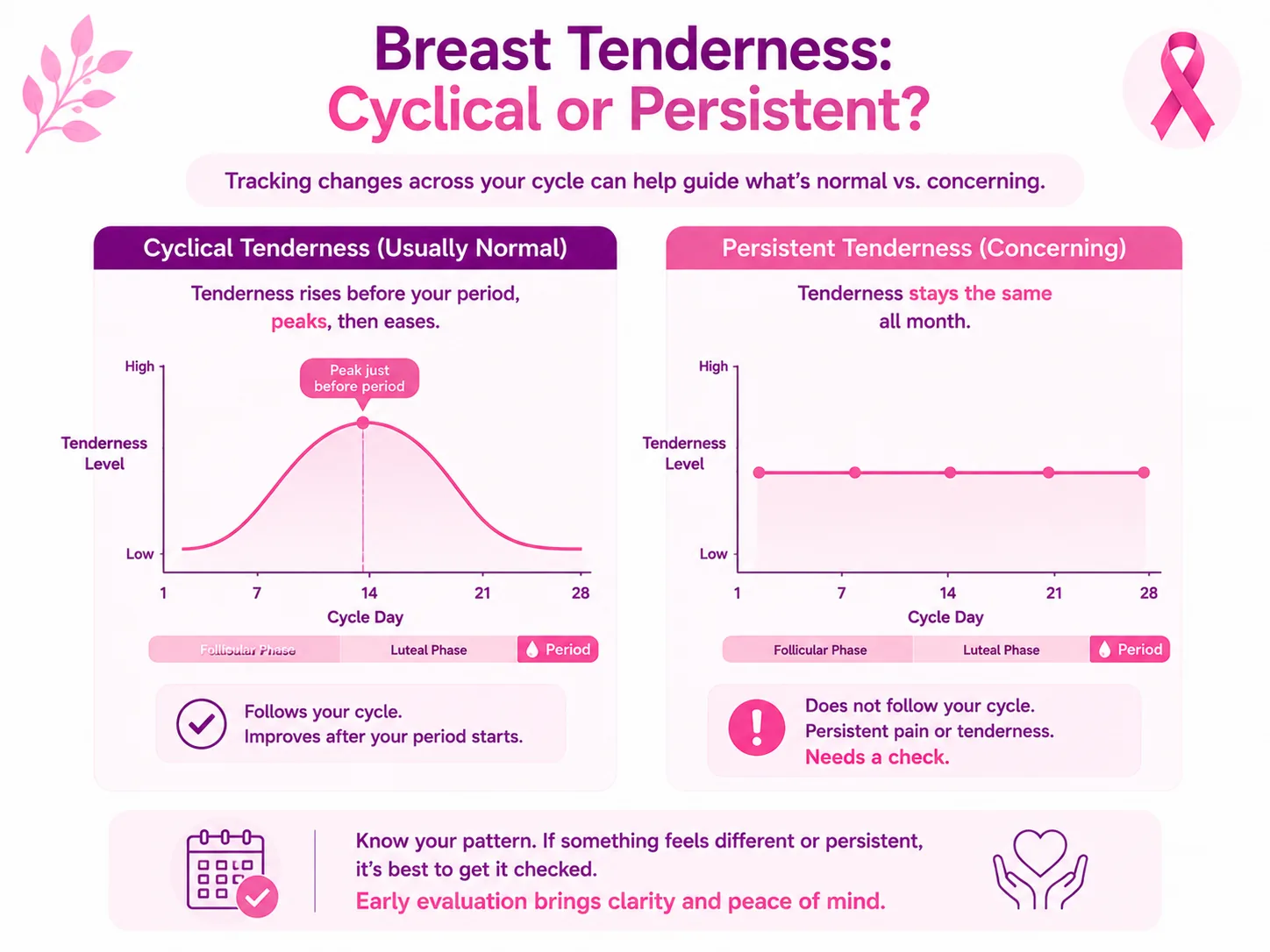
Knowing which type of pain you have is the single most reassuring step. Doctors sort breast tenderness into two groups — cyclical (tied to your period) and non-cyclical (not tied to it). Cyclical pain accounts for about two-thirds of all breast pain and is almost always hormonal and harmless.
Linked to your menstrual cycle. Comes on in the week or so before your period, usually affects both breasts (often upper-outer area), feels like a dull ache, heaviness or swelling, and fades once bleeding starts. Most common between ages 20 and 50; it typically settles after menopause.
Has no link to your period. Often in one breast and one spot, may feel sharp, burning or stabbing, and can be constant or come and go. More common after age 40. Causes include a cyst, an old injury or surgery, costochondritis (rib-joint inflammation) or a poorly fitting bra.
Track your pain against your cycle for one to two months. If it reliably arrives before your period and eases after, it is almost certainly cyclical — reassuring. If it ignores your cycle, sits in one spot, or comes with any change you can see or feel, have it checked.
It is the company that pain keeps that matters more than the pain itself. Tenderness with none of the signs below is almost always benign. Tenderness with any one of these should be checked by a doctor without delay.
Talk to our team
Call the helpline or leave your details, and someone will help you arrange a consultation at the CION centre nearest you. One helpline serves every CION centre.
Call CION on 1800-202-8726 or request a callback. Woman-led, doctor-led care across 35+ centres in Telangana & AP.
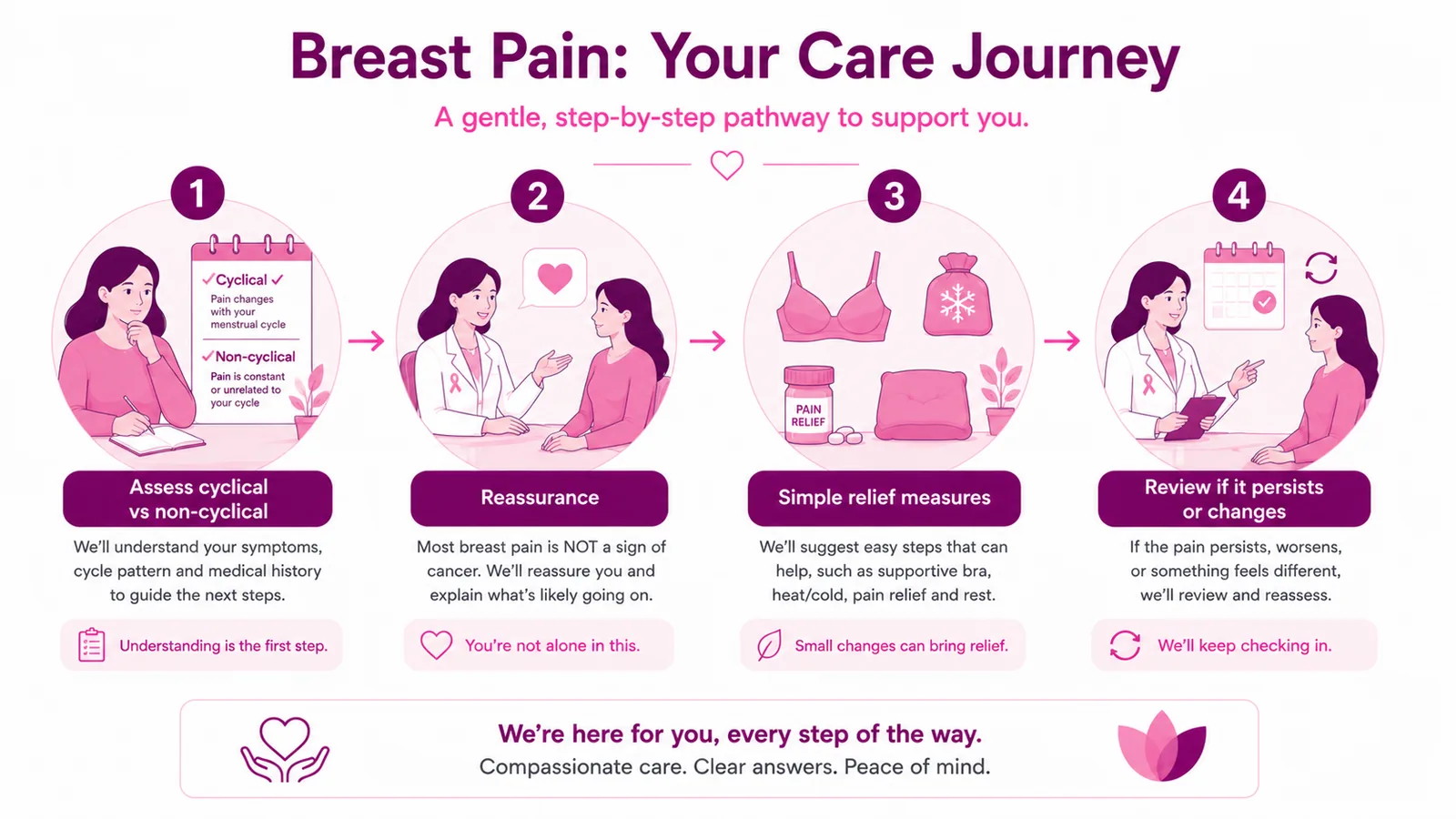
For everyday cyclical tenderness with no red flags, simple measures relieve most women without any medication. These are first-line steps recommended by breast specialists — try them for a few weeks before considering anything stronger, and always check new medicines or supplements with your doctor.
At CION Cancer Clinics in Hyderabad, a breast specialist reviews your tenderness calmly and thoroughly, following the same evidence-based pathway used by leading breast clinics worldwide. Our promise is simple: no rushed decisions, no unnecessary tests, decisions for healing, not billing. If a scan is needed, the choice is guided by your age, because younger breast tissue is denser. As a guide, ultrasound is usually the first test under about 30–40, while a mammogram (often with ultrasound) is used from 40 onward. Most women with cyclical pain and a normal examination need only reassurance — and that itself is a result worth having.
A senior breast specialist takes a full history — when the pain comes, one side or both, your cycle, medicines and family history — then examines both breasts, the armpits and the chest wall to separate breast pain from muscle pain.
If anything needs a closer look, CION follows the standard triple assessment — examination, imaging (ultrasound or mammogram by age), and a biopsy only when truly indicated. No test is ordered that won't change your care.
Anything suspicious is reviewed by CION's tumour board — medical, surgical and radiation oncologists together — so your plan reflects a panel of senior specialists, not a single view.
CION is a woman-led organisation with clear, upfront costs and a free first consultation for every patient. You leave knowing exactly what is going on and what, if anything, comes next.
Trained at AIIMS, Tata Memorial, and leading international centres. Combined 150+ years of experience. Every complex case is reviewed by 3+ of them — together.


MBBS(Gold Medal), DNB(General Medicine), DM(Medical Oncology)(Gold Medal)

MBBS, MD(General Medicine), DM(Medical Oncology)(Adyar,Chennai), ECMO, MRCP SCE(UK)

MBBS, MD (General Medicine), DrNB (Medical Oncology), ECMO, MRCP SCE (Medical Oncology) (UK)



MBBS (AIIMS), MS (Surgery) (AIIMS), DNB (Surgical Oncology), MRCS (Edinburgh)



MBBS, MS(General Surgery), M.Ch(Surgical Oncology), FMAS, FARIS(Ongoing)






MBBS, MS (General Surgery), DrNB (Surgical Oncology), FALS Oncology

Want a specific doctor for your case? Mention them when booking.
Book Free ConsultationShare your name and number — we'll call you back within 30 minutes to schedule your consultation.
Where to find us
Addressed by landmark, because that is how this city navigates. Each centre also names the areas it serves, so you can place it without a map. Consultation and day-care Chemotherapy run at every one of them.
Talk to our team
Call the helpline or leave your details, and someone will help you arrange a consultation at the CION centre nearest you. One helpline serves every CION centre.
Usually not. Breast pain on its own is rarely caused by cancer — most breast cancers start as a painless lump rather than as pain. Up to 70% of women get breast pain at some point, and only about 2–7% of those who see a doctor for it turn out to have cancer, almost always with another sign present. The reassuring rule: pain alone is very unlikely to be cancer, but pain together with a new lump, skin dimpling, a turned-in nipple or nipple discharge should be checked promptly.
Most breast cancers do not cause pain at all. When cancer does produce discomfort, it tends to be a constant pain in one fixed spot that does not follow your monthly cycle and lasts more than a few weeks — and there is usually a lump or another change alongside it. One uncommon exception is inflammatory breast cancer, which can make a breast red, warm, swollen and tender over days without behaving like a normal infection. Cyclical, both-sided tenderness that eases after your period is the opposite picture and is almost always harmless.
In the days before a period, your estrogen and progesterone levels rise, which makes breast tissue swell and hold fluid. This is felt as tenderness, heaviness or aching, usually in both breasts and often worst in the upper-outer area near the armpit. It typically starts 3–5 days before bleeding and eases once your period begins. This pattern is called cyclical breast pain, it affects most menstruating women at some point, and it is not a sign of cancer or serious breast disease.
It can be. Cyclical pain usually affects both breasts, but it is common for one side to feel more tender than the other. One-sided pain is also frequently caused by simple things — a cyst, an old injury, a strained chest-wall muscle, or an unsupportive bra. What matters is whether anything else is going on: if the one-sided pain sits in a fixed spot, lasts more than two weeks, keeps worsening, or comes with a lump, skin or nipple change, have it examined. Otherwise, tracking it against your cycle for a month is a sensible first step.
Cyclical tenderness typically lasts a few days to about two weeks each month and fades soon after your period starts. Non-cyclical pain is less predictable — it can be constant or come and go, and in about half of cases it eventually settles on its own. As a practical guide, see a doctor if breast pain persists beyond two weeks, steadily worsens, stays in one spot, disturbs your sleep or daily life, or starts for the first time after menopause.
Yes, both can. Stress and anxiety can heighten how strongly you feel breast pain, and relaxation, breathing exercises and better sleep often help. An unsupportive or poorly fitted bra is one of the most common and most fixable causes of soreness — a well-fitted supportive bra, and a soft sports bra at night or during exercise, relieves many women on its own. Caffeine, very salty or high-fat foods and certain medicines can also add to tenderness.
See a specialist promptly if your tenderness comes with a new lump or thickening, skin dimpling or persistent redness, a newly inverted nipple, nipple discharge (especially bloodstained), pain in one spot lasting over two weeks, or new pain after menopause. You should also get checked if a breast turns red, hot and swollen over a few days. At CION Cancer Clinics, Hyderabad, the first consultation is free — a senior breast specialist examines you, explains what is happening, and arranges a scan only if it is genuinely needed. Call 1800-202-8726 to book.
It often starts and ends with a careful history and a clinical breast examination — many women with clearly cyclical pain and a normal exam need no scans at all, just reassurance. If imaging is warranted, the choice depends on your age: ultrasound is usually preferred under about 30–40 because younger breast tissue is denser, while a mammogram (often with ultrasound) is used from 40 onward. A biopsy is only done when imaging or examination finds something that genuinely needs it. At CION, no test is ordered unless it will change your care.
Browse our complete guide to breast cancer — types, symptoms, tests and treatments. Tap any topic to read more.